Skip to content

Posts from the ‘MGIC (MTG)’ Category

Week 55 Update: The Insurers

The Insurers

I added to all 3 of my insurers in the last two weeks; Radian Group, MGIC, and MBIA.  Regarding Radian and MGIC, while the data this week was mixed, I still am of the mind that the worst of housing is behind us.  While I’m not ready to jump into home builders or lumber stocks or anything else that is dependent on a robust recovery in prices or demand, I am willing to make a bet on mortgage insurance companies that need things to just stop getting worse.   The insurers need prices to stop falling and defaults to continue to slow.  I am inclined (albeit skittishly) to believe that will happen.

The housing data this week, while not great, supported that thesis.  The market focused on the month over month decline in existing home sales (down 5.4%), but year over year the trend is still to higher sales (4.5%).  The trend, while not robustly bullish, appears to be of a bottoming nature.
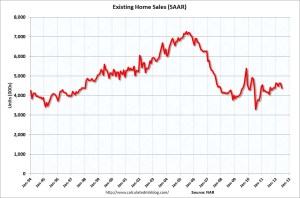
Perhaps more importantly, inventory continues to decline and the year over year number is down a somewhat startling 24.4%.

Total housing inventory at the end June fell another 3.2 percent to 2.39 million existing homes available for sale, which represents a 6.6-month supply4 at the current sales pace, up from a 6.4-month supply in May. Listed inventory is 24.4 percent below a year ago when there was a 9.1-month supply.

Bill Mcbride (of CalculatedRisk) pointed out in a recent post that it is really the inventory number that we should be focusing on:

I can’t emphasize enough – what matters the most in the NAR’s existing home sales report is inventory; what matters the most in the new home sales report next week is sales. It is active inventory that impacts prices (although the “shadow” inventory will keep prices from rising). Those looking at the number of existing home sales for a recovery in housing are looking at the wrong number. For existing home sales, look at inventory first.

Meanwhile the monoline insurers (Radian and MGIC) are writing more  new business and this is some of the best business they have every written.  I have already written about how strong lending standards are these days.  Below is the trend for New Insurance Written (NIW) for the first 7 months of this year.

The returns on the new business should be quite impressive.  Mark Devries, the analyst from Barclays that covers the insurers, was quoted in this Bloomberg article on expected returns:

Firms that stay in the business may benefit from a return on equity above 20 percent on new coverage as the exit of some rivals allows remaining insurers to boost prices, and tighter underwriting standards limit claims.

Meanwhile the old book continues to wind down.  The delinquency bucket for both insures continue to fall.
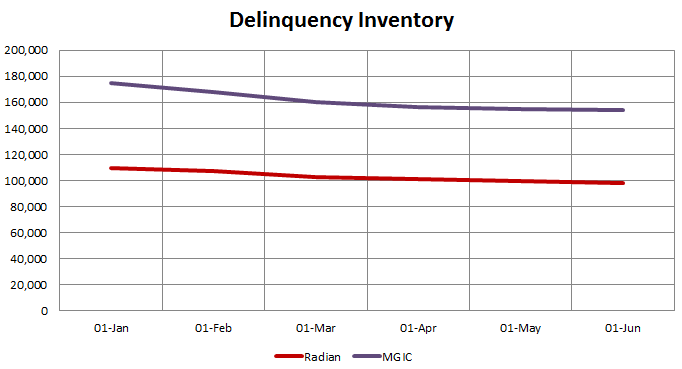
The insurers are like those movies you see where there is a big explosion and the movie star starts running and there is this big fire ball behind them and its gaining on them but the movie star keeps running and eventually the big fireball burns itself out.  These insurers are trying to outrun their legacy business by printing as much new business as they can to overcome the losses on the legacy.  I think when they hit that point that new gains outrun old losses is when they really move.

As for MBIA, the company is less dependent on any specific economic dynamic then they are on  the outcome of their court cases with Bank of America.  There are signs these cases could be coming to a head, but of course they might not.  Its really difficult to say when this will end and whether a settlement will be reached before a verdict.  When I tried to analyze the deal between Bank of America and Syncora earlier this week and the conclusion I came to was that you couldn’t extrapolate much of anything to MBIA.
Why I am starting to like the Mortgage Insurers

The mortgage insurance business has been a tough business to understand.  I have been working for a number of weeks now trying to wrap my head around it, first with MBIA (which strictly speaking has a financial guaranty business not a mortgage business, but same diff), and then with Radian Group and MGIC.  Each company has unique intricacies that take time to work out.  Its been a slog.

But while the companies are different in their details, there are some common reasons for the difficulty:

  1. The accounting of the business (particularly in the case of financial guaranty) is complicated by derivatives that are mark to market and/or on the balance sheet but not fully recourse to the company
  2. The mortgage industry is soon to see regulations that will change its landscape (these go by the acronyms QM (quality mortgage), QRM (quality residential mortgage) and the future of the GSEs (Fannie May and Freddie Mac)).  The final details of these regulations are still very much up in the air
  3. The remaining legacy losses from the mortgage crisis are going to be determined by the future rate of default of the homeowners the companies have insured.  Given that what has occurred in the US Housing market is unprecedented, there isn’t a historical guide to help predict how those defaults are going to play out

Nevertheless, I am slowly working my way through each complication, and as I do the picture that is emerging is one that is certainly ugly but that also holds promise.  The reasons that make the mortgage insurance business difficult to understand are the same reasons the companies in the space are trading at bankruptcy like valuations.  To put this in perspective, Radian and MGIC both traded at $60 plus per share in 2007.  Today they are at around $3.  I doubt that either company is ever going to go back to its old high, but the basic business that led to those earlier valuations is essentially intact and with a few things going right, the stock price of each could be significantly higher than it is today.

That basic business, when you get past the accounting jungle, is really pretty simple.  These are insurance companies.  They write contracts where they agree to pay if a borrower defaults on their home loan.  In return they receive a fee (called a premium) either up front or on a periodic basic.  They are also required to have a reserve  put aside to pay out the claim  in the event that there is a default. Until a claim payment is required they earn returns on investing that reserve.  In the aggregate, as long that the cash that the insurer receives from its premiums and the returns on its investments exceed the amount that they have to pay out in claims, then the insurer will be making money.

Both Radian and MGIC are still performing that basic business.  What’s more, the volumes that they are writing, while down from their pre-crisis, pre-housing bust highs, remain substantial when compared to the current value of their equity.  Of late, these volumes are also showing substantial year over year increases.

To illustrate the potential, in 2011 Radian wrote new insurance that will provide $717M of premiums over its life time (compared to premiums collected on existing insurance of $680M).  Before the housing collapse caused claims to skyrocket, you could expect returns after claims of at least 10-15% on that insurance.  So maybe $70-$100M in earnings.  In addition Radian produced investment income of $225M in 2011.  Expenses and costs of the mortgage insurance division is about $150M.  Radian has about 133M shares outstanding.  Adding these elements together you can see that absent the legacy book of business, its not unreasonable that the company would be earnings over $1 per share.

Of course the problem with the insurers is the legacy book.  In the case of Radian, that legacy book produced $1.3B in provisions for loss and over $1.5B in actual claims paid.  These numbers dwarf the premiums Radian is receiving and any income its earning from premiums and on its investments.  The result is a massive loss, particularly on a per share basis.

You could run through the same analysis for MGIC and draw similar conclusions.

My thesis here is that the legacy book will not always be the problem it is now.  And it appears that defaults from the book have peaked.  House prices in many areas of the US have stabilized and in some areas they are rising.  And the regulatory framework being developed seems to creating more space for private mortgage insurance.

I’ll have more to write on both Radian, MGIC  and the current regulatory state of the US housing market in upcoming posts.  What I wanted to outline here is the potential.  It is the potential that makes these companies worth investigating further.  If the business does turn around, we are talking about multi-bagger potential.  Of course if it doesn’t… well they may be headed for bankruptcy.  Now I fully admit that I am still fuzzy on whether the business can turn around before the companies run out of cash to pay off claims in their legacy book.  But it appears that the carrot  is big enough to justify an attempt to figure that out.

Adding more Mortgage Insurers

I have already written about how I stumbled upon MBIA Inc. (MBI) as I was researching mortgage insurance companies and in particular MGIC.  My interest in the mortgage insurers has been brought about by my desire to seek out companies that might benefit from a turn in the housing market.

I am not looking for a hockey-stick-like turnaround in housing.  I don’t expect to see prices or new constructions having a significant rise any time soon.  But I do think its  plausible that we are at a point where things no longer get worse.

How to play the bottom

Thus far, I’ve looked to play this bottom in a couple of different ways.

My foray into the servicers has been an attempt to capitalize on the premise.  Nationstar Mortgage (NSM), Newcastle Investment Corp (NCT), Home Loan Lending Services (HLSS), PHH Corp (PHH); all are examples of companies that should benefit from a stabilization in the mortgage market.  So far the thesis has paid off and I am up (since my purchases at the beginning of the year) well over 50% on Nationstar, about 30% on PHH Corp, and 15% on Newcastle (not counting the dividend).

I have also been able to capitalize on the trend by jumping into select regional banks that had exposure to the mortgage market turnaround.  Both Rurban Financial (RBNF) and Community Bankers Trust (BTC) have been big winners for me here, returning thus far 50%+ since the beginning of the year.

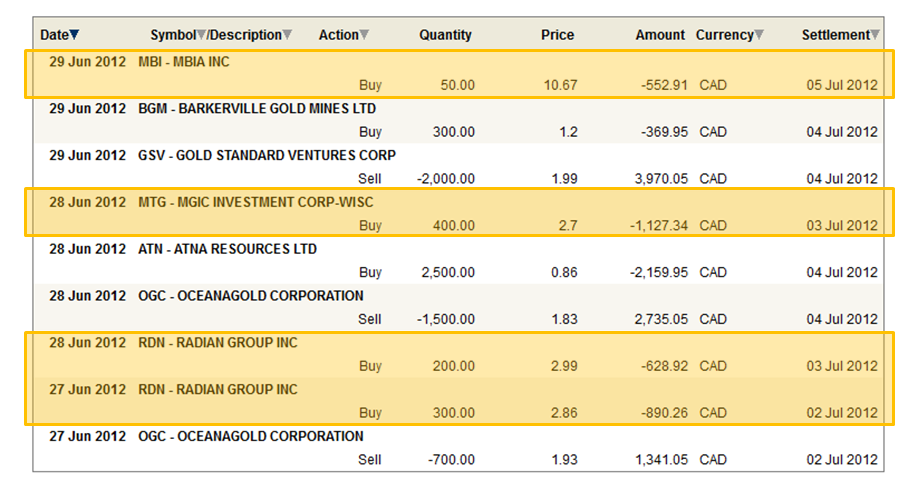
I now have have a third business for playing the housing bottom.  The insurers.  In addition to MBIA, last week I bought a fair position in Radian Group (RDN) and a lessor position in MGIC (MTG).  I also added a little to my position in MBIA (MBI).  In the case of Radian I unfortunately didn’t catch the bottom in the stock, but at least was fortunat enough to have gotten in well before the week long run ended, and I am actually seeing quite a profit on the position already.   Trades in my practice account that I track here are shown below:

Why Insurers?

I tend to have a lot of significant thoughts on my bike ride home.  It must be something about the state of semi-awareness that biking down major thorough fares in rush hour does to one’s brain.  On the one hand, what with cars whizzing by you and changing lanes and pulling out you are always on alert.  On the other hand, its the same ride you have done hundreds of times and so it is easy to day-dream yourself into a whole other world of thoughts.

It was about a month ago that I was biking home from work and thinking about what other businesses could benefit if the housing market in the United States just stopped getting worse when it occurred to me that I really should be looking at the mortgage insurers.   If ever there was a business whose livelihood was dependent not on a robust recovery in housing but instead an end to the continual decline, it was the insurance business.  As a mortgage insurer, you are less concerned if prices rise or new sales increase than you are that people don’t default on their loans.  Clearly, people not defaulting on their loans is  the necessary condition to any housing recovery.

This appears to be happening.

The most recent Home Price Index (HPI) report, put out by CoreLogic,  said the following:

“We see the consistent month-over-month increases within our HPI and Pending HPI as one sign that the housing market is stabilizing,” said Anand Nallathambi, president and chief executive officer of CoreLogic. “Home prices are responding to a restricted supply that will likely exist for some time to come—an optimistic sign for the future of our industry.”

Meanwhile, according the CoreLogic Shadow Inventory report, serious delinquencies in some of the hardest hit areas are showing big year over year declines:

Serious delinquencies, which are the main driver of the shadow inventory, declined the most in Arizona (-37.0 percent), California (-28.0 percent), Nevada (-27.4 percent), Michigan (-23.7 percent) and Minnesota (-18.1 percent).

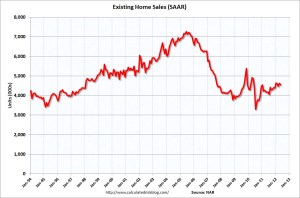
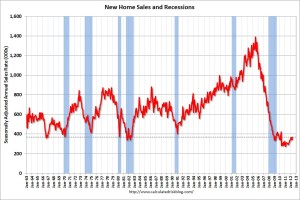
A look at charts of new home sales and existing home sales (taken from CalculatedRiskBlog) show a pretty clear bottom.

My thesis was echoed by Radian management on their Q1 conference call.

We believe our core mortgage insurance business is attractive with strong returns, outstanding credit quality and sound pricing.We continue to capture a much larger share of new mortgage insurance business today than ever before in our history in an extremely competitive but high quality market.

Radian further echoed the sentiment that defaults are declining at the KBW Mortgage Finance conference:

You saw our press release this morning. In addition to the strong level of NIW, delinquencies continued to decline. So in May they declined again. Primary delinquencies fell below 100,000 for the first time in quite some time. In addition, the new default line, which really drives the incurred losses, was down 25% from May 2011. So year-over-year on a monthly basis down 25%, and that is a greater reduction than our projections have shown.

Insurers like Radian and MGIC stand to benefit from another trend that I called out in my post Pounding the Table on Mortgage Servicing Rights a few months ago.

Now we have the opposite scenario.  Lending standards are so tight that only the most fool-proof borrowers are able to get loans.  The risk of default should be greatly reduced.  The result again is for the MSR to stay on the books, paying out cash, for longer.

When I had looked at Radian and MGIC last year, one thing that made be skeptical was that they weren’t writing enough new business.  The same can’t be said any more.  In particular in the case of Radian,they are writing significant new insurance:

In fact, our market share of this profitable new business is double what it was in the challenging underwriting years of 2005 through 2008 and this increased volume is improving the overall credit profile of our MI portfolio. In the first quarter, we again wrote $6.5 billion of new mortgage insurance business and our pipeline remains strong with new insurance written (NIW) reaching approximately $2.6 billion in April.

Again at the KBW Mortgage Finance Conference, Radian provided at update that in May saw an additional $2.7B of NIW.  They also put some numbers to the exposure to the legacy book of insurance, versus the newer insurance written:

With our increasing market share we have grown the composition of the higher-quality books 2009 and subsequent at a much greater level than some of the other MIs that have legacy exposure. So as of March 31, we are up to 31% of our risk in force. That is from the 2009 and subsequent books. And, importantly, the 2006 and 2007 vintages, those poorer vintages, are down to 31%. By the end of 2012 at the rate we are going, the 2009 and subsequent are likely to be in the 40% range of our risk in force.

More to Come

These are complicated businesses and it is going to take me some time to fully wrap my head around the potential.  My positions thus far are reasonably small because of this.  As is often the case for me, my initial investment provides the incentive  to investigate further, and if I like what I see I buy more.  I just hope that the stocks don’t run away from me before that happens.  I expect to come up with more detailed write-ups  about both Radian and MGIC in the near future.