Skip to content

Posts from the ‘Portfolio’ Category

Buying when you don’t want to

The hardest posts for me to write are the one’s where I have to write that I bought a bunch of stocks on a day where the market was down a lot.  Its tough because I am worried I will be proven wrong.  Its extra tough because I am notoriously early and so I have been wrong many times before.

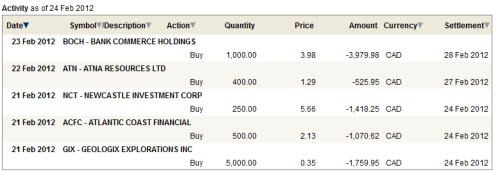
The market really tanked today and nothing tanked harder than the junior gold and oil stocks.  I had lightened up significantly on the gold stocks last week; I exited Canaco Resource, OceanaGold and a significant portion of Aurizon Mine. Unfortunately I used some of the proceeds to buy Pan Orient Energy, which took it on the chin today.

Nevertheless there is some truth to the old adage that the best time to buy stocks is often when you don’t want to.  Today I didn’t want to buy anything.  I even had half a mind to sell it all and stand away.

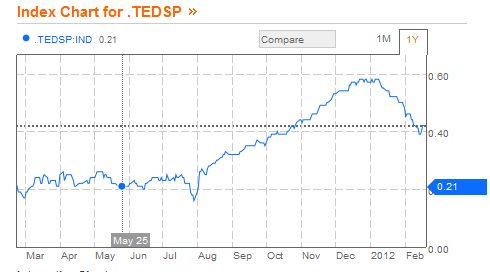
But having thought it through, I am having trouble making sense of the idea that this is the start of something big.  I have become a convert to the idea that the LTRO has taken out much of the systemic risk potential. The prices of periphery bonds suggest as much; even after today’s shellacking Italian and Spanish bonds sit near their lows.  The TED spread and Swap spread hardly moved at all and currently sits at 40 and 27 respectively, well of their highs of 60 and 55.  The bank stocks, while hit hard, did not lead the way down in the way they did in August.

It just doesn’t feel to me like it did in August, or in November for that matter, when the fear was palpable.  Yes, we are worried about Greece and what is going to happen.  But the evidence does not suggest that the big players are that worried.  If they were we would see more signals of the stress in the bond market.

Which makes sense.  By this point everyone knows about Greece.  Everyone who had money at risk with Greece should have been able to figure out how to take it off the table.  That yields aren’t rising in the periphery suggests that the real problem, that a Greece default would cause a domino effect, is not in the cards.

What I bought

I’ve had good luck buying Aurizon under $5 in the past and so I did so again today, restoring my full position in the stock.  I also bought more Golden Minerals.  Golden Minerals is a stock I had been tempted to sell when it got to $10, but I got a little greedy and decided against it, only to watch the stock fall back to $6.80 today, which is not too far away from my original purchase price.  The stock is reasonable at these levels; the company has $2 cash on hand per share and a 6Moz gold equivalent resource.

Interestingly, Rick Rule was on BNN yesterday and he had some positive comments on Golden Minerals in this clip (I’m not really sure how to embed video from BNN).

Since last Wednesday its been a swift fall for many gold stocks.  My bet here is that the latecomers have been fleshed out and that with stocks like Aurizon and Golden Minerals approaching their 52 week lows once again, we are close if not at the bottom.

I also added to Pan Orient.  This will be the last time that I add until I see the stock begin to rise again.  For the time being I will sit tight with what I own.

Week 34: Its a bull market (for the moment)

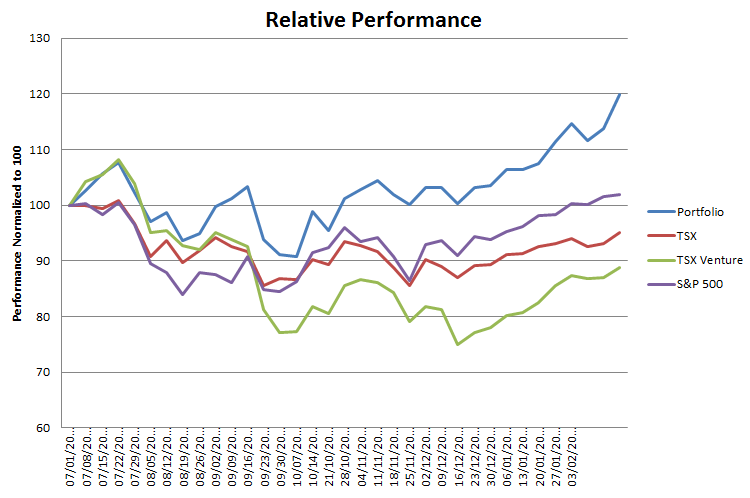
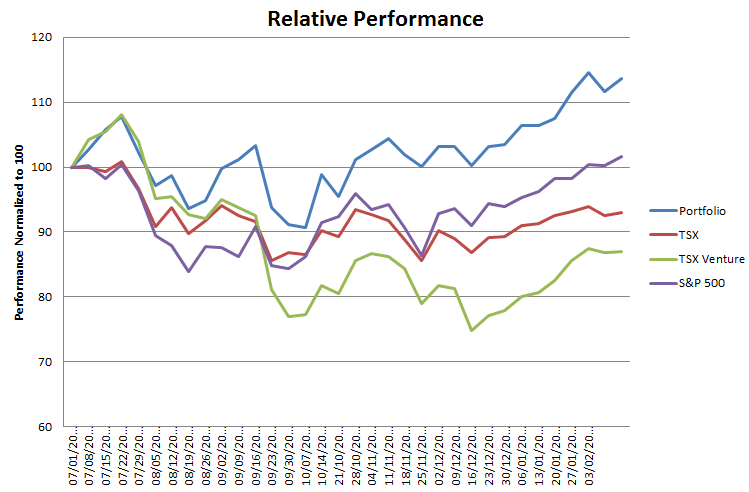
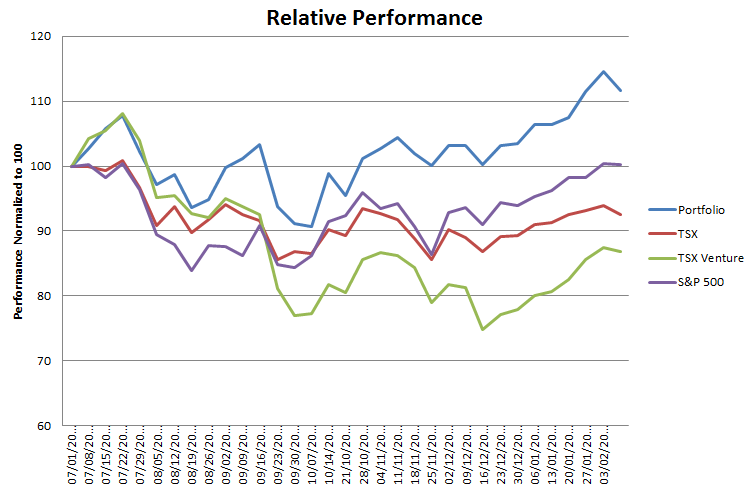
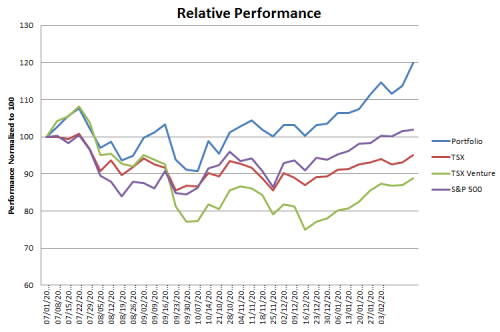
Portfolio Performance:
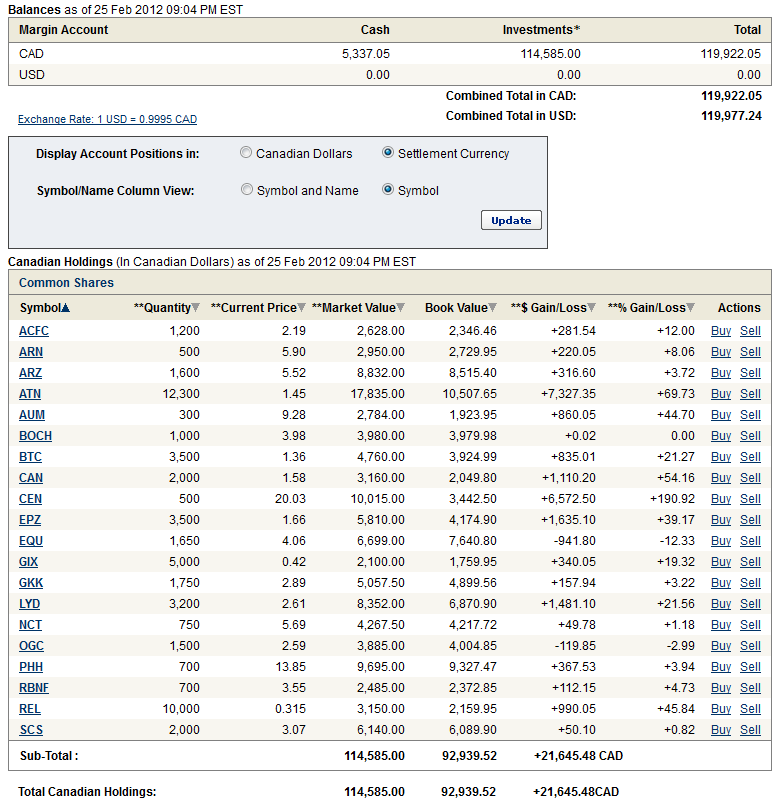
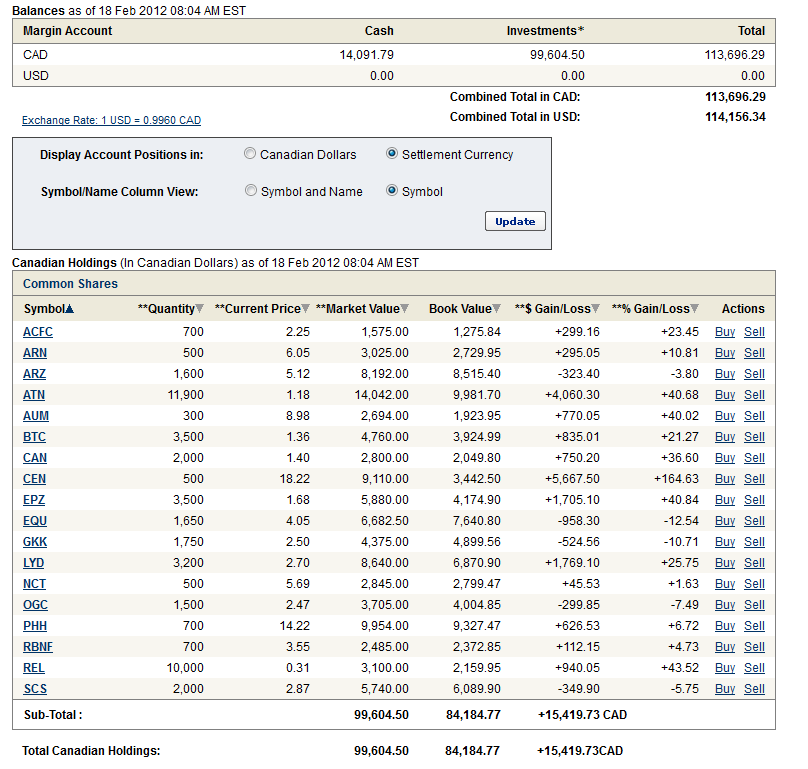
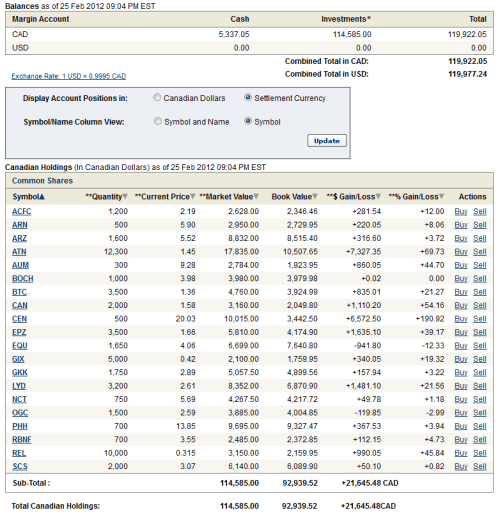
Portfolio Composition:
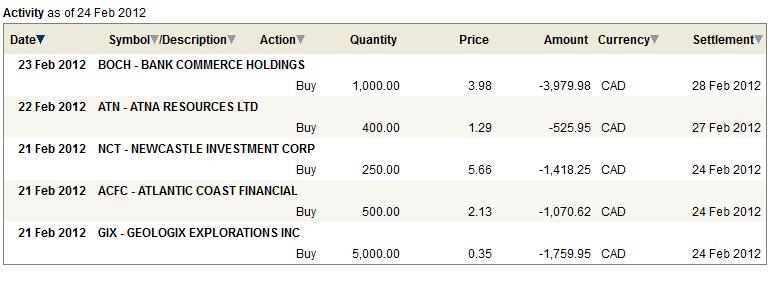
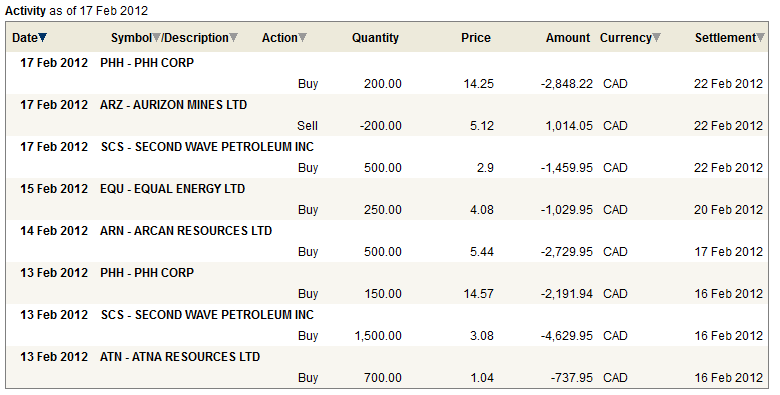
Trades:
Europe to the sidelines (for the moment)

Eric Reguly had a worthwhile article in the Globe and Mail this weekend.  He outlined the reasons why Greece and Europe are still as badly off as they were a couple of months ago.   Apart from the markets perception, nothing has changed.

The basic problems in Greece, and in the rest of the periphery, he says, remain.

The country’s economy and its social fabric are unravelling at an alarming pace and the second bailout, combined with a sovereign bond haircut, will do next to nothing to stop the horror show.

So why is the market rallying when these problems have not gone away?

I think that there are a lot of similarities between the markets reaction to Europe today and the reaction of the market in 2007 and 2008.  During the housing crisis, what drove the market down was not so much the fear of falling housing values, as it was the fear that falling housing values would cause banking problems.

At times, when it appeared that the housing problems were going to create only housing problems, the market rallied.  When the spillover to the banking system was evident, the market fell.

There are different types of bear markets.  There are bear markets that are economic and those that are financial.  When an economic bear market hits, some sectors get hit hard, some get hit, and there are always some that actually don’t do too badly at all; the idea being that there is always a bull market some where.

When a financial bear market hits, everything goes down.  Because in this case what drives the bear market is a lack of liquidity to buy stock.  So all stocks fall.  To be sure, this eventually hits the economy and causes a financial bear market, which happened in late 2008-2009 and compounded the problem.  But there is a fundamental difference here in that during an economically driven bear market, though it may be more difficult a stock picker can still pick stocks.  In a financial bear market you can’t pick anything and you just have to get the heck out.

How this relates to today is seen in how the market does not seem to care whether Greece goes into a severe recession.   This is because Greece is an insignificant spec in the world economy.  The market only cares if the problems in Greece spill over into the banking sector and cause banks to fail, not lend, seize up, and other worrying verbs, thus precipitating another financial bear market.

I wrote a long piece on the LTRO a month ago.  As it turns out this has been the most popular blog post that I have ever written.  This is somewhat unfortunate because this isn’t intended to be a blog about Europe, I am not an expert on macro economics or on banking, and the post is only tangentially related to the purpose of this blog; the stocks I own.  At any rate, in the post I argued that the LTRO may have a short term psychological impact, but over the long run it wasn’t going to do much for the Greek, Portugese, Italian and Spanish economies because none of the problems those economies are having have been dealt with.

I still think this will be the case.  Reguly highlighted the reasons why (referring specifically to Greece) in his article:

Labour costs remain too high. The economy is sinfully undiversified and laden with low-value industries, like stuffing tourists onto cruise ships. Corruption is rife. The tax-collection systems are primitive. The professional protection rackets – from truck drivers to doctors – remain intact. The country lacks a working land registry. The bureaucratic red tape leaves entrepreneurs and land owners in despair.

This is all really bad stuff.   And its stuff that applies in large part to Italy, to Spain, and to Portugal.   However, what is forgotten, and what I think I neglected  in my post about the LTRO, was that while all this is true, it was also true a year ago, two years ago, long before Greece came to be a headline and before it began to cause markets to collapse.

The LTRO has accomplished an extremely important objective and that is that is has (temporarily) removed the mechanism for a banking collapse.  The banks in Europe were on the precipice because they were overlevered (see my analysis of Deutsche Bank which remains levered at an insane 60:1) and they faced problems funding that leverage.  Now, with the help of the LTRO, the banks are still overlevered but can get all the funding they want from the ECB.

Juggling Dynamite

I was listening to the Canadian money program Money Talks yesterday.  The had Danielle Park, who writes the blog Juggling Dynamite, on as a guest.  You can listen to the interview here by selecting the 10:00 am segment for February 25th.  Parks basic argument is that this rally is a sham.  Its built on liquidity, will die by liquidity, and there is no evidence that the economies of the world are getting better.

The main theme is the incoming recession… its already underway in Europe, Japan and the UK, what has been going the last several months is all about liquidity injections again, but the reality is it doesn’t fix things, we don’t have any solutions, debt has to be written off…

She argues that individual investors have to be very careful right now.  They have to be careful about chasing the market up here, careful about jumping into dividend stocks to try to get a bit extra yield, and to be extra careful about fixed income because the yield you are getting there are miniscule.  She has some very good comments about how dangerous the current environment is to the individual and moreover, how criminal it is that central bankers continue to punish savers and try to force risk averse individuals into risky assets.

Now, if you look at what I have done over the last few weeks, I have moved from almost 50% cash to basically no cash.  So I must be completely at odds with her assessment right?

Wrong.

I think she’s dead on.

This is a false rally.  This is a liquidity driven rally.  This remains “the banks in Europe are not going to implode tomorrow so they must be worth more today” rally, which is not a positive pronouncement about anything other than that the end of the world is postponed.

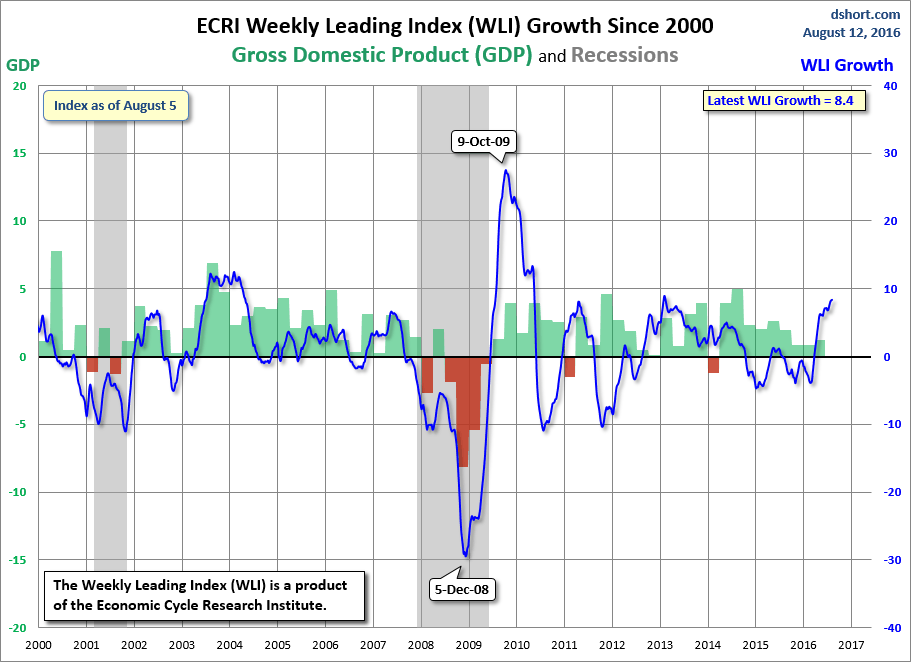
CNBC had Lakshman Achuthan on this week to talk about his recession call from a few months ago.  Last week I talked about how one of the indicators I follow, the ECRI’s WLI, was perking up, and that this perhaps portended to a strengthening US economy.

Maybe I have been too quick to look for confirmation.  The counterpoint is that it is indeed simply a liquidity driven event.  Achuthan also argues, much like Park, that it is.  Central bankers are printing money and that money has to go somewhere.  Real economic activity is weak and so the money goes into speculative investments instead.  Achuthan said that given the amount of money being pumped into the system, he is surprised that the WLI has not risen more than it has.

Here’s the entire clip:

But what can you do?

So rally is on weak legs.  Nevertheless, its a rally. If you recognize it as a liquidity driven rally then really, what you want to invest in (temporarily) is liquidity driven stocks.  If you look at the stocks I am buying lately, they are exactly that. I am doing the right thing, even if perhaps I have not fully understood the reasons.

I like to call the junior gold explorers, companies like Geologix, Golden Minerals, Canaco, little liquidity eaters.  The stock price of these sorts of companies have much more to do with the availability of liquidity then they do with the price of gold.  That is plain to see by looking at a chart of any stock in the sector.  Every stock suffered through 2011 even as the price of gold rallied hard.  Every stock soared beginning in 2012 once the LTRO was announced and it became clear that liquidity would be in abundance again.

But these are trades.  I do not expect to be holding any of these stocks 2 years from now.  Absent some sort of paradigm shift like a move to the gold standard, these are stocks to hold for the run up and then cut loose when it looks like they are turning the taps off again.

But in the mean time, in the words of Jesse Livermore, from whom I stole my blog title and my avatar:

“But I can tell you that after the market began to go my way, I felt for the first time in my life that I had allies- the strongest and truest in the world: underlying conditions”

The underlying condition right now is one of liquidity.  It is not the intent of this blog to philosophize (too much) on the eventual consequences of such liquidity.  There are plenty of folks, like the wonderful Ms. Park, who are already describing those consequences eloquently.  The intent here is to try to evaluate those conditions clearly, and to describe how I am acting to capitalize on those conditions.

For the moment anyways, that means that I own stocks.

Of course next week could be a different story.
Week 33: Admitting the possibility of a bull market

Portfolio Performance

Portfolio Composition:

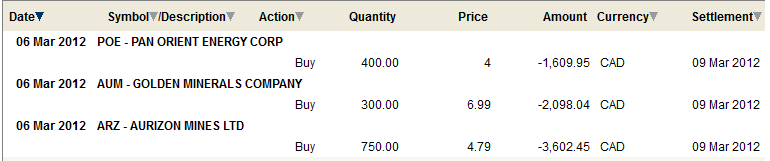
Weekly Trades:

Posts this week:

Can’t Stay Away: Arcan Resources and Second Wave Petroleum

PHH, Newcastle Investments and Mortgage Servicing Rights

Shadow Inventory and how an improving US Economy begets an Improving Housing Market begets and Improving US economy begets….

PHH and one way to bet on a turn in the US economy

Jumping on the Bandwagon

As I wrote about earlier, I am coming around to the view that the US economy will perform reasonably well over the next few quarters.

Now let us not confuse the short term with the long term here.  I don’t for a moment think that the longer term issues in the US have been solved.  The situations in Europe, in Japan, and in the US are very similar.  There are massive storm clouds on the horizon, and those coming storms are causing the winds to pick up and the boats of the economy to waver in the seas.  But the storms themselves have not yet reached us, and so while we may have bouts of turbulence brought on by rising winds, or even, as in the case of Europe in November, sudden gusts that threaten to capsize the rigs, the actual storms are still a little ways off in the distance, far enough  that we can pretend at times that they are not there.

Now appears to be one of those times.

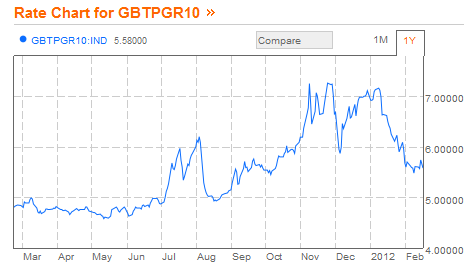
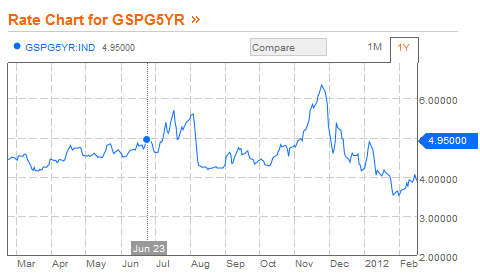
The LTRO seeming to have stabilized the banks of Europe in the near term.

TED Spread:

Italian 10 year:

Spanish 5 Year:

The economies of the European periphery, while entering what has to be an inevitable and deep recesion, are still far enough away from the consequences of these (maybe 2-3 more quarters) that we can ignore that more bailouts or a mass exodus from the euro is close at hand.

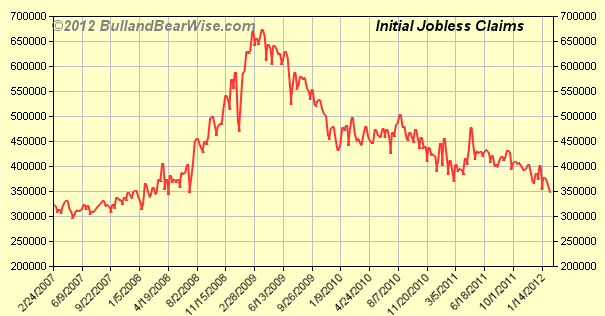
Finally, there can be no doubt that the numbers in the US are picking up some steam of late.  How long will this continue?  Perhaps not too long, but who is to say.

More specifically, the housing sector has been beaten to such a pulp in the past few years, and the stocks involved have taken such a beating, that even a stabilization at these low levels (both prices and activity) may lead to a substantial uptick in the share prices.

Always on the look-out for a bull market

So while I don’t really believe it can last over the long term, that doesn’t mean I can’t take advantage of it.  In the absence of the arrival of a true storm (like what happened in 2008), there is always some bull market somewhere.  You just have to find it.

Where am I looking?

  1. US Regional and Community Bank stocks
  2. Mortgage Servicing companies
  3. Oil stocks with large resources that can take advantage of Hz-multifrac technology to exploit those fields

I still don’t know what to think of gold. There is a bull market out there, but only for select stocks (see Atna and Argonaut Gold for a couple of examples).

Buying into Newcastle and buying more into PHH

As I wrote earlier, I believe that the mortgage servicing business provides a unique opportunity right now, and while I have started a position in Newcastle Investments in response to that, I expect to increase that position substantially over the coming weeks.  I have also turned PHH Corporation into one of my largest positions.

I’ve already talked about both of these investments ad nauseum in the last couple posts so I am not going to reiterate those theses here.  What I will say is that I am becoming more and more cozy with the mortgage market bottoming idea and I would expect that you will see more of my capital make its way over to this market in the coming weeks.  I am already looking for an opportunity to exit OceanaGold and reduce my position in Aurizon Gold.  The proceeds are likely to either go into PHH or NCT, or into another mortgage leveraged corporation that I find.

Letter 32: Sacrificing to the gods, the story of gold demand, Atna’s Pinson disappoints (slightly)

Portfolio Performance

 Portfolio Composition

Shaking it up

Things weren’t exactly peachy for me this week.  Rarely have I felt more confused about what sectors I should invest in then I do right now.

One of the best gauges of just how divided I am is the number of stocks I have in my portfolio.  This got up to 20 stocks on Thursday this week.

20 stocks is silly.  I’m not running a mutual fund.

Anyways, on Friday I sacrificed a number of these positions to the trading gods.

A sacrifice to the trading gods?

A sacrifice to the trading gods can be anything from selling a few shares of a single company to wiping out a number of positions in a sort of sacrificial blitzkrieg.

When things aren’t going my way and I am feeling confused and disordered, quite possibly the cause of such troubles is that I have upset one of the trading gods.  In such a case, it is necessary to appease these gods by “sacrificing” one or more positions as atonement.

On Friday, in the midst of another crummy looking day, I did just that.

In my actual account I also liquidated Second Wave Petroleum.  I came within a hairs breadth of selling OceanaGold, Golden Minerals and Canaco as well, but I decided to stick with them (for now) because it just feels to me like gold is on the verge of a move up.  There may be a second leg to this sacrifice yet.

So what is this superstition all about?

Well on the one hand the sacrifice is about gods and reconciliation and bowing to the higher power.  You don’t mess with the supernatural.

On the other hand, there is a method to this seeming madness.

Let me tell it like this.  I was listening to Radiolab this week.  Help!   That was the title of the program.  The episode had a story about a young man who had “lost his life to a coin toss”.

What, you say?   Well that was what the reporter that overheard the remark said, and so he set out to track down the poor, life-less man that uttered those words and to find it how it was that a life could be lost by such chance.

As it turned out the young man managed a massage parlor.  It had been his fathers business and he had taken it over.  A number of months (maybe years) before his father had come to him and his brother and told them that one of them had to take over the business.  The father didn’t care which boy took it over, but it had to be one of them, and the boys had to figure out which one would be it for themselves.

Neither of the two brothers was very excited about the prospect.  After sitting on it for a few days, hanging over their heads, finally the one son couldn’t take it any more.  He proposed to his brother that they make a bet on who had the most tea leaves float to the top of their next cup of tea.  The one with the most tea leaves would walk away clean.   The loser would take the business.

Well the bet was made and the tea leave floated.  The brother who lost the bet was despondent at first, but he begrudgingly took his place.  He had to be dragged to the massage parlor for work by his father, and he had to be forced to work on his own father’s feet until he became proficient enough to work on the clients.  At first he hated it, but over time his attitude changed.  Soon he began to like the interaction with people, the sense of performing a service, he felt good about having happy clients with happy feet.  He began to relish his job, coming in weekends and working late nights.  He no longer regretted his decision.

Now here’s the interesting part.   When he was asked about the bet by the report, he replied that it was luck of the draw.  But his brother said something enitrely different.  His brother said he would have never have let that bet decide for him whether he would take over the business or not.  The bet wasn’t going to make the decision for him.

But not so for his brother.  He believed that the bet was never about him anyways, it was always about his brother.  His brother, he says, deep down wanted to manage the massage parlour.  He couldn’t admit to himself, and definitely couldn’t bring himself to admit it to his father.  The tea leaves helped him along, gave him the reason to do what he should do but did not want to come to grips with.

The reporter went back and confronted the brother now running the massage parlor with this theory. He didn’t deny it.  On the one hand he wouldn’t say that he set up the whole gig with the tea leaves just to have an excuse.  Of course not; he couldn’t say that.  But he also wouldn’t deny that the tea leaves had led him to act as he really wanted to act.  “I probably couldn’t have done it without the tea leaves, he says, but once the tea leaves had spoken then I had no other choice.”  The tea leaves made him do what he knew needed to be done.

And that’s why you make sacrifices to the trading gods.

Weekly Trades