Skip to content

Posts from the ‘Portfolio’ Category

Week 219: Feeling more like a bear market

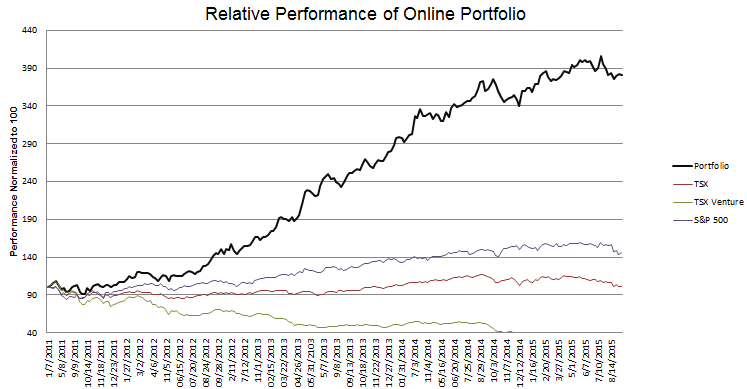
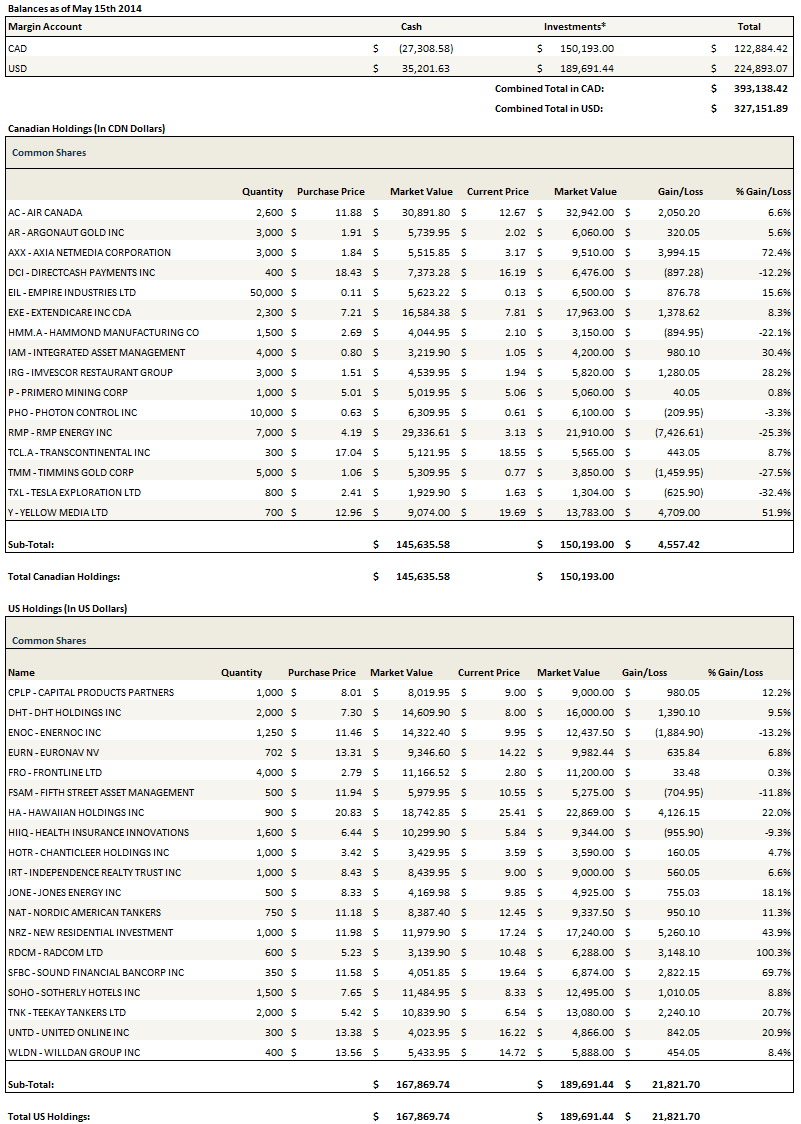
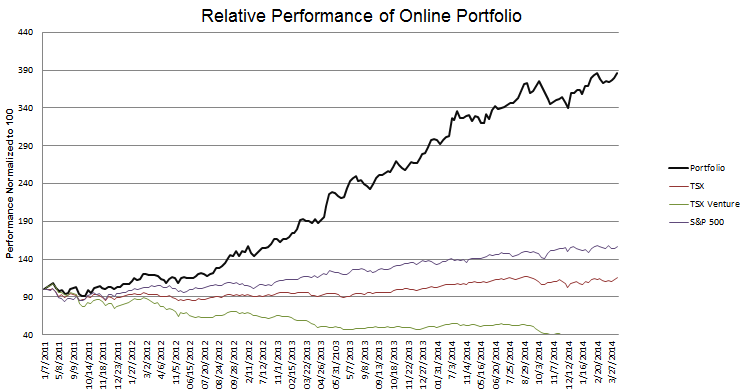
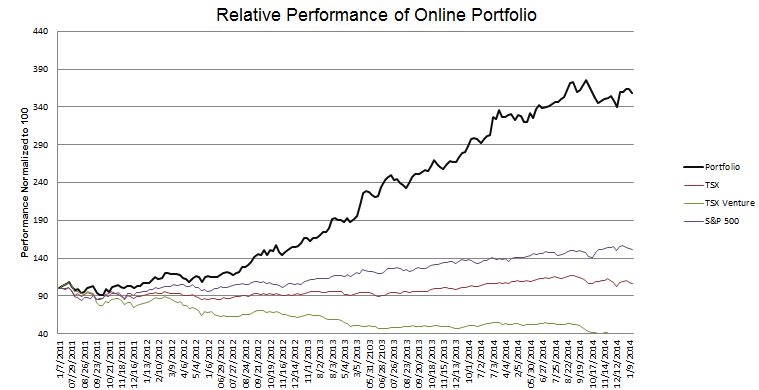
Portfolio Performance
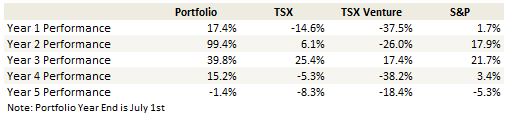
week-219-yoyperformance

week-219-Performance

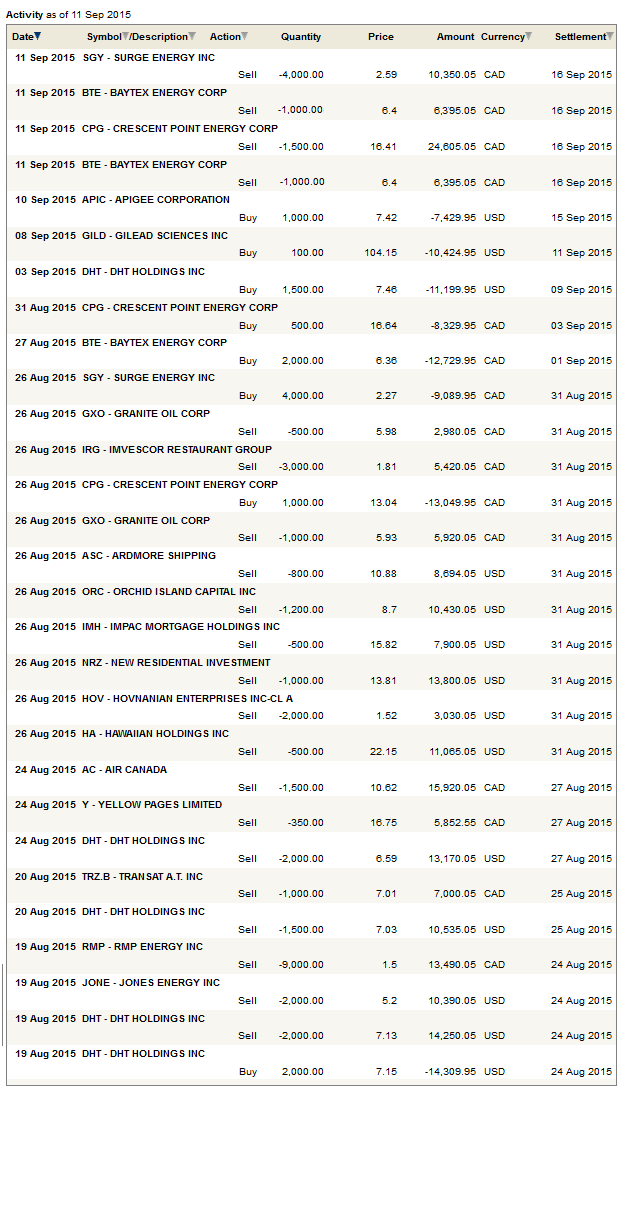
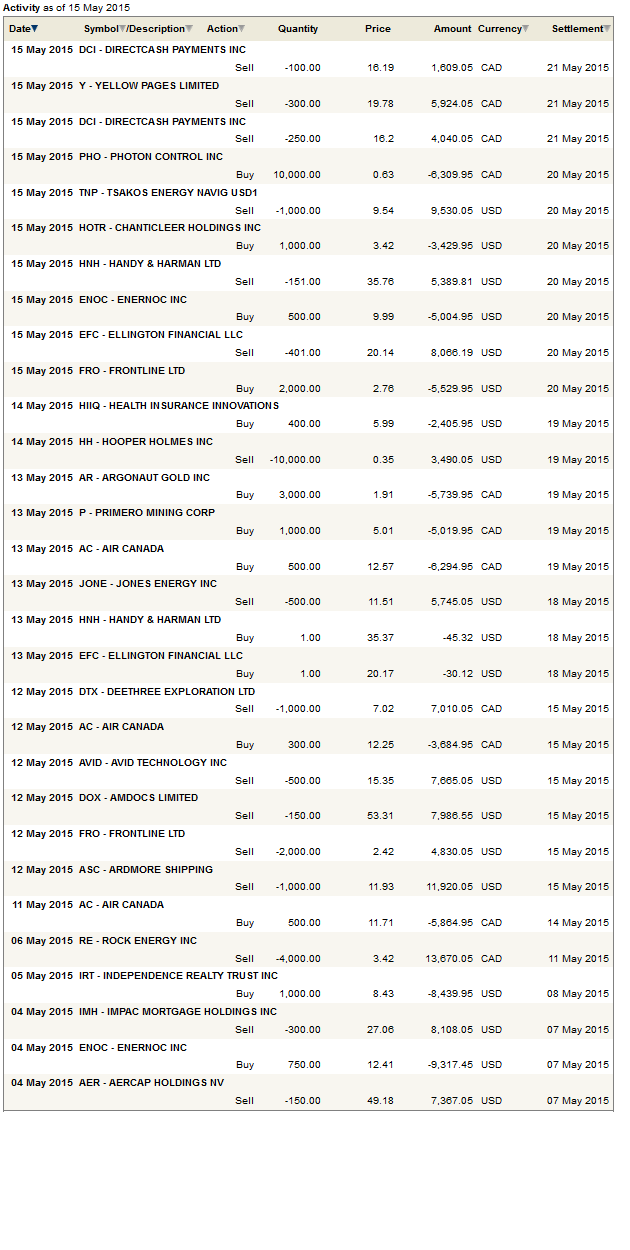
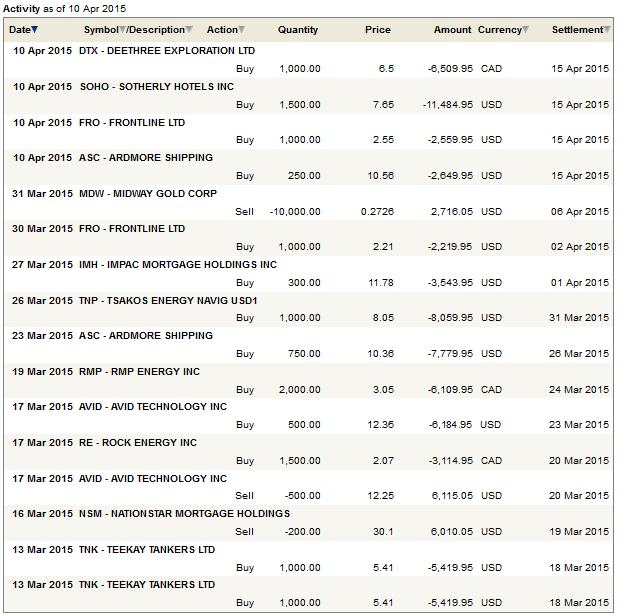
See the end of the post for the current make up of my portfolio and the last four weeks of trades

Monthly Review and Thoughts

In my update four weeks ago I wrote:

When I raise the question of whether we are in a bear market, it is because, even though the US averages hover a couple of percent below recent highs, the movement of individual stocks more closely resembles what I remember from the early stages of 2008 and the summer of 2011.

Since that time my concern that the averages had only been lagging the inevitable has born itself out.  We have seen a 10-15% pull-back depending on the index you are referencing.   It has become clear that we are indeed in a bear market, if not by definition then certainly in spirit.

The next obvious question is – when do you buy?  Every other pullback over the last few years has been a buying opportunity.  Is this pullback, being the deepest of the bunch, the best of the bunch?

I don’t think so.  At least not yet.  There are just too many headwinds right now.

First, returning to what I wrote last month:

When the Federal Reserve ended its quantitative easing program last year I was concerned that the market might revert back to the nature it had demonstrated after first two QE endeavors.  But for a number of months that didn’t happen.  Stocks kept moving; maybe not upwards at the speed they had previously but they also did not wilt into the night.

I am starting to think that was nothing more than the unwinding of the momentum created by such a long QE program.  Slowly momentum is being drained from the market as the bear takes hold.

Nothing has changed here and stocks are still too expensive to say that we’ve passed through this process.  If QE was a positive influence on stock valuations, certainly the lack thereof has to be a negative influence.  While there are a few stocks that are cheap right now, many are not.

Second, when volatility is as high as it has been over the last few weeks it usually indicates the market is breaking down rather than breaking out.  I’ve seen this pattern too many times; increasingly choppy and nomadic market moves tend to break down.

Third, we don’t really know what is going on in China.  Nobody really knew how strong the boom was through the last decade; in fact I made a lot of money following the advice of metal prices over analyst comments.  Similarly, I don’t think there are many that have a good grasp on the magnitude of the slowdown.

None of this means that it has to play out to the downside.  Maybe China will be a blip, stocks will resolve themselves to the upside and I will be frantically trying to catch up.  But betting against the odds is not profitable and these odds don’t feel like they are in my favor.

So what am I doing?  Sitting with a lot of cash ( I have 55% cash in my investment account and 60% cash in my RRSP).  Picking a couple of opportunities where I see them but keeping the size small enough that I won’t be hurt if the markets break down again.  And where I can, holding some shorts to help hedge long exposure.

The last five years have been an incredible opportunity to compound capital.  In 2012, when the Fed was clearly going to announce more QE and stocks were going up every day my strategy was simply to find the most levered longs I could to make the most of the upside.   I remember how I was derided by many for doing that.

To give a particular example, I remember how some folks on twitter wrote snide remarks about my YRC Worldwide position.  What a shitty company it was, how it was inevitable it would go bankrupt (one even wrote that the probability of a YRC banruptcy was 100%), and so on.

I just couldn’t figure it out.  I kept thinking, who cares?  The point of this game is to make money and in that particular environment, with the amount of stimulus we had and with a US economy on the mend, it was exactly the kind of stock that could run as a multi-bagger.

It seems as though some investors/pundits think that being right is a philosophical exercise.  And in this game it’s not.   My only measure of success in the market is how quickly and how far that chart at the top of each post trends from the lower left to the upper right.  The rest is sophistry.

While 2012 was the time to buy the levered longs, today the reverse is in play.  You have to be very careful about even buying good businesses that you believe are being mis-priced by the market.  In a bear market just about everything goes down, so you better be sure about what you pick.  Just because it is a good business with a moat doesn’t mean it won’t get sold off with the rest of the market.

I do think that in this environment growth is most likely to come back first.  I am looking for stocks with catalysts and stocks with growth profiles maybe not recognized yet by the market.  Especially if they are beaten down.

Selling Out

I did a lot of selling leading up to and on the bounces of the first decline.  I wanted to get my cash positions up to at least 50%.  I sold entirely out of Hawaiian Holdings, Impac Mortgage, Orchid Island Capital, Ardmore Shipping, DHT Holdings, Air Canada, New Residential and Yellow Pages. I also reduced just about every other position I had.

Since that time I have bought back into Ardmore Shipping and Air Canada to lesser degrees than the level that I had originally held them.  I have added back my full position in DHT Holdings as I see strong fourth quarter shipping rates as a catalyst for some short term gains.  The other stocks I might buy back if the prices become very attractive or if I see changes to the landscape that make me more constructive on the market.

New Positions

Most of my research in the last month focused on biotech firms.  I have to say, its been a lot of fun.  Its fascinating stuff. I even discovered a Vice documentary on how we are using viruses to battle cancer.   The technology leaps are amazing!

I looked at Mylan, Mallinckrodt, Intrexon, Teva, and a whole pile of smaller Phase 2 candidates (including Flexion, which subsequently was clobbered after their FX006 Phase 2b trial had less than stellar results – note though there might be an opportunity with this one).

Most of these names I can’t bring myself to buy because of valuation.  Even though the charts are bad and the stocks are way off their 52-week highs, most still look expensive to me.  But I did take small positions in a couple of names: one large cap pharmaceutical stock (Gilead) and one small cap phase 3 drug developer (TG Therapeutics).   Here is what I think of both of Gilead and TG Therapeutics and why I added them.

Gilead Pharmaceuticals

Gilead is a much bigger company than I typically invest in.  With over 1.5 billion shares outstanding,currently trading at $105, they have a market capitalization of around $160 billion.  The company has very little debt, with cash on hand of $7.4 billion and $12.2 billion in long term debt as of the end of the second quarter.  They also just raised an additional $10 billion of debt this week, which many are speculating will be used for an acquisition.

Gilead produces leading hepatitis drugs (Harvoni and Solvaldi, with Harvoni being the next generation treatmen) and leading HIV drugs (Truvada, Atripla and Stribula).  The two hepatitis drugs accounted for 65% of sales in the first half of the year.  Harvoni, which is new to the market, accounting for almost 50%.  They also make a cancer drug that I will discuss a little when I talk about TG Therapeutics.

In 2014 Gilead had cash flow from operations of $12.8 billion and capital expenditures of $500 million, so free cash flow was $12.3 billion.  In the first half of 2015 cash flow was $11.4 billion and capex was $300 million.  The increased profitability is coming from an increasing number of insurance payers approving coverage of the hepatitis drugs and from the recent introduction of Harvoni.

If you annualize first half cash flow Gilead has a free cash flow multiple of 7.4x, which is a lot cheaper than the other drug companies I have looked at.  Why?  The market is concerned about the concentration of revenues in one drug (Harvoni), potential competition for the hepatitis drugs, and the lack of a pipeline of new drugs.

While these concerns are valid, I think that the discount is over done.  When I look at other large bio-techs Gilead trades at a 30-50% discount on free cash flow, and that seems too large.  It just seems like the relative sentiment has gotten too extreme.  There is also the potential of a catalyst in the form of an acquisition that the market approves of.  Finally, as this excellent 3 part Seeking Alpha article series identifies, Gilead’s pipeline of homegrown drugs is not as barren as is often made out.

I’m keeping my position small.  Much of this thesis is based on valuation and as I’ve already implied, I don’t believe that valuation in a bear market is a terribly strong leg to stand on.  I think Gilead does well and outperforms if the market does well. But it will likely fall along with the market if things depress further.

TG Therapeutics

I owe this idea to a tweeter by the moniker of @Robostocks123, who has been tweeting about TG Therapuetics for some time.

Of all of the late stage biotechs that I looked at, this one made the most sense to me.  TG Therapeutics is a $600 million market capitalization company with no debt and $60 million of cash.  The company is in stage 3 development of a couple of different drugs targeting lymphomic malignancies.

The first drug, TG-1011, is in a phase 3 trial as a combination with another drug, Ibrutinib, which is owned by Abbvie.  Ibrutinib has already been approved to treat b-cell lymphoma’s but there are a number of patients taking Ibrutinib that have had to discontinue treatment early because of adverse side-effects.  Combining Ibrutinib with TG-1011 is expected to improve the effectiveness of the treatment and, most importantly, reduce adverse reactions and so far the results bear that out.

While we won’t know the phase 3 results for a few months, the Phase 2 results looked pretty promising.  First with respect to adverse events, the combination of TG-1011 and Ibrutinib led to very few serious side effects:
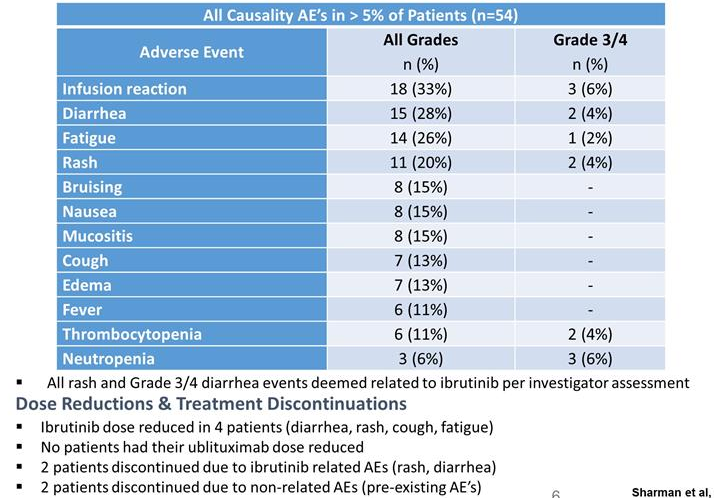
adverseeventsAnd with respect to efficacy, the combination showed improved results over Ibrutinib alone.
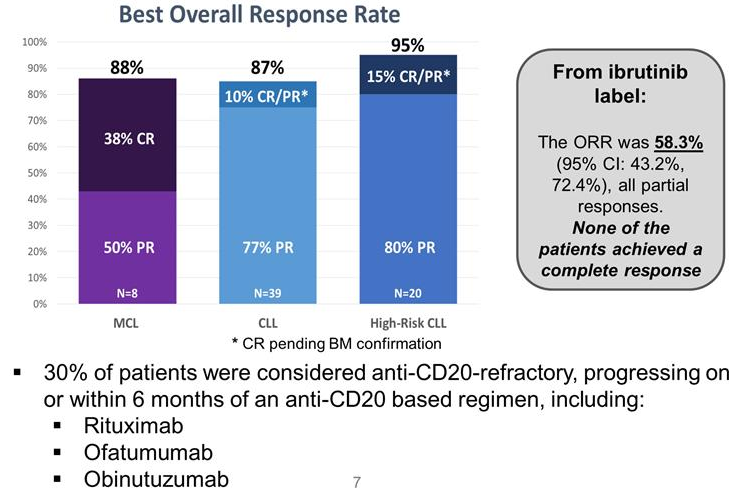
responserateThe immediate opportunity is that after approval TG-1011 will be prescribed alongside Ibrutinib.  Ibrutinib is relatively new but already is experiencing fairly significant revenue.  Below is an excerpt from Abbvie’s last 10-Q (Abbvie calls it Imbruvica):

ibrutinibI’m sure some will see the following as a promotional red flag but TG Therapeutics put their own quantification to the opportunity in this slide at their recent presentation at the Rodman & Renshaw Annual Global Investment Conference:
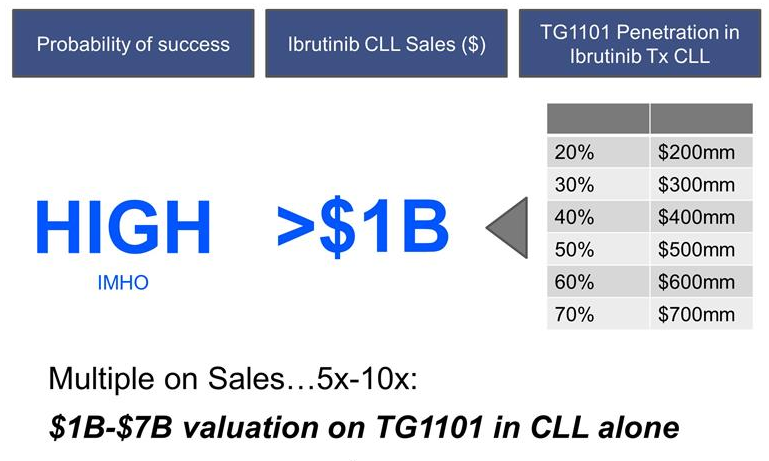
potentialTG Therapeutics second drug in Phase 3 is TG-1202.  The 1202 drug is a PI3K-delta inhibitor, again targeting lymphomic malignancies.  It is the same type of compound as another already on the market called Zydelig (from Gilead with $50mm of revenue in the first half of 2015).  A third similar compound called Duvelisib from Infinity Pharmaceuticals is in phase 3 trials.

Both drugs from the competition suffer from varying degrees of toxicity problems.  Specifically with Zydelig patients can experience very bad diarrhea that can become life threatening.  The consequence is that often patients don’t stay on the drug long enough to fully recover.  Lymphomic malignancies are extremely difficult to fully wipe out and so you need a drug or combination of drugs with low toxicity so that treatments can run their full course.

TG-1202 appears to have a much improved toxicity profile versus the alternatives while having similar effectiveness.

While TG-1202 is showing promise as a single agent the ultimate game plan of TG Therapeutics is to combine TG-1202 with other drugs.  The first combination that is being investigated is alongside the TG-1101 compound.

A phase 3 trial is just about to begin using the combination of 1202 and 1101.  The trial includes the potential for accelerated approval of the drug combination if a significant overall recovery rate is observed among the first 200 patients.  As I already mentioned earlier stage testing of TG-1202 on its own showed both good tolerance from patients and good efficacy.  The hope is that together with TG-1101 TG Therapeutics will have a real winner, and one that does not depend upon a third party drug lie Ibrutinib.  A further possibility that will be investigated down the road is that a 3-drug combination of TG-1101, TG-1202 and Ibrutinib may provide even more benefits.

TG Therapeutics is taking the attitude that no one drug is going to cure the blood cancers they are targeting.  So their approach is to layer together drug combinations, first by adding TG-1101 to Ibrutinib, then by combining TG-1101 and TG-1202, and later by adding in combinations of earlier stage drugs in their pipeline like IRAK4 and Anti-PDL1.

Obviously I’m not an expert in this field, so maybe someone will be able to point out a fatal flaw in this idea.  What I see is a company with upcoming catalysts and with a stock price that does not, in my opinion, reflect the potential success of those catalysts.  So its a buy, but a small position because we know that when biotech’s go wrong, they go wrong badly.

Apigee

In addition to my two bio-tech buys, I added a small position in one tech name.  I found Apigee while scouring the 52-week lows a few weeks ago.  When I was first looking at the company it was trading at about a $180 million market cap with no debt and $90 million in cash.

I am going to do my best to describe what Apigee does without using the word platform.  Because everywhere you read about anything tech you read about the platform, and I honestly believe that at least 50% of the time what that really means is the author doesn’t know exactly what it is the company does so using a term that implies a vague, black box it will be less likely to arouse suspicions.

So what Apigee does, as I understand it, is write code that allows companies to have their internal databases, servers and applications accessed by users (it could be a consumer of the data for personal or commercial use or another company leveraging the data or functions from an application to build upon their own application), but with restrictions in place that limit what data can be consumed and by whom, what app functionality is exposed and what modifications can be made, and that give the company the ability to track, monitor and extract information about what the API clients are doing and how their data and applications are being consumed.

So they sell an API platform.

I think its a pretty decent business idea.  There are plenty of non-tech companies that are getting dragged into the mobile world and to think they are going to hire programming staff that will create mobile interfaces that function and perform effortlessly, be secure, be expandable over time and serve the needs of clients seems like a tough gig to me.  I’ve worked in a dedicated software firm for seven years and its tough to have good code even when this is what you do.  Having a third party provider of the necessary middle man interfaces makes sense.

Of course the question is whether Apigee has the best solution out there.  While I can’t speak directly to that I can fall back on the results.
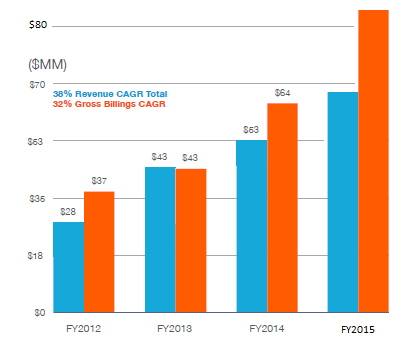
revenue

Apigee is growing revenue, growing gross bookings and adding clients.   Note that I added the 2015 data to the company slide below.

But I am still not completely sold on the stock, and I have kept my position quite small.  My problem is that Apigee is far from being cash flow positive.  And I really have a problem holding stocks will lose money as far as I can model out.

Below is my model.  The 2016 numbers are based on their own midpoint guidance while 2017 is based on my estimate of 25% revenue growth, some improvement in margins as subscription and licensing takes a bigger piece of the pie, and modest operating cost increases.
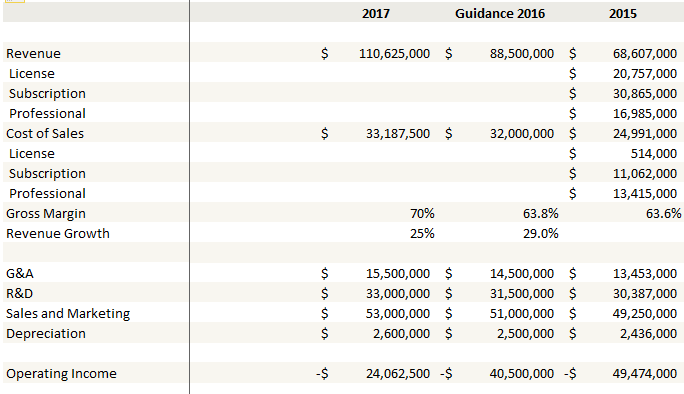
forecast

The company says they expect to be cash flow positive in the second half of 2017 so maybe my expectations are too conservative.  And really, that’s kind of the bet here.  The story is an IPO gone bust, but the results so far suggest the business is on solid ground.  If the company puts together a couple more quarters of beats that profitability number is going to start to come in and I bet the stock gets back to its IPO price.

Where I am at with Oil

If I were a promoter I might say that I nailed the bottom in oil stocks.  A more honest appraisal would point out that it took me three tries.

Those that follow the blog will recall that I had tried and failed to pick a bottom in July.  I was in the process of my second try when I wrote my mid-August update but that one didn’t stick either, as I sold out of RMP Energy and Jones Energy soon after my August 16th post (I kept Granite Oil which has turned out to be a big winner even as other oil stocks have suffered).  My third attempt came on the heels of this release from the EIA, where they revised production downward for the first six months of the year and that one proved to be the winner.

The changes to the EIA data, which clearly show US production has been declining since early in the year, seems like a game changer to me.  Maybe it is not a reason for oil to go straight up, but it might be a reason for it to no longer go down.  Just like the stock market, it’s not when the data begins to get better that matters, but when the data stops getting worse at an accelerating rate.  Its all about the second derivative.

So we will see.  After the EIA release at the end of August I bought Crescent Point, Surge Energy and Baytex, and added back Jones Energy and RMP Energy.  However I knew I would not have the nerve to hold onto these positions if they moved and sure enough I quickly panicked down my positions in each on that first, rather dramatic, correction from $49 (and no I did not catch the top in any of the positions).

I’ve since sold  completely out of a number of the positions (I currently hold Granite, a little Crescent Point and a little RMP) as we seem tenuously on the brink of a re-test.  While I want to believe that an oil turn is upon us, I’m just not sure.  I am really torn about whether to believe the Goldman Sachs of the world or side with the tiny minority that think that all the data doesn’t quite make sense.

Because the reality is that to be an oil bull you have to believe the data is wrong and the forecasts are wrong.

One opinion I will note is this interview from BNN ith Mike Rothman of Cornerstone Analytics.  Rothman believes, if you can believe it, that we will see $85 Brent at year end.  Check out the date – he called this on August 25th, when oil was carving out its bottom in the $30’s.

Rothman’s thesis is basically that the IEA numbers aren’t right and everyone, all the experts and so on, are at their root basing their opinions on this one set of numbers.

And they have an unfortunate problem that I think is well known where they are chronically underestimating demand.    Typically the problem is in the emerging markets… we’re seeing a major episode of that… a lot of the assertions I’m sure you have heard, I’m sure the people listening to this program have heard is that the oil market is oversupplied by 2-3mmbbls and that demand is weak.  Demand is at record levels.  Its not an opinion its an assessment of the actual data.  The problem is the underestimation of the non-OECD.

I am somewhat sympathetic with this view.  I remember back to pre-2008 when the IEA continually underestimated demand.  Meanwhile we know that world production declines by 4-5% and that decline is, if anything, accelerating.  Wells have to be drilled to stem that decline and it still requires capital to drill wells.  I have to ask – is that capital really getting the return to justify its expenditures?  Because if it takes 2-3 years to get back your capex then its not worth doing even if you are a national oil company.  You’ll end up deeper in debt.  I don’t know, maybe everything I read is gospel but it just doesn’t sit right with me.  I would love to see well level analysis and economics of new developments in Iraq, Iran, Russia, all these countries where it is supposedly so profitable to ramp production and where all those production ramps are sustainable.

But with all that said, I remain neutral in my actions.  I’m not going to pound my fist and say the market is wrong.  I’m just going to quietly write that I don’t think things are as certain as all the oil pundits write and continue to be ready to pounce when the skies clear enough to show that an alternate thesis is playing out.

Portfolio Composition

Click here for the last four weeks of trades.

week-219

Week 202: Better Late than Never

Portfolio Performance

week-202-yoyperformance

week-202-Performance

See the end of the post for the current make up of my portfolio and the last five weeks of trades

Monthly Review and Thoughts

I am a week late getting this portfolio update out due to a really busy weekend that kept me from doing any writing.   Fortunately very little is pressing.  I only made a handful of portfolio changes and added two stocks, small positions at that.

Given the relative dearth of transactions, I thought this would be a good post to give an overall update on some of the stocks I own. I have stepped through my thoughts on a few positions, giving a brief summary of why I own them and what I expect going forward.

But before I do…

This week I picked up the book Reminscences of a Stock Operator.  It is a book that, in addition to which this blog received its name, I read again and again, rarely from start to finish, usually just a chapter starting at whatever page I happen upon.  It has is so much knowledge and so much of my own investment philosophy is tied to its precepts.

This week I opened the book to the chapter about Old Partridge, an fellow with a thick chest who carried a big line and had been around the block a few times.  Its quite a well known chapter, mostly for two comments made by Partridge.

The first is perhaps the most famous.   Being one of the senior members of the house, and given the propensity of speculators to look for an outside influence to sway their opinion, Partridge was often asked for his opinion on tips and whether they should be bought or sold.  When asked such a question he would always respond with the same answer: “You know, its a bull market”.

The weight of this statement is the simple recognition that in a bull market the general trend of stocks is up and if you are confident of the general condition of the market, you can’t go too terribly wrong.  The general trend will  lift most boats.  A precept to be taken seriously for sure.

The second well known passage occurs when Partridge is being presented with advice from a tipster who had given him an idea that had worked out well and was now suggesting that Partridge sell and wait for a correction. To this tipster Partridge replies that he cannot possibly take the man’s advice, for if he were to do so he might lose his position, and he could not bare to do that.

This is really a statement about our own fallibility and our own psychology.  Regarding the former, if the correction does not materialize, then where are is poor Partridge now?  Without a position and up against his own mind’s wrongness to get it back.

As for the latter, are we really so sure of our own emotions that we can stomach either A. buying back the stock at a lower price only to have it fall further or B. waiting too long for the bottom so as to miss it entirely and not being able to stomach a later purchase at a price more dear?

Anyone who has played with real money will know that the mind plays tricks in each of these circumstances.

So this is what is well-known and often quoted from the chapter.  But I was struck by a less often, if ever, quoted passage that is, in my opinion, equally or more important.  I will quote this exactly since it is less well known, with emphasis on one sentence in particular:

“In a bull market your game is to buy and hold until you believe that the bull market is near its end.  To do this you must study general conditions and not tips or special factors affecting individual stocks.  Then [when the bear market comes] get out of all of your stocks; get out for keeps!

Now step back and think about this for a moment.  Livermore is not saying that one needs to be cautious in a bear market, or flee to safety stocks, or go net short.

He is saying sell it all.

How easy would it be to sell every position tomorrow if you had to?  Forget about the logistics, think only of the psychological strain.  Could you really let go of every stock you owned?  Or are reasons already creeping into your mind about why this one or that one should be different, should be held onto, will persevere through the carnage.

I know those reasons are abound for me.

My point is this.  This is not a precept to be taken lightly, and not one to be first dwelled upon at the time when action is required.  To follow it requires training the mind to ruthlessly let go of all your former beliefs and go to 100% cash (or as close as is possible) when the time comes.  This is something that requires practice, and something I am trying to ingrain in myself right now.

With that said, on to the stocks.

New Positions – Enernoc and others

I had a few new positions in the last month.  I bought Enernoc (ENOC) I bought Chanticleer Holdings (HOTR) and I bought some gold stocks for another swing.  I’m not going to talk about the gold stocks.  I bought a few very small one’s on the recommendation of a friend that I agreed not to talk about on the blog and so I won’t.  I bought a few larger one’s for the online portfolio that I have talked about before and really have nothing new to add other than that gold looked ready to break-out (it did) and so I thought the stocks would follow (they did).

The idea behind Chanticleer came from this SeekingAlpha article, which I found to be quite good. But to be honest I bought the stock as more of a short-term momentum play than a long-term hold.  I have to spend more time on it to know whether it is anything more and if I do and decide favorably, I will write more about it later.

On the other hand I expect to hold Enernoc for at least the immediate term.

Enernoc operates two businesses, a legacy demand response power management business and an evolving energy intelligence software (EIS) business.

The demand response business is very lumpy, and that lumpiness leads to the kind of stock reaction that happened in February and again a few weeks ago.  The company partners with enterprises to provide load reductions in times of high power demand.  By pre-buying into generation capacity that is no longer required (and thus no longer needs to be delivered) they split the winnings from the savings derived thus profiting from the result.  The difficulty is that the company’s profitability depends to a degree on the volatility of the power market, which is cyclical and hard to predict.

This year Enernoc is experiencing this negative cyclicality in Western Australia.  In addition, a contract they have with PGM cannot have its revenue recognized until fiscal 2016.  This combination led to revenue guidance in 2015 of about $100 million below 2014.  The market didn’t like that.

It is the second business, an EIS software platform, that really has me interested.  The EIS platform is sold to enterprises and utilities and allows for the centralized monitoring, analytics, reporting and most importantly management of energy to reduce consumption and manage supply.  From what I can tell they have one of the leading solutions on the market.  And I really like the market.

As a general rule I’m not much for technology story stocks but this makes sense to me.  I believe that the electricity grid is in the early stages of a pretty profound transformation.  Anyone can pull up a graph of solar costs and see that while we are not there yet, we are headed for a world where solar will be cheap enough to be competitive in say the next 5-10 years, if not sooner.  As that time comes upon us the management of energy, both to and from the grid  and at the level of each individual enterprise or consumer, is going to be much more important.

Meanwhile, the evolution of the industrial internet means a general trend toward the greater use of measurement and analytics in all areas of business.  Energy consumption and distribution will be forefront of this shift.

Enernoc says that right now their primary competition to their EIS platform are spreadsheets and apathy.  I believe both of these impediments will become less viable as the electricity grid evolves.

I would urge readers to give a listen to at least the first 45 minutes of the investor day presentation, available here.  I thought they painted a compelling picture.  Please tell me if you think I’m on crack.

Of course one look at the stock and the numbers and they are terrible.  So terrible that I am not going to roll out any spreadsheets or models because they are just too ugly.  I think 2015 guidance was for -$3 per share in earnings or something like that; I can’t even remember the exact number because it was so bad that it wasn’t even  worth remembering.  Cash flow isn’t quite so bad because much of the earnings hit is due to the revenue deferral.  The company expects break-even cash flow in 2015.

The stock delivered crappy numbers in the first quarter and got smacked and it could easily deliver crappy numbers in the second quarter too.

Nevertheless I think at some point we see the EIS business overshadow the results.  The key metric is annual recurring revenue (ARR), which the company reports for both utilities and enterprises.  ARR growth will reflect annual subscriptions to the software.

In 2015 Enernoc is expecting 70% ARR growth for enterprises and 15-20% growth for utilities.  If they hit or exceed those numbers I don’t think the stock will continue in the single digits.

This is the kind of story that could get a silly valuation if things turn out right.   It is a somewhat un-quantifiably large opportunity that could be extrapolated to a big number if it starts to work.  Its not working yet and that’s why the stock is in the $9’s.  I think there is a reasonable chance that changes in the next 6-9 months.

Revisiting some existing positions

Air Canada

I made this my largest holding after first quarter earnings were announced.  Air Canada continues to get very little respect from the investor community.  With estimates that top $3 for the full year 2015, the stock trades at around 4x earnings.

Even after accounting for the relatively difficult business of air travel, and recognizing that free cash generation hampered in the near term by the build out of the fleet, I have trouble believing the stock isn’t worth more than this.

I was talking to a twitter acquaintance about Air Canada and WestJet.  He was making the very valid argument that WestJet was an easier position for him to make larger because it was A. less leveraged and B. had lower cost.

The conversation made me revisit a comparison I made of the two airlines.  One thing I looked at was analyst estimates for the two companies.

epscomp

Air Canada trades at a discount to WestJet on both and EBITDAR and EPS basis, but the discount is far greater with regard to the latter because of the leverage that Air Canada employs.  Air Canada has about $5.5 billion of net debt while Westjet debt is  around $1.1 billion.

I believe that the discount Air Canada receives is due to historical biases that are beginning to close.  There is evidence that Air Canada is taking market share from Westjet.  Costs are coming down and CASM declines nearly every quarter.

The nature of their network is that it is always going to be higher cost, but what matters are margins and margins have been increasing.   In the first quarter operating margins reached 6.3% and return on invested capital rose to above 15%.  If they continue to roll out their plan, expand margins while increasing capacity, it will be harder and harder to justify a 3-4x earnings multiple on the stock.

Axia NetMedia

Axia is one of about  five stocks that I rarely look at.  I have no intention of selling my position.  I have confidence in the long-term direction of management.  And I think they provide an important service to rural residents and businesses (high speed internet access) that has, if I were to steal the term of a value-investor, a wide moat.  I’ve also lived in Alberta all my life, grew up in one of the small towns that Axia provides service to and know the family of their CEO and Chief Executive Officer to be stand-up people.

The business is not without its faults: it requires large up-front capital expenditures to lay fiber to mostly out of the way places.  In Alberta it is dependent on a somewhat complicated agreement between Bell (which owns the fibre backbone connecting the 27 largest communities), the Alberta government (which owns the backbone to the rest of the communities) and Axia (which operates the backbone owned by the Alberta government as well as owning branches to individual communities and businesses off of the backbone).

The stock has appreciated over the last couple of years but still trades reasonably at around 7x EBITDA.  Once the build-out of fibre in France and Alberta is complete and capital expenditures trend into maintenance, the business should produce ample free cash.

Its a stock I hold without concern and add to on any of its infrequent dips.

DHT Holdings

This is my biggest tanker holding.  DHT owns a fleet of 14 VLCCs, 2 Suezmax and 2 Aframax vessels.  They have another 6 VLCC vessels scheduled for delivery in 2015.  I like that they have growth on the horizon and I do not feel like I am paying up for that growth.

In the first quarter DHT reported earnings of 25c.  They booked VLCC rates of around $50,000 per day and Suezmax rates of about $30,000 per day (note that in the press release DHT referenced $60,000 per day for its VLCC’s but this referred to spot exposure only).

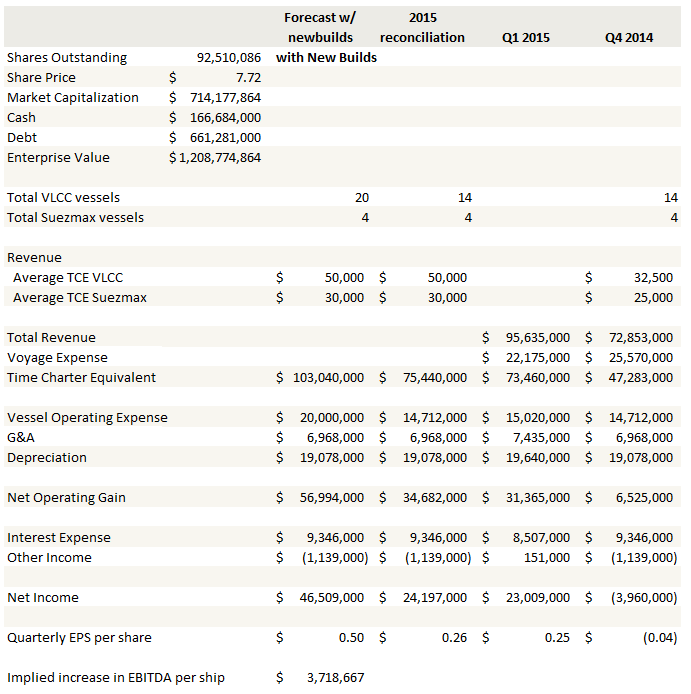
Along with the first quarter results the company gave guidance on new builds, saying on the conference call that “under a rate scenario, say, $50,000 per day, we estimate that each of these ships will add some $3.7 million of additional EBITDA per quarter.”

Take a look at my model below.  Those 6 additional ships, delivering $3.7mm of EBITDA at $50,000 day rates, are going to double earnings to around 50 cents per share quarterly.  This is comparable on a per share basis to Euronav, yet Euronav trades at $13.

newforecastLike the other tanker companies reporting earnings DHT had mostly positive things to say about the future.  The company pointed to a 2 year plus wait to get VLCC delivered from Korean or Japanese yards.  They also don’t think the strength in the tanker market has anything to do with contango – instead that it’s a function of higher demand, longer routes and limited order book bringing on little new supply.

Empire Industries

I was really happy when I found out that the Canadian government had decided to support the 30 meter telescope.  As I’ve written in the past, Empire had significant contract work lined up for the telescope, but the work was contingent on financial support for the telescope from the government.    The company expects the 30 meter telescope contract to add about $80 million to their backlog.

Even without the $80 million, Empire’s backlog has been increasing.  Backlog at the end of the first quarter was $155 million versus $93 million at the end of the fourth quarter.  The increase in backlog due to orders for the Media Attractions group, which continues to make inroads in Asia and the Middle East for its amusement park rides.

So with all this good news, why is the stock languishing?  Oil.   The Hydrovac truck business is getting squeezed on volumes and margins and the steel fabrication segment is weak:

hydrovacandsteelfabbizSo the problem with the stock is that some business are doing quite poorly.  Even with positives from the telescope revenue things remain a bit up in the air because of these other lagging businesses.

Finally I have read on Stockhouse that there is the Chinese seller trying to get out of their position.  I have no idea whether this is true, but it makes some sense particularly given the pressure on high volume that the stock experienced after earnings.   Earnings day is often a good opportunity to liquidate in these low volume venture stocks.

Teekay Tankers

This was my third largest tanker position (behind DHT Holdings and EuroNAV), but after being downgraded by Deutsche Bank on concerns about supply in the second half of 2016, I hemmed and hawed, modeled what looked like it was going to be a very strong quarter and after a whole lot of consternation, I added to my position.

I actually got a copy of the Deutsche Bank report thanks to one of my very helpful twitter pals.  It’s a reasonable report.  Deutsche Bank expects higher supply growth in 2016 than they had previously estimated.  This is because of a pull-in of 2017 new builds into the second half of 2016, and lower scrapping of ships.

I don’t totally agree with their numbers; in one case in particular they assume scrap of 0.5% for 2015 and 2016 while the actual year to date numbers for 2015,which have been extremely low, are 0.3% over the first four months.  It seems a little to pessimistic.  Nevertheless the themes are reasonable.

The question I wrestled with through the day on Tuesday was whether the tanker rally would end prematurely on the basis of an expected re-balancing of ship supply in year and a bit down the road.  My conclusion was that it’s too far to see; too far to expect the market to discount.

What is the new equilibrium price of oil?  What is the new demand level at that price?  How many new-builds are going to get out on the ocean?

We are already seeing the EIA increase oil demand estimates and we know they are typically behind the curve.  We are already seeing costs come down for oil services, suggesting a lower price of oil will deliver similar margins.  Deutsche Bank assumed a 38% non-delivery of the order book.  This is probably reasonable, but after listening to comments from Euronav and DHT about the composition of the order book its conceivable that the number could be higher.

I get the feeling that Deutsche Bank, and presumably many others, are basing their conclusions on the narrative that tankers are a fragmented industry that has never and will never get their shit together.  The problem with this narrative is that its not really historically accurate.

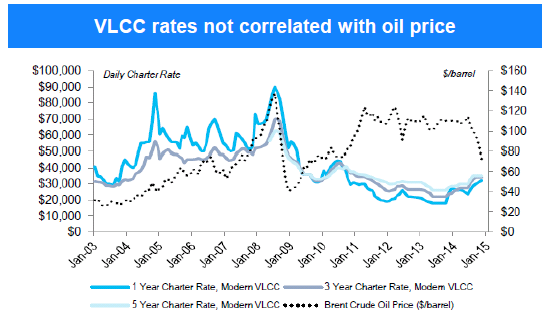
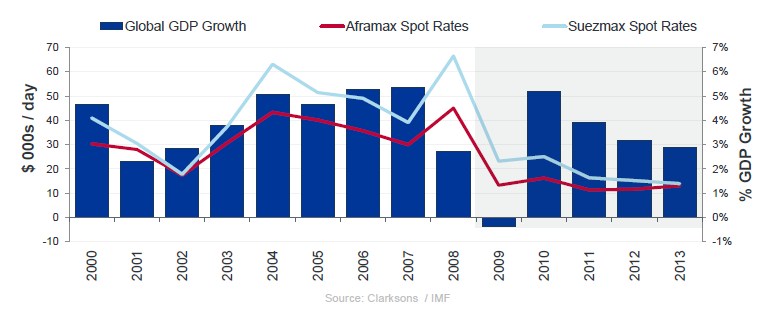
Below is a chart from the Euronav roadshow giving historical VLCC rates, followed by one from Teekay Tankers investor day giving historical Suezmax and Aframax rates:

vlccrates

historicalratesThe VLCC, Suezmax and Aframax markets went through a 4 year period, from 2004-2008, where rates were extremely profitable.  In fact they were higher than today.  Yet the narrative is that at the first sign of positive earnings, tankers will flood the market and so the current cycle will be 12 months tops.

I’m not so sure.

I’m not suggesting that the questions and history paint a clear picture for tankers.   I’m simply suggesting the picture is not convincingly dark.  And the valuations, in particular Teekay, reflect a lot of darkness.

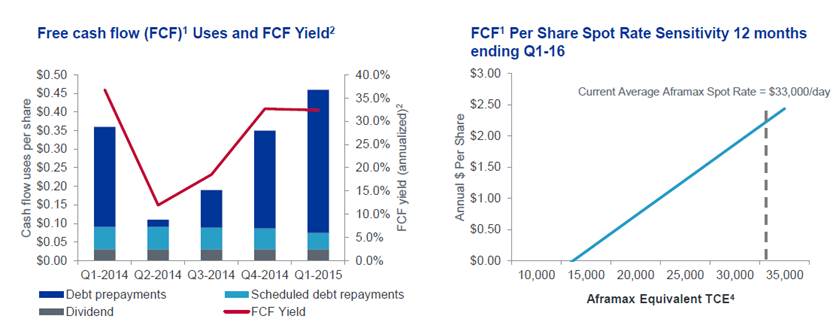
Rather than give you my model for Teekay, just take a look at the following slide of the company’s cash flow.

freecashflowThe company’s cash flow increases by 57 cents for every $5,000 increase in day rates.  Its extraordinary leverage.   Now albeit their definition of “free cash” is a little suspect – free cash for tankers is basically, “we’ve bought all our ships and don’t plan to buy any more”.  But nevertheless a cash flow multiple  of 3x, when that cash will go straight to the balance sheet in one form or another absent further ship purchases, seems inexpensive to me.

Extendicare

Sometimes you just have to wait out the speculators.  When Extendicare announced the sale of its US assets in November, my first instinct was to sell my position.  It was a poor deal, though maybe not as bad of a deal as the market reaction insinuated.  I did a lot of work in the days after the deal, basically distilling what remained of the thesis into a simple observation: the current market price at the time (around $6.50) was essentially assuming that Extendicare did nothing right going forward: that they remain underleveraged and that they don’t put the cash from the deal to work in a accretive manner.  When I thought about the chances of this happening, I saw it as a real possibility, but not a certainty.  I also suspected that there were some very large shareholders who had been betting on a positive outcome to the US divestiture and they were now forced to sell shares of an illiquid stock with no momentum at the end of the year.

The picture was thus one of abnormal and perhaps unwarranted weakness. Thus I concluded that I would hold onto my shares and in fact added to them when the stock got as low as $6.20.

Since then we have had a recovery.  Extendicare has proven that it can put the cash proceeds towards a positive end, having purchased Revera Home Health homecare business for $83 million.  The acquisition is expected to add 10 cents to Extendicare’s AFFO.  This has allayed concerns that the dividend may need to be cut to what is sustainable for the Canadian only operations.  Also in the first quarter the company bought back 978,000 shares, or a little over 1% of shares outstanding.

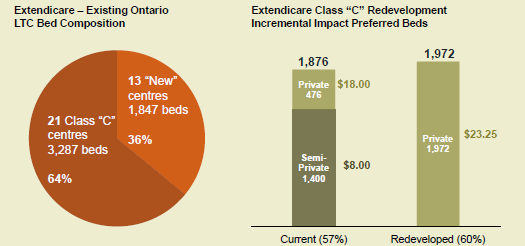
Perhaps most importantly, the Ontario government amended its subsidies for redevelopment at the of February.  The base subsidy for large homes was increased to $162,000 per bed from $121,000 per bed over a 25 year life.  Also the revised design standards no longer include LEEDs certification, which should bring down construction costs.  Below is the outcome of Extendicare converting 1,876 of its Class “C” beds (the lowest type) into 1,972 Class A beds.

newontsubsidies

The amendment of subsidies is a big deal for Extendicare.  The vast majority of their beds are in Ontario.  When asked on the call whether the latest changes by the government would make it economically attractive to redevelop their Class-C beds, Extendicare responded that while there are still practical details to iron out, in theory the economics are there.

Given that Extendicare now has multiple options for its cash including further acquisitions in the homecare segment, redevelopment of existing Class C facilities, and new developments in the independent living/assisted living space, investors can begin to look forward at possibilities rather than backward at missed opportunities.  I’m holding my shares.

Hammond Manufacturing

Taking the what they do statement right from their MD&A: “Hammond Manufacturing Company Limited manufactures electronic and electrical enclosures, outlet strips and electronic transformers that are used by manufacturers of a wide range of electronic and electrical products. Products are sold both to OEM-direct and through a global network of distributors and agents.”  Simple business. No real moat.  But the type of business that can see a very positive impact from a change in their cost structure such as that brought on by the current weakness in the Canadian dollar.

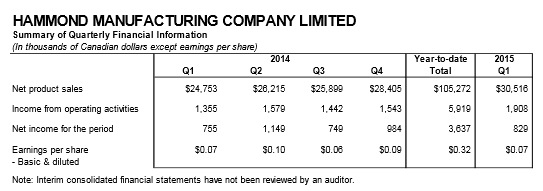
The stock has so far been a bit of a disappointment.  They had a great quarter on the top line – revenue was up to $30.5mm from $24.5mm in 2014, which is inline with my thesis that they would be one of the manufacturers to benefit from the lower Canadian dollar.  The revenue gain was partially due to foreign exchange gains and partly due to market share gains.

Income from operations was also up significantly:

q1

The problem with the quarter, and what was unexpected for me, is that they had a really big foreign exchange loss of $623,000 versus $145,000 last year. $380,000 was due to a USD loan for their US subsidiary. This really depressed the bottom line.

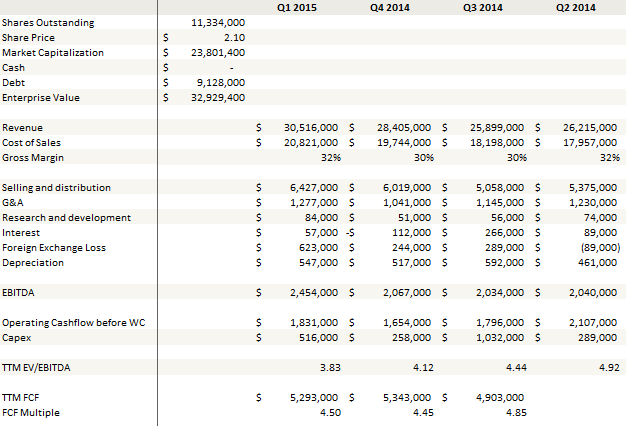
Excluding the foreign exchange loss, Hammond actually didn’t have a bad quarter.  The stock remains reasonable.  Below are the trailing twelve months results for the company.  The free cash generation (below computed before changes in working capital) is compelling and I see no reason for a return to parity for the Canadian dollar and thus no reason to think this level of cash generation can’t continue.  I am considering adding to the position, even as I am down fairly significantly on it.

ttm-results

Euronav

Euronav had a very interesting conference call, which unfortunately has no transcript via Seeking Alpha, so it is difficult to quote.  I’m paraphrasing.  Euronav said they believed we are at the beginning of a multi-year run for the market.  They see the catalysts for this run being:

  1. limited vessel supply
  2. increasing demand for oil
  3. rising tonne-miles as cargo moves over greater distances and ships reposition over greater distances

One of the most interesting points that Euronav made, and one that I had not heard before, is that there is a significant amount of vessel tonnage available for sale.  They estimated that 10% of the tanker fleet is up for sale from private owners, distressed entities, and opportunistic speculators.  Of that 10% a significant number of the vessels are in the 0-5 year range.  The point here is that the quality of available fleet is not far off of new builds, and so if capital begins to come into the tanker market looking for a home, there are plenty of places for it to go without adding to supply via new build orders.

Another interesting comment that Euronav made was that you need 40 new build VLCCs per year to keep up with oil demand.  Returning to the Deutsche Bank analysis I mentioned in my Teekay Tankers remarks, Deutsche Bank is estimating an increase in 30 VLCCs in 2016, followed by only 10 in 2017.  Again, I’m not so sure that their analysis is as bearish as their price target changes suggest it is.

Euronav’s bottom line is the same one I have already stated for DHT Holdings and Teekay Tankers.  Its too cheap if you think rates in the current range can sustain themselves.  The company can generate earnings north of $2 per share at current rates (earnings were 55 cents in the first quarter).  At $13, which is where I was buying it, it trades at 6x earnings.   If that multiple goes to 8x you are looking at a 36% upside in the price.

Stocks I sold

I exited a number of positions in the last month.  I sold out of Handy & Harman (HNH), Ellington Financial (EFC), Hooper Holmes (HH), Amdocs (DOX), Ardmore Shipping (ASC), Impac Mortgage (IMH) and Avid Technologies (AVID).

In the cases of Amdocs, Ardmore, Impac and Avid, I sold out because the stocks had risen to a level that I thought closely reflected a fair price.   With Impac Mortgage in particular I caught the top with the on-line portfolio sales, but I regret to say that in my real dollars portfolio I only sold half at $27, and had to let go of the rest at $22.  I may revisit Ardmore in the future if it dips but I just have so many shipping plays in my portfolio right now I thought it prudent to take profits on some of them.

Handy & Harman and Hooper Holmes both just weren’t working out, I was down about 20% and so I had to make a decision of what to do.  I decided to cut the positions because I am simply less certain about their future direction than I am with other stocks in my portfolio.

I still own Ellington Financial in my other account where I hold mostly dividend payers.  I just didn’t think holding a stock where the upside is mostly yield makes much sense in a portfolio that does not track dividends.

Portfolio Composition

Click here for the last five weeks of trades.

week-202

Week 197: “Make your money while you can”

Portfolio Performance

week-197-yoyperformance

week-197-Performance

See the end of the post for the current make up of my portfolio and the last four weeks of trades

Monthly Review and Thoughts

On Thursday, while I was surfing around the web over lunch hour trying to figure out what I wanted to write about this month, I stumbled on a YouTube clip of Neil Young being interviewed on Charlie Rose. He describes what he thinks of Bob Dylan’s song writing (the quote in the title of this post is attributable to the Dylan song Rambling, Gambling Willie).  Young observes the source of inspiration that leads to a great song.

The argument about whether investing is an art, a science, or just a mundane business is one that depends as much on who is making the argument as it does on an objective reduction of its reality.  Investing has elements of all three and it’s essence is whatever one associates with best.  I stand firmly in the camp that it is an art, and I think that for the kind of shooting star sort of performance I try to achieve it is that hard to put your finger on source of inspiration that leads to out-performance.

Maybe I am being too bold to analogize the making of a great song and the development of a great investment idea but as I stand back from both I do note some common characteristics. Both tend to be built on their historical predecessors, both stand in deference to the structure they abide in and, when done correctly, both live within the bounds of their genre’s common sense.  At the same time each has to extend outside of that imposed limit just enough to see what is not easily seen, but not so far as to drop off the cliff of abstraction or dogma.

Most importantly though is that both are built upon a sensibility, one that is hard to put your finger on but nevertheless is there.  Being more of a word guy, I can describe this best with lyrics; when you hear something that is right, you just know it, even though you might not know why.  You can try to break it down to the linguistic structures, cultural context and the feelings it invokes, but I don’t think you will ever quite get to understanding.  The right phrase in the right spot is right because it just clearly is, and if you happen to be possessed by the inspiration that Neil Young describes you will discern that and act accordingly.

The sensibility on which an investing idea is based is no less complicated, no less abstract, and I would argue no less difficult to reduce down to its essence.  But if you are in the groove, you just know that a good idea is good before you even know why.

Two Interesting BNN Segments… the first on the market

I listen to a lot of BNN clips.  I will have them on in the background as I’m doing research.  Most of it is not helpful and I’ve become deft at tuning out the noise.  But every so often I hit upon a gem.  I came across a couple of those in the last month, with the first being this segment on market performance.

I can’t figure out how to embed a BNN video for the life of me so here is the link to the segment.

The theme is the performance of small cap stocks, and in it Jonathan Golub describes his thoughts on the small cap sector.  The really interesting part is in the last minute, where Golub notes that in the average year that the economy is not in a recession you will see 16-18% gains in the stock market.  But when we hit a recession you “lose all your chips” and the average loss is 35%.

A couple of points here.  First, this exemplifies something I have been saying, that one has to get while the getting is good but be ready to get out when it ends.  There is no hiding when the tide goes out.

Second, this is relevant to what we are seeing right now.  All of the gnashing of teeth over valuations and the lack of a correction forgets that the stock market rarely makes a sustained move down when the economy is expanding.  But once the economy begins to contract the moves down are exaggerated when compared to the amplitude change in growth.

In the mean time there are always ways to justify valuation. Right now the most common one is that with interest rates low, inflation expectations non-existent, so ergo a future dollar is worth more than it has been in the past.  Therefore, paying a higher multiple for that future dollar of earnings is justified.  This logic, which like all justifications contains both germs of truth and seeds of failure, can be used to rationalize stock prices to these levels and probably a lot further.

… and the second on oil

Over the last couple of months I have picked away at position in oil stocks on weakness and at this point have accumulated positions of a decent size in RMP Energy (RMP), Rock Energy (RE), Canaco (CNE), Jones Energy (JONE) and most recently DeeThree Energy (DTX).

There are still plenty of analysts and much of the twitter universe posturing for a further decline in oil and with it a commensurate drop in the oil stocks.  I don’t know about oil, it may fall if the storage concerns are real, or it may not, but I do think that barring some further shock (ie. a demand shock brought on by a recession) we have seen the lows in the stocks.

It doesn’t make sense to me that oil stocks (at least the one’s I own) will fall to new lows even if the price of oil does drop further.  I understand there are leveraged companies that can ill afford further whittling of their cash flow and for those names sure I can see further declines.  But for well capitalized companies, I just don’t buy the idea that further panic will engulf them and send them down further.

To think that is to embrace the idea that an oil stock price should be based on the current price of oil.  That’s crazy.  Nothing in the stock market is priced off of current prices.  If it was, shipping stocks would be trading at 3-4x what they are, Pacific Ethanol would have gotten to $50 for crashing all the way back down to $5, I could go on.  Oil stocks, like everything else, go up and down based on the expectation of future business.

Turning again to a BNN clip, Eric Nuttall was on Market Call last week and he had some interesting observations about the oil market.

The four important data points that Nuttall provides are:

  1. US company capital expenditures are expected to be down 40-50% in 2015.
  2. Production has already seen monthly declines in Eagleford and Bakken
  3. The natural decline in the US is 2mbbl/d per year
  4. Weatherford was recently quoted of  saying that international capital expenditures have fallen by 20-25% and that as a result they expect production ex-US and ex-Canada will fall by 1.5mmbbl/d in 2016

I think there is a growing understanding that prices are too low to support stable production levels worldwide and that we will soon (in the next 9 months) see the impact of this as supply turns down.  Without getting into too many details, I have seen enough declines of Eagleford and Bakken wells to know that these fields are not eternal springs of flowing oil.  We are already seeing the first signs of declines in these fields.  And the natural gas analogy is flawed; there is no such thing as associated oil, so there will be no analogy to the associated gas (and of course the Marcellus) that led to the strong production from natural gas even as rig counts fell.

What I find ironic is that many of the same names who derided oil companies for not producing free cash at $100 are somehow confident that production will remain high at $50.  It seems like a rather bizarre confluence of opinion to me.

But most investors are beginning to realize that well financed oil companies will soon be making significantly more cash flow than what is implied by plugging in the current spot.  So I don’t think we see new lows in names like those I own, or if we do it is going to be an operational catalyst (see RMP Energy for an unfortunate example), not a general malaise.

Portfolio changes

I did not make a lot of portfolio changes over the last month.  The few things I did do was to add two more shipping companies to my basket of tanker stocks, and a cheap little hotel REIT trading well under net asset value.  I will discuss each below:

Ardmore Shipping

As I watch my tanker trade finally start to pay off, in the last month I added three new tanker stocks, Euronav (EURN), Tsakos Energy (TNP) and Ardmore Shipping (ASC).   There was a good Seeking Alpha article on Tsakos, which is available here, and I’m still stepping through my research into Euronav, so I will focus my discussion here on Ardmore.

Both Ardmore and Tsakos allowed me to dip my toes into the product tanker market.  Up until now I have focused my purchases on crude tanker companies.  However, with oil prices low demand for oil products (gasoline, heating oil, jet fuel and the various chemical product inputs) should be strong.  While Tsakos Energy has a diversified fleet with 30 crude tankers and 29 product tankers, Ardmore is a pure play on the product tanker market with a fleet consisting of only MR tankers.

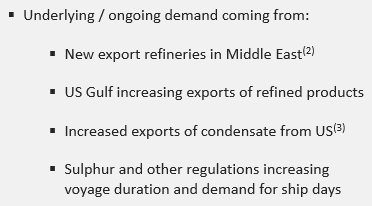
In addition to the demand story, Ardmore listed the following reasons to expect strengthening demand in the product tanker market.

demanddynamic

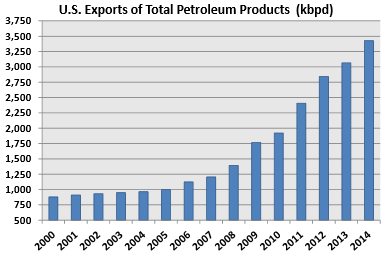
The following chart is from the Capital Product Partners corporate presentation, and it illustrates the extent to which point 2 from above is asserting itself:

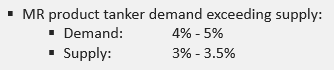
USexportsOn the supply side, Ardmore sees demand outstripping supply in the medium term:

supplydynamic

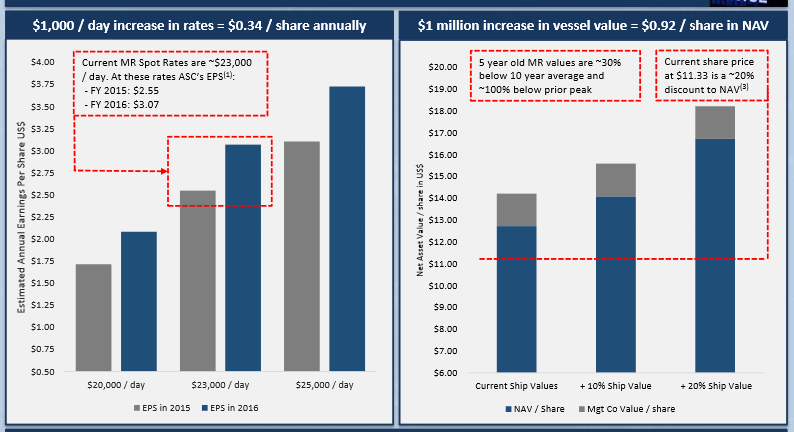
So the supply/demand situation is favorable.  But what really drew me to Ardmore is their valuation.  The company provided the following charts on Page 7 of their January presentation.

earningspotential

Right now MR spot rates are above $23,000 per day.  From the above slide, the company is saying they expect to earn at least $2.55 per share with rates at current level, and the stock trades at a little more than $10.

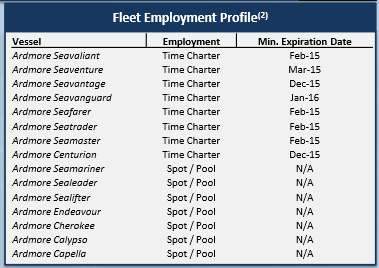
Ardmore owns and operates exclusively MR2 tankers (mid-range tankers).  They have a fleet of 24 tankers including 10 new builds that will delivered throughout this year.  The fleets average age is only 4 years.  Their operating fleet is almost entirely on spot or short term charter.

fleetWhile Ardmore looks cheap on an earnings basis they are also reasonable on a net asset value basis.  According to their January presentation Ardmore is priced at a 20% discount to net asset value.

I still like the crude tanker story more than the product tanker story, and indeed my bet on tankers is severly skewed to the crude tanker side (I know, DHT, TNK, EURN, FRO, and NAT on the curde side).  Nevertheless I do think there is upside in both and that Ardmore is a solid way to play the product tanker side.

Capital Product Partners

While Capital Products Partners was one of the first tanker stocks I bought, but I haven’t written much about them and so, since I’m talking about the product tanker market in this post, I wanted to give them a bit of space here.

Capital Product Partners differs from the other tanker plays that I own in that it is not a direct play on the spot market.  Every vessel that the company owns is chartered out for the long term, with some of those charters lasting upwards of 10 years.  Capital Product Partners also differs from the other positions in that it is a dividend play.   The company distributes virtually all of its available cash flow in dividends and markets itself to dividend investors.

Yet even though the company has very little exposure to the spot rate, I still look at this as a play on nearterm tanker market fundamentals.  The idea here is that as rates prove themselves durable, investors will become more comfortable with the dividend sustainability of the company and perhaps anticipate increases to the dividend.  The shift in sentiment should lead to capital appreciation, which when combined with the 10% dividend that the company pays will need to a nice overall return.

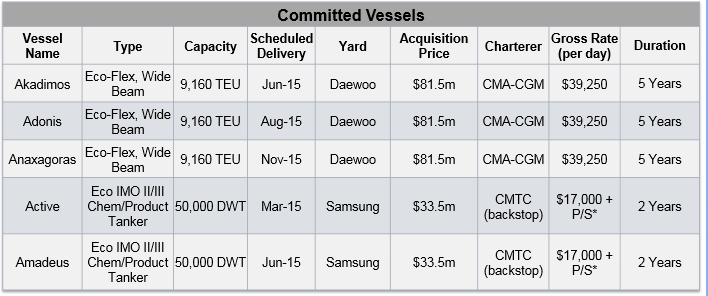
Capital Product Partners is primarily levered to the product market.  In all they have 18 product tankers, 4 suezmax tankers, 7 containers and 1 capesize dry bulk vessel all with period employment.  Their fleet is fairly young with an average age of 6.5 years (their MR fleet is on average 8.3 years old). In addition they have 3 container vessels and 2 MR tankers being delivered in 2015, all of which will be on long term contract:

newvessels

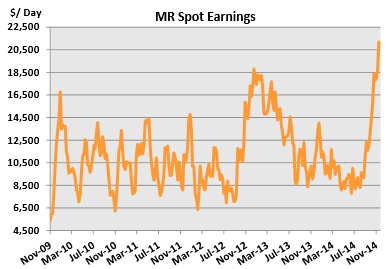
In their corporate presentation, the company provides a chart giving some historical perspective to current MR rates.  As you can see, MR spot rates are higher now than they have been in some time, and since the chart was published, rates have gone higher still and are now in the $25,000 per day range:

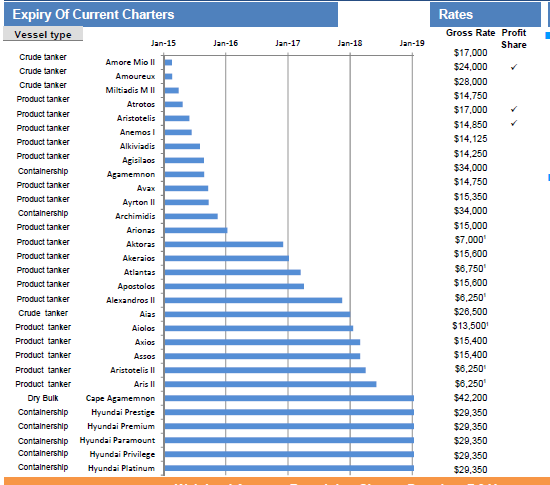
MRspotBelow is a table illustrating the expiry of charters for Capital Product Partners.  Notice how the expiry of most of the product tankers occurs in 2015, which should result in rate hikes to the majority of the renewals, whereas the containerships and the dry bulk vessel, for which the market is currently in excess and rates very soft, are chartered for years in advance.

charters

I have some questions about the long-term sustainability of the dividend, but I don’t think I will be sticking around long enough in the stock to warrant too much consternation over them.  They’ve been paying a dividend for a while, so from that perspective things look good,  but I still am uneasy over the long term in the same way that I am around many of these capital intensive businesses: Asset purchases are lumpy and large and so free cash generation follows suit which makes it really difficult to discern exactly what the average free cash is over the long term.

For example cash flow from operations over the last 3 years has been $125mm, $129mm and $85mm respectively.  Vessel acquisition and advances less proceeds has been: $30mm, $331mm and -$20mm (in this year dispositions exceeded acquisitions and thus resulting in negative overall expenditures). Clearly the company’s free cash has whipped wildly over this time.   Taking the three year period fas a whole, free cash (before dividend) has been essentially nil at -$2 million.

Now some might look at this as a red flag and something to be avoided, but I think it fits quite well into the thesis (which is short enough in duration to not worry too much about the long-term sustainability).  No doubt investors are assigning the 10% dividend in part because they are evaluating the same free cash flow numbers I am and questioning the sustainability of that dividend.  If however charter rates do show themselves to stay high for the short-term (lets say the next 12 months), this concern will be alleviated and backward looking free cash flow models will be thought to be inadequately pricing in what will come to be viewed (by some at least) as a secular change in rates.

Whether the rate change will be truly secular is up for debate; I really have no idea what rates will be in 2 years let alone the 10 or 20 years relevant for modeling Capital Product Partners sustainability and I think that anyone who does better have called the downturn in the oil price 2 years in advance to have credibility in that prediction.

What I do know is that when the price of a commodity changes, even if turns out to be for a short time, there consensus perception of that commodity shifts at the margins, and that shift in perception can make very large differences in the valuations of those equities priced off of the commodity.  Such is the nature of the world we live in and rather than gnashing one’s teeth at the uncertainty, better to take advantage of it and make a few bucks on the euphoria.

Sotherly Hotels

I have been on the look-out for some safer investments.  As much as I enjoy speculating in tankers and airlines and oils, these remain short-term plays.  I doubt I will have investment in more than one or two of these stocks in a years time.

I came across Sotherly from a SeekingAlpha article available here.  Its written by Philip Mause, whom I have been following for a while and of whom I have gotten a number of solid income oriented investment ideas from.

The income angle of Sotherly is modest, the company pays about a 3.5% dividend, but they have a exemplary habit of increasing that dividend on a quarterly basis. I’m also pretty sure they could pay out a significantly higher dividend if they chose to. The dividend amounts to about 25% of AFFO, and they expect AFFO to grow from $1.09 per share in 2014 to $1.21 in 2015.

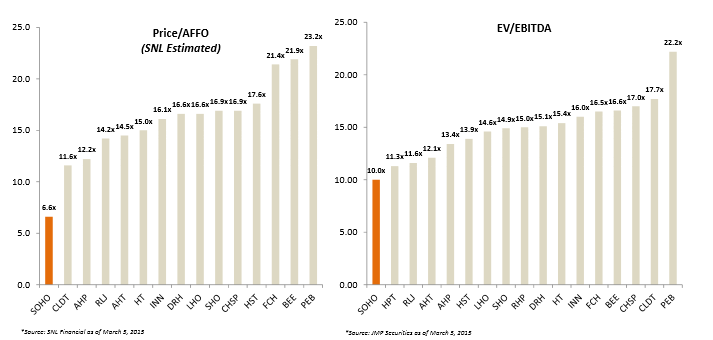
The stock trades at a significant discount to other hotel operators as the chart below illustrates.

comparison

I think that the reason the stock trades at such a discount is its size; with 10.5 million shares outstanding and another 2.55 million units, at $7.74 the market cap of Sotherly’s is only about $101 million.  Volume is typically light and so its too small and too illiquid for most institutions.  But the smallish dividend likely limits its attractiveness to the retail contingent.  It is in this no-mans land that there is the opportunity.

The company’s stable of hotels is situated across the south east United States:

hotels

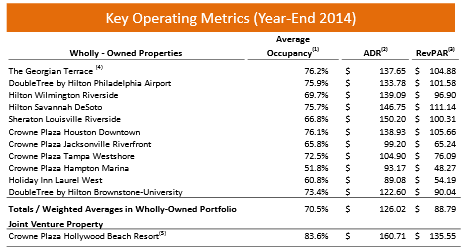
In total these hotels have a total of 3,009 rooms.  Looking at this on a standard EV/room basis, rooms are priced at $112,662 per room, which isn’t particularly cheap.  However this is mitigated by fact that these are mostly high-end hotels – ADR and RevPAR are quite high:

hotels2

On an EV/EBITDA the stock trades at 11.7x and on FFO basis they trade at 5.7x.  The company guided AFFO for 2015 of $1.24 per share and on the conference call when confronted with some discrepancy in the high and low estimates for their AFFO guidance they were forced to admit that they were being conservative on the high end.  Again turning the the company presentation, they put the “inherent value of assets” at over $17 per share:

NAV

On the last conference call management was adament that they would not issue equity at these prices and that they would need to see at least $10 before reconsidering that position.  While they have some exposure to Texas, thus far occupancy does not seem too impacted by oil and many of their larger corporate customers are not oil related.  I’m not sure what else to write about this one.  Its a solid hotel operator trading at a discount to peers for not a very good reason.  As long as the economy  remains sound I think the stock slowly walks up to the double digits over the rest of the year.

Impac Mortgage

I’ve gotten a bunch of questions in emails about Impac Mortgage.  So yes, I have bought back Impac, I took a tiny position around $9 and added to it at $11.  But its a small position and I haven’t talked about it on the blog or on twitter. The reason?  I really don’t know how this plays out, so my thesis is pretty weak.

The company is doing some interesting things.  They have a deal with Macqaurie for the purchase of their non-QM originations and they bought out a fairly large online origination business called CashCall.  So they are doing something, and the share price is reacting.  Still, I find it hard to quantify what it all means for the fair value of the stock. So I really dont know what I’m buying.

If you look at the recent financials and they aren’t great, so the bet I’m making here is kind of a bet that Impac is going to use these pieces and become a big non-compliant originator but while that qualitatively seems like a sound thesis, I don’t really know what numbers they will be able to churn out. To put it another way I probably wouldn’t have bought the stock if I didn’t have a history of it and some comfort that Tomkinson seems pretty experienced and can put something together.  So I own the stock but probably won’t talk about it any more unless something happens to clarify the situation.

What I sold

Midway Gold

My Midway Gold sale wasn’t quite as bad as it looks.  I forgot to sell my holdings in the practice portfolio account and  by the time I realized this the stock had tanked to under 30 cents.  So my sale looks particularly ill timed.

Nevertheless I sold Midway at a loss after the company announced delays with Pan, a potential cash shortfall and some early problems with grade.  The company realized news in its March update that one of the water wells malfunctioned so it has taken them longer to fill up the tailings pond and that Pan would not see the first gold pour until the end of the month, delayed from early March estimates.  Worryingly the company had drawn $47.5 million of its $53 million lending facility and was under negotiations with its lenders to fund working capital requirements.  To make matters worse early results showed some grade discrepancies with their model as grades were coming in lower.

Of all the news, it was the grade discrepancies that led me to sell.  If it hadn’t been for that I would have chalked it up to early days mining hiccups that they would eventually struggle through.  But until the grade issue is resolved you just don’t know what you are getting.  So I had to sell.

Nationstar Mortgage

As I wrote in my comment section last month, I didn’t talk about Nationstar because the stock was a trade that I didn’t expect to hold very long.  As it turned out, I held it hardly any time at all, selling the stock in the day following the posting of my last post.  Nationstar was down below $26 when I bought it and I sold it at around $30, so I made a little profit on the transaction.

I bought the stock because I thought there were some tailwinds here in Q1: the company said on their fourth quarter conference call that so far in first quarter originations were strong.  They also expected amortization to be lower in the first quarter, which will boost earnings.  Nationstar also has a reasonable non-HARP business so they don’t face quite the pressure Walter Asset Management does at that winds down and that, combined with the evolving travails at Ocwen, might bring marginal dollars into the stock from investors looking for the one remaining non-bank servicer without significant regulatory risk (or at least so it appears).   Nevertheless I figured the move from $26 to $30 was probably too far too fast so I took my quick profit.  I have been thinking about buying back in for another run now that is again languishing in the mid-$20’s.

Final Thoughts

I waited three months for it but the tanker trade is upon us.

Portfolio Composition

Click here for the last four weeks of trades.

week-197

Week 185 Just your run-of-the-mill Portfolio Update

Portfolio Performance

week-185-yoyperformance

week-185-Performance

See the end of the post for the current make up of my portfolio and the last four weeks of trades

I don’t have any general comments to make so I am going to get right into my portfolio updates for the last month.

The Tanker trade

The biggest moves in my portfolio have tended to take place in the first couple months of the year .  In 2013 it was YRC Worldwide.  In 2014 it was Pacific Ethanol.  I’m hoping that this year its the tanker stocks.

Of course the tanker stocks have already had significant moves.  I have been adding positions at prices that are much higher than they were a couple of months ago.  But to use Pacific Ethanol as an analogy, the move from $2 to $4 was only the first act.  I’m not sure if these stocks will put on the show that Pacific Ethanol did, but I am hopeful there is  a second act in the cards. Read more