Skip to content

Posts from the ‘Silicom (SILC)’ Category

Adding Silicom after the Collapse

What a terrible piece of news.

Silicom ran up to almost $80 on expectations of a major cloud player using their 100G switch fabric NIC card in their next-gen cloud architecture.  The run rate on the contract was supposed to exceed $75 million in 2019.

Silicom had about $125 million of revenue in 2017 so clearly the deal was a game-changer.  When the company announced last week that the customer was pulling the pin on the product, the stock tumbled.

It actually tumbled for some time before the announcement, which is pretty sketchy.  Clearly someone knew something.

Others might steer clear of a stock that behaved like that.  But I’m willing to take a chance.

I found it hard to come up with what the numbers will look like without the cloud deal because Silicom has been tight-lipped about it on the calls.  Needham seems to think that Silicom has recognized $30 million of revenue from the cloud customer so far, though I’m not sure if they are including the first quarter in that estimate.

My best guess is that the run rate ex-cloud deal is around $100 million.  The stock has about a $240 million enterprise value at the current level.  So its at 2.5x revenue.  Maybe trading at a 10x EBITDA multiple, maybe a little less?

I’m okay with those multiples because there’s still is a lot of room for growth.  The company put out a press release later in the week where they outlined that they were “close to several major, strategic new SD-WAN and NFV-related vCPE Design Wins from major telcos”.  They expected the first to materialize in the “near term. ”

They said that each potential win would ramp to $10 million plus revenue run rate.

In the same press release they announced a dividend cut, saying they would need cash to ramp these customers.

A cynical take is that the press release was manufactured to justify the dividend cut.  After all it’s possible that Silicom had already procured inventory from the cloud player and will now have to write it down.

That’s a possible scenario, but I’m not convinced its the right one.  For one, inventories were only $7 million higher at year end than the previous year and were actually down sequentially in the fourth quarter.   This with revenue that has ramped from $25 million a quarter to $30 million plus over the last year. There’s not a lot of evidence of an unusual inventory ramp.

Second, they have $35 million of cash on hand at the end of the year.   So you’d need a big write-down to deplete that.

Third, to think Silicom ramped inventory in the last two months on a product that they described in February as having “no general availability to customers” and that was still experiencing a “customer challenge” that kept the design from being finalized, doesn’t make a lot of sense to me.

There could be a write-down coming, but I doubt it’s too much.

My guess is it’s exactly what Silicom said in their press release: that these are big potential wins and that Silicom “must make sure that we have all the financial resources to fulfill demanding supply commitments once these potential wins reach their full deployment run rate”.

These are potential telco wins after all.  I know from my experience with Radcom just how important cash levels are to telcos looking to make large purchase orders with small suppliers.

If anything I suspect that Silicom was planning a secondary on the announcement of their first big telco win.  But the cancellation of the cloud deal and collapse of the share price makes that far less desirable.  So they are saving money where they can.

If that’s the case, then I think that when such a win is announced, the stock will move back into the $40’s.   At the current price I’m willing to take the plunge and see if that’s the case.

Q1 Earnings: Silicom

Silicom had a good quarter.  They beat on revenue (25.3 million) and they guided to a nice revenue increase in the second quarter ($28.5-$29.5 million).

As I wrote about last month, the rise in the stock price has been mostly due to the large switch fabric NIC design win that they announced in March.  On the conference call management provided more color around this win.

The win is for the design of a new, custom 100G switch fabric NIC to be deployed in datacenter racks.  The design presents a number of technical challenges and they are still working through those challenges.   So far Silicom has received an initial $25 million purchase order and a follow-on $8 million order from the customer.  The PO’s are being written even though the card is still in the beta phase and thus still under development.  The PO’s are to insure that Silicom has components on hand and can ramp production quickly to the $30 million plus run rate once a final design is approved.

Interestingly, Shaike Orbach, Silicom’s CEO, said that they were engaged with 10-15 other cloud players for similar designs.  He tempered those remarks by saying that the sales cycle was long (can take as much as two years), that some of the engagements would be for smaller wins (but some could be bigger) and that the architecture of all cloud vendors do not line up as well with Silicom’s technology as this vendor did.

At any rate though, there is a large pipeline of potential deals.  As an aside, if anyone knows who the existing win is with, please email or direct message me.

SD-WAN

There were also comments around SD-WAN.  They have a similar number of SD-WAN prospects that they are talking to (around 10).  These include traditional telecom vendors that have SD-WAN solutions, start-ups, and even service providers.  Talking directly to service providers is a new development as Silicom has traditionally worked through OEM vendor channels.

There was a bit of color around the potential of the SD-WAN opportunity.  Alex Henderson from Needham asked the following question:

If it’s the entire white label box at the edge, I would think that A, that would be a little bit lower margin but B, a lot of revenue associated with that because we’re talking about 1000s of branches and individual deployments here, that seems like a very big ramp when that starts to kick in. Am I thinking about that right? I mean it seems like a very large number?

Orbach’s response was to agree that potential quantities were “very big” and that they had some competitive advantage in that they could provide features not available from others.  I’m still quite excited about the SD-WAN opportunity.

FPGA Opportunity

One comment that came up a few times on the call was the growing importance of their FPGA solutions.  Orbach said that while the switch fabric win is not an FPGA solution, Silicom’s FPGA capabilities were instrumental in getting the win as the customer expects future generations of the product to require FPGA’s.

At the end of the call Orbach gave more color around the importance of FPGA solutions (my underline):

So first of all I would like to tell you that we think that FPGA technology and solutions around FPGA are going to be extremely, extremely important. We’re investing in that. You understand it may take some time but we believe that it will be extremely important. Just like you have said, I mean one of the reasons I mean there are two I would say trends, not trends, but two events and — well even event is not the right word but two things which are happening together which I believe are important to understand, maybe even three. So one is again the cloud, I mean the cloud, I think that cloud vendors do understand today and that’s by the way why we have been able to success even with that customer that in order for their cloud to be effective, in order to cut down their expenses they need to have several ways or to do offloading within the cloud. Our FPGAs seem to be recognized now almost by everyone as the right technology for the purpose of doing this kind of offloading. I think that although — when I’m saying cloud by the way I mean the whole package, I mean it’s cloud and NFV, SD-WAN virtualization, all that together. So when build systems using these technologies you would need to do offload, the right technology to do offload is FPGA.

Orbach also hinted at collaboration with Intel (and their Altera FPGA designs) and referred to a MOU around FPGA development that he said was important.

I did a little bit more research into FPGA development and this looks like an area that is beginning to hit its stride with more and more use cases.  FPGA designs offer more flexibility, less up front cost and are preferable to vendors that either don’t want to commit a large spend to a custom ASIC design or do not have funds to commit to such a closed end design.  It sounds like the performance gap with ASICs, which has largely been what has limited their use, has closed considerably over the last few years.

In particular I found one white-paper by Altera/Intel that was particularly insightful.  The paper describes 3 evolving use cases for FPGA’s that all seem very closely aligned with Silicom’s strengths.  They are:

  1. Datacenters
  2. 400G cards
  3. Wireless Remote Radio Units

The paper basically suggests that the requirements of the next-gen designs will fit much better with FPGA solutions than ASIC solutions.

While Orbach and the above paper suggest that big FPGA wins are still some time in the future, it really starts to clarify the runway of opportunities for Silicom for me.  I think this could be a multi-year run for the stock as the company seems very well positioned for trends to white-box hardware, offload functionality to secondary NIC cards, and utilize more FPGA based solutions.  I didn’t add to my position on the results, but if there was enough of a correction I certainly would.

Silicom Design Wins

I took a starter position in Silicom a couple months ago.  I did so because I thought their products were aligned with the software/hardware decoupling that is occurring.  But I kept my position small until I saw more results.

Those results came a couple of weeks ago when the company announced a huge design win for a 100G switch fabric network interface card (NIC):

Silicom has received initial purchase orders (POs) in the aggregate amount of $17 million to cover a small-volume Alpha phase, an intensive Beta program and the product’s first commercial deployment. Having completed deliveries for the Alpha phase, Silicom is now in the process of delivering the Beta-program products while completing two additional activities: 1) finalizing the product configuration and validating the solution’s performance within the servers in which the Silicom products will be deployed, in cooperation with a Tier-1 server manufacturer; and 2) ramping up product manufacturing to a full mass-production level. Based on the customer’s guidance, Silicom forecasts that revenues related to the design win will build to more than $30 million per year.

I added to my position after the news release.

I was surprised that the stock didn’t move more on the news.  I bought into the stock early in the day on the 21st at around $46-$47 but saw it tail back down to $45 as the day went on.  It seems to be just a slow response; on Friday the stock had butted up against the $50 mark (editors note: maybe not! It’s Wednesday now and $50 is no more!).

If Silicom achieves the $30 million run rate they expect, I think this contract has a pretty big impact on the valuation, enough that it maybe isn’t even all priced in, even after the $10 move.

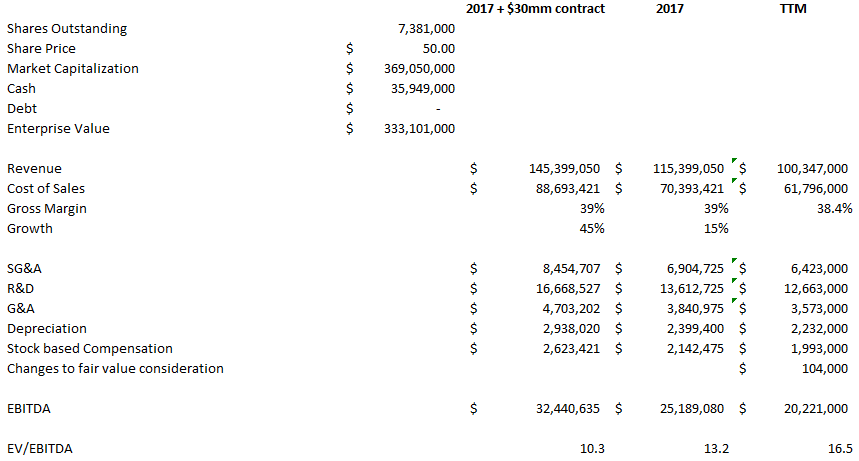
Below I’ve added the $30 million onto a 15% growth estimate (my own estimate, Silicom has said double digit growth for 2017) and assumed that expenses (R&D, G&A) grow by half as much as revenue (the company has said that their business model is levered to growth and that the “majority” of new gross margins will fall to the bottom line, so I think this is reasonable).
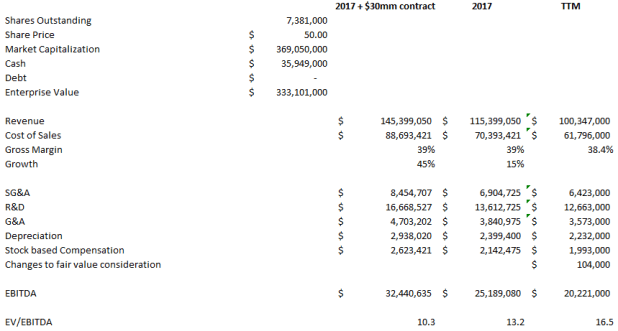
I might be too optimistic about the growth rate, maybe some of that $30 million should be part of the 15%.  Everyone can judge that for themselves.  I’ve chosen the assumption because I like the prospects.

If I’m not, at $50 the company is trading at 10x forward EBITDA.  Given 30%+ growth in 2017, it’s not an aggressive multiple for that kind of growth.

Let’s look at the products

I am hopeful that this high growth rate is sustainable.  Silicom has products aligned to a number of growing segments.  To understand my enthusiasm, let’s take a closer look at the product line.

I’m still a little foggy on terminology here so I apologize if I am classifying something wrong.  Most of what Silicom sells falls under the broad category called network interface cards (NICs).  Under that category are server adaptor cards, which is where the majority of their NICs, switches, and FPGA cards.

So what do these cards do?  They provide network connectivity and offload tasks from the CPU (buffer storage, processing packets, that sort of thing) so that the appliance they are working with can run more efficiently and focus on the dedicated tasks they are intended to do.

The cards come in a variety of flavors. There are different network speeds (1G to 100G) and different tasks they are designed to offload.  These are things like data encryption, acceleration (where a chipset on the card performs some CPU tasks at times of peak usage) , data compression, time stamping, and bypass, which recognizes failure of an appliance and reroutes data when it occurs.  There are also FPGA cards, which are programmable, and can made to handle a custom task.

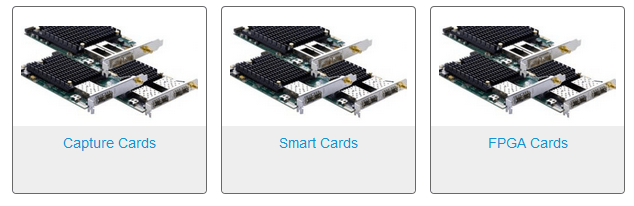
You can see the full list of flavours here.  Below I’ve taken a screen shot of the highest level breakdown of the product line, just to get a feel for what the options are and what the cards look like:
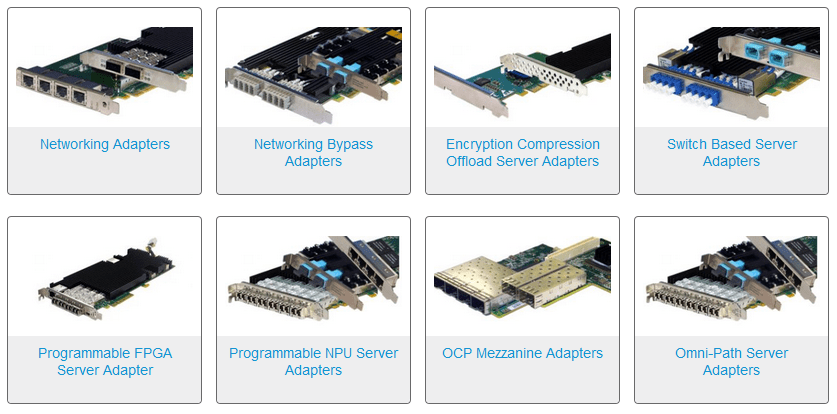
There are also higher end programmable cards using FPGA chips (field programmable gate arrays).  The FPGA cards are an “efficient way for the advanced user to achieve even lower latency and to implement any filters or acceleration that are necessary for a specific application.”  These cards are used in “networking, financial and big data solutions” applications.  The FPGA based solutions are a product line that was came with the acquisition of Fiberblaze in December 2014.
Recently Silicom has had design wins for time stamping with a Tier 1 monitoring company (which I read somewhere was likely Gigamon), for encryption cards with a former customer that they had lost 3 years ago, the aforementioned very large win for a 100Gb switch fabric NIC, and most recently for by-pass cards to be used with a cyber security appliance.

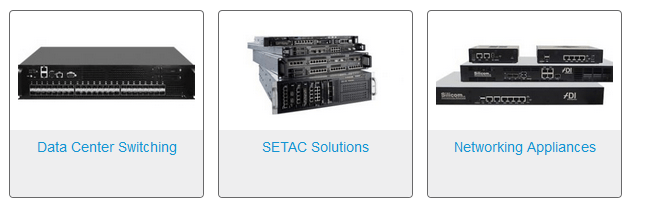
Silicom also has a number of stand-alone products.  There are switching solutions, network appliances and a product that converts off the shelf servers into appliances (SETAC).
Silicom describes their growth opportunities as being in cloud and in cyber-security.  The cyber-security opportunity is pretty straightforward; their cards piggyback off of cyber-security appliances providing a network interface and offloading CPU tasks.  The cloud is a catch-all for many different opportunities, including integration of their cards into monitoring, packet processing, and switching – pretty much anywhere where workloads can be offloaded from a CPU, thus creating efficiency.

SD-WAN Market

Also part of cloud is Silicom’s entry into the SD-WAN market.  I’m going to talk about this one in more detail because I think its potentially a big opportunity, and has the visibility to get the company noticed by analysts.  Their product is an off-the-shelf virtual CPE solution.
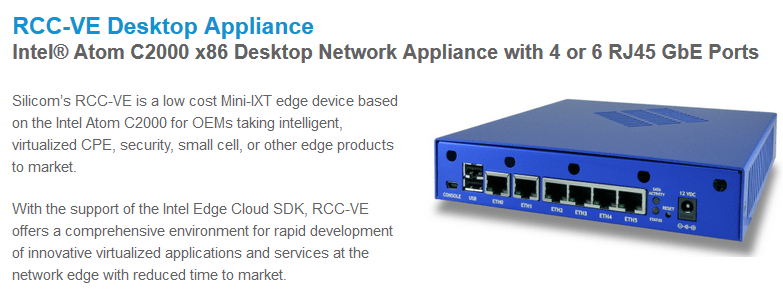
SD-WAN is one of the first applications to embrace network function virtualization, or NFV, something I ramble on about when talking about Radcom or Radisys.  SD-WAN entails the decoupling of software from hardware for routing traffic at edges of the network.  As such, traditional proprietary appliances are replaced with “software application running on inexpensive appliances to implement a flexible traffic routing solution between branch offices and the Cloud” (from this article).

Demand for SD-WAN from service providers is surging.  Silicom already has two design wins for SD-WAN appliances.  The first is with Versa Networks, where Silicom is one of three companies (along with Advantech and Lanner) providing hardware.  They announced the win in September.  A second win was for an SD-WAN customized vCPE appliance, which is expected to scale to $5 million annually, and was announced in November.  In this case the customer wasn’t announced, but my guess is its Velocloud, which seems like a likely bet to be an existing encryption card customer.

This SeekingAlpha article suggests that SD-WAN deals could be in the $10 million range, which is a lot bigger than the typical win Silicom has.

As part of the second win, Silicom said this in the press release:

“In fact, the customer’s forecast is another clear demonstration of the momentum of the SD-WAN market, as both enterprises and service providers begin adopting the new technology to enable their transition to the Cloud, NFV and the virtualized environment. We believe that our favorable positioning in this market, due both to our basis in the WAN Optimization market and the unique new technologies that we have developed, will enable us to benefit strongly from the momentum of this ‘hot’ new market space, making SD-WAN a significant new revenue driver for Silicom.”

Silicom also announced that the same customer that they had a by-pass card design win from was “considering the potential use of Silicom’s vCPE appliances as part of its Cloud offering”.

So I like the idea and hope to see more wins

Silicom’s gross margins are generally around 40%, which implies that the “moat” for their products is not very high for a technology company.  While this may be a bit concerning, what I find interesting is that they seem to be the largest non-integrated competitor in the business.   As this SeekingAlpha article points out, Silicom has nearly 200 different SKU’s whereas their nearest competitor (interface masters) has 35.  The large integrated players (Intel for example), are way bigger of course, but they also don’t offer the range of solutions that Silicom has (being constrained to their own chipsets).

I really like this idea.  I think Silicom has the right product set at the right time, ready to take advantage of the shift towards using commercial off the shelf hardware to accomplish more tasks.  I think the recent $30 million design win is not fully being priced into the stock at current levels, and yet it may only be a harbinger of what is to come.  I bought the stock in the mid-$30’s and added in the mid $40’s.  I would probably add one more time on another big win.
Week 298: Keep on Truckin

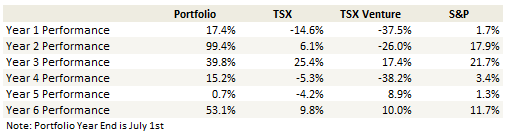
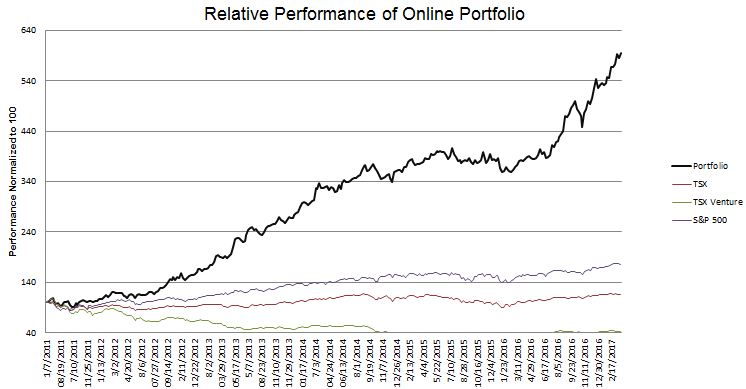
Portfolio Performance


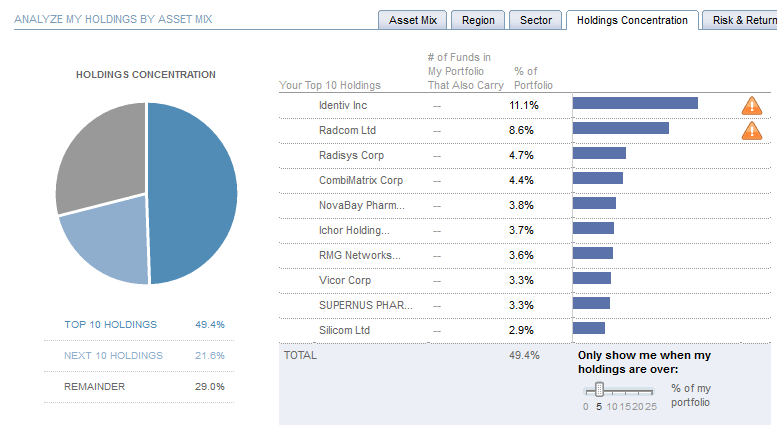
Top 10 Holdings

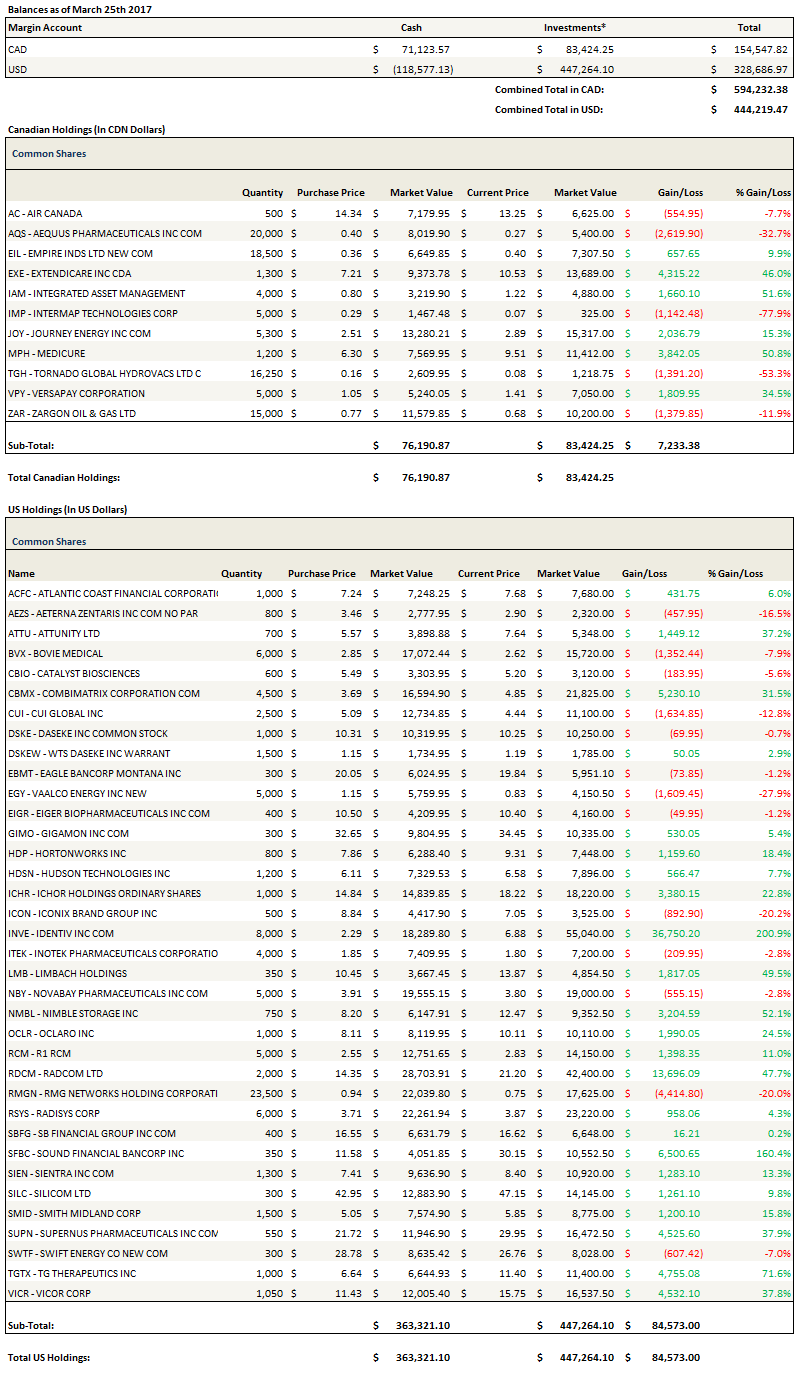
See the end of the post for my full portfolio breakdown and the last four weeks of trades

Thoughts and Review

No great insights this month.  My portfolio continues its upward climb even as the market stalls.  I continue to be buoyed by my large position in Identiv and more recently my large position in Radcom.  Combimatrix is consolidating in the $4’s but it looks healthy and I am hopeful it will break out on another leg up soon.  Silicom has helped a lot and I will talk more about that shortly, as has Supernus.  I still have a bunch of stories that I think are on the cusp and waiting for that final catalyst, Radisys, Vicor, and maybe even CUI Global, which I wrote about a little earlier this week.  Overall, no complaints.

New Position: Daseke Inc.

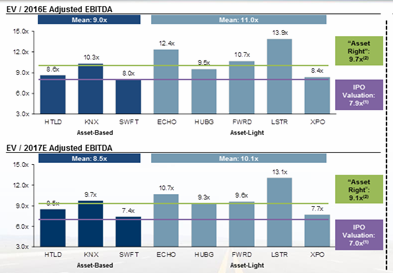
I added a new position in Daseke after reading this write-up by Dane Capital.  The story seems pretty straightforward.  Daseke is born of a special purpose acquisition company (SPAC) that acquired the previously private company, its trading cheaply relative to its peer group (see chart below from their presentation) and is in an industry that should see a tailwind as economic activity, infrastructure spending and oil and gas capex pick up.  There is not point repeating what Dane Capital already wrote so I recommend going to the article for the details.

I added both warrants and shares.  I’m not really sure whether the warrants are fundamentally overvalued or undervalued compared to the shares, I just thought they represented a good upside given that the stock is probably around two times EBITDA lower than it should be and that if it traded up to an appropriate level it would get to the high teens, which would be a triple for the warrants.

What I added to

I added to four companies over the past month.  In each case I was persuaded by an upbeat outlook about the future that was given by management on the calls.  I’ve already written my thoughts on Vicor.  Likewise I wrote up CUI Global just the other day.

I also added to Accretive Health, which has changed its name to R1 RCM.  I last talked about R1 RCM here.  Not much has changed, they are making progress on-boarding Ascension and finally moved their stock over to the NASDAQ.  I figured the NASDAQ listing would be a bit of a catalyst, so I added the day prior to that.

Finally I added to Silicom on this news.  This is just a huge contract for the company with an $17 million initial purchase order and $30 million expected annual run rate.  I read somewhere that the customer is likely with Gigamon.

I do intend to write-up Silicom, I just keep getting tied up with other stories, and I wanted to spend time understanding their whole product suite before putting any post up.  The good news is that as I have dug more, I have become even more comfortable with the company.

What I sold

On the sell side of the ledger, I already wrote about my sales of Nuvectra and Rubicon Project, and my reduced position in Bovie Medical.

In addition to these names I also sold the last of Willdan Group.  Willdan has been a great name for me.  I added the stock in the single digits, around $8, and am selling the last of my shares in the low-$30’s.  The business is still humming, and the company seems to have shifted to an acquisition strategy that so far is fueling further growth.  Yet at this price I just feel like the upside is priced in, with the stock trading at 25x the upper end of their 2017 guidance (which is $1.20 diluted EPS).

A couple late Biotech Buys

I also bought starter positions in a couple of mid-stage biotechs at the end of last week: Eiger Pharmaceuticals and Inotek Pharmaceuticals.  I got both of these names from Daniel Ward, who comes up with a lot of good ideas.  I’ll try to write up some details on both companies in the near future, but you can get a pretty good overview of the investment thesis if you listen to their recent conference presentation (Eiger at the BIO CEO and Investor conference and Inotek at the Cowen Healthcare conference).

The Catalyst Biosciences Catastrophe

Finally there is Catalyst Biosciences.  This is so painful.  So on Friday I put in a market order for Catalyst in the practice portfolio.  I always use market orders with the practice portfolio because it doesn’t always work to put in limit orders.  With limit orders sometimes you get filled, sometimes you don’t, even if the stock moves below your limit.  But because I didn’t like the bid/ask spread on Catalyst (it was something like 5.20/5.45 at the time, so really big), and because the stock bounces around a lot, in my actual account I put in a limit order at 5.10.  I liked the stock because it was at a big discount to cash, but it didn’t seem like there was any reason to chase it.

It was with great pain that I watched the open this morning.  Catalyst opened in the $9’s and proceeded to move to as high as $18.  I made a killing in my practice portfolio (its not reflected in the update because this update is for the four weeks ended last friday) but I made nada in my actual account.

I hate, hate, hate limit orders.  I rarely use them and this is a big reason why.  If you want to buy a stock, buy it.  If you want to sell it, sell it.  All the pennies I may save putting in limit orders over the next year will not amount to what I should have made on Catalyst today.  It makes me a little ill to think about it.

Portfolio Composition

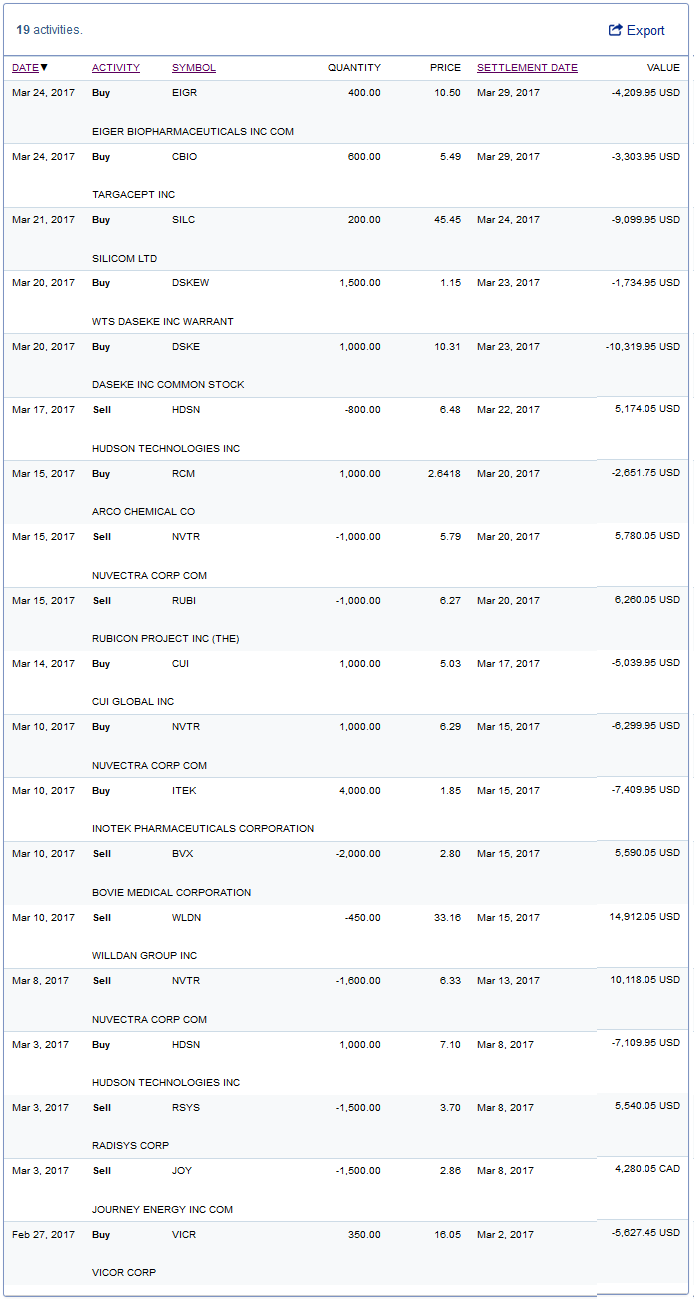
Click here for the last four weeks of trades.