Skip to content

Posts from the ‘Uncategorized’ Category

Low Tolerance

My tolerance for draw-downs has declined with age.

Ten years ago I used to say, irreverently: “you have to lose money to make money”. More often than not, I still do. It is far more common for a stock I buy to go down 20% before ever going up than for it to go straight up after I purchase it.

On individual names I have not changed – I still give lots of leeway. But when it comes to my portfolio as a whole, I do not have the patience for it.

What I deem to be an “acceptable” draw down has shrunk dramatically. 10 years ago I had no problem with a 10%+ move down. 5 years ago that had shrunk to around 5%. Now, at 2% I start getting worried.

2% is not a lot of leeway. It assuredly means that many times I am selling stocks that are simply in a lull. That I am not giving the ideas time to work out.

But investing in stocks is not the same as investing in real estate or a business. I can always buy back tomorrow.

I firmly believe that one of the biggest edges I have as a small retail investor is my ability to sell at will.

There aren’t many things a retail investor has an edge in. Research – no. Team – well (looks around the empty room) uh, no. Access to management – certainly not.

But the one thing I can do is sell. Free myself up and start over again.

Take this week for example. After mostly avoiding what has been a sort of crummy market for the last month or two – even as the indexes have gone up many (most) stocks have not – I was hit by the malaise of everything non-FANG, non-EV (of which my portfolio has neither group at the moment).

Energy got hit and while I don’t have big energy positions, I have enough. Commodities in general got hit, and Olin Corp, Westlake Chemical Corp and Chemtrade are all commodity plays. The biotech rally turned sour (again!). And then on Friday gold did what gold does and failed to hold its breakout.

Of all these names I only kept my chemical company positions and a few gold stocks. I sold all my energy positions, many of my biotech positions and some of my gold stocks.

I can always buy them back if I am wrong.

Consider Vertex , Ionis, Bristol-Myers and PTC Therapeutics. The idea was that these stocks had lagged and with drug price pressure off the table the stocks could run. And they did run – for about two weeks. Then they topped and started falling again.

I could stick with these names under the hope that this is just a retest of the lows and they are still in the early stages of a new bull market. I remain hopeful that is case.

But honestly, I have no idea. Sentiment in biotech is awful. We are in tax-loss selling season. There is no immediate catalyst for either of these stocks. And my original thesis – a run off of the drug-price news, it simply has not played out. Pivoting to anything else is thesis creep.

And with all of these stocks, I can buy them back any day I want. They are not illiquid microcaps. When biotech does have another leg of its bull market Ionis is probably going back to $60 or higher. Whether my cost basis is $31 or $35 is not a big concern.

This is the perspective I used on all these sales. I can always buy them back. I may buy them back Monday if conditions change. But let’s see how the biotechs act the next few days. While the charts of the bigger one’s like Bristol-Myers, Vertex, Ionis, PTC Therapeutics and Incyte Corp look roughed up, but some of the smaller one’s look downright awful.

With that in mind, let’s look at some charts.

I have a chart deck of about 50 biotechs I step through at least every weekend. And quite honestly, it looks like a disaster right now. Many of these charts have broken down to new lows or on the verge.

Consider Lyra, a name I have owned and written about before. I was kicking myself for selling the stock on its first pop to $7.50, after which it promptly went all the way up to $9.
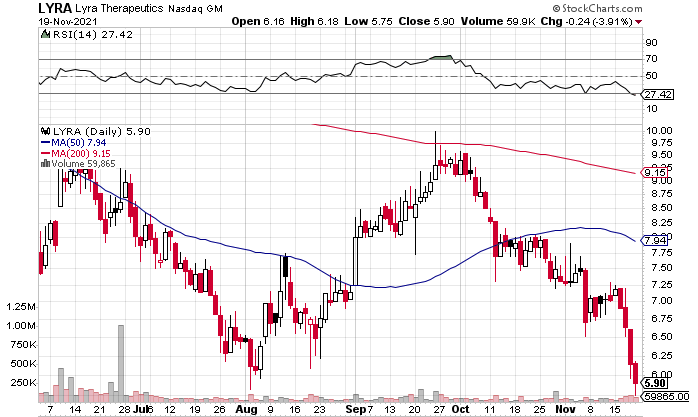
Well since that move to $9 Lyra has been a steady road down to $5.75 now. No news. Where does it end?

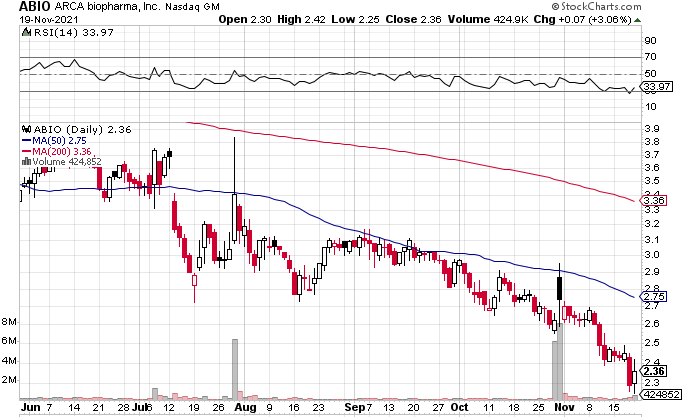
Or Arca Biopharma. This is a name I mentioned early this year. It is, admittedly, a shitco. But it is a shitco that is now trading at a -$25 million EV. That is negative twenty five. How negative can it go?
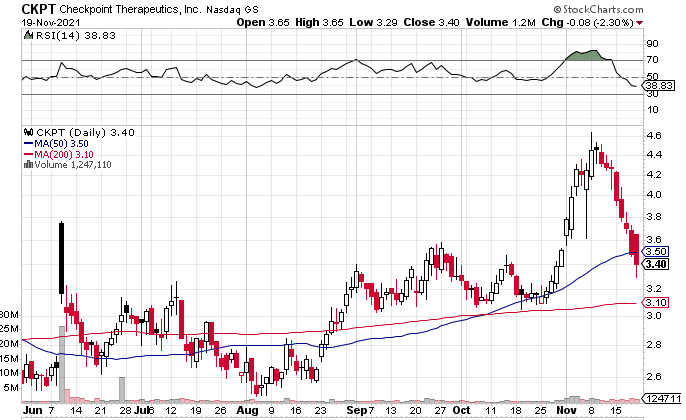
Checkpoint Therapeutics was one of the immunology stocks I bought in August. I was lucky enough to not believe the rally and sell a bunch of it above $4. The company has readouts in the next month or two that could be game-changers. But it takes a lot of courage to buy this chart.
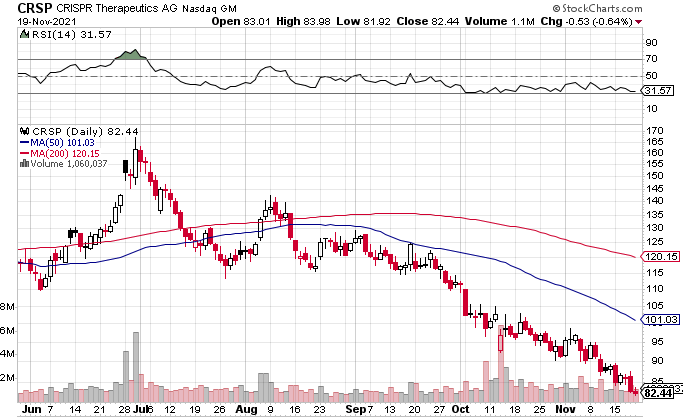
I thought genomics was the future. That might be the case but in the short-term, I was just wrong.
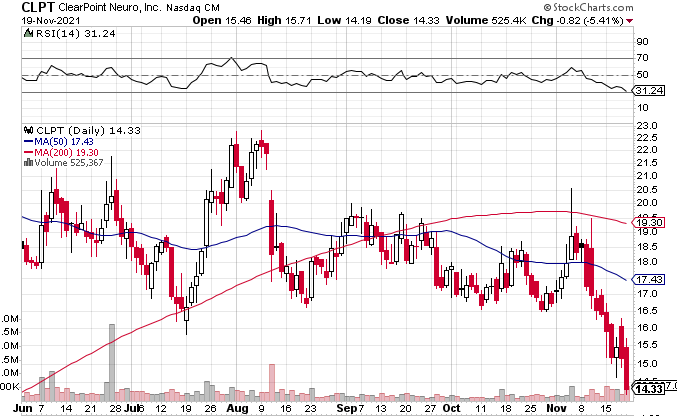
Clearpoint catches a whole lot of hell on twitter but honestly? This chart is no different than 90% of the other biotechs out there.
I could go on and on and on.

I know the biotech stocks are setting up for an incredible run at some point. But I’m not sure that comes before a good, old fashioned panic. A day where they open way down and everyone is freaking out. I want to be on the right side of that – with cash ready to buy.

So that’s where I’m at. I”ll end with the one biotech I have kept a piece of. Eiger Pharmaceuticals. I have sold some of my position, but I’ve held a good chunk of it.

Eiger is the one risk I am willing to take in biotechland right now. Eiger’s Interferon Lambda molecule is in a large COVID trial in South America, called the Together trial.

There are many signs that this drug works. It is not perfect – its not the pill that Merck and Pfizer have, but it is a single injection as opposed to a daily regime. Stocktwits actually has a very good Eiger board, complete with posters that provide the journal data on Lambda and their other molecule, lonafarnib, both of which are in trials for HDV – which is really the main story with Eiger.

Having read through all of the literature I can get my hands on, I come away thinking there is a fair chance Lambda will have good results. I don’t believe that is priced in the stock. We’ll see.
Orbit Garant – A Bear in a Bull Market

This is a very simple idea.

Orbit Garant is a micro-cap (~$38 million market cap) contract driller. Not for oil, for metals.

If you want a picks and shovels play, this is literally a picks and shovels play. When a mining company wants to drill out a deposit or explore a new area, they call on Orbit to do the drilling.

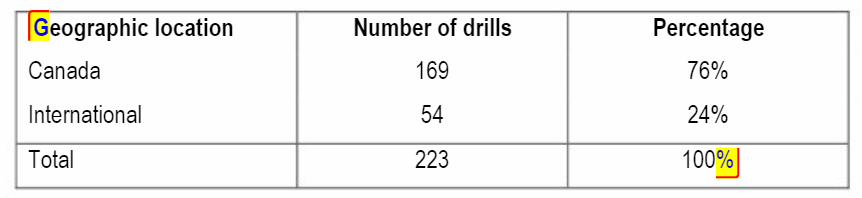
They own 231 drills, 75% of them in Canada. They operate in Canada, Africa and Chile.

Customers include (from the AIF): Glencore PLC, Agnico-Eagle Mines Limited, Newmont Goldcorp Corporation, and intermediate mining companies, including Eldorado Gold Corporation, Hecla Mining Company and Tahoe Resources Inc.

Their fortunes are driven by miners looking for: gold, base metals and iron ore.

There is a decent chance that metals are in a long-term bull market. Old arguments apply: the lack of new deposits, the need for exploration, the rise of EVs, and then on the gold side all that stuff about central banks and money printing. As Greta would say: blah, blah, blah.

Orbit Garant is the beneficiary, whichever poison you pick.

If you go read the MD&A, just about the first thing Orbit talks about is how mining finances are trending. That is because Orbit is simply a bet on the bullishness or bearishness of investors on the mining sector. The more money investors pile in, the more companies drill. The more they drill the more they need Orbit.

In the last real mining bull market, so 2011-2012, Orbit Garant was a $7 stock. Really, the company is not all that different now.

In 2012 there were 33 million shares and $26 million of long-term debt. Today there are 37 million shares and $32 million of long-term debt.

That increase in debt has been to facilitate growth. Over the last 11 years Orbit has increased the number of drills they own from 155 to 220.

If you make a spreadsheet of the financials for the last 11 years of the business, you will see that G&A expenses have been pretty flat, dilution has been minimal and debt increases have been reasonable. The company makes money when margins are good and does not when margins are bad.

In a bull market Orbit has pricing power and in a bear market it does not. In the bull market of 2011-2012 Orbit had enough pricing power to increase gross margin % to the low 20’s. In the ensuing bear market gross margins dropped to mid-single digits. This last fiscal year gross margins rose again, to 12%.

Right now, the main pressure on gross margins appears to be the large increase in work. Orbit said in the last MD&A that they are seeing a shortage of experienced drillers in Canada and are having to train them up. This is not good for margins in the short-term. But it should be “transitory”.

They are also upgrading their drill rig technology so that fewer workers are needed.

If this was a SaaS company, the market would cheer the margin compression that comes from growth. With a drilling contractor, the market sells the stock off even as revenues increase from $20 million to $50 million year-over-year because margins are still weak.

I said this was a simple story and here is the reveal. In 2011 and 2012 Orbit did $25-$30 million of EBITDA. Right now the stock trades at a market cap of $38 million and an EV of $67 million.

The trend back towards that level of EBITDA is already well on its way. In fact, the top-line is already there. Orbit did more revenue in its last fiscal year (ending June) than it did in 2012 (because they have more drills). They just don’t have the margins yet (gross margins were 12% versus 22%).

FCF is also already strong. Ignoring working capital changes the company did $12+ million of cash flow this last year and generated $6 million of free cash. Their free-cash margin this last year (ex-working capital changes) was actually about the same as it was in 2011-2012 (though at that time they were adding to their fleet so capex was much higher).

I bought Orbit too soon. I started a position at $1.20. This is one of those cases where I broke my rules and added to a losing position at $1.

With these dinky little Canadian venture stocks you kind of have to add on weakness. The stocks go down not because anything is wrong but because nobody cares. It has nothing to do with the business. Look at Apollo. I had that stock in my portfolio for almost a year now and all it did was go down. I should have added to it.

Unlike Apollo, Orbit has improving fundamentals, which makes it easier to add to. It also has zero liquidity, which means you can’t make a position too big no matter how much you like it.

Nevertheless, at a buck it seems worth breaking a rule or two.

PS: Just some general thoughts:

The biotechs have worked and the gold stocks seem to be working so far (though who really knows)… I’ve kept most of my index short positions through this melt-up, which certainly hasn’t helped my performance… I did cut loose some of the single name shorts, mostly before they reported earnings, and surprisingly, even into a melt-up this has turned out to be a mistake more times than not. Even as the market has gone up many single names that I was short but covered have been trashed. Which is interesting if not unfortunate… Last week I started to scale back longs: I sold CENX (which has not worked), GRIN (which has not worked this time around), CLBT (which I only held a couple days), and cut a couple of my spec bio’s in half after a nice move: EIGR and SGMO… My overall thought for the coming week is to scale back more so that I don’t get smoked on a drop from this crazy run-up… Wondering if I should be cutting these bank stocks a bit – CUBI, BSVN, TBBK but I like holding bank stocks for the long run… I bought two new positions: SBEA and SID but I’m not going to write about either unless I’m sure I will keep them and I’m just not sure yet.

Drug Price Reform is Off the Table

On Thursday morning before the market opened I saw this tweet come out from one of the biotech folks that I follow.

This was followed up by at least one analyst turning more constructive on biotechs:

One of the stories I remember from Reminiscences of a Stock Operator (the book) is that when the San Francisco earthquake hit, the market took a while to react because it was in a bull market.

Momentum is a strong force and the example here was that even the obvious devastation of an earthquake could not immediately topple the market.

Well, biotech stocks are in anything but a bull market. And momentum cuts both ways. The news came out and the market yawned. On Thursday you could have picked up many names at discounts to where their share price was just a few days before.

Nevertheless, in my opinion, this is very big news. My running thesis has been that the underlying “ask” behind the last 6 months of misery in biotech-land has been the specter of higher drug prices.

This article, written about a month and a half ago, put it starkly. It says that “Merck would cut its R&D efforts by nearly 50%” under the drug price reform proposal at the time.

If these sort of cuts came to pass, it would have had huge ramifications for all biotechs. Mergers and acquisitions would dry up. Money flow into the sector would slow. It is no wonder that biotechs have been down in the dumps.

So again, I think that this news, if it holds and isn’t more political gerrymandering, should be the bottom.

I bought biotechs on the news. But even I was not immune to the momentum. I bought some at the open, but not too much – just in case. Which really means, just in case biotechs keep on being biotechs.

The stocks I bought were not the same clinical stage spec companies that I’ve been playing with for the last year or so. This time I bought companies with approved drugs that generate revenue and cash.

A lot of these companies have been beaten up to 52-week lows. Even as the market has soared higher, they have not. Three of the four below are at a level that is roughly the same as their level at the height of the covid panic.

  • I added one of the behemoths, Bristol-Myers Squibb (I came a hair away and should have added Abbvie though). BMY is a $130 billion company and trades at 7x next years earnings.
  • I added Incyte Corp. They are a $14.8 billion company with $2 billion of cash and close to $3 billion of revenue. They are expected to grow 20% next year (they have grown at a ~20% CAGR the last 5 years) and trade at 10x next years EV/EBITDA.
  • I added Vertex Pharmaceuticals, of which I am reading the book The Million Dollar Molecule right now. They are the leaders in cystic fibrosis, have a $48 billion market cap with $6 billion of cash, trade at 9.5x EV/EBITDA and are expected to grow 11% next year.
  • I added PTC Therapeutics, which reported earnings just yesterday, beat revenue estimates and raised guidance, trades at ~6x sales (this is the only one of the list that is not profitable yet) and is expected to grow 35% next year.

If there are other cheap names with decent prospects, please email me!

In addition to these I already hold a bunch of clinical stage biotechs that I have held for some time.

I am fairly heavily biotech weighted. Which makes sense. It truly has been the pain-trade and I seem to gravitate to those.

We will see what next week brings. While it was a slow start on Thursday – I did notice that by end of day Friday they were beginning to pick up steam.

Markets react slowly when an earthquake makes them change direction.

—–

PS: In one other bit of news that is worth mentioning but not a whole post, Vidler Water, which I wrote about back and June and have been quietly sitting on, announced the sale of some credits this week.

While this sale is not a sure thing yet (it is a small amount up front with the option for a larger amount to be purchased before year-end), it could be very important to the Vidler thesis.

My only real worry about Vidler, and the reason I kept my position not super big, was that they had a lot of water credits in the Harquahala Valley, Arizona. My concern was that I read something and talked to someone else who questioned whether those credits were really worth what Vidler was saying at the time (they said a little under $400/acre-ft).

Well this deal is pricing one batch of those credits at $400 and another at $450. So if a material amount of credits sells in this deal, it vindicates the pricing. Which alleviates my concern. So I did what I had to do when something like this happens. I doubled down on my position.

Alchemy

Because I am trying to be a bit cautious about what is going on with China and energy, I have limited myself from taking too many new positions. I only want to add stocks that are unconnected, or better yet positively correlated, to it.

My two main areas of addition the last few weeks have been gold stocks and a basket of chemical manufacturers.

Gold Stocks

While I have no idea what gold is going to do, I do know that when gold miner sentiment gets very bad, the miners tend to rally. Even if it turns out to be short-lived, it is good for a trade.

Image

Meanwhile when I look at the gold miners, they appear to me to be one of the cheapest sectors of the market.

While I’ve taken positions in Torex Gold, Jaguar Mining, Superior Gold, Wesdome (again) and Fiore Gold, I want to take another name, Argonaut Gold, as our example.

I pick Argonaut because of their milk-toast factor. There is not a more bland miner out there. Argonaut has some very boring, very low grade assets in Mexico and they are now building a large, low grade, high capex mine that is having cost over-runs in Canada.

But here’s the thing. Even Argonaut has been able to generate loads of cash of late. About $100 million of free cash flow (ex-development of the new mine) over the last 12 months.

The stock trades at ~5.5x free cash flow (ex-mine development). The mine they are building (Magino) will increase production by about 50% and lower costs for the corporate whole by 2023.

Now I have not bought Argonaut. I am a little worried about cost over-runs at Magino. They need many of the same inputs that appear to me to be in short supply. Costs are already over their 15% buffer.

But it illustrates the value. If gold doesn’t collapse (which it might, I mean who really knows) these miners appear extremely cheap and unloved.

Chemicals Trade

This is a basket trade for now, until I have fully researched these names and have a better sense of the biggest beneficiary. I added back a name that I owned a few months ago – Chemtrade Logistics. I have also added Olin Corp and Westlake Chemical. I might add Methanex.

While we are inundated with commentary telling us the worst of supply chain issues are behind us, I am less sure that these forecasts will turn out to be correct across the board.

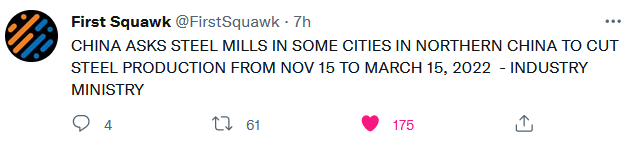
Take for instance this news that came out of China a few hours ago.

Steel production had been curtailed through September. Production was supposed to come back beginning in October. Now they are asking for at least some production to be cut through March. This strikes me as odd if you believe the energy crisis will be over in a month.

This is good news for steel producers. If I wasn’t already nervously long Stelco and Algoma I would consider buying some steel stocks right now.

Steel and aluminum seem likely beneficiaries of China electricity cuts. But there are also some chemicals that require a lot of electricity to make. For example, note the process to make chlorine:

There are three key ingredients to make elemental chlorine; salt, electricity and water. From these three ingredients, we get elemental chlorine (Cl2), caustic (often sodium hydroxide or NaOH) and hydrogen (H2). As these three products are highly reactive, technologies have been developed to keep them apart.

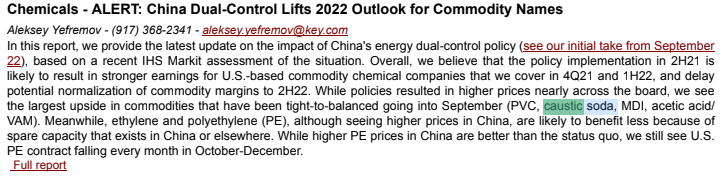
Electricity is central to the process. Not surprisingly, Chinese production of caustic soda is being curtailed.

Current tight supply conditions in Asia’s liquid caustic soda may continue in the near term, as recent curtailed output in China has had ripple effects across the wider regional market.

The article goes on to say that the curtailments will continue until December at least.

Due to China’s dual control policy as well as a shortage of national energy reserves, market participants expect curbs on output to remain in place as the country heads into the winter season in December.

And remember, it is not just China. Europe is having the same problems with energy. Caustic soda prices there are going up as well.

Producers had for the most part targeted double- to triple-digit increases for Q4 compared to Q3, reflecting tight availability in the European market combined with strong global demand for caustic soda. However, in the face of large energy cost increases in September caustic soda producers have independently raised their price targets for the quarter.

KEM ONE announced an increase of 200/dmt beginning from 1 October due to erosion of margins caused by high electricity costs, according to an email to customers on 23 September.

Other producers have raised their targets from between + 100-125/dmt at the beginning of discussions to + 140-170/dmt as of the second week of October, according to sources.

The following was from KeyBank last week:

If you take a look at producers like Westlake, they should reap a windfall – at least for a while.

Westlake’s trailing 12-month FCF is $1.44 billion. The stock has an EV of $14 billion here. So 10x FCF. But that FCF is heavily weighted to the most recent quarter. They did $653 million of FCF last quarter.

Annualized that would be $2.6 billion and we are at 5x FCF. And prices are still rising, so that FCF could look even better in Q4.

Of course, these are stocks to not overstay your welcome on. If you look at Westlake, over the last 5 years FCF has averaged about $800 million. So they trade at 17x FCF on that average. Which still isn’t crazy – especially in this market.

But much like the shipping stocks there will be a windfall and then supply will come back. And the stock prices will probably fall when that happens.

I’m just not sure when that will be. It could be soon – I mean this blog thinks Europe is in the catbird seat being short natgas right now. So what do I know? If this comes to pass I am going to have to scramble out of these positions sooner than later.

But just case everyone is wrong about everyone being wrong, they seem like a nice hedge on a more troublesome scenario playing out.