Skip to content

Posts from the ‘Uncategorized’ Category

Mostly Out of the Market for Now

Having so much uncertainty about the coronavirus in combination with a market that is at all-time highs, I made the decision Wednesday to get (mostly) out for now.  Over the last 2 days I sold down nearly all my positions.  I’ll wait this one out until I feel a bit more clear about where things are headed.

I don’t have a clue whether the coronavirus scare is over or whether it is only in a lull brought on by the strict measures being enforced in China.  It seems to me that if 10+ cities are shutdown, we should expect to see the number of cases slow.  It is also possible that the number of cases have simply stopped being reported.  From what I have read of flu’s, they don’t really just disappear so it seems at least possible that this is not one and done.

But I’m also being influenced by the market.  When the market was down 70 points on Friday I was buying a few stocks, but after the move this week, in the wake of what I don’t really see as a resolved situation, it just doesn’t make sense to me.  Yes, I know – stimulus.  Whatevs.

As I’ve said on a few occasions, because I don’t run money for anyone, and therefore have no investors to answer to and no shareholder letter to write with returns to justify, I just have no reason to take risk when I don’t feel comfortable doing so.  The market is at an all-time high.  The risks seem to be plenty.  So I’ll just wait this out for a month or so and see what happens.  If I miss a 5% move, big deal.  I would think that most of the euphoria of a virus-nonevent has been already priced in over the last 4 days (but who really knows).

I still have a smaller position in Smith-Micro, a smaller position in Sonoma Pharmaceuticals, my position in Nuvectra and Schmitt Industries (which announce a voluntarily delisting – I mean come on!) and a couple other tiny 1% positions.  I have two new positions that I have kept for now, Rada and Sharps Compliance, neither of which is particularly tied to this virus and Sharps should be positively correlated to it.  I also continue to own my gold stocks and I did add a bit to Wesdome this week when it got into the low $8’s.

My positions remain hedged with index shorts.  Though not in the practice portfolio where I cannot short, in my actual portfolio I’m still short some shale names, a couple of airlines and a couple cannabis names.  All very small as I really hate losing anything material on shorts.


Week 432: Coal for Christmas!

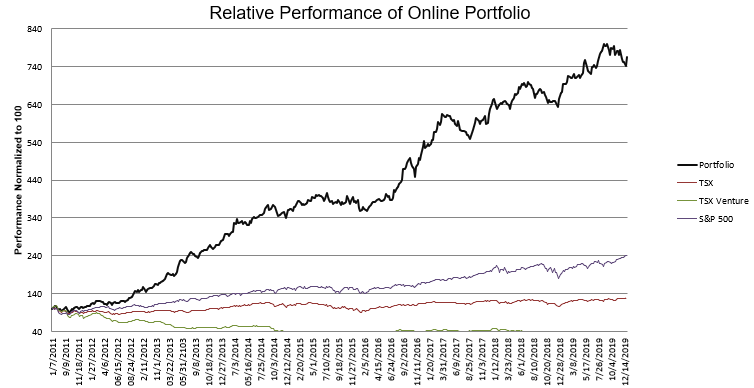
Portfolio Performance

Thoughts and Review

I have been wrong about the market.  My cautious approach has turned out to be unjustified and the market has soared to new highs.

As a consequence, my S&P and Russell shorts have performed poorly.  That has been a headwind.  But quite honestly, it hasn’t been the problem with my portfolio.

Instead, as I wrote about in my last post, the problem with my portfolio has been bad stock picking.  I’ve been smacked with 3 events, each of which whacked my portfolio and pulled it back a step.

First Nuvectra.  Then Evolent.  Then Mission Ready Solutions.  Three events that led to under-performance in November and December.

I’ve had dry spells before, and I can only hope that the worst of this one has passed.  This last week has helped, and even in these last couple days I’ve popped another couple percent from end of week levels.   So maybe the worst has passed.  I can hope!

On the topic of hedges, though the market is clearly in a bull run I have decided to keep them.  I’ll sleep better knowing that I have some protection to the downside.

This move in the market seems to be all about multiple expansion.  The S&P is at 20x this year’s earnings.  Earnings growth from 2018 to 2019 was minimal – Bank of America-Merrill Lynch has 2018 S&P earnings at 161 and the 2019 S&P earnings consensus at only 163.   That means that growth this year was basically nada.

While next years earnings are forecast to have a big jump (to 173), the trend has been for those estimates to come down so I would take the numbers with a grain of salt.

It is just not an environment where I want to go out on the limb.  So I will hold onto my hedges and hope that my stock picking (and luck!) improves.

Evolent Health

After having played out contrary to my expectations early in December, Evolent has since worked out much more favorably – events have been back inline with my original expectations.

The whole process has been a gong show.   I don’t like gong shows – they cost me profits as I get whipsawed.  That happened here as I did sell the stock after the original decision by former Governor Bevins to not include Passport Health Plan in the new Medicaid awards.   Then I bought back my stock somewhat higher after realizing that Bevins may be overturned and this was unlikely the end of the saga.

Newly elected Governor Beshear came into office December 10th.  Six days later he pulled the plug on Bevins plan to overhaul Kentucky Medicaid.

The Bevins contracts were awarded on the basis of the Bevins overhaul.  Not surprisingly, Beshear followed up with an announcement on the 23rd of December that he would cancel the managed care contracts that Bevins had awarded.

Honestly, if I had a bit more confidence, I would have gone all in on Evolent in anticipation.  With the Bevins overhaul scrapped, Beshear had plenty of reason (and cover) to re-award the contracts.

I think it is likely, but not a certainty (after this last debacle I cannot use the word certainty!), that Passport gets awarded the new contract when it is announced some time this spring.

Beshear has been pro-Passport so far.  He was the one that approved the Evolent take-over in the first place.  I go back to his comments pre-election about wanting to get Passport’s new health campus built.  There was also another community voice that was recently speaking in favor of Passport, Steve Trager, president & CEO of Republic Bank & Trust Company.

There is still lots of reason to be skeptical Evolent.  They are only borderline cash flow positive and their position as a service provider to smaller health plan entities like Passport means there is the risk that in the long run these smaller players will be un-competitive with their larger competition.  The Passport exclusion was seen by at least one brokerage as evidence of that.  In my opinion it is all politics.  But with the politics now working as a tailwind, I am inclined to stick with Evolent for now.

Nuvectra

Nuvectra is also playing out in a way that I would interpret as positively, though you would not know it from the stock price.

I’m probably missing something.   There is probably some “gotcha” in the bankruptcy process that I simply am not discounting.   If so, it will be a learning experience.  If I’m not, it would seem that the probabilities are that Nuvectra’s net assets, on liquidation, should exceed its debt by more than $2 million (which is what the equity is currently valued at).

But we’ll see.  At the very least this will be a learning experience.

The company produced their November financial statements and a schedule of assets and liabilities.  Cash levels are at the expected level.  Expenses have dropped to a trickle.  Most importantly, the amount that creditors are owned is in line with what I was expecting.

Amounts owned to secured and unsecured creditors total around $20 million.  This isn’t too far off of the value of the assets, even before considering the IP.

The definition of what is secured debt and what is unsecured debt seems to vary.  I’m not sure I understand exactly why.  I’ve seen an amount of $13.5 million, $10 million or $16 million.  That part is a little confusing but the overall amount of debt always seems to add up to around $20 million.
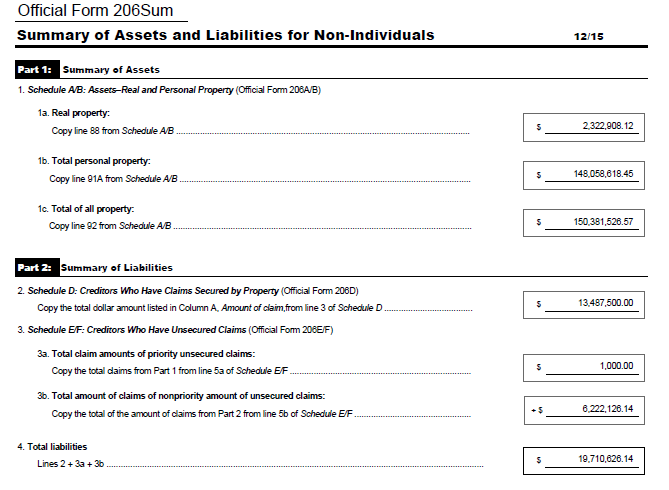
As you can see from the balance sheet, on the surface, Nuvectra’s assets far exceed the liabilities.  But this is because of net-operating losses (NOLs).

I have no answer as to whether there is a chance that these net-operating-losses have some value when the company exits bankruptcy.

I did notice that Sears struck a deal whereby their NOLs were preserved upon exit.  Maybe it is just wishful thinking to believe that the shell that exits bankruptcy might preserve at least some of them?

Anyway, that is not the bet here.  While I’m sure that in a 363 bankruptcy auction Nuvectra’s assets will fetch less than the book value, I can’t help but think that together with the Agovita and Virtis IP the overall value should be able to exceed $20 million.

In fact, in an argument filed by the unsecured creditors, the idea was pushed that assets far exceeded debt (thanks to @Fbushek for pointing out this excerpt as well as a couple of others):
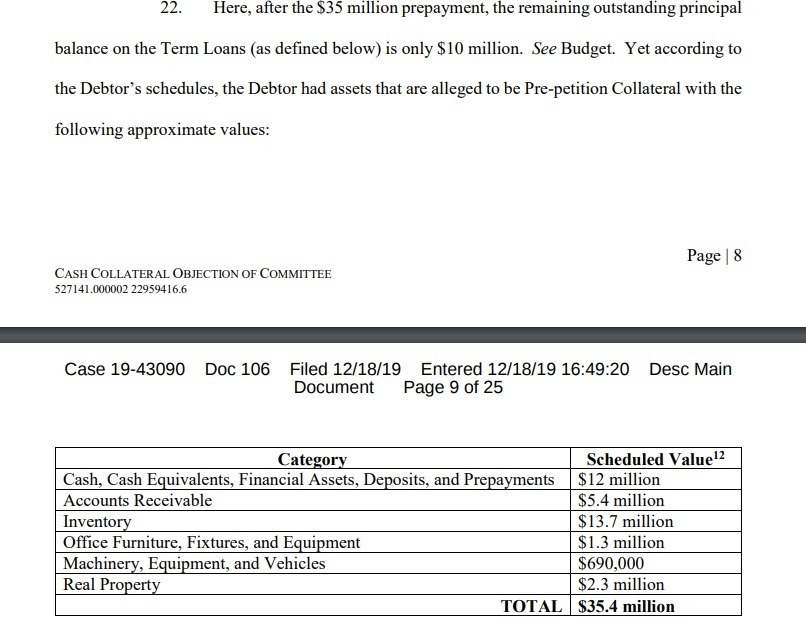
Now it must be said that the unsecured creditors were making an objection about whether the secured creditors cash collateral lien should include IP.  So they were trying to paint a rosy picture.

Another consideration is that a lot of the “value” is inventory.  I’m not sure what value that inventory is going to have in the 363 sale – though if the sale is what I expect – that of the Algovita product line in concert with a restructuring of the Integer manufacturing contract – meaning the product supply chain is intact, then it might be worth quite a bit.

The final consideration is that, of course, these numbers assign nothing to Algovita and Virtis, which are the primary assets of the company.

With the stock pricing in so little at this level it seems like a reasonable risk for the potential reward.  I only wish I had been more patient and bought my shares here rather than up when the stock was 20c to 25c.

One other interesting point is that Nuvectra came out with their list of executory contracts they wanted to reject.   Integer/Greatbatch wasn’t among them.  Also, in a separate document intended to list the contracts to be retained, there was no mention of Integer/Greatbatch either.

My guess is that Nuvectra is keeping their options open for the auction.  Rather than eliminate the contract, they will leave it up to each bidder to decide if they want to carry on the relationship with Integer/Greatbatch, which I would presume would mean a negotiation of some sort of new agreement (and the proposed cure costs).

Apart from these disclosures, most of the rest of the documents (and there is a lot of them) is a lot of noise.  There has been back and forth between the secured and unsecured creditors arguing whether IP should be part of the secured creditors claims, back and forth about conflicts of the law firms hired to represent the parties involved, and amendments to this or that document.

The only other point worth mentioning is something called “avoidance actions” and what that might mean.  I’m still fuzzy on how this might work but it appears that avoidance actions could clawback some of the dollars paid in this contract.  For example, the unsecured creditors make the following point:
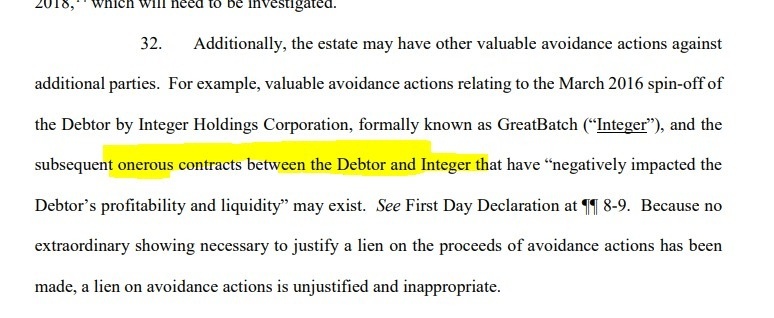
Just by the fact that the assets are in bankruptcy, this contract no longer is a lead weight on the Algovita asset.  As a consequence, Algovita may be worth more in bankruptcy than it was pre-bankruptcy.

The point the unsecured creditors are making is that this additional “value” that occurred due to the avoidance of the contract with Greatbatch/Integer should not necessarily be the first lien of the secured creditors.  Because that value didn’t exist when these creditors signed their debt agreement with Nuvectra.

I’m not sure how meaningful the discussion is for an equity holder.  At the end of the day either everyone gets paid and there is something left over for equity, or not.   So how the assets are allocated between secured and unsecured creditors is an interesting intellectual exercise but maybe not so relevant to the investment case.

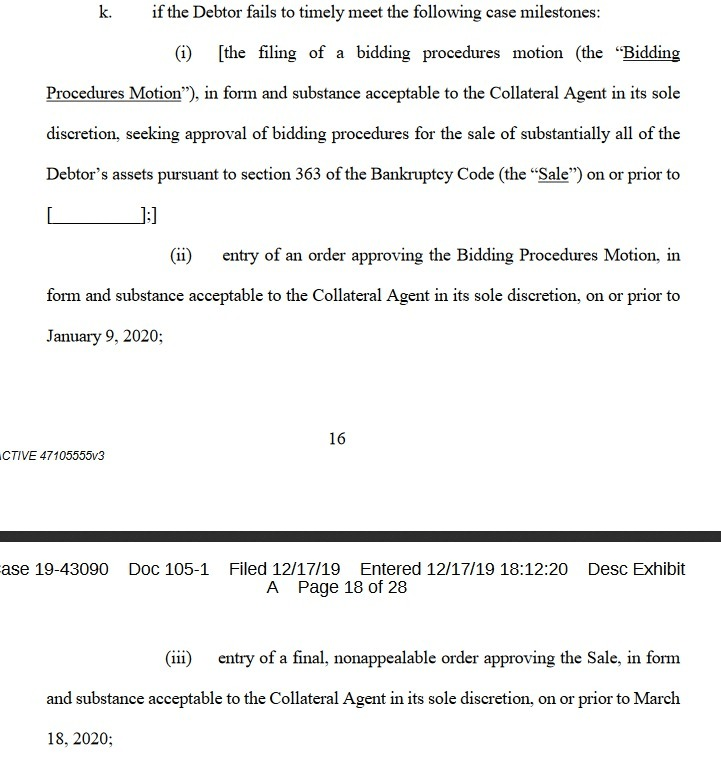
The one other thing relevant thing that has been settled is the schedule.  It looks like the process will take place quickly.  The plan is to have bidding procedures approved by January 9th.   The auction should be complete by March 18th:
Finally, after market close on the 31st, Nuvectra released news (and they do not release much news these days) that Algovita had received full-body magnetic resonance (MR)-conditional approval from the FDA.  I’ll need to dig into this a bit more to quantify just how important this is (this is a good paper describing that ~80% of SCS patients will require MRI’s within 5 years, so the approval addresses a significant untapped population), but it is reasonably important, as it means that Algovita can be applied to a wider range of pain issues and therefore the asset is presumably worth more to a buyer today than it was last year.

Gold and Oil Stocks

Gold stocks are making a move.  I’m holding the same one’s I have been for a while and added a couple of others.  I added smaller positions in Golden Star Resources and Leagold as it became more likely that gold was finishing its consolidation.  I also bought back Wesdome (which I never should have sold).

My largest gold stock position is Gran Columbia.  It still seems to be the cheapest of the bunch if you ask me.

On the topic of oil, I added another name to my basket of Crescent Point and Whitecap this week with Gear Energy.  There is nothing fancy here.  You can go onto SeekingAlpha and read all the articles about whether or not it is undervalued or overvalued compared to peers.  I’m playing this at a dumber level – invest in relatively liquid names that aren’t likely to screw anything up and that therefore will participate if the sector move in Canadian oil stocks continues.  I’ll get “cute” with my ideas if the move looks to be sustainable, but for now, if it is, these names will move just fine.

New Positions

I took a few new positions in the last couple months that are worth mentioning.

One of them is Velan.  I started writing this up for this post but it quickly became a post in and of itself so I will be posting a write-up on the name shortly.

Two others are past names I am revisiting – Digital Turbine and Intelligent Systems (da-dum!).

The fourth is SMTC, which I bought in December.  I have been watching the company for a while and the stock briefly fell below $3, which is where I took my position.

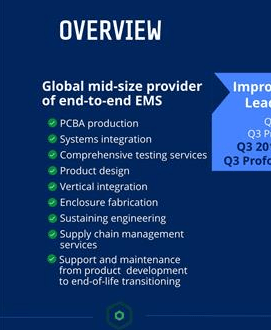
SMTC provides contract manufacturing for semi-conductors.  These are typical EMS tasks like PCB assembly, enclosure fabrication, system integration and testing.  They operate out of Mexico and the United States.
SMTC competes against companies like Keytronics, Sigmatron, Benchmark, as well as the larger, well known names like Flex, and Plexis.

SMTC made a major acquisition last November.  They acquired MC Assembly for $65 million.  The acquisition doubled the size of SMTC.  The company said they expected to realize $6 million of cost synergies once the acquisition was complete.  But honestly, I do not see those synergies in this year’s financials so far.  Costs appear to be up in the aggregate.  I’m wondering whether this is related to integration of the two companies and 2020 will show the synergies materialize.

Their business tends to be higher end, lower run rate manufacturing where quality, flexibility and a willingness to handle lower volume orders is important.

To compensate them, SMTC gets margins that are double of what tier 1 guys are getting – 12% while industry margins are in the 6-7% range.

SMTC has a large footprint in Mexico.  They had a far smaller one in China, but they exited China completely as of year-end.

The stock got hit in September after they guided down their 2019 numbers.

“In addition to the China closure, we are seeing softness in certain end-markets across semiconductor and data center expansions. Accordingly, we are updating full year 2019 revenue to range between $354 and $362 million, which excludes $16 million of revenues in 2019 attributable to SMTC’s operations in China, and Adjusted EBITDA to $25.0 and $26.0 million,” said Smith.

Admittedly, I’m not convinced about this one.  My bet here was partly on valuation and partly on a bottoming of the business.  If a trade truce does market a manufacturing bottom and 2020 is better than 2019, then SMTC looked like a cheap bet in an expensive market.

FWIW, SMTC guided to decent topline and bottom line growth in 2020:

We expect our 2020 revenue and Adjusted EBITDA, which will exclude any operations in China, to range between $390 and $410 million and $29.0 to $31.0 million, respectively

The midpoint of guidance puts the company at 5x EBITDA on next years numbers.  This compares favorably to their closest competitors but since I bought the stock I looked at larger competitors like Flex and Sanmina and they trade at similar or even lower multiples (Flex trades at 4.2x EV/EBITDA on 2019 numbers and 5.5x on 2020 estimates).
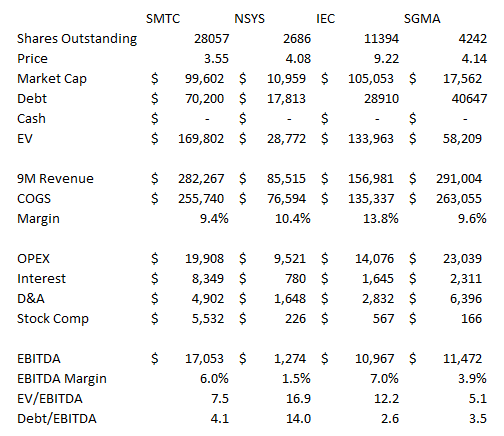
I might have been too quick to pull the trigger on this one.  It is not as cheap as I originally thought and the benefits of the acquisition have yet to materialize. Nevertheless I’m sticking with my small position for the moment.  It seems like the company should have economic tailwinds if trade is bottoming and they should be past any acquisition integration hiccups.  2020 might be a better year for the stock.

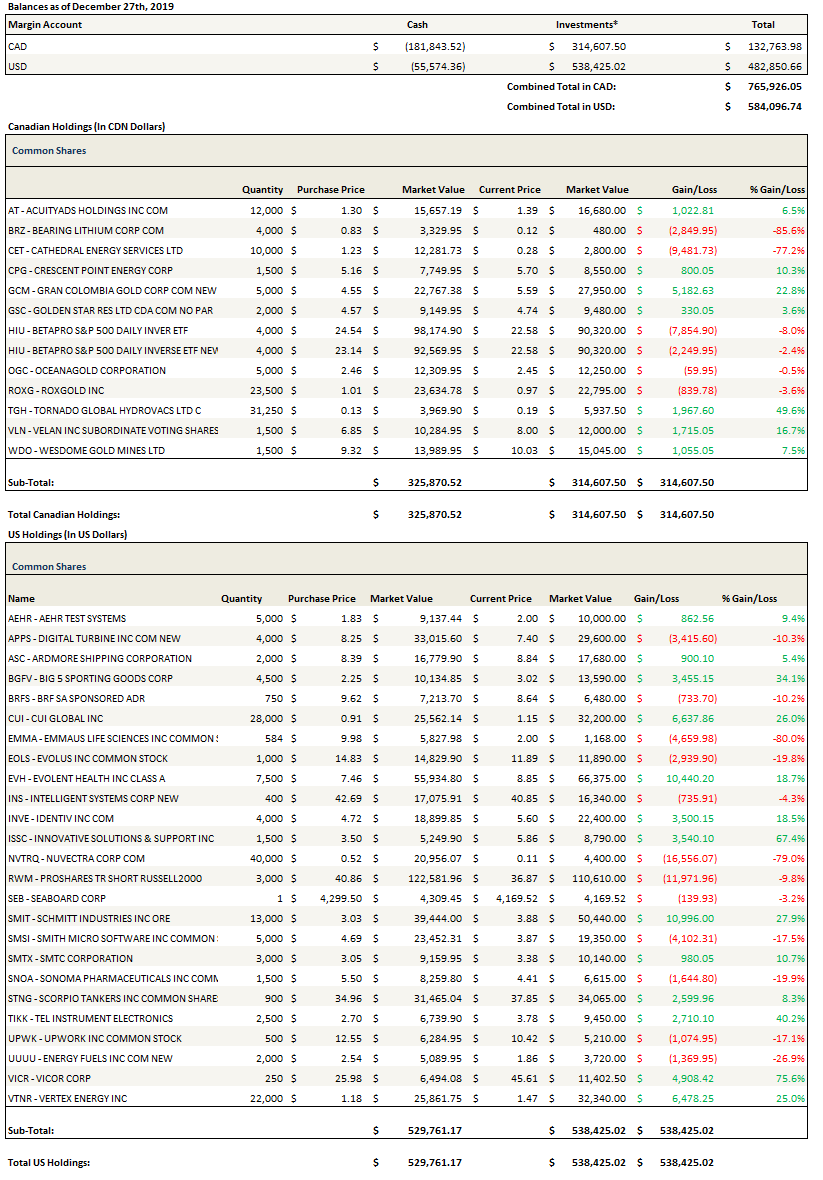
Portfolio Composition

Click here for the last ten weeks of trades.
Evolent Update

It is not a lot of fun writing updates when things aren’t going well.  So, let’s get this over with.

There have been 3 unforeseen events that have befallen my portfolio in the last month.  Hopefully the old saying holds true.

In all honesty I don’t know if I’ve had a string of luck like this before. I’ve had lots of bad calls of course, it just goes with the territory, but to have 3 event driven moves, all of which your could argue were on the low side of probabilities, in such a short time, well I think that is a new one for me.

The first event, which I have already talked about at length, is the Nuvectra bankruptcy.  I won’t discuss this one much except to say that of the three events, this was easily the most predictable.

I knew there was a chance that Nuvectra wouldn’t make it.  They were losing lots of money and they needed a buyer.  I thought that the probabilities were in my favor that they would find a buyer given all I had read about the products and potential, but it wasn’t really all that unlikely that they wouldn’t.

The other two events were less likely.  The Evolent Passport renewal and the Mission Ready TLS inclusion.

I’ll leave the Mission Ready discussion for another time.  Suffice to say that at least for now, I do not see a positive way to look at this.  Sometimes you just have to admit defeat and move on.

Evolent, on the other hand, is more nuanced.  Like Nuvectra, the negative event can be construed as an opportunity, albeit a risky one.

What happened was straightforward enough: Evolent’s subsidiary Passport Health Plan didn’t get renewed by the state of Kentucky as a Medicaid provider for the upcoming 5-year term.

Based on all the work I had done, heading into the renewal this seemed like a pretty unlikely event.  Passport had been a provider for 20+ years.  They had a reasonably good track-record with patients.  They weren’t even ranked at the bottom of the 5 existing providers (Humana was, and fwiw they were renewed, while Anthem, I better ranked plan, was not).

What’s more, since Evolent took Passport over, their financial performance had done a 180.  Passport had gone from loss-making to profit making.  Their operating margins had met Evolent’s 1-2% target as of the fourth quarter.

To think that the state of Kentucky would disrupt their Medicaid citizens by pulling the plug on Passport seemed unlikely.

Yet that is what happened.

Of course, we don’t know the reasons, but I really suspect that politics are in play here.  I also think this is the unusual case where there is a good probability that the ruling is overturned.

Consider the following

  1. The administration that made the decision (the Bevins administration) had an ongoing beef with Passport
  2. Passport actually sued the Bevins administration earlier this year before Evolent got involved
  3. The Bevins administration lost the election and is out of power on December 10th, which means they made this decision with 11 days left in their term

Now consider these comments from members of the incoming Beshear administration and other Kentucky politicians.

From this article:

“I am very hopeful that as soon as he (Beshear) takes office, he will look into this situation and try to adjust accordingly to affect the lives of the citizens of Jefferson County, because this is really a slap in the face to the citizens of Jefferson County,” said Metro Council President David James.

“Awarding $8 billion in contracts with just 11 days left in this administration is concerning,” wrote J. Michael Brown, incoming executive cabinet secretary and chair of the Beshear transition team. “As we move through the transition and ultimately the change of the administration, we will be taking a close look at this action.”

From this article:

Louisville Metro Council President David James said in a statement that Passport’s 20 years of providing health care to “people who would not otherwise be able to afford health care” is necessary for the community.

“Now at the beginning of the holiday season, Gov. Bevin has decided to take away this security for those members of Passport not only for themselves but their families,” James said. “It is a cold, callous decision done purely for political reasons.”

From this article, comments from Republican Jason Nemes, which gives a bi-partisan flavor to the pro-Passport side:

“While I have great respect for the current administration … it concerns me that 8 billion dollars in contracts were awarded in the last days of the current administration,” Nemes wrote.

“Of more concern to me is that two incumbents with a proven track record in Kentucky were ousted. Passport, in particular, has been serving the Commonwealth for 22 years. Passport supports many community agencies that help people in need and many of these individuals improve their health outcomes and quality of life because of that.”

From this article:

Beshear, who takes office on Dec. 10, said it would be “premature” to discuss his administration’s options to address the Passport situation, citing the legal formalities involved with awarding state contracts.

“There’s a lot of rules and regulations that will be in play, but my commitment is to do the right thing once we have all the information,” Beshear said in an interview with WDRB’s Lawrence Smith.

The incoming governor added that it was “concerning” that the Bevin administration decided to award “$8 billion in contracts with 11 days to go” in office.

Beshear also said he is “committed” to getting Passport’s stalled construction project for a headquarters building in west Louisville back on track, “whether it is through this project or another.”

“That building symbolizes so much hope, but we can’t let it become false hope,” Beshear said. “… It is time to bring real jobs and real economic progress to west Louisville.”

What is particularly interesting about the last quote is that Beshear won’t say what he is going to do with Passport because of “legal formalities” but he’s committed to getting Passport’s headquarters built?

There is a lot I don’t know here but I’ll tell you one thing I know for sure – if Passport doesn’t get renewed that headquarters doesn’t get built – because Passport isn’t going to exist.

What’s more, Evolent reiterated on their post-announcement conference call that if Passport doesn’t get renewed, the wind down that would occur in the second half of the year would return cash to Evolent that would pay off their investment.  So, its not a total disaster for the company.

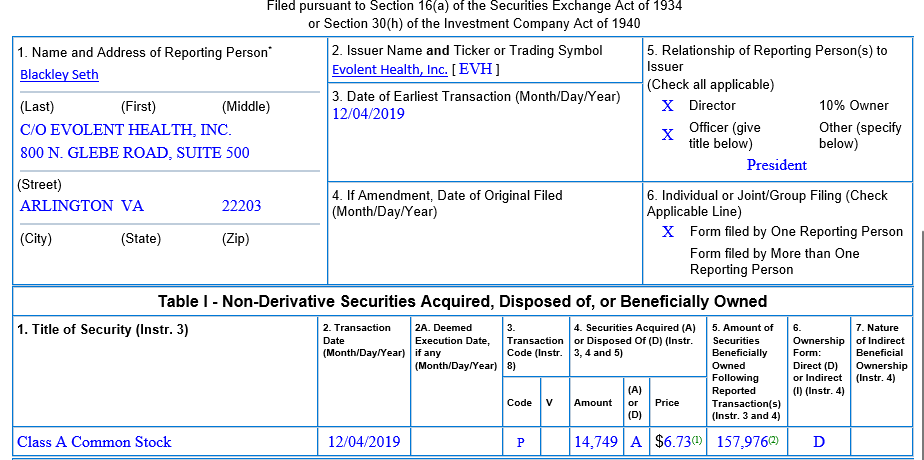
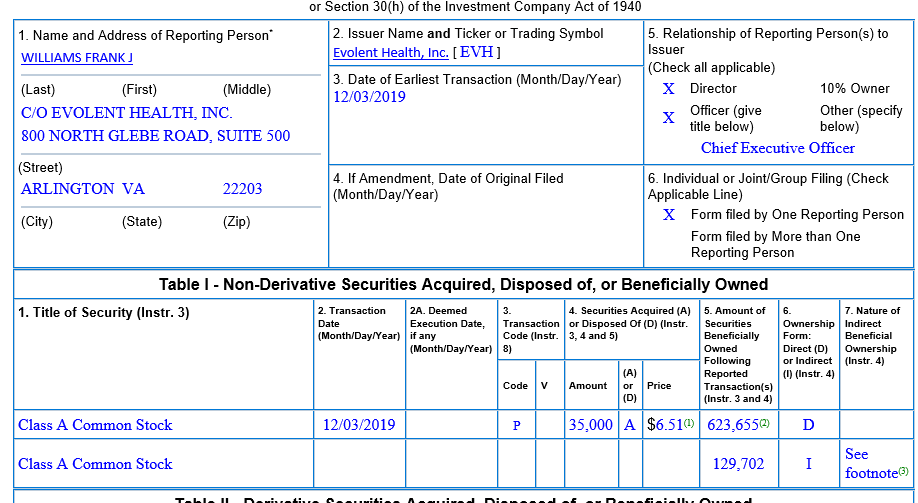
The last data point is this.  On Thursday there were two insider buys.  The first by Frank Williams, the CEO, and the second by Seth Blackley, the President.

These aren’t token insider purchases.   they were six-figure buys – $225,000 in the case of Robinson.  They show confidence by the management team and, maybe more importantly, they imply that the company won’t be raising cheap equity to pay for Passport, which is something a few analysts have worried about.

The Evolent story is even more complicated now then when I first bought the stock.  But apart from the Passport debacle, the company has been moving in the right direction.

This is on of those cases where my gut reaction was to sell the stock on the Passport news, which I did.  But after understanding the details I described above, I decided to buy it back and then some.

Note: I wrote this on the weekend and last night this came out, which further cements my expectations.

Another Nuvectra Update

Nuvectra is not even close to being my largest position.  It is however BY FAR my largest loss right now.

Be that as it may.  The past is the past.  Another less dubious distinction that Nuvectra holds is that right now it is the most interesting position I have.  This is why I am devoting more space on this blog to it today.

The situation with Nuvectra is fascinating to me.  It is the starkness of the outcomes.  I am pretty sure the two most likely end game scenarios are A. lose it all or B. make a lot.

Nuvectra started trading on the over-the-counter market today.  The stock has a “Q” on the end and is no longer part of the Nasdaq.  It likely won’t be changed on your brokerage account for a day or two.

One of the things I researched in the last week is how bankruptcy stocks trade.  What I have learned is that they fluctuate wildly.

Nuvectra could go down to 5c and it means nothing.  It could go up to 50c and mean nothing.  In fact, today Nuvectra briefly touched 8c first thing in the morning.  It closed over 20c.

Bankruptcy stocks trade with insane volatility.  You basically have to place your bet, accept the possibility of a 100% loss, and stop looking at it.

With that said, let’s move on to the news and recap what has happened since I last wrote.

A Barrage of Filings

The company has submitted a slew of bankruptcy filings.  Most of them are pretty boring and the legalese is painful to read.  But there are some details that have been disclosed that give us an idea of where we stand.

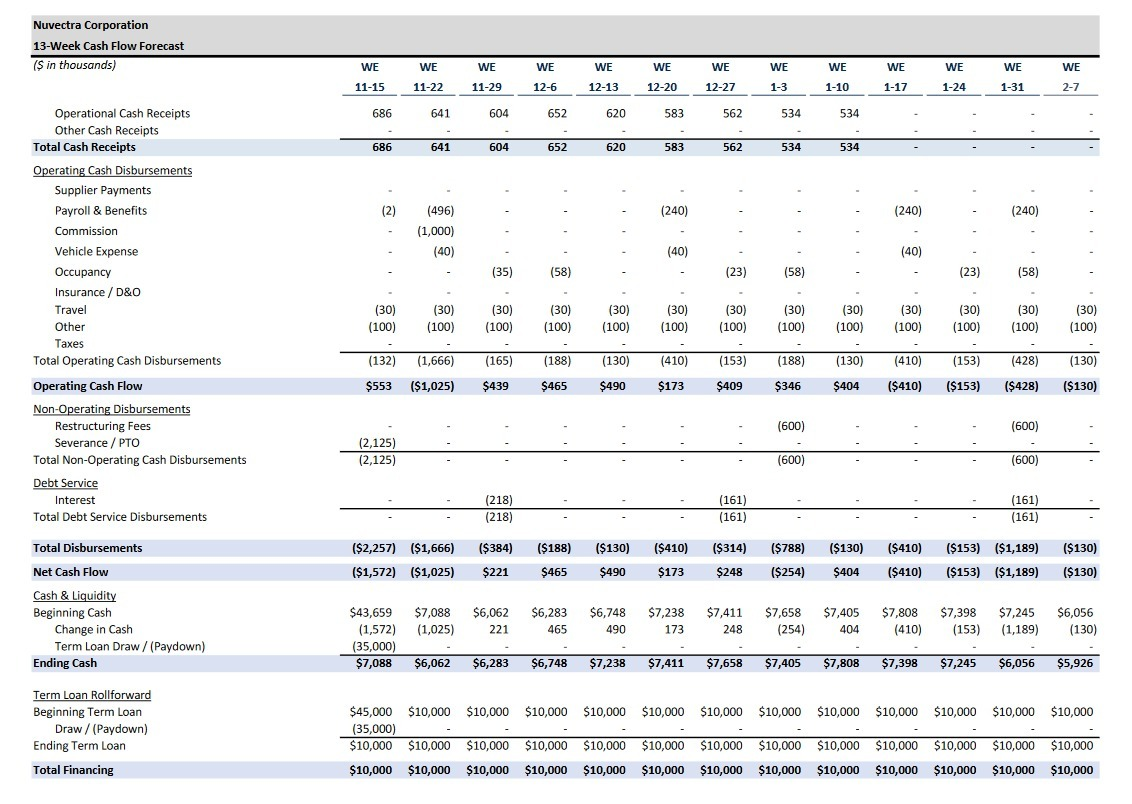
First of all, Nuvectra had to provide a cash forecast as part of the cash collateral requirements.  That plan shows the company’s cash and liquidity through the bankruptcy process.

What we see is that Nuvectra has paid off the majority of the term loan that was outstanding.  $35 million was paid down.  There is $10 million of the term loan left, against about $7 million of cash as of last week.  The year-end number for cash (I’ll explain why the year end date appears is important shortly) is about $7.6 million.

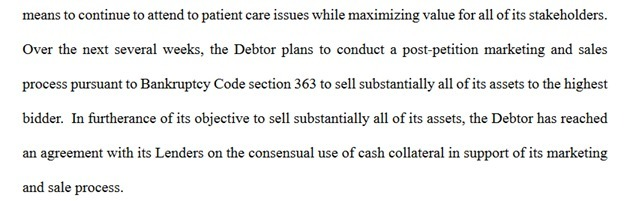
Next, Nuvectra clarified their intent.  In a Chapter 11 bankruptcy you can either have your debts cleaned up and continue operating as a business or you can try to sell everything and dissolve the company.  Nuvectra is doing the latter:

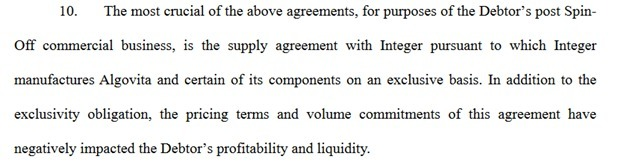
I mentioned in my last post that my suspicion was that this bankruptcy was precipitated by the existing manufacturing contract that they have with their former parent, Integer.

To re-cap the history, when Nuvectra was spun-off they were saddled with a 5-year deal whereby Integer would be the sole manufacturer of Nuvectra’s Algovita systems.

This contract was less than ideal for Nuvectra.  Gross margins for Algovita have been around 50%.  Yet I don’t see any reason they should be less than 70%.  There is a case to be made that they should be even higher.

My guess has been that any buyer of Algovita balked at the manufacturing contract.  The only way out of the manufacturing contract was via bankruptcy.  So that is the direction Nuvectra went.

Nuvectra alluded to this in one of their bankruptcy filings.

One of the big questions marks for me has been whether Nuvectra is on the hook for the manufacturing contract now that they are in bankruptcy.

As part of the Integer contract there were minimum volumes specified that totaled a little over $20 million for the rest of 2019 and for 2020.

Some sleuthing from @fbuschek has been really helpful in this regard (big h/t for all the help).  It appears that when you go through Chapter 11 such contracts, and minimum requirements, can be rejected by the debtor.

And from this source:

What is so significant about executory contracts in a bankruptcy proceeding is that the Bankruptcy Code authorizes a bankruptcy trustee, and in the case of a Chapter 11 proceeding the debtor-in-possession, to reject any executory contract or lease where it is in the best business judgment of the trustee or debtor-in-possession to do so. Provisions in executory contracts and leases that prohibit or restrict such rejections are unenforceable

If we are correct and the minimum volume contract is no longer applicable, the debts of Nuvectra consist only of the secured and unsecured creditors.

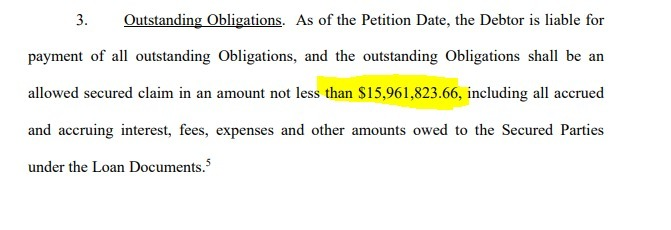
Let’s look at those creditors.  We received information about both.  First, the secured creditors.  In a filing late this week we learned that secured claims were around $16 million.

The largest of these secured claims is the $10 million they still owe on the term loan.

The other $6 million?  An earlier filing listed a number of claims that Nuvectra was petitioning to fulfill.  This was stuff like salaries, commissions, insurance, warranties, etc.  I’m a little uncertain about how I should be including the insurance and warranty amounts, so those might be off, but I am heartened that the numbers provided in the filing totalled around the amount of remaining secured debt that Nuvectra had outstanding after you remove the term loan.

After secured debt we come to unsecured debt, which was totaled for us in an earlier filing.

This filing actually shows the 20 largest unsecured creditors.  After #20 the amounts are small enough that they can be ignored.  In total it appears that there is a little over $5 million due to unsecured creditors.

Its worth pointing out that the two largest unsecured creditors are their suppliers: Greatbatch (now Integer) and Minnetronix.

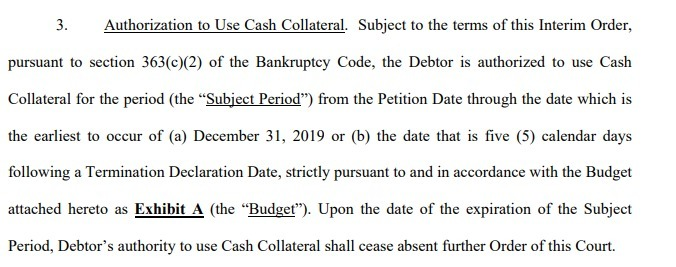
I mentioned earlier that I would explain the significance of year end.  Here is an excerpt from another filing, released earlier this week, that stipulated details about the cash collateral agreement.

The key clause is that the cash collateral date goes until the earliest of a unspecified termination date or December 31 2019.

Here’s a question: why limit your cash collateral agreement to December 31st?  Why not come up with some terms that take you out into next year, so you have a nice long runway and don’t have to go back and extend if need be?

It sounds to me like they expect to have this thing wrapped up quickly.

Another point that came out literally minutes before I wrote this.  Nuvectra put out an 8-K announcing 89 employees are being let go.  Nuvectra had about 200 employees in mid-June.  They already had 25% layoffs in August.  So this move takes the headcount down to ~50-60 people.

Adding it up: Where are we?

It looks like there are $21 million to $22 million in creditors to pay off.  There is $7 million of cash.  The company had inventory of $8 million at the end of the second quarter accounts receivable were $9.4 million.

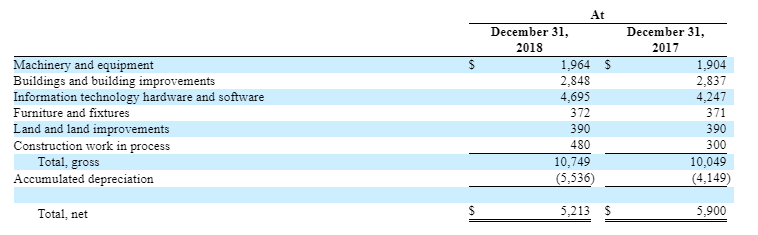
Property, plant and equipment, net of depreciation, was $5.2 million at year end 2018.  Nuvectra owns their research and development facility in Blaine Minnesota.   They lease their other facilities (interestingly, from Integer).

You can discount these amounts as much as you want.  I am not going to try to figure out what the cash value is because I haven’t gone through near enough bankruptcies to know what these kind of assets can fetch and the information we have is largely circumstantial or analogies.

The bigger question, also fraught with uncertainty, is going to be this: what are Algovita and Virtis worth to a bidder in bankruptcy court?

Algovita has ramped to be a $50 million revenue product.  Obviously, it is not a profitable product, but that is largely due to the dead-weight manufacturing agreement that lets Integer take way too much margin.

What is Algovita worth now that it is unencumbered by that manufacturing contract?

While Nuvectra is letting a lot of their people go (so you would essentially be buying the IP and maybe (???) retaining a few key lead personnel) it still strikes me that this IP should be worth quite a bit.

Once you buy Algovita, in particular if you are big company like Stryker, you can set up a cheap outsourced manufacturing agreement (maybe even negotiate a better one with Integer) and use your existing sales team to sell it.  I would expect profitability to follow shortly.

There was a time, not long ago in fact (like 6 months prior), when brokerages were valuing Algovita as a $300 to $400 million product.

As for Virtis, I don’t have a lot of data to work with, and the product is still awaiting approval from the FDA (expected mid-next year).  JMP described the opportunity with Virtis earlier this year:

We also continue to expect a decision from the FDA regarding the approval of Nuvectra’s VIRTIS SNS (sacral nerve stimulation) product, an indication with only one competitor today on the market and an ~$750 mln TAM.

Virtis has had their approval delayed by the FDA multiple times with requests for more information.  It’s been 3-years since Nuvectra filed with the FDA.  Earlier this year Virtis was expected to be approved in the second half of this year but that now has been pushed out.

Meanwhile a competitor in the space has gotten approval.  Axonics has a device targeting the sacral neuromodulation (SNM), the same as Virtis.  The Axonics device was approved for fecal incontinence in September and urinary symptoms in November.

The Axonics device is the second to market.  The incumbent is a Medtronics device called InterStim.

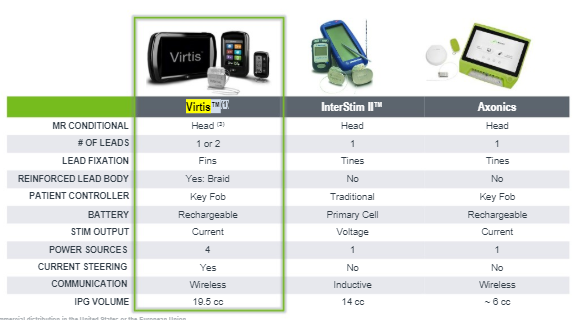
The big disadvantage of InterStim is that it has to be pulled out every 5 years or so, meaning you need to have multiple surgeries.  Both the Virtis and Axonics devices use rechargeable batteries and so their life is 15 year plus.

Nuvectra gave this direct comparison of the devices earlier this year.

The following is a note from Wells Fargo.  It describes the Axonics submission, clarifies the the “paper” pathway and identifies some of the device differences between it and Virtis.  It seems the Axonics device has some advantages.

Average analyst estimates for Axonics next year are $80 million of revenue and negative $45 million of EBITDA.

The market is giving Axionics a “Nuvectra-like” market capitalization for top line growth and bottom line losses at $600 million.

The delays to FDA approval have obviously hurt Nuvectra a lot.  The FDA could just be being cautious on approval given that Nuvectra chose to go the “paper” route – they did not do trials and instead relied on literature for their submission.

I get the sense that the Axonics device may have a few advantages, while Virtis has others (it has current steering which is basically like a dimmer switch, 2 leads with more channels and the leads are stretchable) but overall the devices seem quite similar.  If Virtis is approved you would think it would have value.

It would not surprise me if, assuming this plays out positively, Nuvectra kept Virtis until there is FDA approval.  I don’t know if that would happen in bankruptcy or outside of it.  But it would seem to me that Virtis would have a lot of value once approved

What will shareholders get paid?

I am not going to try to do math on the above figures.  Any set of numbers that I try to use could be easily shot down.  What is PP&E worth?  What is the end cash position? Most importantly, what will Algovita and Virtis sell for?

All I will say is this.  I think there is a reasonable chance that the combination of value from these sources greatly exceeds debt and leaves shareholders with significant value.

Keep in mind, at 20 cents Nuvectra is worth $3.4 million net.

What are the chances that assets exceed liabilities by substantially more than that?

I would say it is non-zero.  In fact, I think it is significantly higher than zero.  So I have continued to add to my position.