Skip to content

Posts from the ‘Uncategorized’ Category

Some things I have learned about Nuvectra

So first of all, on Tuesday night Nuvectra announced they are entering Chapter 11 bankruptcy.  My portfolio took a bath.

Second, most companies entering Chapter 11 bankruptcy see their stocks go to zero.  That is a probable scenario here, at least from past experience you are betting against the odds, so do not take this post as anything other than information.  As my blog is private, it will won’t be read by many, which is probably for the best.  I actually find it a little embarrassing writing about this, but if I am going to track my follies, I felt I should be up to date.

I think that the company went into bankruptcy to get out of the contract they have with Integer for manufacturing Algovita devices.  The Integer (formerly GreatBatch, also the company they spun off of) manufacturing contract has always seemed out of whack to me.   Nuvectra should have higher gross margins than they do (they are only around 50%) and the reason they don’t is because of the manufacturing deal they have with Integer.  Some comments today from the Medtechy board, which seems to be populated with employees and former employees of the company (as they refer to staff by first name and with a familiarity no one else would have), would back this up:

Margins have to be high for another company or investor to take on this market… Integer spun Nuvectra off as a standalone, saddled with a high cost of production and low probability of profitability…. Simply put, Integer’s contract doomed Nuvectra…Chapter 11 was the only way out of it… Selling the product wasn’t the problem…. Making a profit with the high cost of production was the issue…

The manufacturing agreement was part of the spin-off of Nuvectra from Integer.  There are other comments on the medtechy board saying everyone knew this deal was taking too much margin away from Nuvectra.

There was a rumor that Chapter 11 was forced by a prospective acquirer.  If that is true, I would bet any prospective acquirer wanted to get out of the manufacturing contract first.

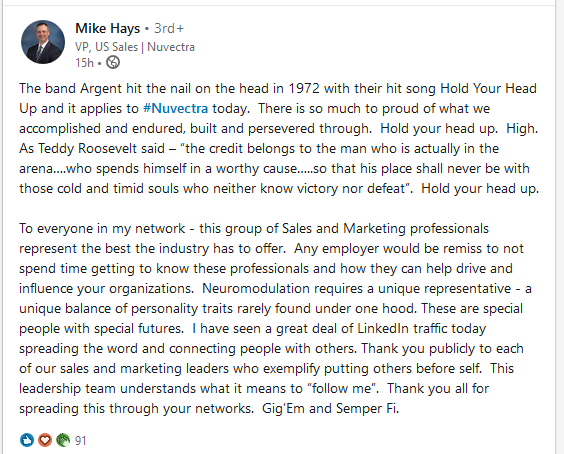
Also, based on Linkedin posts I am fairly sure that Nuvectra laid off most or all of the sales staff yesterday.  For example:

Finally, the bankruptcy report released showed only a little over $5 million of unsecured creditors and almost all of that are due to the two manufacturers, Integer/Greatbatch and Minnetronix.

I have very little idea of whether this means there will be leftovers for shareholders.  We don’t know the current cash position.  I can only guess about what the plan is.

It was a bit odd that in the bankruptcy announcement 8-K filing they said they were filing for a default on $10 million, which is less than the debt they had outstanding from Silicon Bank and Oxford (which is about $40 million) and not equal to any of the individual tranches of that debt.

The filing of the Bankruptcy Petition constituted an event of default under the Company’s Loan and Security Agreement, dated as of March 18, 2016, as amended, with Oxford Finance LLC and Silicon Valley Bank (the “Loan Agreement”), resulting in the acceleration of the Company’s obligations under the Loan Agreement. Thus, all outstanding debt under the Loan Agreement (among other obligations) is in default and accelerated, but subject to stay under the Bankruptcy Code. The outstanding principal amount of such debt is currently $10.0 million.

One interesting and maybe irrelevant point is that Michael Burry took a position in Nuvectra in the third quarter.  It’s at least nice to know I have been wrong in good company.  Burry was famous for his bankruptcy picks, so it would be interesting to know what he is doing now.

My guess (this is a total guess and could simply be dissonance), is that a complicated 3-way deal needs to happen between a potential acquirer, Integer and Nuvectra.  These parties have to come to an arrangement that lets the acquirer out of the manufacturing contract and compensates Integer in some way for it.  I would also guess that getting to an agreement was not going to be fast outside of bankruptcy.   It may have even been clear it would drag on and Nuvectra would continue to hemorrhage cash.   So the board said lets let the courts help us figure this out.

Supporting my view that the company has chosen bankruptcy to complete the 3-way deal is that they announced they are still exploring a sale in the press release, saying they “are exploring a range of options, including a sale of the Company as a whole, of the Algovita Spinal Cord Stimulation System (“Algovita”), of Virtis® or of specified assets.”

With that said, I held my shares and even added to my position in Nuvectra yesterday.  I am fully aware that I could lose the rest of my investment in the stock and I have reconciled myself with a 100% loss if it occurs (fwiw most of that loss already has occurred).  While it is quite possible I am displaying some form of dissonance, there are too many things that don’t add up to me here, and I am inclined to believe, at least on the evidence I have, that there is more than $4 million of value in this company once all the debts are paid.

Also, if you have nothing to comment on but snark or to tell me why you didn’t buy the stock and how smart you are because of it, please don’t bother.  I won’t post it anyway.

CUI Global – A Bet on Management not Blowing It

I seem to be in the midst of a series of retro posts.  First it was Identiv and now CUI Global.  Both of these are stocks I’ve owned in the past and am now revisiting.  I’ll look at Pacific Ethanol shortly (kidding).

Unlike Identiv, I did not do well on my previous endeavours into CUI Global.

I bought the stock in the past on the promise that their GasPT technology might make inroads into its very large addressable market.  That never happened (still hasn’t) and the stock fell and fell and fell.

I bought the stock again yesterday but this time I am coming at it from a different angle.  The stock is trading at a negative enterprise value and my bet is that management doesn’t do anything to screw that up.

A negative EV sounds like a deal! But…

There is always a but.  In this case it is complicated by a pivot and prospective acquisitions.

Let me take you through the valuation and recent history of CUI Global to explain the “but” here.

First the valuation.

CUI got to a negative EV by selling itself off.  They have announced the sale of two of their businesses in the last month or so.

The first was the sale of their electromechanical components business.   The business was sold for $4.7 million of cash, the assumption of a $5.3 million note, and a $5 million earn-out.

The second sale happened yesterday.  CUI sold their power business to Bel Fuse for $32 million.

What is left is CUI’s energy division.  This consists of the GasPT product and their engineering services.  CUI also has a 20% interest in Virtual Power Systems (VPS).

What’s Left

The GasPT business is why I was involved in CUI Global a few years ago.  The company has a better product for measuring gas composition.  The market for this product is potentially very large.  But getting traction with large utilities has been a challenge.

The company has been engaged with Snam Rete, the large Italian energy provider, for years now and while there are always signs that the big deal is around the corner, so far that hasn’t materialized.  You can say the same for Engie, the French gas provider they are engaged with, and for their other engagements (China, TransCanada, and the UK regulator).

That is not to say there isn’t progress.  They had an order from their distributor Samson in April.  They had a $900,000 order from a UK Gas Network operator in July.  In August they had an order for their VE probe and analyzer from a large gas network operator in the United States.

There are orders.  But these aren’t to the scale of the promise of the device, which has yet to materialize.

The company also has an engineering services business.  That business has fared better.  The vast majority of the ~$12 million of revenue the energy segment generated in the last six months came from this business.

CUI is the largest integrator of natural gas systems in the U.K.  They provide contract engineering to “gas utilities, power generation, emissions, manufacturing and automotive industries”.  They opened a Houston facility in 2015 and it seems like they have generated some growth from this expansion.

Its Complicated

If this was the whole story it would be a pretty simple decision – are these businesses (there is the 20% VPS ownership as well), worth more than negative $7.5 million?

The complicating matter is that CUI Global is in the middle of a pivot.  In May they announced that they had made 4 non-binding offers for private companies that together would have transformed the company into a much larger entity – one with $40 million of EBITDA and $350 million of revenue.

The goal seems to become a broad energy infrastructure provider with a focus on the Houston market.

If all of these transactions were still on the table at the terms described back in May (160 million shares, $30 million of cash and a $45 million unsecured note) the share price would be quite cheap at this level.

What complicates matters even further is that since that time CUI has walked away from 3 of the 4 transactions.  The remaining one appears (and I say appears because they have been more than a little vague about details) to be Target 1.

Coming up with a valuation of CUI Global “pro-forma” this transaction is difficult because the company never backed out each transaction individually and we also don’t know if the terms have been adjusted since May.

It’s clear as mud.

New CEO

The other piece to this puzzle is that CUI has taken on a new CEO in October – Jim O’Neil.

O’Neil is the former CEO (from 2008 to 2016) of Quanta Energy Services.  The pivot that CUI is making is centered around O’Neil’s involvement.  He has been with the company in some capacity since at least early this year.  His primary responsibility has been vetting potential acquisitions.

While I don’t know a lot about O’Neil, and I probably should dig into him more, he seems to have a decent background.

Mr. O’Neil had responsibility for various initiatives including: the company’s renewable energy strategy; commercial and industrial operations; internal audit; merger and acquisition initiatives, including overseeing the acquisition and integration of InfraSource, Inc., then the company’s largest acquisition to date; and more. Before joining Quanta, Mr. O’Neil spent 19 years with Halliburton, where he held various positions that encompassed responsibility for its Gulf of Mexico operations; deep-water development; and health, safety and environment.

You Have to Believe

While CUI has not yet delivered on their promised pivot, they did deliver on the divestitures they promised on the second quarter call.   Their electro-mechanical division is now all but gone and they have gotten a decent return for the parts they sold.

I took a position because it seems more likely to me that something goes right with the acquisitions than not.

With that said CUI can still do something stupid and kill the golden goose – more specifically, buy some energy infrastructure business at an exorbitant price and have the negative enterprise value eaten up by that.

On the other hand, if the company completes an acquisition on reasonable terms things could turn out quite well.

There are synergies here, with the primary one being taxes.  One thing about running a shitty business for a long time is that you manage to accumulate a whole lot of net operating losses.

As of December 31, 2018 and 2017, the Company recorded a consolidated valuation allowance of $20.3 million and $17.7 million, respectively. During the years ended December 31, 2018, 2017 and 2016, the Company recorded an increase in valuation allowance of $2.6 million, a decrease in valuation allowance of $5.8 million, and an increase in valuation allowance of $2.7 million, respectively. The Company has provided for a full valuation on existing deferred tax assets in the United States and United Kingdom. Prior to 2018, the valuation allowance was on the deferred tax assets of the United States only. As of December 31, 2018, the Company has available federal, state and foreign net operating loss carry forwards of approximately $67.8 million, $62.8 million, and $2.2 million respectively, which the federal and state net operating loss carry-forwards will expire between 2019 and 2038.

That is over $4 per share in NOLs.

Of course, those NOLs are useless with the existing businesses that CUI operates.  But with the acquisition of a profitable energy infrastructure business, they represent a lot of incremental cash flow.

Anyway, that’s the story here.  You get a couple of businesses with some degree of potential for less than zero and a lotto ticket that an accretive acquisition makes the whole thing a big winner.

There are also earnings and a conference call tonight after the close that might shed some light on how this all plays out.

The downside is that if management screws the pooch all that value could go poof in the night.  That is a distinct possibility.  These guys haven’t exactly delivered over the years.

Nevertheless, a negative EV and all those NOLs at least puts them ahead in the count.

Perfect.

Identiv

In the fourth quarter of 2016 I was fortunate enough to catch the inflection in Identiv.  At the time the stock was an unloved perimeter security play that had recovering from the aftermath of a minor RFID mania.

A few years prior Identiv had been named supplier to Disney for RFID transceivers that went into their Infinity toy line.   Unfortunately for Identiv, the stock crashed and burned as Infinity turned into a bust and Disney discontinued the product.

The Disney carnage took the stock from $12 to $2.  The latter is about where I bought the stock. Like many of my stock picks, I had an admittedly fuzzy idea of how Identiv might play out to the upside.

My long thesis could be summarized in two points:

  1. Their former CEO, Stephen Humphreys, had returned in September 2015 and seemed to be righting the ship, reducing costs and stabilizing the business to the point where at least they wouldn’t go bankrupt
  2. At a market capitalization of less than $20 million it was trading at under 0.5x sales and it wasn’t that far from profitability.

As it was, in part because of the turnaround and in part because of a mania in stocks brought on by the election of Republicans across the board, Identiv ran up to $7 before all was said and done.

Since that run up, the stock hasn’t done much of anything.  It quickly backed off an admittedly high valuation and since that time has mostly bounced around the $4 to $5 mark.

Identiv reports earnings today after the market closes and I have taken a position going into that report.   Not because of the report mind you, I don’t know if the third quarter will have anything special and, having taken a position, I fully expect a 20-30% sell-off on earnings before I have a chance of being proven right on the name.

Two questions here that I want to answer: 1. Why has Identive done nothing for two years and 2. Why am I buying the stock now?

Answer #1:  Identiv hasn’t done much for the last couple of years because the company’s business has kind of stagnated.

While Identiv has made a few cheap acquisitions that have helped increase revenue (and in all honesty these acquisitions look pretty decent to me), organic revenue growth has been absent.

The company’s Premises business, ex-acquisition, hasn’t been doing all that well.

The Premises business sells on-premise security solutions to government and private business.  This means cameras, keypads or card readers, credentials, locks, and then the hardware and software to control and monitor the premises.

If I understand it right, up until this year the business consisted of two product lines.

  1. A very robust, federal government certified (the certification is called FICAM – Federal Identity, Credential, and Access Management) security system powered by their Hirsch Velocity software.
  2. A commercial grade, Cisco partnered system called Identiv Connected Physical Access Manager (ICPAM)

In addition to these full solutions, they sell card readers, credentials, and other physical hardware piecemeal.

My sense is that the Cisco partnership, where Identiv provides the edge hardware and software platform while Cisco provides the network infrastructure and video surveillance piece, has been less than ideal.

Partnerships between a behemoth like Cisco and a minnow like Identiv, have a tendency of not working out all that well for the minnow.  I don’t have any specific evidence but based on the lack of mentions of ICPAM since the first half of 2016 I am led to believe ICPAM sales have disappointed.

The other hint is that the acquisitions Identiv has put together are puzzle pieces that Cisco was delivering.

There have been 3 acquisitions that Identive has made.

The biggest of these was 3VR.  3VR is a video surveillance company.  Identiv bought them in February 2018.  Identiv picked them up on the cheap – paying a little over $6 million for a company expected to generate $10 million in revenue in 2018 and that had over $60 million of venture capital ploughed into it over the past 10+ years.

A second acquisition, in December of 2018, was Viscount, which added two products.  Viscount’s Freedom platform is a software-defined physical security perimeter solution, while the Liberty platform is a lower-end, entry-level security perimeter solution.  The important piece of both of these solutions is that neither is tied to Cisco servers and video surveillance solutions.

Freedom and Liberty are similar monitoring and analytics platforms to what Identiv has in their own platform Hirsch Velocity (for government, but they address different parts of the market.

I suspect the most important thing about these platforms is that they aren’t tied to Cisco’s gateway, server or video solutions.  Hirsch Velocity is a high end solution, used by government, its great for winning government deals but its too expensive to compete commercially.  Freedom and Libery provide options for commercial applications that don’t involve Cisco.

Also worth noting is that Freedom is certified for FICAM.  Between Freedom and Hirsh, Identiv owns 2 of the 4 solutions that can bid on Federal government security contracts.

Thursby was a third acquisition in November 2018.  Thursby added mobile security solutions, including apps for accessing secure data on mobile devices, and dongles and readers used with mobile devices for verifying credentials of the user.

Together these 3 acquisitions and the existing platform of identity cards, scanners, controllers and software give Identiv a complete physical security solution, applicable to government, but also to most levels of business.

While the Premises business has been rather blah for some time, Tthere are some hints it is about to gain traction.

First was the announcement in the first quarter of a fairly large Federal win.

One was a multiyear federal program award to one of our partners for FICAM deployments at over 500 sites worldwide. This is a good indicator of the increasing commitment to FICAM, and it’s really an endorsement of our Velocity software – Q119

– on the 500 sites in the federal government, roughly how many doors per site would that be? Steven Humphreys, Identiv, Inc. – CEO & Director [5] It varies dramatically. It’s anywhere from a couple of dozen to a couple of hundred

I remember back to when I first looking at the stock in 2016, Humphreys said that their FICAM solution would cost around $1,200 per door.  If you do the math on 500 sites with maybe 75 doors on average, that would be a $45 million opportunity.  Not inconsequential for a Premises business that is doing around $40 million a year.

That win was followed up by this news last week.

Hirsch Velocity Software is the physical access control system (PACS) platform specified in a recently awarded multi-year, $150M blanket purchase agreement (BPA) for the National Physical Security Program (NPSP) Maintenance and Installation Program. As part of the contract, the United States Marshals Service (USMS) is deploying Hirsch Velocity Software at more than 900 facilities across the country to deliver mission-critical security and protection to USMS facilities, visitors, and employees.

Don’t get too excited about the $150 million – I don’t think all of that purchase order is going to Identiv.  They are specifically referring to their software getting the win, not the entire platform.  But 900 facilities with even 20 doors per facility is still a good sized win for a company this size.

Then yesterday another U.S government agency selected Hirsch for their locations, which are home to 100,000 employees.

There was also this news today that an RFID tag collaboration between NXP and Identiv would be used on a scratch and reward game on Kraft cheese slices.

I’m not sure how material the revenue would be on this application, but Identiv has been trying to gain traction with their RFID products for years now, and this and another recent application in Hot Wheels cars could (and I emphasize could) indicate a turning point.

Identiv isn’t particularly cheap, but its also not pricing in a lot of success.  It trades at 10x this year’s EBITDA.  A couple of these government wins could tip the scales on that EBITDA number so we’ll see, I’m willing to brave the earnings storm.

If it’s true…

So first of all, my blog is private again.

Second of all, Mission Ready is moving a little this morning because this was posted on the Federal Procurement Data System.  The second one down is a $US200 million contract award.

In typical Mission Ready and TSX Venture fashion, there has been no confirmation, no press release and no halt of the stock.

If this is what it appears to be, it is quite significant to Mission Ready.  Consider that this is a ~CAD$35 million company, give or take.  Even assuming a 10% margin on these dollars, they represent a significant influx of cash.

Is it true?  Or is there some sort of gotcha that is not evident?  It would be nice to know with a bit more certainty.