Skip to content

Posts from the ‘Uncategorized’ Category

Some thoughts on the CNX Midstream guide down

So this isn’t a stock that I own right now.  I have owned it though.  I’ve been following it and some other midstream plays fairly closely since early December.

Up until recently these midstream stocks weren’t performing all that well.  They were getting beaten up with oil even though some of these companies have absolutely nothing to do with crude.

CNX Midstream for example.  100% natural gas and liquids.  They are the child of the old Consol – basically a situation where the E&P assets went into one company (now called CNX Resources) and the midstream assets, so pipelines, compressors, and facilities, went into another.

CNX Resources is a fairly large Marcellus/Utica producer, wet/dry natural gas, 1.4 bcf/d.

CNX Midstream operates all the pipelines for them.  They basically handle gas for CNX Resources and one other customer (HG Energy, which is private) so they are very concentrated.

Most importantly, CNX Resources owns 33% of CNX Midstream.  They are also the general partner, which means they manage and operate CNX Midstream.

On their fourth quarter call CNX Midstream surprised the market.  EBITDA guidance was $200 million to $220 million.  Distributable cash flow guidance was from $150 million to $170 million.

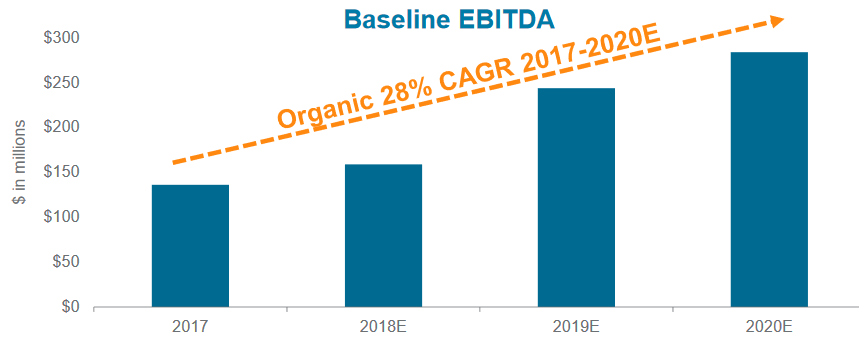
Up until that point analysts had been expecting an EBITDA guide of around $245 million and the floor on DCF was thought to be $170 million.  So this was a significant guide down.  Below is from their analyst day forecast back in March of last year:
So what happened?

Well part of it was that their E&P partner CNX Resources reduced their activity in 2019.  They phrased it as “minimum activity levels” and stressed that they would be “flexible” and add capital depending on prices and returns, but bottom line is that they are budgeting less than was anticipated.

So there’s that.  What can you do – your customer is worried about prices or returns or whatever else and they decide to reduce activity.   That means reduced through-put for CNX Midstream, or at least less growth than the analyst community was expecting.

But that’s only part of the story.  One analyst, I believe his name was Matt Niblack (?) pointed out that there was still something that didn’t quite compute:

…the minimum [DCF] has been adjusted down from $170 million to kind of $150 million to $170 million due to timing and other factors. But there’s still upside to that, and we just have to see how that goes. I guess my only other question here then is, in the minimum guidance range, if that seems — and also, I think implied in CNX’s production growth range, you’re looking at kind of roughly flat economics relative to Q4, right? And I’m just taking your EBITDA in Q4 and multiplying it by 4. I realize there will be some seasonality associated with that, so that will vary quarter to quarter. But for the full year, that’s what you’re looking at. And yet, there’s significant growth CapEx…

So the question is, why are you spending the same amount of growth capital if you aren’t growing as much?

I read the transcripts a couple times and while the company is a bit vague about it I think the hint they give is when they start talking about de-bottlenecking:

“So a significant portion of the capital that we’re spending in 2019 is associated with de-bottlenecking projects”

So CNX Midstream spends money de-bottlenecking.  That’s either compression, looping, twinning… it’s something that is going to lower pressure in an existing line.  Lower pressure of course means more gas.

But it’s more gas on the back of Midstream’s capital.

This brings up the point about the competing interests of the E&P and midstream.  Particularly when the midstream is controlled by the E&P.  Whose best interests is the de-bottlenecking in?

I would argue that the E&P, so CNX Resources, benefits more from de-bottlenecking.   If it was all one company the capital decision would be based on whether we get more bang (ie production/NAV/cash flow per dollar spent) from drilling a new well or from adding compression/looping an existing line and getting uplift from existing wells.

In this case it’s not all one company.  CNX Midstream pays for the de-bottlenecking.  So its a bit of a free-bee for CNX Resources.

Yes, CNX Midstream gets the volumes as well.  But they just get a toll, and they could have gotten those volumes anyway if the E&P had used its own capital and drilled some more wells.  Now I realize that drilling more wells in an area that could use some de-bottlenecking is likely going to back out other production.  Sure. So drill them somewhere else, where there is capacity.  Volumes are volumes for the midstream.  My point here is that the uplift is paid for by the midstream but they aren’t getting the full benefit.

Of course CNX Midstream says that its a good rate of return. From the call: “I mean, we could follow up with those specifics. I mean, those are good rate of return projects. Otherwise, we wouldn’t do those on a standalone basis. It’s sort of like core, like baseload, sort of like easy low-hanging fruit stuff to do.”  And it does give CNX Resources the ability to ramp production more at some point, now that pressures are lower.  So there’s that.

One thing de-bottlenecking definitely does is it helps an asset look better, at least for a while.  Not saying that’s the case here, I really don’t know.  But type curves never talk about pressure.  It’s rate vs. time.  Nevertheless, you lower the pressure and rates go up.  There is a reason engineers do a bunch of crazy math on their wells and introduce concepts like material balance time and pseudo-time.  Its because its pretty easy to get the wrong impression from a rate vs. time graph.

It all just makes you wonder if CNX Midstream might be taking one for the team here?  CNX Midstream spends some money on de-bottlenecking.  It’s not really a big deal in the grand scheme of things, the stock takes a bit of a hit but it bounces because it doesn’t affect the dividend or anything.  CNX Resources gets some free uplift from it.  That helps their guidance.  Everything looks a bit better. No one gets hurt.

Who knows!  Maybe it’s all just efficient capital allocation.  Nevertheless I think the thought exercise is worthy of contemplation: that there is at least the potential of misalignment with these E&P-midstream separations in the United States.
Copper stars not quite aligned

Sometimes all the stars align for a trade.  And sometimes there is one star that is way off in its own orbit, throwing off the whole picture.

That’s what I’m thinking about copper right now.

There is a lot I really like about this idea:

  1. The demand picture is premised on what seems like the inevitable adoption of electric vehicles and increasing electrical infrastructure
  2. The supply picture paints a scene of depleted reserves and an empty pipeline that will lead to significant deficits for years to come
  3. The prices of copper equities are reasonable, if not downright cheap, and certainly not pricing in the upside of a rising copper price

It all fits.  Except for one thing.  These damn tariffs.

In my opinion there are reasonable odds that what is to come is more brinkmanship, more anti-ups, and maybe even some sort of climatic event ala Nixon in 1971 that changes the way the world operates for good.

Of course maybe not.  The market is certainly saying its all good.  But the market also rose right after Nixon put a 10% surcharge on imports and pulled the rug out from under Bretton Woods.

The 70s didn’t really go all that well.

I don’t know what is going to happen.  But it’s uncharted territory and it wouldn’t surprise me if the market is as clueless as I am.

Consider the following:

  1. We have a President that was elected, in part, by folks who lost their jobs or had their communities disrupted by the relocation of industries that were allowed to leave because of free trade (yes its complicated and there were other causes, but free trade was definitely part of it).
  2. The President has made it clear he will do whatever it takes to make good on his promise to fight for these people and communities and get those jobs back (whether or not what he is doing is actually going to be in their best interests is not clear but also not really relevant to the line of reasoning here)
  3. It’s not really clear if anything can be done to turn back the clock on these cities, counties and communities that have had the industries they were built on stripped from them, so perhaps regardless of what the President does, the outcome will disappoint

Those 3 points suggest that it is at least possible that we spiral into a vicious circle of escalating actions that don’t have the intended effect and therefore lead to even more escalation.

I’m just not sure I want to own a lot of copper in that environment.

With that all said, the picture for copper supply and demand assuming a “steady as she goes” economy is pretty enticing.

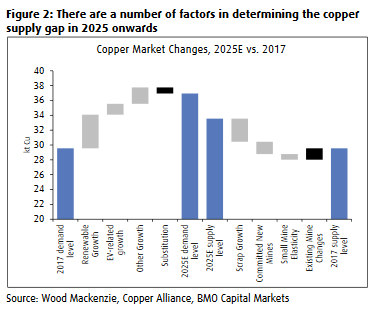
BMO put together a long and very interesting research piece describing the supply and demand dynamics of copper over the next number of years.

The demand side is being driven by electric vehicle demand and the grid infrastructure required to move to a higher amount of renewables.

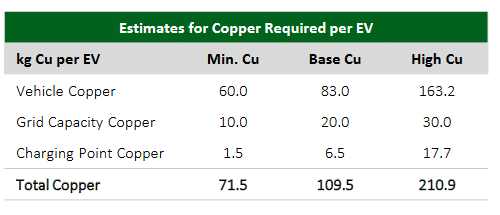
The simplest explanation of why this will increase the demand for copper is this: An internal combustion engine contains 23kg of copper for wiring, whereas a battery electric vehicle and plug-in hybrid contain between 60-83kg of copper.  On top of that another 20kg of copper is needed for grid capacity and 6.5kg for the charging point.

On the supply side, a combination of declining grade, rising capital costs and a number of years of depressed copper prices have left us with a depleted pipeline of projects.

The conclusion, which is hard to find fault with, is that there is a significant shortage of copper projects in the development pipeline and projects will only be added if the price of copper rises enough to incentivize them.

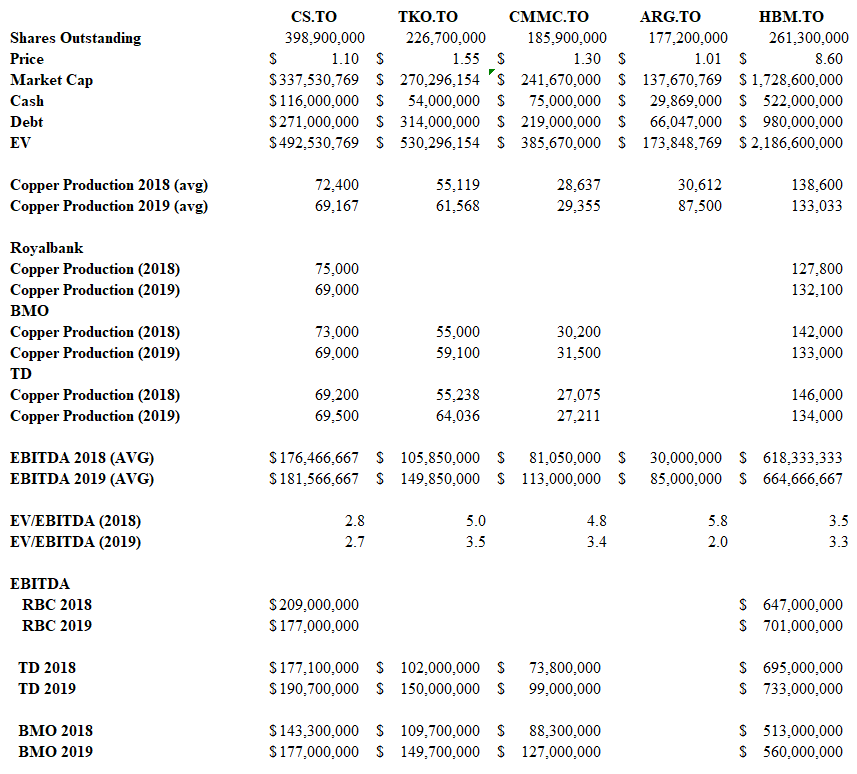
So how do you play this?  Well maybe you don’t because there is just so much risk in the world.  I’m still trying to figure that out.  But if you do, I certianly think the copper stocks are reasonably priced for it.  Below is a comparison of a few that I have dug into where I just took analyst EBITDA estimates and averaged them to get a rough idea of the EV/EBITDA multiple these companies trade at (note that because Amerigo isn’t followed by any brokerages I have reports for I used the companies own estimates that I found in their presentations).

At the moment I have taken positions in a couple: Copper Mountain and Capstone.  But these positions are really, really small (<<1% each).

For now they are going to stay that way.  I’m just too uneasy about where all this trade stuff is going.

Q1 Earnings: Radcom

I’ve fallen behind writing about the earnings reports so far this season.  In the next few posts I am going to catch up with a few brief thoughts on a number of the reports that came out over the last week and a half.  Starting with…

Radcom

I’m surprised the stock has moved so much after the company reported first quarter results on Thursday.  I didn’t think there was a lot of new information provided.  Revenues ($8 million) were in-line with expectations, guidance was maintained, the trials are progressing.  On this the stock has jumped almost 20%.  Go figure.

I guess investors have focused on the progress.  The four trials are wrapping up, and within the next 6-9 months they expect so be able to announce wins, though nothing specific was provided.  Ravkaie (the CEO) gave positive color around the potential for wins, but that isn’t anything new, he’s been saying that since the trials were announced last summer.  They indicated discussions with new carriers that will begin trials in the third and fourth quarter. And some of the tenders that are now coming in are for pure NFV solutions, which is a new development (most of their engagements were for hybrid deployments as carriers transitioned slowly to NFV) and one that should play right into their wheelhouse.

I unfortunately got shaken out of about 25% of my position the day before earnings.  Doesn’t it always happen that way.  Netscout, a competitor, announced a win with Vodafone that day, and my initial reaction was that maybe Radcom had lost that trial (though no one is sure who Radcom is in trials with, one of the companies that comes up in discussions is Vodafone).

On further reflection, that might be wrong.  It was pointed out to me that the Netscout press release refers to passive probes, which are not the same thing as the active probes that Radcom’s MaveriQ solution uses (passive probes are more akin to offline testing and measurement which would be like the sort of thing Exfo does).  Second, on the conference call, Ravkaie was specific about calling out Netscout as a competitor and saying that they do not have a comparable NFV ready solution to compete with Radcom.  So it seems more doubtful to me now that the Vodafone win is a loss for Radcom then it did at first glance.

Honestly, I think my move was driven as much by position size as the Netscout news.  Whenever I have a position that is big I get quick on the trigger with any rumor to the contrary.  The fact is that the morning of earnings I had the opportunity to add back at 18, but I didn’t.  I was not convinced the results were incrementally better to justify running back in.  That proved to be wrong, at least for now.  So I will just participate in the move with the shares I have and see whether it is for real.

Third Quarter Earnings Update: Empire Industries

I’m catching up on a few of the later quarterly results that came out.  Empire Industries was typically late with their results, which came out on November 29th.  They were mostly a non-event.

The company is in transition.  Up until this year the primary business unit of Empire, Dynamic Attractions, developed custom amusement park rides.  Their rides are high end, technologically complicated rides like the Harry Potter & the Forbidden Journey attraction.

In the last year they have transitioned their Dynamic Attractions business model from customer attractions to standard products that they can sell to multiple park operators.  The transition is expected to improve margins, as they focus on more of a manufacturing process than on one-off creations.  So far though it has not.

eilpost1

On the call CEO Guy Nelson said that they expect to be mostly through these growing pains by2017.  He pointed to the Flying Theatre, which I believe was the first standardized product.  They’ve sold 10 Flying Theatres so far, and the last nine have been at much better margins than the first.  As more products get over this hump, margins are expected to improve.

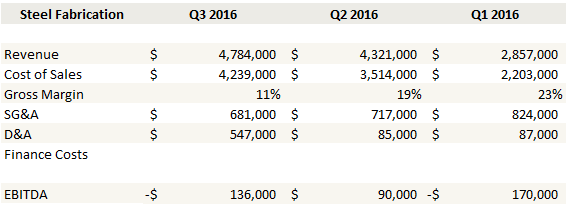
With the spin-off of the hydro-vac business (which I have written previously about here), the other remaining business unit for Empire has been steel fabrication.  Nelson said that they will be changing the direction of the steel fab business, exiting the contract manufacturing business and focusing it on producing parts for Dynamic Attractions.  This is probably a good idea; the Steel Fab business has not been profitable.

eilpost2

Nelson also gave an update on the SpacePark that was announced when Justin Trudeau visited China in the summer.  I mentioned the agreement in this prior post.  Unfortunately my optimism may have been misplaced.   Nelson was quite candid about the agreement, said that they hesitated with the new release, felt some pressure given that the agreement was attended by Trudeau, and that he felt that the Chinese counterpart only had about a 50/50 chance of securing the needed land for the park.

On August 9th Empire announced a $10 million contract for the design phase of the thirty meter telescope.  On the call they confirmed that this revenue will be seen in 2017.  It’s good to see the telescope, which has been held up by regulatory issues due to its Hawaii location.  Wikipedia describes the backstory well.  I’m not sure that the final location of the telescope has been decided.

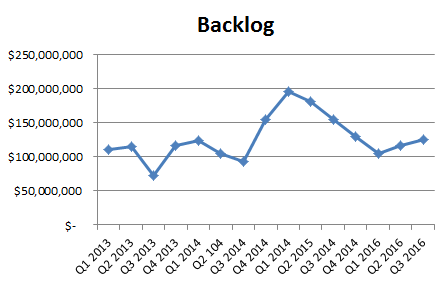
The backlog seems to have stabilized after falling from its peak in early 2014.

eilpost3

The improved margins in 2017, the healthy backlog and the additional $10 million contract for the thirty meter telescope design should lead to an improved 2017.

But I want to see how successfully they can transition to this model before I take any more of a position.  Let’s see margins improve, and let’s see orders continue and hopefully increase.

Empire is a typical position.  A decent company, lots of ways to a positive outcome, but nothing has materialized yet.   So it remains a small position as I wait for a catalyst to justify increasing it.