Skip to content

Posts from the ‘Uncategorized’ Category

Shifting Some (more) Dollars to Biotech

I made a sorta of shift in my portfolio last week. I sold a lot of the commodity stocks that I’ve been holding for the last couple months and used the cash I raised to buy biotechs and a couple of other special situation-y ideas (CALM, PCYO).

This is far from a new foray into biotechs. But until last week I have mostly been buying biotechs that have nearly or more cash on hand than their market cap and that have a low burn rate.

This week I waded into a few more expensive names. I added CRISPR Therapeutics, Intellia Therapeutics and I added back to Caribou Biosciences. All are CRISPR names and all I’ve talked about before. Both CRSP and NTLA are trading far from cash. These are multi-billion market cap companies. So this is a different idea than what I’ve been going after in biotech over the last few months.

Why buy more biotechs? Perhaps I am a degenerate gambler. But there has to be a point where you just say enough is enough. The funny thing is that the biotech names with approved drugs generating revenue are actually doing quite well. I have owned Vertex for a little while here and its been great (I sold it this week). I also owned Incyte for a time and it was doing well too. Others like Bristol Myers, Eli Lilly and Merck have done great and mostly avoided the downdraft in the market.

So it just seems like a real disconnect. If you have a revenue producing drug the market is valuing you highly. If you don’t the market is sending your stock to the trash heap.

That sure seems like the kind of situation that would lead to some takeovers. And that is what led me to buy these CRISPR names. They seem like reasonable takeover targets.

Second, I’ve been following biotechs closely enough to notice a slight change in their trading the last few days. They have gone down but I’d swear they are going down reluctantly. We’ll see.

In addition to these two stocks, I added to a few of the names I already own. I added a new negative enterprise value biotech Graphite Bio. With an EV of negative $120 million I think this might be the most negative EV I’ve seen. It doesn’t seem like a very good company, the drug pipeline keeps running into road bumps, but nevertheless, it only takes a little change in sentiment with these names.

There is the chance with a name like Graphite and a few others I own that a hedge fund steps in and pushes for strategic alternatives. This happened with one name I own already, Arca Biopharma. Arca had some bad COVID trial results a few weeks back and I was like, oh boy here we go, back to $1.50. While the stock did hit $1.50 in after-hours that night it also mysteriously recovered back to flat the next day.

Something was up and that something was that Cable Car Capital stepped in a bought a lot of shares and then pushed for the company to do strategic alternatives.

I wonder if, in the absence of takeovers, we see other hedge funds do this as well?

It just seems like in a crappy market like this, owning stocks that trade at less than cash, especially if there is some sort of readout in the near-ish term that could give the stock some enthusiasm, is not a terrible thing. Biotech also has nothing do to with COVID in China or inflation or the US economy really, so even though the sector has been a disaster, its not really in the middle the maelstrom in most ways.

We’ll see. I’ll keep these purchases on a short leash.
No Market for New Stocks

Yesterday my uncle asked me why I haven’t written in a while. I told him it was because I don’t know what to write about.

That is true. I don’t really know what to write. But there is a more nuanced answer that explains why that is the case.

I’m not writing about individual names because I don’t have much confidence in stocks right now. I feel like I am closer to selling than buying with most. Why put out a new idea when part of me thinks I’ll just end up selling it in a week or two anyway?

The same goes for searching for new ideas. My idea generation has been lethargic. But that is almost a protective stance. New ideas are dangerous is a crappy market.

I mean, remember some of the ideas I have mentioned over the last few months? Finance of America lasted all of a month in my portfolio – I had to dump the stock at $3.20 after buying it at $3.80. Checkpoint Therapeutics made sense given their results but I had to dump it soon after as well (though I bought it back again more recently, a second mistake!). The banks have been a mess as well.

So I don’t know… it isn’t a good market for holding onto stocks (and I won’t hold on if they go down) so why bother making a case for them? You can get lucky like I did with Vidler and Eiger. Or try to pick a bottom like I sort of did by buying Facebook, Google and Vertex when it looked like the market was going all bear market rally-gog on me again. Admittedly, the commodity stocks have been a good idea for a month or so (though this stupid Bioceres just won’t go up). But overall, its just not a great market.

And with the large-cap rentals, what am I going to say anyway? Hey, I got this great idea. Its called Facebook! Oh, and btw, I like it so much I’ll probably sell it the first time it has two down days in a row (which I did). Why bother?

This market, in terms of writing about it, is kind of like the inverse of last Jan-Mar. Early last year there was no point talking about the stocks I was buying because the reasons they were going up were not rational. If you look back to February and March last year, I wrote very little.

At that time, stupid little biotechs or microcaps were going up 50% in pre-market in a single day. There was no rational reason for it. It was ridiculous. If you wrote about why you were buying them it just looked stupid because there was no real reason to buy them other than that they were likely going to go up on someone stupider buying them higher. So you just bought and sold as best you could to capture gains and kept your mouth shut.

Now, the reason to keep your mouth shut is that the stock you buy is likely going to go down even if there is no news or good news. The most interesting stocks to me here are the SaaS stocks and the biotechs, simply because they have been beaten down so much. But they are clearly in between states of equilibrium – investors are still trying to figure out how they are going to value them and so until that is settled there is no point getting into the weeds of writing big dissertations on why I own A and not B.

With the biotechs, as I have been painfully recording, I tried to pick the bottom a couple, 3, 4, too many to count times, to varying degrees of success. Biotech has a unique attribute that has allowed me to go bottom picking here whereas with SaaS I could not. That attribute is that cash is cash and I have almost exclusively bought companies trading at or below cash.

And you know what? Most of my wins in biotech have just been buying stocks that were trading well below cash and watching them trade to slightly above cash (ABIO, ALDX, CFRX, LYRA) while my losers have been buying names that were trading not close enough to cash (CKPT, CRBU, CRVS). Only Eiger has actually gone up on results (btw – this a good podcast interviewing Eiger’s largest investor, Paul Wick and why he thinks the stock is cheap).

So yeah, you can see what I own. I still have a lot of gold stocks and a bunch of small biotech positions (which could be gone in a blink if the bottom falls out again). I own a lot of Vidler but I won’t soon enough (we will see what kind of bidding war we get there, if any). I might buy another water play in its stead. I own some Ag stocks, a bit of energy and I tried buying back a bank (CUBI) but that has not gone well. I have a fairly big index short position and in my real portfolio I remain short a whole pile of individual names that are mostly the darlings of yesteryear. My portfolio still only goes up a little on big up days and is mostly flat on down days. It is kind of boring really.

I don’t expect to be writing a lot until there is an all-clear that this bear market is over. Picking bottoms here is for the gamblers. Until we have such a bottom. then you can follow my portfolio for changes. I’ll try to post it regularly.

PS – I do own a lot of gold stock $’s here but I have learned that to ever talk bullishly about gold stocks is an invitation to embarrassment. So I will hold these stocks quietly and sell them if they start to break down. The #1 precept of gold stock investing is WTFDIK.

Peabody Energy and why it is very tricky to make a decision right now

It is very hard to know what to do with commodity stocks right now. For those that have held commodity stocks into the run-up (which could even mean “since Monday” given the incredible melt-up we have had), we are sitting on big gains.

Do you sell on those gains or are bigger gains to come?

In my last post I described some of the risks of holding commodity stocks right now. They are:

  1. Some sort of peace agreement
  2. The removal of Putin from power, one way or another
  3. Global recession
  4. Western countries outside of Europe getting fed-up with paying high prices and starting to view this as a “Europe problem”

All of these are on the table I think.

On the other hand, you have the reward of holding commodity stocks. Yes, they are up a lot, but how much higher could they go in a scenario where prices are higher for longer?

Let’s take the case of Peabody Energy.

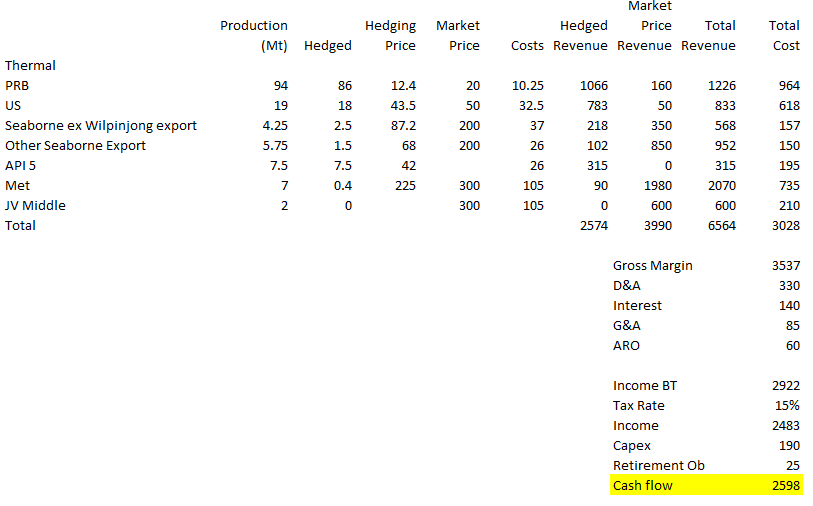
The great thing about looking at Peabody is they laid out their 2022 guidance in very understandable terms a few weeks ago. So it is very easy to model what their cash flow will be under different scenarios.

Peabody is, in a way, at the epi-centre of the crisis. Russia is the third largest thermal coal exporter. Russian coal accounts for roughly 30 per cent of European metallurgical coal imports and over 60 per cent of European thermal coal imports.

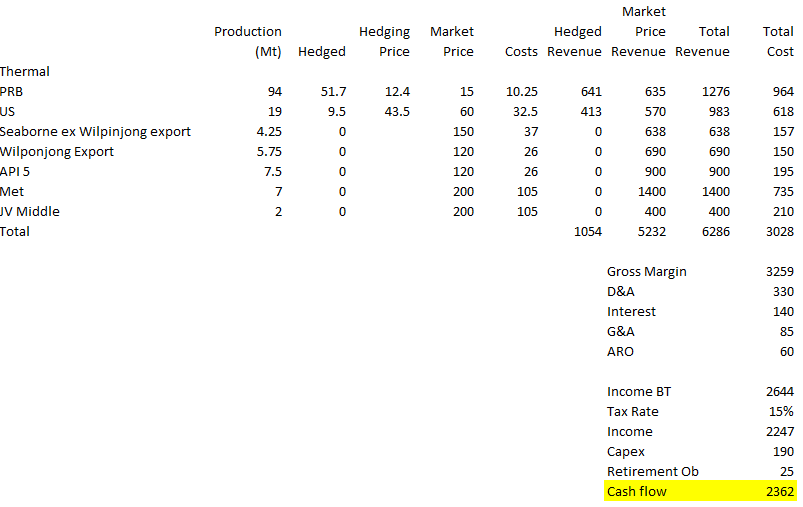
This guy put together a nice spreadsheet of Peabody. I’ve copied that below with a couple of changes.

The first scenario I’ve modeled is at $200 thermal and $365 met coal (Peabody receives a 15-20% discount on their met/pci coal). This is actually below current prices but well above the historical norms.

Peabody has a market cap of $3.3 billion and an enterprise value of $4.2 billion. So under this scenario, if these prices were realized for a full year, Peabody free cash flow would be roughly 80% of their market cap and 60% of enterprise value.

Now let’s look at the extreme. Right now, thermal coal is at $400. I don’t know what PRB coal is at, but the last time thermal was $400 PRB went to $30. What happens then?

While this scenario seems very unlikely over any long period of time, it could be approximate to what they earn in the very short-run. Peabody’s free cash is about $1 billion more than its current market cap.

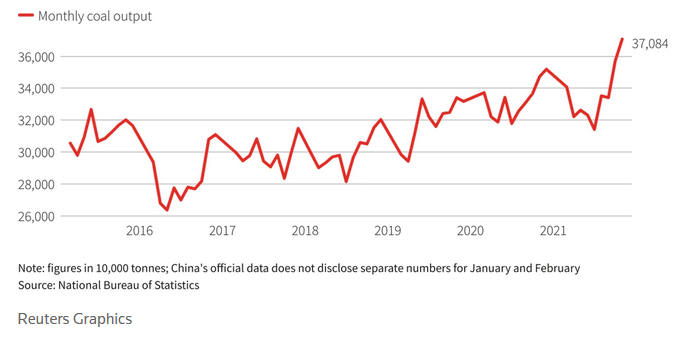
Russia supplied about 200 million tonnes of coal to the world last year. China produces 4.07 billion last year. China had to push their producers late-last year to get to that level. You can see that below:

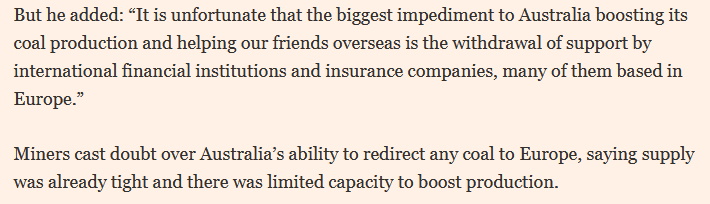
Australia is a big coal producer but this was their response a few days ago.

It is not entirely clear that the world can quickly make up any deficit.

That means the big questions are:

  1. How long will the spike last
  2. What is the new equilibrium if sanctions continue for a long period of time

The thing is, if there are still sanctions through 2023 much of the contracted coal that Peabody signed at lower prices is no longer under contract. The PRB coal, for example, is only 55% committed for 2023. It is pretty easy to see how even at much-reduced prices (from current levels), but still very high historic prices, 2023 would set up as another huge cash flow year for Peabody.

Are these the right prices for that scenario? I don’t know. But this is a scenario where we are in a conflict through 2023. If that is the case I know the prices are going to be higher than the 2021 prices. How much, its really hard to say.

Peabody is an easy example because they have given such detailed guidance. But working though similar scenarios with my other positions. Its the same result to varying degrees. For example, Cardinal, my biggest oil position, should do $400+ million of free cash at current prices. Cardinal’s market cap is $1.1 billion.

But… I am not actually trying to make the case to own Peabody or Cardinal or any other commodity stock here. FWIW I sold some of my position in Peabody (which I had added only on Monday) because it was up 40% in 5 days and I mean, holy cow, it feels irresponsible not to take some profits on that. I sold a little of Cardinal as well.

What I am trying to say is that it is really, really, really tricky to know what to do. It is truly about balancing the risk and reward based on your own individual circumstance and tolerance. Because Peabody could be a $50 stock in 6 months but it could also be a $15 stock in two weeks.

Outcomes to the upside and downside have suddenly become more extreme. That is why one of the only things I’m fairly certain of is you have to take down exposure to both.

World on tilt.

Don’t be a hero

It’s a bear market in stocks. It’s a bull market in commodities.

You don’t want to overthink that too much. But in bull markets there are times to be long, times to be very long and times to take some off.

I think we are at #3 now. While the rise in commodity prices makes it tempting to just keep adding to copper stocks, steel stocks, oil stocks, ag stocks, gold stocks and so on, that FOMO is usually best taken inverted. I have taken the opposite tact and started taking some profits on these names.

Rising commodity prices are your best friends until they are their own worst enemy.

I’m unsure what these rising prices mean for the global economy. I’m really unsure what rising food prices mean.

Consider these quotes:

  • The Black Sea region (Russia and Ukraine) accounts for more than 30pc of global wheat exports
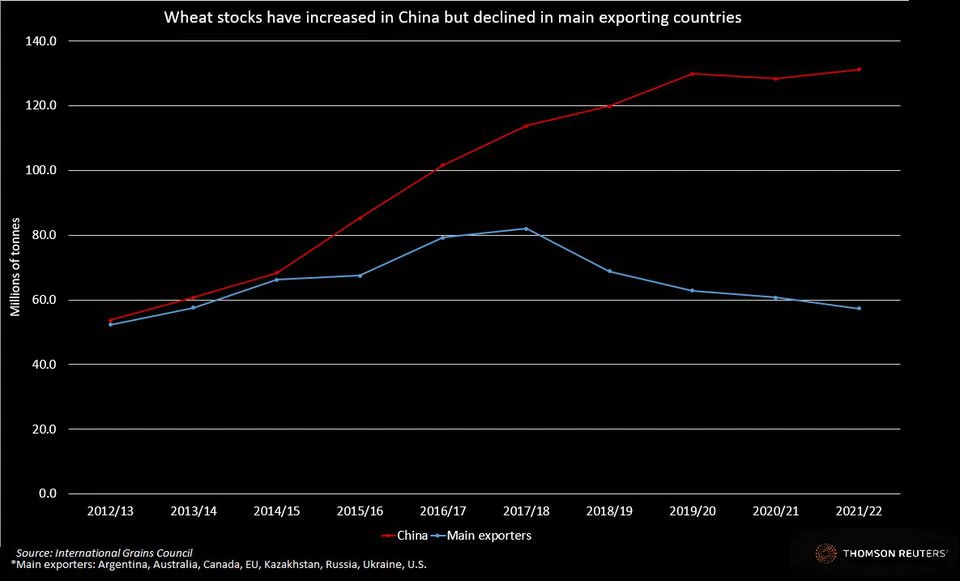
  • Stocks in major wheat exporters – the European Union, Russia, the United States, Canada, Ukraine, Argentina, Australia and Kazakhstan – are set to fall to a nine-year low of 57 million tonnes by the end of the 2021/22 season, International Grains Council (IGC) data shows.
  • If Russia and Ukraine are excluded, other major exporters account for 16% of global stocks or enough wheat to feed the world for less than three weeks.
  • Russia is a major low-cost exporter of many kinds of crop nutrients. “No other nation has the same breadth of readily exportable fertilizer supply,” says Alexis Maxwell, an analyst with Bloomberg’s fertilizer analysis and news publication Green Markets. “Their fertilizers move to all continents.”
  • ..in Russia, the share of imported seeds is almost 40%? And for potatoes, the share of imported seeds is 90%? That is, of course, farmers will come up with something over time, but at least in the short term, we should expect a shortage of basic agricultural products and a sharp rise in prices. And that’s not all either..
  • The Ukrainian planting season comes up in less than 4 weeks

Meanwhile, China has been slowly accumulating wheat for some time now:

I don’t mean to imply a doomsday picture of food shortages. I really don’t know. In this blog I talk about what I see and how it influences the decisions I make with my investments. These headlines and the details make me uncertain. And I always lean to cash when I am uncertain.

That said, I don’t want to be too short. We have seen so many bad things happen over the last two weeks. If something good happens the market could flip on a dime.

I mean, what if Putin is taken out? That would be great for the world, a relief for everyone, but probably less so for commodity stocks and (maybe…) shorts of everything else. It seems a low probability, but its not impossible. I think its important not be to positioned to get punched in the face if some “white swan” like that happens.

I want to be careful to all possibilities.

Meanwhile the shorts I hold have been so bad (which is to say good to be short) that I am left wondering how much lower they can go. These names (I’m talking mostly about SaaS/momentum/covid beneficiary stuff) go down every day, even when the market rallies. There has to be some sort of bottom at some point.

The shorts I am more inclined to keep are those that are economically sensitive. At this point I’d rather have that small short dependent on consumer spending that has seen its price appreciate to an unseen level during covid than I would the SaaS name that has already fallen all the way back to where it started and is still growing 30%.

You add it all up and you end up with more cash. Less positions and smaller positions. My portfolio had a good couple weeks. I’m back to the highs. I don’t feel like this is the time to press.

It is worth taking a step or two back from the action in front of your eyes. It is not going to matter if you miss the last leg up or down or if you don’t time the bottom to the day. There are times to take risk because you can see that the market is at your back. There are times not to, because the winds, while not necessarily in front of you right now, are swirling unpredictably and so you can’t be sure just how they will settle.

Most important, I would rather wake up each morning and not have to worry too much at all. Except for the Upper Colorado River snowpack of course. I’m okay worrying about that. Its going to snow there this weekend by the way, but I think it will not be enough. It will be an average year at best and that is not going to change the trend.