Skip to content

Summing up Earnings: Impac Mortgage, Rurban Financial, PremierWest Bancorp

In the next few posts I will summarize my thoughts on the quarterly earnings reports released so far for the companies I own.   In this post I am going to look at Impac Mortgage, Rurban Financial, and PremierWest Bancorp.  I will follow that up shortly with another post that looks at Radian Group, PVF Capital and Community Bankers Trust.

Impac Mortgage

In my post last week on Impac Mortgage, I noted the following concern:

In my opinion, the biggest short term risk is that the third quarter GAAP number disappoints. This could easily happen as a result of further charges to the repurchase reserve or mark to market changes to the trusts that overwhelm the profitability of the operating business. Given the run-up in the stock, a low GAAP number could cause some of the short term holders that haven’t looked closely at the businesses to run for the exits.

As it turned out my fear of a poor GAAP number was realized, but the strength of the underlying mortgage origination business was impossible to ignore, and the stock shot up higher anyways.

I was pleasantly surprised with the results.  The mortgage origination segment outperformed even my most optimistic expectations.  Lending volumes increased 33% quarter over quarter.  Earnings from the segment increased an astonishing 100% quarter over quarter.  Further, the company said on the conference call that October volumes were $290 million, which, if extrapolated for the entire quarter, would be another 22% quarter over quarter rise in the fourth quarter from the $709 million originated in Q3. Read more
Impac Mortgage: Where the money comes from

When I first bought Impac Mortgage (back at the beginning of August) it was on the basis of GAAP earnings (which were 50 cents per share in the second quarter), and revenue growth from the mortgage origination business.  Soon after, when I looked more closely into earnings, I determined that much of what was reported in GAAP was obscured by mark to market adjustments and a legacy business that is no longer operating.  Fortunately if I ignored these effects, the resulting picture was even better than the one painted by GAAP.

So I left it alone and went on to other things.

To digress for a minute, this is my process.  Once I feel like I have a clear answer on a stock, I don’t look too much further into the details.  When I look at a stock I look hard, and I usually come up with a fairly accurate picture, but after I feel able to draw a conclusion, I don’t spend a lot more time quibbling over the details.

I don’t have time.  I have time to look into maybe 2 stocks per week.  If I spent week after week evaluating a single security, it is simply inefficient.

Does this lead to mistakes?  Absolutely.  Sometimes I miss a key aspect that changes the equation.  But to mitigate mistakes I have learned to reevaluate when the market tells me I am wrong, and to act quickly when it turns out I am.  And actually, this has been one advantage of starting this blog.  There have been a couple of cases where readers have pointed out something that I have missed.  And I’ve saved money as a result.

Given the amount of time I have to allocate to investing, this remains, in my opinion, my most efficient process.  Study the business, figure out what the key drivers are and where problems are most likely to arise, evaluate those drivers and problems, make a decision and move on to the next one.  Take another look if things start to go amiss.

With respect to Impac, as the stock moved up from $2.50 to $10, I wasn’t that concerned with getting a better grasp on the specifics of earnings.  My initial analysis showed me the drivers, and they led me to conclude that the stock wasn’t even close to reflecting those drivers, and that was enough for me.

But now, with Impac hovering between $10 and $11, further analysis is warranted.  My intent below is to understand how each of the businesses that Impac operates generates earnings, and to compare the earnings generation capacity to GAAP, hopefully eliminating some of the confusion introduced by GAAP. Read more

Falling NIMs, Rising Mortgage Banking and two new bank stocks: Monarch Financial and PVF Capital Corp

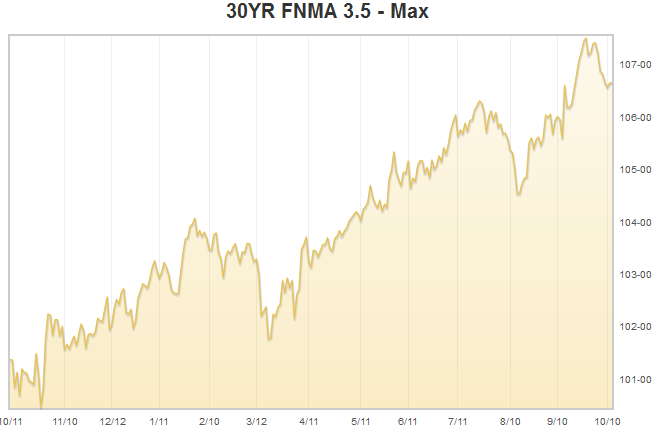
One consequence of the quantitative easing campaign that was initiated by the Federal Reserve is that is caused a rise in mortgage backed securities, and a corresponding drop in interest rates for those securities.  To illustrate, below is the 30 year Fannie Mae.

This drop in rates is bad for holders of MBS debt who depend on the yield that it returns.  As a consequence many mREITs have been under pressure.

To varying degrees banks are in same boat.  You saw this with the release of results on Friday from JP Morgan and Wells Fargo.  The subject was discussed here in the Financial Times.

But I think you have to be careful before painting all banks with a broad brush.  The extent of the damage depends on the percentage of assets that each bank has in securities in general and in mortgage backed securities in particular.  This can vary quite a bit, especially among the smaller community banks.

I have looked at each of the banks I own.  Most are not overly exposed to mortgage backed securities or to securities in general.  The table below shows the total investment security exposure vs. loan exposure for each bank, and then breaks down the investment securities by type. Read more

Week 67: Sitting Tight

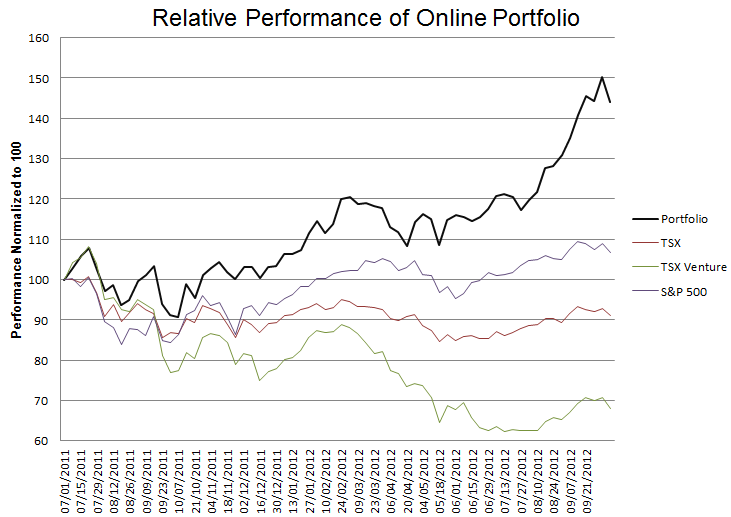
Portfolio Performance

Volatility

I always have a volatile portfolio.  I don’t think that there is any way to outperform the market and not be volatile.  If there is I haven’t found it.

Two weeks ago it soared up 6%.  Last week i gave back all of those gains.

Volatility is just something I have learned to live with.  The important thing is not to let it shake you out of your positions prematurely.  When you get skyrocketing stocks like Nationstar or Impac Mortgage they are bound to have fast and sharp corrections.  What I have to try to do, and what can be very difficult to do, is to divorce myself from the immediate price movement and simply ask myself the question of whether the story is intact and whether the value is reflected.

I am reminded of the following excerpt from Reminiscences of a Stock Operator:

I think it was a long step forward in my trading education when I realized at last that when old Mr. Partridge kept on telling other customers, “Well, you know this is a bull market!” he really meant to tell them that the big money was not in the individual fluctuations but in the main movements that is, not in reading the tape but in sizing up the entire market and its trend. The market does not beat them. They beat themselves, because though they have brains they cannot sit tight. Old Turkey was dead right in doing and saying what he did. He had not only the courage of his convictions but also the intelligence and patience to sit tight. Disregarding the big swing and trying to jump in and out was fatal to me. Nobody can catch all the fluctuations. In a bull market the game is to buy and hold until you believe the bull market is near its end.

Read more