Skip to content

My Take on Radian’s Quarter

Things continue to get better at Radian.  I stepped through  the news release this morning when it came out.  I really liked what I saw and when the stock opened weakly I checked my doubts at the door and bought a chunk more.  Below is the receipts from the practice portfolio I track here.
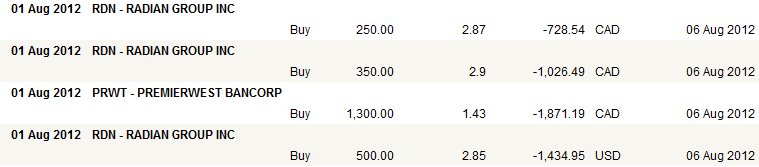
Having since reviewed the conference call transcripts and presentation slides, I am comfortable in my purchases.

But you have to ignore the GAAP number

Before I get into what the quarter was, first a little bit about what it wasn’t.  The first quarter operating results had nothing to do with what was posted in most of the headlines you read about Radian today.  You have to ignore the GAAP number.  Whenever you read a GAAP number in an article discussing the earnings of a mortgage insurer, I think you have to get more details about what’s going into it, and maybe question the intelligence of the source.  Because GAAP for an insurer is more often than not going to include mark to market adjustments that will dwarf the earnings or losses of the real business.

This quarter’s GAAP for Radian was obscured by the commutation (commutation is an agreement to make an up-front pay-out in return for the elimination of the exposure) associated with the default of insurance they had written on a large collateral debt obligation and 6 trust preferred securities .  The statutory impact (meaning in the eyes of the regulator) of these reductions in exposure was positive to the company, but because of the accounting oddity that is financial insurance accounting, Radian had to consider the impact to its own viability as a going concern when originally booking the expected loss on these securities, meaning  that the exposure was booked on the balance sheet for much less than the actual anticipated loss.  The result of the commutation was to realize the rest of the loss (less any net benefit Radian realized from the commutation) so they had to write down a$96 million dollar non-cash loss for the quarter.

And that’s why GAAP is generally a meaningless number for the mortgage insurers.

Radian explains their reserving methodology

So getting past GAAP, my biggest reservation about Radian has been whether they have booked sufficient reserves to meet their claims.  In particular, Radian has always booked a surprisingly low claim rate on loans that have been delinquent for 12+ months.  As the slide below (from the Q2 conference call presentation) shows, Radian is anticipating a 57% claim rate on the bucket of loans that have been in default for 12 months or more.  This number drops to 47% when you account for rescissions  and denials of those claims.
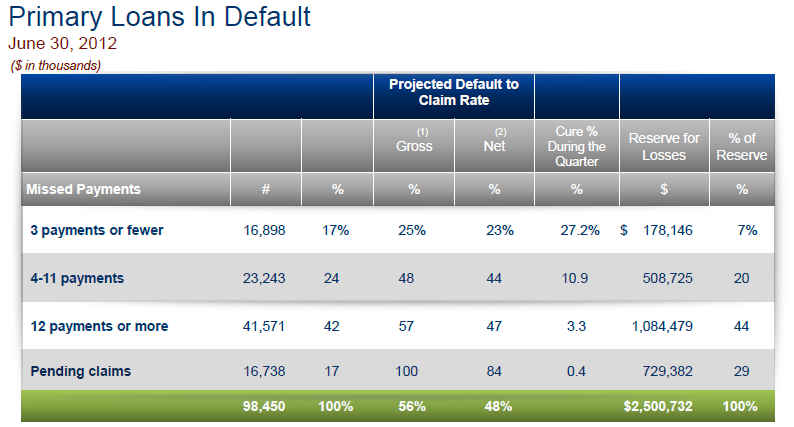
Now intuitively, the idea that a loan that has been in default for the last 12+ months only has a 57% chance of resulting in a claim seems somewhat absurd.  But Radian has stated on numerous occasions that this is what the historical numbers show.  During the conference call today Radian provided some numbers to help back up that claim.
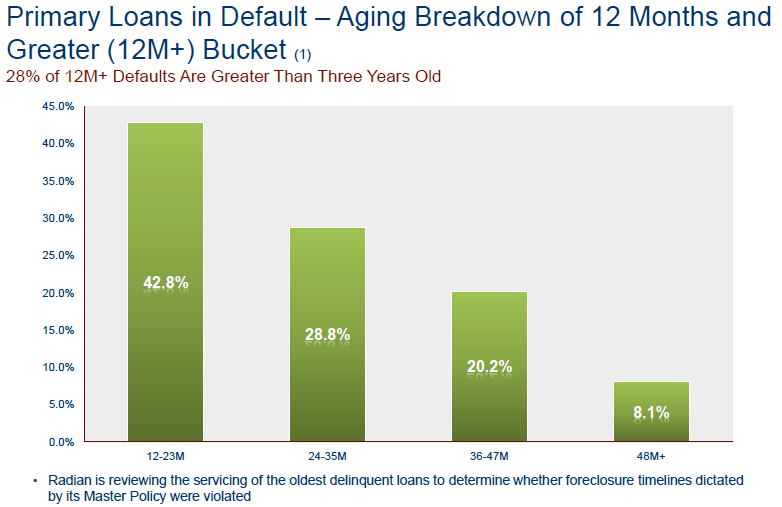
Radian provided the above breakdown of the loans in the 12+ month bucket.  28.8% of that bucket have been in default for 2-3 years.  Another 28.3% have been in default for 3+ years.  In addition, the company pointed out that “many of our older delinquencies remain in the early stages of resolution, meaning that no foreclosure action has started.”

Clearly these loans are broken.  I mean there is a servicer at the other end of these loans and that servicer has every interest to get that loan through to foreclosure as quick as possible.  I find it hard to believe that there are servicers out there eating the costs on defaults for 2+ years before getting the loan foreclosed on.

This is the basic argument that Radian has made in the past.  If 57% of the loans in 12+ month bucket have been around for 2 years or more, then clearly something else is going on.  And if something else is going on, then maybe the expectation that 43% of those loans aren’t going to result in a claim is not such a bad one.

What was really interesting was that the company provided a bit more color than usual with respect to how these late stage lingerers may never result in a claim against Radian.

Based on our preliminary analysis, we believe that a meaningful percentage of these delinquencies, to the extent they do become claims, will be subject to claim curtailments or denial and thus will not become fully paid claims.

You can see in the footnote on the above slide that Radian is reviewing some of these older defaults to see whether they have breached the  time limitations.  On the conference call one of the questions was with respect to this, and Bob Quint (CFO) expanded on this by saying:

Yes, we mean, we — the servicers are required to begin the foreclosure within 6 months from the default and then may have 1 year to perfect the claim after that. So those are the general time frames within our master policy. Now of course there could be some things within the law that extend that, but those are the general guidelines. So we’re really looking at 18 months from default that the — that’s the time frame: the 6 months plus the year.

If I understand what he is saying correctly, it suggests that potentially a large number of the claims past 18 months due could be in breach of the master policy and therefore not valid for claim.  Of course, going back to the original slide, that means that some 57%+ of 12+ month.

So this helps. Now I understand the mechanism by which these late stage delinquencies can be written off without claim.  Perhaps I can rest easier about this… well at least a bit.

Provisions down sequentially and year over year

Another pleasant surprise was that provisions on the mortgage insurance book was down sequentially (from $234 million to $208 million).  Based on the company’s first quarter guidance and comments I had really thought this number would be up quarter over quarter.  That is was down was encouraging.  The company did not, however, reduce their provision guidance for the year, deciding instead to leave it at $1.1 billion.  However when pressed on the issue in the Question and Answer Quint seemed to buckle a little to the point that they might be sand-bagging this one a bit.

Premiums down as well

I was a little surprised that net premiums earned were down from the first quarter.  At first I thought this was simply margin compression. Radian wrote a lot of business in the quarter, and the net insurance written was up some $3 billion, so for overall premiums to be down the old business running off must have a higher premium than the new business.  Radian is taking market share, after all, and so it wouldn’t be too unexpected if the company was doing so by shrinking their margins.

But I think that the larger impact is re-insurance.  Some of the premiums are getting redirected to the reinsurance companies.    You can see when you compare insurance in force with risk in force.  Insurance in force expanded to $130.4 billion in Q2 from $127.5 billion in Q1.  But risk in force dropped from $33.2 billion to $31.9 billion.  The difference is reinsurance agreements that Radian has entered into.

But even if margins are being compressed some, I am not overly worried about it.  Margins have expanded significantly since pre-2008 when the mortgage and financial guaranty companies were writing business with 20 basis point margins.  Radian looks like they are writing it with 55-60 basis points now.  Of course only time will tell if this sort of margin is sufficient, but I am willing to bet that it will be.

And that leads me to my second point.   I am fairly confident that the business being written now is going to turn out to be great business in the long run.  With credit being as tight as it is, with the US having gone through its consumer debt binge and bust, with the business being 99% prime, 75% with 740+ FICO scores, and only 1.3% with loan to value of greater than 95% I just think we are in a new world here where defaults on new loans trend below rather than above.

Its also not clear how much of the margin compression is due to a move down the risk ladder.   If Radian insures more loans in a quarter that have lower loan to values, and from borrowers that have higher FICO scores, premiums are going to come down but that does not necessarily mean the company is taking on more risk.

Keep-in on writing business

Remember that as I wrote a couple weeks ago, the insurers are like movie stars trying to outrun the fireball of their legacy book, and the only way that they stand a chance of doing this is if they keep running by writing new business.  Indeed Radian continues to write a lot of new business.  In addition to the $8.6 billion in new insurance written in the quarter, Radian wrote another $3.4 billion in July.  This is the 7th month in a row that Radian has wrote an increasing amount of new business.
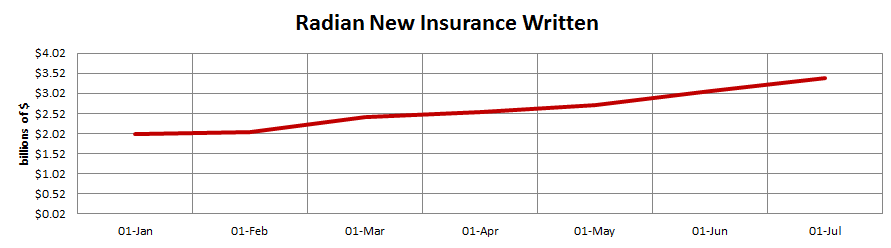
I think that Radian’s strategy of writing as much business as they can, taking market share, and growing, is exactly the right one.  I mean clearly this is an example of doubling down.  They bet on insurance in the early and mid 2000s and that bet bombed, and so they basically have the choice of walking away (which would likely result in little or no equity for shareholders), or leveraging up and hoping the new business can outweigh the bad.  They are leveraging up.  As the company pointed out on the conference call today:

If the pace of our new business volume continues, we expect that, by mid-2013, our book of business written after 2008 will be larger than the book written in 2008 and prior.

I like where this is headed.  As I said, I decided to buy more stock today near the open.  Now we’ll see how it plays out.
Three Community Banks worth keeping an eye on Part II: Shore Bancshares

I owned Shore Bancshares earlier this year but don’t own it now. It was one of four banks that I bought back in January when I jumped into the community bank sector whole heartedly. While the other 3 banks I bought worked out to various degrees, Shore did not, and I sold out shortly after the first quarter results came out for a small loss.

At the moment I’m out, but Shore is not forgotten. I continue to review the company’s results and look for an improvement that would justify an entry point. Looking at the second quarter, while the eventual value proposition is still there, the company doesn’t seem to have quite turned the corner just yet.

Shore operates 10 branches in Maryland and 3 branches in Delaware. The majority of its lending activities revolve around the commercial and residential real estate market in these regions.  Shore has a particularly high percentage of commercial real estate loans.  Of the company’s $819 million in loans at the end of the first quarter, $315 million were commercial real estate, while $309 million were residential real estate and another $114 million were construction loans.

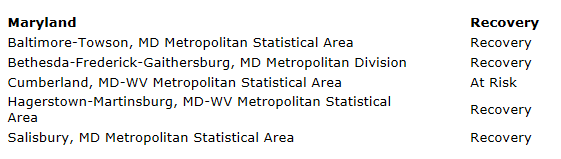
The loan book has been hit by the downturn in the economy in Maryland. Maryland’s economy is not doing badly, but it is also not doing particularly well. The economy has pretty much mirrored the US as a whole. Below is an Economy.com table of the key economic regions in Maryland. The table denotes each area as either being in recession, being at risk, being in recovery, or expanding.

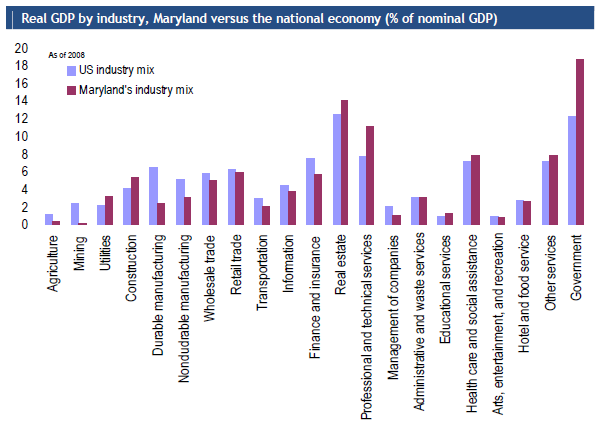
Another informative research piece on Maryland’s economy was put out by JP Morgan. One point made that I found of particular note (and that is illustrated in the chart below) is that Maryland (not surprisingly) derives a larger than average percentage of economic activity from government.

This would have to be considered a headwind to growth going forward. As one Baltimore economist put it:

We know the decline in federal government outlays has just begun,” said Anirban Basu, a Baltimore economist. “The economic outlook, I think, is pretty grim.”

The article goes on to point out that “because Maryland gets a disproportionate share of federal contracting dollars and other spending, it’s likely to feel a harder hit from any reductions [in government spending]”

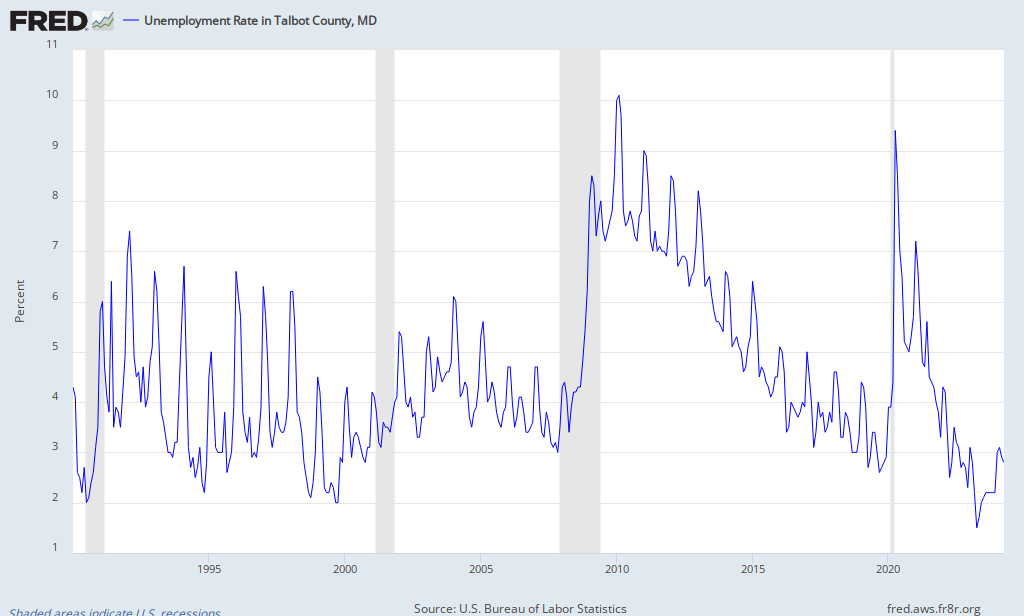
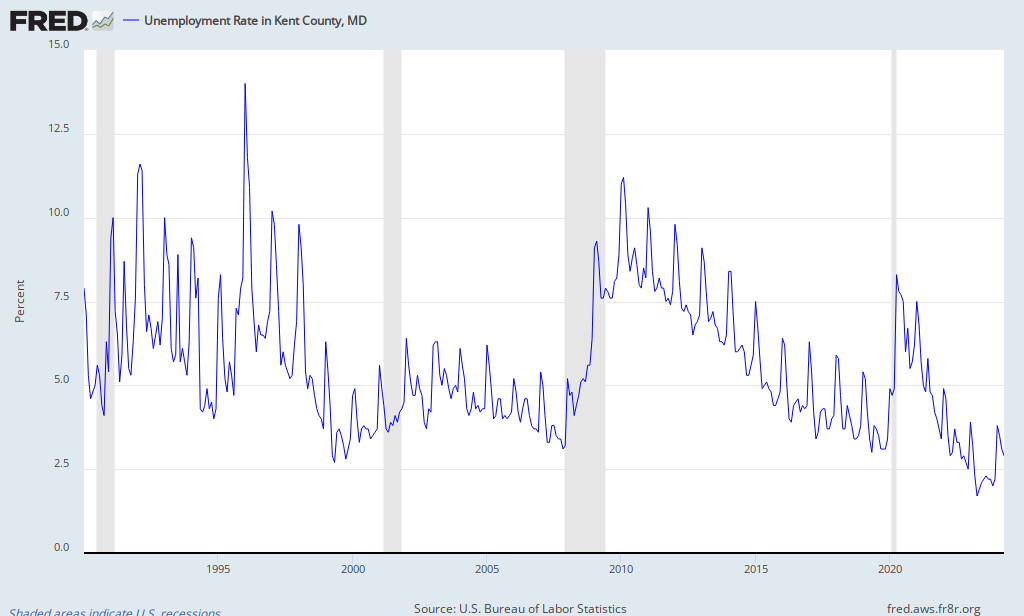
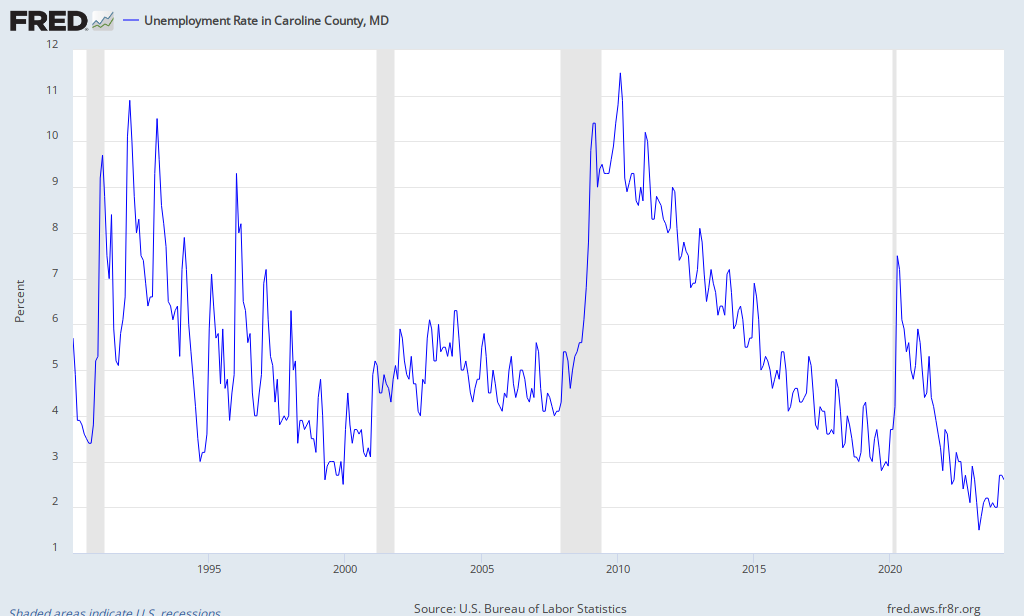
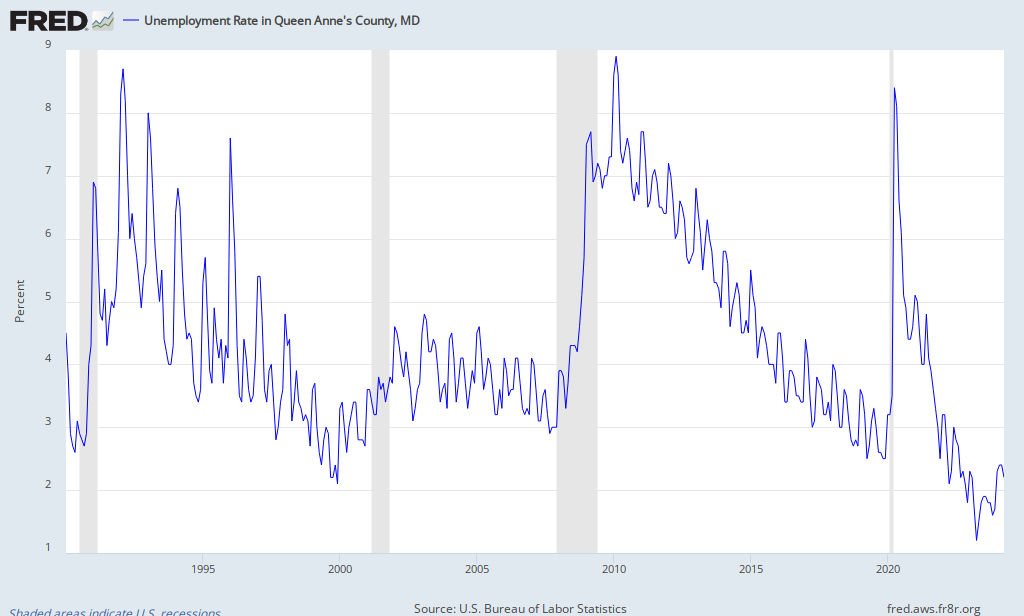
To drill down a bit further to the counties Shore operates, (Talbot, Dorchester, Kent, Caroline, and Queen Anne’s), you can see from the following unemployment charts that each fairly closely mimics the experience of the US, with some improvement from the worst levels of 2009-2010, but still an elevated unemployment level.

Talbot

Dorchester

Kent

Caroline

Queen Anne’s

The economic malaise shows up in the impaired loan book. Shore has $33 million in impaired construction loans (28.9% of outstanding), $30.9 million in residential real estate loans (9.9% of outstanding) and $30.6 million in impaired commercial real estate loans (9.7% of outstanding).

The problem with Shore remains what it has been for the last few years. How much longer will economy lead to deterioration of the loan book deteriorate?

Company CEO W. Moorhead Vermilye did not paint a terribly encouraging picture in his second quarter comments:

“The operating environment remains tough as we are not yet seeing a meaningful upturn in the real estate related activities that drive the Delmarva economy. We continued to work diligently to resolve and dispose of problem loans, as reflected in a higher level of troubled debt restructurings this quarter,”

So those are the negatives, and why I am not ready to buy Shore just yet. The positives with Shore is its valuation is compelling in the event of a recovery.

The potential when Shore recovers

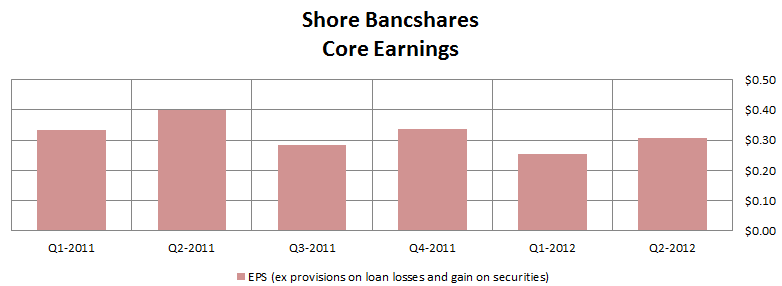
A great deal of the current problems are priced in the stock. Shore has a tangible book value of over $12 per share.  Its trading at less than half of book. The underlying earnings potential of the franchise remains strong; if you ignore the effect of all the onetime charges due to bad loans, the underlying banking business (ex provisions, one time charges, and gains) has been producing earnings at over a $1 per share clip for the last few quarters.

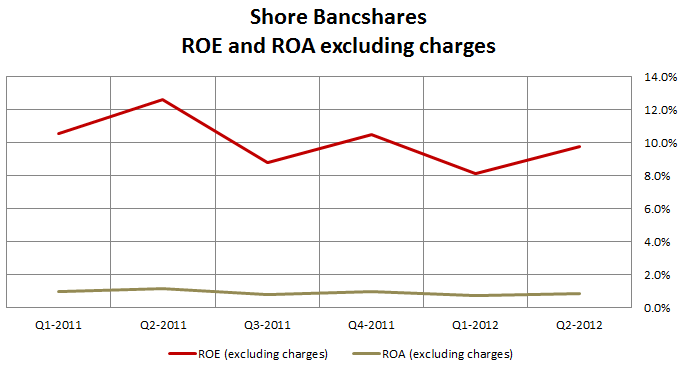
But even this may underestimate the earnings power of a stabilized Shore. Again excluding the onetime charges, ROA and ROE are solidly below where they were before the financial collapse. This suggests to me that once (or I guess if) the bank has its problem loans under control, they can embark on a cost reduction strategy to size the bank to the new level of business.

You can see the same influence if you look at the efficiency ratio, which has been hovering around 100% for the last six quarters.

Not quite there yet

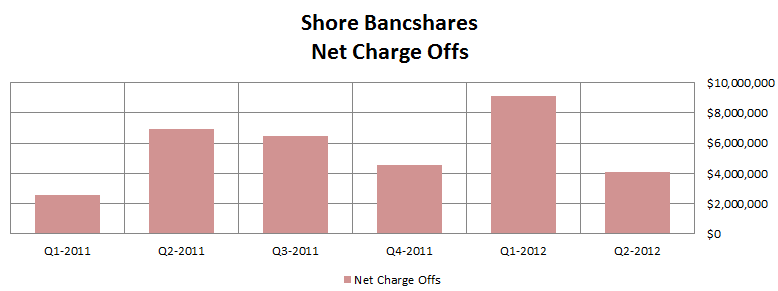
One positive for the second quarter was that Shore did see a significant reduction in charge-offs.  Charges were cut to half of what they were in Q1, extending the previous downtrend that had been in place before Q1.

I would be more excited about this reduction in charge-offs if nonperforming assets had shown an improvement. Unfortunately they did not.

Until I begin to see a leveling off and ideally a drop in the non-performing assets, its difficult to make a move into the stock.

Other risks

Apart from the economic risks I already outlined and the presumed impact on the loan book, there really isn’t a lot else to worry about with the business. Reading through the risk factors of the recent 10-K was mostly an exercise in the plagiarisms of the standard banking risk fare:

  1. Concentrated Commercial real estate loans are being affected by the economic downturn
  2. Interest Rates falling
  3. The market value of their investment portfolio declining
  4. Competition
  5. Funding Sources
  6. Key Personnel

The only item of any concern is the one I’ve already highlighted.  Their loan portfolio, and in particular their commercial real estate portfolio, needs a strong economy to right itself.  Its really just a wait and watch until the bad loan book stabilizes.

Waiting on my hands

The reason I am reluctant to buy Shore is because until they start to see a sustained downward trend on their nonperforming loans, the company remains at risk for panic. We saw that panic back last fall when the stock fell into the mid-$4s. It could happen again with the right confluence of European and US financial worries. Rightly or wrongly, the stock will likely remain range bound until the book turns around, and we won’t begin to see that until at best October, when the next quarterly is released. I, before then, the stock dropped another 15%, which would put it in the $4.50 range, I would be tempted to buy. Absent that, I will wait patiently on my hands.

Three Community Banks worth keeping an eye on: Part I

For those of you new to this blog, I have been investing in community banks since early 2011.  I described my foray into the sector in this post,  almost a year ago today.  To reiterate:

I got introduced to the idea of buying regional banks stocks about 6 months ago.  Two separate catalysts piqued my interest in the idea:

  1. Last summer I read the David Einhorn book, “You Can Fool Some of the People All of the Time”.  In that book, which is about a fraudulent business development company called Allied Capital, Einhorn spends a chapter outlining his investment philosophies.  One of the ideas he puts forth is investing in mutual holding companies.   Seth Klaman has been another proponent of investing in MHC’s.
  2. Tim Melvin’s trade of the decade.  Melvin, a fairly well known value investor, believes that the small regional bank stocks have been beaten up well beyond what is justified and that their recovery represents the trade of the decade.

I’ve had some good luck investing in community banks over the last year.   Some have turned out extremely well (Rurban Financial (RBNF) and Community Bankers Trust (BTC) have been more than doubles).  Others have been less prolific (Oneida Financial (ONFC),  Home Federal Bancorp of Louisiana (HFBL), Shore Bancshares (SHBI), Atlantic Coast Financial (ACFC)) but generally I have gotten out of with either a small loss or a small gain.  One of my biggest mistakes has been a lack of patience; indeed if I had held onto Oneida and Home Federal, I would have seen 20% gains from my purchases last year.

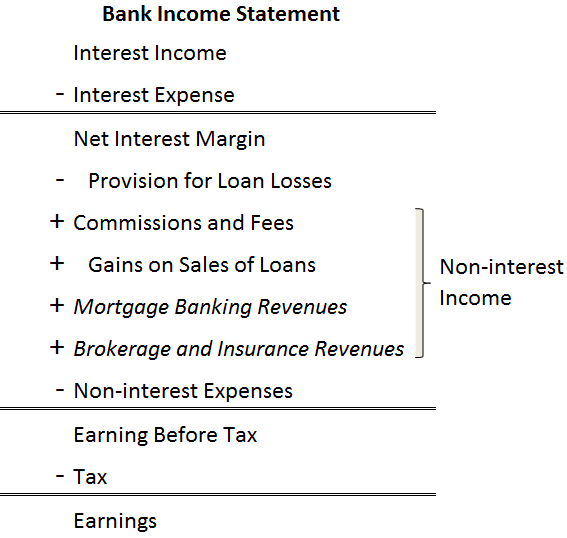
Community banks are simple businesses.  It makes them easy to compare and evaluate, and relatively straightforward to project into the future.  A community bank income statement generally looks like this:

Banks earn interest on the loans they make and the securities they buy.  The extent to which the interest earned exceeds the interest paid on funding (for community banks the vast majority of funding is deposits) is the banks margin, called the net interest margin.  With only a few other wrinkles, such as revenues received from originating and servicing mortgages, or in some cases from running insurance or investment wings, the degree to which the net interest margin exceeds the expenses associated with running a bank (called non-interest expense) is the profit of the bank.

How I’ve made money on the banks

There are plenty of solid banking franchises  trading at reasonably cheap prices.  You can probably make 10-15% per year by buying well run banks with low levels of nonperforming assets and reasonable return on assets and equity, and socking them away.

This was how I started with my own banking investments.  The first three banks I bought were Oritani Financial Corp (ORIT) Oneida Financial (ONFC), Home Federal Bancorp of Louisiana (HFBL).  Each is a solid franchise, each has a low level of loan losses, and each trades at or near tangible book value with decent returns on assets and equity.  I’m sure each will continue to go higher over the long run.

But I am always in the pursuit of the best returns and those are usually found a little further up the risk ladder.   One of the basic premises of my investing strategy is that while the price of risk is ultimately assigned by the market, the perceived quantity of risk involved varies, and can be reduced by research, critical thinking and sweat.

Going further up the risk ladder meant looking at banks that most investors would shun.  I studied the banks that had been hit the hardest by the financial crisis.  While a bank with non-performing loans above 3% is generally considered of questionable quality, I started looking at banks with 8-10% non-performing assets.  While banks with return on assets of 1% and return on equity of 10% might be thought to be worth considering, I looked at banks with negative returns, shrinking assets and dwindling equity.

This tact has proven to be fruitful.  Three stocks that I have bought have resulted in above average returns.  Two of them, Rurban Financial (RBNF) and Community Bankers Trust (BTC) have been in the neighborhood of a double so far.  The third, Bank of Commerce Holdings (BOCH) returned a quick 30% before I took the position off, though I am looking at adding it back at the right level.

My one regret has been not to have taken more positions in banks.  To give a couple of examples of banks I looked at but just couldn’t get comfortable with, First Financial Northwest (FFNW) has doubled from $4 to $8 in the last year and a half, while Heartland Financial (HTLF) has nearly doubled since last fall.

But even with some of the moves we’ve seen I think there is still more to come.  As the economy recovers banks should see improvements to their loan book and strengthening margins on the securities they buy.  And I continue to believe that the banks most likely to outperform will be those that were hit hard during the recession but that managed to survive.

3 Banks I’m Looking at

I have my eye on a number of banks that meet these criteria.   There are 3 in particular that I have been looking at this weekend.  While I am not quite ready to pull the trigger on any of the three, I am getting close, and I think the ultimate upside once they work through their books of problem loans is a multiple of the current share price.  I am going to look at each one individually in the upcoming 3 posts.

  1. Shore Bancshares (SHBI)
  2. Premierwest Bancorp (PRWT)
  3. United Community Bancorp (UCBI)

Next up will be a post on Shore Bancshares shortly.

The OceanaGold Gamble

I first bought OceanaGold at $1.80 at the end of May.  I originally bought it strictly as a trade.

The price subsequently moved up and I added to the position twice, first at $1.98, and later at $2.14.  You’ve heard me say it before – do more of what’s working and less of what doesn’t.

Well sometimes that backfires.   When gold got pummeled in mid-June, my position in OceanaGold got hammered back below $2.   It happened so quickly that I did not have time to react, and I ended up losing all of my profits and a little more on top of that.

Such is the difficulty of owning a trading stock with a secular thesis.

From that time until this week OceanaGold didn’t do much of anything.  It sat in the 1.80’s, would briefly rise into the 1.90’s but never for more than a few days.  I held, not wanting to sell near the low without justification and not having the time to do the work I needed to do to get that conviction.   But over the weekend (last weekend), I stepped through their recent reports and presentations, made a few runs at their numbers, and I decided I might just stick this one out.

Two reasons to stick it out

OceanaGold had a terrible first quarter.  Costs were up and above $1000 per ounce.  Production was down over 20%.  The mines that it is currently operating in New Zealand have been struggling with costs pressures for some time now.  But the first quarter was particularly bad.

Part of the bet I was making when I bought OceanaGold at $1.80 was that the first quarter was an aberration.  And, having stepped through that first quarter in some detail now, while I don’t expect costs to drop back to pre-2011 levels, I do find it plausible they they fall back into the low $900’s an ounce.  Similarly, production could easily return to 60,000 ounces plus per quarter.  The progress made in its second quarter earnings release on Thursday suggests this just may be in the process of playing out (note that I wrote most of this post before the Q2 earnings were released so I won’t be talking in detail about them).

The other part of the bet on OceanaGold is the expectation that the company will be reevaluated for the better once the Didipio project begins to produce substantial ounces.  Because of the by-product credits from copper production, Didipio will produce gold at negative cash costs for the first couple of years.

Let”s step through this two-pronged thesis in more detail.

Production Costs should come down

Productions costs on a per ounce basis were bad in the first quarter and they have been rising for some time now.

When you look closely at the rise in production costs over the last number of quarters you can attribute the rise to essentially 3 factors:

  1. Rise of the New Zealand Dollar
  2. Fewer Ounces produced
  3. Changes in the amount of the total costs that can be amortized as pre-stripping

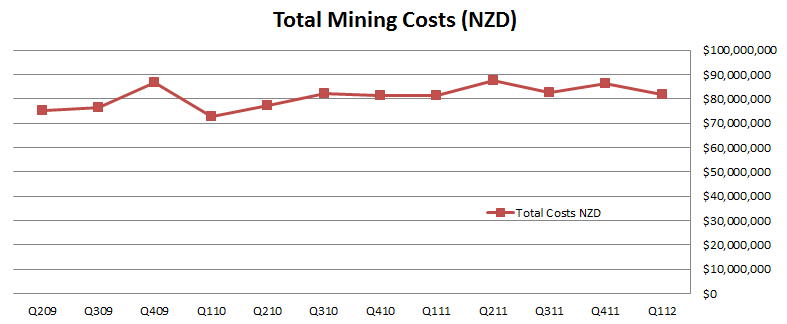
I was quite astonished by just how much of the company’s costs increases could be attributed to these 3 factors.  In fact all of it.  If you look at the total operating costs in New Zealand dollars over the last few years, including costs that were amortized as pre-stripping, they are remarkably flat.

Note that I did this work before the Q2 earnings release so it is not included in the chart.

What the chart illustrates is that this a story of a company dealing with cost pressures due to their local currency appreciating and the natural evolution of the mine plan with changing grades and changing strip ratio.

Looking ahead, I don’t expect much further appreciation of the New Zealand dollar.  With a global slowdown at hand, it seems reasonable to expect the NZD to weaken against the US dollar.  The fewer ounces produced has been a function of various issues that occurred in Q1.  There were issues at the Macraes open pit, at Fraser underground and at Reefton.  The good news is that it appears the company made progress on all fronts in Q2 (production in Q2 was 55,000 ounces versus a little over 50,000 ounces in Q1) and expects production back to normal (which would be around 60,000 ounces per quarter) by Q3.  As the above chart of total costs  indicates, costs per ounce are primarily a function of ounces produced.  A return to 60,000 ounces per quarter would show a drop in costs to about $900 per ounce.

Didipio

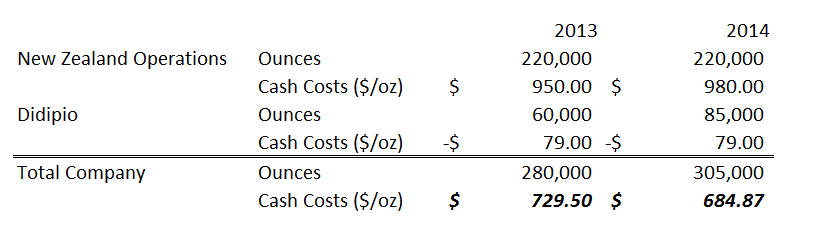
The other part of the bet on OceanaGold is the expectation that the company will be re-evaluated once the Didipio project begins to produce ounces. Because of the by-product credits from copper production, Didipio will produce gold at negative cash costs for the first few years and over the life of the mine cash costs will be substantially lower than the existing New Zealand operations.  This is going to dramatically bring down corporate cash costs.  I expect that analysts will be more inclined to give OceanaGold an average mid-tier multiple once their cash costs settle in-line with other mid-tier producers.

In the table below I have estimated the impact of Didipio on corporate cash costs in 2013 and 2014.

By way of analogy, consider Agnico Eagle.  In the first quarter (again I wrote most of this post before second quarter numbers were out) Agnico recorded cash costs of $594/oz.  Agnico’s largest mine in terms of gold production for the quarter was Meadowbank, which produced 79,000 ounces for the quarter.   Meadowbank produced those ounces at costs of $1,020 per ounce.  Taken alone, Meadowbank would be a high cost producer and receive a low multiple.  But Agnico offsets the high costs at Meadowbank with costs of $278/oz at Pinos Altos and $216/oz at LaRonde.

Looking at the latest BMO report on Agnico Eagle, I note that the company gets a cash flow multiple of 10x.  This compares to OceanaGold at 4x cash flow excluding Didipio and 2x cash flow including it.

Clearly, there is room for an upside re-evaluation.

Gold Price

The last factor that is going to determine the future direction of the share price is the price of gold.  I have some thoughts there, but I am not going to go into them in detail here.  Suffice it to say that this is the piece of the puzzle that I am least confident about.  Its unfortunate that I am so uncertain about whether gold will continue to rise or whether it will stall out and potentially fall.  Because given the other factors at hand, OceanaGold would seem to be a good place to build a large position at today’s prices.