Skip to content

On the trials and tribulations of owning gold stocks

About a month ago I wrote the following in an email to a friend:

I probably seem crazy to be chasing gold stocks in and out like I have.  I’ve been wrong over and over.  But I’m not losing much money doing it because I keep selling before it gets out of hand and I know from experience that when they move up they will move so fast and you have to be ready for it.  What we saw in January was nothing, in the past I have had stocks triple in a month when they move.  They can move so fast in such a short time its crazy.

At the time I was getting mucho frustrated and more than a little despondent about the reaction of the gold shares.   Gold stocks were being sold indiscriminantly.  Even though the price of gold was holding up rather well, the stocks of the companies that produced gold were being trashed.  For those companies that only explore for gold, the thrashing was even worse.

I follow a few rules for investing.  One of those rules is to never add to a losing position.  Another rule is to scale out of stocks that are not doing what I think they should do.  A third is to mind the intraday reversals.  The consequence of following these rules with the gold stocks is that I have bought in and been bounced out of these companies a few times over the last couple of months.  I have owned Aurizon Mines, Lydian International, Golden Minerals, Barrick Gold, Newmont Mining. I now own OceanaGold and Agnico Eagle in addition to a large position in Atna Resources and Gold Standard Ventures and (sigh) Canaco that I have held throughout.

While my furstration has left me tempted to walk away from gold completely, the reasons I didn’t give up was three-fold.

First, I just can’t get past the conclusion that the underlying condition of the world right now should be favourable to owning gold and gold stocks.  World economies are weak and weakening, and along with it so are the inputs to gold mining.  Interest rates are near zero, which means that alternative paper investments (bonds) do not have their usual yield advantage over gold.  Central bankers have shown a bias towards printing money to avoid lengthy recessions and prevent a destabilizing banking crisis.  Debt in the developed world is still high historically.

In this environment the perception of gold should be favorable, and its perceived value in units of paper currency should increase.  The truth is that the price of gold is based on perception.  I think that is why you have such wild fluctuations in both gold and gold stocks.  Its because gold has no value apart from the value that man has historically perceived in it.  And its difficult to nail that down.  I am starting to get tired of the term, but to say that gold is the existential commodity is really not very far off.

Second, the gold stocks are cheap.  They are trading at multiples that I didn’t think gold stocks would ever see.  Newmont and Barrick have been down as low as 8x earnings.

As well, with economies slowing, I think we are finally going to see the benefit to gold mining from lower energy,  labour and capital costs.  It has become so common for a gold company to report escalating operating costs, or increase the estimate of capital costs to build a new mine, that it is now almost expected by the market.  But these costs do not rise in a vacuum.  They rise because energy, copper, steel and labor prices have been rising.  As economies around the world slow, this effect is reversing.  We should begin to see that effect in the second quarter numbers, where cash costs beging to show decline.

The third reason that I didn’t give up on gold stocks is because I know that when they turn, they turn hard.  I have been on the outside looking in before when this turned happened.  I have learned that it is extremely difficult to buy a stock when it has risen a significant amount in a short period of time.  In the same manner that gold stocks have fallen day after day for months, with seemingly no support, they can also do the opposite, and rise very quickly and dramatically in a short period of time.  The only way I have found to take advantage of this, given my own constitution, is to be in before the rise begins

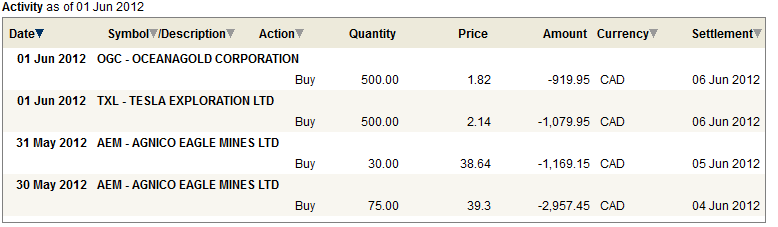
In my update last weekend I noted that I had bought a position in OceanaGold and in Newmont.  This week I added to OceanaGold and initiated a new position in Agnico Eagle:

I finally had timing on my side with these purchases.  Yesterday gold and gold stocks took off after the dismal employment report.  I was pleased that in my review of the carnage after the market closed, that because of the outperformance of the gold stocks, I was actually up a reasonable amount in my portfolio.  This despite the fact that Newcastle and PHH got clocked pretty hard, and the oil stocks I own, Mart, Equal and Pan Orient succumbed to the pressure of falling oil prices and oil stock malaise.

Is what happened yesterday the sort of rise I have been waiting for?  While it feels like it to me, its impossible to say.  What I do know is that the underlying conditions in Europe have been supportive of a rising gold price for some time now.    To say that gold must fall with Europe (presumably because of margin calls) can only be taken so far.  There are only so many margin calls that can be made before no one is on margin any more.

I have listened to twice and would highly recommend this interview given by Donald Coxe on the James Pulplava Financial Sense news hour. He said the following:

With the great gold mines they have 20 or 30 or 40 years of reserves and you are getting it for free.  Gold prices voer the longer term are bound to go up.  You don’t have to pay via a call option to own gold in the future, you are getting it for free with these great gold companies.  This is an amazing investment opportunity.  All you have to say is, it won’t be an amazing investment opportunity if no governments are running deficits, if the money supply growth is not above 3.5%, in which case you should not own gold.  If that is what you believe is likely then you should not own gold.  On the other hand if you believe that is about as likely as an invasion of spaceships from some remote part of the milky way, which is my view, then you should be owning gold.  And the best way to do that is by owning the gold mines.

Before today the concern about gold, I think, was that the American economy was on the cusp of a robust recovery and quite truthfully, if the US can grow sustainably, it can solve a lot of its problems.  What the job report yesterday suggested was that the recovery is not robust.  It needs to be understood that there is the possibility that the US just continues to muddle.  The job report today does not mean that the US is collapsing, as the stock market and bond market seemed to suggest it was.

The bottom line, I think is that gold is an asset negatively correlated asset to paper currencies, and as paper currencies lose their perceived value, gold must benefit.  Gold miners remain a very cheap way to take advantage of this idea.

Stepping through the Nationstar Mortgage Income Statement

I have spent the last couple of nights reviewing the first quarter (and first ever) Nationstar Mortgage financial statement.

While the statement is not overly complex, it does have a few tricks.  At the end of the day, I am trying to determine an earnings estimate for each business segment.  To do that, need to make sense of the each of the line items that constitute the GAAP earnings, and then decide which are legitimate revenues and expenses, and which are just accounting items that need to be excluded.

What is the Business of Nationstar?

Nationstar operates three businesses:

  1. Mortgage Servicing
  2. Mortgage Origination
  3. Legacy Business

Through the mortgage servicing business Nationstar services a portfolio of loans.  The portfolio consists of loans that they have originated, loans for which they have bought the servicing rights from another party, and loans that they have agreed to subservice for a set fee.  Nationstar collects principal and interest payments and generates ancillary fees related to the mortgage loan.  In return Nationstar receives a fee, usually defined as a percentage of the unpaid principle balance of each loan.

The mortgage origination business originates residential mortgage loans.  Most of the loans that Nationstar originates are qualifying loans, meaning that they are eventually bought by and securitized through one of the GSE’s (such as Fannie Mae or Freddie Mac).  Nationstar runs this business as as feeder for their servicing business.  The vast majority of the loans originated are refinancings of existing loans that Nationstar previously serviced.

The legacy business consists of a number of legacy portfolios.  The portfolios  of what are basically pools of mortgage loans whose cash flows pay interest and principle to note holders sit on balance sheet and are in run-off.

Why you can ignore the legacy Business

Each portfolio of loans and its related outstanding notes under the legacy business segment constitute what is called a variable interest entity (VIE).  According to the GAAP accounting rules, Nationstar has to carry VIE’s on its balance sheet and consolidate the profits and losses of on its income statement.

According to GAAP, the rules for consolidating a VIE is such that if Nationstar is the primary director of activities of the entity and if Nationstar holds a beneficial interest or obligation to the entity, they must be consolidated on the books.  Nationstar meets these criteria and so the entities go on the balance sheet.

Yet in Nationstar’s case, the liabilities are non-recourse to the company.  Thus Nationstar is not liable for any losses that these entities incur.   This makes the consolidation somewhat misleading. The losses experienced by the VIE’s are not transferrable to Nationstar, even though they pass through the income statement like they are.

I decided to take a bit closer look at these VIE’s to understand exactly what they are and make sure they weren’t boogey men in the closet.

Nationstar accounts for the VIE’s with the following assets and liabilities on its balance sheet.
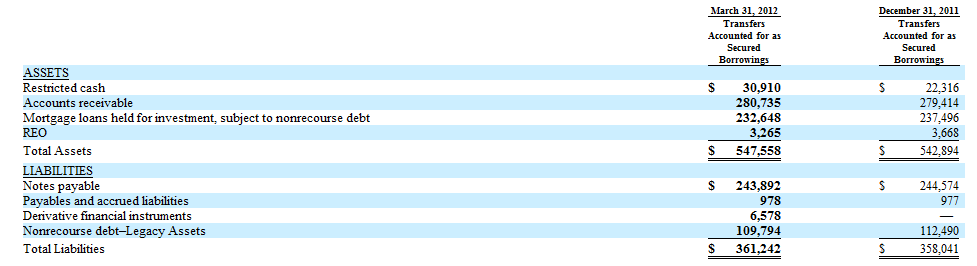
The VIE’s are of two types.

  1. Securitizations of residential loans transferred to trusts
  2. Special purchase entities (SPE)

In both cases, Nationstar is considered the director of activities because they are the servicer of the mortgages that make up the assets of the entity.  So that’s the first criteria met.  In the case of the securitizations, Nationstar has retained one or more of the subordinate securities from the securitizations, and so this qualifies them as holding a beneficial interest.  In the case of the SPE, because Nationstar remains in control of the mortgages transferred.  The result is that in both cases these entities must stay consolidated on the books as per GAAP.

But the key point is that the debt holders do not have recourse to Nationstar.  The assets within the VIE’s structure are the only assets that can be used to repay debt.  So in reality, the VIE is quarantined from the rest of the balance sheet.

The other side of the coin is that Nationstar may be able to see income from the interests they do retain in these entities.  However this is unlikely.  That’s because the entities are full of a lot of non-performing mortgages that were originated before the mortgage market blew up.  Nationstar says the following about their prospects in the last 10-Q:

As a result of market conditions and deteriorating credit performance on these consolidated VIEs, Nationstar expects minimal to no future cash flows on the economic residual

With no likely benefit from the VIE’s, and with all losses experienced by the VIE non-recourse to Nationstar, there is basically no reason to consider the VIE in any evaluation of the company.  And that is what I plan to do here.

The Mortgage Servicing Business

I’m going to start the analysis of servicing by providing the segments income statement and then going through each item in the statement line by line.
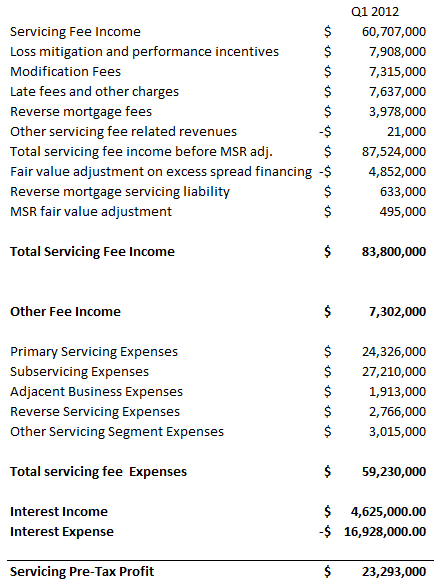
Servicing Fee Income:  This is the base fee that Nationstar receives.  A servicing fee is generally a percentage of the unpaid principle balance of the mortgages being serviced.  The unpaid principle balance averaged  $96,107,000,000 in Q1.  Nationstar earned fees of 60,707,000 off of that.  That puts the average servicing fee at 25 basis points, which is the typical fee received for servicing Fannie Mae and Freddie Mac qualified mortgages.

Loss Mitigation and Performance Incentives:  Fannie and Freddie compensate servicers if they successfully complete a repayment plan or loss mitigation on a loan that is 60 days or more delinquent.  The guidelines Fannie has set out for this are:

  • The mortgage loan must be 60 or more days delinquent when first reported with a Delinquency Status Code 12 – Repayment Plan – by the servicer.
  • The mortgage must be brought current upon the successful completion of the repayment plan.
  • Once a repayment plan incentive fee has been paid, a 12-month period must elapse from the date the related mortgage loan became current before another repayment plan incentive fee will be paid on that mortgage.

Nationstar receives fees when they mitigate a loan meeting these guidelines.  I didn’t look for Freddie’s guidelines but a imagine they are similar.

Modification fees:  These are special fees that Nationstar earns through modifying loans that qualify through the government sponsored HAMP and non-HAMP Modification programs. As per the FHFA servicing paper:

In certain instances and programs, servicers can also earn revenue in the form of incentive fees available under proprietary modification programs (generally in accordance with the Enterprises’ Servicing Guides) and through federal government modification programs (e.g., the Home Affordable Modification Program (“HAMP”)).

Late Fees and other Ancillary Charges:  According to FHFA, “servicers are also entitled to certain ancillary fees under the Servicing Guidelines, which include, among other things, late fees assessed on delinquent payments, charges for issuing payoff statements, fax charges, biweekly payment fees, and advertising supplement fees.”  That sums up what these are.

Reverse Mortgage Fees:  These are fees from their reverse mortgage portfolio of servicing right.  In terms of the servicing fee structure, the fees accrue to Nationstar but I’m not sure if Nationstar actually gets paid in cash until the property is  sold and the mortgage (and all its accrued interest) is paid off.

Change in Fair Value on Excess Spread Financing:  This has to do with the Newcastle deal.  Nationstar and Newcastle have entered into a couple of servicing arrangements whereby Nationstar performs all the servicing for a base fee (usually 7 basis points) and Nationstar and Newcastle share in the excess servicing right (with Newcastle getting a cut because they put up a substantial portion of the capital to purchase the rights). When Nationstar sells their partial interest in the excess servicing right (usually 65%) to Newcastle they treat that on the balance sheet as a financing.  So they book a liability associated with the loan and an asset associated with the underlying servicing rights.  The loan liability is recorded at fair value so Nationstar has to mark the value up and down each quarter.  In my opinion this is a pure accounting item and shouldn’t be included in earnings.

MSR Fair Value adjustment: This one is tricky.  The MSR fair value adjustment is comprised of 3 parts:

  • Actual prepayments of the underlying mortgage loans
  • Actual receipts of recurring cash flows
  • Market-related fair value adjustments

The fair value of the mortgage servicing portfolio is affected when the loan is repaid because the value associated with that particular mortgage servicing right gets written off.  The value of actual receipts of cash flows could be considered to be the basic amortization of the mortgage servicing right.   The Market-related fair value adjustment is the adjustment to the value of each servicing right based on the likelihood it will prepay in the future or not.  It’s the market-related fair value adjustment that we want to remove from the earnings calculation. Unfortunately Nationstar doesn’t break out the fair value adjustment between these items so its impossible to know how much of the adjustment is market related and how much is due to prepayments and recurring cash flow and how much is the fair value adjustment.

To give an example of what each of the three components might look like, PHH breaks them out into separate items.  Here is an excerpt from their first quarter 10-Q.

The reason that its important to deduct actual prepayments and actual receipts of recurring cash flows is because Nationstar is capitalizing the servicing portion upon origination.  So they are booking the earnings at the start, and that is only legitimate if they are amortizing that capitalized servicing right over the life that they receive fees.  If you ignore the amortization but not the capitalization you would be double counting earnings.

Given that Nationstar does not break out the items, I think that the only way I can properly handle this is by deducting the capitalized servicing from the origination segment and ignoring the entire fair market adjustment.  If I ignore the capitalization of the servicing and the fair market adjustment, then I don’t have to worry about its amortization over time.

Expenses and Impairments:  In the 10-Q Nationstar doesn’t breakout what the individual expenses and impairments are.  However, in the prospectus they do.  They reported the following expenses and impairments for the last 2 years:

I do note that none of these items are impairments so I’m not sure what that’s all about.

Interest Income:  It looks like the main source of interest income for Nationstar comes from the reverse mortgage servicing that they hold.  To be honest I am not sure what aspect of the reverse mortgage this interest income is coming from.  I know that Nationstar  receives a fee in return for servicing the reverse mortgage, but it’s not clear to me whether some of this fee is defined as interest as opposed to just being a fee.  My guess on this is that when a reverse mortgage is created Nationstar collects interest on the as of yet unadvanced amount.  But I don’t know for sure whether this is the case or not.  If its not I don’t know how they are are collecting interest.  In the end it’s a small sum.

Interest Expense:  As a servicer you are responsible for payment of late principle and interest amounts.  You are also sometimes responsible for taxes and insurance if the escrow funds set aside for the borrower aren’t sufficient.  All of these funds will eventually be paid back, but in the mean time you have to get the money from somewhere.  Nationstar sets up servicer advance lending facilities with banks and draws on these funds.  The cost of funds is generally a LIBOR plus arrangement.  Interest expense also includes interest from the senior unsecured notes that the company has outstanding.

The Mortgage Origination Business

Following in the same vein as servicing, here are the numbers for the origination business, followed by a description of the items involved.
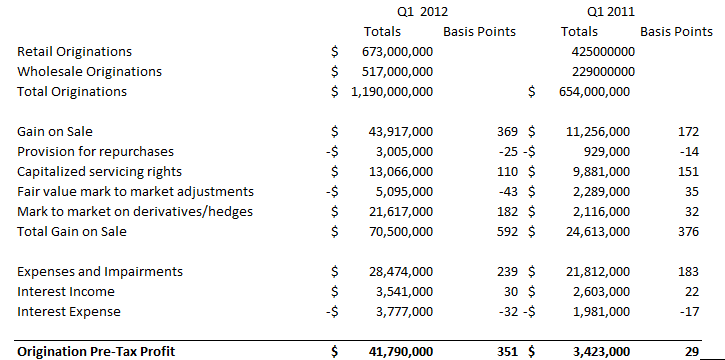
Gain on Sale:  According to the prospectus, “transfers of financial assets are accounted for as sales when control over the assets has been surrendered by Nationstar”.  So unlike PHH, which books revenues when the interest lock commitment is made, Nationstar does not book revenue until the mortgage is transferred.  Margins were high in the first quarter, at 369 basis points.  PHH also recorded extremely high margins in the first quarter, so Nationstar was not the only one.  In the PHH 10-Q the company suggested that these margins are expected to remain high for the remainder of the year, and that they may stay high for longer as the increased risks associated with the industry are being realized through higher margins.

Provision for repurchases: I can’t be positive because Nationstar doesn’t provide any details about this line item, but I suspect that it is a provision taken for repurchase requests from the GSE’s.  Nationstar originate the vast majority for their loans for the GSE’s and there have been notable putbacks by them on originators for poorly originated loans during the boom.  PHH took a $65M provision in the first quarter.  Given that Nationstar was a fairly small originator until just recently, the $3M provision by Nationstar seems comparable to me.

Capitalized Servicing Rights: I already discussed this item to some extent in the servicing segment.  Nationstar capitalizes the expected profit from the servicing cash flow stream and books that as profit up front.  Changes to that capitalization are realized in subsequent quarters on a mark to market basis as part of the MSR Fair Value adjustment.  The important point to note is that Nationstar capitalized its servicing at 110 basis points.  This means that Nationstar is capitalizing servicing at roughly 4x the servicing fee.

Fair value mark-to-market adjustments: These are adjustments that are made on the mortgage loans held for sale.  Nationstar originates mortgage loans and there is always a pipeline of these loans that have yet to be sold to a GSE or other securitization.  The changes in the value of this pipeline from quarter to quarter is recorded as this line item.  I don’t think this item should be considered in earnings.  The loans will eventually be sold and at that time will be recorded as gain on sale. Until that time the marking up and down of the unsold loan portfolio is really just an accounting fiction.

Mark-to-market on derivatives/hedges:  There are 3 types of hedges/derivatives that Nationstar uses:

  1. The first type of hedge that Nationstar has is an interest hedge on the Interest Rate Lock Commitment (IRLC).  The IRLC is a commitment by Nationstar to provide a particular interest rate to the borrower for a certain amount of time. We have all gotten these when we went to a lender for a loan.
  2. The second type of hedge that Nationstar enters into is one that de-risks changes in value of the mortgage that will eventually be originated and sold from the IRLC.  Nationstar enters into forward sales of MBS against IRLC’s in an amount equal to the portion of the IRLC expected to close, and against mortgages held for sale in amount of the mortgage to be sold.
  3. The third type of hedge is a interest rate swap that it will use to hedge the interest payments on its debt.  Nationstar always has short term warehouse lending facilities drawn upon to fund its origination pipeline.  These lending facilities are typically variable rates and base on LIBOR.  Nationstar will enter into a swap to essentially fix that rate.

Origination Segment Operating Costs: According to the prospectus, the originations segments operating costs include staffing costs, sales commissions, technology, rent and other general and administrative cost.  Pretty basic stuff.  Making a comparison again to PHH, Nationstar had operating costs that were about the same on a per origination dollar basis.  Expenses and Impairments for Nationstar were 239 basis point of Total Originations.  For PHH costs were 246 basis point.

Interest Income: This is income that Nationstar earns on originated loans prior to selling them to the GSE’s.

Interest Expense: Similarly to interest income, interest expense is the cost of funds required to originate a loan.  Nationstar taps warehouse funding to bridge the gap between the day the loan is signed off and when the loan is eventually delivered to the GSE or other third party who will ultimately securitize the loan.

Adding it all up to Earnings

The point of going through all of the above was to determine which of the line item revenues and expenses should be included as part of operating earnings.  To review, I concluded that I would ignore the expenses due to the Newcastle arrangements, the fair value adjustments to the servicing portfolio, the capitalized portion of the origination, and the fair value adjustment to the originated loans that have yet to be sold to the GSE’s.

I also have to come up with a tax rate.  In the 10-Q Nationstar said that they expect a tax rate in the range of 20-28% for the period ending December 2012.  I have chosen the midpoint, 24% as the rate I will use here.

Igoring the items and applying the tax rate results in the following first quarter earnings for the company
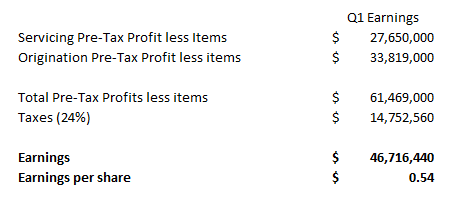
Its not bad.  These earnings would put the current share price at a little under 10x earnings.

The key point for putting this valuation in perspective is to not that Nationstar is growing at a phenomenal rate.  The company grew their servicing portfolio at 50% last year, after having grown it at 100% the year before.  The Aurora transaction will expand the unpaid principle balance of the servicing portfolio from $97B to $160B, or about 60%.   The deal that Nationstar is negotiating with ResCap is even bigger.  The Rescap deal is for an unpaid principle balance of $374B.  Now Nationstar is splitting this between themselves, Newcastle and Fortress Investment Group.  Presumably though Nationstar will be doing all the servicing work, with the other parties just stepping in to provide capital and take a piece of the excess servicing fees.  Obviously, such a large deal would represent tremendous growth to Nationstar, upwards of 300%.  While one has to wonder if Nationstar can pull off the logistics of such quick growth, there is little doubt that the earnings potential of the company will increase exponentially if this deal goes through.   And you get that potential for about 10x their operating earnings.  The bottomline with Nationstar is that you get to participate in an impressive growth opportunity without having to pay up for that growth.
Week 47 Update: When in doubt – Get Small

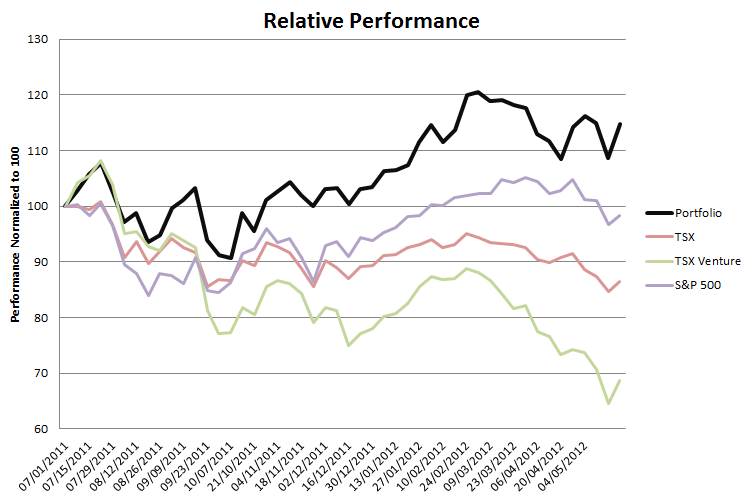
Portfolio Performance

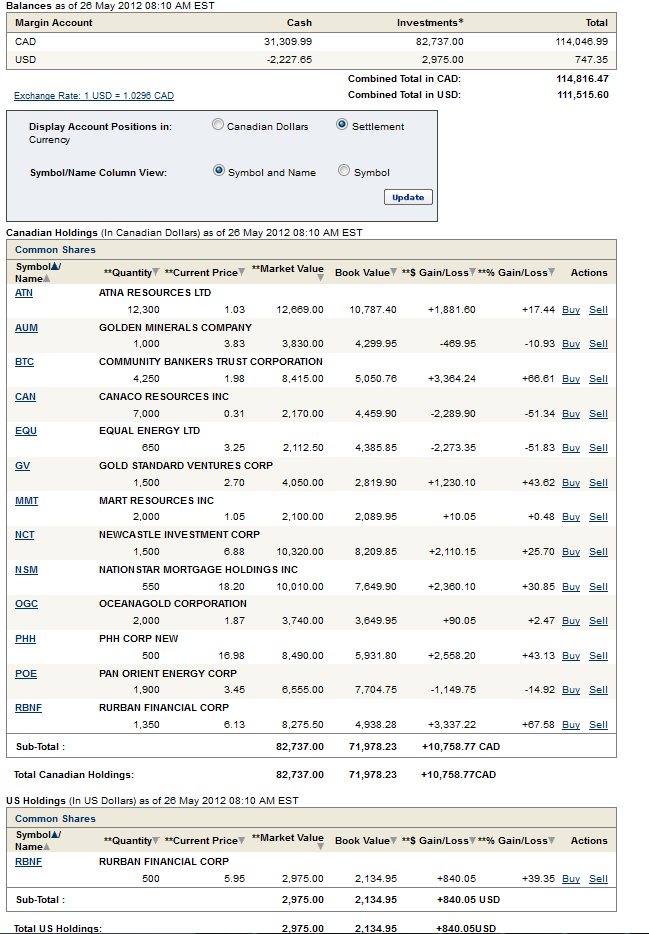
Portfolio Composition


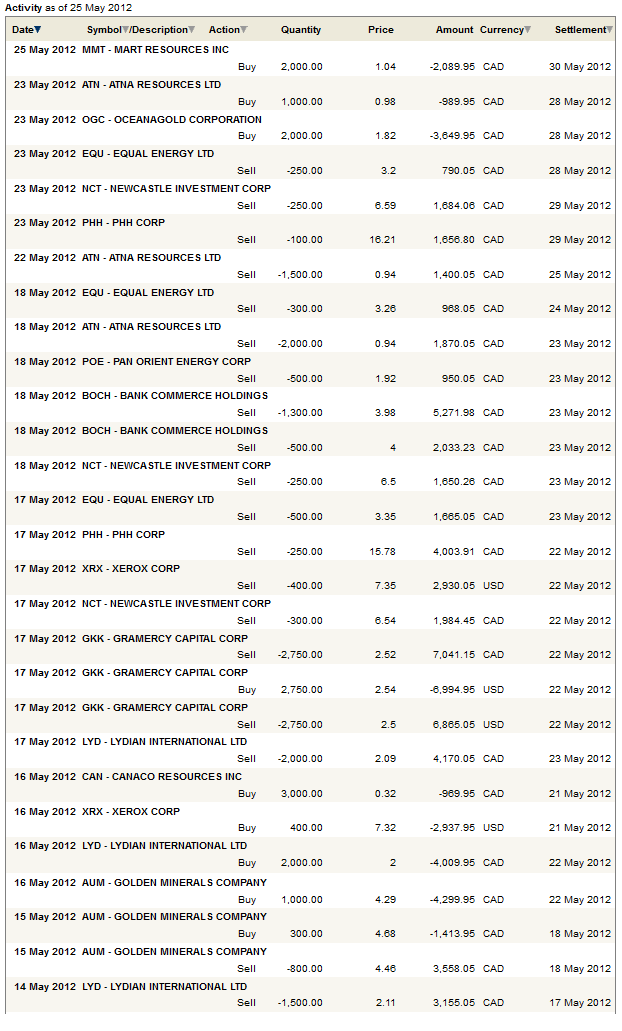
For the last two weeks of moves, click here.

Letting Go…

The occupation of investing is really one of evaluating risk.  If you run a large institutional fund or a hedge fund or some other large sum of money, you perform this evaluation on a formal basis, giving its conclusions a formal sounding name like risk adjusted return or something of the like.  If you are an individual investor your process is much more informal, your conclusions are often not written down (though a blog helps in this respect), but nevertheless you are continually going through the same basic process of evaluating the potential risk against its potential return.

I try to eliminate risk through exhaustive research of the companies I invest in.  That elimination process involves getting up at five in the morning on weekends and spending hours readings through 10-Q reports and MD&A’s. It involves staying up late on week nights listening to conference calls and reading industry publications.  All this effort is done in the attempt to understand what makes each particular business tick, and to understand if the fundamentals of that business are improving in such a way that value is about to be realized.

I find this to be time well spent.  On the one hand I enjoy the investigative process.  On the other, it is profitable.  I am often able to narrow my focus to sectors that should experience positive fundamentals, and then to further narrow my focus to companies within those sectors that have competent management teams and solid assets that can deliver on a consistent basis.  Whether the sector is mining or mortgages, paper or potash, banking or bitumen, it makes little difference to me.  Given the time I can understand the business and develop a thesis to invest or not, and more often than not I am right.

In the 1990s and in the early part of this decade that was all you needed to do to consistently beat the market.  You could do the work, pick good companies, understand the industry trends and wait for it to play out.  It was a simple time.

Nowadays however, following that recipe in a vaccuum can you leave you without a leg to stand.  The market today is analogous to playing a hand of cards where within the deck lies a single trump card that if played automatically will lose the hand for you.  You can manage the cards you are dealt the best you can, do your darnest to evaluate the probabilities and make the best risk adjusted decision, but if that trump card is played you will lose it all.

That trump card was the US banking system in 2008 and it is the European sovereign system now.  In either case the details differ, but the trump-like nature is essentially the same.  The risk is systemic, the probability of that risk occuring is unknown, the outcomes of that risk impossible to quantify.  Whenever you play a hand in the market these days you put yourself in danger of the consequences that the risk happens to be realized while your money is still on the table.

Because this is a risk that is so difficult, perhaps impossible, to understand, there is no way to hedge against it.  I have yet to hear anyone, expert or otherwise, offer up a coherent and definitive conclusion on what to expect if Greece exists the Euro.  Do markets open down 10% and continue to fall? Is it a non-event and an opportunity to buy?  Is Greece this years Bear Stearns, to be followed by a few months of a false reprieve before the big one hits, perhaps it being Spain that takes on the role of Lehman this time around.

There was an excellent conference call held by Donald Coxe this week.  During the call Coxe laid out the situation in Europe as well as anyone has.  It appears to be coming to a head.  More and more what we are seeing is that people, organizations and banks are making adjustments on the assumption that the Eurozone will not hold.  Banks in the Eurozone are frantically trying to tie their loans to countries that may be forced to leave by getting financing from within those countries rather than abroad.  Assuming there is an exit, the potential for a true global financial crisis is great if it is not an orderly one.  Along with that would very likely come a global recession.

While it is not clear whether Greece will leave this week, next week or next month, it has become more clear that they will indeed leave eventually.

What is unclear is how such an event will ripple through the system.  To provide a few examples, consider the following:

  1. Right now the Eurozone countries run deficits with one another.  Primarily Germany runs massive surpluses against southern periphery deficits.  These imbalances are currently tallied in something called the TARGET2 mechanism.  Target2 is essentially a way of transferring funds to countries (like Greece and Spain) that are running current account deficits so that those countries don’t run out of money.  As long as all the countries are in the Eurozone these liabilities are just a paper trail between the individual Euro nation central banks and the ECB.  However if a country with a large Target2 liability leaves the Eurozone, suddenly that liability needs to be paid back (the ultimate owner of the liability is the ECB).  But will it be paid back?  If it isn’t the ECB will take a big hit to its capital, potentially one that is big enough to cause the Central Bank to run out of capital completely.  What happens when a Central Bank runs out of capital?  I don’t think anyone really knows.  Without a doubt it will be damning to confidence at the least.
  2. What exactly is going to happen to Greece (or a little later, to Spain) if they leave the Euro and stop receiving funding from the rest of the Eurozone?  The reason Greece is able to make basic payments such as salaries, pensions, drug and medical benefits, is because of the inflow of money from outside the country.  If that inflow stops, what happens to the country?  Does it devolve from borderline chaos to complete chaos?  You have to wonder.
  3. There are pension funds and insurance companies and other large entities that perform basic public services that likely have large balances of periphery debt.  I was listening to the Goldman Sachs Insurance conference before bed last night.  William Berkley, who is the CEO of the William Berkley Corporation, gave a fascinating talk about the industry.  Most interesting perhaps is that Berkley believes that the biggest source of upside in the insurance industry over the next 24 months is likely to come from the failure of one or more of the large insurance giants in Europe.  He gave it a 50/50 chance of happening.  The reason he expects it to happen is because he is fairly certain that these companies are holding the bag on a large amount of peripheral sovereign and corporate debt.  If this doesn’t scare you, it should.  While 2008 began with the crisis of Lehman, it was amplified and extended by the crisis of the insurer AIG.  Had AIG not been dealt with, that crisis could have been far worse.
  4. What will bond holders of Spanish, Portugese, and Irish debt do in response?  You always have to remember that, as Donald Coxe has described, the situation is existential.  What that means is that the perception of weakness is weakness, and it will breed weakness.  Will a Greek exit destroy the perception of Spain to such a degree that it becomes inevitable they will leave to?  Do Spanish bond rates skyrocket in response?

Look, I am not an expert on the Eurozone or the consequences of a break-up.   I’m just throwing out these ideas to highlight the complexity of situation and to illustrate how it is basically impossible for any of us to make a legitimate assessment of it.  What it means to our investments is anybody’s guess.

Lighten Up

All I think I can do in a situation like this is to get smaller.  Take on less risk, don’t take too many chances, wait for it to play out one way or another before wading in too far.  Remember that even after Lehman went bankrupt, it took a few days for the market to recognize the consequences that were about to be felt.  I don’t think this was because the market was ignoring those consequences so much as that no one really knew what they were until they started to happen.  Same considerations this time around.   It could be Y2K all over again.  It could be Lehman all over again.  We will just have to wait and see.

As an individual investor you are at many disadvantages.  You don’t have access to the research, you don’t have access to the capital, you don’t have the range of strategic alternatives (hedging, taxes, etc) that a larger investor would be privy too. But the one advantage that you have as an individual investor is your ability to act quickly and to the extreme.  A mutual fund, pension fund or hedge fund would have a lot of difficulty going to all cash, both from a logistical and a performance perspective.  As an individual you answer to no one but yourself.  You generally can cash out with little to no movement of the underlying stock price.  If things get hairy, you have a legitimate choice as to whether or not to wait it out until they aren’t anymore.

Such is even more the case for my particular circumstance.  The reality of chasing above market returns is that I am constantly venturing into areas that are volatile.  Such is the case with gold stocks, oil stocks, even to an extent with the mortgage servicing stocks and smaller banks.  These companies trade up and down to a greater extent than the market.  Whether the fundamentals dictate it or not they will move down hard if the general market moves down.  There is no amount of analysis  that I can do to mitigate or prevent this.  I can only accept this consequence as the likely reality, and plan accordingly.

I completely sold out of Gramercy Capital, Bank of Commerce Holdings, and Shore Bancshares in the last two weeks.  I lightened up on the rest of my holdings by 10-20%.  I ended this week with a little less than 30% cash.  I plan to raise that cash level to 50% in the next week or two.

I would have an even higher cash level already, except that I have also entered into two short term positions as well.  OceanaGold and Mart Resources.  My thesis for OceanaGold is that the situation for the gold stocks appears to be turning.  There have been a number of days where the stocks have outperformed the bullion, and there was even one day were gold was down substantially while many of the large cap mining stocks were up.  This appears to me to be the start of something.  OceanaGold remains one of the cheapest gold producers out there.  It is by no means the most efficient producer, and thus it has also been beaten down substantially during this bear market in gold shares.  I bought some shares at $1.80 simply on the notion that if this is a turn in gold stocks, OceanaGold should see some outsized gains as it recovers the ground it lost.  If gold weakens further or if the gold stocks resume their downward trend, I will bail quickly.

Mart Resources is purely an event driven purchase.  I own Mart in another broker managed account already and so I follow the story closely, but have never owned it in the account I track here so I don’t talk about it much.  The company has two news events that I suspect are going to occur shortly.  The first is the potential for an announcement of a dividend.  I believe that such an announcement could result in a significant pop in the stock, as it gives credibility to what is otherwise looked on warily as a Nigerian story.  The second is a pipeline deal with Shell, which would allow Mart to increase their production, perhaps substantially, and allow the brokerages that follow the story to up their targets based on larger 2013 volumes.  Again, I am looking for an event to occur in somewhat short order, but I am not holding this stock for the long run.  If the events in Greece take a turn for the worse, I plan to cut and run.

I come back to the quote I gave last week from Peter Bernstein.  I think this is something worth repeating at a time like this:

The trick is not to be the hottest stock-picker, the winning forecaster, or the developer of the neatest model; such victories are transient. The trick is to survive.

We live in impossible to understand times.  You have to accept your own limits of knowledge and simply walk away from the table.  Will I miss opportunities by having such a high level of cash?  Quite possibly.  But you can’t chase shadows.  You have be a prudent manager of risk.

My Canaco Debacle

My post on Canaco’s Magambazi deposit has received more attention than perhaps any other post I have made.  What is sadly ironic is that while I put a lot of work into my evaluation of Magambazi, the net return of all of that work has been less than zero.  I want to take a few paragraphs here to do a post-mortem on the subject and to come up with a few lessons learned.

Lesson #1 Analysts can be lazy and you shouldn’t believe they know more than you

I began my relationship with Canaco at the end of last year in an attempt to take advantage of tax loss selling.  I bought the stock at $1.10 having done very little research into the company besides having read through the corporate presentation, acknowledged they had a significant amount of cash on the balance sheet, and read through a couple of Canaccord reports that I got my hands on, suggesting that Magambazi had somewhere between 2-3 Moz of gold.

Soon after the stock ran up along with all the other gold stocks and I felt like I better get a more clear idea of what I owned and whether I should continue to own it at that elevated price.  Thus came about my analysis of the Magambazi desposit. I did my analysis of  Magambazi when the stock was $1.70.  The analysis suggested that the Magambazi deposit was unlikely to contain 2-3 Moz and was far more likely to  contain 1-2 Moz, with the greater potential being on the low end of that range.

As I wrote at the time, while my analysis raised a lot of questions, I was reluctant to believe it over the parade of analysts with estimates of 2 million ounces plus grading 3 g/t or more:

All 3 of these estimates are lower than I would have expected.  To be honest, I’m not sure what to make of that.  I don’t know how much I trust my own work given the uncertainty with specific gravity and obviously the low-tech tools I am using.

In the end I concluded that I could quite possibly be wrong, and that even if I was right, the stock was probably trading not too far away from where it should given the cash on the balance sheet.   I concluded that while I wouldn’t add more, I wouldn’t sell my holding right away either.

Fortunately my conviction tends to be heavily influenced by price level, and as the stock began to fall, I changed my tune.  Soon after my write-up gold stocks began to fall (in particular junior explorers began to be decimated). I wrote the following:

While I still question whether there is an error in my analysis, I do think I raised enough questions about the deposit, and enough uncertainty about the eventual resource estimate to be somewhat wary of the NI 43-101 that will be out shortly.  I decided to step aside until that resource comes out, or the share price falls back to the point where I feel like the downside is priced in.

I sold my position at $1.47 per share.

It is at this point that it all could have ended well.  I could have ridden off into the sunset with a tidy profit and a big “I told you so” in the mail when the 43-101 on Magambazi came out.

But it didn’t end well.  Because I got cute.

Lesson #2 Don’t get cute

In retrospect my reasoning on the matter was fairly sound.  The logic based on the knowledge available was acceptable.  The problem, I believe, lay in optimism of my original assessment, which was perhaps unconsciously skewed by an attempt to match analyst estimates that were far more robust than what I was seeing.

Anyways, here is how it went down.

Canaco was trading at 85 cents.  They had 50 cents of cash in the bank give or take.  I looked at Magambazi and thought, look, they are going to report at worst 1 Moz at 3 g/t, how much lower can the share price go?  Its priced in right?

I bought Canaco at 87 cents.

It didn’t seem like a bad bet at the time.  And fortunately I didn’t buy a very large position (actually looking at the relative size of the position in my practice portfolio it appears I over-bought there.  My actual position in Canaco was about 1% of my overall portfolio, but it looks like I bought around 3% in the practice portfolio.  I’ve noticed this is a continuing problem for me because I’m not doing the ratios with each trade and so my practice portfolio has gotten somewhat out of sync with my actual portfolio.  But enough of that).

Nevertheless, unfortunately it would turn out to be large enough to take away all the profits I had made and then some.

When I look back on this fateful purchase I notice two catalysts to the downside that I really underestimated at the time:

  1. The junior market was about to go into a deep bear market where even cash is not valued at cash anymore
  2. The reported 43-101 grade of Magambazi would be based on an open-pit model

Number 1 is what it is and what can you say.  Its a shitty market. It was #2 that really killed the stock.  When the deposit came in at 1.5 g/t  that was final nail in the coffin.  Even my estimates calculated that the average grade would be 3 g/t.

So what happened to the grade?

Canaco hasn’t released the actual Ni 43-101 report so I can’t really talk too specifically about the assumptions made.  But they did say in the news release that the resource was based on a pit model:

Measures were taken to validate that the mineral resource meets the condition of “reasonable prospects of economic extraction” as suggested under National Instrument 43-101. To this end, a pit shell was generated using a gold price of US$1,250 per ounce and an overall pit slope of 40° for the purpose of resource tabulation. Only blocks within the pit volume were included in this resource estimate and Table 2 presents a summary of the estimated mineral resource for a range of cut-off grades. The cut-off grade of 0.5 grams per tonne was selected as the resource base case considering extraction by conventional surface mining and mineral processing methods.

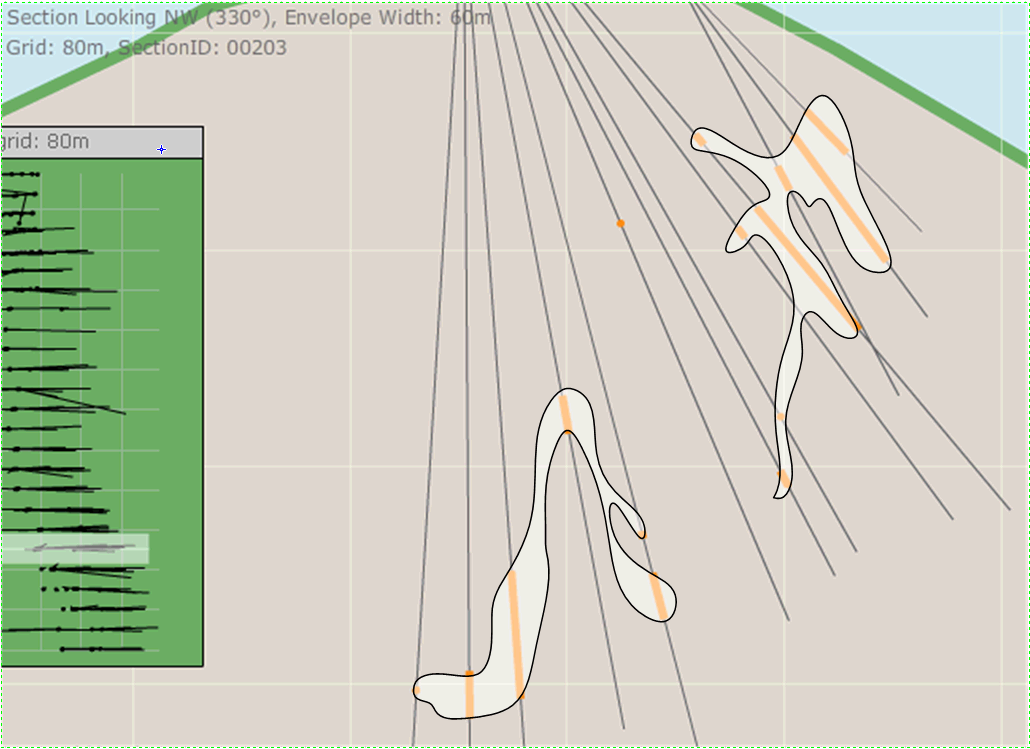
When I did my estimate I made a very tight block model around the high grade intercepts.  I drew my lines to fit exactly around each intercept, with no give or take around it.  Take a look at the cross-section below for example:

I suspect that what happened is that when the open-pit model was done, it was determined that realistically, you were not going to be able to separate the high grade ore from the low grade shell so easily.  You would inevitably end up with a diluted grade going through the mill and so the mined deposit grade would be a lot lower than what you would get if you could just surgically extract the high grade material.

I totally missed this.  Its obvious in retrospect.  Canaco management even said they were looking at Magambazi as an open pittable project.  But I didn’t put two and two together.

Cést la vie.

I remember when I read the news release when it came out in the morning the first thing I thought was, wow, that’s really bad.  As I tweeted that morning, that’s why you call it speculation, not investment.  I put in a sell at the market order, I figured that with 50 cents of cash I’d still get out at over 50 cents and be done with it.  Alas, before the market opened it became clear that the stock wasn’t going to trade at anywhere near 50 cents.  It is unfortunate in cases such as this that because I have a job and cannot watch the market during the day, I often have to make decisions to buy or sell at the open in premarket and deal with the consequences later.  Weighing the alternatives I took the order off and decided to see where the stock ended up.

Lesson #3 When something is bad, its rarely worth buying

The basic premise here could be applied to many things; bad managements, bad businesses, and bad markets.  It certainly could be applied to bad deposits.  If its bad, don’t try to put a value on it.  Just walk away.

When I bought back Canaco at 87 cents, it was because I figured the market was overestimating the “badness” of Magambazi and underestimating the cash on hand.  Between that purchase, and my sale of Canaco at $1.47, I had implicitly put my own valuation on that badness – somewhere between a dollar and a dollar fifty a share less the cash on the balance sheet.

The problem with doing this is that badness tends to have an extremely relative value.  Something good tends to hold its value regardless of the market, but something bad tends to fluctuate wildly as participants go between optimistic and pessimisstic evaluations of just how bad it is.  To make a case and point, look at Lydian International.  I sold out of Lydian a couple of months ago when I was liquidating all things gold but dine that time the stock has held up remarkably well.   That is because, as I pointed out in my initial analysis, the Amsular deposit is basically a good, solid deposit.  There are always bidders that step in when the stock begins to sway.

Canaco is the opposite.  Magambazi is a questionable deposit.  It still might work.  It might not.  Me trying to put a value on that was stupid.   When something isn’t good, you  need to just walk away.

Where to go from here?

I talk a good game but sometimes I don’t do what I say.  Perhaps I will look back on this with another lesson learned and say that yes, I should have just walked away at 30 odd cents.  But I haven’t.  At least no yet.  In the case of Canaco, even though Magambazi had proven to be bad, I was just too tempted by the fact that the company was trading at about 2/3 of its cash on hand.  Cash is neither bad or good.  It is cash.  When cash is valued as though it wasn’t cash, I am always tempted by the opportunity to prosper from its revaluation back to cash.

I bought a few more shares at 32 cents.

It just seems rather insane to me that we are in an environment where the cash you have on your balance sheet isn’t valued as such.  And yes I know this is an exploration company, and they could eat up that cash in a number of stupid ways.  But still… a little less than 50 cents of cash trading at a little more than 30 cents?

Another point that Canaco has in its favor is that the actual amount of cash is quite significant compared to drilling and corporate expenditures.  If Canaco was a $5M market cap company with $7M in cash, I would be far more skeptical that they would eat through that cash quickly and therefore that it shouldn’t be valued on their balance sheet at whole value.  But Canaco is a $60M market cap company with $95M in cash in the bank.  The company has apparently stopped drilling on Magambazi at the moment.  Cash corporate expenses look like they are about $1.3M per quarter.  Its going to take a while and a good number of bad decisions for that cash to disappear.

The other point is that Magambazi, while being a relative disaster, is not a complete disaster.  The market, with its unrealistic expectations having been set by the analyst community, certainly viewed it as such.  Yet there are 1 Moz there, and there is the potential for more.  The cash provides the opportuntiy for good things to happen.  Heck, even a general market recovery (something that albeit may be fantasy and that I am not myself leaning towards) could be enough to move the stock significantly towards its cash value.

Anyways, those are the reasons.   I make no promises about how long I will continue to hold any of these shares.  I may decide that the opportunity cost of holding Canaco isn’t worth it and just dump the whole thing.  If the share price goes on a run, which given just how bad it has performed with essentially no bounce makes you think some sort of a pop may be possible, I would likely sell.  I would certainly sell at cash value; I might even sell at 40 cents.

Until that time, the debacle continues.