Skip to content

What do you do when a market melts down

It took me a while to understand the issue that caused the market meltdown today.  I felt like this came a little out of the blue.  It didn’t but I was being lazy and not reading ft.com and other publications that focus on Europe.

Bad mistake.

The best article that I have found so far that talks about the crisis was written by FT Alphaville.

Its a crisis of confidence.  Trichet came out yesterday and said the ECB wouldn’t be the buyer of last resort for Italian bonds.  That means that for the next month or two, or until the euro-government backed facility to buy euro-government debt is approved by the european parliaments, there is no lender of last resort.

That freaked the market out.  What’s worse, its a case of perception creating its own reality, because while Italy is not in as bad of straits as Greece (it has a budget surplus), it can’t afford to pay skyrocketing interest payments.

Any way you cut it, what is happening in Italy doesn’t look good.  The chart below is the widening Italy CDS.


I sold some stocks yesterday. Grudgingly, but I sold some of my non-core positions like Geologix. I can’t possibly know how this is going to turn out.  The prudent response is to reduce risk.

Mercer and the Quarter that Didn’t Matter

Look, no matter how you slice it, Mercer International released a solid quarter yesterday.  Operating income of $36.2M was almost identical to operating income in Q1 of $36.6M.  Pulp price were higher than Q1 but downtime in Q2 was 16,000t vs. only 1,000t in Q1 so the steady earnings are exactly what you would want to see.

EBITDA is down from its peak but still very strong.  The quarterly EBITDA per share is almost obscene (though you have to consider the debt load to get a true picture on a Enterprise value basis).

Moreover, costs are steady from the last few quarters, which I think is pretty impressive in this environment.  Operating expenses were $468/t of pulp sold in Q2 vs. $448/t of pulp sold in Q1 and $461/t of pulp sold in Q2 2010.  Take into account downtime and expensed plant turnaround (Mercer expenses all maintenance including $7.7M in Q2) and you have a steady cost story in a world where commodity production costs are rising everywhere.

But none of this really matters on a day like today.  On a day like today the only thing that matters is that Mercer is a commodity play, and it produces what has been a historically volatile commodity.  Thus, whn

Mercer is a solidly run company. It is also a low cost producer of NBSK (perhaps even THE low cost producer, though I must say I have not done an exhaustive comparison.

They have a lot of debt, something which only adds to the volatility in a market like this.  Net debt has been trending down each quarter as they generate cash.  They really have paid off a substantial amount of debt in the last year.

Mercer remains upbeat about the NBSK pulp market.  Prices have been softening over the summer but this is seasonal.  June NBSK inventories remained at 28 days, which is historically low.  There is still no significant new supply additions coming on-line in the foreseeable future.

But the market doesn’t care about any of this.  A slowdown is here and fear of a recession is rising, and that’s all that matters.

Look, I’m down about 10% on Mercer.  Typically when I am down 10% I start to take money of the table.  Its one of my rules.  Today I didn’t.  I’m going to put up a bit of a stand here.  I don’t own that much Mercer, it won’t kill me if I’m wrong here, and I just can’t bring myself to sell the stock when its trading at what I would say is an unfairly cheap price.  So I hold, for now.

Week 4 Portfolio Update

I got smacked around along with everyone else last week, losing about 5%.  Still I am up almost 3% since inception 4 weeks ago.  I tried to use the volatility to reallocate money towards the stocks that are working the best, and away from what has not been working.

I sold out completely of OceanaGold and Klondex Mines.  I’ve talked about the former in a post already; of the latter it is a mine not yet producing, and so prone to problems, and as I felt the debt ceiling problems would be resolved I did not want to be too overweight in gold stocks.

I sold out of Novus Energy, which had less to do with Novus and more to do with Second Wave and Coastal, which I wanted to money to add to. I also sold out of Newcastle Investments in favor of more Oneida Financial.  I gave my thoughts on Oneida in the last post.

Oneida Financial – Local MHC Continues to Make Good

I got introduced to the idea of buying regional banks stocks about 6 months ago.  Two separate catalysts piqued my interest in the idea:

  1. Last summer I read the David Einhorn book, “You Can Fool Some of the People All of the Time”.  In that book, which is about a fraudulent business development company called Allied Capital, Einhorn spends a chapter outlining his investment philosophies.  One of the ideas he puts forth is investing in mutual holding companies.   Seth Klaman has been another proponent of investing in MHC’s.
  2. Tim Melvin’s trade of the decade.  Melvin, a fairly well known value investor, believes that the small regional bank stocks have been beaten up well beyond what is justified and that their recovery represents the trade of the decade.

After spending a few months getting to understand the banking industry, and scouring the net for cheap MHC’s trading below or at book value, I stuck money into a couple of them, with one of those being Oneida Financial.  Now, in the 5 or so months that I’ve owned it the stock has done absolutely nothing.  You might want to take that as neither a good or bad thing in this market.  Oneida has bounced back and forth between 8.40 and $8.80, but does not seem in any hurry to break out in either direction.

I have already written an extensive write-up on Oneida’s regional banking business and why I picked Oneida as one way to play this trade of the decade.  I’m not going to go further into the details of my reasons here.  I’m just going to focus on their second quarter results.

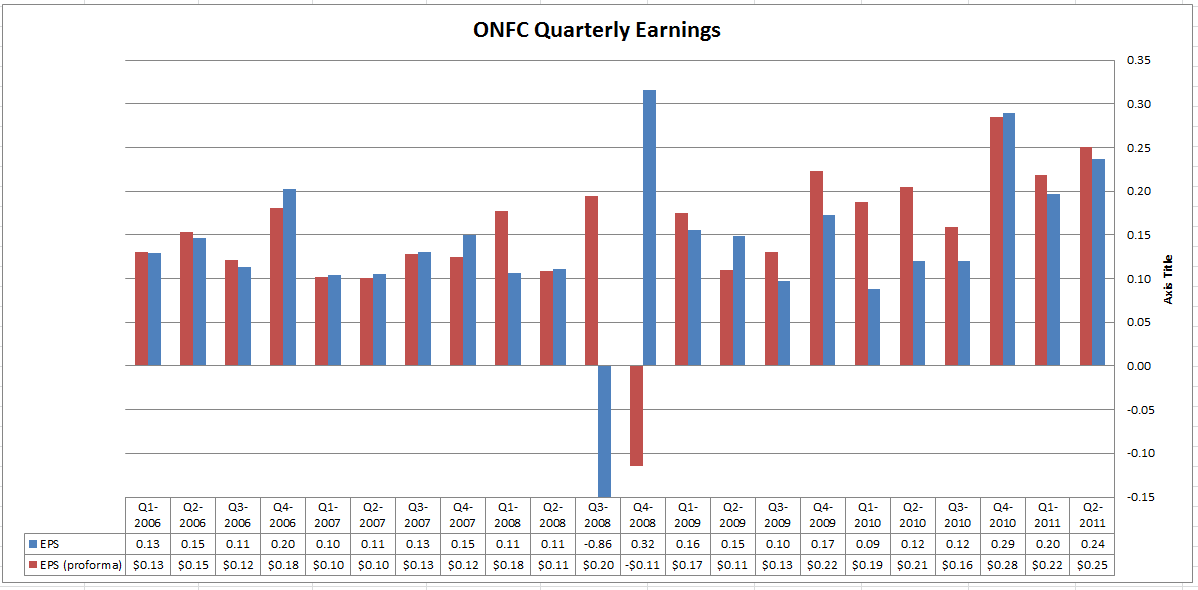
Another strong quarter for earnings.  Oneida earned 24 cents for the quarter.  Stripping out loan loss provisions they earned 25 cents.  Over the past 4 quarters their earnings have been 84 cents basic and 91 cents after stripping out loan losses.  Below is a chart of their earnings over the last 5 years.  There has been a steady upward march over the past two years.

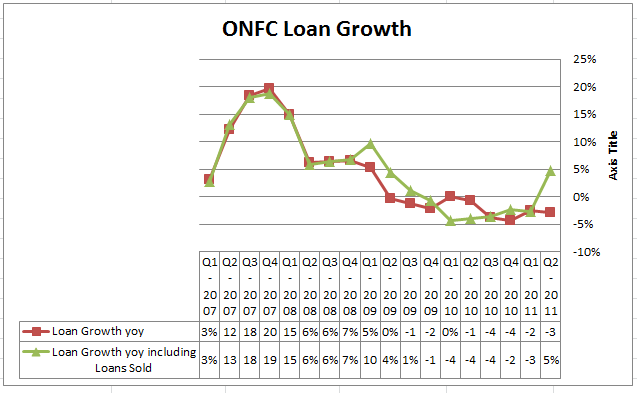
I bought Oneida in part because I thought they were cheap based on earnings power.  They should easily be able to earn a $1 next year, meaning they are trading at less than 9x earnings on a forward basis.  What I have been waiting for is for Oneida to begin to grow their loan book again.  Its been shrinking (albeit at a small rate) since the 2008 debacle.  This looks like it might be starting to change.

Oneida’s loan growth is a bit tricky because they sell of much of the fixed rate loans they generate.  So to get a true picture of their loan generation, you have to add back the fixed rate loans that are being sold off.  Below is a chart of loan growth at Oneida showing both growth before and after accounting for the fixed rate loans sold.  Up until this last quarter loan growth has been negative since Q2 2009.  That changed this quarter with the uptick.

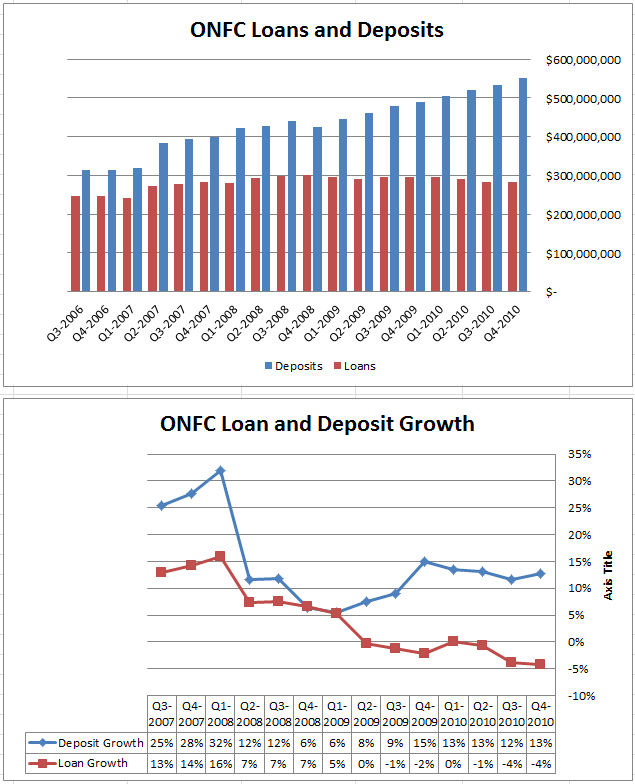
Deposit growth declined somewhat in Q2 from the last few quarters.  Nothing to worry about yet though.


The company continues to sell below book value and tangible book value.  More importantly, book value continues to grow at a smart pace.