Skip to content

Corvus Pharmaceuticals and Two Types of Stock Picking

My investment strategy is really two pronged. These prongs are completely different from one another, polar opposites in fact.

One prong, which makes up most of my portfolio, consists of buying “undervalued” stocks. These are not necessarily cheap stocks. They can be. ie. the containership companies a few months ago, but no one could have said Caribou Biosciences was “cheap” at a $900 million IPO market cap.

If I see the stock as undervalued on some metric – in Caribou’s case because they hold patents to CRISPR Cas12a, have Jennifer Doudna on their board and are run by Rachel Haurwitz – then I buy and I wait for others to see the same thing.

So that is the first prong, and it make up most of the stocks I own.

The second prong is to buy the news.

While this is not as material to my portfolio, the situations tend to be much more fun to write a blog post about. So while I have been buying immunology stocks through September on the expectation of news someday, the ones that are most interesting to discuss are the one’s that I bought today on news yesterday.

Corvus Pharmaceuticals. Here is their story.

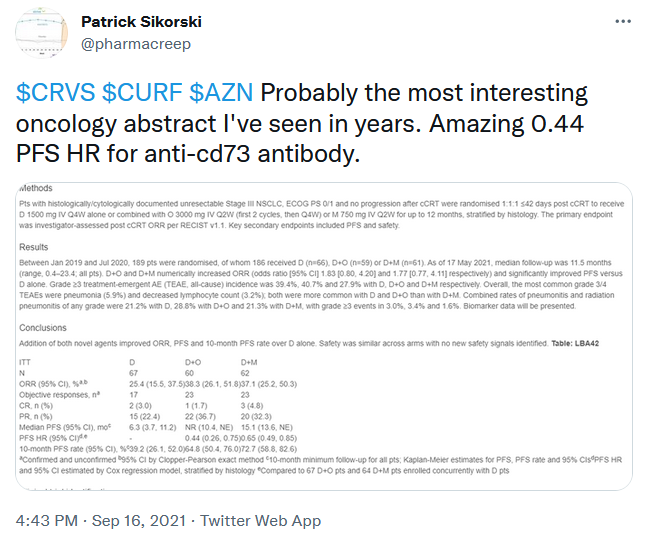
So after the market closed last night I am perusing my Twitter Biotech lists (lists are great on Twitter, and you don’t have to create your own, just join others that have a good swath of fintwits) and I see this bit of news.

Now I don’t know Patrick, but I do follow his comments on the list from time to time and he seems like a good chap. Doesn’t seem to be one of these biotech pumpers on twitter that runs from one pump and dump to another.

As it happens, because I have been researching immunology stocks for the last month or so, I know a little bit about one of the companies mentioned – Corvus.

I don’t know a lot about Corvus. In fact, I don’t believe I know a lot about immunology. Which is why I haven’t posted at all in the last month. I keep thinking, I really should write about these immunology stocks I’m buying. And then I think, but I don’t really know what I’m talking about, so what if I am just the sucker at the table?

Well there are a couple of things I remember about Corvus from having looked at them about 3 weeks ago. First – I know they are cheap. Prior to today they were worth only about $30 million ex-cash. So the market gives them no respect.

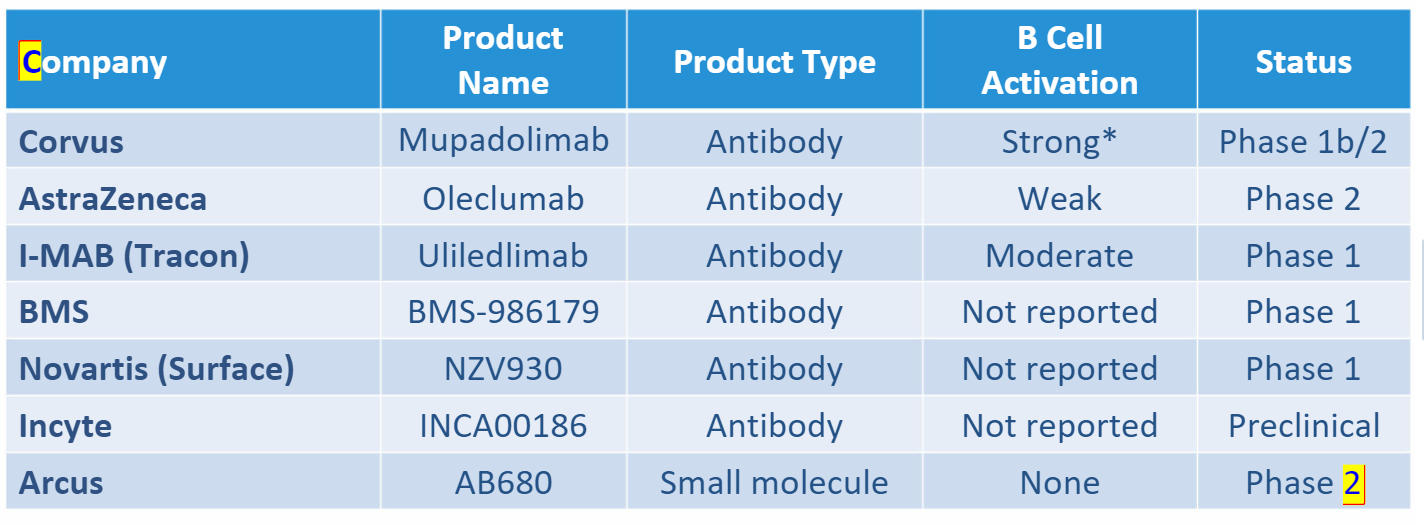
Second, I know they have a anti-cd73 antibody. In fact, I remember that they listed the AZN drug in their presentation.

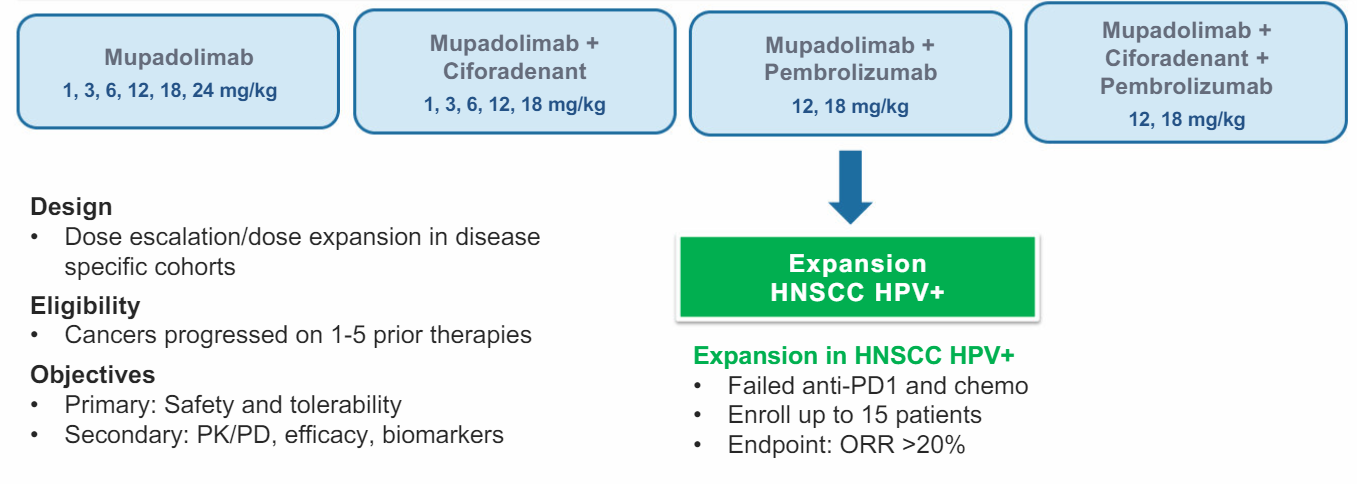
Third, I know that they are going after NSCLC in their trial, they just expanded that trial, and that data will be announced very shortly (November).

Fourth, I have done enough work in the field of immunology now to realize two other things:

  1. The D+O arm of the AZN study is showing very good results (albeit on a very small sample size).
  2. An EV of ~$100 million for a potentially successful therapy is nothing.

Now keep in mind that I would consider myself to be in the “no clue if I’m the chump” category of investing in immunology. There is still SOOOO much I don’t understand. But I bought Corvus this morning in premarket and again after the open. I also bought the company who owns the “M” in the above study – Innate Pharma.

Somebody, I can’t remember who, said that you do the work so you are ready to act when the moment comes. It is a bit like muscle memory. But with the brain – all that research up front so that you can recognize a situation that is mis-priced and jump on it when it happens on you. That is what this second prong strategy is.

Let me emphasize one last time that I am a newbie to immunology. I could get creamed on both of these. But at least they make for an interesting story.

A Bit of Vindication

After a few tough weeks (in particular a CRISPR drawdown and the general biotech drawdown – which I bought into the way down – blah – was particularly grueling) I feel a bit vindicated these last couple of days. It was probably a good thing I have been away on vacation most of the time and not able to dwell on the ups and downs.

There were a couple of interesting bits of news last night.

Biorem

The first was news out from Biorem. I talked about Biorem way back in January. I have held my position since then and it has done basically nothing. Biorem released their second quarter results last week and those results were fine but did not hit the inflection I am hoping for.

Biorem’s backlog, however, remains very large ($30 million – which is over a year of revenue) and in their earnings release (no conference calls for this microcap) they stated ““Barring some unforeseen developments we expect a much stronger second half of the year as we deliver to projects delayed from the first half of year as well to projects originally scheduled for delivery in the second half of the year”.

The opportunity for the stock price to appreciate on such an improvement in their business increased markedly this morning. Biorem announced a share buyback. But not just any share buyback. A “60% of outstanding share” share buyback!

They are buying back 23 million shares from TPFG Environment Investment Limited for 52c. 23 million its a lot of shares! This is above the recent trading price of 45c but below where I was willing to buy shares back in January.

If the results in H2 are indeed better than H1, the purchase of these shares is a steal. There are now ~15 million shares outstanding. That means the stock has a market cap of $7.5mm. Yes the cash is gone, but it has been put to good use.

Derek Webb, who is CEO, and Doug Newman, CFO, have 400k shares and another 2.2mm in-the-money options between them.

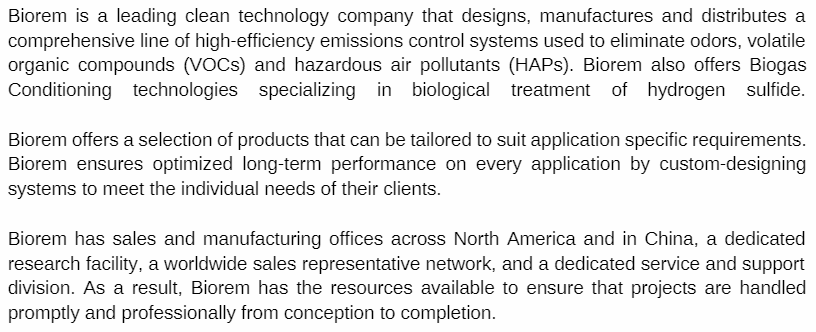
Just as a reminder on what Biorem does:

While I can’t be sure of how the second half will materialize it feels to me like Biorem has improved the potential reward side of the equation by buying back so many shares. Consider that they did $2 million of earnings last year. With only 15 million shares, that would have been 13c EPS. On a stock that is 55c that seems decent.

Dixie Group

This is the second time in the last year that I have written about Dixie right after earnings. The first time was (briefly) last November. I owned the stock for a couple weeks then sold it for a bit of a gain.

Well I am at it again with Dixie. Ironically, I bought in this morning at pretty much the price I got out of it back then.

For some reason Dixie’s results of late make me think of Larry David – pretty, pretty, pretty, good. Kinda of that not quite believing, skeptical, wondering whether it will all blow up tomorrow kind of vibe.

But to Dixie’s credit they put together another good quarter.

Dixie has 15 million shares outstanding so a market cap of $45 million. They have about $75 million of debt.

In Q2 Dixie topped the $100 million mark in sales for the first time since Q2 of 2019. They had EPS of 22c per share.

The third quarter looks pretty, pretty, pretty good so far as well:

Our residential floor covering sales and orders for the first 5 weeks of the quarter have continued at a very strong pace, well ahead of the same period a year ago. Both residential sales and orders are approximately 30% ahead of sales and orders last year and 2019 as well. 

Dixie is in the process of selling their commercial flooring business. Its a weak business (sales have been down since COVID) so I don’t know what they will get for it. It is also not the manufacturing facility – that is going to be used to expand the residential business. In Q1 commercial did $14 million vs. $21 million the year before. I won’t know Q2 until they come out with the 10-Q.

I’d hope they could fetch at least $25 million for the commercial business (though I have to admit, without the manufacturing I’m not sure what the rest is worth).

The bottom line with Dixie is that they just keep putting together surprisingly good quarters and the stock, while better than it was back in November, has a ways to go to reflect that.

Finally, Eiger Pharmaceuticals.

Honestly, last night I was planning to write a post on how stupid things had gotten with Eiger. The stock, which closed at $7.55, was trading at a market cap below $260 million with above $160 million in cash. A $100mm EV for a company with an approved product (Zokinvy) and two pretty good shots on goal at the $1 billion+ HDV market just seemed crazy to me. I never thought the stock would get this low again.

Well biotech woke up this morning and Eiger did with it. Its about time! Still, Eiger should be higher, if you ask me.

I last wrote about Eiger in November, when Zokinvy was approved. Zokinvy targets Progeria and processing-deficient progeroid laminopathies.

BTIG did a writeup on Zokinvy where they said Eiger would get $650k per year for each patient. There are 20 patients in the US, 23 in the EU and 180 patients identified worldwide (there is estimated to be 400 total but some of those I’m guessing are no identified yet?). I’m not 100% sure how Eiger collects on that steep $650k because in the US, where they are collecting revenue already, they say that none of these patients pay directly. They did about $3.5 million in revenue from the drug in Q1 but that included the initial inventory stocking.

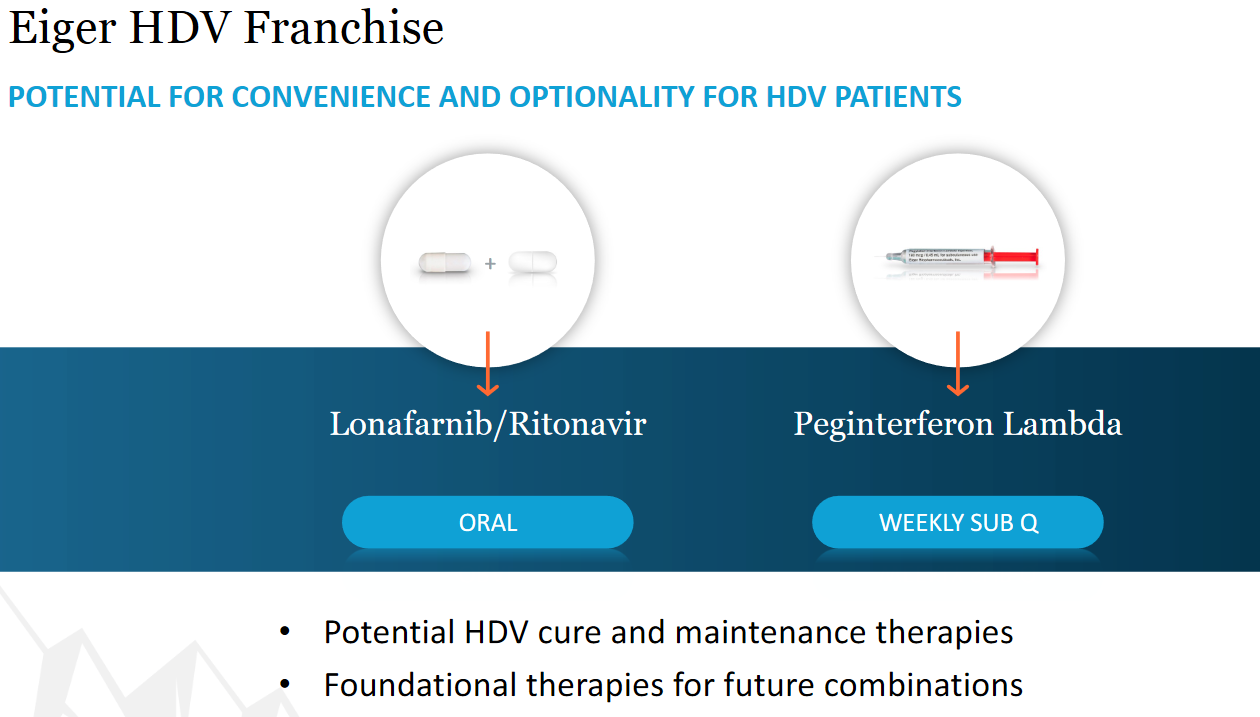
Eiger has two drugs targeting HDV.

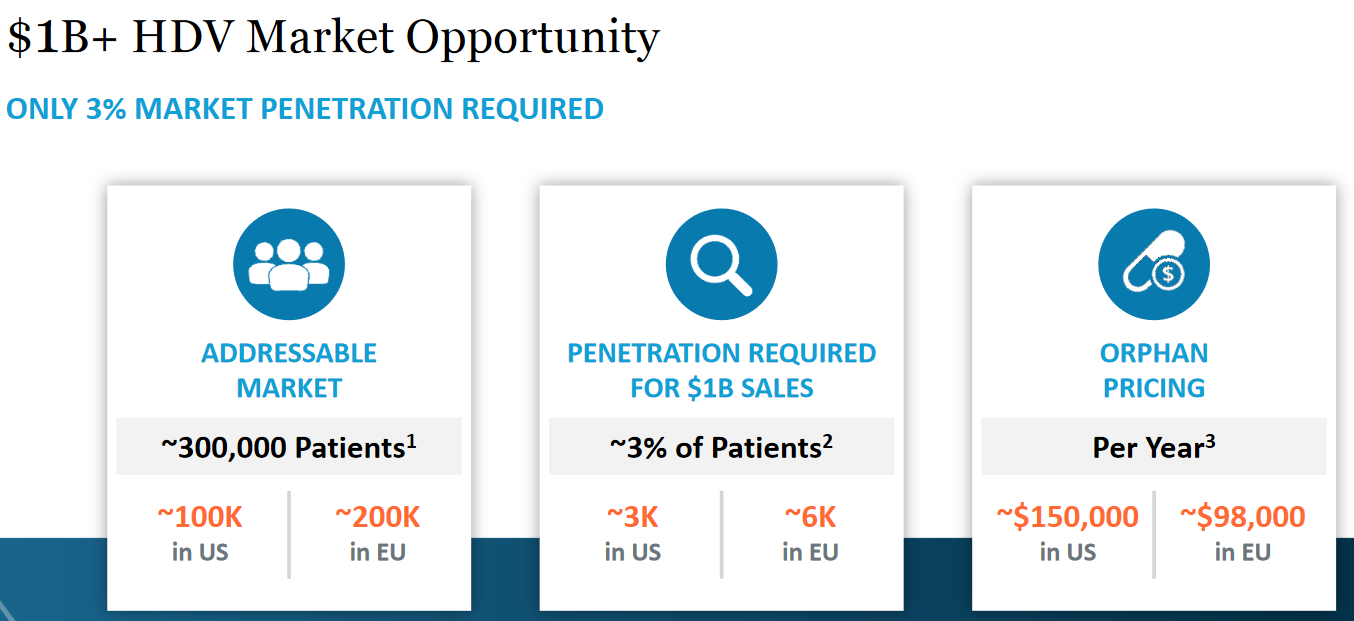
At the Ladenburg Thalmann conference Eiger outlined the oportunity for these therapies:

So what does this mean for our commercial opportunity? Well, if you think about those 300,000 patients — roughly 100,000 in the US and 200,000 in Western Europe — and we’ve done considerable market research and benchmarking and believe that a treatment for HDV will cost $150,000 per patient, per year. And if you think about the number of patients then you would need to diagnose and actually get onto a treatment to create a $1 billion market opportunity, it’s 3%; it is roughly 3% in the US and 3% in Western Europe. So that’s less than 10,000 patients in total.

In other words, it is easily a $1b market.

Lonafarnab/Ritonavir is in Phase 3 and will complete enrollment this year. Lambda is just starting its Ph3 and will begin enrolling shortly (we should get an update on that with earnings tonight).

There is a wildcard too. Lambda is also working its way through a Ph3 study with COVID. Eiger had this to say about that at the TL conference.

Now Lambda is also currently in a Phase 3 trial, as I mentioned earlier, investigating newly diagnosed outpatient COVID-19. We generated positive Phase 2 results out of the ILIAD study in Toronto at Jordan Feld’s clinic, demonstrated a potential to improve clinical outcomes and curb community spread. Treatment was well tolerated. This is a single subcutaneous injection upon — literally upon diagnosis, and the patient goes home.

 So we believe Lambda represents a potential true outpatient treatment versus monoclonals, which have to be intravenously infused. And even in patients who are vaccinated, the threat — as you may now be well aware, the threat of variance is a major concern.

 Brazil is on fire with COVID. We were lucky to have the investigators in the TOGETHER trial come to us and request that Lambda be included as an arm. We have now dosed our first patients, and we look forward to updating on what could be a registration-enabling study for Lambda in COVID in Brazil.

Eiger kind of blew the opportunity with COVID early on because Lambda Ph2 data actually looked very good, but they were slow to get it out into trials. But with Delta, they get a second chance. If they report good data the stock could move on that alone. Consider HGEN, which is worth $950 million right now.

I think Eiger is getting thrown out with all the biotechs. Its just been a complete disaster in biotech land since March, and I am hopeful this rally puts it behind us. I think if it does Eiger should do very well.

Biotechs are Awful and Caribou Biosciences Looks Reasonable

My foray into gene editing has been more miss than hit so far. I bought a few of these stocks four or so weeks ago and have subsequently watched them crumble along with the rest of biotech.

As of Friday I had positions in CRISPR Therapeutics and Intellia Therapeutics. These positions are both underwater now, by 15% and 10% respectively.

More generally, it has been a tough market to buy biotech stocks. This is definitely the pain trade right now. A pain trade is buying something that is clearly out of favor and has zero love with the expectation that this will change and it may change quickly. Energy has been the best example of a pain trade over the last few years. You buy energy stocks because they are hated and then every once in a while they have a barn-burning rally and you make a killing.

Biotechs are definitely loading up on the pain right now. That pain is accentuated by the fact that the market keeps going up as they go down. The only biotechs that are not going down are… is Moderna. I own some Moderna, so that is a nice respite from the others.

But back to gene editing. I lightened up a little on a few of my gene editing names Friday afternoon once I realized that there was a new name that I think looks better than the others.

Caribou Biosciences went public on Friday about 2 hours after the market opened.

I did not realize Caribou was about to go public. I have been on vacation and missed the news. So about 30 minutes before the market closed Friday after seeing a tweet on Caribou, I was scrambling to see if I wanted to own the stock.

One thing about spending the last month or so trying to understand gene editing is that while it has not translated into making me a good picker of these stocks, it has at least given me a decent understanding of the landscape.

And if I am right, Caribou is mispriced compared to its more established (as stocks, not as a company) peers.

At its closing price on Friday Caribou traded at a market cap of $950mm. They have $425mm of cash on hand. That compares to CRSP and NTLA at around $10 billion, BEAM at $6.5 billion, EDIT at $2.7 billion, VERV at $2.4 billion and GRPH at $1.5 billion.

Now CRSP and NTLA have programs that have already had some positive Ph1 results. That is why they have the highest valuations. BEAM does a newer version of gene editing called base editing that may turn out to be superior to Cas9 editing, and that is why BEAM gets the relatively high valuation given that they are pretty early on (they don’t have a therapy in human trials just yet). The rest have points for and against but all are very early stage.

In general, at least a ~$2 billion valuation seems to be the norm for these gene editing CRISPR stocks. You could certainly argue they are all overvalued – in fact what I see is most traditional biotech investors are pretty put-off by the valuations these stocks get given the point where their therapies are in development (either Ph1 or pre-clinical) – but I think its tougher to argue why Caribou should be at $500 million net of cash while these others all trade at multiples of that.

Why? Well for one, Caribou holds a lot of the CRISPR IP. If you read the Intellia 10-K, they say they license much of their IP from Caribou. In fact, if I am understanding the disclosure correctly, Caribou will get a mid-single digit royalty on any product Intellia markets that uses the Caribou IP.

Caribou has the IP because this is Jennifer Doudna’s original company. Caribou was created shortly after Doudna and Emmanuelle Charpentier discovered CRISPR Cas-9. Doudna is still with the company heading up their scientific advisory committee. Their CEO, Rachel Haurwitz, was with Doudna as a research assistant since the beginning and has been CEO since Caribou was established.

It seems like a pretty all-star-like team here. They are full of the original discoverers and they own the underlying IP (though there are ongoing patent battles with the IP so that is something that could change, for the better or the worse).

The biggest knock that I have seen made against Caribou is that they are going after different indications than the rest of the group. Pretty much all the CRISPR names I’ve mentioned are going after the kinda “lowest-hanging fruit”. That would be stuff like sickle cell disease and other genetic blood disorders, liver diseases, and eye diseases. There are a bunch of reasons why CRISPR editing is most conducive to these targets, but they are.

Caribou is going for the big kahuna. They are going after cancer.

There are a couple things about targeting cancer that could be construed as negative.

First of all, its a tough nut to crack. Something like sickle cell disease is relatively simple because we know that it is caused by a particular gene mutation and we know that CRISPR techniques can knock-out gene mutations. So its a fairly low bar (I mean intuitively, not in practice) to conclude that if you can get the process down right, you can knock out the genes causing the mutation and prevent the disease.

Cancer is of course very complicated. What’s more, Caribou is not doing something totally unique with their approach. Caribou is using Cas9 and their own, proprietary (I think) Cas12a editing techniques to edit CAR-T cells that are used in cancer therapies.

(Note: I don’t believe that Cas12a editing is done by any of the other public gene editing companies. I am trying to learn more about Cas12a editing. FWIW Caribou says that its more precise edits than Cas9.)

Using CAR-T cells isn’t at all new. But editing them in the way Caribou is doing is new. The specific edits Caribou is making to the CAR-T cells are new, including the “first clinical-stage allogeneic anti-CD19 CAR-T cell therapy withPD-1 removed from the CAR-T cell surface by a genome-edited knockout”.

Planning to use allogeneic cells is also new. Allogeneic means using cells from a healthy donor, rather than harvesting cells of the patient. This has the potential to make the manufacturing of a therapy a much easier and consistent process. From what I have read, the limitation of using patient cells has been a stumbling block in getting CAR-T therapies used so far.

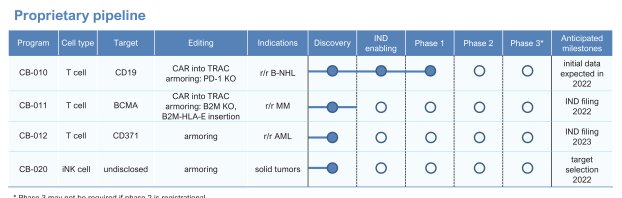
Caribou’s lead therapy candidate, CB-010, has just started its Ph1 trial. They recently dosed their first patient in the trial and expect results in early 2022.

CB-010 will be followed up by 3 other therapy candidates:

Worth noting is that the CB-010 CAR-T edits are being done by Cas9 editing. The following 3 candidates will use Cas12a.

So anyway, going after cancer is maybe a reason that Caribou is not valued like the other gene-editing names. But you could also argue the opposite. Cancer is a huge TAM and if Caribou shows some success with CB-010 the market is going to flip on its head and look at Caribou as the leader in new gene edited therapies against cancer. Which would obviously be massive.

My point in this very quickly written post is not to try to parse the positives and negatives with a fine tooth comb. It is simply to look at the positives and negatives and conclude (tentatively at least) that Caribou is probably as well positioned as most of these other gene editing companies, and yet the stock price is less than half of their valuation.

PS –

In addition to the gene editing pain, I have taken on additional pain by buying or adding to a number of biotech positions in the last couple days. I bought some BIOC on my expectation that their COVID testing business may last longer than many have anticipated. I bought some Lyra because it is again trading close to cash. And I bought back my EIGR position because it again has dropped below $8 and they have a Ph3 Covid trial that should readout soon and that could be more relevant with the Delta variant gaining steam.

On the other hand, if biotechs go from bad to worse to off the charts then I am going to feel pain this upcoming week.

Aehr Test Systems

Aehr is a stock that I have been waiting on for (literally) years. I’ve owned the stock maybe a half dozen times. Whether I have made money on it as a whole, at least before yesterday, is questionable.

Aehr is has always been a stock of big promises. The promise has been the big order, that new vertical application, a customer, or customers, that is going to buy their test systems by the 10s or 100s.

That is not just me speculating. If you go back to my original post on the company (here) I noted that management itself was speculating on this way back in 2017.

The company doesn’t give a lot of guidance, and there isn’t much of an analyst following to prod information out of them, but on the third quarter conference call management said that if successful with their lead customer (probably TI?) they could ship 10 systems a program and that they are currently working on 2 programs.  So the lead customer alone could amount to a $40 million to $60 million opportunity per program.

But I had pretty much given up hope on this ever happening. Year after year of small piecemeal orders created skepticism. It did not help that Aehr has some directors that sell shares incessantly, which does not boost one’s confidence.

Recently, one thing that I had noticed about Aehr was that the stock price seemed stronger than I would think it should be. The stock had been trending in the $2-$3 range through the first 6 months of the year. This was a little unusual, because Aehr’s results had not been very good at all, and while management talked a good talk on calls that was really nothing new.

When a stock is stronger than it should be, especially when its a micro-cap, it is often telling you something.

So I took particular interest to the company’s fiscal fourth quarter call last Thursday to see what might be going on.

The numbers in the fourth quarter were ok. The revenue number, $5.5 million, was nothing to write home about, but they had $5.4 million in bookings and a backlog of $7 million.

A $7 million backlog has been kinda a magic number for Aehr. When things are good, the backlog gets to above $7 million. When they are bad it can go as low as the $2’s. I believe that $7 million of revenue a quarter was the breakeven level that the company stated years ago. On the call they guided this coming fiscal year at above $7 million per quarter, which is pretty, pretty good – for Aehr.

On the call Gayn Erickson, who has been Aehr’s CEO since I started following the company, gave color about a few new opportunities that have shown themself to Aehr.

One of these opportunities is in silicon carbide devices.

This past fiscal year, we made significant inroads into the emerging silicon carbide device market, which continues to be a very promising key growth driver for Aehr and will be a major focus in the coming fiscal year. Silicon carbide power semiconductors have emerged as the preferred technology for battery electric vehicle power conversion in onboard and off-board electric vehicle battery chargers and the electric power conversion and control of the electric engine. Our FOX-P family of products are very cost-effective solutions for ensuring the critical quality and reliability of devices in this market, where performance and reliability cannot only mean increased battery life but also whether you have to walk home from a vehicle whose power semiconductor fails in the powertrain.

Failures of the SiC device is particularly bad in a vehicle because it usually means the vehicle just stops. It reminds me of an alternator in an ICE.

SiC chips are more expensive than silicon, which is why they are not used across all applications. Where they shine is in high voltage applications and in applications where the chip is going to be under a lot of stress. Renewable applications like EVs, solar and wind fit the bill.

Aehr has had a customer that has been looking at their test systems for silicon carbide chips for a while now. I believe the first mention of this was the October 2019 call.

What was news on Thursdays call was that the customer had qualified the Aehr test system and was expected to order a number of them this year.

During this past fiscal year, our lead silicon carbide customer qualified Aehr’s FOX-XP system for high-volume production burn-in and infant mortality screening of silicon carbide power devices at wafer level for electric vehicles. This customer is a leading Fortune 500 supplier of semiconductor devices with a significant customer base in the automotive semiconductor market. They have now qualified several devices for automotive applications on our solution, ordered multiple FOX-XP systems and have purchased multiple new WaferPak contactor designs that are expected to be qualified and moved to production during this new fiscal year.

Also on the call, Erickson talked about a ramp from the other major developing vertical, silicon photonics:

We’re excited to mention that our lead customer in silicon photonics has forecasted a ramp that we believe will drive new orders for additional FOX-XP systems and a significant number of WaferPaks this quarter. This customer one of the world’s largest semiconductor manufacturers, continues to look to Aehr to support their high-volume production ramp and wafer level burn-in capacity, and is forecasting significant growth in shipments for silicon photonics devices that we expect to drive the need for additional production test and capacity for multiple years in the future.

Erickson went on to describe why Aehr’s Fox system is ideal for the new evolving designs in silicon photonics:

It turns out that the photonics part of the silicon photonics, which is the laser needs a thing called aging or stabilization. We actually test the devices and it takes a number of hours to stabilize the laser to be able to get it to a point where it is useful in that application. Historically, that stabilization was done in a discreet package at somewhere else. But when you put it into a silicon photonics, when you integrate it together, that laser exists on a wafer. Well in order to actually enable that, you would actually need to be able to do a wafer level burn-in to make — to take advantage of all of the scaling that’s going on, and that’s where we come in. The FOX-XP system is capable of not only having all the power supplies and the capability to 100% discreetly determine and test every single laser that are measured in thousands per wafer in one short, but also can deal with the amount of power to the devices and removal. And then we can do that with up to 18 wafers at a time. So now all of a sudden, it is a cost-effective enabler for silicon photonics.

They also announced that 2 new silicon photonics customers had accepted the Aehr system after completing testing.

The thing about Aehr is that they have always held out the possibility of a big home run. While they piddled along with these pissy little $1 million or $2 million orders, the opportunity was that one day they would announce the big score.

Again going back to those old 2017 conference calls with Erickson. At the time he was saying that he thought that Aehr’s FOX-XP system “increases their TAM from $100mm to $400mm annually” and that they could take a significant portion of that.

It is that “carrot” that has kept me watching the stock through all the years while it did nothing.

I took a position on Friday after reviewing the call but honestly, I thought I still had lots of time to add to it before something would happen. After all, this is Aehr and Aehr is all about over-promising and under-delivering.

I was wrong.

Yesterday Aehr announced a $10.8 million purchase order from the SiC customer that they mentioned in the call. They will be used for testing SiC devices in the automotive market.

In the press release Aehr said there is more to come: “This customer continues to forecast orders for multiple additional FOX systems and WaferPak Contactors this fiscal year and a significant number of systems and WaferPaks over the next several years due to electric vehicle semiconductor test and burn-in demand. “

Aehr has never had an order like this. Like I said, its always these $3 million, one-off orders. A $10 million order is a whole new ball game.

It suggests to me that this time around Aehr is actually gaining traction in commercial applications. Not just selling systems piecemeal for a niche application or a verification by some large OEM. But real commercial applications.

Of course, the stock popped yesterday. I am sorry about always being late to the game with these posts but when the news comes out first thing in the morning I just don’t have time to write up a post in real time explaining what it means.

Nevertheless, even at $6 Aehr has a market cap of $140 million. This really is not a lot in the grand scheme of things. Way back in 2018 I made some projections of what EPS might look like if Aehr got to a magical $10 million revenue per quarter number. I estimated they could do 35c for the full year.

Flash forward to today and really, not much has changed. If anything their cost structure appears to be lower.

Aehr is a lot like Vicor. Remember that Vicor was a stock I held on and off for years and they were forever promising the big order and it never happened and then one day it happened and the stock took off.

My mistake with Vicor was not realizing just how far things could go. With Vicor I sold the stock at around $35 per share. It was a triple or so, so I did fine. But Vicor kept climbing, it got above $100 at one point!

I never completely understood how that happened but the lesson is that once the new market materializes (and interestingly with Vicor it is actually the same market – EVs – as Aehr is benefiting from), and if that new market is the hot new thing, the valuation can get rather silly.

With Aehr, even though it has moved, the valuation is far from silly.

The caveat is that Aehr probably raises capital here. They have a little under $5 million of cash, which is really not much. I would not be at all surprised if they raise more here or at least very soon.