Skip to content

Smith-Micro

I took a position in Smith-Micro after their quarter was announced Wednesday. This is probably the third (or fourth?) time I have owned the stock.

This is not a perfect situation to buy but I decided the positives outweighed the negatives.

The negative – a big one – is that revenue is not going the right direction. In particular, Safe & Found revenue is dropping. Their expected quarterly (!!) churn on Safe & Found in the fourth quarter is 7-12%, which is not good. There are some mitigating factors here, like the merger of T-Mobile and Sprint which is probably uprooting their customer base, but still.

So why did I decide to buy the stock? Because when I read through the transcript, it sure sounds like multiple new customers are very likely in the next couple of months. They talk about “multiple opportunities”, how they have added features “that are required for new accounts”, how they will need all their new people (70 hires) for new deployments in the first and second quarter, and he did not disagree to the comment “you’ve talked pretty confidently about at least a couple in the next 30 days, perhaps a third one by year end.”

It just seems that this is one of the few stocks that has not moved post-COVID and so 2 or more announcements of new customers in the next couple of months could be fair catalysts. If they don’t happen or if the response is muted, then I should be able to exit the stock before we get any more data points on those scary churn numbers.

Research: A Few Names, Kopin Industries

So. Many. Earnings reports. This is the week of the quarter where it is a little overwhelming to go through all of the earnings reports hitting my email. I think it is worse this year because of the election – all the companies that would have normally released results Tuesday delayed it a couple of days to Thursday, so yesterday morning and evening was a deluge.

I don’t have time to take notes on all of them. Read it, decide if there is anything actionable, go onto the next. I will go back to the one’s that warrant another look later.

Three names have caught my attention so far though. Two new names and one old one.

The old one is one I mentioned back in August, Apollo Healthcare and Beauty, which released results this morning. 38c EPS for the quarter, $31 million of EBITDA in the quarter and they generated roughly $35 million of free cash flow. They have a $260 million market cap. Nuff said.

First new one is Dixie Group. So first of all, this is a bit of a shitty company. I’ve followed it for a long time and they always seem to blow it, one way or another. They appear to have decent products (they sell flooring) but they can never put together a decent string of quarters.

But this last quarter, actually last two, are interesting enough to at least get me looking.

The top line is still down (which is not good as I am reminded of Scott Fearon (who wrote Dead Companies Walking) axoim, which was simply – short companies with declining revenue.

But that is largely COVID, and meanwhile their costs are down and gross margins are up. They generated free cash for two quarters and the stock has a market cap of $15 million or so.

Second new one. I added notes below. The company is Kopin Corp. They have kind of a blighted past as well, lots of years where revenue has bounced around from $20 to $30 million and the company has lost copious amounts of money.

But, they make microdisplays. So displays that you would put near your eye. Their traditional market is into military and first responder applications (thermal weapon sights, fighter pilot helmets, firefighter thermal camera masks) and I think that is why the stock is a bit weak (all these military related stocks, or even if they are perceived as being military related, seem to have taken a hit with Biden getting the vote). But the new vertical that is just developing is virtual and augmented reality.

Anyway, Kopin grew revenue yoy by 55% in Q3, which seems quite good but it was off of a weak comp. Most of the quarter was because of military.

So that wouldn’t have me particularly excited. The bigger news for me is that they are finally seeing the AR/VR market get some traction. They said “we are also very excited to see growth coming from our enterprise customers who have incorporated our displays and modules into their AR products.” and “Our view of the market is that the long-awaited adoption AR/VR system is finally beginning to come.”

This stock reminds me a bit of Vicor. A new tech that takes time to get traction with a payoff on the horizon. But I need to dig more.

Here are the notes on Kopin so far:

  • initiated by HC Wainwright Aug 25
  • market cap of $130mm
  • $15mm of cash, no debt
  • been around 30 years
  • had success bringing tech solutions to market, developing profitable tech
  • provide reflective displays, microdisplays

Microdisplays

  • these a small form factor displays used at near-eye placement
  • three microdisplay technologies:
    • transmissive – they call them their CyberDisplay products
    • reflective
    • emissive
  • at a high level the two more mature technologies are AMLCD and LCOS, the OLED is newer, and is just being designed into products
  • they “believe some customers will want to switch from AMCLDs to OLED microdisplays in the next two to three years”
  • so their development focus is: AMLCD display subassemblies for military applications and OLED display components for military, industrial and consumer applications
  • miniature transmissive active-matrix liquid crystal displays –  AMLCDs
  • AMLCDs are either transmissive or reflective
  • AMLCDs go into thermal weapon sights, fighter pilot helmets, firefighter themal camera masks, augmented reality, virtual reaity consumer products
  • they have 428 x 240 resolution to 2048 x 2048 resolution
  • reflective liquid crystal on silicon – LCOSs
  • LCOS are used in 3D optical inspection
  • these are reflective displays
  • LCOS have 1280 x 720 pixels (“720P”) resolution to 2K x 2K resolution
  • AMLCDs and LCOSs are time domain imaging
  • organic light emitting diode – OLED
  • OLED are Lightning displays
  • OLEDs are emissive displays
  • OLEDs emit light when there is current flowing thru, whereas AMLCD requires separate light source – this is probably emissive vs. the other types
  • OLED light is evenly distributed across fwd direction, so better for wide angles, and has higher contrast than AMLCDs
  • they seem to be focused on OLEDs – they say they think they can bring down costs by breaking up manufacturing into 3 parts, I think focusing on design and not manufacturing
  • their proprietary tech is in the backplane circuit design – so they will do that piece, outsource the backplane manufacturing and the layering of the OLED on the backplane wafer
  • OLEDs have 1280 x 720 (“720p”), 2048 x 2048 (“2K”) and 2560 x 2560 (“2.6K”) resolution
  • currently KOPN has two OLED microdisplays on the market:
    • a 2k display with 2048 x 2048 resolution in a 0.99” diagonal size aimed at VR/MR
    • 720p display with 1280 x 720 resolution in a 0.49” diagonal size, which is aimed at AR applications
  • they also have a 2.6K display that is in demo/prototype
  • say OLEDs are used in “Customer development programs” whatever that means – they are superior for some AR and VR applications
  • their transmissive products – they explain this proprietary manufacturing process they have for creating the transparent circuit on the transparent substrate
  • ASICs – these are ASICS to interface with the displays they make
  • backlights, optical lenses
  • they design all components, manufacture all the displays, outsource the ASIC and backlighting
  • they sell the displays standalone or in a module with an optical lens, backlight, pastic/metal housing and other add-ons
  • have a subsidiary called NVIS that sell to military – head mounted and hand held military equipment that is used for training – also may be used for some industrial applications, not sure
  • most common application is military – thermal scopes, rifle sights, aircraft headgear, missile targeting, replacement CRTs
  • this is an industry where military leads tech – subsidizes development that is eventually used in commercial applications
  • expect more commercial applications over coming years
  • commercial applications are: ophthalmic surgery, semiconductor inspection (3D metrology), visual
    • enhancement in firefighter breathing apparatus helmets
  • they design and manufacture the visual systems into modules that can be integrated into various products
  • products encompass a bunch of different display technologies: AMLCD, LCOS, OLED)
  • have wins with companies like: 3M Scott, Solos, Vuzix, and RealWear
  • they recently reduced investment in new system design other than the NVIS sub
  • focusing on just selling the display components, particularly the OLED

Market

  • micro display market currently $700mm
  • expected to grow 20-24% CAGR
  • they are targeting emerging market called “wearables”
  • describe wearables as three markets:
  • body-worn devices such as sensors, scanners and terminals which are sold to the military to improve soldier effectiveness
  • industrial markets to improve worker productivity
  • consumer market to monitor health and fitness metrics such as heart rate, speed and temperature.
  • smartphone makers looking to create products that complement/replace smartphone

Customers

  • a big chunk comes from military:
  • I think the funded R&D is generally military as well

Solos Spinoff

  • happened Sept 30/19
  • sold and licensed Solos product line and Whisper Audio technology to Solos Technology
  • received 20% equity in Solos as a result
  • it’s a related party transaction, their CEO owns 15.5% of Solos and two other family members hold 37% interest in Solos
  • sold off the product lines to focus on the display products
  • it looks like Solos makes glasses that have builtin speakers, also tie-in to a mobile app called AirGo
  • so Whisper is the sound tech that goes into the glasses – including noise cancelling algorithm

Competition

  • general commercial display market: dominated by Asian companies: AUO, BOE Technology, Himax, Samsung, Sharp, Seiko, Sony
  • their competitiveness against these guys depends on consumers wearing near-eye displays
  • also compete against cell phone displays from Samsung and Oculus – these are lower res, greater image latency, but lower cost
  • also are other AMLCD, LCOS, and OLED techs: include plasma, LEDs, virtual retinal displays

Investments

  • they own 20% equity in Solos Inc
  • they had equity in RealWear but wrote that down to 0 in Q419 – this isn’t good b/c RealWear was 20% of revenue in 2019
  • have 153 employees
  • they depend on their sales to military: F-35 Strike Fighter, FWS and other U.S. military programs
  • are in qualification for Family Weapon Sight program – which is next gen procurement program from military

Legal

  • there is a legal proceeding against them by a company called BlueRadios

Research: Bank Earnings and CUBI

I went through all my bank earnings reports and conference calls on the weekend. When I say all, it isn’t really a big universe. It consists of: BSVN, BCBP, CADE, CUBI, MLVF, OCFC, PKBK SBFC, SFBG, SI, UBSI.

Nothing super exciting. Still hard to get excited about most of them unless I decide I just want to buy them cheap, close my eyes and wait it out. But I did buy CUBI back, and of course I bought Silvergate (more on that shortly). If there was any theme to all these earnings reports it would be that deposits remain up big and that the deferred loans are coming down fast, in large part because they better come down fast since the bank GAAP holiday is going to end Dec 31st and if these banks haven’t figured out how to make these loans current they are going to have to reserve for them (extend and pretend has been fun while it lasted but its now coming to an end).

The other thing that I think I underestimated was just how beneficial these PPP loans can be. In all honesty, between the extend and pretend CARES act and these PPP loans, it feel like a bit of a free-money wealth transfer to banks if you ask me. But anyway, the loans are pretty much no risk to the banks because the government stands behind them, the banks collect the interest, which are usually in the 2% range it seems and the best part (for the banks) is that they rake in fees for originating the loans and I didn’t realize how significant those fees can be.

Here is where CUBI comes in. They had a SBA lending program heading into the pandemic so they were well-placed to ramp up the PPP lending program once it was announced. They have originated $5 billion of PPP loans. That works out to 30% of the loan book as of the end of Q3. That’s a lot. Most other banks I’m looking at are 5% or less.

Anyway Customers expects to generate $100 million in pre-tax origination fees from these loans. They must be getting a 20 bps origination from the government to originate.

They recognize the fees when the loan is either forgiven or paid back. Given that we are in a ‘free for everyone’ world now, these loans are going to be forgiven and relatively soon. Customers figures 90% of loans will be forgiven by the end of the first half of next year.

~$100 million over the next 3 quarters is some decent juice to earnings. Consider that Customers net income was about $60 million last quarter and that was with $12 million of fees from PPP.

Meanwhile Customers is bringing down their deferred loans like a good little bank – from 7.3% in Q2 to 2.6% in Q3, and they operate in New York and New Jersey, where the virus pig is further through the python than most places.

Everyone hates Jay Sidhu it seems and maybe there is good reason but he is making some decent decisions here. He was quite adamant on the call that he is not going to stand by while the stock continues to trade at the rather shockingly low multiple of 0.45x tangible book. If they have to, he said they will take the nuclear option:

We are working on scenarios to shrink the balance sheet and have massive stock buybacks so that the appropriate valuation of the company is being reflected by — into the value of the organization.

Anyway, may not be the best run bank in the world, but does it really deserve to be priced as one of the worst?

Here are my notes on the quarter:

  • so first: Bank will earn approximately $100 million in pre-tax origination fees from PPP loans, significantly adding to its common tangible equity in 2021 – that’s a crazy amount of fees for a company with a market cap of $400mm
  • they recognized $12mm of fees in Q320 – will recognize the rest over life of PPP loans, expect 90% to be forgiven in H12021
  • total PPP loans are $5b – of total loans of $16.4b so about 30%
  • additional PPP loans in Q3 contributed $10mm of Net Interest Income
  • PPP loans have 1.97% yield on avg
  • expecting 95% of their PPP loans to be forgiven – half of their loan balances are below $150k
  • Core EPS of $38mm or $1.20 per share
  • their NIM declined to 2.86% – seems similar to other banks
    • are projecting NIM in 2.9% to 3% range for FY 2020
  • deferments are down quite a bit – from 7.3% to 2.6% – now $302mm loans
  • for reference here is the relevant section of CARES on loan deferments:

Temporary Relief from Troubled Debt Restructurings. A financial institution may elect to suspend requirements under U.S. GAAP for loan modifications related to the COVID-19 pandemic that would otherwise be categorized as a troubled debt restructuring and to suspend any determination of a loan modified as being a troubled debt restructuring, including impairment for accounting purposes, as a result of the effects of COVID-19. Any such suspension (1) is applicable for the term of the loan modification, but solely with respect to any modification, repayment plan or other similar arrangement that defers or delays the payment of principal or interest that occurs during the applicable period for a loan that was not more than 30 days past due as of December 31, 2019; and (2) will not apply to any adverse impact on the credit of a borrower that is not related to the COVID-19 pandemic. The election may begin effective March 1, 2020, and end at the earlier of December 31, 2020, or the date that is 60 days after the date on which the national emergency declaration related to COVID-19 is terminated. Financial institutions are directed to maintain records of the volume of loans involved so federal banking agencies may collect data about such loans for supervisory purposes. (Section 4013)

  • key point is that the deferments end Dec 31 2020 right now
  • hospitality is $404mm (3.5% of total loans) and 31% in deferment – so about $120mm or 40% of their deferments are hospitality
  • avg loan to value in hospitalty is 65% – seems pretty low, if these loans do get called they’d get back their money on sale you’d think
  • their multi-family portfolio has vacancy rate fof 3.4%, is 60% LTV, 4% of it is in deferment
  • consumer loan deferments down to $25mm from $60mm
  • NPAs are still very low, at 0.34% but this is of course because of the deferment
  • their reserves are way higher, at over 2%, or $155.6mm
  • guiding to $3/share core earnings for 2021
  • also to mid-high single digit loan growth (excluding PPP)
  • deposits were up 21% to $10.8b yoy
  • expect funding tailwind from $466mm of CDs that mature at YE and will reprice down significantly – that is close to 5% of interest bearing deposits
  • saw loan growth of $6b, to $16.6b – of that $5b were PPP loans, so about $1.6b of loan growth outside of PPP
  • this just seems too low to me: we are trading at about 43% of September 30 book value and only at about 4x 2020 and 2021 earnings.
  • on stock buyback:

are working on scenarios to shrink the balance sheet and have massive stock buybacks so that the appropriate valuation of the company is being reflected by — into the value of the organization.

  • I’m not exactly sure what this is but it’s a little concerning:

our specialty lending, lender finance business is the largest component of that. It’s an approximately $1 billion business for us today, and that will be driving majority of the growth. That’s a business that is predominantly at approximately 65% advance rates on a pool of collateral with collateral swaps in the event that there’s ever an issue. And as we’ve modeled it out, you’d have to be at a reception multiple times as big as a great recession to ever experience $1 of loss. So that’s the biggest component of our specialty niche businesses.

BankMobile

  • expected to close by YE
  • have “no intention of owning equity” in BM in long run

Research: Daseke

I’ve been following Daseke ever since they took over another company I used to own called Aveda Transportation (I think that was 2018?). There was a large contingent payout for Aveda based on EBITDA that quite honestly I think us shareholders of Aveda may have been screwed out of, but whatevs, that business basically imploded with oil and has been a disaster for Daseke so it turned out okay anyway.

Daseke put together another good quarter. That is two in a row. Some of the sequential improvement was one-time in nature but the new management team has clearly turned things around since the old founder Don Daseke was let go.

I don’t own the stock but I do own some of the old SPAC warrants which covert at $11.50 and expire Feb 2022. They remain a long-shot but I paid about 15c for them and it just seems like on the off-chance that Daseke continues to improve through 2021, maybe we get an infrastructure bill, maybe wind continues to take off (they ship a lot of turbines on their flatbeds) that the warrants are as good of a moonshot as anything else right now.

That said, while the quarter was good, it seems to have a lot of one-time tailwinds so I’m not sure how sustainable this stock move yesterday is.

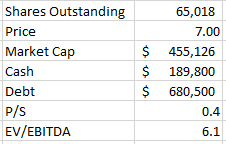
Here’s where we stand with share structure.

So based on TTM EBITDA I see them at about 6x. Its not incredibly cheap or expensive.

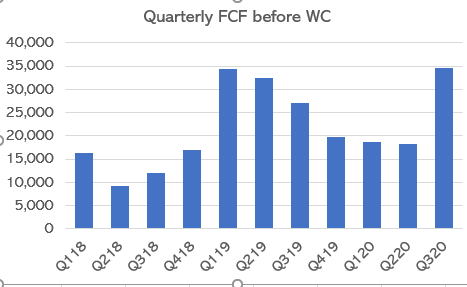
They did generate a lot of free cash again in the quarter:

The thing about the warrants is that because of the leverage, a relatively modest change in valuation or operational improvement can make a big difference to the stock price. So if they get to trade at 8x EBITDA instead of 6x EBITDA (or if, conversely, they can keep the EBITDA improvements coming and say, get to a $50mm per quarter run rate sustainably and a 6x multiple), the common goes to $12 and the warrants are in the money.

So its not impossible. Unlikely? Yes, but not impossible. A moonshot.

Below are the notes from the quarter as well as the notes from the Q2 that I had made previously and I don’t think I ever posted.

Q320

  • another big improvement to operating ratio – 92.5% for the quarter down from 96.5% in Q220
  • but sounds like this is a bit of one-time anomaly, not really representative of further business improvement
  • still focused on getting operating ratio below 90%
  • expecting OR improvement in 2021 over 2020
  • up to $15mm of net income – 22c EPS
  • aEBITDA of $56mm
  • have delivered $156mm of fcf year-to-date
  • net debt is now under $500mm – down $135mm yoy
  • they finished the divestiture of the Aveda shitshow!
  • still seeing lower freight volumes in flatbed
  • specialized revenue was flat yoy excluding Aveda
  • all the EBITDA improvement yoy was from specialized
  • had a big (one-time??) benefit from disruptions in wind and high security – this is a lot, $15mm added to EBITDA from these
  • kinda seems like these one-timers were all the uplift:

So Q2 was 96.5; Q3, 92.5 million, if I do the back-of-the-envelope math on the $15 million benefit you mentioned this quarter from nonrecurring items or unique items, I guess, this quarter, it implies virtually all of — kind of the sequential improvement was onetime in nature.

  • also saw tailwind from COVID cost reductions that won’t continue
  • tailwind from wind is contining at least in part in oct
  • very difficult to forecast wind – they don’t know how 2021 will look, too project based
  • expect insurance to be $2mm per quarter headwind in 2021
  • kinda guided to an okay Q4 but seasonality will kick in and make it down a bit
  • expect capex of $75mm to $80mm in 2021
  • still seeing many of their industrial markets trending down
  • seeing pockets of strength in roofing, pgysum, commercial glass
  • turnover: finished this quarter, I think, just under 62% in total turnover, which is down from a year ago and down sequentially as well. So we’re having a good year from a turnover perspective – I think its been around this level for at least 2 years now

Q220 results

  • they had an operating ratio for the combined company of 96.5%
  • best operating ratio since they went public over 3 years ago
  • yoy operating ratio improvement of 250 bps
  • divested Aveda Transportation and Energy Services – collecting $48mm from PP&E sales so far – but with winddown costs will be $7-$10mm cash drain
  • o&g exposure will drop to 2% from 13%
  • core business revenue was down 13% in Q220 excluding Aveda – EBITDA down 5% – EBITDA was $45.8mm excluding Aveda – Aveda was a drag of $1.8mm EBITDA
  • they actually showed an EBITDA increase in Q220, up 13%
  • are investing in their fleet – lowered average truck age from 3.8y to 3.4y from start of year
  • it wasn’t totally clear to me but sounds like avg age depends on specialized vs. regular flatbed fleet
  • of the 9 operating companies they have, several are operating at “sub-90%” operating ratios today
  • their specialized segment is what includes Aveda – it saw revenue of $221.5mm and EBITDA of $33mm – so it is a big driver of bottomline
  • their specialized segment OR is 90% – that is up 410 bps yoy
  • flatbed segment had revenue of $137mm – this was down 22% yoy
  • but EBITDA in Flatbed was $20.4mm – which was up a little yoy
  • they decreased net debt $118mm yoy – leveraged at 3x which is below 4x of covenant
  • they guided to capex of $60mm to $65mm – this must be $160-$165?
  • maintenance capital is in $75mm to $100mm range
  • their goal is to get operating ratio down to 90% across all the business lines
  • segments that were strong: lumber, wind, defence – while aerospace not likely to come back soon, metals is weak
  • July trends are flat – improvement through April, May, June but July is flat
  • they expect to see continued OR improvement through the rest of the year
  • CEO was “shocked” at resilience of Daseke model – how well freight held up in Q220