Skip to content

Research: Luby’s

  • announced this today:

has approved and adopted a plan of liquidation and dissolution (the “Plan of Liquidation” or the “Plan”) that provides for the sale of the Company’s assets and distribution of the net proceeds to the Company’s stockholders

the Company currently estimates, assuming the sale of its assets pursuant to its monetization strategy, that it could make aggregate liquidating distributions to stockholders of between approximately $92 million and $123 million (approximately $3.00 and $4.00 per share of common stock, respectively, based on 30,752,470 shares of common stock outstanding as of September 2, 2020).

  • this doesn’t sound like a new press release – they had this in the 10-Q:

On June 3, 2020, we announced that our Board of Directors approved a course of action whereby we will immediately pursue the sale of our operating divisions and assets, including our real estate assets, or the sale of the Company in its entirety, and distribute the net proceeds to our stockholders after payment of debt and other obligations. During the sale process, many of our restaurants will remain open.

  • I guess the new thing is putting numbers to it
  • have 30.7mm shares outstanding $31mm market cap at $1.05
  • another $63.7mm of debt
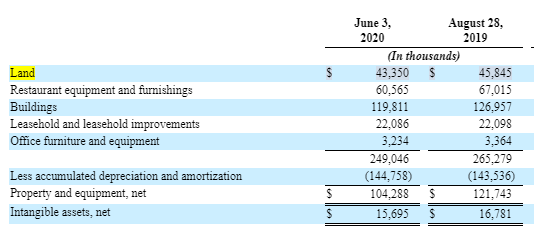
  • book value is $65mm – also intangible assets of $15.7mm
  • got a $10mm PPP loan but that is in those numbers
  • presumably the RE must be worth quite a bit?  Or maybe the brands?
  • this is the RE on the balance sheet, certainly if its closer to undepreciated value it is worth a lot:
 

  • this SA post seems to have it about right:

Bottom line: Luby’s owns the structures and land on over 90 of its locations. This property is on its books at cost, and many have been owned for decades. As an obvious consequence, there has been plenty of appreciation that is not reflected on the balance sheet.

  • they had appraised the properties previously: Luby’s, which on Friday had a market value of $39.4 million, said its remaining 74 properties were appraised at $211 million last year, according to its annual report filed with the Securities and Exchange Commission.
  • if the RE is really worth $200mm it seems like a pretty straightforward play

What they do

  • they own hamburger restaurants – Fuddruckers, Lubys Cafeteria and Cheeseburger in Paradise
  • own 31 Lubys and 8 Fuddruckers at end of Q220
  • are another 59 Fuddruckers franchises
  • In 2010, bought Fuddruckers for $61 million and three years later acquired Cheeseburger in Paradise for $11 million.
  • they also operate Lubys Culinary Service
  • their results haven’t been improving much – revenue has been declining
  • costs have come down some so they are fairly close to breakeven
  • in quarter before COVID sales were down 7% yoy, they had a slight cash flow loss
  • had 13 store closings and 7 transfers to franchisees
  • they closed 22 stores yoy in Sept quarter last year
  • total of 39 restaurants closed in year up till Nov 2019
  • the fourth quarter results were really not that good, the stock dipped that day to the $1.80s but then popped back up
  • though SSS were stabilizing – they were up a little over 1% at the cafeterias and flat at Fuddruckers – nothing to write home about but better than the past
  • before liquidation they were restructuring – transitioning accounting, payroll, reporting and backoffice to leading multi-unit residential outsourcing firm, blah, blah, blah
  • they have a special committee doing the strategic review
  • they are transitioning some company-owned Fuddruckers to franchises – have done 14 since Apr 2019  not sure what that means for RE?
  • I bought some at the open – seems like it is likely worth more than $1.80, not sure if I have enough info to say for sure its worth the $3-$4 the company is saying though

Research: Radcom Q2 Results

Radcom ACE

  • RADCOM ACE, which is a very advanced cloud-native containerized architecture product
  • an outcome of hard work of multiple years
  • already introduced this technology to some of our selective customers
  • early adopters of 5G are moving already to this cloud-native architecture

On 5G evolution

  • are now in really the very early adopter stage when we start to see the first operators globally
  • announcing they are moving to the next stage with their 5G networks and starting to invest in their 5G core
  • while we see operator announced their 5G and the 5G investment and some even nationwide,
  • most of them are still in a very early stage in their 5G investment, primarily focused on the radio side
  • most operators start with investments only on the radio side
  • still use their 4G network core in order to support this new radio connection
  • this is stage we are at, once they move to the next stage of 5G after the initial launch and want to go more strategically with that, they need to upgrade their network core
  • we commented all along that the time line for the 5G assurance solution is likely to be late in 2020 and primarily in 2021
  • expect to see contracts in the service assurance space, second part of 2020 and primarily in 2021, while the market is expecting to get to peak in 2022, 2023
  • early adopters will select their solutions in the next 6 to 12 months
  • vast majority of the carrier will select a solution of service assurance in order to assure that they get visibility

COVID slowdown:

  • despite the COVID-19, the transformation to 5G continues. Overall, it is going as planned. So we don’t see any significant effect
  • actually see some acceleration in some operators in terms of the 5G implementation
  • are very busy these days already to continue and build and increase the pipeline for 2021
  • this year is mainly about building the engagements, releasing the product that we are very excited to release and securing our contracts towards 2021

Competition

  • from Henderson, Needham: is the competition able to deliver a cloud-based architecture? Or are they still well behind you guys?“believe that our deep knowledge on virtualization, being engaged with the top carriers doing virtualization in the last 4, 5 years, giving us a clear advantage in this space. We were waiting for the virtualization technology to start, pick up pace. And we are very excited that in 5G, everything is going to be virtualized. So we believe our deep experience, including a very large scalable implementation in virtualization, which is going to come to play once we are starting to implement 5G. So yes, it’s definitely an advantage for us”

Overall commentary seems a little more bullish to me this quarter than in the past.  Nothing imminent yet but still seems like one to watch closely for an inflection.

Research: PagerDuty into Earnings

So just like HOME, PD is going to report after a big move.  I reviewed the stock again to decide whether to sell some or all before earnings. With HOME I ended up selling 2/3 (should have sold it all).  I wasn’t planning to but the stock went crazy yesterday which forced my hand.  Same thing looked like it was going to happen with PD but it reversed so fast today I’m not sure whether I will sell or not any more.

General

PagerDuty

  • collect machine generated data from any software enabled device, combine with human response data and analyze it
  • their tech sits on top of company’s technology system
  • takes in data from underlying applications and applies automation and machine learning to orchestrate actions of experts to fix problems it has identified
  • so PD can look at incidents, compare to past incidents, address severity on past, route to proper DevOps person
  • in an abstract description:

you need solutions to understand how that technology is operating, automatically use software signals to detect whether something is having a problem or not. And then getting those software signals turned into actionable work and routing that work to the right people in the right moment to solve a big problem at the right time is super important.

  • ingests all of the incoming alerts from monitoring tools, analyzes and whittles them down to ones that require responses
  • it’s a way of detecting issues quickly through data analysis:

ROI

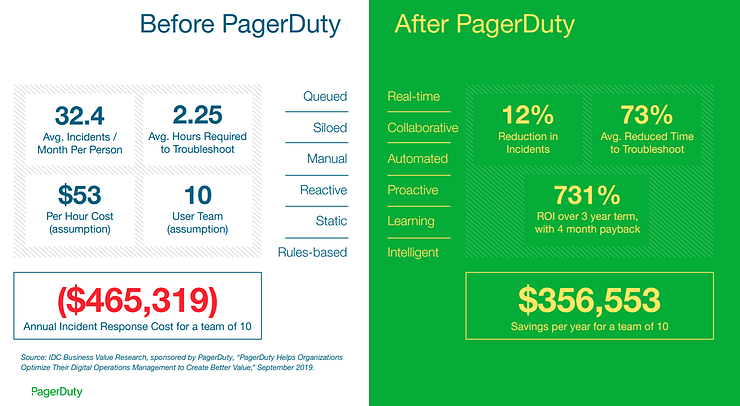
  • they claim IDC has identified 731% ROI for customers over 3 yearrs – by reducing number of incidents, time to resolution
  • the ROI is tied to down time or disruption time – makes it quantifiable
  • example of a large retail bank in the U.K. that’s got millions of customers and thousands of employees. And when they implemented PagerDuty, they saw an 85% reduction in the number of nonactionable alerts that were coming their way

Developer Focus

  • product has been focused on software developers – on DevOps – so resources that are focused on issue investigation
  • have many large developer focused customers – Twilio, Zoom, Box, Elastic, Datadog, Okta, Cloudflare
  • platform is cloud-native
  • can drop PagerDuty into a small team and have it up and running in 10 minutes
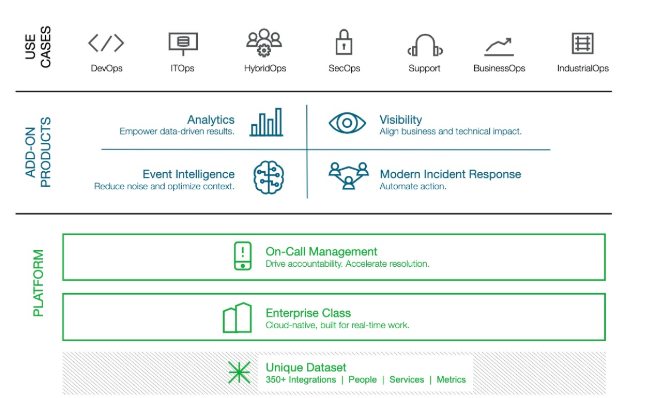
  • one primary products (on-call management) and 4 add-on products:

  • they are tied into data sources like: AWS, Datadog, HashiCorp, New Relic and Splunk
  • also have bidirectional integration into Atlassian, Microsoft VSTS, Salesforce, ServiceNow, Slack

TAM

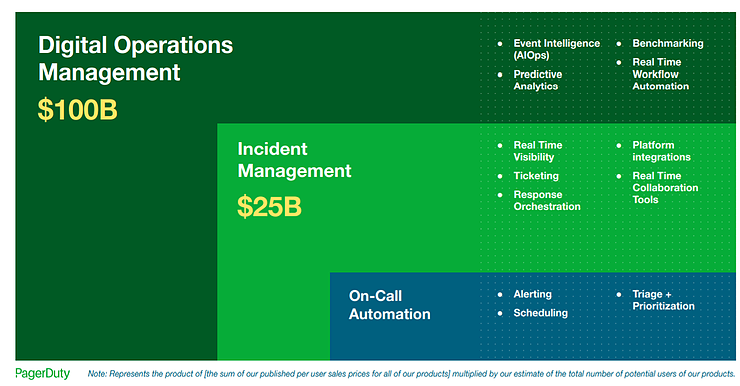
  • they estimate their addressable market is $25b
    • based on 85mm potential users x $295/y in revenue
    • this is the size of the DevOps or incident management market, which is their traditional market
  • the 85mm users comes from this:

  • right now PD has 348 customers with $100k+ ARR
  • reason for smaller deals is likely b/c
  • 12,000 customers – 1/3 from Fortune 500
  • 16% of those customers are outside of DevOps

New Market Penetration

  • so traditional market is targeting DevOps in incident management market
  • trying to enter a broader enterprise market – where apps would be built on their platform
  • they estimate the size of this market at $75b, so much bigger:

Digital Operations Management

  • examples of enterprises using PD for Digital Operations Management:
  • Box uses PagerDuty to help ensure that its services are always available to its customers, leveraging PagerDuty Modern Incident Response to run automated response plays that enable teams to mobilize faster and take action in real time.
  • GoodEggs uses PagerDuty to enable warehouse operations and development teams to analyze signals from refrigeration units to ensure food stays fresh for deliveries.
  • Petoton – have been using it for application development and track issues but are starting to use it to track shipments with customers
  • The Gap – uses PagerDuty to directly connect product and IT teams as well as distribution centers, creating smarter, more streamlined approach to handling incidents. We estimate that this digital operations upgrade will save Gap millions of dollars per year.
  • large oil and gas organization uses us to manage the efficiency of their fuel trucking terminals.
  • We have a payments customer that uses us for their physical security team as well as legal.
  • We have a large software company that uses us to manage the real-time workflow across the legal team when they’re trying to finalize contracts across business units
  • have a significant number of customers who have adopted us primarily in — for the security use case, particularly as you see DevSecOps taking hold in organizations; and also customer service, where increasingly, the reason customers are engaging with companies, because they’re having a difficult time, tends to be rooted in an issue with technology, the mobile app, the digital app, I can’t finish this e-commerce transaction, I can’t find the pricing that I thought


Competition

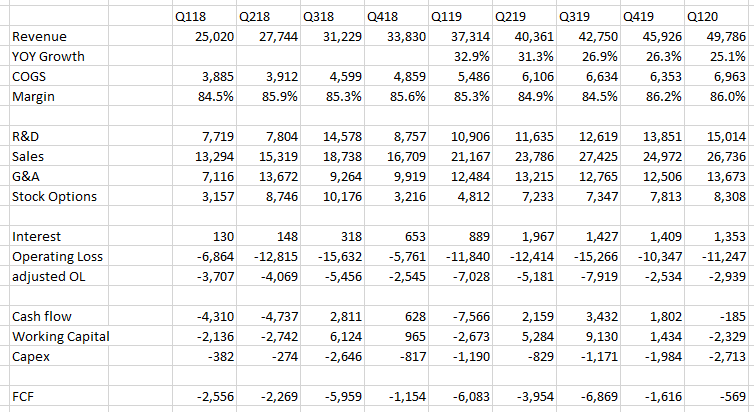
  • saw expansion rates decel from 140% plus in 2019 to sort of 122% – I think this was the big negative on the stock over the last number of months
  • primary competition is OpsGenie by Atlassian and VictorOps by Splunk
  • OpsGenie had 1,396 customers Q2 2019 when Atlassian acquired it
  • Atlassian did a new release of OpsGenie with integration with Jira, Bitbucket in June

From William Blair (June2020):

  • vast majority of our new customer acquisitions are uncontested
  • Let’s touch on competition. It comes up all the time, and you guys probably hear this a lot. But there’s a couple of competitors out there that, certainly, if you take — they’ve cut pricing, some very dramatically.
  • in response Tejada notes 95% retention, that they are integrated into 275 of most popular and important apps, not worth ripping out for 10-15% opex savings
  • also on enterprise: And then the last thing that I would just mention is we’ve made a significant effort that has really paid off in moving to enterprise, right, in that — we really don’t see any competition in enterprise per se
  • she also mentioned lack of competition on enterprise in Q1cc
  • they said their churn in SMB in Q120 was macro related

Impact of Covid

  • been a mixed bag
  • grew ARR in Q120 by 55% – that is an acceleration
  • strong quarter with largest customers
  • weaker with SMB
  • saw deals take longer
  • also customers seeing 2x to 11x number of incidents
  • seen an acceleration of digital transformation activities that would have taken them years being pulled forward and now being completed in months
  • an acceleration to cloud adoption and cloud migration
  • know that when PagerDuty is deployed with a cloud migration initiative or cloud adoption initiative, that initiative goes faster, a factor faster (inaudible)
  • we think that these are tailwinds that long term are going to continue to be very strong for PagerDuty.

Convertible

  • sold $250mm of 1.25% convertible
  • price on convertible is $40

RBC on PagerDuty (Aug 28th)

  • believe that estimates are reasonable
  • SMB is 20% of ARR which is going to be a headwind – saw higher churn in Q120
  • feels to me like a beat is almost expected here because the consensus revenue number ($50.7mm) is conservative
  • job posting data for PD hasn’t been great – negative QoQ in both Q2 and Q3

  • They aren’t quite as reasonably priced as they were when I bought – 15x P/S is a lot more than 9x
  • I’m also not sure they really benefit that much from COVID – their pricing is seat based so its not like more incidents from their customers means more revenue
  • Finally, OKTA and TEAM seem to be putting on a pricing war
  • On the other hand the damn stock crapped out today on a sector rotation – if it was $37-$38 still I think I’d sell at least 2/3

Research: Apollo Health and Beauty

  • 73.8mm shares outstanding at $2.78 for market cap of $205mm
  • there are another 20.9mm warrants outstanding but they are way out of the money at $11
  • they used to be called Acasta Enterprises – beginning July 2018 had operating sub called Apollo Health and Beauty
  • amalgamated with Apollo Apr 2020 – changed name to Apollo…
  • Apollo has been around since 1991
  • employs 500 people
  • one of largest private label personal care product manufacturers in NA
  • develop and manufacture branded and private label products for retailers
  • products sold across 10,000s of stores in NA
  • was a breakeven business in 2019
  • I guess its their sanitizers and cleaners that are selling:

  • they kind of allude to what is going on in Q220 MD&A: The Company attracted new customers and augmented existing customer demand for its cleanser and sanitizer products
  • it is actually kinda surprising how little info or promotion of these results there are in the filings or PRs

Q2 Results

  • debt at end of June was $35.7mm – they paid off about $29.4mm of debt in June
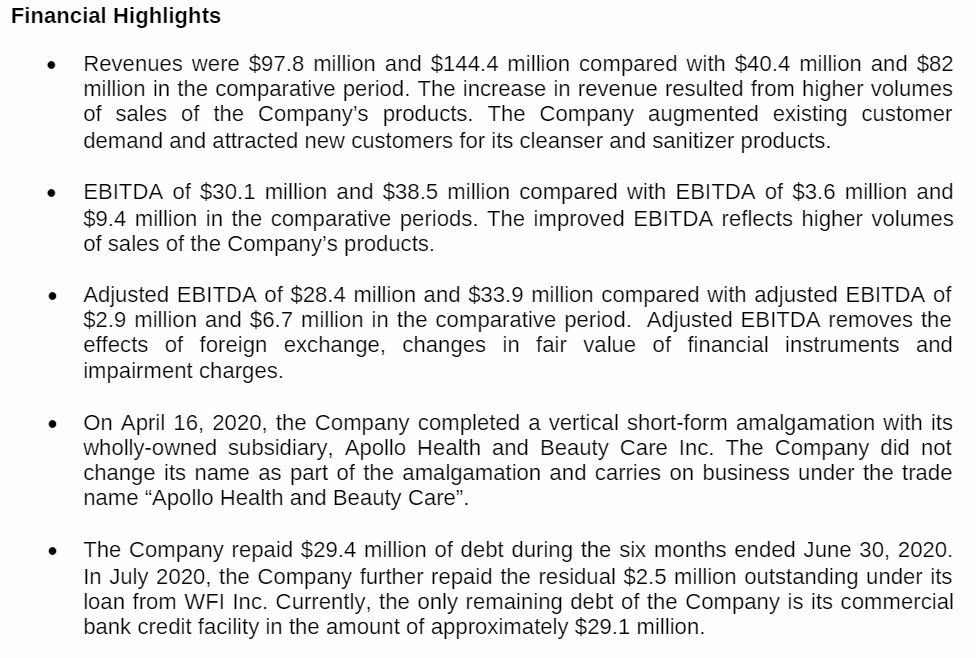
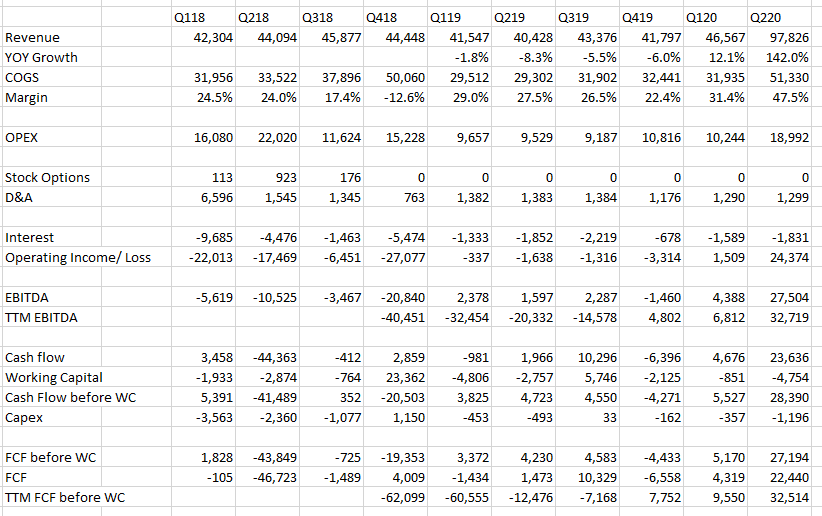
  • EBITDA in June quarter was $30mm
  • SG&A was quite a bit higher too though – up from $2.5mm to $7.9mm yoy in Q220
  • also a pretty big increase in professional fees and general office expenses
  • EPS in the Q220 was 35c
  • it’s a pretty crazy increase in results:Stan Bharti is chairman of the board (?!?) but he actually doesn’t own any shares according to circular, which seems odd
  • run by Charles and Richard Wachsberg
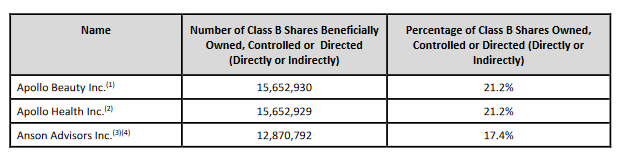
  • these Wachsbergs own a lot of shares:
  • another 2.5mm shares owned by Carlo LiVolsi, a director
  • this does not seem like a scam or promo to me, just looks like they are in the right place at right time
  • probably limited to COVID but really, should have pretty good results for a number of quarters, maybe 3-4 I’d guess, which would nearly would match the market cap
  • revenue has been pretty consistent up until this quarter
  • these are the last 10Qs of financials.  They actually appear to have been turning the corner in Q1:

  • it looks like they changed CEO and cleaned out the board a over a year and a half ago:

Acasta Enterprises Inc. (TSX:AEF) (“Acasta”) announces it has agreed with Charles Wachsberg and Richard Wachsberg, who together own approximately 36% of Acasta and are the co-founders of Apollo Health and Beauty Care (“Apollo”), to replace the Board of Directors (the “Board”).

The current Board and the Wachsbergs were not able to agree on strategy going forward and, accordingly, Geoff Beattie, Robert Schwartz and Jay Swartz have stepped down as Acasta directors and Ian Kidson has stepped down as Interim CEO and director.

Stan Bharti, Carlo LiVolsi, Jeffrey Spiegelman, Richard Wachsberg and Charles Wachsberg have joined the Board. The new Board has appointed the Wachsbergs as co-CEO’s of Acasta.