Skip to content

Research – NatGas

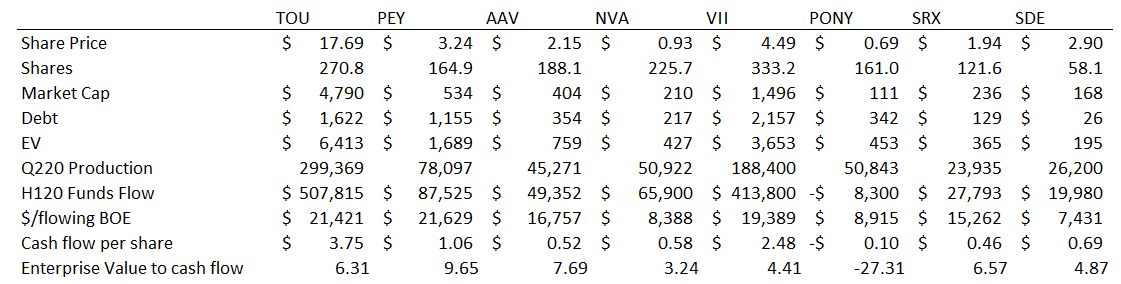
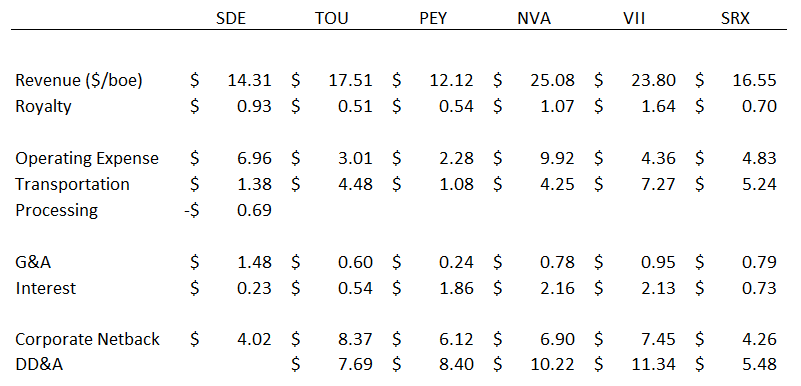
I have been in natgas stocks since shortly after the COVID bottom.  I mentioned it here.  They did well, pulled back (and I sold/chickened out briefly) and then took off again.  I’m in a basket of names.  Below is a comparison I did this week.  Rafi Tahmazian made some good points, particularly about how overlooked the Montney is, in a BNN interview a couple weeks ago.  Pretty much sums it up for me.  Meanwhile some of these stocks seem cheap even after the run-up.

Valuation:

Costs (H1 results):

In addition to the usual suspects that I have already mentioned owning (PEY, AAV, PNE), I think Spartan Delta looks very reasonable, has good management, former BXE assets that I am familiar with and thus I like it a lot.  Nuvista is also interesting to me as more of a levered flyer on the Montney and the option that we get a full-fledged price recovery like what Rafi speculates.

Research – Broadwind Energy

I have decided to try out something new for the blog.  Instead of just doing my usual posts and company updates on a irregular basis, I am going to start posting what I am researching on a day to day basis.  Whatever name I have researched will be posted, likely in point form, as I am basically going to copy and paste my notes from the word document that I am already jotting them down in.  We’ll see how this goes.  Most of the stocks I will mention will not be one’s that I will buy.

Broadwind Energy

  • $58mm market cap at $3.44
  • $32.5mm of debt – they put total debt at $22mm in 10Q, not sure why
  • precision manufacturer – low margins
  • manufactures structures, equipment, components for clean tech
  • 72% of revenue comes from wind energy – provides steel towers and adapters to wind turbine manufacturers
  • have production in Manitowic Wisconsin and Abilene Texas – have combined capacity of 550 towers or 1,650 sections – 1,100 MW of power
  • gearing segment is gears and gear boxes for a bunch of different industries
  • also have industrial segment hat supplies combined cycle natgas turbine market
  • in 2019 they grew revenue 42% yoy
  • H1 revenue growth came from heavy fabrication
  • revenue was up pretty decent yoy – from $41mm to $55mm in Q220
  • it is low margin business with ~10% gross margins
  • 3c EPS in Q220, 9c EPS in H120
  • they had positive cash flow before WC – around $5mm in H120 – with capex of $900k that is FCF of $4mm in H120
  • but their own estimate of FCF was -$8.6mm for Q220 because of WC changes
  • their backlog was down quite a bit $112mm vs $144mm yoy and book to bill was 0.7
  • here is what they said about backlog being down:

We booked $39,558 in new orders in the second quarter of 2020, down from $104,612 in the second quarter of 2019 driven primarily by a $64,927 decrease in Heavy Fabrication orders as certain tower customers secured production capacity in the prior year in advance of historical lead times due to surging wind tower installation expectations in 2020.

  • saw weaker orders from mining and construction due to COVID
  • their Heavy Fab order yoy were down pretty significantly, from $96mm to $31mm
  • gearing segment down due to lack of orders from O&G
  • they did say they expect H220 to be similar to H120 so fcf should be strong in H220 – but then said they thought uncertainty from COVID would impact Q420 results
  • before COVID they did see strong orders – in Q419 they said orders in 2019 were double yoy and book to bill was 1.24 – backlog at YE was $142mm, up 80% yoy
  • honestly I don’t see why this stock is up so much, free cash seems decent and over the long run wind energy capacity grows but why the stock tripled from the bottom, I’m not sure, seems a little much, maybe why the price has peeled off


August Update – More Rotation

There was a tweet I saw earlier this week explaining that bloggers should reduce the size of their posts and clearly identify their themes with headlines to benefit their readers. Because of my concern about increasing my readership, I will do neither of these things.

With that said, this is a post about stocks, not theory, as the last few of my posts have been. So it will probably be more interesting on that alone. I will do my best to countervail that with long, drawn out text descriptions and no illustrations.

Well as they say on the True Crime Garage, that is enough of the business. On with the show. I am starting to roll my portfolio over into names that stand to benefit once things get back to normal.

I would not go so far as to buy an airline or a restaurant just yet.  But I have noticed a number of names that have produced very good results and that should continue to produce good results as the economy recovers.   And some of theses stocks seem unreasonably cheap.

The biggest of my purchases has been Big 5 Sporting Goods.  If you go back in my portfolio, you’ll note that I have owned BGFV before.  It was a position before the pandemic, and it was a position briefly in May, but I sold out too soon.

I was very close to buying it back leading up to their second quarter results but unfortunately I did not.  The results were extremely good, and the stock popped.  Not one to be deterred by a rising stock price, I bought the stock after that pop, as I think it should be able to carry on higher.

BGFV saw same-store-sales (SSS) increase by 15.5% in the second half of Q2, once their stores had begun to open.  In July this carried on to even higher heights – to 31.9% SSS growth.

Diluted earnings for the quarter were 52c per share.  Guidance for the third quarter was even better; BGFV estimated that it will come in between $1 and $1.30 per share.  In July the company eliminated all of its debt and has a cash position of $38 million against a market cap of $138 million.

Even as I type this, I feel compelled to add more.  The stock, which is trading a little over $6 right now (as an FYI I wrote this yesterday and now it is up even more I see), seems way too cheap given these results.

The second name I added was Waitr.  Mark Gomes did a video write-up on them on Youtube a few weeks ago.  Now I actually haven’t watched that video.  But I assume it is quite good. Still, I first came across the name when I received an email about the video being posted so I have to give the hat tip to him for the introduction.

As an aside, not watching the video was intentional.  I have kind of taken a different stance to tips of late.  I decided I do not want to know why other investors like an idea.  I love getting new names or symbols to look at, but I do not want to hear why I should buy it.

Why is this?  I have noticed a trend – many of the bad ideas I have been in over the last few years have come from other people’s rec’s.  I am not sure why I make poor choices on other people’s ideas, or what it is saying about me, but I decided on a resolution to not review anyone else’s blogs or reports or tweets on anything. 

I began to do this in March and to be honest, it is working out well. It may make for a lonely existence but I think it is necessary given my propensity to be talked into bad stocks by other people.

I will, however, take names and research them myself, which is what I did with Waitr.  It looks like a great idea to me.  They are a food delivery service, based in the southern states, they did an acquisition last year that seems to have went south itself, and left the company losing a ton of money, but then COVID came along and they blew the doors off with the first quarter results.

But this does not seem to be just a COVID story.  The first quarter results were good, but it was in large part because they got their costs aligned with their revenue and actually generated cash for the first time.

I took a small position in early July, but I backed up the truck yesterday when the stock inexplicably dropped a buck after announcing their second quarter earnings.

From what I can tell, the second quarter was even better than the first.  If I look at free cash flow before working capital changes it came in at over $15 million.  At $4.50 this is a company with a market cap of $360 million.  They also got back on the year-over-year growth train in Q2 – growing the top line at 17.8%.   It just does not make any sense to me that the stock should fall on these results.  So, I added a bunch.

Another name I added on a dip is an old favorite – Smith Micro.  Smith did not put together a great second quarter and the stock dropped below $4 yesterday as a result.  But when I read through the conference call transcript it sure sounded to me like they have a bunch of new carrier wins that are on the verge of being signed.  On the call they described it as “late-stage” and “contract” negotiations, which kind of imply to me it is just a matter of dotting I’s and crossing t’s.

I also bought back small amounts of a couple of other positions I previously held – Evolent Health and Sharps Compliance.

Evolent had a really good second quarter, much better than I thought they could have.  They finally showed a decent growth number and are now EBITDA positive. The Passport debacle did not turn out well (count me as surprised that the new Kentucky administration still passed on Passport when they re-evaluated the awards).  But Evolent appears to be getting their money back and maybe more from the sale of Passport’s customers to Molina and the return of statuatory capital. They have also made inroads with one of the winners of the Kentucky program awards, Molina, which they have said will be partnering with Evolent in two states, Kentucky and Oregon. Evolent used to be a $20+ stock. I have always thought it could get back there if they got their shit together, and maybe they finally have.

Sharps Compliance is really the same story it was a few months ago.  They should benefit from the eventual vaccine deployment.  The stock came back into the $6’s and I thought it was worth buying there.  Now it is back in the $8’s and I am less excited about it here.

I am looking closely at another previously held name – DLH Holdings.  They also had a very good second quarter and the company is generating a lot of free cash.  I also added a small position on a second economic recovery name, the At Home Group, but this is another stock I have to dig into more before I can say with certainty that I am onboard.

The other more interesting situation that I am looking into right now is the BankMobile merger with Megalith Financial Acquisition Group.  I have talked about MFAC in the comments a few months ago and have held a tiny position in the stock for a while.

On Thursday MFAC announced what I suspected was going to happen – that they bought and were going to take public BankMobile from Customers Bancorp.

While BankMobile is interesting, it is CUBI that has caught my eye right now.  The bank is trading at under 50% of tangible book.  The second quarter earnings were out and they were not that bad.  CUBI has done the same thing as another bank I own (Sound Financial) – generated a lot of PPP loans – in fact CUBI is the 6th biggest PPP lender in the country.

BankMobile is a nice growth business but it was not doing much for CUBI.  In fact, BankMobile lost $12 million before taxes last year according to the disclosures released yesterday, which means that they were a drag on pre-tax earnings by about 15%.

CUBI will take equity in BankMobile as part of the transaction, so they will still benefit from growth of that business.  And just taking a step back, I think you have to take BankMobile out of CUBI so that it can expand the deposit generation franchise to other banks. The whole point with BankMobile seems to be to collect fees from the deposits they generate. Having more banks onboard just increases their reach. There is also an issue with CUBI’s size, as they have limits on the fees they can charge to merchants from BankMobile transactions once CUBI gets too big (it is something called the Durban amendment). Making BankMobile its own entity eliminates this growth constraint on CUBI.

The dig on both CUBI and the transaction is that it is an example of both nepotism and cronyism.  It is hard to disagree with this. Jay Sidhu, the CEO of CUBI, also runs MFAC, the SPAC that bought BankMobile, and his daughter is the CEO of BankMobile and will be the CEO of the new company.

I admit that does not look good.  Sidhu is also benefiting through his founder shares, (though he is forfeiting most of them, there are still around 800,000 that he plans to keep, which he got basically for free, and so this is a pretty good payday for him).  But the deal also does not seem particularly unfair to either side to me, at least based on what I have been able to see so far. But I have to say, I am still trying to figure it all out and the disclosures are painful to read through. My bottom line opinion right now is that at such a low price to book I am inclined to take a chance on CUBI.

That wraps up all the buys.  My sells are pretty simple. I have sold pretty much all the SaaS stocks I owned other than PagerDuty and I have been lightening up on my gold stocks after this tremendous run. I also sold the rest of Overstock (too soon of course).

That is pretty much it for now.  Good luck!

Carry, Passive and a New Narrative

I am continuing to work through a new way of looking at the market and so this post will not talk very much about individual stocks. 

In May or June, I started to realize that my framework for understanding the market was missing something. 

I did not really know where to look for answers.  All I knew was that the narrative that I was assuming drove the market could not be entirely right.

Before the virus, my simpleton view was that the market was going up because central banks were supporting it through easing, while the economy was not terrible.  Together this led to expanding multiples and some growth – markets went up.  But I also thought this was probably getting stretched, so I had my portfolio hedged.

Then the virus hit.  Even though I saw the virus coming a little before most, and managed through it pretty well, I was surprised by just how fast and far markets moved down and then back up in its wake.

The word I kept using, somewhat unconsciously, was “tilt”.  I kept saying to anyone who would listen, that this market is on tilt.

I don’t know why I chose that word.  It just intuitively seemed kind of right.  In retrospect, it was more apt than I realized.

Tilt is something that happens in pinball when you shake the machine.  You basically force another factor into the game that the game was not designed for.  It is no longer being played by the intended or agreed upon rules.  In some sense, you have changed the game.

Are We on Tilt?

I know, I know, you can list a bunch of reasons to explain why the market has gone up.

There is the argument I made early on – that some stocks that are actually doing better because of the pandemic. 

There is the argument that the stock market is made up of large companies, while the carnage caused by the pandemic is centered around small business. The biggest companies will take share.

There is the argument that the virus is not as bad as we thought.

And then there is the always present argument that central banks are storming the world with liquidity and that will lift all boats.

I realize all these things play a role. I have used them to varying degrees to inform my own stock decisions.  I bought companies that were outperforming because the virus.  I bought gold on the central bank narrative.  I even sold short names like Ruths Chris, Spirit, and Delta and in June (no longer short any of these) because I didn’t really buy the whole virus is done argument – my opinion is that it has become largely irrelevant to stock prices as a whole – good for some names, bad for others.

But at the same time, I did not feel like these arguments, even taken together, explained what was happening.  There had to be more to the puzzle – what was causing the tilt?

Wrapping My Head Around It

One question that I have always had, that has never really made sense to me, is this – if central bank money printing is causing asset bubbles, then why do the bubbles concentrate in some places and not others?

Why do stocks go up in one place or sector but in another they do not?  Why do a few stocks garner most of the gains?  Why do house prices go up some places and not others?  Why don’t commodities just go up when equities are?  Why doesn’t gold just go up?

In the past I have been fortunate to be introduced to important books or people at the right time.  I started reading Basic Points, by Donald Coxe at the beginning of my investing journey (around ~2003) and he was the perfect voice for explaining the commodity boom in China.  I stumbled on a book at the library by Richard Duncan in 2007 (The Dollar Crisis) which was an epiphany for me.  I still believe it is the best explanation of the international monetary system out there at least for a beginner.  The list is long.

In this case, I was lucky enough to have someone point out a book to me that helped illuminate the cause of our current tilt.  The Rise of Carry may not be the best book on the subject (or maybe it is?) but for me it was an introduction to a whole other world.

Carry

There is a lot to say about carry and what I have learned so far.  Many details and specifics, and maybe most interesting for me, the overlap with Duncan’s book – the two books essentially say the same thing from different directions.

But that is for another time.  For now, just my aha moment.  That carry trades do not depend on fundamentals.

Here I found my tilt. 

The game we assume we are playing in the market is based on a rule that we take for granted.  That the market discounts.

Apart from purely technical traders, when an active market participant is deciding to buy or sell a stock, there is some sort of discounting method that informs that decision.  It could be a big spreadsheet, a simple P/E, maybe its just P/S, whatever.

But what if enough market participants begin to buy stocks for totally separate reasons?  What if they are just making side bets? 

These trades would be systematic.  Their decision-making process would not consider the underlying “value” of what they are trading.  They are making the trade because they expect it to be profitable of course.  But those profits do not care about the value of what is being purchased or sold.

Carry trades care about market structure – the market must have a structure that makes these trades profitable.  As long as that structure is there, these trades do not really consider the fundamentals that underly the trade.

Carry trades have been going on forever – I mean insurers and banks are essentially running carry trades. 

Carry became more influential to markets in the 1990s.  At the time it was mostly a currency phenomenon – the currency carry trade. 

So carry is nothing new.  But what is new-ish is how much of the carry trade now centers around the S&P 500.  In The Rise of Carry, the authors call the S&P “the epicenter of the global carry trade”.

The authors argue that carry strategies now have enough influence on the S&P, through selling volatility and clipping the coupons, that carry to a large degree drives the S&P 500.

If that is true then the S&P is being driven in part by strategies that do not discount.

But carry trades are not the only market element that are trading systematically, without regard for discounting, and as a result putting the market on tilt.  In fact, in the wake of my education on carry I was introduced to an even bigger participant.

Passive

I was lucky a second time to stumble on the right source.  A couple of comments on the blog a few weeks ago mentioned Mike Green.

The funny thing about Green is that I have a subscription to RealVision.  I have listened to a bunch of his interviews.  He is a regular interviewer on the platform.

But I never really clued into what he was really saying.  In the last few weeks, I have gone back and listened to or read the transcripts of pretty much every one of his interviews.  They have taken on a new meaning to me.

Green talks about the carry trade himself – there is an interview he did with Andrew Scott where they describe the impact of Asian retail investing in retail structured products that was fascinating – but his main theme is the impact of passive investing.

Passive investing fit like a glove into the narrative I was already beginning to craft with carry.

This is an even more pervasive example of a market force that simply does not discount. 

The logic of passive investing is so incredibly simple.  If you give us money – we buy.

And it is big.  Consider the following stats:

  • Passive investing makes up ~43% of the US market right now
  • More than 100% of gross flows into the stock market are passive
  • People under 40 are highly passive investors while over 65 are active investors (20-25% passive)
  • Nearly 85c of every incremental retirement dollar flows into a target dated fund

To me that seems like an awful lot of money that is pretty much ambivalent about what it is buying.

A New Narrative

So here we have a couple of legs on which to build a new narrative.

While I am still not sure about magnitude, I have some confidence that together, these strategies are quite influential.  If that is right, there are some big implications. 

The biggest of these implications is that the demise of discounting leads to a growing indifference to value. 

I hate to get all philosophical, but I can’t think of a better way of saying it: value is existential.  It only matters because we say it matters.  If, at the extreme, every market participant is making their buying and selling decisions on some other criteria, then value, and valuation, has no meaning.

We are not at such an extreme, and I am not really sure we could actually get there, but we are moving in that direction, and that is enough to make a number of other inferences.

Others I can think of:

  1. Markets will become less responsive to economic conditions
  2. Markets, just in general, will become harder to move down (carry and passive inflows should be supportive most of the time) but when markets do move down, they move down harder and faster than in the past (because of A. the nature of carry and B. there are less active investors willing to “buy value”)
  3. Momentum will gain strength – what goes up should see more money go into it – ie. market cap weighted indexes naturally add to what is already strong
  4. A rise in correlation – securities are traded as a group. Differentiation that was brought on by discounting individual stocks is lost.
  5. Cash deployed – active cash is ~5% while passive cash is 10bps so more passive means more cash goes into the market – another support to the upside
  6. Increase in leverage – carry requires leverage and each reinflation of the carry trade is necessarily larger than the last.
  7. Domination by Vanguard/Blackrock – they have an outsized share of the passive market.
  8. Impact of obscure market players – stuff like how regulatory insurance requirements is driving, long dated put buying carry trades, Asian retail structured products as put sellers, how yield enhancement strategies dampen vol and then cause it to explode

There are others I am sure.  I am still working through all of this and there are likely other very important pieces of the puzzle that I haven’t figured out yet.

What Now?

It is too bad that I did not realize this 4 months ago.  It seems so obvious to me now that while I was hedging my portfolio with RWM and HUI.TO short index ETFs, I should have been hedging it directly with long vol.

Long volatility for a dumb retail guy like me simply means being long the VIX.  I am not going to mess around with option strategies and the Greek alphabet.  And like I have said before, the one great advantage of a retail schmo is that I have no benchmark, no expectation of performance. If I lose on the VIX for two years no one is around to care.

The VIX will lose money slowly until it makes it very fast.  Consider that the VIX went from 10 to 100 in March.  If I had been long that with the 25% of my portfolio instead of index shorts, I would have made a killing.

But going long the VIX right now does not seem like good timing. 

We just had the carry crash.  The market has tremendous support from the central banks, and as the authors of The Rise of Carry point out, central banks are the largest volatility sellers of all.  Rates are likely to go lower, or at least stay low.  Inflation is non-existent.    Essentially all the elements that you can imagine upsetting the wheel cart have been pushed off the road.

Meanwhile the VIX is at 30.  I would like to see it would fall back into the teens at least before all is said and done.

If anything, it seems more likely that we are at the beginning of another wave.  Stocks only go up.  I have been very twitchy, selling on the last couple of corrections, but each time I’ve been quick to buy it all back and more as things stabilize.

It is my way of getting comfortable with this new narrative.  I am slowing coming around to believe it.  First that happens in my head, and now its materializing in the portfolio.

With all that said, briefly on my positions:  I added to Globalscape the last few weeks as I found the decline in the stock inexplicable.  I added a new position in Novavax after reading a brokerage report by H.C Wainwright where they estimated 2021 earnings of over $12/share if the company is successful in their vaccine candidate.  I also added another biotech name – Immunic.