Skip to content

Adding Gold Names

I decided to add more gold names yesterday as it looks to me like gold is breaking out.  I finally got a move out of some of my existing positions.  Americas Silver has jumped from $3.80 to $5.80, Gran Colombia Gold has moved from $1.40 to $1.60 and Klondex Gold has broken out of its $4 choke hold and is trading at $4.35.

First, I decided to add to both my existing positions in Gran Colombia and Klondex.  Gran Colombia had very good news on Monday, announcing that their mine strike had ended.  The stock, at $1.60, has hardly participated in the gold move, and is one of the cheapest gold stocks out there and less than 4x free cash flow.  The hair remains but the settled mining dispute removes some of it,  and I have to think it goes higher.

Klondex is my largest gold position and I added to it yesterday.  My add here was simply that it appears to have broken out from the $4 level (Canadian).  I’ve written about Klondex in the past.  Its been under pressure for months from an unusual GDXJ rebalancing that caused a lot of forced selling from the fund and follow-ons.  I note that there was a 25,000 share purchase by one of their directors on Thursday.

I added two new positions.  First, I added Wesdome.  Wesdome operates two mines at its Wawa complex in Canada and also has two advanced stage projects in Canada.   They have a $320 million market capitalization and $22 million of cash and no debt.  Guidance for the year is 55,000 oz.  I ran a quick comparison of gold companies looking at their enterprise value per ounce produced.  This is super simplistic of course, it doesn’t account for costs, reserves or development projects that are generally big determiners of value. Nevertheless, when I look at Wesdome it compares favorably (at $5,500/oz) to other miners.  There are cheaper one’s out there (for example Gran Colombia and Jaguar Mining, which I will talk about in a minute), but these generally have a lot of hair.  I don’t see much hair on Wesdome.

Jaguar, which I also added, comes out even cheaper, with an enterprise value of less than $1,000 per ounce.  But it has lots of hair.  I actually owned Jaguar years ago.  It has a new management team, a lot more shares, but essentially the same mining complexes.

Jaguar has a market capitalization of $90 million, $20 million of debt and $20 million of cash.

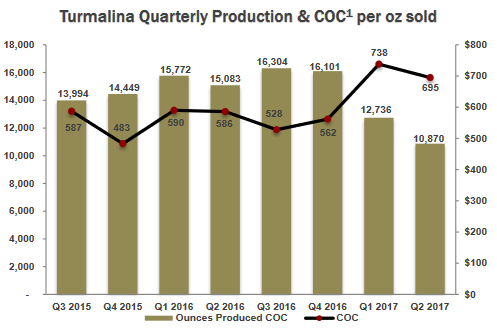
Apart from being really beat down, and very cheap (at least on a superficial basis), Jaguar actually seems like they had gotten their shit together up until the last quarter.  They had consistent production from both their Turmalina, Pilar, and Roca Grande mines.  But production slumped at Turmalina in the first quarter, causing the shares to slide.

The share drop was potentially accelerated by Resolute Funds, which sold 30 million shares over the quarter.  I found this article, which speculates on the impact of the Resolute Funds liquidation.

My bet with Jaguar is that in a rising gold price environment, many past transgressions will be forgotten.  It is also that maybe the second quarter does not portend the future. Jaguar kept guidance in the second quarter, and they had been producing consistently at Turmalina for the past 6 quarters.

Adding a new position in Imaflex, Selling Psychemedics

I added a new position in a company called Imaflex this week. Imaflex trades on the Canadian market.  They produce polyethylene films for packaging, garbage bags and, most recently, agricultural products.  I’ll do a more detailed write-up but for now the thesis is:

  1. this is a small company ($65 million market capitalization)
  2. they just reported strong growth (32% year over year revenue growth in the second quarter)
  3. they are ramping up a new product called Shine N’ Ripe that uses a thin film wrap around plants to increase sunlight and deter insects
  4. that product is gaining traction, having generated $2.1 million of orders in the second quarter on top of $3.3 million in the first quarter, and is driving growth

The company trades at a fairly reasonable valuation of 14x free cash flow based on the trailing twelve month numbers.  Focusing on more recent history, they trade at only 8x free cash flow if you annualize the last quarter results.  This is a small position for me so far, at 0.5%.

Its also in Canada, which means I don’t have to worry about currency, the bane of my existence the last few months.

Selling Psychemedics

A second trade, after much consideration, was to sell Psychemedics.  As the stock rose back to the $21 level I decided I did not have the conviction to wait and see if it would go back into the teens.

Psychemedics didn’t have the best quarter in Q2.  The main culprit was gross margins, which declined from 52% in the first quarter to 48% in the second quarter.  In the last two quarters of 2016, the company had gross margins of 59%.  Historically, margins have been around 50%.

Unfortunately Psychemedics doesn’t give a conference call so we are left with only what they have written to understand the significance of the decline.

What the company said in the second quarter press release was:

In the past quarter, we have made a number of strategic decisions and are implementing a number of strategic initiatives that we believe are in the best long-term interests of the company. Our market share remains strong and we have taken further strategic actions to solidify and strengthen our long-term position in the market. In addition, we now have established a wholly-owned subsidiary in Brazil and have brought on a Country Manager, a Brazilian national to manage our business in Brazil and work with our distributor. We believe in the long-term attractiveness of this market and are willing to make short-term investments and sacrifices.

In the 10-Q they said that “the decrease in margin was attributable to a mix of business, the inclusion of Brazil sales taxes and additional depreciation from equipment placed in service.”

I have been worried that Psychemedics had lost market share in Brazil to a competitor, Omega, that had just started operating in Brazil 3 months ago.  Omega stated on their website that they have achieved 25% market share in Brazil in the first 3 months of operations there.

But after talking to management I got the impression that Omega’s press release may have been optimistic and that while they are now a competitor in Brazil, they have not scaled to the degree they are suggesting.  There was a lawsuit between Omega and (indirectly) Psychemedics earlier this year.  There is clearly no love lost between the two companies.

Still, the rising costs/shrinking margins bother me, particularly given the valuation.  I am uncomfortable that Psychemedics is trading at over 10x EBITDA when they are having trouble maintaining margins and there is some uncertain level of increased competition in the Brazil market.   And I can’t help but look at the long-term stock chart and note that it wasn’t that long ago that the stock traded at $10.  It shouldn’t trade at $10 again, but a motivated seller in a crappy market and I think $15 is not impossible.

On the other hand its entirely possible that the market looks past the second quarter, the stock continues to trade at this level for a while, and then we get an upside surprise in the third quarter and its back to the mid-$20’s.  I’ll accept the risk I miss out on that.  If I had a bit more confidence, ie. if I hadn’t just been smacked down by an incessantly strong Canadian dollar, I might be more willing to take the risk.  But given the strength in the Canadian dollar, and my suspicion that the US dollar weakness is not a temporary event, if I am going to own a US stock, it needs to be a lopsided bet. Psychemedics doesn’t feel like that right now, so I’m out.

Love the Illiquidity: Blue Ridge Mountain Resources

Back in June I got an old stink bid filled on Blue Ridge Mountain Resources.  It took a while to fill.  The stock trades on the grey markets, meaning there is no active bid and ask (at least none that I can see), the security is extremely illiquid and can go for days without trading.   You can’t even access the website with their financials and presentations without getting a password from the company, which is why I haven’t written about my position until now.  Recently the company uploaded a recent presentation onto their public site, which gives me the opportunity to talk about my position and refer to that.

Blue Ridge Mountain is the post-bankruptcy resurrection of Magnum Hunter Resources.  I have had pretty good luck with these sort of post-bankruptcy, grey market situations. Here’s the pattern: I wait patiently to get an order filled at  a good price, I wait patiently for the stock to get listed on an exchange where it can get some volume, and then I wait patientlu for it to be revalued accordingly.  It doesn’t happen overnight, but more often then not it happens.  Most recently, this was a successful strategy with R1 RCM (formerly Accretive Health).

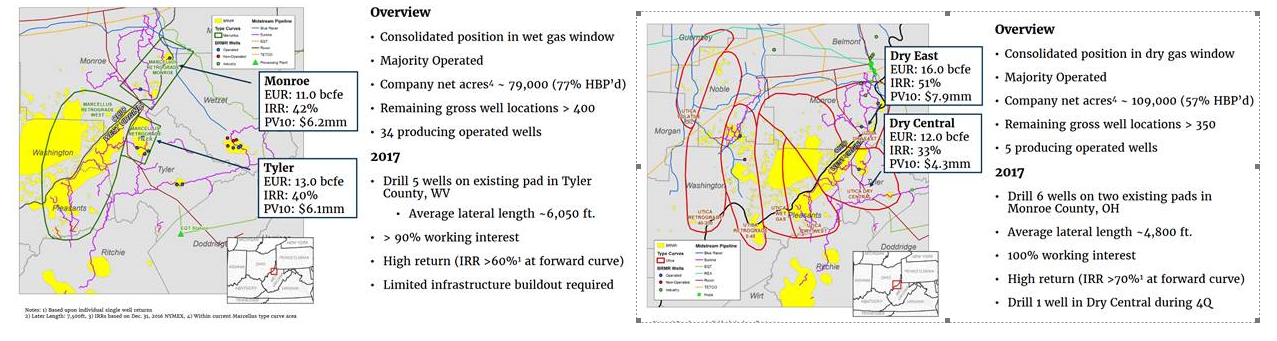
Blue Ridge owns significant assets in the Marcellus/Utica basins in Ohio and West Virginia.  They own 77,000 acres in the Marcellus and 109,000 acres in the Utica.  Much of this acreage is in the dry gas and gas-condensate sweet spots. Below are maps of their acreage in each basin (Marcellus on the left and Utica on the right):

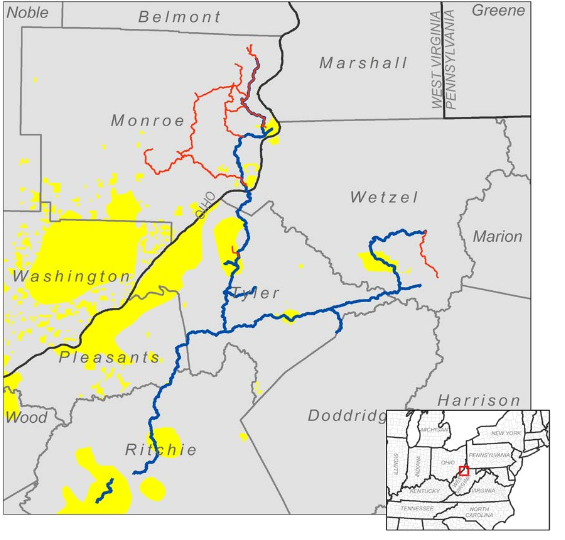
The company also has a 44.5% ownership in the Eureka pipeline, which is a gas gathering pipeline in Ohio and West Virginia that snakes through the Blue Ridge Mountain acreage.

Blue Ridge has a market capitalization of $450 million at $9/share.  At the end of second quarter, as they continue to sell off non-core assets (Magnum Hunter was a bit of a serial acquirer, so Blue Ridge Mountain has a range of assets outside on the Marcellus/Utica that are considered non-core, including some Bakken acreage, some Kentucky acreage, and other real estate holdings), they had almost $100 million in cash.  They have no debt.

The Marcellus/Utica Acreage

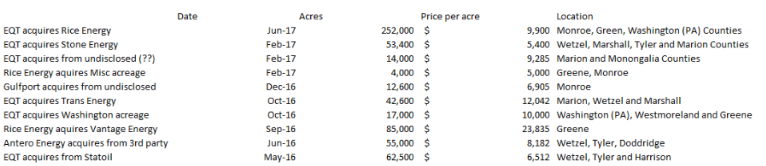
Forgetting for a second about Eureka, lets just take the Blue Ridge gas assets on their own.  Assuming a value on acreage alone, and assuming that about half of that has overlap between the Utica and Marcellus (I have not found any public information that delineates just how much of the Utica and Marcellus acres overlie each other) the stock is trading at around $2,500/acre.  Recent transactions in the Marcellus/Utica have taken place anywhere between $5,000/acre and $9,000/acre.  Here is a list of recent Marcellus/Utica transactions that I compiled:

The most recent transaction was when EQT Corp acquired Rice Energy for $8 billion.  Here are comments on the acreage valuation of the deal and in the area:

Analysts with The Williams Capital Group LP estimated an average price per undeveloped acre for the transaction of $9,900, “which is roughly in line with core acreage valuations over the past year.” Analysts with Bernstein similarly calculated a per-acre price of around $9,000.

Now I don’t think that all of the acreage is worth $9,000/acre.  I think that some of the acreage might be worth that though, or at least close to it.  The Tyler, Wetzel and Monroe county acreage is all in the same counties as prior transactions, so I would expect it to go in the $4,000 to $8,000 per acre range and some of the Northern most acres might be worth $9,000 or more.  Blue Ridge Mountain announced on their first quarter call that they divested a small number of acres (350) in West Virginia for about $4,500/acre.

I’m less sure about the acreage in Washington county, because I haven’t seen any transactions in that area of late.  Of course this could be simply because Blue Ridge Mountain owns most of the prospective acres in Washington county (if you study their map you will note their leases cover most of the NE quadrant of the state).  They said on the first quarter call that they planned to market the sale of 23,000 non-core acres in the southern part of Washington county in the second quarter.  So it will be interesting to get more details on what they can sell that acreage for.  They also said they would be drilling a well in Washington county in the third quarter of 2017 and the way they worded it gave the impression this is the first well they’ve drilled there in some time.  All of this acreage is within the Marcellus and/or Utica windows, so I doubt that very much of it is going to be worth less than $2,500 per acre.  Some of it is clearly worth much more.

Production for the Marcellus/Utica assets was 74MMscfepd in the first quarter. In the second quarter, because of asset sales, natural declines, and the fact that Blue Ridge hasn’t drilled any wells in a year, production had declined to 65 MMscfd.

The company expects to drill 4 Utica wells in the second half of 2017.  With production from those wells, exit guidance is to get production back to 100 MMscfd.  They described their base rate at between 51-59MMscfepd at year end, meaning that these four wells will add between 30-40MMscfepd.  Their base decline is between 12-15%, which is quite low (this is the one benefit you get when you don’t drill any wells for a while).  Given the low decline of the base production and the high impact of new wells, its not hard to see how Blue Ridge Mountain can grow production once they start drilling.

On a flowing boe basis, the current market capitalization (ignoring Eureka completely) values them at $32,000 per flowing boe net of cash.  That number is much lower if you use exit production guidance.  It is also not reflecting what is really valuable; the sizable undrilled land position with no wells on it throughout West Virginia and Ohio.

Eureka Midstream

While a case can be made that the natural gas acreage exceeds the current value of Blue Ridge on its own, there is also the Eureka pipeline to consider.  Eureka has been underutilized for the last number of years because of limited takeaway capacity from West Virginia and Ohio.  It currently operates at about 30% capacity.  Nevertheless, the midstream operation is expected to generate $66 million of EBITDA in 2017.  This guidance was reiterated in the second quarter.

Pipeline assets can go for up to 20x EBITDA.  At 15x EBITDA Eureka would be worth about $300 million to Blue Ridge.

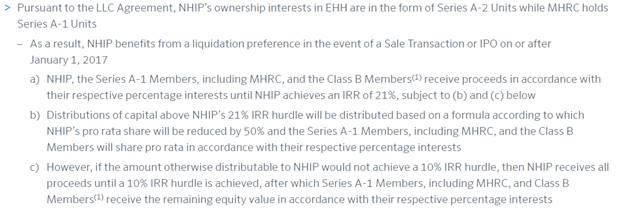
But there’s a catch.  Morgan Stanley has a majority ownership (54%) in the pipeline.  But Morgan Stanley also has a preferential return clause for their ownership: the return on their original capital investment is guaranteed a minimum of a 10% IRR in the event of sale.  This works out to a preferential return of $672 million if a sale was completed this year.  Below I clipped the relevant clause from the bankruptcy documents:

The preferential return clause makes me a little uncomfortable valuing Eureka.  Its not clear to me what incentive Morgan Stanley has, as majority owner of the pipeline, to initiate a sale if they can watch their investment grow at 10% annually.

Nevertheless, the pipeline ownership is worth something.  In its 2016 year end financials, Blue Ridge Mountain recorded their equity interest at $185 million.  This is after a write-down of $180 million that the company took in November 2015.

Obviously, Eureka’s value could increase substantially as new takeaway capacity is brought on to take gas out of the Marcellus/Utica basins, which will allow midstream assets like Eureka to operate closer to full capacity.  Blue Ridge Mountain said in the first quarter that they expected Eureka to exit the year with 1.1bcfpd of gas flowing through Eureka, up from 850mmscfpd currently.  This 30% increase in throughput should help Eureka get closer to the 10% IRR that is consistent with the Morgan Stanley clause.  Assuming a corresponding bump to EBITDA, Eureka would generate $85 million of EBITDA in 2018, which at a 15 multiple would value Eureka at $573 million for Blue Ridge Mountain.

The company has said that they are exploring options with Eureka.

Summing it up

So what’s it all worth?  Well there is a lot of uncertainty with the numbers.  With Eureka I can get anywhere from $150 million to $600 million.  With the Marcellus and Utica assets it could be between $400 million and a billion depending on what you value the acreage at.  So its a pretty big range.

But what I feel pretty comfortable saying is that together these assets should be worth more than the current stock price.  Maybe significantly more.  The hard thing is accumulating the stock.  I think you have to just put in a reasonable bid with a long date and wait for it to come to you.

CUI Global Second Quarter results – lots of irons in the fire

While I have been reluctant to add to any stock right now and have been weighing any purchases carefully, I did add a bit to CUI Global after the release of their second quarter results.

As a reminder, the company operates in two segments. Their Power and Electromechanical segment sells power supplies, power monitoring and interconnect products, and has recently collaborated with a small start-up called VPS Partners to create a technology for datacenter power management called ICE.  In the Energy segment CUI Global offers their GasPT gas analyzer system, a newly developed odorizer, VE probes for sampling gas and performs integration and engineering project work.

Segment Results

The company had an improved second quarter, mostly due to the Power and Electromechanical segment.  That segment saw a big jump in revenue, from $13.6 million in the first quarter to $18.2 million in the second quarter. The company attributed the jump to an inventory refresh from distributors, a ramp in sales from new distributors, particularly Arrow Electronics, and design wins from 2015 and 2016 that are now ramping into production.

Regarding Arrow, on the second quarter conference call the company said they saw “much more upside” in the relationship with Arrow and that Arrow, which became a distributor early this year, is expanding the CUI Global product line and re-ordering products already.

Revenue continued to lag on the energy segment, coming in at $4.3 million versus $4.1 million in the first quarter.  The company remains held up by tariff issues with Snam Rete, which was the first major customer for the GasPT units.

More on Snam Rete

As the company reiterated on the second quarter call, the Snam Rete contract calls for 7,000 GasPT units and is worth €120 million to CUI Global.  It’s an extremely significant contract.  Snam Rete is installing the GasPT units at the offtakes of major industrial customers, where they will be used to more accurately and quickly measure gas usage by these customers.

CUI Global delivered the first 400 of these analyzers last year before receiving word from Snam Rete that they would not be able to install any more of the units until they received regulatory approval to switch out devices on third party sites.  Bill Clough (the CEO) described the issue back on the fourth quarter conference call as follows:

The plan that [Snam Rete] rolled out to install these device is to buy the installation point from these high-end industry customers. Right now where the customer connects to the gas system is currently owned by the customer and due to EU regulations that come into effect next year, the customer has to upgrade that connection, which is going to be quite costly. Snam is offering to buy that connection point from them and to install our device along with some other upgrades that they are going to do including flow computers and other things. And in order to do that they also need to buy an access or an easement to get in and obviously maintain what they are installing.

There is no problem whatsoever if the customer voluntarily agrees to that, which they believe almost all customers will, as obviously they sell an asset that’s going to cost them a lot of money during next year, and so it’s something that becomes a revenue generator as close to cost. However, the energy authority over there says the problem arises with customers who do not want to just pay. Those customers would be paying the same tariff as the customers who do participate, which they felt was a potential anti-trust violation, or what they what they are having to do is, design and implement a two-tariff system, which they have done in the past.

There has been progress on the Snam Rete bottle neck.  A few days before the quarter announcement I got an email from a friend pointing to a press release from Snam Rete (here).  The release described Snam Rete’s commitment to the “upgrading of measuring systems located at redelivery points of the transportation network through the acquisition of metering systems from final customers”.  The press release outlined a €310 million loan from the European Investment Bank that would be used, in part, to acquire these offtakes.  CUI Global referred to this press release on their conference call.

Also on the call Bill Clough said that Snam Rete had met with the regulatory authority in June, that the meeting was “productive” and that they expected to here back after the August recess.

The issue with Snam Rete still appears to be a delay, and not a permanent impasse.  I would argue that the current share price is reflecting more the latter than the former.  Snam Rete’s schedule on deployment is expected to require 100 analyzers a month.  At €17,000 per analyzer, resumption of this contract alone would more than double Energy segment revenues.  That positive outcome is just not priced in at a $3.50 stock price.

Odorization Orders

The Snam Rete press release linked to above also describes a commitment to the “installation of odorization systems for industrial final customers”.  This is referring to the purchase of CUI Global odorizer product, which is a product that simply mixing in an odorizing chemical with otherwise odorless natural gas.  CUI Global licensed the technology from Engie at the same time that they entered into the relationship with them.


On the call management said that Snam Rete is looking at purchasing 1,300 of the odorizers.  They said Engie is also looking at deploying the odorizers throughout their system.  CUI Global said on their first quarter call that odorizers would sell for €7,000 to €10,000. The odorizers are still in the beta phase of development but they are proceeding to field trials (with Snam Rete) in September.

Other GasPT orders

CUI Global is making progress with Engie as well as in North America with a pipeline company in Alberta (TransCanada?).

Regarding Engie, CUI Global submitted a bid on 1,000 GasPT units and 1,000 remote terminal units (RTUs) to be installed by Engie’s subsidiary Endel.  They said on the call that they are the only bidder, and they that have already been spec’d in on the design.  The per unit revenue for the analyzers is in the €17,000 to €20,000 range, and there is similar pricing on the RTUs.  So again, another big opportunity.

In Canada, the company has had their previous Italian testing approved by Measurements Canada, which leaves a final step of a 3 month installation test on a Canadian pipeline.  This is expected to begin in September.

Future Billing Contract

This is a contract with DNV GL to explore the potential of using GasPT units to monitor the delivery of biogases into the delivery system.  The project is in the early stages and won’t result in revenue until 2019 at the earliest.  However it could have big implications if it concludes favorably.  Clough said that if the project is approved and deployed across the network (the UK) it would require in the range of 45,000 GasPT units.  If adopted in other European countries (France, Germany, the Norwegian nations), a similar magnitude of units would be required for each country.  Keep in mind the Snam Rete contract, which is extremely significant in its own right, calls for 7,000 GasPT units.

ICE Technology

The last data point that I will touch on is the ICE technology.  As I mentioned above, this is a partnership with VPS to provide a power optimization solution for datacenters.  CUI Global provides the hardware while VPS has developed the software.

On the second quarter call for the first time management gave a bit more color around the opportunity.

There “is no competing technology in terms of doing peak shaving” to ICE.  The return on investment by implementing an ICE system is significant, as it can unlock 10% to 20% of power capacity.

So far beta and sampling testing have reported good or better than expected results.  They expect small, immaterial revenues in beginning in the fourth quarter.  This will be followed by a pick-up in 2018 and adoption (assuming it occurs) in 2019.

They delineated the revenue opportunity based on data center size.  The smallest scale centers are $750,000 opportunities, the average datacenter is a $2 million opportunity, and the largest scale datacenter is $30 million opportunity.

The overall total addressable market (TAM) is estimated at $700 million to $1.5 billion for North America and 5x that for the rest of the world.  I suspect that these numbers are for the entire ICE product.  As CUI Global delivers only the hardware, and I get the sense that the innovation is really the VPS software, their fraction of the TAM is likely quite a bit less than the total.  Nevertheless, it’s a big market for a little company.  They said that in the mid-term they could see revenue ramping to a few million per quarter and in later years with scaled adoption it could be as much as $15-$20 million.

Overall

At $3.50 CUI Global has a market capitalization of $75 million.  Net debt is about $4 million.  They plan to raise about $4 million cash from the sale of their Washington facility. That cash influx, combined with the better outlook from both the energy and electromechanical segments has led them to cancel the at the market (ATM) share program.  I think a lot of investors looked unfavorably at the ATM program, particularly the uncertainty as to whether the company was helping to beat down its own stock over the last few months (they weren’t).

At the current market capitalization the company trades at 1x revenue.  Given the opportunities outlined above, I think its still a reasonable bet, which is why I added a little last week.