Skip to content

Third Quarter Earnings Update: Empire Industries

I’m catching up on a few of the later quarterly results that came out.  Empire Industries was typically late with their results, which came out on November 29th.  They were mostly a non-event.

The company is in transition.  Up until this year the primary business unit of Empire, Dynamic Attractions, developed custom amusement park rides.  Their rides are high end, technologically complicated rides like the Harry Potter & the Forbidden Journey attraction.

In the last year they have transitioned their Dynamic Attractions business model from customer attractions to standard products that they can sell to multiple park operators.  The transition is expected to improve margins, as they focus on more of a manufacturing process than on one-off creations.  So far though it has not.

eilpost1

On the call CEO Guy Nelson said that they expect to be mostly through these growing pains by2017.  He pointed to the Flying Theatre, which I believe was the first standardized product.  They’ve sold 10 Flying Theatres so far, and the last nine have been at much better margins than the first.  As more products get over this hump, margins are expected to improve.

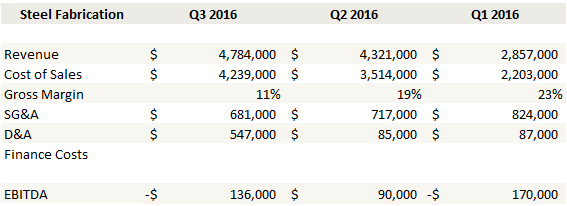
With the spin-off of the hydro-vac business (which I have written previously about here), the other remaining business unit for Empire has been steel fabrication.  Nelson said that they will be changing the direction of the steel fab business, exiting the contract manufacturing business and focusing it on producing parts for Dynamic Attractions.  This is probably a good idea; the Steel Fab business has not been profitable.

eilpost2

Nelson also gave an update on the SpacePark that was announced when Justin Trudeau visited China in the summer.  I mentioned the agreement in this prior post.  Unfortunately my optimism may have been misplaced.   Nelson was quite candid about the agreement, said that they hesitated with the new release, felt some pressure given that the agreement was attended by Trudeau, and that he felt that the Chinese counterpart only had about a 50/50 chance of securing the needed land for the park.

On August 9th Empire announced a $10 million contract for the design phase of the thirty meter telescope.  On the call they confirmed that this revenue will be seen in 2017.  It’s good to see the telescope, which has been held up by regulatory issues due to its Hawaii location.  Wikipedia describes the backstory well.  I’m not sure that the final location of the telescope has been decided.

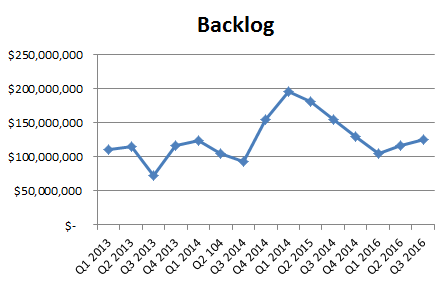
The backlog seems to have stabilized after falling from its peak in early 2014.

eilpost3

The improved margins in 2017, the healthy backlog and the additional $10 million contract for the thirty meter telescope design should lead to an improved 2017.

But I want to see how successfully they can transition to this model before I take any more of a position.  Let’s see margins improve, and let’s see orders continue and hopefully increase.

Empire is a typical position.  A decent company, lots of ways to a positive outcome, but nothing has materialized yet.   So it remains a small position as I wait for a catalyst to justify increasing it. 

Swift Energy as a Post-Bankruptcy Recovery Story

Heading into the OPEC meetings I owned small positions in a number of oil and gas stocks.  After the agreement was reached I significantly ramped up those positions.  As I wrote on the weekend, in the days following the OPEC meeting I added back Granite Oil (GXO) and added to Resolute Energy, Journey Energy, and Zargon Oil and Gas.  But my biggest add was to Swift Energy.

I have talked about Swift before here.  I took a position in the spring as the company was coming out of bankruptcy.  They had agreed to a pre-packaged bankruptcy deal that would give existing shareholders 4% of the new company.  In addition to the equity, existing shareholders received warrants.

It was the warrants that caught my attention.  For every share that you received you also received 7.5 warrants.   The warrants were way out of the money ($80 and $86), but they also had a long dated expiry (2019 and 2020).  It seemed like a good leveraged bet on something going right.

Since that time the company has emerged from bankruptcy and the stock has traded up from around $20 to $33.  So that’s pretty good, but remember the distressed levels that many oil and gas companies were trading at in February-March.  Swift has really market performed at best.

I think that’s because the stock has been stuck on the grey markets, and only recently began to trade on the OTC market.  On a third rate exchange and without liquidity, Swift has seen little interest from investors.

Peer Comparison

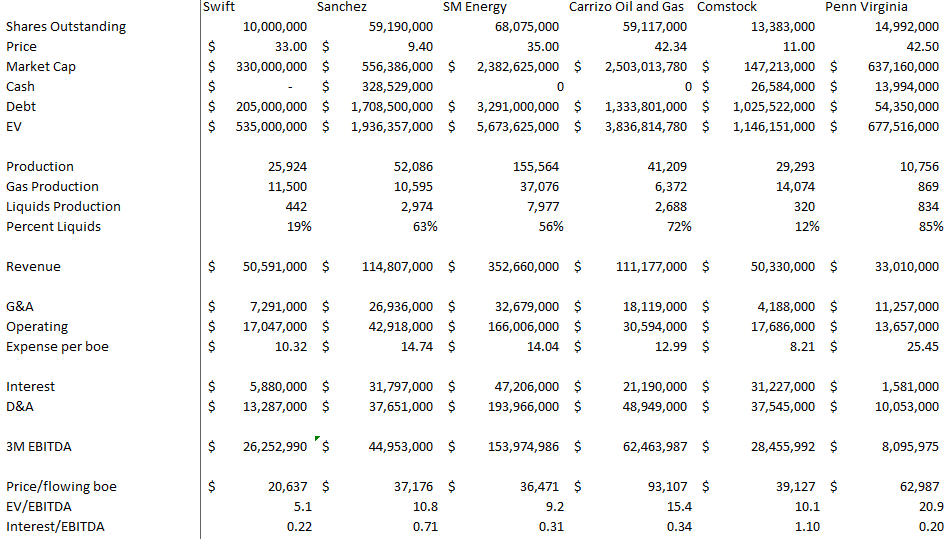
Below is a comparison I made between Swift and a few other comparable oil companies.  I picked companies that operate in the Eagle Ford and where I could that have a natural gas weighting.  Its difficult to find ideal peers to Swift because most Eagle Ford operators are oily.  Swift is gassy because they found a sweet spot in the gas window in Fasken and have been exploiting it.  But as I will describe, its not wholly accurate to describe Swift as a pure play on gas and they have more in common with their oil peers then their oil weighting suggests.  I know this comparison isn’t perfect: I just took the data directly from the last 10-Q, so it doesn’t account for recent transactions from SM Energy or Sanchez Energy, and all of these companies are bigger than Swift; its difficult to find public oil and gas companies in the Eagle Ford that have an enterprise value on par with them.  I’m open to suggestions.

comparison

Perhaps the closest comparison is Comstock Resources.  Comstock is gas weighted, has Eagle Ford land in the same counties as Swift (McMullen and LaSalle counties) but also has a lot of gassy acreage in the Haynesville.  Comstock trades at twice the valuation of Swift, based on both flowing boe or EBITDA.

I made a comparison based on EBITDA because it was simple, but if anything it understates Swift’s value because coming out of bankruptcy the company has a relatively low debt level.  Swift pays far less in interest than most peers, so more EBITDA drops to cash flow.

Thinking of Swift as a pure gas player is misleading.  The history of the company shows that it has typically had an equal oil/gas weighting.  It has only been in the last couple of years that gas production has dominated.

Fasken Gas Acreage

This shift to gas is because of the Fasken acreage.  In 2014 the company made changes to their completion techniques at Fasken and achieved a dramatic improvement in their results.  Below are well results before and after.
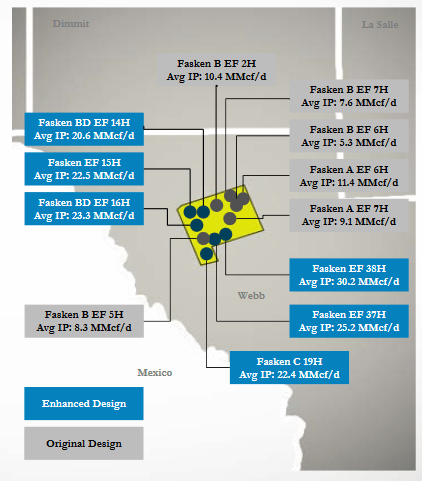
swift1

Swift has focused its drilling on Fasken since it went into bankruptcy in early January.  In early 2015 the gas weighting was around 60%.  In the third quarter it had risen to 81%.

While being gassy is often inferior to having a more oily weighting, the Fasken wells generate strong returns.  Most of the new wells are have produced over 2.5Bcf (over 400,000boe) in the first year:
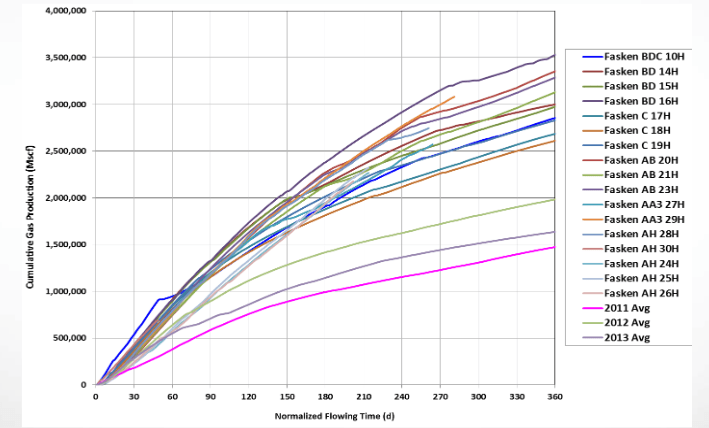
swift2

At $3 gas the company says that Fasken wells generate over 100% IRR at $3 gas.

Other more Oil Weighted Properties

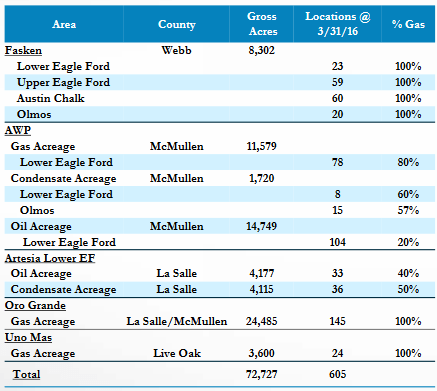
While the company has focused on Fasken and become a gas-weighted producer as a result, their remaining acreage is more balanced.  In particular in McMullen County (their AWP acreage) they have over 200 locations in their oil and condensate windows:
swift3

In fact, apart from their newly acquired and untested acreage in Oro Grande and Uno Mas, Swift has far more oil acreage than gas.

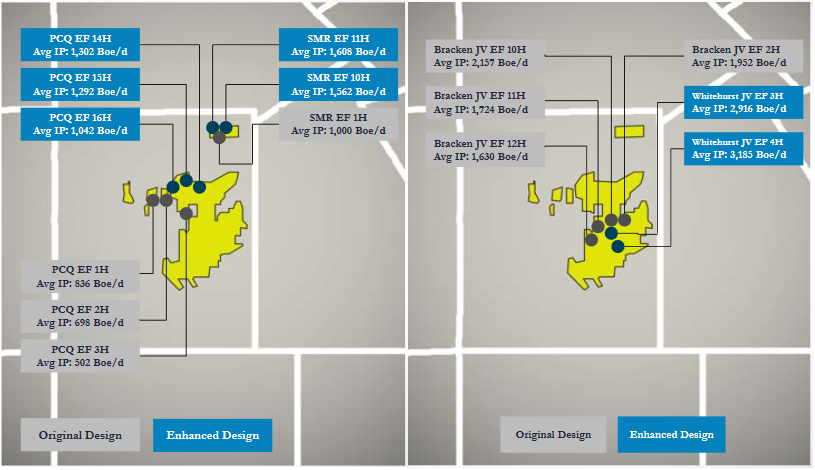
Much as they “cracked the code” in Fasken and achieved a step change in results, Swift appears to have had a similar breakthrough in AWP.

swift4

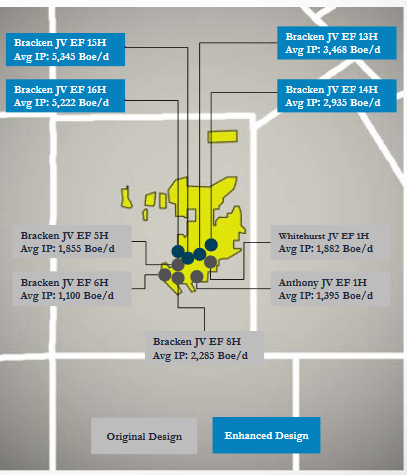
The PCQ wells are typically 90% oil while the Northern Bracken/Whitehurst wells are around 50% condensate.  In the south Bracken where it is gassy, Swift has had success not far different from Fasken, with Bracken wells IP30s exceeding 5,000boepd and cumulative production that looks like it will exceed 2BCF in the first year. Below are IP30’s from this area:
swift5

Capital Expenditures

Swift has curtailed their drilling and completion activity since entering into bankruptcy.  In the third quarter 10-Q, they described their 2016 operating activities at Fasken:

At our Fasken field in the Eagle Ford play, eight wells were placed into the system during the first nine months of 2016. Seven wells were placed into the system at rates between 15 – 20 MMcf per day of natural gas and one well had mechanical issues and was placed into the system at a restricted rate of 9 MMcf per day of natural gas. The Company resumed drilling operations at Fasken in October 2016 and expects to drill four wells by the end of the year. These four wells are expected to come online in early 2017.

And in the second quarter 10-Q they described their AWP activities:

The expenditures were primarily devoted to completion activity in our South Texas core region as we completed four wells in our AWP Eagle Ford field and also initiated completion work for four wells in our Fasken field.

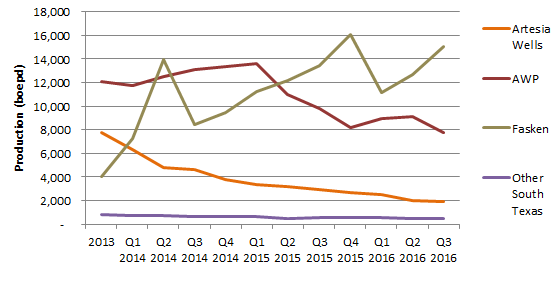
Prior to October, the company had not drilled any wells in 2016.  They completed 4 AWP wells in the first quarter, and completed 8 Fasken wells in the second and third quarter.  The impact of these activities can be seen in an area breakout of production results:

swift6

Artesia has seen no drilling activity for the last couple of years and the wells in the area have been declining naturally.  In 2015 the company drilled and completed only one well at AWP and so the decline there is close to natural.  The flattening of production in the first and second quarter at AWP coincides with the 4 well completions during that time.  Fasken saw the majority of activity in 2015, followed by a lull in the first quarter of 2016 and a corresponding drop in production that recovered once the 8 new wells were completed in the second and third quarters.

A few implications can be drawn.  First, two wells per quarter at AWP seem sufficient to maintain production levels there.  Second, 4 wells per quarter at Fasken increased production by 2,000boepd.  Third, production declines at Artesia are moderating and should be fairly insignificant to overall corporate production going forward.

The company has spent $60 million on capital expenditures this year.   In the 10-K the company said they would spend $12 million on corporate and regulatory costs.  That leaves $48 million that has been spent completing 12 wells and starting drilling on maybe one or two of the 4 wells being drilled at Fasken before year end.   Given that completion costs at Fasken are around $3.5 million, tie-in is another $0.2-$0.3 million and that costs are AWP are slightly higher, the numbers line up.

Production Going Forward

At current production rates, $3/mcf gas and $50 oil Swift should be able to generate EBITDA of $130 million and be able to cash flow around $115 million.  That would be enough cash to drill and complete  4 AWP wells and  another 11-12 Fasken wells.  That level of drilling should be enough to grow production, with my guess being by about 10%.

This compares favorably to a number of other E&Ps that I have looked at where I have difficulty seeing how they can maintain production levels at $50 oil while remaining within cash flow. In many of these cases its simply the debt burden and interest payments that bog them down.

Nothing is Perfect

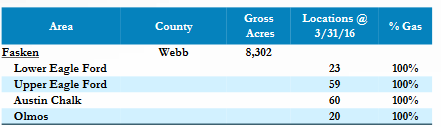
Swift is not without risk.  One risk with Swift is that their remaining drilling inventory at Fasken is modest.   Swift only has about 8,300 acres at Fasken, and in the lower Eagleford, where they have focused their drilling, they only have about 20 locations left.  It remains to be seen whether the upper Eagleford, Almos or Austin Chalk can produce as prolifically.
swift7

I’m also not sure about the upper management.  After emerging from bankruptcy a new Chairman of the Board was appointed, Marcus Rowland.  Rowland was an original member of the Chesapeake team being with the company from the early 90’s until 2011.  I’m sure he had a lot of successes at Chesapeake but he has also been known for steep executive compensation.

A month before Rowland was appointed, a number of Swift’s original executive team left the company, including Terry Swift.  I have mixed feelings about that.  I know that many think these guys were incompetent.  They totally mishandled the balance sheet and then blew it by not hedging anything heading into the 2014 downturn.  But they also were very good operators.  They unlocked Fasken, and showed continual improvement in drilling efficiencies and performance.  I hope that the engineering teams remain intact.

At any rate there is a void that needs to be filled.  They appointed the COO as the new CEO on an interim basis.  But we will have to wait for the longer term plan.

Swift also some lower priced hedges.  They have about 20-25% of their gas production in 2016 hedged at around $2.80 per mcf and another 25% collared between $3-$3.90 per mcf.  They have about 20% of their 2017 oil production hedged at $48 per barrel.

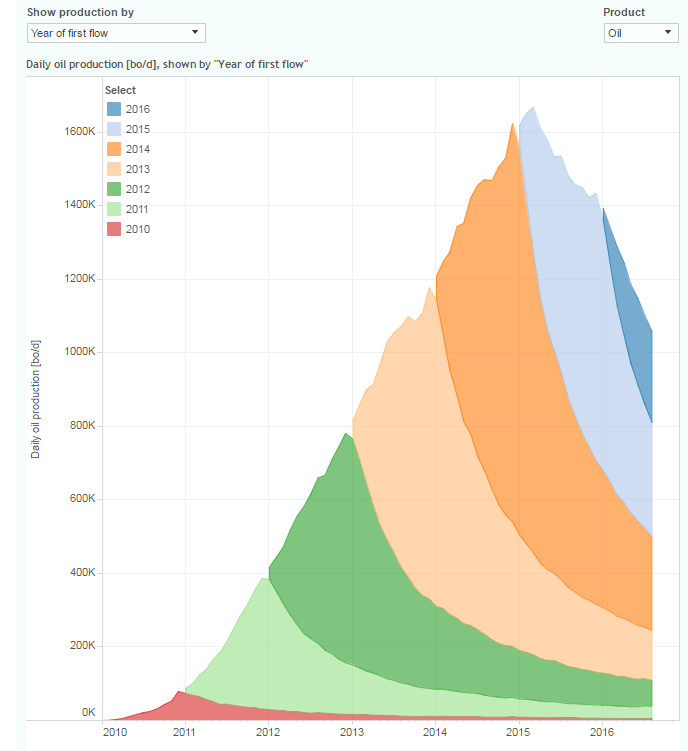
Finally, the Eagleford is not the premier basin that it was a few years ago.  That spot has been taken by the Permian.  As pointed out in this tweet, $50 oil is not bringing back rigs.

//platform.twitter.com/widgets.js
This post, from a blog that provides good information about shale production, illustrates the declining trend the Eagleford has experienced:

eagleford


Week 282: Two Big Events

Portfolio Performance

week-282-yoyperformance

week-282-performance

Top 10 Holdings

 week-282-holding-concentration

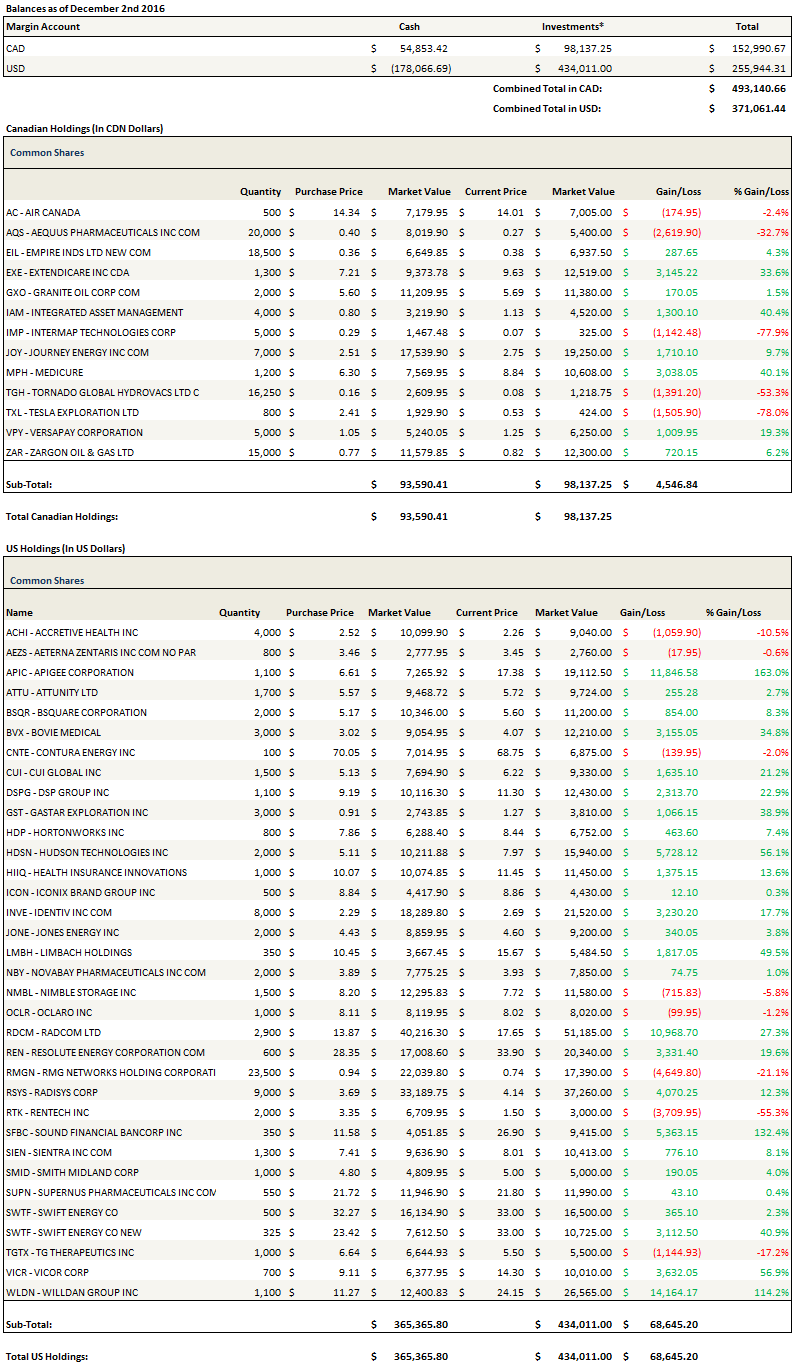
See the end of the post for my full portfolio breakdown and the last four weeks of trades

Thoughts and Review

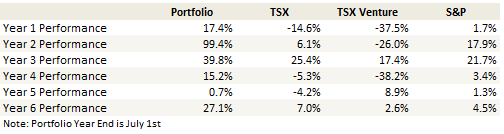
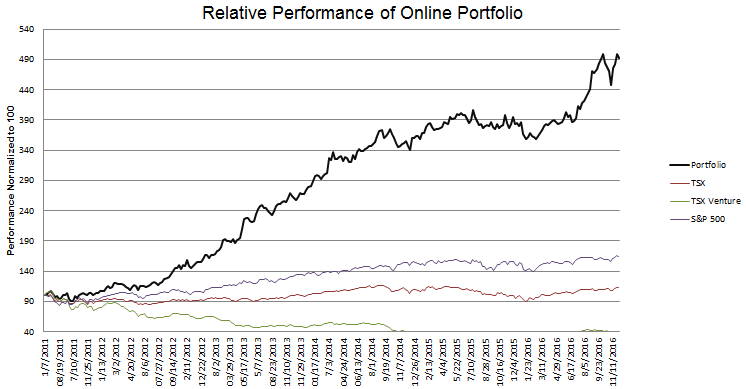
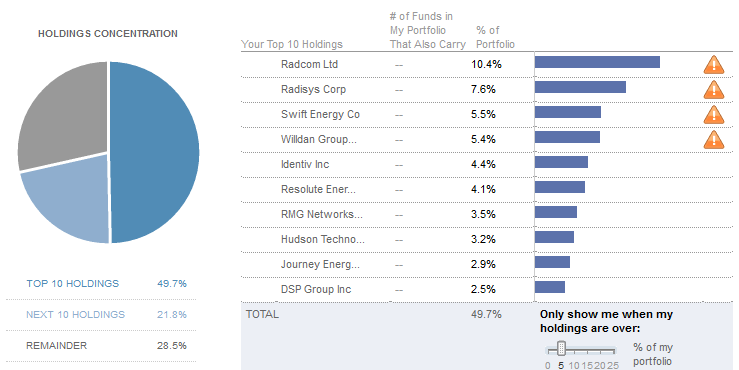
My portfolio bounced back this month.  This was somewhat remarkable given that my two largest positions, Radisys (RSYS) and Radcom (RDCM), continued to perform poorly.  I don’t expect much from either of these stocks until they are able to secure additional contracts with service providers.  With year end coming up, I am hopeful (but not counting on) some news on that front.

The rest of my portfolio did extremely well, benefiting from the rotation to small caps that occurred after the election of Donald Trump.  I didn’t anticipate the market move or the small cap revival.   But I wasn’t the only one, in fact I didn’t hear that prediction from anything I read.  I would be interested if anyone else knows of an expert, newsletter writer or manager that predicted the move?  They would be worth following.

In retrospect it makes sense; expectations of significantly lower taxes and a relaxation of regulations would lead to a market rally with a bias on small caps with domestic exposure and few tax loop holes.  The stocks that have performed the best for me have had that characteristic.

Willdan Group (WLDN) is a text book example.  Willdan has always paid a high tax rate, sometimes over 40%.  If the companies tax is cut in half, which is not impossible under a Republican government, earnings go up by 30%.  They are also essentially an infrastructure play, another positive.  The stock has moved from $16 to $24 in the month since the election.

Adding Healthcare, Infrastructure, Biotech

While I wasn’t positioned for a rally leading into November 8th, I adapted as the market moved higher.  As I’ve written about here, I added Health Insurance Innovations shortly after the election on the expectation that changes to the Affordable Care Act (Obamacare) would open up competition, which would be positive for their business.

I also added an infrastructure play, Smith-Midland (SMID), as it seems that this will be the focus of spending under the Trump administration.  Smith-Midland makes make pre-cast concrete products like barriers, sound walls, small buildings, and manholes.  They have a market capitalization of $25 million and even after having run up to $5 are not expensive.  There is a good article on the company here.  I also added to my existing position in Limbach Holdings, another infrastructure play.

My last move in response to the election result was to add to a few biotech names.  This worked out initially but interest has waned in the last couple of weeks.  I added to my position in Supernus (SUPN), to Bovie Medical (BVX) and added back some TG Therapeutics (TGTX).  I may jettison the latter position soon.

Responding to OPEC

The Trump move was followed by the OPEC move, which I again don’t profess to have predicted.  I was agnostic going into the OPEC meetings; I held my usual weighting of energy positions, but did not pile into them as a bet that a deal would be reached.

Instead, as is my typical strategy, I chased the news, adding to energy names on the heels of the announcement.  By waiting I missed out on the first 10% move, but once the deal was announced it was a far lower-risk entry into stocks on my watchlist.

It can be argued that OPEC’s cut will only lead to high US production, or that it will be diluted by cheating by OPEC members, but nevertheless its difficult to argue that this doesn’t put a floor on prices.  And if there is a floor, stocks that previously had to discount the possibility of another move into the $30’s do not have to anymore.  Therefore stock prices needed to move higher.  I think they still do.

Many of the names I am interested in are small enough that they do not move immediately with the market.  Thus I have been able to add to Journey Energy (JOY) and Zargon Oil and Gas (ZAR) at prices not too different to what they were leading up to the announcement.  There is a good SeekingAlpha article (and comments, in particular note those on the interim CFO hire) on Zargon here.  I haven’t seen any analysis on Journey, and I will try to write up a summary on the stock in the next couple of weeks.

A second energy name that I added to and am in the process of writing up is Swift Energy.  As I tweeted on Friday:

I also added Resolute Energy (REN), a Permian player I have been in and out of over the past 6 months, and added back Granite Oil (GXO).  There was a good comment to my last portfolio update that gave me some perspective on the concerns I had raised about Granite.  I wanted to add to Jones Energy (JONE), but it moved so quickly off of the OPEC news that I didn’t get a chance.

Finally I added to a derivative play, CUI Global.  CUI Global is a bet on Trump as well as OPEC.  The company has said in their presentations that they have struggled gaining traction with their GasPT products in North America because of the dour investment climate for oil and gas infrastructure.  This should change under Trump and with support to oil prices.  Its no guarantee that CUI Global will be the beneficiary, but if their product is as good as they profess it to be, it should be the preferred measurement tool for new projects.

I also added a position in Contura Energy.  It was written up here.  I think this article will move behind the paywall soon, so I would recommend reading it sooner than later.

Where we go from here?

I’ve taken on some risk as the market has moved higher and especially after the OPEC agreement.  But I do not expect this to last long.  I’ll be paring back positions over the next few weeks.

I don’t feel like I know what to expect from this new US regime.  Tweets like the one’s Donald Trump made over the weekend, promising a 35% tax against companies moving production abroad, leave me wondering where we end up?  Are these just empty threats, impossible to implement?  Or is this only going to escalate?

It’s uncharted territory.  If government spending increases significantly, taxes are cut and trade restrictions are imposed, I’m not sure where it leaves us.  Will bond yields rise, setting off a negative market event?  Will investors continue to pile into domestic US equities?  Will stocks based in foreign locales or with manufacturing operations abroad sell-off on concerns over tariffs being implemented.  The answers are just way beyond me.

Lacking confidence in the answers means I have to get smaller.  That’s the only response.  Since July (my year end) I am up nearly 30%.  I feel like I am pushing my luck asking for the same kind of performance in the second half of my fiscal year.

Portfolio Composition

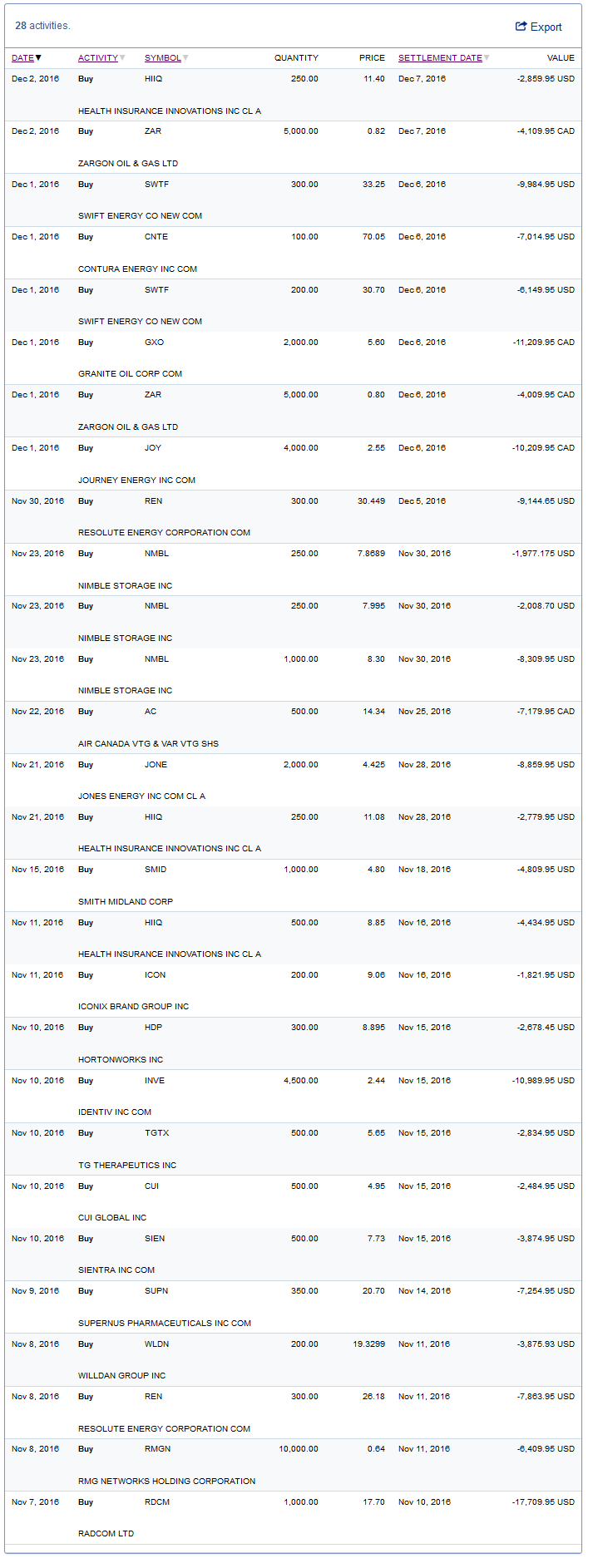
Click here for the last four weeks of trades.

week-282

A Changing Regulatory Environment makes Health Insurance Innovations Interesting

When I sold Health Insurance Innovations in the spring their business was under attack from the department of Health and Human Services (HHS).  The HHS had decided that short term medical insurance policies (STM) were an end run around the affordable care act (not an unreasonable conclusion) and was proposing a rule change (subsequently implemented) whereby STM policies would be limited to “less than three months, and coverage could not be renewed at the end of the three month period”.

So I sold.  It seemed like a broken business model, which was unfortunate as Health Insurance Innovations had just hit their stride.

But then the Republicans swept the election.  The Affordable Care Act will likely be spun back into some other form.  The headwinds become tailwinds.  While it’s not clear what form health care insurance will take going forward, I think it’s reasonable to assume the changes will be positive to Health Insurance Innovations.

While took some time for investors to notice that his tiny sub $100 million market cap company had just had its prospects turn for the better (small caps are not efficient), the stock has been on a tear since the day after the election.

Because I’m not sure exactly what the eventual impact will be, I’ve taken cues from the market, adding as the stock goes up.  This has worked out pretty well as I put on a small initial position in the 6’s, then added in the 8’s, the 9’s and then at 10.

But I’m not adding any further.  I don’t have a large position, but its enough given that I don’t really have a sense of what will succeed the ACA, and Health Insurance Innovations has some legal and regulatory issues that are yet to be resolved and that lend to some uncertainty.  These state regulatory examinations of some of their third-party distributor call centers are described in the latest 10-Q.

My optimism that the eventual outcome of the ACA rework will be positive for Health Insurance Innovations is because their business relies more on a platform than any particular insurance product.    Their AgileHealthInsurance.com platform is a comparison and online enrollment tool that can sell any type of health insurance product.  The site lists products available from multiple carriers and helps consumers pick a product that meets their needs and is the most affordable option.

The company supplements AgileHealth with a retail channel where they sell through third party call centers and I believe still own one call center (ASIA). They restructuring two others,  Secured and ICE in November 2015.  They stock theses channels with policies from a wide range of carriers, including HCC Life Insurance Company, Companion Life Insurance Company, Standard Life and Accident Insurance Company, Nationwide Mutual Insurance, and US Health Group.

Health Insurance Innovations engages with the carriers to create new products depending on the current regulation environment and demand.  They have primarily sold short term medical and auxiliary health plans because that is all that the ACA has allowed for.  On the third quarter call they talked about how they are working with carriers to create product alternatives to STM.

I think that there is a good probability that whatever replaces the ACA will have more choice.  This is in the direction Republicans typically lean.  More choice should play into the hand of Health Insurance Innovations, their platform and their carrier relationships.

The stock is not expensive.  If I gave you the following metrics what would you value the company at?

  • 9 month year over year revenue growth of 30% and policies in force growth of 46%
  • Adjusted EPS of 33c in the third quarter and full year revenue guidance of between 88c and 95c EPS
  • 2017 topline growth of 20%
  • Net cash ($5 million of debt and $14 million of cash) on the balance sheet

Note that I am adjusting the company’s 2016 revenue to account for the impact of moving owned call centers to be third party and the associated accounting treatment of this.  GAAP revenue growth has been over 70% year over year.

Even after a pretty tremendous move up, at $11 the stock is not really pricing in its earnings and growth.

Of course up until November 8th this made sense.  While the company said they could overcome the inevitable revenue decline from STM, I don’t think many believed this.  There was already evidence that new applications were flattening from the second to third quarter (see the submitted IFP applications in the third quarter press release).  Even as the company showed that Limited Indemnity Medical insurance (LM) made up 45% of Individual and Family Plans in the third quarter, the stock price hardly budged.

Now that the future of the ACA is uncertain, and given that Republicans tend to err on the side of choice, things seem to be setting up much better for the company.  While its hard to buy into a stock that has run up as much as Health Insurance Innovations has in as little time as it has, I don’t think you can make the argument that it is unreasonably expensive at this price.  I’m willing to hold on here and see if it has further to go.