Skip to content

Week 246: Hidden in Plain Sight

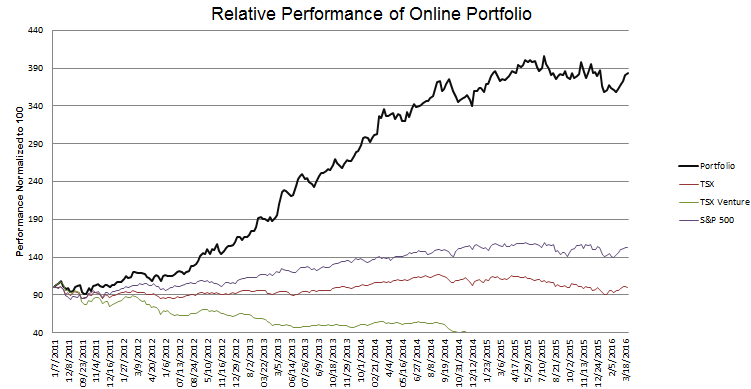
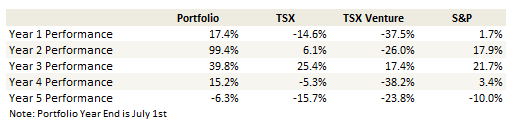
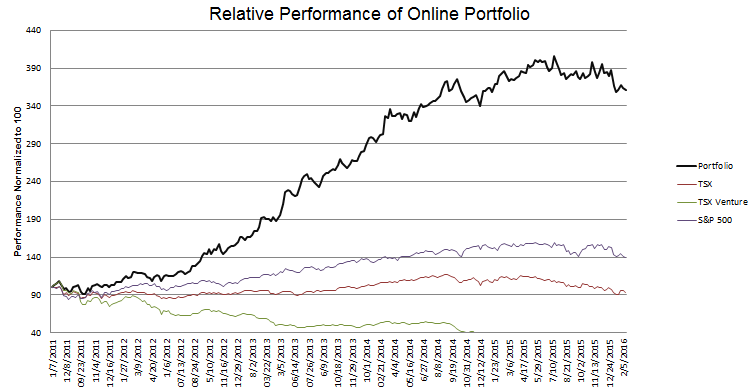
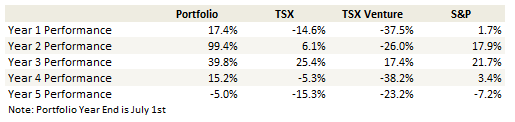
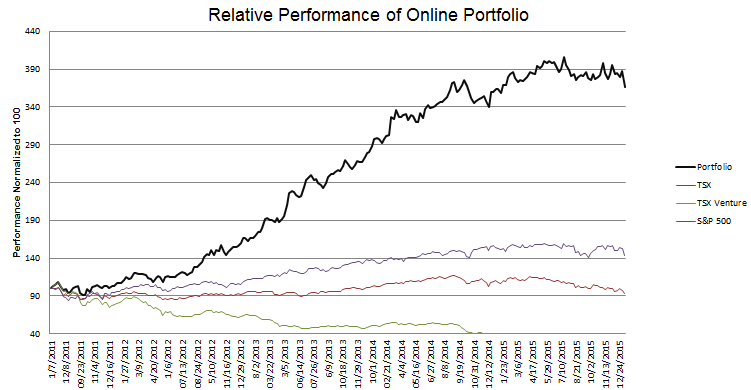
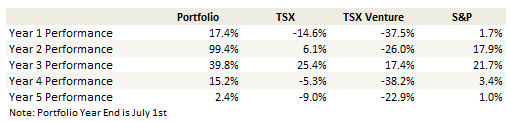
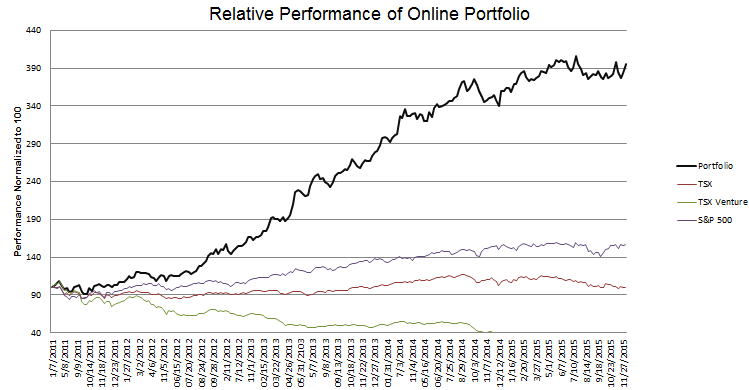
Portfolio Performance
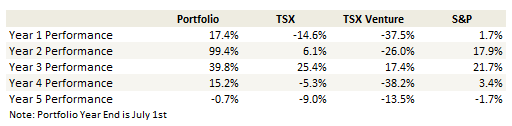
week-246-yoyperformance

week-246-Performance

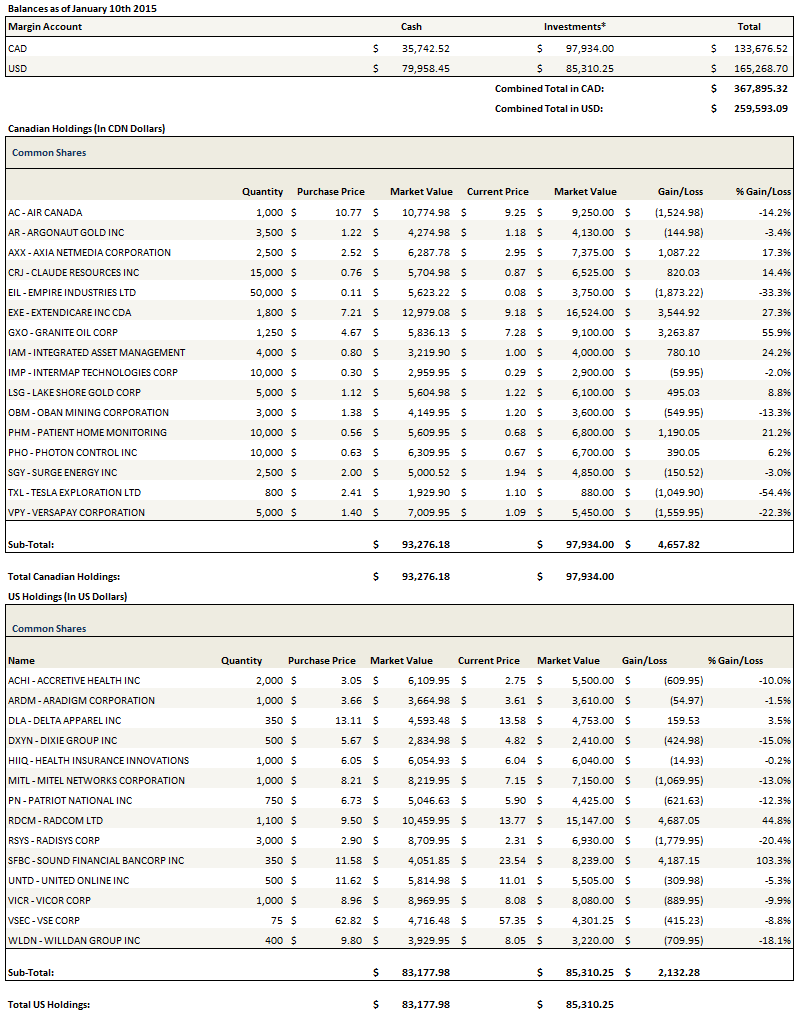
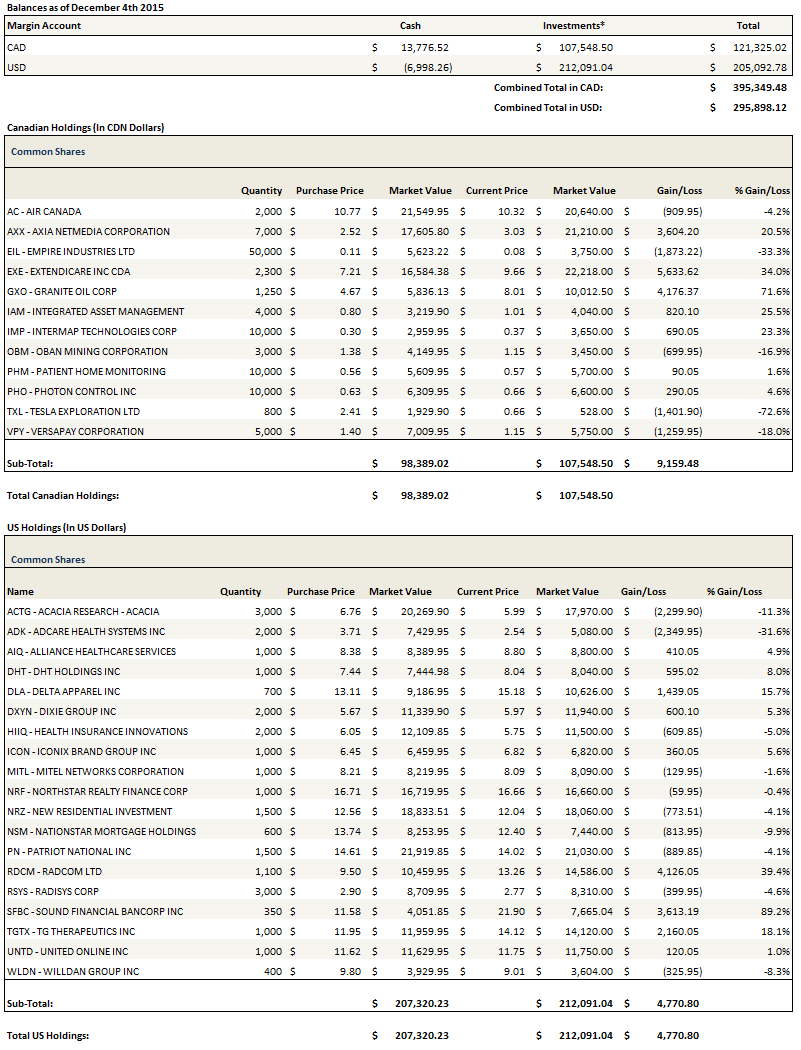
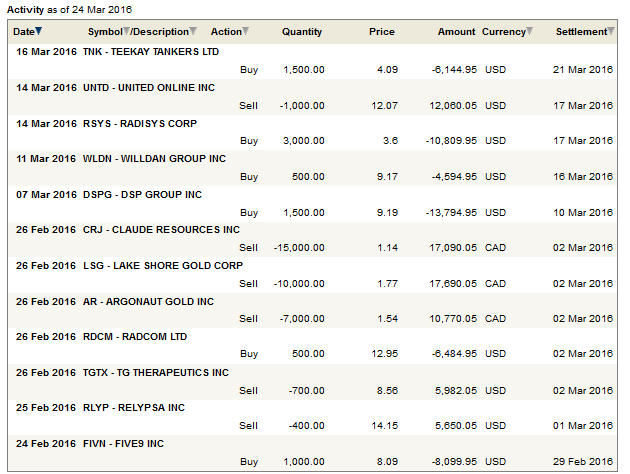
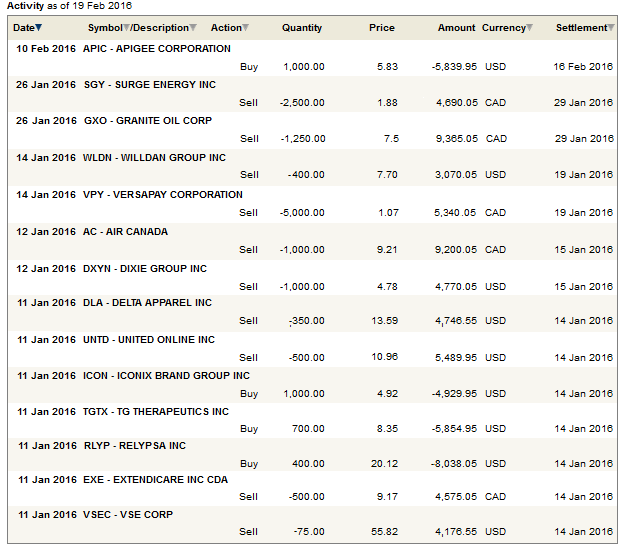
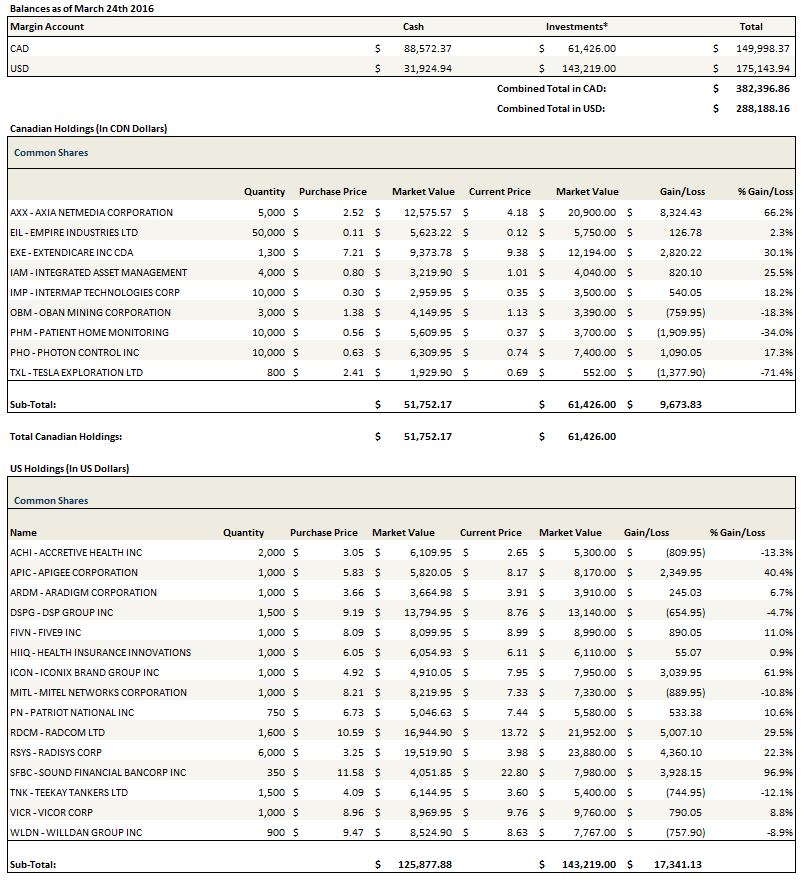
See the end of the post for the current make up of my portfolio and the last four weeks of trades

Thoughts and Review

The market was up and so not surprisingly I had much better performance in the last month.  Even so, I performed better than I might have expected given just how much uninvested cash I have sitting around.

It just goes to show how much of a drag the losers have been.  I’ve had my share of winners in the last year, but my performance has been flat because I also had a bunch of crappy losers.

It would be one thing if I couldn’t distinguish between the winners and losers ahead of time.  But when I look back at what has cost me over the last year, it has been pretty predictable; stocks where I am stretching for a trade, stocks where the value wasn’t clear, or stocks where my primary motivation was their attractive yield.

I’m going to make a concerted effort to prefer cash to those positions going forward.

In the last month I haven’t been actively looking at stocks.  I’ve been surprised by how quickly the market has bounced back and I remain skeptical that it can continue.  So with the exception of a couple of opportunities that I will describe below, I am will remain holding a high cash position until I see a reason to believe the market will sustain a move higher.

Takeovers!

I went a long time without a takeover and then in the matter of 6 weeks I got 3 of them.  First, both of my gold stock picks, Lake Shore Gold and Claude Resources, were taken over.  I bought Lake Shore at $1.12 and, after the takeover offer from Tahoe Resources to exchange each share of Lake Shore for 0.1467 shares of Tahoe, the stock now trades at a little under $2.  I bought Claude at 76c. Silver Standard Resources made an offer of 0.185 shares for every share of Claude.  At the time of the offer this amounted to $1.65.  I’ve sold some of each position and so have reduced stakes in both.  They have been solid performers and I am not unhappy.

A few days after the Claude Resources news my long held fiber-to-the-home play, Axia NetMedia, got scooped up by a private equity firm, Partners Group.   While I was happy to see a quick takeover of both of my gold stock positions, I was more divided by the news from Axia.

The problem is that the opportunity at Axia is much greater than the $4.25 takeover offer.  The company has a massive build out on its horizon in both France and Alberta.  Its becoming clear that fiber-to-the-home is not just a “higher speed-nice-to-have” but a necessary conduit to access all forms of media.  Axia’s cash flow stream once this build-out is complete will far exceed the price paid by Partners Group.

The problem is getting from here to there.  As Axia outlined on their last conference call, the capital necessary to realize the growth is a stumbling block for a $200 million Canadian company.  Axia warned on their last call that they were evaluating alternatives; that they would try to raise capital and if not consider offers by a larger entity with greater access to capital.  Partners Equity is a $50 billion investment management firm.  The only reason that a firm that large bothers with a takeover this small (Axia was a $200 million market capitalization before the offer and under $300 million at $4.25) is because they see significant upside.

Radisys, Radcom, Willden, and what the Market Misses

I’ve made a number of mistakes over the last couple of months but one thing I have done right is add to my positions in Radcom and Radisys in the face of market weakness.

Radisys has had a big move in the last month, moving as high as $4 from $2.50 in January.  I have added to my position on the way up.

The Radisys move over the last couple of weeks has been instructive.  Consider that during the fourth quarter conference call the company announced a large contract from a Tier I customer (from this transcript):

And finally, and maybe most important in this release is, we secured orders totaling approximately $19 million, the majority of which is contained in deferred revenue at year-end for our new data center product targeted at telecom and cable operators which we expect to launch more broadly in the coming months.

The stock moved a little but nothing that couldn’t be explained by what were decent quarterly results.

About three weeks later Radisys officially announced the product, DCEngine, with this press release, along with the name, details and comments from the Tier 1 customer, Verizon.

“As Verizon introduces open, flexible technology that paves the way for central office transformation, we look to companies like Radisys to assist us in that journey,” said Damascene Joachimpillai, architect, cloud hardware, network and security, Verizon Labs. “Network modernization will rely on solutions such as DCEngine that meet service provider needs with open source hardware and software technologies.”

The stock has moved straight up since this press release.

I think this demonstrates how poorly small cap companies like Radisys are followed and how slow the market can be to react to positive developments.  While I find it easy to second guess myself when what I construe as good news in announced and the stock doesn’t move, it is worth reminding myself that this isn’t always an indicator of importance.

With that in mind consider the following situations, Radcom and Willdan Group, two stocks I have had in my portfolio for some time, and Vicor and DSP Group, two new positions that I have added.  I believe all four of these situations represent similar “hidden in plain sight” opportunities.

Radcom

First, Radcom.  Radcom announced in early January that they had signed a contract with a Tier I customer for their next generation service assurance solution MaverIQ.  There wasn’t a lot of details provided, only that the initial phase of the contract would be completed mostly in 2016, and was worth about $18 million.

On their fourth quarter conference call in mid February the company gave more color.  They said the contract for NFV deployment was much bigger than the $18 million announced.  I’m pretty sure its with AT&T.

While they declined from giving guidance (historically the company has given virtually no guidance in the past so this was no surprise) they were willing to say that they expected their cash level to increase to $20 million from current $9 million by end of the first half of 2016, and that the increase in cash would be due to new revenue and not deferred payments.

They also gave an indication of just how big the deal with AT&T might be (my bold):

We just said that we received an $18 million initial deal out of a bigger deal. There is – it’s a large transformation, so it’s not – I think when you’re envisioning it, so I’m going to try to help you model it, right. So when you’re envisioning it, envision something between 2.5 to three year evolution for the very significant portion of the transformation, okay. It doesn’t mean that everything stops after three years, but envision that over the course of those three years, that number $18 million that we’ve disclosed is just an initial number out of something bigger, that’s bigger than that. And I can’t disclose the accurate numbers here. There is things that it depends on. There is – it’s more complicated just throwing other number out there, but it’s much bigger than $18 million, okay.

In addition they made it clear that they are ahead of the competition, witnessed by their comments about Netscout on the call.   They are in the process of trials  with other Tier 1 customers and believe that the next-gen service assurance market will be a “winner takes most” market where they can take the most.

Radcom is a $130 million market cap company.    They just said they can generate $10 million of free cash in the first half of 2016, that the contract they have announced is actually much larger than the announced number, and that they have a product that is significantly better than the competition.

If Radcom can win a couple more contracts in the next year the stock should trade significantly higher than it is now.  it probably gets bought out at some point.   In the mean time I think its quite a good growth story.  The market is really not paying a lot of attention to the “color” provided on the conference calls, and instead is focused on the rather puny revenue that the company generated in 2015 ($18.6 million) and the rather lofty valuation for the stock if you use that backward looking measure.

Willdan Group

Update: I got a response from Willdan IR and they say the revenue is not new revenue and is included in guidance.  I am still of the mind that this is an expansion of scope though and I am happily holding the position I added that I describe below.

Second example.  On their fourth quarter conference call, which I thought was quite positive in terms of the outlook provided for 2016, Willdan stated the following about their ongoing contract with Con-Ed:

We have the extension for 2016 at a value of approximately $33 million. We’re prepared to go beyond this baseline and expect to. The good news is that we continue to perform well for Con Ed and as a result we are in discussions to expand our scope of activity in the second half of 2016 to include more programs targeting customer segments, for example, more of Brooklyn, Queens and larger projects, 100 kW to 300 kW in our SPDI program, the type of programs that will include in the larger retail stores and warehouses and more real estate.

Note that the transcript is incorrectly referring to the SPDI program, which should read SBDI (small business direct install program).

Flash forward to Thursday. In a press release Willdan said the following:

Willdan Group, Inc. (“Willdan”)(WLDN) announced that it has been awarded a one-year, $32.8 million modification from Con Edison to an existing Small Business Direct Install (SBDI) contract.  Under the modification, which extends through the end of 2016, Willdan will be delivering approximately 86 million kilowatt-hours in electric energy savings to Con Edison’s small business customers throughout the entire Con Edison service territory. This includes the Bronx, Brooklyn, Queens, Manhattan, Staten Island and Westchester County, New York. Willdan described this forthcoming modification in its recent fourth quarter earnings conference call.

Based on the language used it seems pretty clear to me that the $32.8 million is in addition to the $33 million baseline contract.  They talked in the fourth quarter conference call about scope expansion with respect to the SPDI and this is scope expansion to the SPDI.

If I’m right, then the market hasn’t caught onto this yet.  Full year guidance is $170-$185 million and so $33 million is significant.

It’s possible I am wrong.  Maybe Willdan is just re-releasing old news.  I would be surprised though.  I have followed the company for some time and their management does not strike me as the sort to throw out a press release with a big number that is a rehash of an already disclosed contract.  It just doesn’t strike me as something they would do.

I think its equally possible that this was the Thursday before a long weekend, that there are maybe one or two analysts following the company, and so no one that was around to check the news cared enough to notice it.  Yet.

For what its worth I added to my Willdan position significantly.  What the heck; I’m buying the stock at the same price I was buying it at a few weeks ago before this announcement anyways.    What’s the downside?

DSP Group

I have been watching DSP Group for a couple of years and have owned it once in the past.  The previous time I owned it the story was primarily one of valuation.  The stock was trading at $7 and the cash and investments on the balance sheet accounted for nearly $6 of that.   But there wasn’t a clear story behind the business itself and so I sold the stock after it went a few dollars higher.

In the two years since the story around the company’s business has been evolving for the better.  The legacy business that they have, and for which I had a lack of excitement in my first endeavor, is the design and manufacturing of chipsets used in the cordless telephones.  It’s profitable and brings in decent free cash, but it’s an industry in decline to the tune of 10-12% annually in recent years.

This business has fallen off the cliff even more in the last couple of quarters.  Slower demand and an inventory build has led to 20% plus year over year declines.   These declines are expected to moderate back to trend in the second half of the year.  However the bad numbers drag down the overall revenue numbers for the company and are hiding some pretty decent growth businesses.

DSP Group has been investing in a number of new technologies that are starting to bear fruit.  Lets step through them briefly:

  1. HDClear – they have developed a new technology that will improve voice quality on next generation phones. On the fourth quarter call the company announced that they had a couple of wins and one of the wins was with a Tier I device supplier.  Turns out that is Samsung, where it has been designed into the S7.  They expect $2 million to $3 million in the first quarter and guided to lower double digit or high single digit revenue for the year.  When I look at some of the numbers I wonder whether it could be higher: according to this article from Reuters (here), DSPG should get 70c-$1 for each HDClear chip sold.  The Samsung S6 sold over 50 million units last year.
  2. VoIP – their VoIP business unit had $22 million in revenue in 2015. They have guided for 50% growth in 2016.
  3. IoT – Eight OEM’s and three service providers have launched products based on DSPG’s ULE technology. They have a ULE chipset that can be used in home automation, security, remote healthcare or energy management products.  They generated $3.8 million of revenue in 2015 and they think that can get to $5 million in 2016.
  4. Home Gateway – Home Gateway generated $14 million in 2015. It is expected to take a step back in the first quarter of 2016 with around $2.5 million of revenue, but this is going to climb as the year progresses and some new product launches, in particular a North American telecom provider.
  5. SparkPA – DSP Group announced a new product, a power amplifier to be used in the high end access point market. They don’t expect any revenues from this business in 2016 but it will ramp in 2017 and they consider the market they are tapping to be over $100 million

The company gave quite a bit of color about the revenue expectations for each of these businesses in 2016 on their fourth quarter conference call.  If you add up the expected 2016 revenue from the new businesses alone you get around $57 million.  These businesses grew at 35% in 2015 and the company said that in aggregate they expect higher growth in 2016.

When I think about a company with an $80 million enterprise value and $57 million of high growth revenue products, it doesn’t make a lot of sense to me.  I understand that overall the company’s revenue is not growing because of the out sized contribution of cordless declines.   But this business is profitable and therefore not a drag on the company, in fact it even helps fund the growth.

I think the stock should trade at least at 2x the revenue of its burgeoning new product lines.  This would be a 50% upside in the stock.  If the growth continues I would expect it to be even higher.

Vicor

I got the idea for Vicor from a friend who emails me regularly and goes by the moniker Soldout.  He gave me a second idea some time ago, called Accretive Health, that I didn’t initially buy and has done really poorly for the last half a year but that I added recently and will talk about another time.

As for Vicor, the company has a market capitalization that is a little under $400 million, $60 million of cash on its balance sheet and no debt.  The company sells power converters.   They offer an array of AC-DC and DC-DC converters that are used in telecom base stations, computers, medical equipment, defense application, and other industries.

Vicor has a history of high-end products and so-so results.  Their technological edge goes back to the 80’s, as they were the original inventor of the DC-DC brick converter, a device that allows the power converter to sit on the circuit board, which in turn allowed a single DC voltage to be distributed throughout the system and converted as required to lower voltages.  However they haven’t made a significant profit since 2010, and even then it was only 80c per share.

The story going forward is simple.  The company says that with recent design wins and product launches, in particular wins for new data centers that will utilize the VR13 standard (more on that in a second), as well as high performance computing, automotive and defense, they can grow revenue 3-5x in the next couple of years.  That estimate comes directly from management (from the third quarter call).

I think it’s fair to say that the array of products that have been introduced and the products which are about to be introduced, for which the development cycle has ended and we’re very close to new product introductions, that in the aggregate these products are more than capable of supporting the 3-by-5 revenue growth goal that we had set for ourselves, and with respect to which we suffered delays.

The increases in revenue in 2016 will coincide with the move to the VR13 class of processors made by Intel (known as the Skylake family of processors) and that are used in a number of high end computing applications.  These processors require power conversion levels that are easily addressed by Vicor’s high efficiency products.  Vicor has already had a number of design wins to be included in VR13 system designs.  The move to a VR13 based architecture has been slower than expected though, and the company has pushed back the revenue ramp from originally beginning in early 2016 to now occurring in the second half of the year.  The company describes the VR13 opporunity below:

VR13 is a class one processor, it’s a class of processors, and it’s processors that in many respects represent the significance that [inaudible] performance relative to the earlier class, which is VR12.5. Now this can be potentially look confusing because, as you follow Intel’s introductions with respect to the many different flavors of these devices, some of them play in a space where now we do not play, and other ones are targeted in particular to higher-end datacenter, more intensive — computing intensive applications. And those are the ones that are relevant to our revenue opportunity.

Vicor has significantly more design wins for the VR13 product line than they did for VR12.5 (again from the third quarter conference call):

To the extent our footprint with factorized power solutions across applications and customers will increase going from VR12.5 to VR13, this product transition is a mixed bag as it may cause near term softening in demand but should result in substantially greater total revenue as VR13 applications begin to ramp.  On a related note, we have started to see significant design wins for our new chip modules as point of load, board mount devices and in chassis mount VIA packages, which validates our expectations of market reception of these products.

Vicor’s technology differentiates them from competitors.  For example they have introduced a factorized power 48V architecture that includes components that can step down voltage directly from 48V to 5,3 and 1V without an intermediate 12V stage.  I believe they were the first company to come up with this solution and I have only seen one other advertising the capability.  Stepping down directly from 48V has higher efficiency and takes up less board space than existing architectures.  On the third quarter conference call the company said the following:

In my recent visits to customers in the U.S. and Europe, I confirmed spreading a rising level of interest in our factorized power 48-volt architecture and are now frontend solutions for automotive, datacenters, high-performance computing, and defense [ph] electronics applications among others.

The 48V products are particularly interesting to data center and server applications where power losses due to the intermediate step-down to 12V are undesirable.  Google, for one has championed a 48V server solution with a new 48V rack standard.  Vicor released a press release describing Google’s initiative:

Patrizio Vinciarelli, President and CEO of Vicor, commented: “By developing its 48V server infrastructure, Google pioneered green data centers. And by promoting an open 48V rack standard, Google is now enabling a reduction in the global cloud electricity footprint.”

The company has been building out their capacity and their existing cost structure can support the anticipated rise in revenue.

So we have significant design wins. We have been working furiously to establish automated manufacturing capacity. There’s been good progress to that end. You know, there’s equipment coming in, factory flaws, have been prepped for it, and we’re going to have a turn now in the very near future in anticipation of volume ramp in Q1 of next year.

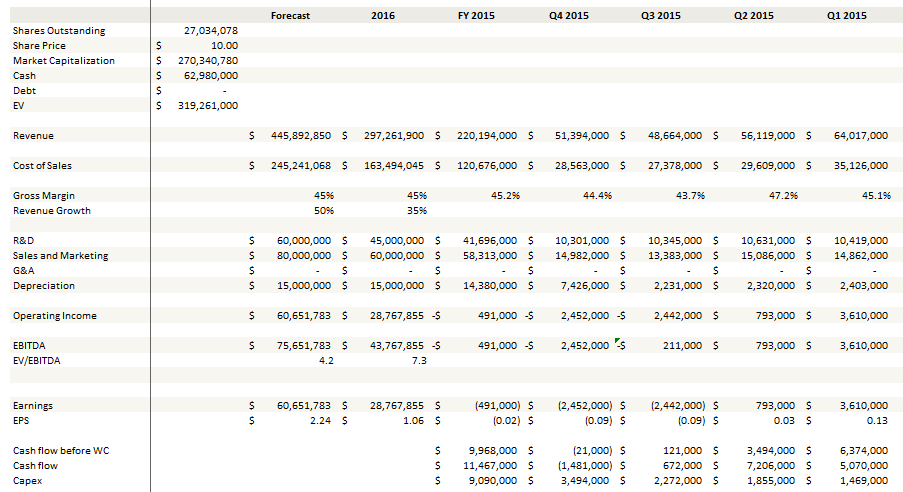
If you step through how the numbers would play out and assume that revenues double at some point, a modest increase in SG&A and no improvement in gross margins as revenues ramp, you can see the leverage to earnings that quickly develops. Note that the company has significant net operating losses that will shelter them from tax:
forecast

Keep in mind that I’m not trying to exactly predict how earnings will ramp.  This is not intended to have the accuracy of a forecast.  Its intended to demonstrate the magnitude of the earnings leverage if the company can make good on their expectations.

I have a position in Vicor and expect the stock to move significantly higher if they can realize their revenue expectations.

Tanker Stocks

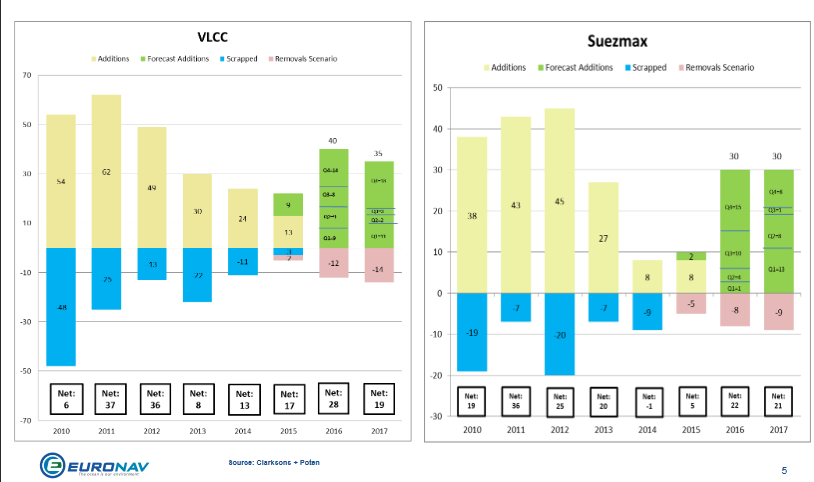
After watching the tanker stocks dramatically under-perform for the last two months I decided to take a closer look.  I concluded that you can attribute the negativity entirely to the order book for Suezmax and VLCC’s over the next couple of years.  The slide below is taken from the Euronav September 2015 presentation.
orderbook

Note that since that time the gross additions for Suezmax have fallen by 3 in 2016 and risen by 15 in 2017, while gross additions have risen by 5 in 2016 and 5 in 2017 for VLCCs.

The rule of thumb on VLCC demand is that every 500,000bbl/d of demand requires about 15 ships.  The new ships being added covers somewhere between 1Mbbl/d to 1.5Mbbl/d of additional demand.  This seems to be inline with 2016 demand expectations, which I believe are around 1.2Mbbl/d according to the EIA.

Some of the new build activity was likely a rush to procure ships before the introduction costly NOx Tier III compliance requirements which adds an additional $2 million to $3 million to the price of newbuildings (source here)

Adding it all up, this seems like a balanced market to me.  But the stock prices of the tanker equities are trading like a dry bulk type oversupply was about to occur.   I think the extremely low prices we are seeing in these stocks will be corrected at some point during the year, if for no reason other than the typical rate spikes that we see periodically.

I have taken a basket approach and bought positions in Teekay Tankers, DHT Holdings and Ardmore Shipping. Of all these names I think I like Ardmore Shipping the best because the order book for product tankers, where Ardmore has all of its fleet, is the least concerning but also think that in the $3 range Teekay Tankers seems particularly overdone.

These should be viewed as trades.  A move to $5 in Teekay, somewhere in the $11s for Euronav, $6.50 for DHT or $10 for Ardmore and I will cut them loose.  All of these price targets are well below where the stocks traded at the beginning of the year.  I just don’t think conditions have changed that dramatically to warrant the change in stock price.

Portfolio Composition

Click here for the last five weeks of trades.
week-246


Week 241: Surviving

Portfolio Performance

week-242-yoyperformanceweek-242-Performance


See the end of the post for the current make up of my portfolio and the last four weeks of trades

I had more than one acquaintance send me news that Orange Capital was shutting down.  I found this sad.  Those of you that have been following the blog know that Orange Capital and myself came into large positions in Bellatrix at about the same time.  The fall of 2014.  Both of us saw a company with excellent assets, the potential for significant growth, and a valuation that was compelling.

Unfortunately for us, while company specific factors lined up, the macro backdrop was quite the opposite.  As a consequence in the last year and a half Bellatrix has dropped from my original average cost of $6 down to, at one point, below $1 and current $1.42.

How Orange Capital and I responded was quite different.  Strong in their conviction that Bellatrix had solid assets and weather the storm, Orange Capital held their position and continued to buy more.  Myself, never all that sure whether I am missing some vital information, always wary of “giving it all back”, threw in the towel at around $4.50 in late November, capitulating into an interim low.

That I happened to be right in this case isn’t the point.  I didn’t forsee $20 oil or a $1 handle in front of the AECO spot contract.  I am positive that Orange had a better researched position than my own.  That I was right was, to a large extent, just luck.

What is demonstrated though is a difference in philosophy between what I am trying to do versus many money managers. I’m not a big believer in my own infallibility.  As my positions go down, I try to reduce them.  I’m not perfect in this respect, but its something I try to follow.

This is a methodology that I am finding has its shortcomings in this bear market.  You end up selling a lot of stock only to see bounce back shortly after.  I’ve been whipsawed on a few positions.

The other point I want to discuss, which is semi-related to Orange Capital, is the topic of blowing up.

The point of existence of a hedge fund is to risk money in order to make more of it.  You can argue the particulars of that statement, that risk reduction can occur through various hedges, diversification, concentration, whatever your flavor is, but the bottom line is that the money should be at risk somewhere or why is the fund even there?

But that’s not my job.  While part of what I am trying to do is of course maximize my profit line, my first mandate at this point in my life is also very clearly and in capital letters, TO NOT BLOW MYSELF UP.

I see some of the funds shutting down and stories about others that are down 15 or 20% this year already.  If a hedge fund is down big going into this weekend (I suspect that this is not completely uncommon and that there are many I have read about that are down far more) their primary motivation has to be to get it back.  They need to make money to survive.

I am down 9% since the beginning of the year as well.  But while it would be nice to get it all back, my primary motivation right now is not that.  My motivation is simply to make sure that my family and I are in a position to live comfortably regardless of what happens.  Whether that is 9% higher or not is really not the fundamental point.  Most important, and what I guard against with absolute vigilance, is insuring that my capital doesn’t permanently disappear.

With that said, my biggest transaction over the past month is irrelevant to this blog.  I paid down my mortgage in full. I also went to a mostly cash position in my RRSP (the Canadian equivalent of an IRA).  My investment account, which I track here, has more risk to it at the moment than I would perhaps like, but that is because, as I tweeted on last Wednesday, I thought there was a decent chance of a rally, which we seem to be getting.

So what do I see that is making me take such a bearish, worried stance? A couple things, and I will get into those in a minute, but the overriding factor is the same one that led me to sell Bellatrix in November 2014.  It simply isn’t working.  And when it doesn’t work I have to stop doing it before I suffer a permanent and significant capital loss.

As for those other things, the two legitimate concerns I see are the same one’s everyone else is talking about (which is partly why I think we might be due for a rally).

  1. The collapse of oil bringing about energy company bankruptcies that a. lead to investor losses that start to domino into broad based selling, and b. lead to bank losses and bond losses that cause overall credit contraction
  2. The collapse of China’s banking system leads to currency devaluation and god knows what else.  Kyle Bass wrote a terrifying piece (which I would recommend reading here) about how levered China’s banking system is, how their shadow banking system is hiding the losses, and about how government reserves are not large enough to pacify the situation without a significant currency devaluation.

Just how and to what extent these things come to pass is about as certain to me as $20 oil was in November 2014.  I have no clue.  But they are there, they are clearly worrisome, and what I have been doing is not working.  So I have to act accordingly.

What I did this Month

Not a whole heck of a lot.  In my online portfolio I added back two stocks and sold a few other. I bought small positions back in Relypsa and TG Therapeutics a few weeks ago.  I also made a couple of more buys on Wednesday of last week, adding (very small) positions in Cempra, Apigee, Five9, Ardmore Shipping and DHT Holdings (I subsequently sold DHT on Friday in favor of Teekay Tankers).

This week I added a small Air Canada position back and made two adds to existing positions: Radcom and Intermap.  Radcom gave a very positive quarterly update, said that the recent contract for NFV deployment is much bigger than the $18 million originally announced and that we should expect more contracts in the second half of 2016 or beginning of 2017.  I’m pretty sure this contract is with AT&T.  And while Radcom doesn’t give guidance they did say they expect $20 million of cash by the end of the first half of 2016.  This would be up from current $9 million.  They clarified that the cash is due to new revenue not deferred payments which exemplifies how profitable the new NFV contract is.  I think its quite a good growth story in a landscape bereft of them.

Intermap closed their $125 million SDI mapping contract and I don’t think the market is giving them full credit it for it.  I would expect that as the money rolls more believers will jump into the stock.  Intermap remains highly speculative but if they can follow up this contract with another large contract the upside for the stock would be significant, making it just the sort of market-insensitive story that I like to have in this environment.

Portfolio Composition

Click here for the last four weeks of trades.

week-241

Week 236 Mistakes were Made (by me)

Portfolio Performance

week-236-yoyperformance

week-236-Performance

See the end of the post for the current make up of my portfolio and the last four weeks of trades

I am late getting this update out. Last week I found it hard to write about my investments as my portfolio is getting ravaged every day.

I was doing pretty well up until the end of the year.  I wasn’t at a high, but I wasn’t too far away and the market was only doing ok so that didn’t seem too bad.  I’d taken some one-stock hits in December, on news from Patriot National, Acacia Research and Iconix, but I had managed to make back those losses by working hard to find other names that worked.

Then the new year hit and it all fell apart.

I wrote about 80% of a write-up last weekend.  I intended to write the rest Monday, but my portfolio got smacked.  Same thing Tuesday.  By Wednesday I was selling some positions and adding to others, so my original write-up seemed out of date.  On Thursday I had a miserable day as the positions I had added to (Northstar Realty, Brookfield Residential, TG Therapeutics, Relypsa) took further hits.  On Friday, after some further losses, I threw in the towel, sold a lot of stock, and went back to a big cash position and (where I can) shorts to hedge the rest.

It is a little depressing. I am literally back to the exact same level I was at during the mid-August bottom which is the same level I was at during the early October bottom (note that I’m pretty sure that intra-day of the crash that occurred in August I was quite a bit lower, though stocks recovered a lot of those losses by the end of the day so we’ll never know how bad it got).  No progress.

You work hard, find some good stocks, manage through some bad one’s, scalp a few trades where you can and make some progress and then in a week you are right back where you started.

Not fun.

I made the following tweets on Friday evening that sum up my sentiment:


So I don’t know, maybe this is going to turn out to be a whole lot of nothing again, but you never know.  What kind of worries me about last week is how many stocks I own and follow made 52-week lows on basically no news.   Stocks that fell like a knife through support on absolutely no reason.  The overall move in stocks was supposedly caused by China but that disagrees with what I saw because what I watched were positions in Northstar, Brookfield, Delta Apparel, Vicor, TG Therapeutics, Relypsa, get obliterated and none of them have anything to do with China (to make no mention of others like Patriot and Iconix, where yes they have their own issues but still the collapsed on no news was somewhat stunning).  In fact much of my losses were the result of buying stocks that I felt were isolated from China but which fell extremely hard anyways.

The last time this sort of move happened was when Bellatrix, RMP Energy and Swift Energy went into free fall in October 2014.  It all seemed terribly overdone at the time but was fully justified in retrospect given what happened to the oil markets.   Looking back on that time, the only thing I wish is that I would have sold out sooner.

I sold sooner this time. Never soon enough, but sooner.

One of my favorite books over the last few years has been Mistakes were Made (but not by me) by Carol Tavris and Elliot Aronson.  In the book the authors investigate how the brain is wired for self-justification. When we make mistakes we experience cognitive dissonance that is uncomfortable, maybe even unbearable.  If we allow ourselves to rely on our natural fallback mechanisms our response is to disengage ourselves from responsibility, make up a story in our head to justify what we did or change the narrative entirely to a more pleasing one.  The intent of which is to restore our belief that we are right.  The consequence is that we do not learn, we do not change, and we are more likely to make the same mistake again.

I am not going to allow myself to justify why I am right and the market is wrong.  Not when I get bombarded with evidence like I got last week.  I don’t know the reason.  Maybe (like with oil in October 2014) there is something out there that I just haven’t figured out yet.  Maybe I’m just picking the wrong stocks in the wrong market.  Maybe everything bounces back next week and I am left scrambling (and I will scramble back into some of these positions if it looks like the coast is clear).  Nevertheless if I was doing things right, this week should not have happened.  I should not be losing 5% in a week.  Something is wrong and the only prudent thing I can do is take a step back until I figure out what that is.

What is written below is what I wrote before the carnage of last week.  Not all of it is relevant.  I sold out Iconix.  I sold out of Relypsa.  I cut Patriot back substantially.  I still hold my golds, and added to a few in the last week.  Note that I also started one new position that I kept, Vicor, but I am in no mood to write it up right now.

Gold stocks: Lake Shore Gold

These gold stocks get no respect.  If I told you that I had a company with a $500 million market cap, zero net debt, generating 50% gross margins and with free cash flow of $42 million in the first nine months what would you say?  Sounds pretty good doesn’t it?  Except its Lake Shore Gold.

I am returning to the gold sector because I see it as a potentially misunderstood investment.  The gold stocks all move inline with the price of gold.  Its painful to watch.  The price of gold goes up $5 and they all get a bid.  It drops $5 and that bid disappears.

Yet for non-US based gold producers it is not the price of gold in US dollars that determines their margins.  Its the price of gold in local currency, or to look at it the other way the cost of production in US dollars.  For Canadian, Mexican and many South American producers, the cost of producing gold has fallen dramatically.  Add to that the reduction in energy costs and many producers are experiencing margins that are actually better than they were when gold was a few hundred dollars higher.

Lake Shore Gold has 439 million shares outstanding.  It has long-term debt of $91 million, cash on hand of $80 million and another $20 million in gold inventory.  In the first nine months of the year the company generated $77 million in cash flow before working capital changes, spent $37 million in capital expenditures and another $7.5 million in finance equipment leases.  Free cash flow was $42 million.

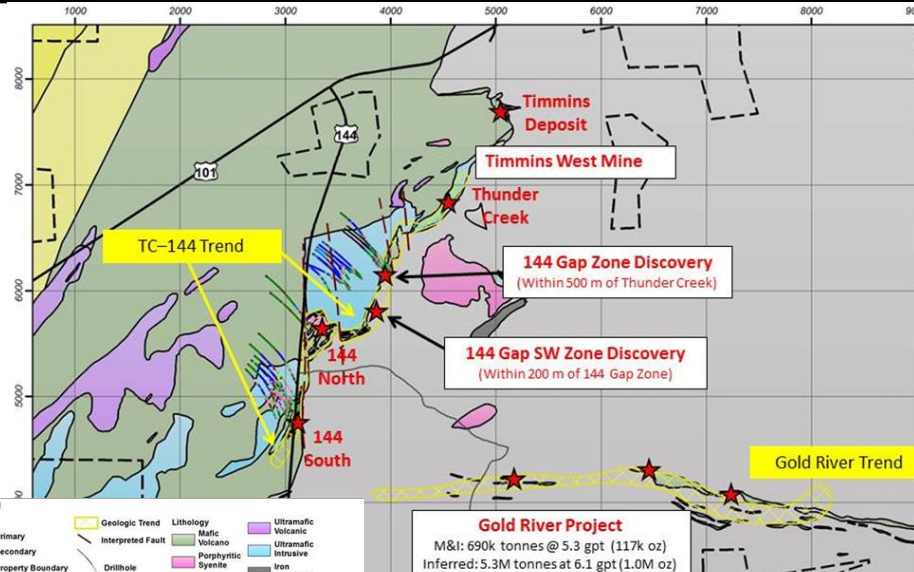
Lake Shore operates two gold mines in Ontario.  The Timmins West Mine is 18km west of Timmins.  Lake Shore produces from two deposits: Timmins and Thunder Creek.  The trend is ripe for new discoveries and there have been a couple with the 144 Gap Zone and 144 West Gap Zone.  Below is a schematic of the four deposits.

timminswest

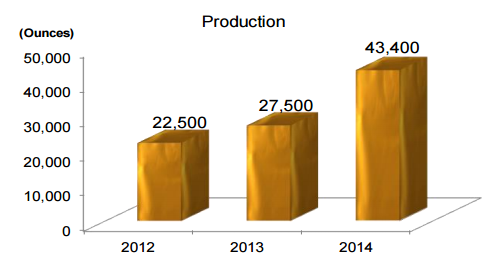
Production from Timmins West has increased over the last three years:

timminswestproduction

The 144 Gap resource is expected in the first quarter.   By the looks of their underground schematic the 144 Gap can be accessed via existing Thunder Creek infrastructure – Lake Shore said in Q3 MD&A that exploration drift from Thunder Creek to 144 Gap was completed in the third quarter, which should simplify the road to production.

I ran a quick and dirty resource estimate on 144 Gap and think it could post an impressive number.  In their MD&A Lake Shore says that the 144 Gap is 300m x (50-125)m x (75-125)m.  I grabbed a specific gravity estimate of 2.92 from the technical report created for Thunder Creek and West Timmins.   The volume of deposit is between 1.125mmm3 and 4.6875mmm3.  I eyeballed the grade of the deposit from slides 13-15 from this presentation.  The results are as follows:

– 2.92 x 1,125,000 = 3,285,000t

– 2.92 x 4,687,500 = 13,687,500t

– 3,285,000 x 4.5 / 31.1 = 475,000oz

– 13,687,500 x 4.5 / 31.1 = 1.98moz

Lake Shore’s second mine is Bell Creek, which is 20km east of Timmins.  The mine also has the milling facility in addition to the Bell Creek Mine where ore from both Timmins West and Bell Creek are processed.  Bell Creek produced 43,400oz in 2014.

bellcreekproduction

Lake Shore recently bought Temex Gold (September 18th) and their interest in the Whitney project for $23 million.  They acquired 708,000 M&I oz and 171,000 inferred oz at Whitney.   The M&I resource is quite high grade at 6.85 g/t.  Whitney is strategically located; its right next door to the Bell Creek Complex.  Whitney was 60% owned by Temex and 40% owned by Goldcorp.

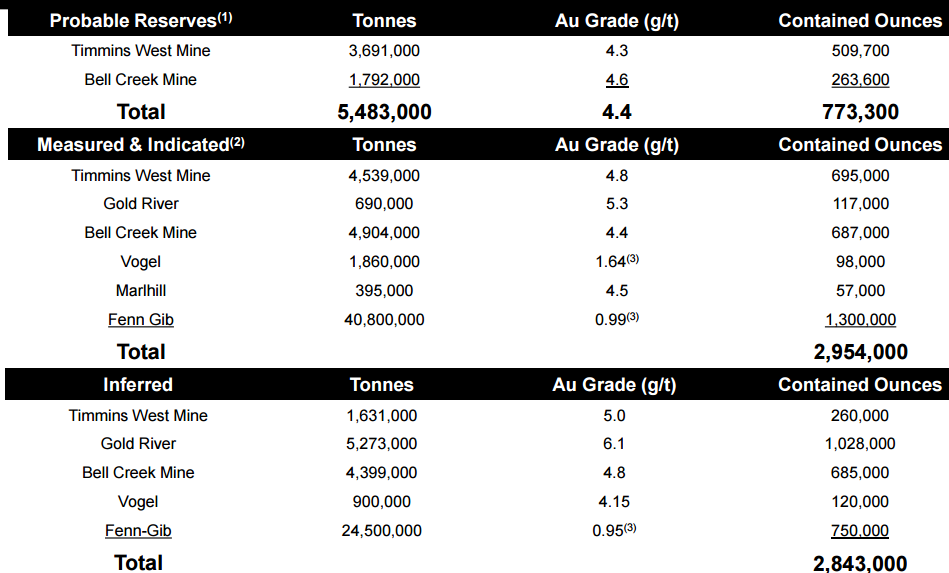
Below are the company’s reserve and resource.  Because so much of the company’s operation is underground, the resource is less robust than many of their open pit competitors.  I wouldn’t read too much into this.  Underground operations are by their nature going to have smaller resources because its simply not economic to drill extensively at depth until mining has commenced nearby.  As we see with the recent 144 Gap zone discoveries there is plenty of potential for additional ounces to be added.

reserveandresource

The only unfortunate thing is that Lake Shore remains a bet on the price of gold.  And I’m not really sure how constructive I want to be on the gold price just yet.  I’m feeling better about gold; I look back to the years between 2004-2007 where the Federal Reserve was raising rates and gold was rising.  I’m hopeful that the beginning of the rate hie cycle will mark the bottom in the gold price.  But I’m not convinced. If I was I would be plowing money into a profitable and well managed miner like Lake Shore and building a big position.  As it is, I’m keeping my position modest, and we’ll wait and see what the next move is.

I also added positions in Claude Resources and Argonaut Gold.  I already have a position in Oban Mining and Carlisle Goldfields.

Taking Hits and Bouncing Back Part I – Patriot National

I had an abnormal number of negative events hit my portfolio in the last month.  Had it not been for these events, my portfolio would have broken out to new highs.  As it was I instead spent the month paddling upstream against the current.

But this is the nature of my investing strategy, which to some degree is bottom feeding in stocks of questionable merit but with the potential for outsized returns if events fall into place.  Unfortunately in each of these cases events fell outside of expectations.

When I invested in Patriot National it was with the understanding that the company had some questionable behavior in its past.  A perusal of the related party acquisitions over the last 18 months leads to some questions and while I am not going to get into the details here, I would direct those interested to read through the proxy for Global HR Research for an example.

Nevertheless I felt comfortable enough investing in the stock because the business was (and is) growing and the CEO Steven Mariano, owned over 60% of the outstanding shares.  This seemed like a good put to me, that nothing too shareholder negative would be done as his own net worth would suffer.

Unfortunately that turned out to be naive.

My mistake here was that I read the news release, thought that the attached warrant was unfortunate, but did not dig any further.   That is until about two hours into trading that morning with the stock down $4 when I realized something must be wrong.  In the proxy document for the offering was a description of the nature of one of the two warrants being offered along with shares, in particular the exercise price associated with the warrant:

Variable Exercise Price” means, as of any Exercise Date, 85% of the Market Price on such Exercise Date (subject to adjustment for stock splits, stock dividends, stock combinations, recapitalizations or similar events occurring on such Exercise Date).

When I read this I honestly couldn’t believe it.  I thought I must be missing something.  Who offers shares that it is questionable the company even needs and tacks on a warrant that lets you buy more shares at essentially any price.  What stops the warrant holders from shorting the shit out of the stock, driving down the price and then redeeming their warrants at the depressed level?  And even if that is explicitly prohibited by the proxy (which it was) what stops investors like me from worrying that they will figure out a way to do it anyways, and selling their position before it happens?

It was essentially a “no bottom” situation where the more the stock fell the more worried you’d get that there were nefarious forces at work and that it would fall further.  So I sold.  About 30% lower than the stock closed at the previous evening.  But over 30% higher than its eventual bottom.

Amazingly, a week later, on Christmas Eve no less, Patriot announced that they had come to an agreement with the subscribers and cancelled the company offering.  Mariano, who was offering some of his own shares as part of the deal, would still sell his.

This brings us to the current state, which is interesting.  As far as the company, its basically status quo.  Guidance has been reaffirmed, no dilution has occurred, its the same company it was a month ago.  Ironically my original thesis, which was that Mariano owned too much stock to do anything too stupid, played itself out as one would expect.  I doubt that the decision go back on the offering was out of concern for the shareholder base so much as the shock that some $80 million of his net worth had evaporated in a few days.

The problem is that credibility has been lost and as a result the stock is trading at about half the level it was at prior to the debacle.  While I totally understand the perspective that you just have to walk away from any management team that would attempt something like this, I am compelled by just how cheap the stock is.   So I added my position back.  We will see if time and maybe a few good moves can heal some wounds.

Taking Hits Part II and II – Acacia Research and Iconix

Acacia Research was the second negative event to befall me.  This one was relatively simpler than Patriot.  The company lost a patent infringement suit that I didn’t think they were going to lose.  It was for their Adaptix portfolio, which is one of their marquee portfolios, and so it calls into question the valuation of that portfolio.  With the stock down at $4 its trading extremely close to cash and you can certainly make the argument that the current price exaggerates the impact of the legal loss.

I sold because I saw the stock falling, knew that the lawsuit was pending and that therefore it had likely went against Acacia, and suspected that there would be more selling than buying over the following weeks so it was better to get out sooner than later.  I plan to revisit after my 30 day tax loss selling period has expired.

When I entered into a position with Iconix it was with the knowledge that there may be more shoes to drop.  So when the SEC announced a formal investigation into the accounting treatment of the company’s joint ventures, I was disappointed but not surprised.  As in the case of Patriot and Acacia I thought it better to sell first and ask questions later, which turned out to be the prudent move as the stock fell further (20+%) than I would have expected.

Iconix feels binary to me at under $6.  Even after the move last Thursday which jumped it to $7 the stock still seems to reflect quite a bit of pessimism about the investigation.

The company isn’t perfect, to be sure.  To reiterate some of what I wrote last post, debt lies at $1.5 billion which is simply too high.  A few of their menswear brands are experiencing headwinds which may or may not be permanent.  The new management conceded that not enough dollars have been spent on advertising and that a “refresh” of a number of their brands is necessary.

Nevertheless, the company owns strong brands prominent in a variety of retail (Walmart, Target, Kohls, Sears/Target) as well as entertainment brands like Peanuts and Strawberry Shortcake that have long term appeal.  They should be able to continue to deliver consistent licensing revenue.  At $6 the stock reflects 4x free cash flow even using somewhat depressed 2016 numbers.  That’s a cheap number for any business that doesn’t have questions about being a going concern.

On further reflection though I decided that the market was probably punishing the stock on uncertainty and passed transgressions than it was on any new revelation.  I think what happened is that the company is suspect because of the already announced accounting issues, and the press release announced was admittedly vague and light on details, so it was an excellent opportunity to imagine the worst.

Relypsa

I got the idea for Relypsa from @exMBB on twitter.  Relypsa has 41.7 million shares outstanding so at the current price it has about a $1.1 billion market capitalization.  the company has $285 million of cash.

Relypsa specializes in polymeric drugs.  In particular they are targeting a condition called hyperkalemia with a drug called Veltassa.  Here is what hyperkalemia is:

Hyperkalaemia (higher-than-normal potassium levels) follows the kidney’s inability to excrete potassium, mechanism impairment of potassium transport into cells or a combination of both, according to ZS’ website. It can cause cardiac arrhythmia and sudden cardiac death.


Veltassa is a polymer that will exchange calcium for potassium.  The existing treatments work on exchanging sodium for potassium, which is not well tolerated in patients.

Our bodies relatively narrow range for which we can tolerate potassium in our kidney.  Most of us take in more potassium than we can handle but we just excrete the extra.  However if you have chronic kidney disease you can’t and you end up with dangerously high potassium levels.

If you have a potassium level of 5.5-6 or greater, there is need to treat the patients, but treatment is intermittent because of the poor tolerance of the available options.  With Veltassa you can take patients that are hyperkalemia, pull down their potassium to the normal range and keep it there.

The patient population is 2.5-3 million patients, with these patients all being parts of the CKD3 and CKD4 (CKD is Chronic Kidney Disease) populations that have high potassium levels.  On one of the conference calls Relypsa said that Veltassa would be sold for $600 per month.

Veltassa has been approved for treatment of hyperkalemia, broad application. The approval occured on October 21st.   The problem with the approval was that it included a limitation of use that it is not be used in emergency situations.  The stock dumped initially but recovered much of the losses through November and December.

The warning label was required because there was some indication of interaction of Veltassa with other drugs – in particular in vitro studies showed interaction with 9/18 drugs tested against.

Listening to some of the recent conference presentations, Relypsa argues that the in vitro test is conservative.  In vitro studies are very good at showing where there is no interaction but give false positives for interactions that need to be verified.

Relypsa is going to perform human drug interaction studies to find out if the in vitro studies are correct.  The human studies they are done with healthy volunteers, there may need to be additional studies with some other patient groups such as type 2 diabetes patients who have stomachs that empty much slower and where a 3hr separation wouldn’t be enough.  But the first results are expected in early 2016.

The concern is that the warning label, if it stays, will put Veltassa at a disadvantage against competition, in particular ZS-9, which was developed by a company named ZS Pharma.  ZS-9 is further behind than Veltassa, an FDA approval decision isn’t expected until the spring and it carries some concerns of its own.

Glassock maintained ZS005’s high hypertension threshold will impact approval or prompt a black-box warning. Lipicky agreed a black box could be issued. Veltassa’s boxed warning states it binds other orally administered medications, potentially decreasing their absorption and reducing effectiveness.

ZS Pharma was recently taken over by AstraZeneca.  They paid $2.7 billion for the company.  ZS Pharma is essentially a one drug company.  The implication is that apart from the warning label concerns about Veltassa, Relypsa should reasonably expect a takeover value in the same range.

Some of the takeover talk has ramped up through December, first with rumors about Merck and then with rumors of a bidding process in the works.  Here is what is said about the takeover possibility on IBD:

Shortly before noon, Street Insider quoted an anonymous source saying that Merck (NYSE:MRK) was about to make an offer for Relypsa for an unknown price. About an hour and a half later, the Financial Times reported that its own anonymous source said that Relypsa was merely starting the process without a particular buyer, though GlaxoSmithKline (NYSE:GSK) and Sanofi (NYSE:SNY) are both potential bidders.

Speculation that Relypsa could be bought has been buzzing since AstraZeneca (NYSE:AZN) agreed to buy ZS Pharma (NASDAQ:ZSPH) last month for 2.7 billion. Relypsa and ZS Pharma both make drugs treating high levels of potassium in the blood; ZS Pharma’s hasn’t been approved, while Relypsa’s drug Veltassa was approved in October but with a stiff warning label about dangerous interactions with other drugs.

Its an interesting situation, one that is speculative to be sure.  There is a short interest that doesn’t buy the story, and plenty of action in both puts and calls.  There is also the question as to why AstraZeneca bought ZS Pharma and not Relypsa in the first place.  Still, I think its worth a speculation.

Portfolio Composition

Click here for the last four weeks of trades.

week-236

Week 231: Tax Loss Buying

Portfolio Performance

week-231-yoyperformance

week-231-Performance


See the end of the post for the current make up of my portfolio and the last four weeks of trades

Monthly Review and Thoughts

I didn’t make a lot of trades this month.  I added a couple of beaten down stocks (Dixie Group and Iconix Brands), added to a couple of existing beaten down positions (Acacia Research and Health Insurance Innovations), added to a less than beaten down position (Axia NetMedia) and sold out of a few poorly performing positions in PDI Inc, Nevsun, Independence Realty and Hammond Manufacturing.  I also reduced two of the three out-sized positions that I talked about in my last update, New Residential and DHT Holdings on pops.  At this point the only really uncomfortably large position I have is in Air Canada, a stock that seems to do nothing but go down.

It is my experience that the last three months of the year can be very quirky.  The confluence of redemptions and tax loss selling leads to seemingly endless downward moves.  While its easy to describe this as an obvious opportunity when you limit yourself to generalizations or retrospectives, the reality is that it is not so easy to buy that which has collapsed when it goes down every day.

I have plenty of examples of stocks I am following that are examples of this. Most are either yield stocks or energy names of one type or another.

First the REITs.  I could pick from a litany of REITs here but I’ll focus on Northstar Realty because I know it fairly well.  The stock can’t seem to get out of its own way, having endless down days followed by briefing sharp rallies that are followed by further relentless selling pressure that can’t be overcome by even a 2% up day by the market like we had on Friday.  Northstar has a yield 15%.  The dividend is backed up by real estate assets, mostly healthcare and hotels.  On September 29th the company announced a $500 million buy back.  Given the current market capitalization of a little over $3 billion, this is not insignificant.  On the negative side, the stock is externally managed, something that seems to be the kiss of death right now, and its hotel properties have underperformed lately.  Risks for sure, but at what point are those risks priced in?

Another example is Navios Maritime Partners, a dry bulk/container shipper.  Navios cut their dividend in November from $1.77 to 85 cents.  They operate in an extremely tough market, but at the time of the dividend cut they made a strong case that the current level was fully supported by existing contracts with almost a 9 year period.  This outlook was confirmed in a solid analysis posted in Seeking Alpha.  The stock has went down relentlessly both pre and post dividend cut.  It’s at $270 as of Friday’s close so its about a 30% yield.

A third example that I just started looking at over the weekend is Suncoke Energy Partners.  Suncoke owns three facilities that turn coal into coke for steel making.   The company has a market capitalization of $300 million versus a tangible book value of around $500 million.  Earnings for the first nine months were $1.16 per share and full year estimates are $1.50 per share.  The stock trades at $6.59 at Friday’s close.  The steel industry is hurting and Suncoke’s partners are expected to shutdown mills that Suncoke supplies.  On the other hand Suncoke has take or pay contracts and their customers are large producers: US Steel, ArcelorMittal USA, and AK Steel.  So are they really doomed, as the stock price performance (down from $15 since August) suggests?  Or will the partners pay and this a great buying opportunity for assets that are temporarily impaired?

Here is one from the energy sector.  Surge Energy.  I’ve owned it before, in the late spring/early summer.  They are currently producing around 14,000 boe/d with 80% of their production being liquids.  In the first half of 2015 they generated $85 million of funds from operations with the oil price (including hedges) averaging a little less than $60.  In the third quarter they generated $17 million of funds from operations on an oil price of $41, so about the current price.  Capital expenditures in the third quarter were $17 million.  The company has about $140 million of debt, so less levered than most.  Is oil destined to float around the $40 mark forever, in the process sending basically the entire North American industry into bankruptcy, or will it eventually find a higher equilibrium?  If it does what will one of the survivors, as Surge would surely be, trade at?  At 5x cash flow on $60 oil Surge would be worth more than 50% more than it is today.

And one last one from energy infrastructure.  Willbros Group.  Management has been much maligned and struggled to turn a profit in the past.  This year, perhaps because of the pushing of activist investors, they’ve sold off a number of their divisions, raising cash and paying down debt.  With the recent sale of the Professional Services segment to TRC Solutions for $130 million they have reduced debt to under $100 million and they have cash on hand of $50 million.  With 63 million shares outstanding Willbros has a market capitalization of about $170 million.  They generated $2 billion of revenue in 2014 and this year, even after the sales of multiple divisions and the devastating downturn in the energy industry their revenue run rate is close to $1 billion.  The company will likely not be profitable until oil prices turn, but when they do there is a lot of leverage to margin improvement and incremental contracts.

So there are some names.  None are sure things, all can have cases made for and against.  My point is simply that at this time of year there tends to be real bargains, but pulling the trigger is a lot harder because there are also always real questions, and the answers are rarely clear.

The stocks I’m going to talk about below, with the exception of Axia NetMedia, all positions that fit into this mold.  These are stocks that have been beaten up, that have warts, but that I feel are overdone.  I just hope that I am right in more cases than I am wrong.

Dixie Group

Dixie Group is a company I have owned in the past, followed for a long time but held out from buying until it got to a price that I thought presented very little downside.

Dixie Group is a supplier of commercial and residential carpet.  They have 16 million shares outstanding at $5.50 for $88 million market capitalization.  They have $131 million of debt that consists primarily ($84 million) of a revolving credit facility that comes due in 2019.

Dixie Group has undergone a lot of changes in the last couple of years.  They made a number of acquisitions of high end commercial and residential businesses in 2013 and 2014, and have spent the last year digesting the capacity.

The results so far have been lukewarm.  Sales have shown some slight growth while the rest of the industry has seen slight declines.  But the increased scale has not translated into improved profitability.

Some of this is skewed by continued restructuring and sampling costs, and some of it is because there have been employee and quality issues that have arisen along with the capacity additions.

Revenues in the third quarter was $109 million which is flat year over year and up somewhat from the first half.  Ignoring working capital changes cash flow was in the third quarter was $8.4 million.

Even though the headline showed a big miss on both revenue and earnings, I didn’t think it was a terrible quarter in a lot of ways.

Gross margins were up to 26% which is a little above the 25% I had been hoping for two years ago when I was looking at the stock.  G&A is rising more than it should and this appears to be due to restructuring costs, increased medical expenses, consolidation of offices.  They introduced a number of new brands over the last few quarters and those new brands are requiring higher sampling costs.  So there are lots of one time things.

But I think that it is the quality problems that are holding back the stock the most.  They said the impact to quality in the third quarter was 1% to their gross margins.  While they suggested this would decline in the fourth quarter, they weren’t very specific about how quickly that decline would occur and implied it could persist into the first quarter of 2016.

I don’t think the market likes the uncertainty.  Heading into earnings the stock wasn’t that cheap if it was producing no earnings and EBITDA on a $20 million run rate.  But after the collapse from $9 to $5 much less is priced in.  The stock trades at a little under book value.

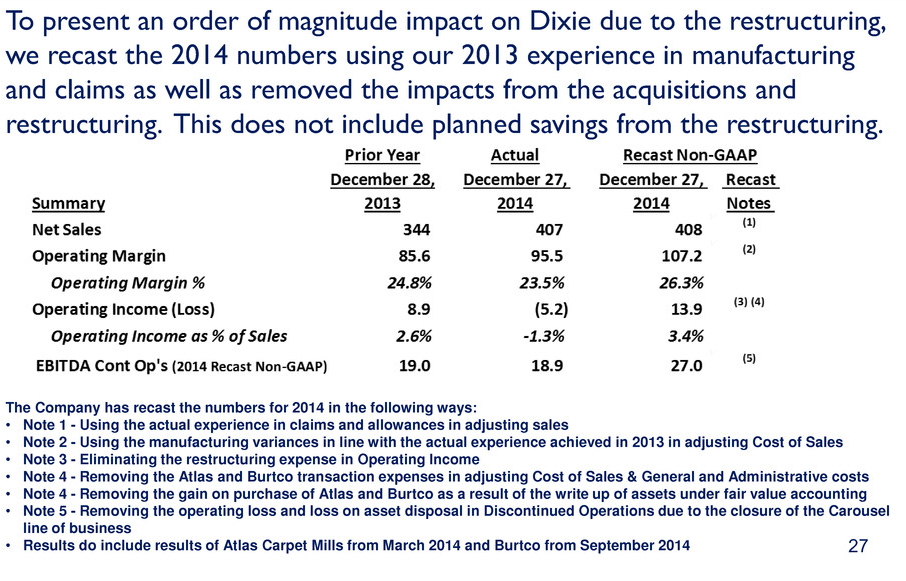
In their third quarter earnings presentation Dixie presented the following pro-forma to restructuring 2014 earnings.

proformarestructuringSo if the dust settles you are looking at a $27 million EBITDA company with a $219 million enterprise value.  So about 8x EV/EBITDA.  Its not incredibly cheap but with some growth the equity portion of that enterprise value could quickly grow back to the $9 level.

Now of course this is the carrot not a forecast.  I don’t know if Dixie will regain operating momentum, get past their integration issues, and begin to grow the business.  They have the capacity now to produce $550-$600 million of carpet.  They just need to find the customers.  What I do know is that at the current price their is not much expectation priced into the stock.  I think its worth a position, one of those stocks where if anything good happens its bound to go significantly higher.

Acacia Research Third Quarter

Acacia had a really bad third quarter.   Revenue was $13 million down from $37 million in the third quarter last year and a $44 million average revenue over the prior two quarters.

So the stock got clobbered.  For four weeks it went down almost every day, from the $9 level to almost $5.  Was it deserved?  Well, the thing about Acacia is that revenue is always going to be lumpy and one quarter does not suggest any particular trend.  The company generates revenues primarily through the settlement of patent litigation.  The nature of the business is that the counter-party in the litigation is unlikely to settle until the very last moment, usually right before the trial starts.  So Acacia’s revenue recognition is always at the mercy of court dates and negotiations.

The poor third quarter was due to delays on litigation on a number of their patent portfolios.  This quote, from the third quarter conference call kind of summarizes their thoughts on the quarter:

The third quarter developments created paradoxical outcomes. On one hand, our marquee portfolios were strengthened through Markman inter-parties review and new patent issuance wins, and now have even greater future value. But on the other hand, we experienced a delay in collecting on that value.

In particular, their Adaptix portfolio is going to trial against Alcatel-Lucent and Ericsson but that was postponed by a quarter.  This is because of the introduction of evidence that actually strengthened Acacia’s case but required delays for all parties to review.  They also announced that they had won two infringement cases on their Voiceage portfolio (HTC and LG), but that it would take time for a formal opinion from the German court that would lead to a settlement.  Subsequently, Acacia announced a settlement with HTC on November 17th.

Acacia’s business model is to partner with patent holders, applying their legal expertise in patent litigation to help the patent holder maximize the value of their asset.  On that note Acacia said that in the current environment they expected to be able to partner with other patent holders without putting up their own capital going forward.  The environment was a “buyers market”.

At a little over $5, where I was buying, the company was getting close to its cash level of $3 per share.  Even here at $6 it still doesn’t attribute a lot of value to the patent portfolio.  There are a couple of good SeekingAlpha articles that discuss the stock here and here.

Health Insurance Innovations Third Quarter

Health Insurance Innovations (HII) had a so-so third quarter. The revenue number was a little lower than I expected at $25.8 million versus the $28 million I had been hoping for.

But there are a number of changes going on at HII that make the story interesting enough for me to add to my position.   First is the development of an online insurance portal, AgileHealthInsurance.com.  They have had Agile up and running for a few months now, and reported that it had accounted for 1,300 policies in July and 5,800 policies in Q3 (suggesting it averaged 2,250 policies in August and September).  Second, through the addition of a number of former sales personnel from Assurant, HII has expanded their broker channel significantly.

Overall the business is progressing.  Total policies in force increased in the third quarter to a record 137,000, up 31.7% year-over-year and 21.2% sequentially.

The revenue recognition associated with policies procured online is part of the reason for lower revenue.   Unlike broker or call center procured policies, those come from Agile have revenue recognized over the full term of the policy while the customer acquisition cost is taken up front which in the short run will depress margins.

Going forward HII expects to gain from a shorter ACA enrollment period and the reality that premiums on ACA plans are “rising rapidly”.

On the third quarter conference call management seemed quite upbeat about how well they are doing through open-enrollment:

Our short-term medical, our hospital indemnity plans, they really fit the need and we’re seeing, unlike last open enrollment period, a dramatic increase in our sales. We can’t wait to share with you the fourth quarter results when we get to that point. This is for the first time, we’re really playing offense during open enrollment versus last year, we were playing a bit of defense.

The fourth quarter will be interrupted by the ACA period, which began in November.  Still, I think that if the company can put up a decent showing during this period the market will take notice.  Perhaps we are already seeing the start of that with the recent $1 move up.

Iconix Brands

It’s been a while since I have been drawn into a company with a recent accounting scandal.  And while I am wary that these sort of situations often go down far further than I expect, I also know that in many cases the eventual profit can be quite significant if you can get through the rough waters.

Iconix is a company that essentially rents out the usage of their brands.  They buy the rights of well known clothing and entertainment brands and then for a price licenses the usage of the brand by department stores and manufacturers.  Their portfolio of brands encompasses a wide variety of low to high end men’s and women’s fashions as well as well known entertainment brands like Peanuts and StrawBerry Shortcake.

brands

Its a pretty good business that has consistently generate 30% margins and significant free cash flow.

The company ran into problems earlier this year. In March the CFO resigned.  Two weeks later the COO resigned.  And then the biggie in August, the CEO resigned.  At the same time they announced their second quarter results and said that they would be reviewing the accuracy of past financial statements.

This was followed up on November 5th by a mea culpa by the new leadership team that past financials were not accurate and would have to be restated.  Shares which had already fallen from the $30’s to the mid-teens, got halved again to around $7.

What’s interesting though is that the accounting irregularities revolve entirely around the income statement.  Here is what the interim CEO, Peter Cuneo said on the third quarter conference call.

This review has identified errors regarding the classification of certain expenses as well as inadequate support and estimation of certain revenues, and of retail support for certain licenses. As such, we will restate our historical financial statements for the fourth quarter of 2013 through the second quarter of 2015.

A table detailing these adjustments was included in last Thursday’s press release. What should be emphasized is that the amounts of the restatements have no impact to 2013 net income. They do result in a small reduction of approximately $3.9 million or 2.5% to 2014 net income, and they are slightly positive for 2015 net income.

Further, these changes do not impact cash, do not impact historical free cash flow and do not impact debt covenants or securitized net cash flow as defined in our securitized financing facility. In fact, gross collections for our securitized brands are up 3% for the first ten months of the year, which reflects the strength and stability of the assets in the securitization.

Now that its down almost 80% Inconix, with 48.5 million shares outstanding has a market cap of about $325 million.  Iconix also has a lot of debt,  $1.47 billion.  Included in that debt is a $300 million 2.5% convertible that comes due in June of 2016.  Normally this convertible would not be an issue.  Given the company’s problems they may have to fund its repayment out of cash.  When I look at the cash on hand and cash flow they can generate from operations, they should be able to do that without too much problem.

The bullish story here is simply that once the accounting issues are behind them, what will be left is a company that generates significant free cash and trades at an extraordinarily low free cash multiple.  Iconix issued the following guidance for 2016:

We expect organic growth to be flat to up low single-digits driven by double-digit growth in our international business and U.S. revenue down slightly. We’re including no other revenue in our 2016 forecast.

Reflecting these expectations, our 2016 guidance is as follows: We expect revenue to be in the range of $370 million to $390 million. We expect non-GAAP diluted earnings per share to be in the range of $1.35 to $1.50 and we expect free cash flow to be in the range of $170 million to $185 million.

Free cash of $170 million is $3.50 per share.

There are hurdles to reaching that guidance to be sure.  On the third quarter call they said their mens apparal segment was performing poorly because of poor performance by Rocawear and Ecko, both mature brands that may be reaching end of life.

Also one of their biggest brands is Peanuts which is experiencing some headwinds.  Peanuts accounts for somewhere in the neighbourhood of $100 million of licensing revenue, so 25%.  While the recently released Peanuts movie has done fairly well in the box office and in ratings, it is suffering on the merchandising side because it has to compete with Star Wars for shelf space over the Christmas season.

Nevertheless, even with the debt, even with the accounting issues, it seems too cheap to me.  Unless there is something further that comes out on the accounting front I think the stock has to move higher at some point next year. It could go down more over the next few weeks with tax loss selling, but I can’t see it staying here for good.  The fundamentals, un-obscured by fraudulent accounting, just aren’t bad enough to justify it.

Axia NetMedia

I’ve owned Axia for years now and recently added to my position.  The company has 63.4 million shares outstanding, and at its current price of $3 they sport a $190 million market capitalization.

Axia owns and operates fiber networks in Alberta, France and Massachusetts.  Each of these networks supplies high speed connections to smaller cities and towns throughout the area.

Axia has already built fiber trunk lines that provide high speed connections to the major centers in each of their networks.  Now they are in the process of signing up homes and offices and building out fiber to individual customers (called FTTH and FTTO respectively).  The addressable market is over 1 million homes only counting the 20 largest of the 400 communities that the fiber reaches.

In Alberta they have completed at pilot FTTH in one community (Vulcan) and are in the process of ramping up in Drayton Valley and Lloydminster.  The package they offer (which I believe is via third party providers) is $59 per month for 25Mbps rates.  In Massachusetts they offer 100Mbps rates for $49 per month.

This doesn’t seem to me to be a bad package for small town households that previously were limited to slower cable or satellite connections that was intermittent or experienced outages.  Having lived in a small town and having had first and second hand experience of the existing internet options I can say that the following commitment would be a major step up:

We are confident that Axia provides the most reliable Internet possible. In fact, for business we commit to 99.9% availability and a maximum 4-hour mean time to repair in the rare event of a fibre cut.

You can view the Canadian and US plans here and here.

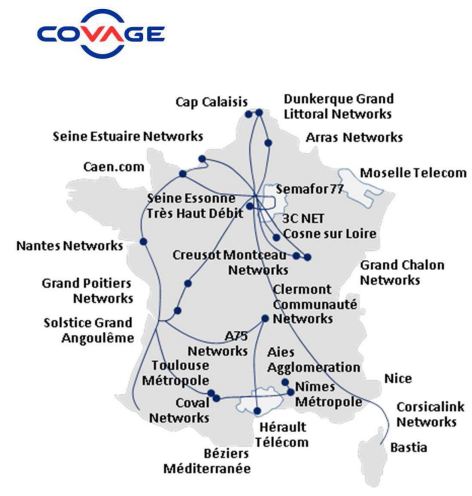
In France the opportunity for growth is even better than in North America.  Covage, of which Axia has a 50% ownership, has 10,600 km of fiber including 3,400 km of fibre backbone.

covagenetworkIn the third quarter Covage’s customer connections were up year over year 36% for FTTO and 61% for FTTH.  On the third quarter conference call Art Price (the CEO of Axia) said that “Covage has sustained growth on its existing networks and has tangible FTTO and FTTP opportunities that could more than triple Covage’s size.”

Subsequent to quarter end Covage won a large FTTO contract that encompasses an additional 22,000 businesses.  Covage currently has a little over 7,000 FTTO connections.  Bringing on 10-20% of these additional sites would mean a large uptick.

Earlier this year Axia won a contract to provide Fiber to Seine et Marne that will pass through 319,000 homes.  Right Covage has around 7,000 FTTH connections.  So think about that for a second.

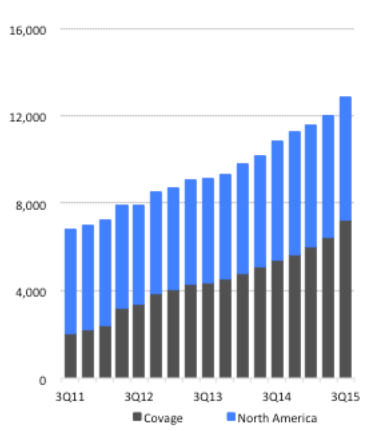
Right now they are growing steadily (see chart below) but the profitability of this growth is masked by the continued build outs of networks and connections.

connections


On the third quarter conference call they had a long discussion talking about the need for capital in the business they are in and what this means the eventual end game has to be.   I think its worthwhile reproducing the response in full:

Well, we’re looking at different options, and the way the company is harnessing the capital markets. I would say in the broad, we’ve been a company that is incrementally growing from a small size to a €200 million market cap size. But now we’re a company that has opportunities in front of us that are multiples of our current market capitalization.

And if we were just going to make the comment that where is this fiber infrastructure ultimately destined in the capital markets, well, clearly this fiber infrastructure is going to end up in billion dollar equity market cap, with capital structure that can issue its own bonds for debt. I mean that’s where this kind of investment ultimately ends up and we all recognize that.

So the question is what’s the path to get to that point? Is that path an incremental path similar to the one we have been on, but moving to a different shareholder class in a different size or is it some other path? And the Board is actively looking at that set of issues and looking at it in the context of the current market and looking at in the context of our investment opportunities having this sort of North American and France character, which some of the capital markets looks together at and other parts of the capital market look at that as segmented.

So we’re in that process, because besides the opportunity in front of us, in order to make those available or actually take those opportunities on, of course there is quite a bit more capital involved and our path is either we line up the company for that capital to rate shareholders’ evolution or we aren’t able to take advantage of the number of opportunities in front of us.

That’s a pretty interesting comment.  It basically says that they see the bottleneck and they are going to figure out what is the best way to address it.  It means they either are going to get the market to buy into the Axia story (and produce much larger share price) or try to find an acquirer with the financial clout to build out the infrastructure that they require to grow.

Either way it seems like a likely win for shareholders.  I think Axia is in the right place at the right time.  I’ve been adding.

Portfolio Composition

Click here for the last four weeks of trades.

week-231