Skip to content

Posts tagged ‘Impac Mortgage’

Is the Gain on Sale Boom over?

Earlier this week my portfolio was rolling along nicely, having closed at an all-time high on Wednesday night with me looking forward to further gains ahead.

And then Flagstar reported their fourth quarter results.

I don’t own Flagstar.  I don’t even follow Flagstar.  They are a Michigan based bank that has had some problems in their past and, most importantly for this discussion, run a reasonably large sized mortgage operation. In the fourth quarter Flagstar reported a big decline in their gain on sale margin, from 244 basis points to 153, and the Street took it to mean that the mortgage origination boom was over. In addition to the carnage of Flagstar (down about $2.50 to $15.57 on Thursday), PHH Corp, Impact Mortgage and Nationstar all took it on the chin.

But while the headline decline was steep, there is more to the story.  During the conference call Flagstar provided some clarity. The following exchange between Matthew Kerin, the president of the Mortgage banking division, and Paul Miller of FBR is instructive (via SeekingAlpha). Read more

Impac Mortgage: A Growth And Value Story

I wrote the following article on the weekend for SeekingAlpha publication.  Hopefully it will be published on SeekingAlpha in the next few days.

Impac Mortgage Holdings (IMH) is a very simple thesis and so I am going to get straight to the point. Impac is a mortgage originator and real estate services provider that has been growing their origination business at an impressive rate. In addition to its two operating segments, the company has discontinued operations in run-off associated with its pre-2008 activities in mortgage lending and as the manager and residual holder of non-recourse trusts.

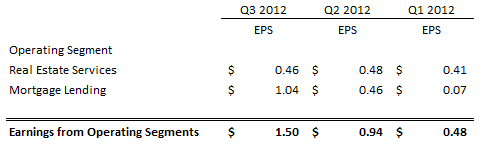
Impac earned $1.50 per share from mortgage originations and real estate services in the third quarter. The mortgage origination business pulled in earnings per share of $1.04, while real estate services business earned $0.46. Below are earnings for these two segments over the first three quarters of 2012.

In addition to these strong numbers, growth is expected to continue to be strong going forward. The company noted on the third quarter conference call that origination volumes in October were another 22% higher than the average monthly volume in Q3. Read more

Impac Mortgage: Where the money comes from

When I first bought Impac Mortgage (back at the beginning of August) it was on the basis of GAAP earnings (which were 50 cents per share in the second quarter), and revenue growth from the mortgage origination business.  Soon after, when I looked more closely into earnings, I determined that much of what was reported in GAAP was obscured by mark to market adjustments and a legacy business that is no longer operating.  Fortunately if I ignored these effects, the resulting picture was even better than the one painted by GAAP.

So I left it alone and went on to other things.

To digress for a minute, this is my process.  Once I feel like I have a clear answer on a stock, I don’t look too much further into the details.  When I look at a stock I look hard, and I usually come up with a fairly accurate picture, but after I feel able to draw a conclusion, I don’t spend a lot more time quibbling over the details.

I don’t have time.  I have time to look into maybe 2 stocks per week.  If I spent week after week evaluating a single security, it is simply inefficient.

Does this lead to mistakes?  Absolutely.  Sometimes I miss a key aspect that changes the equation.  But to mitigate mistakes I have learned to reevaluate when the market tells me I am wrong, and to act quickly when it turns out I am.  And actually, this has been one advantage of starting this blog.  There have been a couple of cases where readers have pointed out something that I have missed.  And I’ve saved money as a result.

Given the amount of time I have to allocate to investing, this remains, in my opinion, my most efficient process.  Study the business, figure out what the key drivers are and where problems are most likely to arise, evaluate those drivers and problems, make a decision and move on to the next one.  Take another look if things start to go amiss.

With respect to Impac, as the stock moved up from $2.50 to $10, I wasn’t that concerned with getting a better grasp on the specifics of earnings.  My initial analysis showed me the drivers, and they led me to conclude that the stock wasn’t even close to reflecting those drivers, and that was enough for me.

But now, with Impac hovering between $10 and $11, further analysis is warranted.  My intent below is to understand how each of the businesses that Impac operates generates earnings, and to compare the earnings generation capacity to GAAP, hopefully eliminating some of the confusion introduced by GAAP. Read more
Further investigation into Impac Mortgage Part I: Non-recourse trusts

I did more research into Impac Mortgage (IMH) over the weekend, and I plan to share my findings in a series of 3 posts.

In this first post I want to focus on the trust assets.  While the trusts are somewhat peripheral to my investment thesis in Impac, an explanation of how they work is central to the following posts I plan to write about earnings, and understanding the trusts helps quantify what potential they might hold for Impac if the housing market recovery becomes robust.

Impac Mortgage was a $250 stock in 2004 (I am including the 10:1 share consolidation that took place).  Obviously it has been a long way down.   The fall in the stock price from then to now has been entirely because of the mortgage market collapse.   This is something to keep in mind while I step through the next few paragraphs.

As I have explained in previous posts, I bought Impac Mortgage because of the growth I anticipate from their origination business.   But while the current business model centers around mortgage origination, it hasn’t always been that way.  Prior to 2008, in addition to originating mortgages Impac created and ran a number of off-balance sheet trusts.  These trusts would buy mortgages, mostly one’s originated by Impac, and pay for those mortgages by selling securitized mortgage obligations to investors.  The trusts would pay interest on their obligations from the cash collected on the mortgages. Read more