Skip to content

Posts tagged ‘investing’

CoreWeave – AI in a Nutshell

I can’t believe I am going to talk about CoreWeave again.  It pains me.  I don’t care about the stock.  I don’t even think it matters that much to the overall market in even the medium term.

But CoreWeave epitomizes the bull vs. bear tug-of-war in the market. So I keep being pulled back in..

Fortunately, nowadays it is much easier to run a few sets of numbers on a stock and get an idea of where it stands.  Which is what this post amounts to.

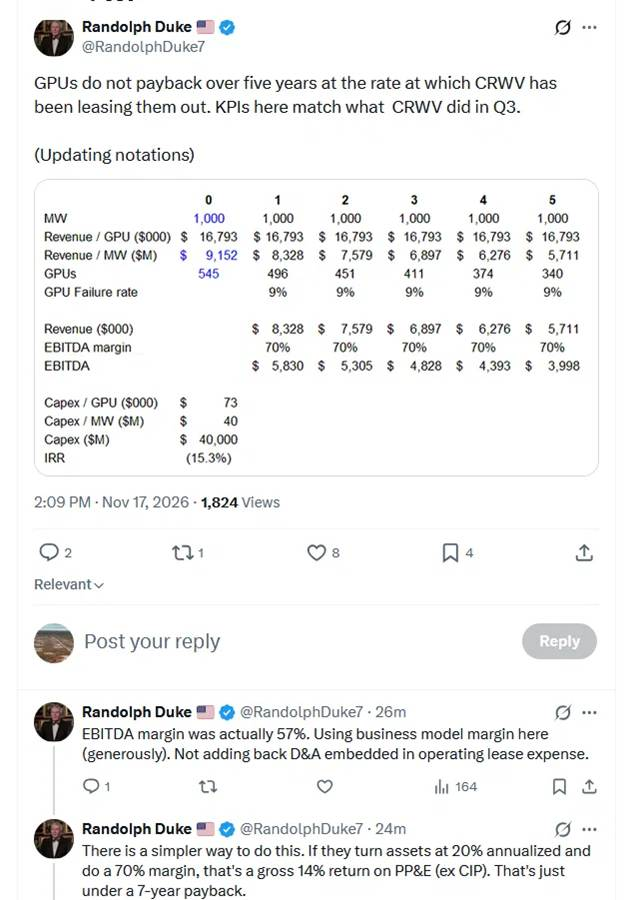
Yesterday I got pulled back into asking questions about CoreWeave with this tweet.

Randolph Duke is basically saying that the IRR of CoreWeave’s GPU purchases is negative if the life is 5 years.  Looking at the numbers, they seem reasonable enough.  I was like, hmm, this looks pretty bad for CoreWeave.

I asked Claude about the model and whether it was accurate.

The key is the assumptions.  The −15% IRR rests on two big assumptions:

  1. A 9% a year GPU failure
  2. Pricing new $40M-per-MW builds at the fleet’s blended revenue per MW

The failure rate does seem high.  I think it comes from Meta’s Llama 3 training run that is detailed in a few places (like here and here).  If GPUs and their memory fail at Meta’s rate, the annualized failure rate will be about 9%.

But those were job interruptions on a training cluster, not dead GPUs.   Which doesn’t mean they failed permanently.

Also, these were failures during training, which is more intensive than inference.  I don’t know CoreWeave’s breakdown between training and inference, but it isn’t 100% training.

Bottomline, I think the failure rate is pessimistic. I’ve seen other places that 3% failure is about right.

The second assumption is pricing.  This is the big one.

The table is based on revenue coming in at $9.15M/MW.  That is the fleet average for CoreWeave.

That’s the whole fleet.  It includes the older Hopper-era capacity that costs less per MW, as well as some even older A100 chips that are basically running for free at this point (they are fully depreciated).

CoreWeave’s Q4 guidance implies about $10.9M/MW across the whole fleet.  It’s already higher than the $9.15M/MW number.  CoreWeave’s exit run-rate guide of $20.5B on 1.85 GW works out to about $11.1M/MW.  New capacity has to be above both, because older capacity pulls the average down.

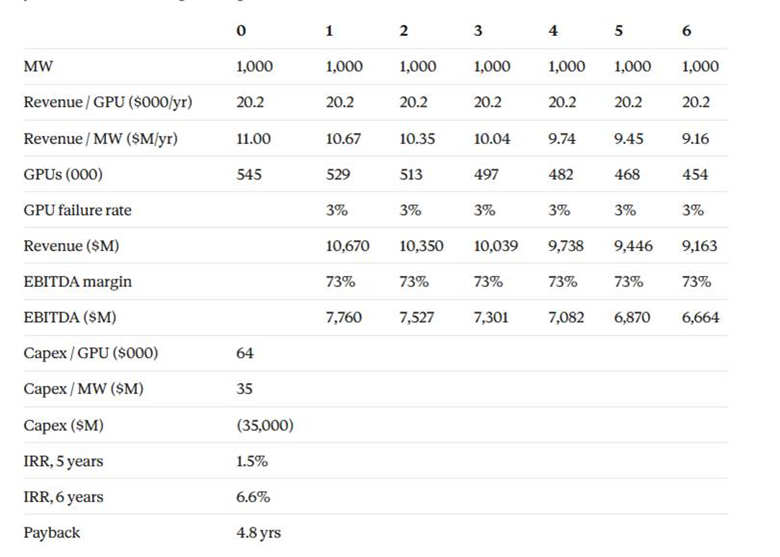
All this underscores the linchpin, which is simply price.  Randolph Duke is using this $9.1M/MW number.  What if I use $11M/MW as a base case with Claude?  With a failure rate of 3% instead of 9%.

I get a somewhat more palatable IRR.  At least it’s positive!

But this is still not a great result for CoreWeave.  Both the 5 year and 6 year IRR are below CRWV’s cost of capital.

So what’s going on here?  Is CoreWeave a time bomb?  Can their management not do math?

The trick here, and this is why CoreWeave really sums up the AI trade so well, is that the $11M/MW may be too low.

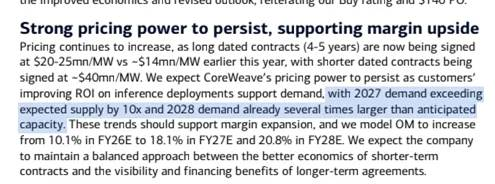
CRWV said they were signing deals for $14M/MW earlier this year and $20M/MW+ now.  This comes from Bank of America:

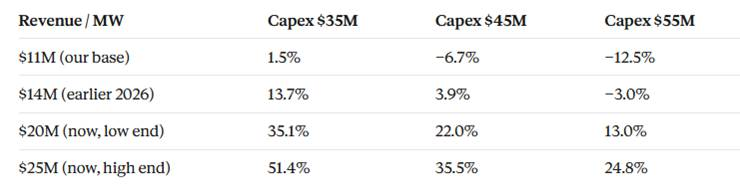
So what does the IRR look like at those prices?  A LOT better.

At the high end, we have a pretty good  51% IRR. 

Now is that revenue number legitimate?  I think that is entirely dependent on your view.  What I will say is that it is not necessarily wrong.

CoreWeave isn’t just making that number up.  SpaceX is thought to have signed a deal at $50M/MW with Anthropic for short term contracts.

Just what this number should be in the medium term is the whole debate.  Should it be $9/MW?  $25/MW?  Somewhere in between?  Somewhere even higher?  Lower?

Within such an extremely large range, CoreWeave could easily be a $0 or a 3-4-bagger from here.

Given where the stock is right now, I would probably lean long over short.  I recognize that it is easy enough to justify both positions.  The downside is real.  CoreWeave has $47 million of debt. There are lots of claims above equity.  If those data centers don’t produce a decent IRR, the equity is toast.

But with the range of outcomes so large, the stock feels like a long-dated option.  Honestly, the thing this reminds me of the most is the E&P shale-shitcos when the shale revolution was going full-steam ahead.  And how many of those companies traded more like options than equities when the sledding got rough. Much blood was spilled explaining why they should go to zero, but some never did.

$40 for an option that could go to, say, $140 (this is Bank of America’s target on the stock) feels like a better risk/reward than going short at $40 and hoping the move from here is a straight line to $0.

But both are in play.

AI in a nutshell.

Evaluating a Bag full of Akamai

A month or two ago I listened to a podcast interview with a credit investor.   I have racked my brain and my listening history to try to figure out what I was listening to at the time, and for the life of me I can’t find the exact podcast or the name of the investor. But I do remember exactly what he was talking about.  It was the credit market for AI.

What stuck with me from the interview was (clearly not his name but) the analogy he made between AI credit and commercial real estate credit.  He used the investing paradigm for valuing commercial real estate credit to poke some holes in AI financing.

On the surface, what he said made sense.  Credit is credit and doing credit analysis is doing credit analysis.  Judge the risk of default under different scenarios and price the credit based on relative risk.

Nevertheless, I felt like something was off about it. I just couldn’t put my finger on it. It wasn’t until credit and AI started to become a real issue that I did.

The issue has to do with the nature of commercial real estate and the nature of AI.

AI has lots of upside and lots of downside.  Things could turn out really good for AI in general, and they could turn out really good for the winners.  But they could also go really badly.  And even if AI wins, there could still be some big losers.

AI stocks, other than the biggest ones like Amazon or Microsoft or Meta, are largely options on being one of the big winners.  That is why they can move around so much.  No business’s underlying value fluctuates 10% or 15% in a day.  But when you are treated as an option on an outcome, you can see those fluctuations as the probability of that outcome shifts.

The contrast with commercial real estate couldn’t be more different.  Commercial real estate can have real downside if it is done carelessly.  But if it is done prudently, the downside can be mitigated.  The upside is modest.   You will collect a spread, and if you are lucky your property will appreciate at a reasonable rate over time.

This makes commercial real estate ideal for credit.  As a credit investor, you are all about understanding the downside.  The upside is not really that relevant to you, because by owning a bond you don’t participate in it anyway.

But take the same credit framework and apply it to AI.  You are focused on protecting the downside.  Looking to price risk appropriately to mitigate it.  If everything goes well you get coupons and your principal back.  If everything doesn’t, you could lose everything.

Given the risks of AI, unless the debtor has pristine credit, you better price it dearly to be compensated for it.  You don’t care what the upside might be.

And that is the problem.  It is sort of missing the whole point right? 

With that in mind, let’s turn to Akamai.

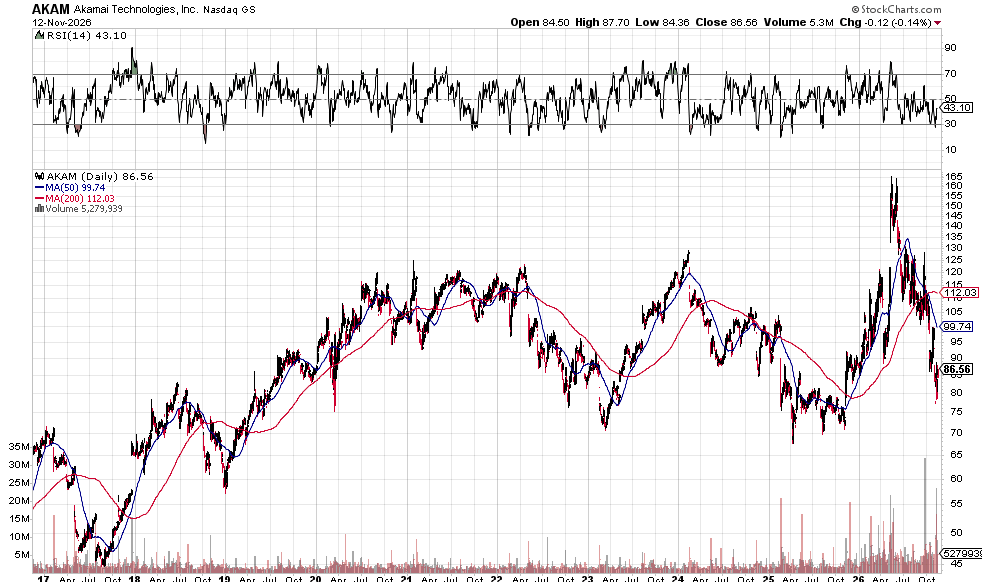
Akamai has just been a mess of a stock.  And much of it is connected to them getting into the business of selling compute for AI.

Akamai began as a Content Delivery Network.  They evolved into an edge security platform.  Those are the core businesses.

Akamai owns servers all over the world.  These aren’t big data centers.  They are small and co-located with other servers by design.  Most of them are located around big cities.  The intent is to be located close to traffic, so they can deliver and monitor content close to the source.

If you are a streaming service, you might pay Akamai to house some of your most popular content in local servers around large populations.  Then if someone wants to watch one of these shows, instead of you having to send the content from your server farm in timbuktu, Akamai can play it from much closer.  It can be cost effective.

On the security side, you just flip it around.  You might pay Akamai to monitor the traffic to and from your website, and if you are attacked or if something suspicious happens, Akamai will shut that traffic down.

For Akamai, it is a business they have been in for 25 years.

Because Akamai didn’t own the sort of space you’d use to stand up 1,000s of GPUs and start training models, it wasn’t a natural play in the first few years of the data center buildout.  In fact the stock has done nothing for a long time.

I didn’t buy Akamai because I thought they’d get into the business of selling compute, though I did get stuck as a bagholder because of it.  I bought the stock after listening the Cloudflare Q4 conference call back in February, and I started to think that Agentic AI may change the game for not only Cloudflare but Akamai as well.

It made sense to me, and still does, the AI agents will generate far more internet traffic over time and that this traffic should drive traffic to the security services and content delivery services that Cloudflare and Akamai offer.

You just think of how agents scour every website to find information, will read 10x or maybe 100x as many pages of information as a human.  I think the clincher for me on that Cloudflare call was when CEO Matthew Prince said “if humans looked at 5 sites when they were making a decision, agents might look at 5,000”.

Cloudflare says bots, including AI agents and crawlers, now make about 57% of web requests.   They do much of this through APIs, and websites will have to act to protect themselves and guide these agents through those APIs using tools like what Akamai and Cloudflare sell.

As well, if traffic is going to explode I thought that proximity to content may, over time, gain importance.  I’m not sure if the CPU based servers that Akamai and Cloudflare use would ever be used directly for inference (both do own some limited GPU servers that do inference), they would be used to fetch web pages, run agent’s tools and process data, tasks which seems likely to grow.

There is a world here of a lot more traffic and more dangerous traffic and what Cloudflare and Akamai do is manage traffic.  So while this business has not been a good on in the past, I thought that may change.

Anyway, that is the thesis.  It has worked for Cloudflare, because everything seems to work for Cloudflare, but not for Akamai.

Akamai is maybe seeing a slight sign of stabilization in their content delivery revenue which has narrowed to a -3% decline, but there has been no inflection at all in their security business, which has bounced around between 9-11% growth for two years.

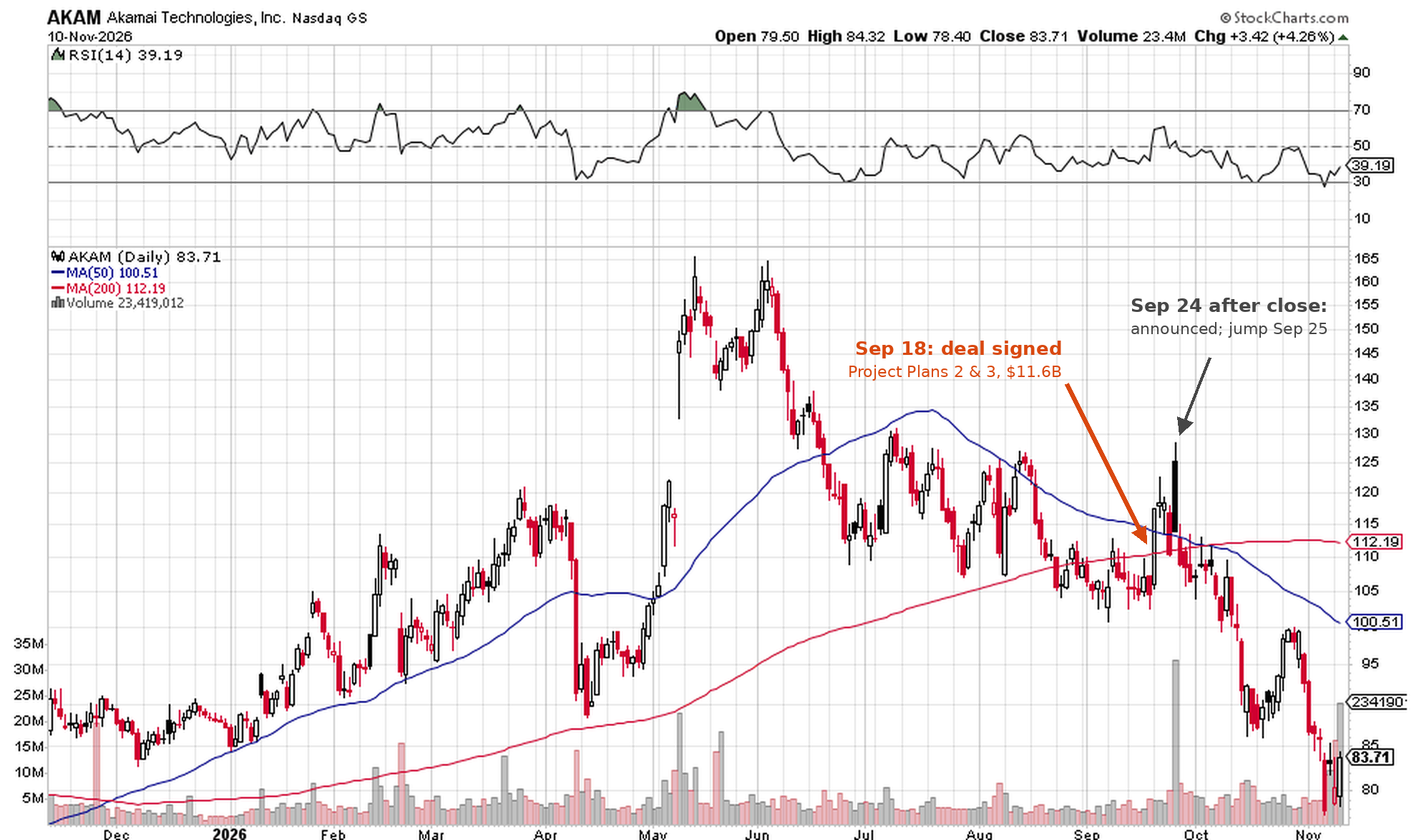
I don’t know whether Akamai is just going to miss out on this opportunity, or if I’m just early and we aren’t going to see a lift until AI video becomes a thing.  But I was not ready to give up on Akamai, especially after doing pretty well on the stock on my first go round.  So I bought the stock in September at $105, thinking really, how much further could it fall?

Shortly after that Akamai did a pivot of sorts.  On September 18th, about a week after I bought the stock, Akamai announced a large compute deal with Anthropic.  The total commitment had Anthropic buying at least $11.6B of capacity from Akamai over 7 years.

This is not chump-change for Akamai.  Akamai’s revenue run rate is a little over $4 billion a year

Sounds great right?  Wrong!

Akamai’s stock has done just horribly since that time.

What the heck happened?

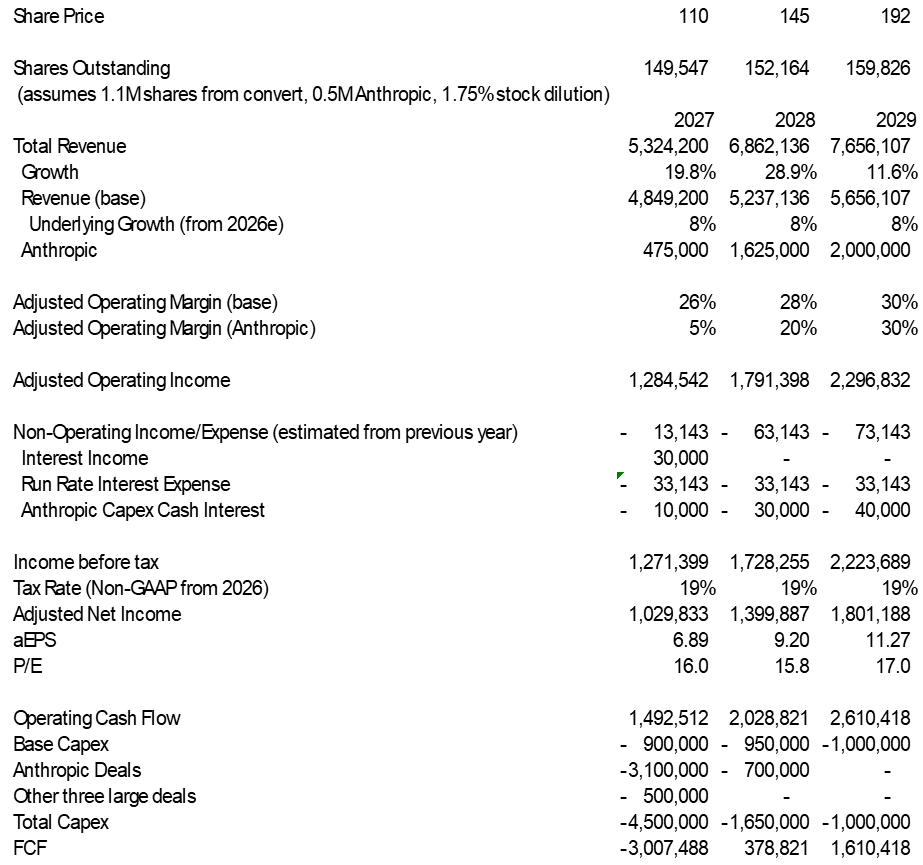
Not really knowing what I had just gotten myself into, I set out to find out.  Shortly after the deal was announced I ran the numbers.  At the time, there were only sparse details on the deal so I did the best I could, which is what I have reproduced below.

My interpretation of the deal with Anthropic was that it was going to be a positive for Akamai earnings, but just not right away.  And markets don’t like lags.

For context, at the end of Q2 Akamai was guiding to a range of $6.40 – $7.05 per share of earnings for 2026.  If you look at the impact to earnings in 2027, it is within guidance for 2026.  So no real growth.  It isn’t until 2028 and 2029 that the deal ramps and Akamai sees its earnings rise.

In fact the deal will likely depress earnings for at least a few quarters.  You can see that my margin estimate from the Anthropic deal for 2027 is only about 5%.  If you parsed out quarterly numbers, Q1 and Q2 of 2027 were likely to be even more negatively impacted by margins as Akamai built out their cloud ahead of any revenue.  They would have to begin paying for colocation costs and increased headcount even before Anthropic started paying for capacity.

On top of that, as we saw with the release of Akamai’s Q3 results, big deals like this have delays.  Which push out earnings even further.

Markets don’t like it when things get worse, even if the promise is that they will get better after that.  There are just too many examples of things getting worse and then just getting even worser.

Markets also don’t like it when things get worse and it costs money to do it. 

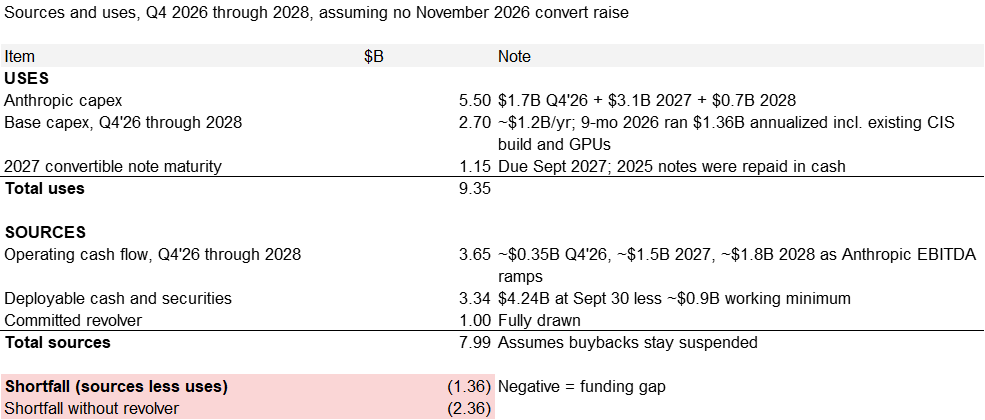
Akamai would have to pay to install the capacity it is selling to Anthropic upfront.  They estimated back in September that they would have to add $5.5 billion of capex to deliver the capacity to Anthropic from the deal.  Of that, $1.7 billion would be spent in 2026, before any revenue is generated, $3.1B in 2027, when very little money is being made and the rest in 2028.

The market was being asked to digest the financing risk of capex and the time risk of cash flow all at once.  And give Akamai capital to do it.

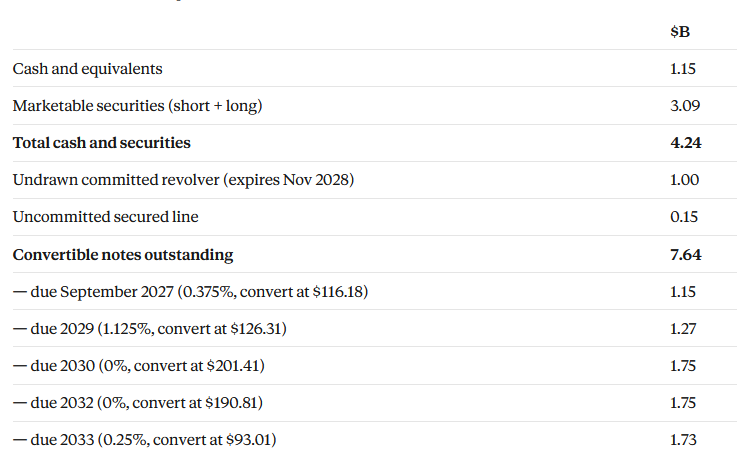
It was a fairly straightforward exercise to go through Akamai’s cash and debt maturities over the next few years.  And from that to conclude that they didn’t quite add up.

Even ignoring the later maturing convertibles, Akamai was short of about $1.4 billion of cash.  And that is with full use of their outstanding revolver.  If they wanted flexibility, you could raise the shortage to $2.4 billion.

You put all of this together and I think you can see why the stock price tanked.

Well what’s done is done.  Akamai reported earnings on November 5th.  They gave us more detail about the large Cloud Infrastructure Services (CIS) deals.

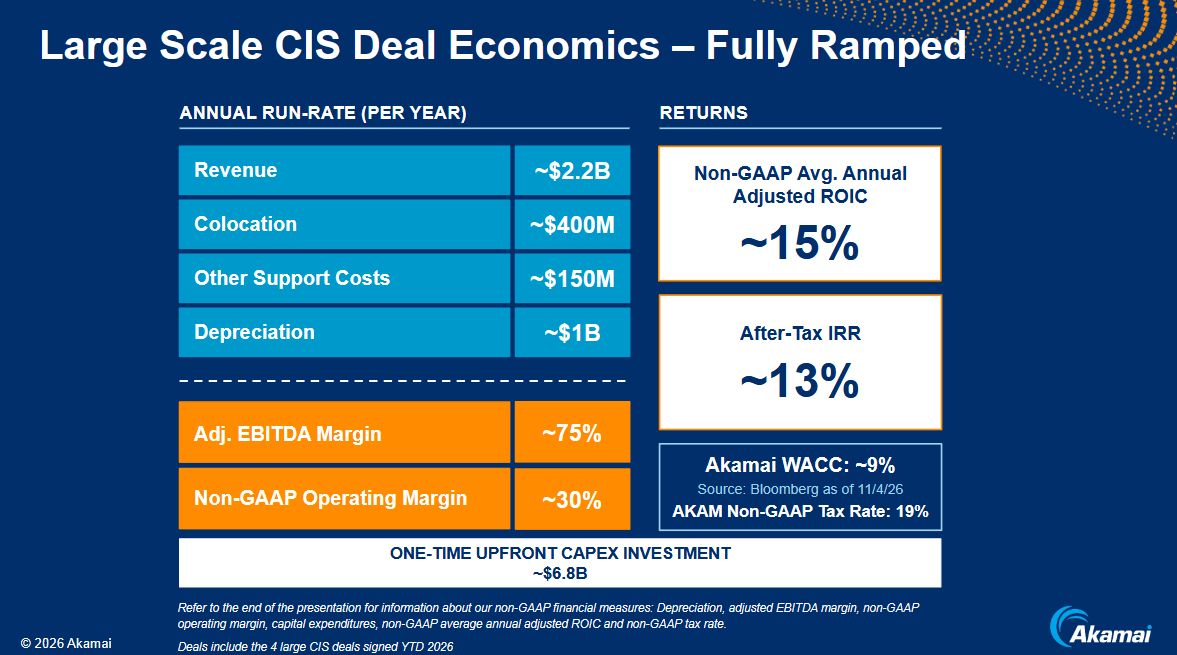
The most interesting information they gave was this slide:

The slides validated a lot of my original assumptions, but made me modify a few others.

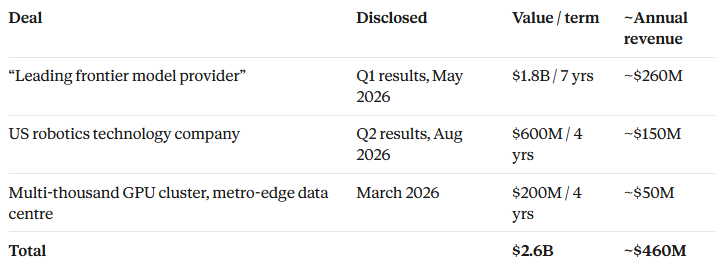
The revenue from all four of Akamai’s CIS deals is $2.2 billion per year, versus the $2 billion I was using based on the Anthropic-only deal release.  The 3 other deals that add up to about ~$0.5B are likely these one’s announced in the first half of the year:

Capex for the 4 deals is $6.8 billion instead of the $5.5 billion that I had been using.

The hardware depreciates over 7 years, not 5 years.

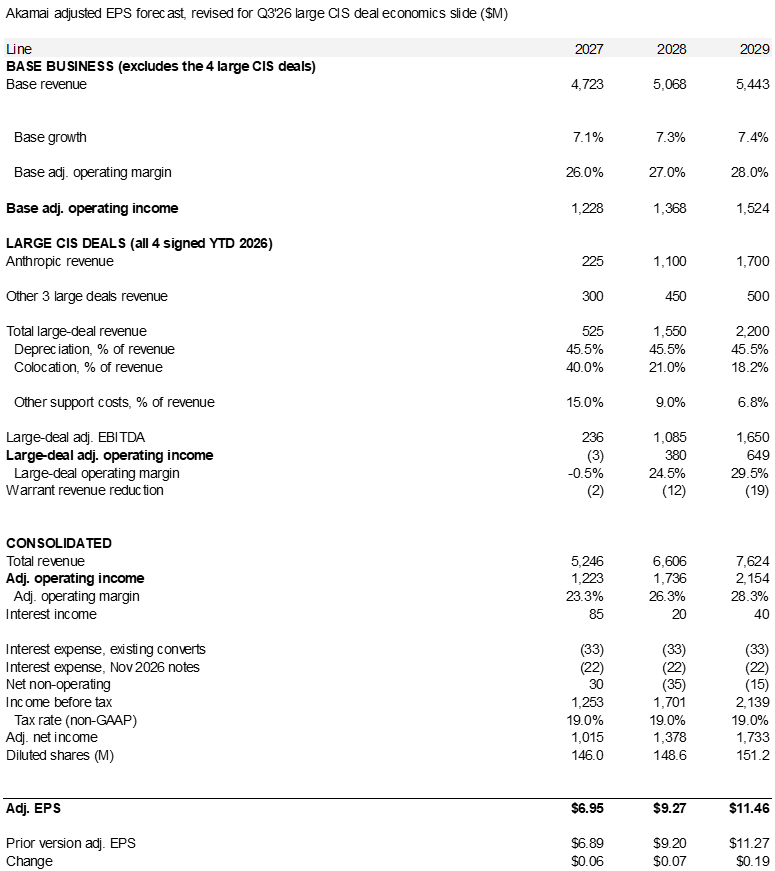
Some minor changes but it really didn’t make a big difference to the earnings per share.

We still have the same problem though.  Akamai will not see much in the way of earnings growth in 2027, but they will in 2028 and 2029.

So it is kind of like a microcosm of what I was saying with AI in general.  The upside here is pretty good.  If earnings do hit $11+ in 2029, and the stock trades around 15x, it is a $160 stock.  Maybe it even gets a higher multiple if my original thesis, that traffic growth will grow their legacy businesses and they can shake the label of being a commodity CDN provider, plays out.

What Akamai needed to do to stop the bleeding of the stock was figure out a way of leveraging that potential upside into the capital it needed to fund it.

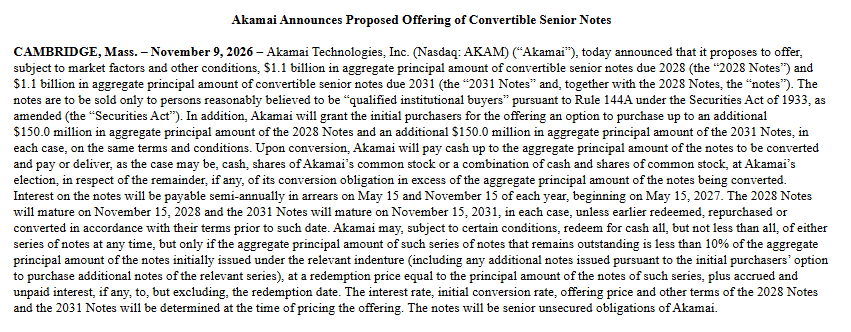
Four days after earnings Akamai announced and then closed an offering for $2.2 billion of convertible senior notes.

If you read through the details of the notes, they have a couple of features worth pointing out.

First, these notes carry an interest rate of 1%.  A very low rate.  So just in terms of the cash interest costs of this financing, it is very cheap.

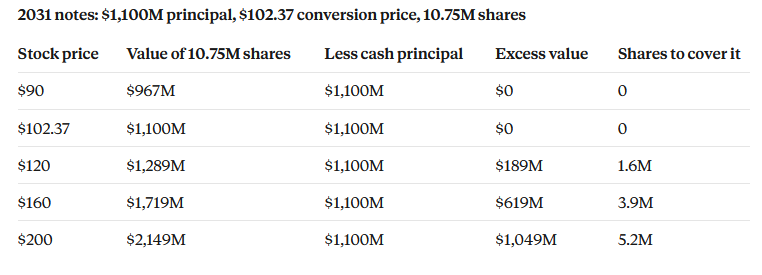
It is cheap because of the convertible feature.  When these notes come due Akamai will pay the principal in cash.  But they will pay the excess value, which will be determined by how much Akamai’s stock price exceeds the exercise price of the notes at the time of maturity, in stock or cash.  The example below is with the 2031 notes:

In plain English, Akamai has structured participation in the upside.

I think it’s the upside that is the important feature of these notes.  And it is something that we will see more of.

What’s more, Akamai bought back the upside they sold through a separately made hedge with Bank of America.  They paid $250 million for a hedge that offsets dilution up to the bank warrant strikes.  The note buyers get the upside, but Akamai paid cash to cancel most of the cost to shareholders.  They paid for it of course, but not with dilution.

COREWEAVE STRUCTURING AN UPSIDE

So that’s Akamai and that is mostly the end of this post except that I want to relate it briefly to CoreWeave.  Why?  Because no one really cares what happens with Akamai but everyone seems to care what happens to CoreWeave.  Yet there is an analogy there.

I listened to the CoreWeave call Tuesday night.  This was their third quarter call, and because CoreWeave is being treated as a bellwether of AI health, I knew the call would be important.

It was one of those calls where immediately you feel like it’s a turning point of sorts.

The problem with CoreWeave is the problem with Akamai on steroids, and the problem I described at the start of this post.  It has been trying to raise capital to fund an AI infrastructure build by offering investors no upside and participation in the downside.

Who wants that?  I get a 7% coupon but if things go south in AI I’m hooped?  It just doesn’t make sense.  Especially with a levered, optionality rich bet like CoreWeave.

The whole reason to invest in a company like CoreWeave at all is because of its optionality.  There’s no option with the debt.

CoreWeave can’t get quite the sort of deal that Akamai did.  Akamai can price convertible notes at 1% because they have a growing $2.4 billion security business and a $1.5 billion cash flowing delivery business if the AI bet doesn’t work out.  CoreWeave doesn’t have that to fall back on.

But just as Akamai found a way around this with its converts, CoreWeave seems to be finding a way around it with its customers.

CoreWeave said on their call that they would not be accessing the unsecured debt markets through at least 2027.

Instead, they are going to get money from those that benefit from their success.  Who is ultimately going to benefit from CoreWeaves capacity?  Its customers.  So CoreWeave asks them to prepay, which many of them can.

You can call this circular financing if you want, but in my opinion it is just a logical outcome of the asset being financed.  It is the outcome of trying to finance an asset with lots of upside and lots of downside.  You need financiers that get the optionality of the upside.

That could be by offering participation in the share price, or by asking customers, who need the capacity to benefit, to pay upfront.  Either way, the counterparty is invested in the upside.  Which is the whole point with AI.

Framing Oracle

Apart from the shitshow that is Coreweave, Oracle is probably the most maligned of the datacenter providers. 

Oracle gets a lot of attention because it is the tweener.  It sits in between the hyperscalers (Google, Amazon, and Microsoft) and the Neoclouds (Coreweave, Nebius, all those bitcoin miner conversions, etc).

Unlike the neoclouds, Oracle has businesses outside of the AI datacenter build.  But unlike the hyperscalers, these are not insanely profitable businesses throwing off wads of cash that can be shovelled back into the buildout.

This all makes Oracle sort of an interesting case study of what the risk and reward of the AI buildout is.

One of the best parts of AI for me has been its ability to make financial models that I otherwise wouldn’t have been able to make.  While making a model is not that hard, the math is easy, digging through all the filings and transcripts to gather all the assumptions and projections from management, analysts, competition and customers is a lot of work and usually requires shortcuts.  But with AI, much of this is at your fingertips.

I did it for Oracle this weekend and it really didn’t take that long.

I’m going to step through it, starting with the assumptions.  The guts of what I did was focused on one segment, called Oracle Cloud Infrastructure (OCI).  I don’t think the rest of ORCL is all that important, certainly not to AI and it certainly isn’t going to determine the big question that I am interested in, which is under what circumstances Oracle is likely to succeed or fail.

The conclusions to watch out for are:

  1. Oracle has a decent amount of debt and there is a reason that S&P cut Oracle to just one notch above junk in July
  2. To complete the buildout of the announced capacity, Oracle will have to add to their debt beginning in about a year, and the amount is not insignificant
  3. Over that same period, if the base case holds out, Oracle is going to go through a period of revenue growth and significant earnings growth.  Yet because of the buildout of capacity, they will have negative free cash flow
  4. The outcome of whether this all plays out positively or negatively to the business and the stock hinges mainly on demand for AI compute over the next couple years.

One last conclusion that is worth mentioning.  Even though Oracle seems to be constantly in the headlines for their New Mexico datacenter, which is always under some sort of opposition, these very large 1 GW+ datacenters are really not anywhere near the whole story of the buildout.  In fact, much of Oracle’s datacenter build is from small, unnamed capacity that we don’t even know where it is.  I bring this up because, in general, we hear about the massive datacenters as being so central to the story.  And they are to an extent, but many, smaller capacity additions are equally important.

Here’s the model.

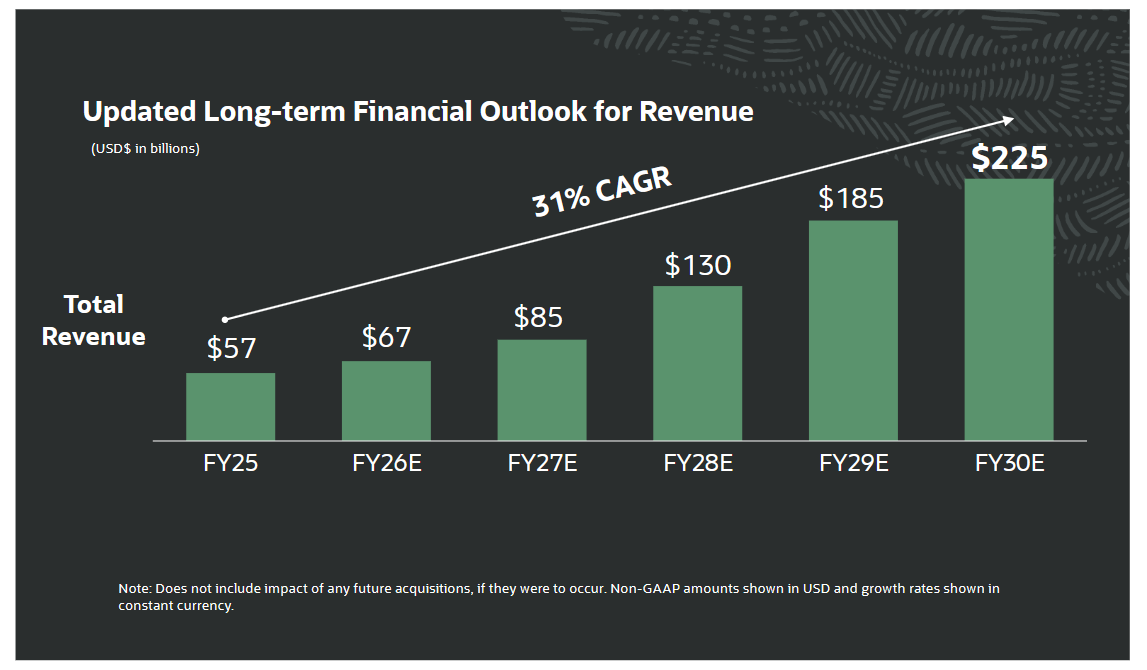
Let’s start with the top line numbers and where they come from.  I am going with this forecast for total revenue, updated by the $5B increase they expect now for 2027.

I am estimating the following prices for Oracle’s new datacenter capacity.  These are flat number through the time frame because really, who knows what pricing will be.  They are a little higher than what Oracle said at their Investor Day last year and inline with what you need to get their stated 35% margin on $30M/MW equipment costs.

  • Revenue per MW per quarter for Blackwell: $2.75/MW/Q  or $3.67/GPU-hr
  • Revenue per MW per quarter for Rubin: $2.75/MW/Q – $4.58/GPU-hr (The shift to Rubin from Blackwell begins in the August 2027 quarter.) 

I can tell you, these prices are well below spot prices today.  The Google/SpaceX agreement, which is a short-term spot agreement from June, was priced at $11.50/GPU/hr.

I am assuming the following large datacenter buildout ramps:

One of the interesting things I learned is that these five sites don’t really comprise all of the capacity add that Oracle is doing.  Oracle must have multiple smaller sites that they are building to get to the capacity adds they expect in 2027 and 2028.  I say must, because Oracle, and no one really, details out every datacenter they have, so you just have to assume there are a bunch of small ones.

The model estimates 300 MW of capacity adds of these small, unnamed datacenters every quarter between now and F229.  That works out to 2.7 GW of the total 7.7 GW of added capacity between now and then.

Revenue from this additional capacity is determined by prices that are largely fixed and we are assuming they are fixed roughly inline with the above pricing.

Margins on the new capacity being added depend on depreciation, power and any other operating costs.  Oracle has pegged gross margins on their new capacity at 30-40%.  I am using 35% at steady-state, increasing from 0% at the beginning of the ramp.

Apart from the AI datacenter business, the model assumes non-AI OCI growth of 35%, which is high, but it is what you have to assume to get to ORCL’s own guidance numbers.

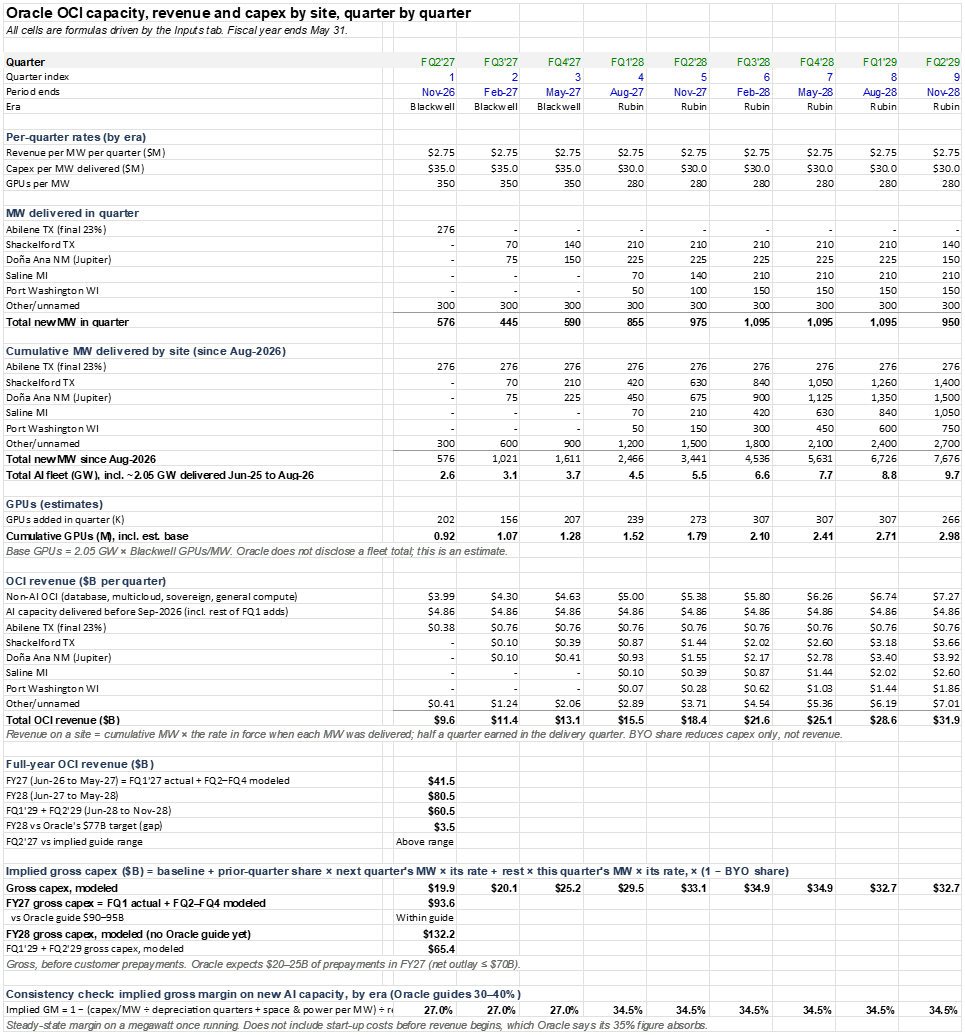
Using the above assumptions about when Oracle’s AI datacenter capacity comes online, how much revenue it generates and the margins of that revenue, you can come up with an OCI segment model over the next 2 years that looks like this:

It’s a lot of rows and columns but you can focus on just a few of them.  The six rows under “Cumulative MW delivered by site (since Aug-2026) are the new datacenter additions (in MW) coming online each quarter.  The “Total new MW since Aug-2026” row is Oracle’s total capacity coming online.

The row labeled “Total OCI revenue ($B)” is how revenue for the segment grows as those datacenters come online.

Finally, the “Gross capex, modeled” is how much capital expenditures Oracle is ploughing in to bring the datacenters online each quarter.

And that’s it for the OCI segment.  You can’t really draw conclusions from it on its own so now I have to take those results and integrate them into the rest of Oracle.

Oracle also has non-OCI businesses which are largely cash generating and slow growth.  This is their software business (what most people know Oracle for), their hardware business and their services business.

Their software business is on-premises, not a cloud business.  It is products like Oracle Database, Java SE, E-Business Suite and other older applications.   Most of this is a license business where customers pay annual fees for updates, patches and support.

Oracle’s hardware business comes from a very old acquisition of Sun Microsystems in 2010.  This includes racks and servers that run Oracle database, and an older server and storage rack business.  This is a funny business that has actually been in decline for years but has started to grow more recently.  I haven’t seen an explanation.

Oracle Services business is the fastest growing of the three legacy businesses.  This is Oracle Consulting, which has professionals that come in and help you migrate to Oracle Database or use the other products.  More recently it seems that some of the OCI integration and education gets uptake here, which may be why its growing a bit faster (~10%).

None of these businesses are forecast to grow all that much.   They just generate consistent cash.  I have growth from 0% to 8% for these segments.  I am not spending nearly as much time figuring out the details here because these aren’t the businesses that are under the microscope.

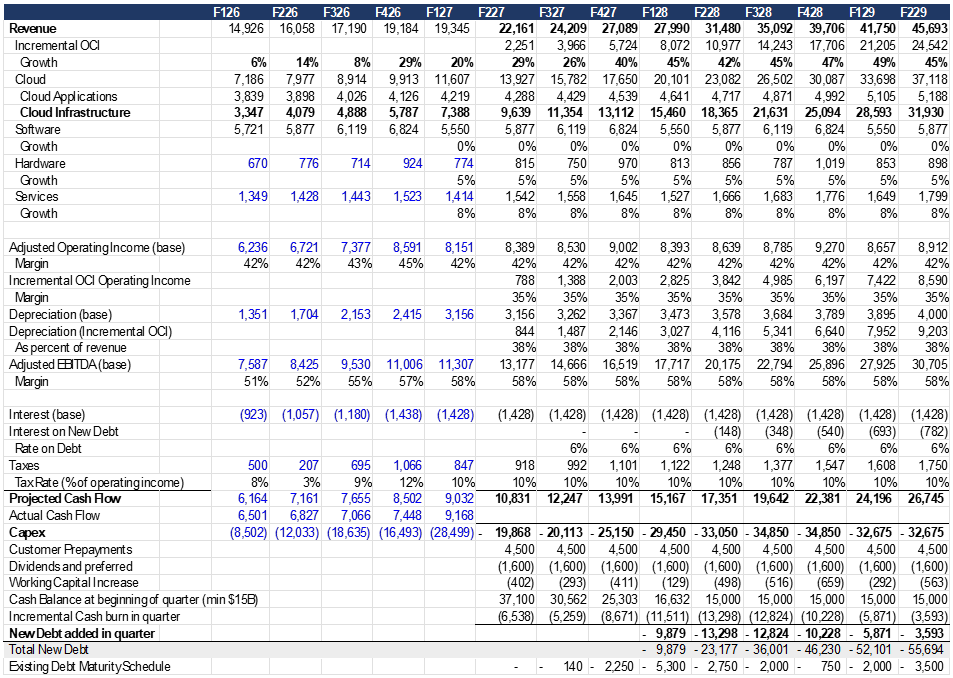
Below I model out how these non-OCI businesses and the OCI business together impact Oracle’s cash position from quarter to quarter.

The inputs from the OCI model come into play in the “Incremental OCI” row, which is the additional revenue Oracle gets every quarter when a new datacenter comes online, and the “Capex” row, which is the gross capital expenditures Oracle has each quarter.

Oracle has a cash position today of $37B.  That cash will pay for the buildout through the rest of their fiscal 2027.  But come 2028, assuming they need to fund all gross capital expenditures with cash and want to maintain a balance of $15 billion or so, they will need to begin to take on new debt in fiscal 2028.  Oracle will likely get ahead of this, and they have said they plan $20 billion of debt for 2027.

The row “Total New Debt” is showing how much additional debt Oracle has to add to complete the buildout to Q229.  This debt accumulates every quarter and reaches $56 billion by F229.

This is a super important point to reflect on.  Because $56 billion (second last cell from the bottom right) of more debt by Q229 is a lot!  Unless…

The word “gross” in “gross capital expenditures” is important for watching how cash changes.  Oracle’s capital expenditures do not necessarily line up with their cash usage.

The reason is that Oracle can finance those expenditures in ways that don’t require them to put up cash.

One way, which is in the above model in the row “Customer Prepayments” is through, well, customer prepayments.  Oracle has said that they expect FY27 capex of $90–95 billion, with net cash capex (after customer prepayments) of no more than $70 billion.

Customer prepayments are lumpy but will average a little over $5B per quarter in F2027.  I modeled them at $4.5B for the rest of the fiscal year.  I don’t know what they will look like in FY28 and FY29 so I assumed they are the same.

The other way that Oracle can fund capex without cash, which is not in the above model, is with vendor financing.  This is, quite honestly, the #1 scare tactic of bears right now.  They point to Nvidia funding purchases of their own chips by their own customers.  We see AMD and Broadcom doing it as well.

Multiple things can be true at once and if you don’t consider all the sides, it is easy to get lost in one narrative.  Which is the case with vendor financing.

The nefarious narrative is simply that vendor financing is bad because it is usually hiding something.  I mean, it’s true, most business-based revenue scams have some origin in financing revenue growth via your own balance sheet.   It reminds me of banks allowing for the payback of unpayable loans with the proceeds from a new loan.  Its not sustainable.

The less nefarious narrative is that this is everyone’s best interests.  It is an acknowledgement that this is a very capital intensive business and if you want to participate you have to raise a large amount of capital before you can hope to see payback on it.

For a vendor like Nvidia to finance an investment in Nvidia GPUs and agree to participate in the return they believe it will generate instead of cash upfront is not necessarily nefarious.  Especially if they are doing it in plain sight, which they are.  If they believe that return is likely, which if you listen to Jensen Huang he clearly does, then it probably makes a lot of sense.

It certainly makes sense for Oracle.  Without it, they wouldn’t be able to grow their datacenter business as fast and they would likely lose out to hyperscalers that can grow more easily. 

Consider this exchange from Oracle’s F127 call in September:

Mark L. Moerdler

Bernstein Institutional Services LLC, Research Division

Ken, we’re going to be sorry to see you go, but I’m sure you have an amazing bucket list ahead of trips and things to do. So I’d like to focus in on the RPO. Can you give us more details on the drivers of the growth of RPO that is not requiring additional CapEx, the prepaid and bring your own chips? Is this AI labs? Is it semiconductor companies? Or is it that sovereign? In fact, we’ve not discussed sovereign cloud in a while, and we haven’t discussed sovereign AI at all. Can you explain how that side of OCI is going and how that will impact CapEx and margins?

Clayton M. Magouyrk

Chief Executive Officer & Director

Sure. So let me make sure we clarify one thing first, and then I’ll dive into the pieces. I didn’t say — and I don’t think myself nor Hilary said that it doesn’t require additional CapEx. We said it doesn’t require additional cash from Oracle, right? So the — I’m not an accountant, but I get to play one on TV sometimes. But the intention of what we’re trying to say is that while there clearly are capital expenditures, it does not require Oracle to go out and find additional cash to do it.

Now the question becomes, well, how do you do that? Well, we have a variety of different models. Sometimes it’s working with our suppliers through different financing arrangements that allows us to pay for the capacity as the customers pay us. That’s one mechanism. Another mechanism is that a customer says, “Hi, I’d like to pay for the hardware, but use your operational ability and your cloud infrastructure, technology assets in your data center to go out and actually turn that into an AI cluster.”

Magouyrk says that additional Capex “does not require additional cash from Oracle”.  He then outlines the two ways – vendor financing and customer prepayments.

Now to be clear, he is not necessarily talking about all the capex in the model.  Its not really clear at all how much of the F28 and F29 capex is going to come from customers or vendors.  We can only guess.  But some of it will.

Which leaves us to consider that Oracle’s cash debt needs will be something less than $50 billion.  Maybe $30 billion?  Maybe $40 billion?  Tough to say.

How hard will it be for Oracle to do that?

That’s the big question that has the stock, and the stocks or Coreweave, Nebius and other even more precariously positioned datacenter plays, in volatile straits.

If you listen to the bear voices that were yelling this last week, you would conclude that financing is not going to happen.

But before I just assume that Oracle can’t possibly fund those requirements, I want to see how the income statement actually performs as these commitments begin to generate revenue.

So far, I’ve just focused on the free cash flow.  And the easy tack, if you want to just make the bear case and leave it at that, is to stop right there.

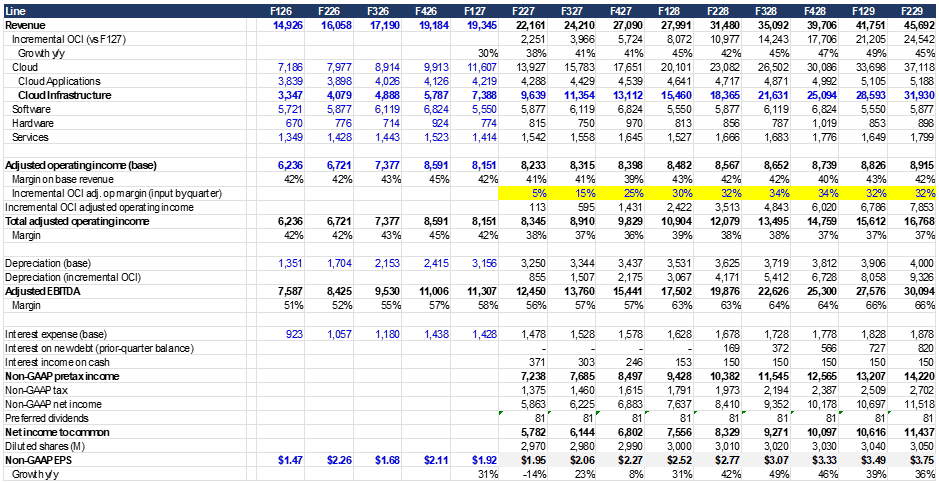
But the more correct thing to do is to look at the whole picture.  Which shows Oracle massively growing revenue and earnings over that time.

The relevant numbers are:

2027 EPS = $8.20 per share

2027 Revenue Growth = 38%

2028 EPS = $11.69 per share

2028 Revenue Growth = 45%

Yes, Oracle is committing to a large buildout in capacity.  On the flipside, they already have revenue commitments for the space from Meta, Nvdia, OpenAI, xAI and even TikTok.  And those commitments are going to put Oracle on one heck of a growth path.

The strange confluence that Oracle is going to see over the next few years is that they will transition to accelerating revenue growth, accelerating earnings, and increasingly negative free cash flow.

Here’s my take. 

If we get to the end of Oracle’s fiscal 2027 and Oracle puts out the above 2027 numbers and they are forecasting numbers inline with what I have above for 2028, it is hard to imagine that A. Oracle won’t be able to secure the debt they need and B. that the stock will be at $130.

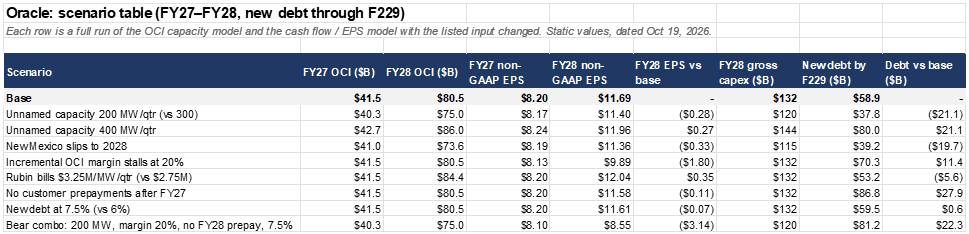
That’s the base case.  Now we can look at some scenarios.

I have one big take-away from these assumptions.  Nothing really matters all that much except for one thing: demand.

Here again it is worth revisiting the assumptions.  Or at least the 10,000 foot view that instructs those assumptions. And the big assumption here is that demand for AI compute grows enough to cover the growth in capacity so that Oracle can bring on its capacity, have it used, and generate (at least) the margin it expects.

We can speculate this and postulate that and what about the CDS spread, and maybe the 10-year yield will rise and well you know the Anthropic IPO may not go off in November, and is OpenAI losing market share to Muse and blah, blah, blah but really, what really matters is demand.  If AI demand growth meets the expectations of tech executives a year from now then it is impossible for me to imagine Oracle stock being lower than today, let alone at risk of some sort of debt default. 

If demand growth expectations are wrong, then the bears are right and this is an overbuild that will materialize in the next year – and let’s be clear, I mean in the next year, not what is going to happen in 2030 or 2032 or some far off year where no one really knows and the market isn’t going to pretend they do – well if it all falls apart and Oracle is going to be tough sledding.

That’s the frame.

Week 246: Hidden in Plain Sight

Portfolio Performance
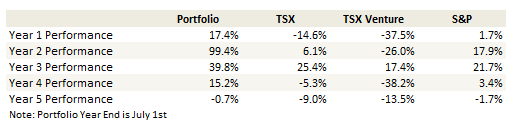
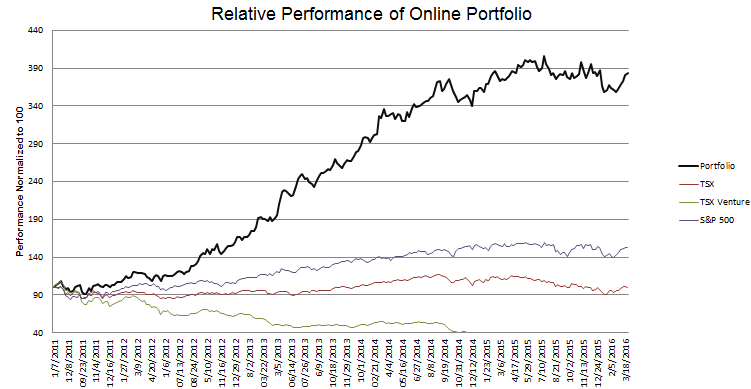
week-246-yoyperformance

week-246-Performance

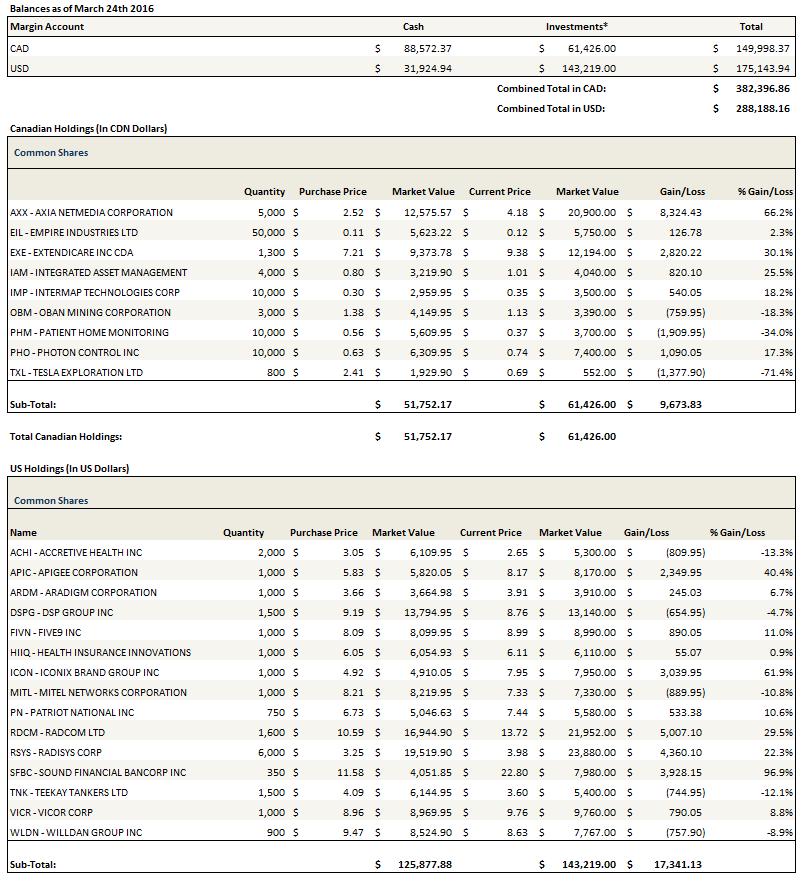
See the end of the post for the current make up of my portfolio and the last four weeks of trades

Thoughts and Review

The market was up and so not surprisingly I had much better performance in the last month.  Even so, I performed better than I might have expected given just how much uninvested cash I have sitting around.

It just goes to show how much of a drag the losers have been.  I’ve had my share of winners in the last year, but my performance has been flat because I also had a bunch of crappy losers.

It would be one thing if I couldn’t distinguish between the winners and losers ahead of time.  But when I look back at what has cost me over the last year, it has been pretty predictable; stocks where I am stretching for a trade, stocks where the value wasn’t clear, or stocks where my primary motivation was their attractive yield.

I’m going to make a concerted effort to prefer cash to those positions going forward.

In the last month I haven’t been actively looking at stocks.  I’ve been surprised by how quickly the market has bounced back and I remain skeptical that it can continue.  So with the exception of a couple of opportunities that I will describe below, I am will remain holding a high cash position until I see a reason to believe the market will sustain a move higher.

Takeovers!

I went a long time without a takeover and then in the matter of 6 weeks I got 3 of them.  First, both of my gold stock picks, Lake Shore Gold and Claude Resources, were taken over.  I bought Lake Shore at $1.12 and, after the takeover offer from Tahoe Resources to exchange each share of Lake Shore for 0.1467 shares of Tahoe, the stock now trades at a little under $2.  I bought Claude at 76c. Silver Standard Resources made an offer of 0.185 shares for every share of Claude.  At the time of the offer this amounted to $1.65.  I’ve sold some of each position and so have reduced stakes in both.  They have been solid performers and I am not unhappy.

A few days after the Claude Resources news my long held fiber-to-the-home play, Axia NetMedia, got scooped up by a private equity firm, Partners Group.   While I was happy to see a quick takeover of both of my gold stock positions, I was more divided by the news from Axia.

The problem is that the opportunity at Axia is much greater than the $4.25 takeover offer.  The company has a massive build out on its horizon in both France and Alberta.  Its becoming clear that fiber-to-the-home is not just a “higher speed-nice-to-have” but a necessary conduit to access all forms of media.  Axia’s cash flow stream once this build-out is complete will far exceed the price paid by Partners Group.

The problem is getting from here to there.  As Axia outlined on their last conference call, the capital necessary to realize the growth is a stumbling block for a $200 million Canadian company.  Axia warned on their last call that they were evaluating alternatives; that they would try to raise capital and if not consider offers by a larger entity with greater access to capital.  Partners Equity is a $50 billion investment management firm.  The only reason that a firm that large bothers with a takeover this small (Axia was a $200 million market capitalization before the offer and under $300 million at $4.25) is because they see significant upside.

Radisys, Radcom, Willden, and what the Market Misses

I’ve made a number of mistakes over the last couple of months but one thing I have done right is add to my positions in Radcom and Radisys in the face of market weakness.

Radisys has had a big move in the last month, moving as high as $4 from $2.50 in January.  I have added to my position on the way up.

The Radisys move over the last couple of weeks has been instructive.  Consider that during the fourth quarter conference call the company announced a large contract from a Tier I customer (from this transcript):

And finally, and maybe most important in this release is, we secured orders totaling approximately $19 million, the majority of which is contained in deferred revenue at year-end for our new data center product targeted at telecom and cable operators which we expect to launch more broadly in the coming months.

The stock moved a little but nothing that couldn’t be explained by what were decent quarterly results.

About three weeks later Radisys officially announced the product, DCEngine, with this press release, along with the name, details and comments from the Tier 1 customer, Verizon.

“As Verizon introduces open, flexible technology that paves the way for central office transformation, we look to companies like Radisys to assist us in that journey,” said Damascene Joachimpillai, architect, cloud hardware, network and security, Verizon Labs. “Network modernization will rely on solutions such as DCEngine that meet service provider needs with open source hardware and software technologies.”

The stock has moved straight up since this press release.

I think this demonstrates how poorly small cap companies like Radisys are followed and how slow the market can be to react to positive developments.  While I find it easy to second guess myself when what I construe as good news in announced and the stock doesn’t move, it is worth reminding myself that this isn’t always an indicator of importance.

With that in mind consider the following situations, Radcom and Willdan Group, two stocks I have had in my portfolio for some time, and Vicor and DSP Group, two new positions that I have added.  I believe all four of these situations represent similar “hidden in plain sight” opportunities.

Radcom

First, Radcom.  Radcom announced in early January that they had signed a contract with a Tier I customer for their next generation service assurance solution MaverIQ.  There wasn’t a lot of details provided, only that the initial phase of the contract would be completed mostly in 2016, and was worth about $18 million.

On their fourth quarter conference call in mid February the company gave more color.  They said the contract for NFV deployment was much bigger than the $18 million announced.  I’m pretty sure its with AT&T.

While they declined from giving guidance (historically the company has given virtually no guidance in the past so this was no surprise) they were willing to say that they expected their cash level to increase to $20 million from current $9 million by end of the first half of 2016, and that the increase in cash would be due to new revenue and not deferred payments.

They also gave an indication of just how big the deal with AT&T might be (my bold):

We just said that we received an $18 million initial deal out of a bigger deal. There is – it’s a large transformation, so it’s not – I think when you’re envisioning it, so I’m going to try to help you model it, right. So when you’re envisioning it, envision something between 2.5 to three year evolution for the very significant portion of the transformation, okay. It doesn’t mean that everything stops after three years, but envision that over the course of those three years, that number $18 million that we’ve disclosed is just an initial number out of something bigger, that’s bigger than that. And I can’t disclose the accurate numbers here. There is things that it depends on. There is – it’s more complicated just throwing other number out there, but it’s much bigger than $18 million, okay.

In addition they made it clear that they are ahead of the competition, witnessed by their comments about Netscout on the call.   They are in the process of trials  with other Tier 1 customers and believe that the next-gen service assurance market will be a “winner takes most” market where they can take the most.

Radcom is a $130 million market cap company.    They just said they can generate $10 million of free cash in the first half of 2016, that the contract they have announced is actually much larger than the announced number, and that they have a product that is significantly better than the competition.

If Radcom can win a couple more contracts in the next year the stock should trade significantly higher than it is now.  it probably gets bought out at some point.   In the mean time I think its quite a good growth story.  The market is really not paying a lot of attention to the “color” provided on the conference calls, and instead is focused on the rather puny revenue that the company generated in 2015 ($18.6 million) and the rather lofty valuation for the stock if you use that backward looking measure.

Willdan Group

Update: I got a response from Willdan IR and they say the revenue is not new revenue and is included in guidance.  I am still of the mind that this is an expansion of scope though and I am happily holding the position I added that I describe below.

Second example.  On their fourth quarter conference call, which I thought was quite positive in terms of the outlook provided for 2016, Willdan stated the following about their ongoing contract with Con-Ed:

We have the extension for 2016 at a value of approximately $33 million. We’re prepared to go beyond this baseline and expect to. The good news is that we continue to perform well for Con Ed and as a result we are in discussions to expand our scope of activity in the second half of 2016 to include more programs targeting customer segments, for example, more of Brooklyn, Queens and larger projects, 100 kW to 300 kW in our SPDI program, the type of programs that will include in the larger retail stores and warehouses and more real estate.

Note that the transcript is incorrectly referring to the SPDI program, which should read SBDI (small business direct install program).

Flash forward to Thursday. In a press release Willdan said the following:

Willdan Group, Inc. (“Willdan”)(WLDN) announced that it has been awarded a one-year, $32.8 million modification from Con Edison to an existing Small Business Direct Install (SBDI) contract.  Under the modification, which extends through the end of 2016, Willdan will be delivering approximately 86 million kilowatt-hours in electric energy savings to Con Edison’s small business customers throughout the entire Con Edison service territory. This includes the Bronx, Brooklyn, Queens, Manhattan, Staten Island and Westchester County, New York. Willdan described this forthcoming modification in its recent fourth quarter earnings conference call.

Based on the language used it seems pretty clear to me that the $32.8 million is in addition to the $33 million baseline contract.  They talked in the fourth quarter conference call about scope expansion with respect to the SPDI and this is scope expansion to the SPDI.

If I’m right, then the market hasn’t caught onto this yet.  Full year guidance is $170-$185 million and so $33 million is significant.

It’s possible I am wrong.  Maybe Willdan is just re-releasing old news.  I would be surprised though.  I have followed the company for some time and their management does not strike me as the sort to throw out a press release with a big number that is a rehash of an already disclosed contract.  It just doesn’t strike me as something they would do.

I think its equally possible that this was the Thursday before a long weekend, that there are maybe one or two analysts following the company, and so no one that was around to check the news cared enough to notice it.  Yet.

For what its worth I added to my Willdan position significantly.  What the heck; I’m buying the stock at the same price I was buying it at a few weeks ago before this announcement anyways.    What’s the downside?

DSP Group

I have been watching DSP Group for a couple of years and have owned it once in the past.  The previous time I owned it the story was primarily one of valuation.  The stock was trading at $7 and the cash and investments on the balance sheet accounted for nearly $6 of that.   But there wasn’t a clear story behind the business itself and so I sold the stock after it went a few dollars higher.

In the two years since the story around the company’s business has been evolving for the better.  The legacy business that they have, and for which I had a lack of excitement in my first endeavor, is the design and manufacturing of chipsets used in the cordless telephones.  It’s profitable and brings in decent free cash, but it’s an industry in decline to the tune of 10-12% annually in recent years.

This business has fallen off the cliff even more in the last couple of quarters.  Slower demand and an inventory build has led to 20% plus year over year declines.   These declines are expected to moderate back to trend in the second half of the year.  However the bad numbers drag down the overall revenue numbers for the company and are hiding some pretty decent growth businesses.

DSP Group has been investing in a number of new technologies that are starting to bear fruit.  Lets step through them briefly:

  1. HDClear – they have developed a new technology that will improve voice quality on next generation phones. On the fourth quarter call the company announced that they had a couple of wins and one of the wins was with a Tier I device supplier.  Turns out that is Samsung, where it has been designed into the S7.  They expect $2 million to $3 million in the first quarter and guided to lower double digit or high single digit revenue for the year.  When I look at some of the numbers I wonder whether it could be higher: according to this article from Reuters (here), DSPG should get 70c-$1 for each HDClear chip sold.  The Samsung S6 sold over 50 million units last year.
  2. VoIP – their VoIP business unit had $22 million in revenue in 2015. They have guided for 50% growth in 2016.
  3. IoT – Eight OEM’s and three service providers have launched products based on DSPG’s ULE technology. They have a ULE chipset that can be used in home automation, security, remote healthcare or energy management products.  They generated $3.8 million of revenue in 2015 and they think that can get to $5 million in 2016.
  4. Home Gateway – Home Gateway generated $14 million in 2015. It is expected to take a step back in the first quarter of 2016 with around $2.5 million of revenue, but this is going to climb as the year progresses and some new product launches, in particular a North American telecom provider.
  5. SparkPA – DSP Group announced a new product, a power amplifier to be used in the high end access point market. They don’t expect any revenues from this business in 2016 but it will ramp in 2017 and they consider the market they are tapping to be over $100 million

The company gave quite a bit of color about the revenue expectations for each of these businesses in 2016 on their fourth quarter conference call.  If you add up the expected 2016 revenue from the new businesses alone you get around $57 million.  These businesses grew at 35% in 2015 and the company said that in aggregate they expect higher growth in 2016.

When I think about a company with an $80 million enterprise value and $57 million of high growth revenue products, it doesn’t make a lot of sense to me.  I understand that overall the company’s revenue is not growing because of the out sized contribution of cordless declines.   But this business is profitable and therefore not a drag on the company, in fact it even helps fund the growth.

I think the stock should trade at least at 2x the revenue of its burgeoning new product lines.  This would be a 50% upside in the stock.  If the growth continues I would expect it to be even higher.

Vicor

I got the idea for Vicor from a friend who emails me regularly and goes by the moniker Soldout.  He gave me a second idea some time ago, called Accretive Health, that I didn’t initially buy and has done really poorly for the last half a year but that I added recently and will talk about another time.

As for Vicor, the company has a market capitalization that is a little under $400 million, $60 million of cash on its balance sheet and no debt.  The company sells power converters.   They offer an array of AC-DC and DC-DC converters that are used in telecom base stations, computers, medical equipment, defense application, and other industries.

Vicor has a history of high-end products and so-so results.  Their technological edge goes back to the 80’s, as they were the original inventor of the DC-DC brick converter, a device that allows the power converter to sit on the circuit board, which in turn allowed a single DC voltage to be distributed throughout the system and converted as required to lower voltages.  However they haven’t made a significant profit since 2010, and even then it was only 80c per share.

The story going forward is simple.  The company says that with recent design wins and product launches, in particular wins for new data centers that will utilize the VR13 standard (more on that in a second), as well as high performance computing, automotive and defense, they can grow revenue 3-5x in the next couple of years.  That estimate comes directly from management (from the third quarter call).

I think it’s fair to say that the array of products that have been introduced and the products which are about to be introduced, for which the development cycle has ended and we’re very close to new product introductions, that in the aggregate these products are more than capable of supporting the 3-by-5 revenue growth goal that we had set for ourselves, and with respect to which we suffered delays.

The increases in revenue in 2016 will coincide with the move to the VR13 class of processors made by Intel (known as the Skylake family of processors) and that are used in a number of high end computing applications.  These processors require power conversion levels that are easily addressed by Vicor’s high efficiency products.  Vicor has already had a number of design wins to be included in VR13 system designs.  The move to a VR13 based architecture has been slower than expected though, and the company has pushed back the revenue ramp from originally beginning in early 2016 to now occurring in the second half of the year.  The company describes the VR13 opporunity below:

VR13 is a class one processor, it’s a class of processors, and it’s processors that in many respects represent the significance that [inaudible] performance relative to the earlier class, which is VR12.5. Now this can be potentially look confusing because, as you follow Intel’s introductions with respect to the many different flavors of these devices, some of them play in a space where now we do not play, and other ones are targeted in particular to higher-end datacenter, more intensive — computing intensive applications. And those are the ones that are relevant to our revenue opportunity.

Vicor has significantly more design wins for the VR13 product line than they did for VR12.5 (again from the third quarter conference call):

To the extent our footprint with factorized power solutions across applications and customers will increase going from VR12.5 to VR13, this product transition is a mixed bag as it may cause near term softening in demand but should result in substantially greater total revenue as VR13 applications begin to ramp.  On a related note, we have started to see significant design wins for our new chip modules as point of load, board mount devices and in chassis mount VIA packages, which validates our expectations of market reception of these products.

Vicor’s technology differentiates them from competitors.  For example they have introduced a factorized power 48V architecture that includes components that can step down voltage directly from 48V to 5,3 and 1V without an intermediate 12V stage.  I believe they were the first company to come up with this solution and I have only seen one other advertising the capability.  Stepping down directly from 48V has higher efficiency and takes up less board space than existing architectures.  On the third quarter conference call the company said the following:

In my recent visits to customers in the U.S. and Europe, I confirmed spreading a rising level of interest in our factorized power 48-volt architecture and are now frontend solutions for automotive, datacenters, high-performance computing, and defense [ph] electronics applications among others.

The 48V products are particularly interesting to data center and server applications where power losses due to the intermediate step-down to 12V are undesirable.  Google, for one has championed a 48V server solution with a new 48V rack standard.  Vicor released a press release describing Google’s initiative:

Patrizio Vinciarelli, President and CEO of Vicor, commented: “By developing its 48V server infrastructure, Google pioneered green data centers. And by promoting an open 48V rack standard, Google is now enabling a reduction in the global cloud electricity footprint.”

The company has been building out their capacity and their existing cost structure can support the anticipated rise in revenue.

So we have significant design wins. We have been working furiously to establish automated manufacturing capacity. There’s been good progress to that end. You know, there’s equipment coming in, factory flaws, have been prepped for it, and we’re going to have a turn now in the very near future in anticipation of volume ramp in Q1 of next year.

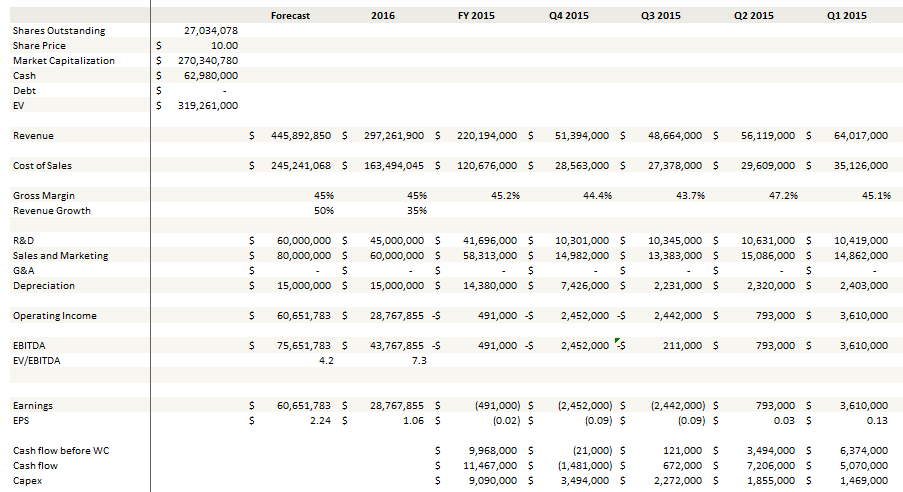
If you step through how the numbers would play out and assume that revenues double at some point, a modest increase in SG&A and no improvement in gross margins as revenues ramp, you can see the leverage to earnings that quickly develops. Note that the company has significant net operating losses that will shelter them from tax:
forecast

Keep in mind that I’m not trying to exactly predict how earnings will ramp.  This is not intended to have the accuracy of a forecast.  Its intended to demonstrate the magnitude of the earnings leverage if the company can make good on their expectations.

I have a position in Vicor and expect the stock to move significantly higher if they can realize their revenue expectations.

Tanker Stocks

After watching the tanker stocks dramatically under-perform for the last two months I decided to take a closer look.  I concluded that you can attribute the negativity entirely to the order book for Suezmax and VLCC’s over the next couple of years.  The slide below is taken from the Euronav September 2015 presentation.
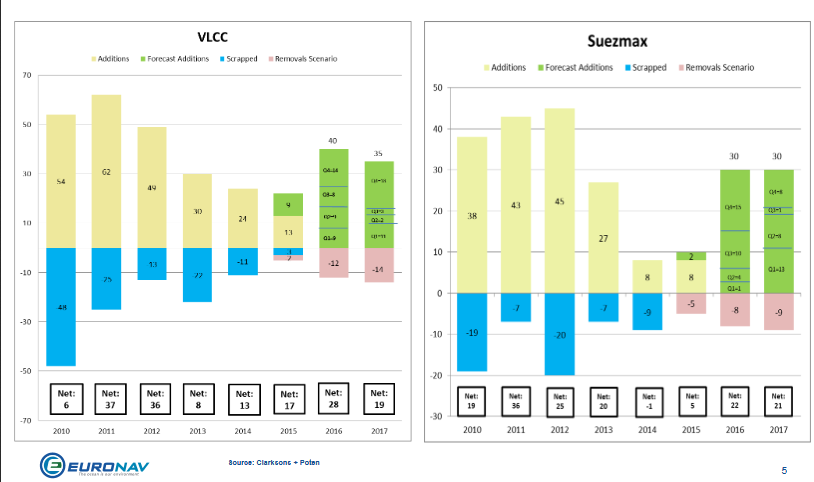
orderbook

Note that since that time the gross additions for Suezmax have fallen by 3 in 2016 and risen by 15 in 2017, while gross additions have risen by 5 in 2016 and 5 in 2017 for VLCCs.

The rule of thumb on VLCC demand is that every 500,000bbl/d of demand requires about 15 ships.  The new ships being added covers somewhere between 1Mbbl/d to 1.5Mbbl/d of additional demand.  This seems to be inline with 2016 demand expectations, which I believe are around 1.2Mbbl/d according to the EIA.

Some of the new build activity was likely a rush to procure ships before the introduction costly NOx Tier III compliance requirements which adds an additional $2 million to $3 million to the price of newbuildings (source here)

Adding it all up, this seems like a balanced market to me.  But the stock prices of the tanker equities are trading like a dry bulk type oversupply was about to occur.   I think the extremely low prices we are seeing in these stocks will be corrected at some point during the year, if for no reason other than the typical rate spikes that we see periodically.

I have taken a basket approach and bought positions in Teekay Tankers, DHT Holdings and Ardmore Shipping. Of all these names I think I like Ardmore Shipping the best because the order book for product tankers, where Ardmore has all of its fleet, is the least concerning but also think that in the $3 range Teekay Tankers seems particularly overdone.

These should be viewed as trades.  A move to $5 in Teekay, somewhere in the $11s for Euronav, $6.50 for DHT or $10 for Ardmore and I will cut them loose.  All of these price targets are well below where the stocks traded at the beginning of the year.  I just don’t think conditions have changed that dramatically to warrant the change in stock price.

Portfolio Composition

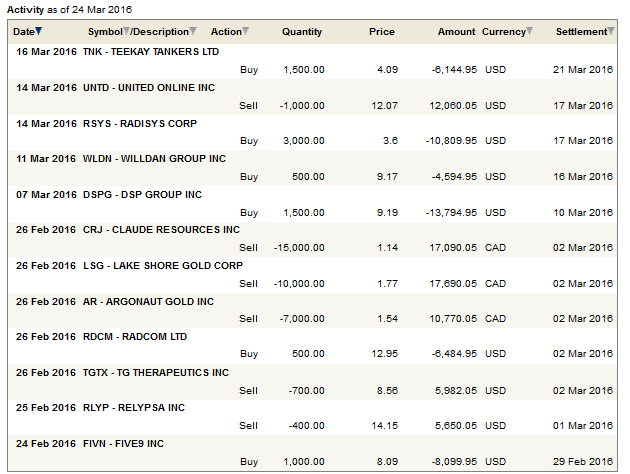
Click here for the last five weeks of trades.
week-246