Skip to content

Posts tagged ‘investment idea’

Sito Mobile – Its Complicated

I bought Sito Mobile about the same time I made this tweet about the company.

I was wrong with the header bidding angle, but have been right about the company (so far).

Header bidding is an advertising technology designed to source the best pricing for ad space on webpages.  This isn’t the ad space that Sito Mobile operates in.   Sito operates in the mobile app ad space.  They have an interesting offering.  Here is how Sito described what they do at the Cowen Conference last year (I’ve paraphrased a little for brevity).
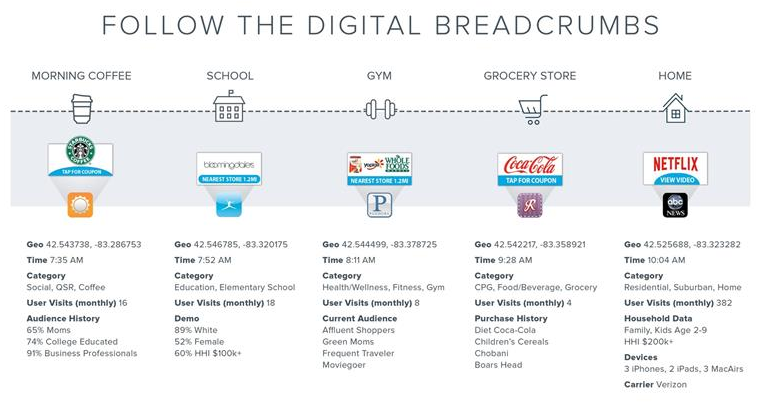
What you see here is a day in the life of a mobile user.  Its important to note that when we interact with our phone and click on an app, we are raising our hand and saying serve me an ad.  Our platform sees every one of those bid requests.  If you look at this user (see timeline above), this person wakes up in the morning and clicks on their weather app.  Every time that they click on an app we gather information.  We gather a minimum of 3 data points and depending on the app and agreements, up to 30 datapoints.  At minimum we gather the geo-location, time stamp, and the device ID.   All the data is anonymized.  That’s the foundation of how we create something called player cards.

The next time we see this device ID at a geo-location its 7:15AM.  It’s an elementary school.  The next time we see the device ID its at a geo-location that is a Planet Fitness.  So you now see a pattern.  Next we see it at a grocery store.  Last we see it at 10:04AM is at a location we’ve seen the device 382 times in the last 30 days, so we can infer that this is likely the home address.  Then we can get additional data from the Wifi about number of devices and carrier for that home address.  We can then layer on third party data from Axiom and DLX and the like to layer on things like household income, demographics around that area, and we start to build a profile.  We never know 100% but in this case we have a high degree of probability that this is a Mom, age 35-44, Caucasian, lives in zip code with average household income of $220,000, college educated, likely own their own home, average length of residence is 7 years, married and has average of 2 children ages 2-9.

That now goes into an audience that we create.  We then layer in her interests and that resulting player card can then be used to target advertisers who want to speak to this consumer.

Once a user has been targeted with the ad, Sito can follow-up on the path that the user follows.  Via it’s Verified Walk-in product Sito can report back whether the user subsequently entered the premises of the ad vendor, thus verifying whether the targeted ad was a success.

While some would legitimately remark that it’s scary how much can be known about you by carrying your smart phone around, the other way to look at it is that it is that the platform should result in more relevant ads being presented to users.  The mobile location history that Sito collects allows it to profile the user, understand their interests and routines, and then target an ad that is appropriate and maybe even useful.  And because of the real-time location data, the ad is also relevant to their current location.  The verified walk-in allows Sito to report back to the advertiser with accurate metrics about the campaigns success.  The value proposition makes sense to me.

The stock price suffered into the new year for two reasons.  First, the company badly missed expectations in the fourth quarter.  The fourth quarter should be the best one for advertising.  Yet media placement revenue was down from $10.4 million in the third quarter to only $8.3 million in the fourth quarter.

This was compounded by news of malfeasance by the CEO and CFO.  Apparently they were making unapproved purchases with company credit cards, debit and withdrawals from payroll funds.  In total $330 thousand dollars that were misappropriated.  In February these executives resigned.

So there was concern that the companies growth trajectory  was failing and concern about the void at the executive level.  The stock plummeted down into the $2’s.

I got interested after the company released its first quarter results.  In fact I think (I can’t remember for sure) I got the idea after reviewing a list of percent gainers the day that they reported.

The first quarter results were better than the fourth quarter. Revenue was down from the fourth quarter (not unexpected given that January is typically a dead month for advertising) but up 34% year over year.  More impressive, the company said that it had its best month ever in April, generating over $4 million in revenue, and they guided to a range of $10 million to $13 million in revenue for the second quarter.  This would be far above the $8.3 million of media placement revenue for the prior year.

So I like the offering and I like the recent growth trajectory.  When I bought the stock at $3 the market capitalization was a little over $60 million, which meant that it was trading at less than 2x forward revenue, quite cheap if the company has indeed regained its growth mojo.  Even now, at $4, its still only 2x revenue, which is not an expensive price tag if 30% revenue growth is really in the cards.

So it’s a simple story.  Growth business, product/service that makes sense, they even have a wealth of data that they have archived over the past couple of years that they are beginning to monetize as data as a service and that will provide an additional revenue stream.  Simple.

Except its not. The complicating factor comes from two activist groups that are looking to replace the board, replace the new CEO and CFO and I think put the company up for sale.

The two groups are the Baksa Group and TAR Holdings.  The latter company is owned by Karen Singer, wife of Gary Singer, who had this interesting article written about them a few years ago.  I didn’t know anything about either of these groups before investing in Sito.  Singer and TAR own over 10% of Sito while the Baksa Group own a little less than 7%.

The groups say that they are not affiliated, though they seem to support each others claims and want essentially the same thing.  What they want is the removal of the executive team (the CEO and and CFO) and replacement of 4 of the 5 directors.  In this filing (one of many) the Baksa Group describes their position and what they are looking to change.

There are lots of complicating and curious angles here.  Just to throw out a bunch of facts: Stephen Baksa was a director of Sito from 2011 to 2014.  The Baksa group appears to be supported on the board by one of the Sito Directors Brent Rosenthal (the only director they don’t want to replace).  One of the Baksa nominees purportedly has a “working relationship” with the Singers.  Some of the Baksa nominees sit on the board or are affiliated with a company called Evolving Systems.  Karen Singer owns 21% of Evolving Systems.  A couple of Singer’s relatives work with Evolving Systems.  And it seems like all of this activism started shortly after a March meeting between Sito management and Thomas Thekkethala, who is the CEO of Evolving Systems and was to become one of Baksa’s board nominees, where they met  to “discuss a potential licensing arrangement that would allow the Company to market its products to Evolving Systems’ customers outside the United States”.  It was 4 days after that meeting, on April 4th, that Sito adopted a poison pill and the activist ball got rolling.

I don’t really know what to make of the activist angle.  Maybe this is all a way for Evolving Systems to take over Sito, maybe there is something else going on.  I really have no idea.  I’ve read through all the filings and I honestly couldn’t pick out any tidbits that gave me certainty about the outcome.  Where we stand now is that the Baksa group has delivered a proxy signed by 58% of common shareholders supporting their proposals to remove the current executive and directors and replace them with the Baksa slate.  Sito has responded that they are having a third party do a count and validate the results and will report back next week.

While I am really not sure about the outcome, it seems to me that its at least possible that this ends in some sort of acquisition of the company.  Management has their backs against the wall with the recent proxy.  The easiest way out of the corner is a takeover, either by Evolving Systems or some other white knight.  And if it doesn’t happen, there are always the fundamentals to fall back on, which is the real reason I bought the stock.
Q1 Earnings: Silicom

Silicom had a good quarter.  They beat on revenue (25.3 million) and they guided to a nice revenue increase in the second quarter ($28.5-$29.5 million).

As I wrote about last month, the rise in the stock price has been mostly due to the large switch fabric NIC design win that they announced in March.  On the conference call management provided more color around this win.

The win is for the design of a new, custom 100G switch fabric NIC to be deployed in datacenter racks.  The design presents a number of technical challenges and they are still working through those challenges.   So far Silicom has received an initial $25 million purchase order and a follow-on $8 million order from the customer.  The PO’s are being written even though the card is still in the beta phase and thus still under development.  The PO’s are to insure that Silicom has components on hand and can ramp production quickly to the $30 million plus run rate once a final design is approved.

Interestingly, Shaike Orbach, Silicom’s CEO, said that they were engaged with 10-15 other cloud players for similar designs.  He tempered those remarks by saying that the sales cycle was long (can take as much as two years), that some of the engagements would be for smaller wins (but some could be bigger) and that the architecture of all cloud vendors do not line up as well with Silicom’s technology as this vendor did.

At any rate though, there is a large pipeline of potential deals.  As an aside, if anyone knows who the existing win is with, please email or direct message me.

SD-WAN

There were also comments around SD-WAN.  They have a similar number of SD-WAN prospects that they are talking to (around 10).  These include traditional telecom vendors that have SD-WAN solutions, start-ups, and even service providers.  Talking directly to service providers is a new development as Silicom has traditionally worked through OEM vendor channels.

There was a bit of color around the potential of the SD-WAN opportunity.  Alex Henderson from Needham asked the following question:

If it’s the entire white label box at the edge, I would think that A, that would be a little bit lower margin but B, a lot of revenue associated with that because we’re talking about 1000s of branches and individual deployments here, that seems like a very big ramp when that starts to kick in. Am I thinking about that right? I mean it seems like a very large number?

Orbach’s response was to agree that potential quantities were “very big” and that they had some competitive advantage in that they could provide features not available from others.  I’m still quite excited about the SD-WAN opportunity.

FPGA Opportunity

One comment that came up a few times on the call was the growing importance of their FPGA solutions.  Orbach said that while the switch fabric win is not an FPGA solution, Silicom’s FPGA capabilities were instrumental in getting the win as the customer expects future generations of the product to require FPGA’s.

At the end of the call Orbach gave more color around the importance of FPGA solutions (my underline):

So first of all I would like to tell you that we think that FPGA technology and solutions around FPGA are going to be extremely, extremely important. We’re investing in that. You understand it may take some time but we believe that it will be extremely important. Just like you have said, I mean one of the reasons I mean there are two I would say trends, not trends, but two events and — well even event is not the right word but two things which are happening together which I believe are important to understand, maybe even three. So one is again the cloud, I mean the cloud, I think that cloud vendors do understand today and that’s by the way why we have been able to success even with that customer that in order for their cloud to be effective, in order to cut down their expenses they need to have several ways or to do offloading within the cloud. Our FPGAs seem to be recognized now almost by everyone as the right technology for the purpose of doing this kind of offloading. I think that although — when I’m saying cloud by the way I mean the whole package, I mean it’s cloud and NFV, SD-WAN virtualization, all that together. So when build systems using these technologies you would need to do offload, the right technology to do offload is FPGA.

Orbach also hinted at collaboration with Intel (and their Altera FPGA designs) and referred to a MOU around FPGA development that he said was important.

I did a little bit more research into FPGA development and this looks like an area that is beginning to hit its stride with more and more use cases.  FPGA designs offer more flexibility, less up front cost and are preferable to vendors that either don’t want to commit a large spend to a custom ASIC design or do not have funds to commit to such a closed end design.  It sounds like the performance gap with ASICs, which has largely been what has limited their use, has closed considerably over the last few years.

In particular I found one white-paper by Altera/Intel that was particularly insightful.  The paper describes 3 evolving use cases for FPGA’s that all seem very closely aligned with Silicom’s strengths.  They are:

  1. Datacenters
  2. 400G cards
  3. Wireless Remote Radio Units

The paper basically suggests that the requirements of the next-gen designs will fit much better with FPGA solutions than ASIC solutions.

While Orbach and the above paper suggest that big FPGA wins are still some time in the future, it really starts to clarify the runway of opportunities for Silicom for me.  I think this could be a multi-year run for the stock as the company seems very well positioned for trends to white-box hardware, offload functionality to secondary NIC cards, and utilize more FPGA based solutions.  I didn’t add to my position on the results, but if there was enough of a correction I certainly would.

CUI Global Fourth Quarter: Slowly inflecting

I’ve had a small position in CUI Global since last summer.  I first wrote about it here.  The thesis has been that their gas measurement technology (called GasPTi) is quite a bit better solution than traditional measurement techniques, that slower than anticipated adoption from utilities has punished the stock but that adoption of the technology is on the verge of inflection.  But even at the time I wrote rather presciently:

Given this trajectory, it’s most likely that even if the story works out it will A. be delayed longer than anyone would have expected and B. have a number of false-starts and hiccups before finally showing consistent growth.

Since that time the corner of that inflection continues to be turned, just not very quickly.  Not surprisingly the stock hasn’t done much.

Until the recent quarter the company gave me little reason to add.  In fact, prior to the quarterly release I reduced my position a little on anticipation that the market would react negatively to what seemed like a near certainty to me: that their major customer for the GasPT product, Snam Rete, would continue to be delayed in installing gasPT units because of a regulatory hang-up, making the  fourth quarter and likely first quarter guidance sub-optimal.  Even though this should have been widely anticipated, small caps are forever inefficient and so I thought it probably wouldn’t be.

That is exactly what happened.   The company reported a crummy fourth quarter revenue number ($19 million versus $23 million in the third quarter), and much reduced sales from their energy segment ($5.6 million versus $7.1 million in the third quarter).  The first quarter guidance was no better.  The stock has sold off since.

Yet I feel tentatively optimistic about the company’s prospects.  I added to my position, but just a little.  Here is my reasoning.

First, though Snam Rete continues to be held up by a regulatory hurdle, I am inclined to believe management when they say that this will be resolved.  They commented that Sanm Rete has a team working with the regulator, that they have worked through similar issues before, and that Sanm Rete is close enough to resolution to have originally thought it would be resolved by year end.

As long as you believe the management story, it doesn’t seem like this is anything insurmountable.  And a single news release noting that the hurdle has been cleared will likely lead to a resumption of Snam Rete’s run rate of 100 GasPT unit installations a month and a significant pop in the stock.

(100 units at $15,000 per unit is $4.5 million per quarter, which would boost their energy segment to almost double the fourth quarter level)

While the poor results and stand still on Snam Rete have taken the focus, the news that has been ignored is that CUI Global did get another big player on-board.  I was way off in my original write-up, thinking such an event would be a huge catalyst for the stock.  I wrote:

I don’t think you can sit on the sidelines and wait and see how it plays out.  Because the next contract, if it happens, will likely be the big move when it happens, and the stock will gap before you can react.

Well they announced that next big player, ENGIE, a large French grid operator, but obviously the stock did not respond as I had anticipated back then.  To be fair they don’t have a signed PO in hand, only an agreement for collaboration and a lot of positive color around the deal on the conference call.  The market probably wants more.

In addition to France, ENGIE also has ties to PetroChina and owns pipelines and LNG in China, a market where there have been discussions about taking the GasPT product into.  So this are potentially two markets that the company can penetrate.  The CEO, Bill Clough, didn’t put a lot of numbers to ENGIE on the call, but in the past has said that the opportunity in France is around 2,500 GasPT units (these would be higher pressure units requiring the VE probe for analysis and that therefore would have a higher ASP then the units they sell to Snam Rete in Italy), and he did on the call refer to negotiations of a 1,000 unit project that are ongoing.

One other development mentioned both in the release and on the call was a change in regulation by the UK gas regulator, OFGEM, which will make GasPT units acceptable for smaller installations.  Clough said that “once approved our European and UK customers will be able to replace gas chromatographs with our GasPT simply because the economics favor our solution”.  I’m not sure how big this opportunity will be, but it is expected to materialize into POs shortly.  They also have the previously announced $40 million engagement with National Grid, a UK utility.

Finally, in the electro-mechanical business they continue to talk enthusiastically about their ICE block solution, which is a software/hardware solution for data centers that is intended to reduce power consumption.  They said that this year they have ICE block units being tested by “several industry-leading data center operators”, mentioning on the conference call  a Fortune 100 DC operator, Fortune 500 DC operator, top tier data center hardware provider (this was all previously announced in this February press release).  They also added fourth company in one of largest ecommerce platforms in the world

I’m not as sure about the ICE block opportunity as the GasPT one.  They are a partnership with a company called VPS, where they are essentially the hardware provider for the VPS software.  VPS describes the ICE Block here, and it doesn’t sound like the hardware is a very important part of it, so what exactly the upside is isn’t clear to me.

Nevertheless even without ICE block, the opportunities with GasPT are enough to keep me interested for now.

While none of this has translated into a positive revenue number or a guidance breakout yet, it all feels very directionally positive to me, and seems more and more like the hockey stick of the inflection is just a matter of time.

RMG Networks Fourth Quarter Earnings: Still waiting for a step in the top line

I had hoped that RMG Networks would have a blowout fourth quarter.  That didn’t turn out to be the case, but I’m still optimistic about the company and am holding onto my position.

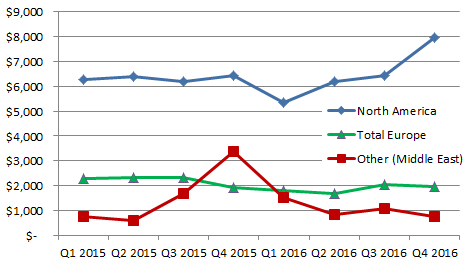
The drag continues to come from the Middle East.  Overall, sales in the fourth quarter were $10.7 million, down from $11.8 million in 2015.  North American sales were up substantially, increasing 25% year over year.  But Middle East sales were down $2.4 million for the quarter year over year, which is just a huge number when you consider that sales for the Middle East were  only $3.4 million for the entire year in 2015.

Below you can see the dynamic.  North American sales have taken off while overall sales have been held back by tough year over year comps in the Middle East.

Now maybe, just maybe this headwind is starting to abate.  First, comps for 2017 are going to be easier because the Middle East generated so little revenue in 2016.   Second, because oil prices are stabilizing they are starting to see things pick up in that region.  On the conference call they said:

I can tell you that obviously we have a plan for every quarter, for each of our geographies and our plan for Q1 for the Middle East we have already completed contractually all the sales required to hit our number for Q1 in the Middle East and that is a dramatic change from 2016

They went on to say they are negotiating another large deal, I believe for the new RMG Max product, with a new customer in the Middle East.  If it closes, the deal would be the “single largest” in the quarter.

The company also provided an update on their partnerships.  It sounds like the Airbus DS Communications partnership (announced in August) has gained the most traction.  The partnership is expected to launch in the first quarter when Airbus releases their next gen 911 system called Vesta which RMG is integrating a display solution with.  They said they had already received $100,000 of orders in advance of the launch.

The Regan partnership, of which I believe the primary motivation is to introduce RMG Networks to new customers, has allowed them to “reach more than 200 companies and have 20 active leads”.

Finally Manhattan, where the update was the least specific of the three, the comments were limited to how the two companies are holding joint webinars and sales training.  Michelsen (the CEO) had said on the third quarter call that they expected to see results with Manhattan in early 2017 but there wasn’t any indication of that on the fourth quarter call.  So we’ll have to watch that one closely to see how it develops.

Overall RMG Networks remains pretty positive about the impact of partnerships.  In response to a question, Michelsen said that achieving 10% of 2017 sales from partnerships was “in the ballpark”.  So we will have to see how 2017 unfolds and whether this forecast holds up.

Finally, the company said the pipeline of sales deals is progressing positively.  The overall size is up about 20% year over year, the larger deal count is up about 1/3 and the average deal size is up 17%.

Overall it was directionally positive quarter, but we need to see this translate into sales.  In my opinion, the first quarter is big.  With the Middle East no longer a headwind, with Europe “improving” and with an expectation of strength in North America, there is no reason that the first quarter won’t be good.  It needs to be or I’m going to start questioning why all the positive “color” is not translating into numbers.  I’m hopeful I won’t have to go there.