Skip to content

Posts tagged ‘investment ideas’

Gran Colombia’s Debenture Redemption looks favorable

On Thursday Gran Colombia announced the warrant terms of a $152 million USD senior secured note offering.  Attached to the notes the company is offering 124 warrants priced at $2.20 per share per $1,000 of note principle.

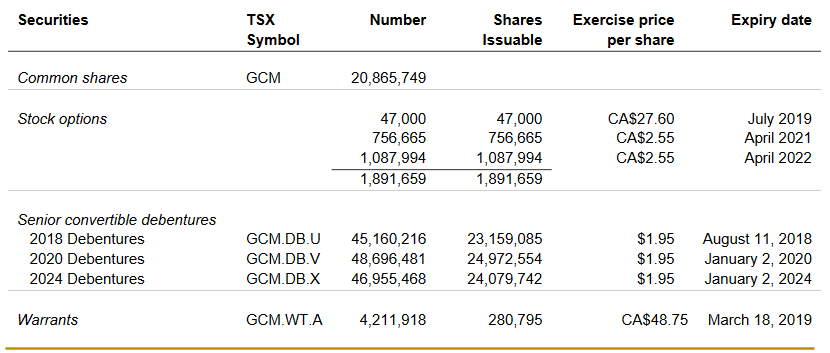
Dilution amounts to 18.8 million shares.  This compares to 72.2 million shares that would have been issued under the existing 2018, 2020 and 2024 debentures if they were fully converted (the table below is from the third quarter MD&A filing).

I think the deal, if it is approved, is pretty positive.  Consider:

Under the prior share structure, a $2.50 share price translated into a market capitalization and enterprise value of about $230 million (~92 million x 2.50 = $230 million).

Under the new notes, and considering redemption of all of the existing debentures at par, the share count is roughly 39 million and the market capitalization is $97.5 million (39 million x 2.50).  The enterprise value is $202 million (97.5 million + $150 million (x 1.25 CAD/USD exchange) – $45 million (assuming in the money warrant conversion of the 18.8 million warrants) – $9 million).

Debenture Holders can participate

As a debenture holder (I own both the stock and some of the X and V debentures) I’m interested in what my options are with the debentures.

The terms gives existing debenture holders the right to participate in the offering:

Existing holders of the Company’s Outstanding Debentures that are eligible to participate in the Offering may (subject to complying with certain procedures and requirements) be able to do so by directing some or all of the redemption proceeds from their current debentures into Units on a dollar-for-dollar basis.

I’m not entirely sure how to read this.  Does it mean that existing debenture holder gets preference to convert their debentures into new notes or is this just on a best efforts basis where an over-subscription to the notes would mean partial allocation?

I’m hopeful that I can direct my debentures into the new notes, but I’m not counting on it.

Its still cheap on Comps

Gran Colombia continues to compare favorably to other gold producers.

One of the quick scans I like to do compares companies on a simple EV/oz produced basis.  I’ll do the comparison and then weed out why some companies trade at lower multiples than others.  Usually there are good reasons.

At $1,400/produced-oz Gran Colombia trades at one of the lowest multiples of the group.  Only the really poor operators that are cash flow negative at current prices (an Orvana Gold for example) are cheaper.   Most of the companies I compare to are in the $4,000 – $6,000 per produced-oz range.  Even the lower tier companies like Argonaut Gold or the struggling one’s like Klondex trade at over $2,000 per produced-oz.

Its still cheap on Cash flow

Even forgetting that it is a gold stock, Gran Colombia remains reasonably priced as a business.

On the third quarter conference call Gran Colombia reiterated guidance for $16 million USD of free cash flow in 2017.   In the fourth quarter they produced 51,700 ounces versus an average of 40,700 ounces per quarter in the first three quarters.

The indication after the strike at Segovia was that new agreements with artisanal miners should lead to more processed ore at the plant.  Based on this and progress at the Segovia mine, my expectation is that 2018 free cash guidance will exceed 2017.

I suggested in my original post on Gran Colombia that I thought $20 million USD of free cash flow was not an impossible goal.  I still think that’s possible.  Assuming the note and debenture deals go through, the market capitalization of the company will be a little under $100 million CAD at current prices.  Even though the stock has climbed since my original post, this still means the stock is at less than 4x free cash flow.

Conclusion

Eventually the note offering and debenture redemption should be positive for the stock.  But it might take a few months.

What’s tricky is that at $2.40 the stock price is right about where the debentures convert.  It isn’t really in anyone’s interest (other than the current debenture holders, though even that is debatable) to see the stock price rise too much above the convert price until the deal is done.

I’ve been adding to Gran Colombia all the way from $1.40 to $2.20.  I see no reason to take any off the table yet.  The company is doing everything right so far.  Hopefully with the new capitalization and simpler structure the market will continue to recognize this.

Wading into another Biotech: Eiger Biopharmaceuticals

As I have talked about on occasion, I am a newbie to biotechs.  To help with my learning curve I rely on a number of biotech investing gurus .  One of them is, Daniel Ward, and over the last few months I have gotten a couple of ideas from him.  One of these is Eiger Biopharmaceuticals (EIGR).

What I like about Eiger is that they have five trials in mid-stage development and plenty of data readouts in the short term.  So (in theory at least) they shouldn’t have been killed by any particular read out.

But that thesis hasn’t played out as I had hoped yet.  The stock tanked a few weeks ago from $11 down to below $9.  The collapse coincided with data presented at European Association for the Study of Liver (EASL) conference in April.   The results were for phase 2 studies that were investigating how their drugs Lonafarnib and (to a lesser degree) PEG IFN Lambda were successful in targeting the Hepatitis Delta virus (HDV).

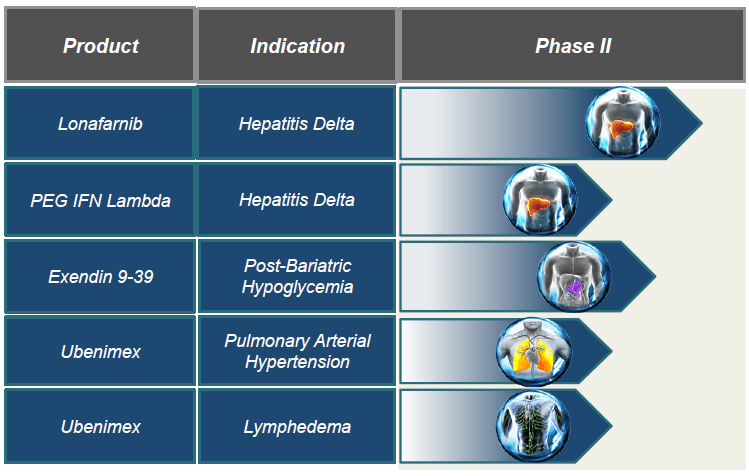
These aren’t the only programs that Eiger has in progress.  In total there are 5 programs, targeting 5 indications with 4 different drugs.  In addition to the two drugs targeting HDV, Eiger has a Post-Bariatric Hypoglycemia program, a pulmonary arterial hypertension program and a Lymphedema program.  All of the programs are in Phase 2.

I’m not going to go into all the programs in this post (its long enough already).   I’m going to focus on the Phase 2 results for Lonafarnib that were presented at EASL.   For more detail on the other programs, there is a good presentations archived on their website from the BIO CEO conference that describes all the programs and gives some background into the HDV indication that I won’t get into here.

Eiger and HDV

So to recap, Eiger has two drugs targeting HDV: Lonafarnib, which they obtained from Merck, and PEG-IFN Lambda (Lambda), which came from Bristol Myers.  Both of these drugs are in Phase 2 of development.

Three phase 2 studies were presented at EASL.  LOWR HDV-2, 3, and 4 as listed below.  The LOWR HDV-1 program had been completed and presented in 2015.  LOWR-2 had already had early results presented in 2016.  LOWR-3 and LOWR-4 were brand new data:
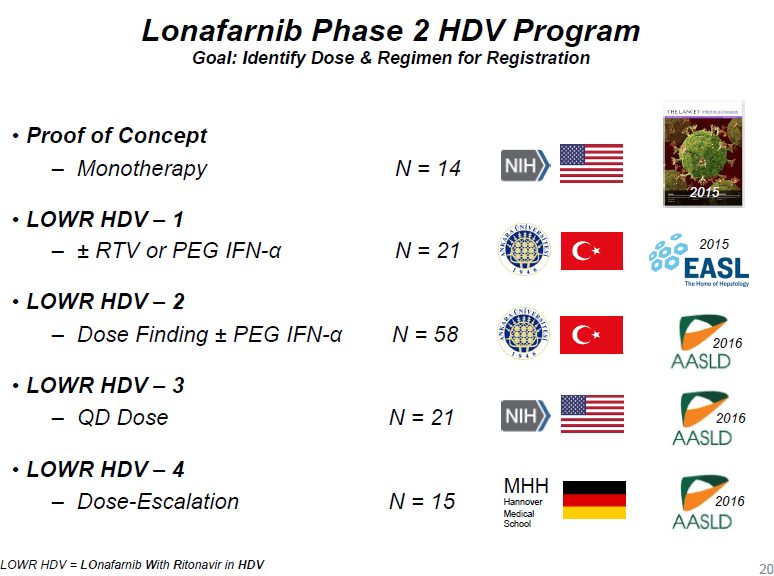
The LOWR-3 and LOWR-4 programs looked at different dosing options of Lonafarnib boosted by another drug called Ritonavir (Ritonavir is a drug used for HIV and you add it to the mix to improve efficacy).  LOWR-2, which also looked at dosing, had an additional wing of the study where a number of patients trialed a 3 drug cohort that included PEG-IFN-Lambda in addition to Lonafarnib and Ritonavir.  This was the only part of any of the studies tha looked at Lambda, which will have its own results presented later this year.

So what happened to make the stock tank on the results?  First, they weren’t perceived to be as good as earlier data.  The most apples to apples comparison that can be made is between the 100mg leg of the LOWR-3 program and the LOWR-1 program.   Here are the results from the earlier LOWR-1 program after four weeks:
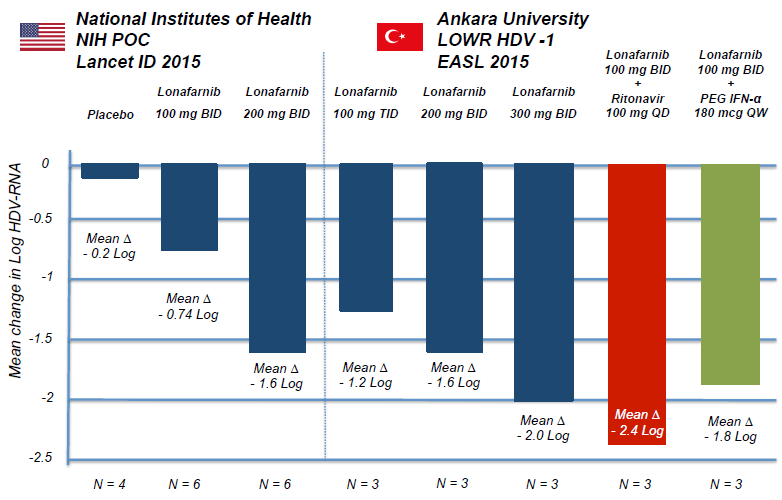
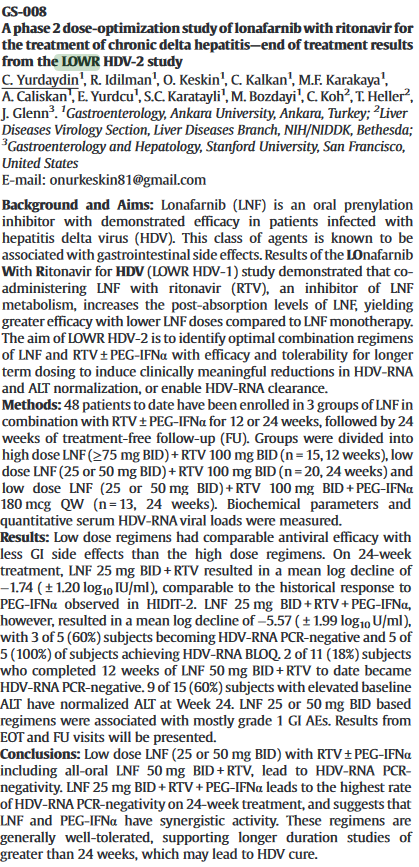
The LOWR-3 program gave 100mg of Lonafarnib and 100mg Ritonavir once daily for 12 weeks to 3 patients. So that should be comparable to the red bar above. The abstract from LOWR-3 is below. The relevant sentences are about 3-4 lines down in the results section (ignore the highlights, they are just artifacts of a word search I was doing).
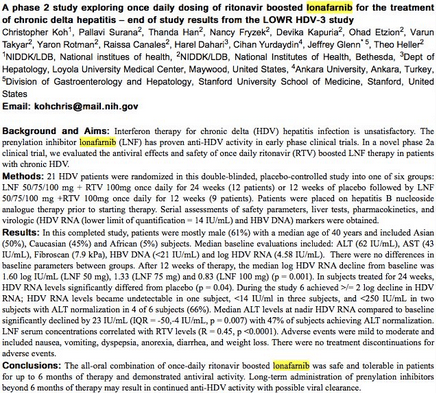
The mean log decline for LOWR-3 at the 100mg dosage was 0.83 log IU/ml.   This is quite a bit less than the red bar from the earlier program.

The LOWR-3 study was more comprehensive than just the 3 patients taking 100mg Lonafarnib for 12 weeks.  There were also 3 patients at a 75mg dose and 3 others at 50mg that took the drug for 12 weeks (I’ll talk more about these in a second). In addition to this there were 12 more patients given the drug for 24 weeks (at the same dose increments of 50mg, 75mg, and 100mg).  In the abstract it said that six of these 24 week patients saw greater than 2 log IU/ml decline in HDV RNA, so that’s good.  But there was no mention of an average HDV RNA decline for all 12 patients, which seems an odd omission.  It would be nice to see the entire paper to get all the data.

A second study, LOWR-4, looked at an increasing dosage.  In this study 15 patients were given gradually increasing dosages of Lonafarnib.  They started 50mg Lonafarnib, escalated to 75mg if tolerated and then to 100mg.  They were also give 100mg of Ritonavir throughout, just like the other study.  Below is the abstract.
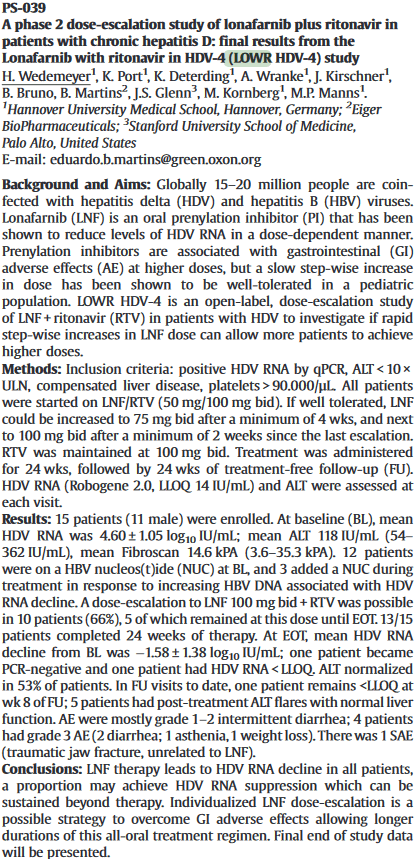
The mean decline in HDV RNA for this study was 1.58 log IU/ml which, while below the 2.4 log IU/ml from the LOWR-1 study (remember again the red bars from above), is not too bad considering the dose was lower for some of the study.

Maybe the more interesting take-away from the LOWR-4 study was that the standard deviation of patients was +/- 1.38.  I Maybe misunderstanding what that means but it seems like a lot of dispersion to me.  I suspect it suggests that the drug performance has a large degree of variability in different patients.

So far what I’ve described is how Lonafarnib didn’t work as well as previous studies, but that it still worked pretty well.  There was a definitive decline in HDV RNA levels, and it was well tolerated in all 3 studies, so there is no reason a patient couldn’t stay on the drug longer to presumably greater affect.

I think the final piece of the puzzle of why the stock went into a tail spin is evident when we look back at the 12 week dose comparison from the LOWR-3 study (the one I said I’d come back to).  I briefly mentioned how in addition to the 100mg Lonafarnib arm there were other patients taking 75mg Lonafarnib and 50mg Lonafarnib along with Ritonavir.  A comparison of the results of these different wings is surprising:

After 12 weeks of therapy, the median log HDV RNA decline from baseline was 1.60 log IU/mL (LNF 50 mg), 1.33 (LNF 75 mg) and 0.83 (LNF 100 mg) (p = 0.001)

According to the above, the lower dosed patients had a better response(?!?).  This is odd to say the least.  I don’t think the market liked that.

The LOWR-2 results also showed increasing the dosage had a murky impact on efficacy.  I’ve pasted that abstract below.  As I mentioned earlier, this is the second presentation of LOWR-2, as it was completed earlier than LOWR-3 and LOWR-4.  There is a video of the earlier results that were presented here.

As the abstract describes, one arm of the study had 25mg Lonafarnib twice daily along with 100mg Ritonavir.  Those patients saw a mean log decline of 1.74 log IU/ml (albeit for 24 weeks), quite a bit better than the higher dosed 12 week patients from the LOWR-3.  I realize this comparison is not quite apples to apples, but again, it adds to the cloudy picture around efficacy and increased dosing.  Indeed the study concluded that “low dose regimens had comparable antiviral efficacy with less GI side effects than the high dose regimens.”

By far the best piece of news from the LOWR-2 study (and I think what the market is really overlooking) was the outsized effect of the arm that used Lonafarnib, Ritonavir and Lambda together.  Repeating the relevant excerpt from the abstract (my underline):

[Lonafarnib] 25 mg BID + RTV + PEG-IFN alpha, however, resulted in a mean log decline of -5.57 ( ± 1.99 log10 U/ml), with 3 of 5 (60%) subjects becoming HDV-RNA PCR-negative and 5 of 5 (100%) of subjects achieving HDV-RNA BLOQ

In the conclusion the authors speculated at a cure:

NF 25 mg BID + RTV + PEG-IFN alpha leads to the highest rate of HDV-RNA PCR-negativity on 24-week treatment, and suggests that LNF and PEG-IFN lambda have synergistic activity. These regimens are generally well-tolerated, supporting longer duration studies of greater than 24 weeks, which may lead to HDV cure.

Note: In my original write-up I mistakenly equated PEG-IFN alpha with PEG-IFN Lambda.  I didn’t pay enough attention to the Greek symbol being used.  These are different drugs.  Alpha was used in the 3-drug tests with Lonafarnib that I talk about here.  But in future tests Lambda will be used.  Lambda is the drug that Eiger owns.  Eiger says that Lambda has similar downstream signaling pathways as Alpha and that because it targets a different receptor it is expected to have less side effects.  But obviously this means there is a little more uncertainty than if Lambda had been used in the 3-drug trial.  So my conclusions below are a little less pronounced.

To get a better sense of just how well the 3-drug cohort worked, I snipped this screenshot from the earlier presentation of the results.  The 5 patient group taking Lambda in addition to Lonafarnib and Ritonavir is in green.
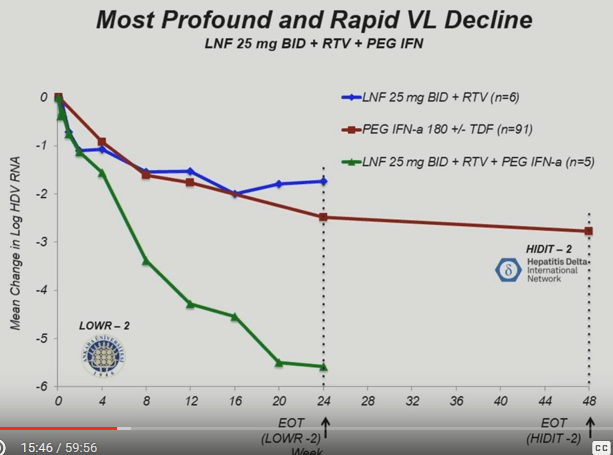
This seems quite promising.

What do I think of all of it?

Well for one I think it’s a great learning experience for me.  I’m digging into data and trying to make sense of it, and at the end of this investment I’ll be able to look back and see what I got right and what I got wrong and hopefully learn a lot for the next time.

With respect to the HDV phase 2 results, I suspect that the stock has overreacted.  I understand that the results are messy, but there is clearly efficacy here.  Maybe the most important point to consider is that Lonafarnib is producing a large standard deviation and these are a small sample of results.  So the noise is producing some inconsistent data.

Moreover, it seems very significant to me that the 3 drug combination that includes Lambda had such impressive results.   With two drugs in development for HDV there are a number of ways Eiger can win here.

The other consideration that I haven’t focused on in this post is that this is only one of Eiger’s programs.  As I mentioned earlier they also have a Lambda program, a Post-Bariatric Hypoglycemia program, a pulmonary arterial hypertension program and a Lymphedema program.  Each of these are in Phase 2 and will have read-outs this year.
There are a lot of shots on goal here.  And this is a $70 million market capitalization stock with $60 million of cash, so its not pricing in a lot of success.  Again, I would recommend going back to their presentations to learn more about the other programs.  I’ll probably talk more about each of them as new data comes out.
Talking about the losers: RUBI, NVTR and BVX

I have a lot of losers.

My investment methodology leads me to take small positions in stocks that I’m not entirely sold on.  These are cases where I haven’t had the time to investigate all the details, or maybe I’ve looked at the company closely and while I see a big enough pay off to justify some risk, I’m still not sure about the odds.

Rather than stay away from these stocks, I take small positions and see how they play out.  I don’t know why this works for me, but it does.

There are two potential consequences of this strategy.

  1. The stock goes up. I maybe am not completely sold on the story yet, but I tend to add anyways. With a bigger position I do more work, get some helpful hints from others, gain confidence in the story and have a winner
  2. The stock goes down. In this case having some skin in the game motivates me to look harder.  When I do I generally either find something I really like and break my rule by adding to my position on the drop, or find something I don’t like, take the loss and move on.

I think the classic example of the second scenario playing out positively is my old position in MGIC in 2012.   I bought the stock at maybe $2 or $2.50, at the time didn’t really understand the details of their mortgage insurance business (I would argue few did!), especially not how the capital requirements worked.  I added a bit on the way down, but more importantly figured out how they allocated reserves and how the dynamics of their statutory balance sheet worked.  Thus I knew exactly how important it was when management said on (I think) the second quarter 2012 conference call that they were getting calls from investors interested in raising capital (the company’s issue all along was liquidity), and I was adding stock while the call was still going on.

I never would have learned enough to pick up on this detail had I not already had a position in the stock.

So that is the positive side.  The more common result of course is that I find something I don’t like and I sell.  Take my lump (usually 10-20%) and move on to another idea.  The important thing is to cut them quick if they aren’t panning out.

Somebody once messaged me (derogatorily I might add) that I should just throw darts.  I like to think I’m a little more discerning then that, but I get the point.  My reply is that this works for me and if you think you can beat the returns I seem to pull of for the time I have to put into the research (I work full time and have two kids), then more power to you.

Here are some thoughts on three losers I’ve had recently.

Rubicon Project

Why spend hours writing a free blog? Well one reason is because as you are writing something up it becomes quite clear if your idea is full of shit.

I started writing up Rubicon Project 2-3 weeks ago.  I couldn’t finish it.  I put it down, came back to it, did some more research.  I just couldn’t figure out what the header bidding disruption meant to their business.

Management said it was manageable.  That it would be a headwind to their desktop advertising but that they would get past it.  But I read that header bidding was going to compress margins for everyone.  That there was more disruption ahead with the adoption of server side heading bidding.  It didn’t add up.

The fourth quarter results are out, and while the company actually performed admirably in the quarter, the first quarter guidance was just awful.  They guided revenue in Q1 in the $40’s (millions) when analysts had expected it in the $60’s (which was still a notch down from the year before).  Thankfully I kept my position small, and reduced a little ahead of earnings because I couldn’t make sense of it.  I sold the rest in after hours.

Nuvectra

I have to give a hat tip to @Rubicon59 (no relation to Rubicon Project) for helping me suss this one out.  I bought Nuvectra because I thought they had a very good technology (spinal cord stimulation with their Algovita system) and a fairly large total addressable market and so with the right sales push they could generate some impressive growth.  They had a lot of cash, almost their entire market capitalization.  And it was even a legitimate spin-off idea, even had an SA write-up on them.

They still might generate that growth.  Probably will.  But the cost side of the curve is just so out of whack, it’s hard to see how they do it before running out of cash.  Particularly after announcing a fourth quarter, where G&A and R&D costs were (respectively) up from $8 million to $10 million and $3 million to $4 million sequentially.

Just to back of the napkin it, the company generated about $12 million of revenue in 2016. We can say that at least roughly, the Algovita system is going to give them 50% gross margins.  R&D and G&A costs added up to $42 million.  These costs increased as the year went on.

The company said at the Piper Jaffrey conference last November that they figured a good target for a sales region was $1-$1.5 million in 12-24 months.  Right now they have about 50 sales regions.  So you assume they hit the high end of that, they can generate $75 million of revenue, and at 50%, $38.5 million of gross margins.  Problem is that’s still less than current expenses.

I realize they also generate some component sales, but even so the numbers don’t come close enough. and It seems like anything other than the steepest of ramps and they are going to be looking to raise capital in a couple of quarters.  So I’m out.

Bovie Medical

I wrote about Bovie in my last portfolio update.  I provided a pretty detailed explanation as to why I thought the concerns over Hologic were likely unfounded and therefore why I took advantage of the drop in the share price.

It was a well researched, well reasoned piece of tunnel vision.

I spent a bunch of time looking at Hologic and trying to confirm or discredit the idea that Hologic was a concern.  What I didn’t spend any time is whether the third quarter numbers were goosed by Hologic even though they hadn’t actually sold any devices.

How is that possible?  I provided most the information that you needed in my post when I said:

The average selling price (ASP) for a generator is much higher than a hand piece so Bovie generates a significant slice of their revenue from it.  From the 2015 fourth quarter conference call :

I guess when you think about it, the generator ASP is north of $20,000, the hand piece ASP is $375

The other relevant piece of information comes from the third quarter call, where Bovie noted that their partners had been purchasing machines for their sales ramp.

So in the [revenue] number our demo product that we armed both Hologic and Arteriocyte sales forces with that is in the number

What never occurred to me (and what I am kicking myself over) was that obviously the third quarter J-Plasma sales were juiced by demo generators.  Keep in mind J-Plasma revenue was a little over $1 million in the third quarter.  It’s not a big number, it only takes a couple of extra generators to skew it significantly.

Unlike Rubicon and Nuvectra, I reduced my position a bit but did not exit it entirely.  Bovie has a lot of positive catalysts on deck in 2017; two new iterations of J-Plasma that will be marketed in the second half, results from a clinical study using J-Plasma that should raise awareness among surgeons, a new partner to replace Hologic (it sounds like they have a number of interested candidates) and a sales ramp from their CONMED partnership for the PlazXact Ablator.

So there is enough reason to continue to hold the stock, especially down here below $3.  But I sure wish I would have saw what was in front of my face a little bit sooner.

Combimatrix: Just too cheap

I stumbled on Combimatrix shortly after taking a position in Nuvectra.  The companies have similarities.  Both are very small biotechs trying to gain momentum on sales.  Both have showed recent growth.  And both have a large part of their market capitalization tied up in cash.

But Combimatrix is cheaper.  To be honest, I don’t quite understand why Combimatrix is as cheap as it is.  It’s possible that there is an element to the story I a missing.  When I bought the stock, in the low $3’s, the market capitalization was a little over $8 million.  It’s closer to $10 million now.  The company has over $4 million in cash and very little debt.

While there are many biotechs around that boast high cash percentages (Verastem, for example, remains with a cash level well over 2x their market capitalization) these companies aren’t generating any revenue.  Combimatrix has a revenue generating business, and the business is growing.

Combimatrix provides reproductive diagnostics testing.  They offer three types of tests: microarray, karyotyping and fluorescent in situ hybridisation (FISH).  I believe these are the only three commonly used testing methods for such diagnostics.

Of the three, Combimatrix’s primary focus is on microarray testing.   It makes up about 70% of their testing volumes.  Microarray is (I think) the newest test method (based on what I’ve read, though there is some indications that FISH being applied to some reproductive diagnostics is new).  It seems that microarray tests have the advantage over karyotyping and FISH in that they provide more information about potential problems (from this article):

chromosomal microarray, detected more irregularities that could result in genetic diseases — such as missing or repeated sections of genetic code — than did karyotyping, which is the current standard method of prenatal testing.

But it is also a more expensive test.  Which has led to problems getting insurance coverage:

The tests can cost $1,500 to $3,000 in addition to the cost for the amniocentesis or C.V.S. procedure. Karyotyping can cost $250 to $1,500. Insurance does not always pay for microarray testing since it is not considered the standard of care for prenatal testing.

Looking back I believe that this is where some of Combimatrix’s problems have come from.  Insurers have been slow to adopt microarray tests into their coverage.  The company hasn’t ramped revenue they way they had anticipated.  There have been cash issues, and capital raises.  But this seems to be changing.  In August Combimatrix put out a press release with the following comment:

“There are now at least 20 health insurance providers this year that have revised their medical policies to include coverage for recurrent pregnancy loss testing,” said Mark McDonough, President and Chief Executive Officer of CombiMatrix.

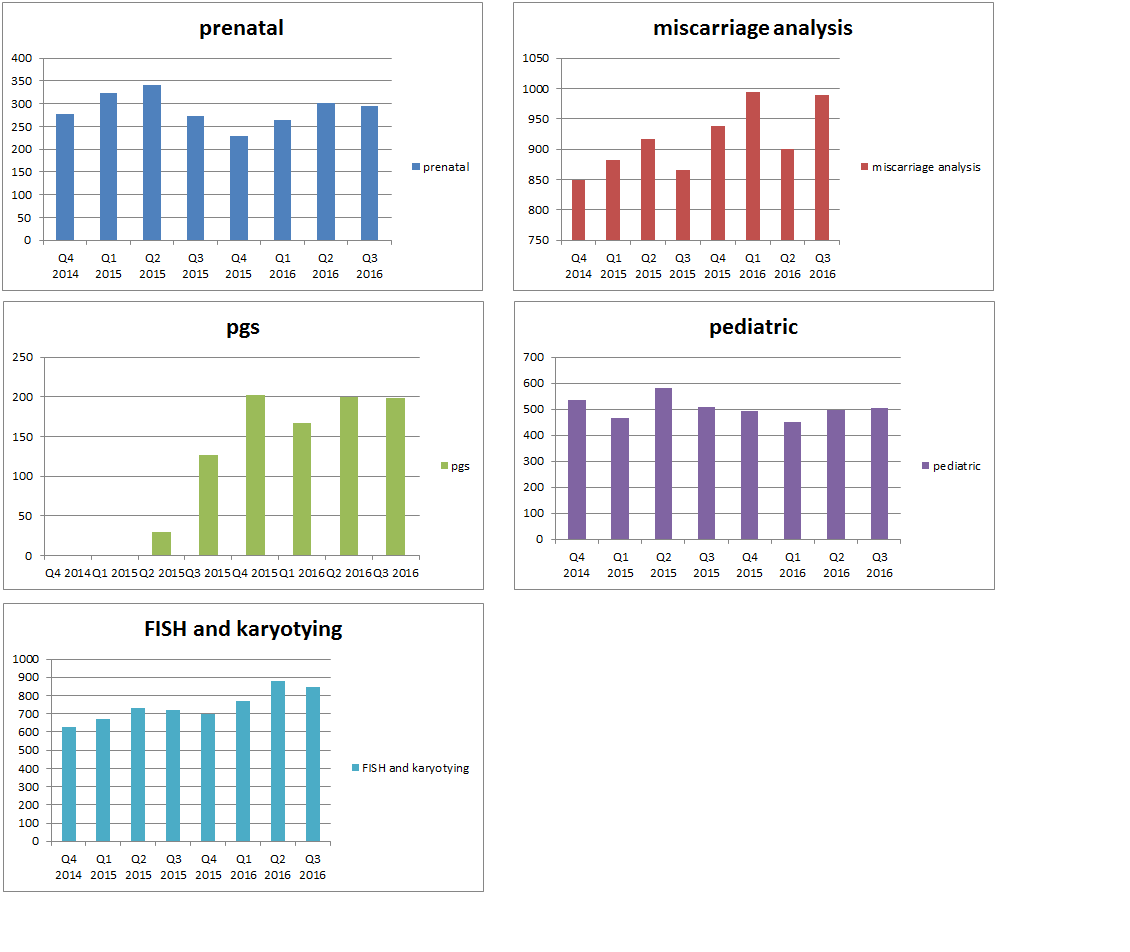
Below are charts showing volume growth for the 5 segments that Combimatrix reports.  Growth is lumpy, but overall there has been a trend towards increasing tests.  They also seem to have pricing leverage, as similar charts showing revenue by product line (not shown) trend more clearly left to right.

volumes

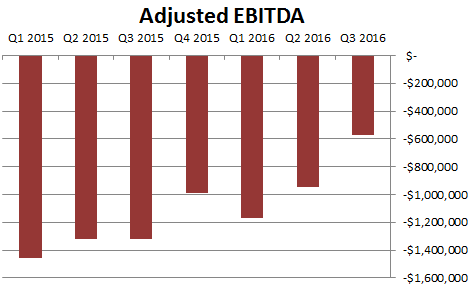
Management has reiterated on a few occasions (most recently in the third quarter conference call) that they will be cash flow breakeven by the end of next year.  This seems reasonable as adjusted EBITDA has been trending towards that level for 2 years now.

adjusted_ebitda

So it’s a cheap stock with a business that is pointed in the right direction.   The only reason I can think of for the stock being so cheap is the risk of further dilution.  As they approach the breakeven mark this concern diminishes and hopefully the stock price responds.  At least that is my expectation.  We will see.