Skip to content

Posts tagged ‘mortgage insurance’

Things that worry me about the Mortgage Insurers

I have been devoting a lot of space to the mortgage insurers, and while the stocks make up a decent percentage of my portfolio, it would be impossible to justify the ink spilled if it were judged only in proportion to position size.  But this is a new business for me to learn, and it is a complicated business with a lot of risk.  Radian and MGIC appear to have a great deal of upside if everything goes right, and a similar amount of downside if everything goes wrong.

Well I did some thinking over the weekend and came up with a list of 5 things that worry me the most about these stocks.  Below I have investigated each worry and became familiar (if not comfortable) with the reality of the risk.

1. Rescission and Denial activity assumptions may be off, particularly for Radian

Rescission and Denial activity is my biggest concern and so I am probably going to devote the most space to it.

Both Radian and MGIC are recording historically high levels of rescissions and denials.  At the end of the second quarter Radian had $532 million of future expected rescissions and denials baked into their loss reserves, gross of $208 million reserved against the reinstatement of previously rescinded policies (called the IBNR reserve).  MGIC had $700 million of booked reductions in losses due to rescissions and denials and $276 million of IBNR reserve.

This is significant in comparison to the capital of each company, which is roughly $1 billion for Radian and $1.5 billion for MGIC.  If there were a significant revision to the assumptions involved, it could impact capital quite a bit.

For Radian, of particular concern is the growing number of denials.  In the first quarter Radian had $177 million of denials where they held the first loss position (was likely to take a loss on the default) versus only $33.3 million of rescissions.  Denials have become much more prevalent than rescissions, which is opposite of how things have been historically.

Below are denials and rescissions at Radian over the last 11 quarters.
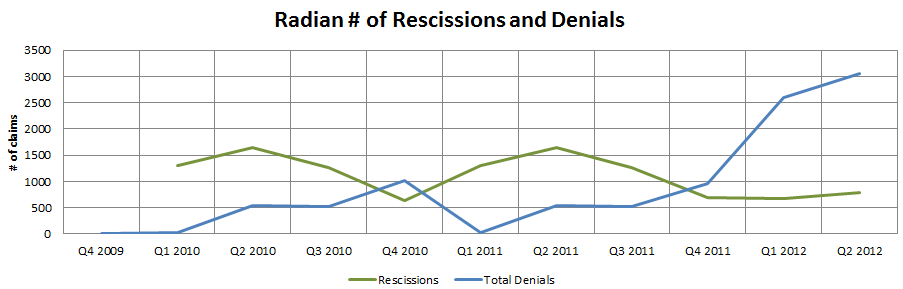
What is worrisome about the increase in denials is that a denial is much more likely to come back as a resubmitted claim than a rescission is.

While denials and rescissions are often lumped together, they are quite different in definition.  Whereas a rescission occurs when there is something wrong with the original documentation that voids the insurance, a denial occurs when a servicer hasn’t provided all the documentation.  Problems with the documentation are difficult to fix, whereas an absence of documentation simply requires that the servicer dig it up and present it.  When the servicer comes back to Radian with said documentation, Radian has to reinstate the claim.

Radian put it like this in their first quarter 10-Q:

Due to the period of time (generally up to 90 days) that we give the insured to rebut our decision to rescind coverage before we consider a policy to be rescinded and removed from our default inventory, we currently expect only a limited percentage of policies that were rescinded to ultimately be reinstated. We currently expect a greater percentage of claims that were denied to ultimately be resubmitted as a perfected claim and paid.

Radian assumes that 50% of denials will come back to the company in the form a resubmitted claim.

As we’ve previously disclosed, approximately 50% of the currently outstanding denials are expected to be reinstated mainly as a result of servicers ultimately finding and producing the documents necessary to perfect the claim within the time frame allowed under our master policy.

So Radian has partially accounted for the increase in denials the last couple of quarters by increasing their reserve for expected resubmissions (the IBNR reserve).  The IBNR reserve increased from $170.6 million at year end to $249.5 million at the end of the second quarter. While the increase is significant, it’s still a long way from the $177 million of first loss denials that Radian had in the first quarter and the $174.6 million they had in the second quarter.  It remains to be seen whether the company has to further add to their reserves to account for the number of denials that come back to the company in the form of a resubmitted claim.

Radian has tried to downplay the impact if they had to do such a reinstatement.  The company said the following on the Q2 conference call:

 While our experience [with denials] clearly supports this estimate, it is important to note that this assumption is not very material to our overall loss reserve estimate. For example, even if the reinstatement percentage shifted significantly to 75, the resulting addition to our total loss reserves will only be about $97 million.

I’m not so sanguine about the company taking a $100 million hit.

The mitigating factor is that Radian can back up their expectations of future reinstatements with historical data.  Every quarter Radian provides a table of how many rescissions and denials have stuck (not come back as a resubmitted claim) as a percentage of paid claims. The data below, which they disclosed in their Q2 presentation, is for the past 9 quarters.
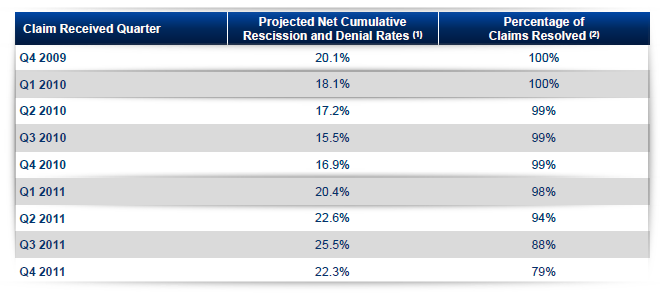
The second column shows rescissions and denials as a percentage of total claims for the period.  The third column shows the percentage of claims that have been resolved from that quarters bucket.

For example, if the number of claims resolved is 100%, as it is for Q4 2009 and Q1 2010, then the Projected Net Cumulative Rescission and Denial Rate has been determined completely from the actual finalized settlement of claims.  To the extent that the percentage of claims resolved is less than 100%, the Projected Net Cumulative Rescission and Denial Rate may still change as the remaining claims are resolved.

With 80%+ of claims resolved, we can be confident that the final percentage of rescissions and denials is going to be pretty close to the percentage stated in column 2.

Well I wanted to see how well the actuals compared with the original estimates, so I took the above and compared it to the estimates of rescissions and denials that Radian had disclosed for each quarter.  For each quarters estimate, I recorded rescissions at face value and cut the number of denials in half to reflect Radian’s estimate that 50% will return as a resubmitted claim.

If Radian was being too aggressive with denials and rescissions, it should show up as a discrepancy between the original estimate and the actual finalized claim settlement.

The conclusion (shown below) was that the eventual rescission and denial to claim ratio matches pretty closely to what the company would have estimated it to be.

Given the above, I don’t know if I really buy the argument that Radian has been more aggressive on its claim management practices than MGIC and that this is going to bite them in the ass at some point.  Radian appears to have done a good job in estimating eventual rescission and denial levels.

There are a couple of other conclusions that are worth discussing.

1. Radian clearly has a higher rescission and denial rate than MGIC, especially of late.
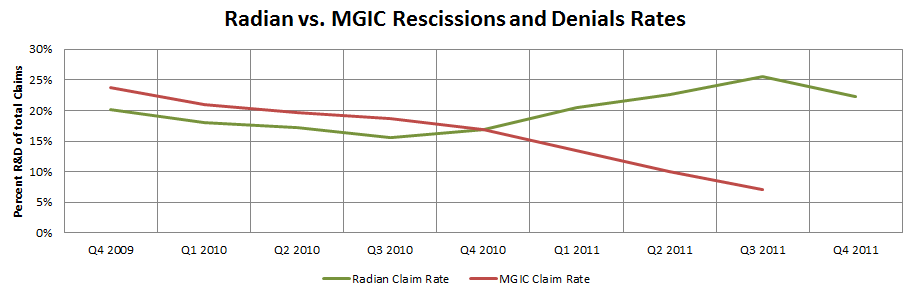
Part of the reason for the drop off in rescissions from MGIC is that MGIC is in a dispute with Countrywide, who is rebutting the rescissions that have been putback on them, and they have chosen not to rescind any Countrywide loans until the dispute is resolved.  Countrywide makes up about 20% of MGIC’s delinquent inventory.  So that’s part of it.

Yet even if you make a liberal allowance for Countrywide loans, at the very most it would raise MGIC’s rescission rate (for example) Q3 2011 to ~13%.  This is assuming all remaining unsettled claims belonged to Countrywide and were rescinded.  It still wouldn’t put MGIC in Radian’s ballpark.  Clearly Radian has something different going on than MGIC.  I’m just not sure what it is.  Perhaps Radian really is just better at evaluating claims?

2. Radian’s Single Servicer Denials
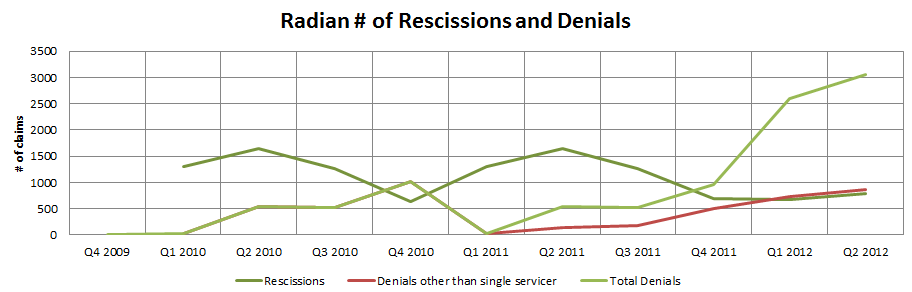
The above chart is similar to the one I showed earlier.  It illustrates the number of rescissions and denials at Radian by quarter, but with the difference that now the denial activity has been broken out a bit further.  Beginning with the Q2 2011 quarter, Radian further delineated its denials between those that have come from a single servicer, and those that have come from everyone else.

What you can see is that while rescission rates at Radian are falling, and while denial rates other than the singled out servicer are fairly stable, there has been a huge increase in denials from this one mystery servicer.

Of course, the obvious question is whether Radian’s assumption that only 50% of those denials are coming back into claim is valid given the high percentage of those denials from this one servicer.

I don’t know the answer to that, and we won’t get better visibility until the next quarter when Radian provides their actual rescission and denial to total claim rate percentage.  Until that time, what we can say is that based on the data so far, it appears the assumption is on target.  The one quarter we can look at is the Q4 2011 quarter, which was when the trend of higher single servicer denials really began to take off.  And for that quarter, Radian looks to have predicted eventual rescission and denial rates fairly well.   Go back to the chart labeled “Radian’s ability to Predict Rescissions and Denials” and note that for Q4 2011, actual rescission and denial rates have been slightly higher than predicted.  And this is with 79% of total claims resolved, so its not a small sample size.

What to make of it all?

I understand the concern; the rescission and denial rates for Radian are high, both historically and versus their competitors.  I have no answer as to why they are consistently higher than MGIC.  But Iargue that Radian has been running at higher rates since Q1 2011, and with most of the claims from Q1 to Q4 2011 resolved, the evidence is clear that Radian was right on the mark, if not a bit conservative, in its assumptions.  Whether this continues with the recent trend of increased denials is open for debate, but as I pointed out, the data we have so far (Q4) again points to the accuracy of Radians estimate.

2. There is an assumption that a large number of late stage delinquent loans will not result in a claim

This one is a concern for both Radian and MGIC.  MGIC has already taken a fairly big hit in the second quarter because cure rates on their late stage delinquent loan bucket (ie. loans that have been delinquent for 12 months or more) were not running as high as they had originally expected.  The company was cautious on the conference call when discussing whether this was a one time event or whether further revisions might be required in future quarters.  They said they didn’t think so, but that they would just have to wait until the data came in.

I’ve talked about this issue in some depth in my post on Radian’s second quarter.  While from what I can see MGIC does not provide claim rates broken down by bucket in their material, Radian does.  As shown below, Radian assumes that only 47% of the existing delinquencies (net of rescissions and denials) that have been around for at least 12 months will result in a claim.

Intuitively, one would expect something pretty close to 100% of delinquencies that have been around at least 12 months to result in a claim. That it isn’t, is the concern.

The mitigating factor is that, as Radian pointed out in the following slide from its quarterly presentation, a large percentage of these 12+ month delinquencies have been around for 2+ years.
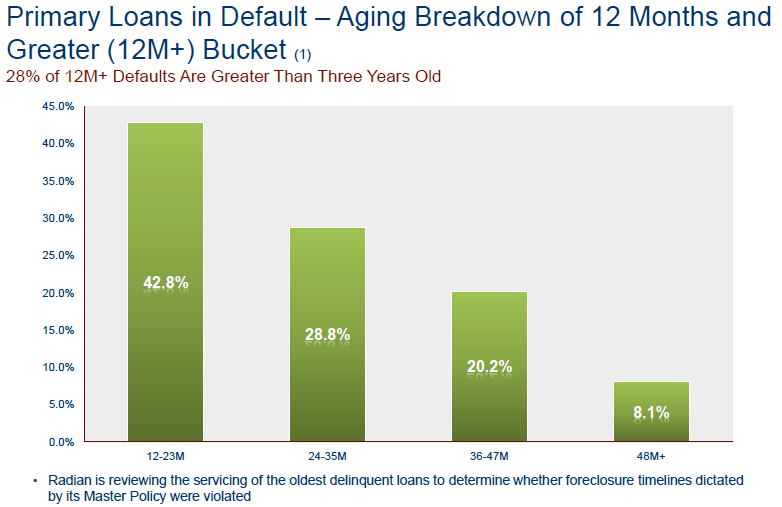
Of course that delinquencies are hanging around for years makes as little intuitive sense as does the idea that only 2/3 of them are going to result in a claim.  Clearly something is going on with a large percentage of these loans, and perhaps whatever is going on is going to make them less likely to go to claim, but I have yet to hear a coherent explanation as to what it is that is going on. As a I wrote previously:

Clearly these loans are broken.  I mean there is a servicer at the other end of these loans and that servicer has every interest to get that loan through to foreclosure as quick as possible.  I find it hard to believe that there are servicers out there eating the costs on defaults for 2+ years before getting the loan foreclosed on.

Until we actually start seeing these loans clear out, this remains an uncertainty, and with so many loans delinquent and in this 12 month bucket, a little bit of error in the assumptions involved could lead to either a big gain or loss to the companies involved.  Going back to Radian’s slide of Primary Loans in Default, the 12+ month bucket accounts for about $1 billion in loss reserves.  If Radian is off on its eventual claim rate assumption, we are talking about a whoopsie in the hundreds of millions of dollars.

As I said, at least as far as I can tell MGIC doesn’t provide enough information to determine its late stage claim rate from their quarterly material, so you can’t draw the specific conclusions you can with Radian.  But you can back out some information based on comparisons to Radian, what management has said on conference calls and from some of the data that they do provide.

First of all, MGIC said on the Q2 2012 conference call that the claim rate for new loans was assumed to be 25%.  Presumably this is referring to 1-3 months delinquents, which would mean that their projection on this bucket is the same as Radian.  Now lets compare loss reserves per default. Radian had reserves per default of $28,410 as of Q2 while MGIC had reserves per default of $25,547.   The severity on claims paid, which is a basically the amount in $’s that the company has to pay to settle out a claim, has historically been similar for both companies if not a little higher for MGIC, so you can’t really argue that the reserve per default  at MGIC should be lower based on severity.  Putting it together, if the early stage bucket is the same, and if the severity per claim paid is the same, then the only reason the reserves per default could be lower at MGIC is because they are assuming a lower claim rate on its 3-11 month and 12+ month buckets.

In other words, all else being equal, MGIC may be more susceptible to future revisions of late stage delinquency cure rates than Radian.   Moreover, the write down last quarter could be viewed as a catch-up of sorts.  But take it all with a grain of salt, because the data is sparse and its difficult to be sure without knowing the intricacies of each insurers current books.

3. MGIC and the Freddie Mac issue

Freddie Mac and MGIC are in disagreement about policy coverage, with the crux of the disagreement being described well by this Reuters article:

The disagreement has been going on for some time, and centers on loss limits on policies that insure Freddie Mac, the No. 2 provider of U.S. mortgage money.

MGIC said in April that it believes the loss limit decreases as policies lapse, while Freddie asserts that the initial limit remains in place until the last of the policies expires.

If MGIC can settle their issues with Freddie Mac in a satisfactory manner the stock will be above $2 again.  Simple as that.

The key word is satisfactory.  $550 million, which is the amount in dispute between MGIC and Freddie, is a lot of money.  Its perhaps not make or break it money for MGIC, which has around $1.25 billion of statutory capital as of Q2, but its awfully close.

MGIC said the following in their disclosure about the lawsuit against Freddie:

“We account for losses under our interpretation although it is reasonably possible that, were the matter to be decided by a third party, our interpretation would not prevail,”

It’s not exactly a reassuring statement of certitude.

The real problem is that Freddie is in the drivers seat here.   As one Reuters article put it:

“Freddie Mac has all the leverage, so my sense is that MGIC is going to have to put in at least the $200 million (in new capital) that Freddie wants and it could go beyond that,” said a hedge fund manager, who no longer trades in MGIC shares but has been a long-time investor in other mortgage insurers.

The other risk is that through the negotiations and/or litigation, MGIC and Freddie taint their working relationship.

“While it is likely that MGIC and Freddie come to an agreement, it is not a given that these two firms continue a productive business relationship,” said Jason Stewart, and analyst at brokerage Compass Point Research and Trading LLC.

As for the issue at question, whether or not MGIC or Freddie’s interpretation is right, this article provided the best explanation I have found as to the legal claim at issue, as well as some direct excerpts from the submitted documents from MGIC.  Quoting directly from court documents:

“During 1998 and 1999, Freddie submitted an ever-larger number of loans for insurance under the eleven policies,” the complaint states. “As of June 30, 1998, the eleven loan pools included loans totaling approximately $35 billion in initial principal balances. By September 30, 1999, the combined IPBs of the loans insured under all eleven pool policies totaled $76 billion, with a weighted average loss limit of approximately 0.85 percent. After payment of modest losses in the initial years of the policies, the remaining combined aggregate loss limits of the policies – MGIC’s amount at risk – totaled approximately $647 million.”

The large risk exposure constrained MGIC ability to write more insurance policies for Freddie Mac and others, so the two parties restructured the deals to get “new pool insurance capacity,” according to the complaint.

The complaint states: “As agreed by the parties, each of the policies was amended by a substantively identical endorsement that (a) kept each policy separate, but replaced the eleven individual aggregate loss limits with a single, combined aggregate loss limit calculated by combining loans insured under each policy into one ‘mega pool’ for aggregate loss limit purposes; and (b) establishing the combined aggregate loss limit at the greater of (i) the ‘existing aggregate loss limit,’ calculated based upon the respective total initial principal balances and existing aggregate loss percentages for each of the policies, or (ii) 0.69 percent of the combined total initial principal balance of both loans ‘insured’ under the eleven pool policies and loans which ‘become insured’ under those policies.”

The thing that doesn’t make sense about Freddie’s claim, and what MGIC alluded to in the court filing, was that if you go with Freddie’s version then MGIC would be taking on more risk than it was before the pools were aggregated.  Indeed MGIC said in the court filing that:

“[Freddie’s interpretation] leads to the entirely illogical result that the mega pool has a constant combined aggregate loss limit of over $1.3 billion for a period of more than ten years – from 2007 until 2018 – lasting many years after coverage has actually ceased for the vast number of individual loan pools at one time insured under the Policy.”

The original coverage before the pools were aggregated was only $647 million and Freddie is suggesting that the amendment made upped the coverage to $1.3 billion?  I don’t really understand how they could argue that MGIC would have agreed to such an amendment.

MGIC also pointed out that Freddie has subsequently acted in a way that was consistent with MGIC’s interpretation of the contract.  After the amendment, Freddie added new, separate pool policies with MGIC.  If Freddie had believed that the coverage on the existing policies was up to $1.3 billion, they would have concluded there was ample room to add under the existing policies.

It should also be pointed out that MGIC isn’t immediately on the hook for the entire $535 million if the dispute goes against them.  As of Q2 2012 the company said that past losses would be about $175 million higher.  Future losses look like they would be coming in at a rate of $40-$50 million per quarter.

I have to say though, based on the information available, it’s muddy.  The language MGIC uses to describe the contract does not specifically say whether pools are to be removed as they cease to be insured. So I whether this is implied is really a matter of interpretation.  I do think that the muddiness of the whole thing does make it unlikely that MGIC would have to take the full $535 million hit but it probably also makes it unlikely that they will walk away without any hit.  It’s probably going to end up somewhere in the middle, which still will not be great for the company’s statutory capital.

4. MGIC is double leveraging

This is another strictly MGIC issue and I am a little fuzzy on it but I’m going to put it out there and maybe someone might comment who understands it better.

I garnered this issue from the following conference call question and answer (taken from Seeking Alpha)

Questioner: All right. And then second, on MIC, if the third stipulation in the Freddie later were granted and MIC was on the hook for losses on MGIC, what would the incentive be for states that aren’t letting you write business above 25:1 now? Why would they allow MIC to write business even if it’s liable for MGIC losses?

J. Michael Lauer: I mean, you’re talking now about the insurance commissioners, regulatory power. The subsidiary is owned by MGIC. And effectively, he’d be control of both of those entities in some kind of situation. The point is that he believes, as we do, that there’s more than enough resources at MGIC to pay claims, okay? So the issue that Freddie Mac has, obviously, is a theoretical issue that if it weren’t, what are the capabilities of getting money out of MIC. And the only way that you would get money out of MIC in that type of situation was if there was excess capital in MIC. And in the near term, I would say that we’re not using much of the capital, obviously, and it’s got a significant amount of capital in it to write business for the next 5 years. So it really doesn’t have a capital issue going forward no matter how much business we write in it in the next 4 years.

Reply of Questioner: But I guess, my question is, I mean, if MIC is ultimately on the hook for MGIC’s losses, could the California or North Carolina, say, regulators like not allow MIC to write new business even though on a stand-alone basis, MIC would have a really good risk-to-capital ratio?

The basic point that this question addresses is that the $440 million of capital in MIC is also being recognized as capital for the MGIC subsidiary.  It is effectively being double counted as capital for the MGIC sub and for the MIC sub.

Presumably as MGIC uses that capital to write business in MIC, the capital available for the MGIC sub becomes less.  Either that or any risk in force added at MIC is added at MGIC.  Regardless, the way the two subs are laid out makes it appear there is more capital then is actually there.

I was listening to an Old Republic call yesterday and they brought up how they didn’t want to get into the business of double leveraging. Now they didn’t explain what that term meant, but I garner that it means exactly what MGIC is doing.  They are double leveraging the $440 million to count against MGIC and MIC.

Of course the insurance regulator of Wisconsin has agreed to this.  So its viability as a strategy is in immediate question.  I bring it up simply as a concern since it seems to me to be a strange structure for the subsidiaries.

So like I said, I don’t understand this issue well enough to draw any sweeping conclusions, but it seems like a funny business to me.

5. Cure Rates on existing loans

I’m going to distinguish here between the issue I already addressed, which is what appears to be the abnormally low cure rates on loans that have been delinquent for 12+ months, and the more general issue here, which is whether cure rates in general can hold up and improve.

This more general issue is relevant to all delinquent loans.  And the answer to the question of whether cure rates are going to improve or get worse, is probably more of a function of the economy than anything else.

I thought that Old Republic did a good job in explaining the factors at play in determining the cure rates.  They said that the bucket was highly dependent on the following factors:

  1. Modification opportunities
  2. Re-employment opportunities
  3. View of property values going forward

When asked to elaborate on the trend, Old Republic said the following:

So far we’ve kind of been on trend. I can’t say that I have seen any serious change the cure rate that would portend to a change in the trend long term.

The risk, and potentially the reward, with the cure rate are the risks to the economy and to housing market in general.  The modification opportunities, with HARP II, are there.  Property values appear to be improving.  Employment is up and down but every month we go without an all out collapse portends to an eventual firming up.  My basic reason to get involved in the insurers is that while housing may not be about to go into a robust up market, it has stopped going down and can be expected to modestly rise.  Moreover, it is my experience that often when things turn, they turn much faster than anyone anticipates.  Its human nature to extrapolate the current trend and expect only small deviations from that trend.  When the cycle hit the inflection point the result is often much more violent.  While I’m not about to predict a robust turn in housing, I wouldn’t be surprised….

Regardless, things are looking better on all fronts, but as we all know, the risk remains…

And with risk comes…

So there you have it.  Lots of risk.  No question about it.  There are multiple pitfalls and trapdoors that these company’s need to negotiate to get to the point where they can see blue sky.  But my point, and why I own both stocks, is that these pitfalls and trapdoors are mostly priced in.  The stocks, particularly MGIC but also Radian to a degree, are priced for bankruptcy.  If they manage to navigate this treacherous terrain successfully, they will not always be so.  And as I have written about on a few occasions already, if that comes to pass, the revaluation will be rewarding.  For now, I just have to watch the news and the data carefully and see how it plays out.

On one last note, I was encouraged to see that both Radian and MGIC management bought shares over the past few weeks (with MGIC being the more important of the two in this respect). These purchases, which are not insignificant and show that management has not thrown in the towel yet.

Sticking it out with MGIC

As I wrote about Friday, I had a small position in MGIC going into earnings, and after earnings were released and the stock tanked I added to that position on three occasions.  The stock price movement after that left me waffling, but in the end I decided to hold on to my shares of MGIC and see how this thing plays out.  In fact, I ended up buying a few more shares on Friday afternoon in the high 70’s.  The position is still not near the size of the other insurers I own, MBIA or Radian, and its admittedly the most risky stock I have owned in a while, but the upside is there and when I think through the outcomes I see more positive potentialities than negative ones. Hopefully this is the right decision; if not it will certainly be a learning experience.

I listened to the second quarter conference call a couple of times over the weekend and there were a few points that stuck out to me.

1. The Regulator is not a problem

On the call the company said on a number of occasions that there are no issues with the Wisconsin Commissioner of Insurance (OCI).  This is a Freddie issue.  The OCI is on-board with their capital plan and has been since 2009.

Interestingly, it was pointed out that the original capital plan approved by the regulator called for sending MGIC into run-off when it breached the 25:1 risk to capital ration and from that point writing all new business from MIC.  It was the GSE’s that balked at that plan and preferred the revised one they are now going with whereby MGIC writes in states it can write in, and MIC writes in the states where MGIC can’t.

It is also interesting to note that the ultimate goal is to write all business out of MIC.  They just have to get the GSE’s on board to do so.  To see how this could play out, consider the following.  MIC has about $440 million of capital.  It can write business up to a 20 to 1 risk to capital level.  Therefore it can write about $8.8 billion of risk in force, or $33 billion of insurance in force.  MGIC is writing new business at about a $20 billion per year clip right now, so MIC has enough capital to write business for MGIC for about a year and a half as a stand alone entity.

It was asked on the call if any of the other state regulators might balk at the arrangement to write through MIC.  CFO J. Michael Lauer responded that he “couldn’t conceive” of a scenario where that would happen.  Fannie Mae has also approved the plan without condition.

It seems that Freddie is the only one with a problem.

2. No liquidity problems

They must have said on at least three or four occasions that the company has a risk to capital problem, not a liquidity problem.  The point here is that while the MGIC subsidiary has breached the 25:1 risk to capital ratio and that has to be dealt with, there are no issues with the resources of the sub to pay claims.   The OCI does not believe that MGIC will be in need of the capital from MIC.

The analysts pressed on the issue as to how the OCI determines that the claims paying resources are adequate.   Do they do their own work, or just sign off on the work of MGIC?  Management responded that the OCI runs their own numbers.  They run off the current pool of business at the MGIC sub based on their own loss assumptions and check to see whether the cash and investments on hand, plus the premiums received over time, are more than enough to cover the losses that are incurred.  The outcome of this analysis has been that the OCI is comfortable with the resources in the MGIC subsidiary and its ability to pay all the claims that come in.

The OCI analysis is that MGIC has sufficient claims paying resources.  They hire advisors to look at MGIC on a run-off basis and they keep coming up with that conclusion.  He’s comfortable with our claims paying resources and therefore he is satisfied with our plan.

At particular issue with Freddie is whether the MGIC sub has access to MIC capital.  Clearly, one of the objectives Freddie Mac was trying to achieve in the letter they sent to MGIC was to get more capital into the MGIC subsidiary and to remove constraints of getting capital out of the MIC subsidiary and into the MGIC subsidiary.  Now whether this is an objective because Freddie is actually concerned with the claims paying ability of the MGIC subsidiary, or whether its because they are using it as a leverage tool in order to get their dispute with MGIC settled is another story.  But the company stated on the call on numerous occasions that this concern is Freddie’s alone, and that OCI, and presumably Fannie Mae too, have no such concerns.

Probably in an attempt to allay some of the solvency fears, management also did something they haven’t done in quite some time, and provided an estimate of the run-off value of the MGIC sub.  They said that the value is $1.9 billion.

If you’ll recall, back in April 2010 was the last time we published the estimate of the assets remaining after the completion on the runoff. Then we estimated, which was as of March 31, 2010, that the consolidated insurance operations had excess claims paying resources of approximately $2.1 billion. Using a similar methodology but clearly with updated assumptions, we would estimate that as of June 30, the excess claims paying resources were approximately $1.9 billion. Now that $1.9 billion amount makes no provisions for any adverse contingency development that could arise from disputes with Countrywide, Freddie Mac or the addressing [ph] is not is a stress scenario. It’s kind of a baseline scenario.

$1.9 billion is about $10 per share.  I know that number does not include any potential Freddie settlement, any further write downs due to changes in the cure rates, but I’m just saying…

3. This is a negotiation

At first, the analysts on the call seemed to default their phrasing of questions as if to concede that it was a foregone conclusion  that MGIC was going to have to downstream $200 million of capital from the parent and pay $550 million to Freddie to settle the issues with the pool insurance.  Maybe that turns out to be the case but based on the language of management during the call it didn’t sound inevitable.  Here was what was said in response to a question from Conor Ryan about the authority of the OCI to grant Freddie’s requests (again courtesy of SeekingAlpha):

I mean, it’s a negotiation. Certainly, they have — it’s a 3-way, obviously, negotiation with the company, the commissioner, as well as the GSEs. And the issue there, and always has been, and the ability of getting any dividends out of MIC relative to needs of MGIC. Our position going in has been that there is excess capital where it won’t be needed. Freddie Mac wants to discuss some type of agreement with the commissioner about some formula where it would come up, and we’ve agreed to negotiate that with them and have meetings with the OCI on that subject.

This seems to me to be somewhat underlined by the timing of the letter.  Freddie delivered the letter to MGIC the night before earnings were released.   They knew that MGIC would not have time to talk to the board about the letter, or to the OCI about the letter.  Freddie clearly intended to put MGIC in an uncomfortable position.  They are trying to get something.  Likely, that something is a resolution to the issue with pool insurance.

4. The worst case scenario is still not the end of the world

Ok so let’s assume that Freddie gets everything that they want.  I don’t think this is going to happen, in fact I think that even in the act of delivering that letter Freddie underscored that there is wiggle room; if MGIC had no negotiating position it would have never come to a 24th hour tactic like this.  But let’s look at what happens if the nightmare comes to pass.

In this worst case scenario the MGIC sub loses $550 million of capital that it pays to Freddie to settle the pool insurance.  This is mitigated by the $200 million of capital they get from the parent.  So the loss is $350 million total.  I estimate that puts total capital at MGIC at around $950 million, and the risk to capital ratio at the MGIC sub is around 37x.  While 37x is not a wonderful risk to capital level to operate at, it perhaps isn’t the end of the world scenario that it is being made out to be.  Genworth is operating at a risk to capital level of 34x right now.  From what I can discern, apart from the 25 to 1 ratio constraints that have already been breached, there is nothing else out there that will trigger based on risk to capital.  At the end of the day, what matters to the OCI is claims paying resources, and if you take management at face value, claims paying resources are sufficient and a run-off leads to over $1.9 billion in positive net present value, so more than enough to absorb the $350 million hit.  Certainly it puts MGIC closer to the edge than they were before, but they are not quite peering over it on their tiptoes as the stock price would suggest.

At this point, MGIC is writing business out of MIC.  At the very least 38% of total new insurance written would be coming out of MIC.  So going foward, risk to capital at the MGIC sub will go up more slowly as only 62% of new insurance written will be out of MGIC.  Meanwhile the parent holding company, while certainly being less capitalized then it was, still would have $210 million in cash and another $70 million in unrealized investment gains.  This is against medium term maturities of $100 million in bonds due 2015.  There are longer dated maturities of $345 million in 2017 and $389 million in 2036, but these are a long ways off and I think the position of the company will be settled before we have to worry about either.

Now I don’t think this scenario is actually very likely and I am just running through it to look at the extreme.  I think its much more likely that MGIC finds some middle ground with Freddie.  But even if it did, is bankruptcy really imminent?  I’m not so sure.  The question that begs is why is the stock price assuming it is?

I think that when it comes right down to it, the fate of MGIC is going to be determined by the same factors as were going to determine it before earnings.  The housing market needs to level out.  Delinquencies on the old book need to see further decline.  The company needs to write business on the new book to realize the 20% plus returns that it is going to deliver.   The Freddie issue creates uncertainty and will potentially make the company position more tenuous, but I don’t see it as the showstopper that the stock price seems to imply.

I’m sticking with that story until I see evidence otherwise.

Adding more Mortgage Insurers

I have already written about how I stumbled upon MBIA Inc. (MBI) as I was researching mortgage insurance companies and in particular MGIC.  My interest in the mortgage insurers has been brought about by my desire to seek out companies that might benefit from a turn in the housing market.

I am not looking for a hockey-stick-like turnaround in housing.  I don’t expect to see prices or new constructions having a significant rise any time soon.  But I do think its  plausible that we are at a point where things no longer get worse.

How to play the bottom

Thus far, I’ve looked to play this bottom in a couple of different ways.

My foray into the servicers has been an attempt to capitalize on the premise.  Nationstar Mortgage (NSM), Newcastle Investment Corp (NCT), Home Loan Lending Services (HLSS), PHH Corp (PHH); all are examples of companies that should benefit from a stabilization in the mortgage market.  So far the thesis has paid off and I am up (since my purchases at the beginning of the year) well over 50% on Nationstar, about 30% on PHH Corp, and 15% on Newcastle (not counting the dividend).

I have also been able to capitalize on the trend by jumping into select regional banks that had exposure to the mortgage market turnaround.  Both Rurban Financial (RBNF) and Community Bankers Trust (BTC) have been big winners for me here, returning thus far 50%+ since the beginning of the year.

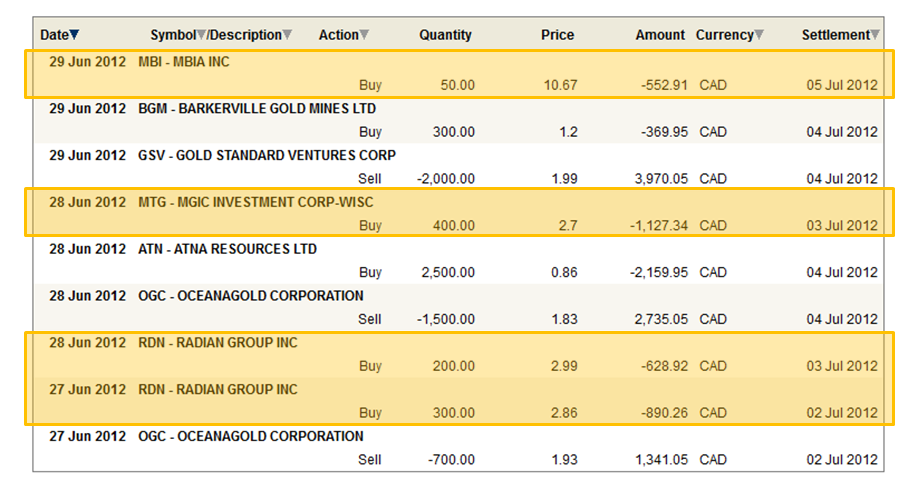
I now have have a third business for playing the housing bottom.  The insurers.  In addition to MBIA, last week I bought a fair position in Radian Group (RDN) and a lessor position in MGIC (MTG).  I also added a little to my position in MBIA (MBI).  In the case of Radian I unfortunately didn’t catch the bottom in the stock, but at least was fortunat enough to have gotten in well before the week long run ended, and I am actually seeing quite a profit on the position already.   Trades in my practice account that I track here are shown below:

Why Insurers?

I tend to have a lot of significant thoughts on my bike ride home.  It must be something about the state of semi-awareness that biking down major thorough fares in rush hour does to one’s brain.  On the one hand, what with cars whizzing by you and changing lanes and pulling out you are always on alert.  On the other hand, its the same ride you have done hundreds of times and so it is easy to day-dream yourself into a whole other world of thoughts.

It was about a month ago that I was biking home from work and thinking about what other businesses could benefit if the housing market in the United States just stopped getting worse when it occurred to me that I really should be looking at the mortgage insurers.   If ever there was a business whose livelihood was dependent not on a robust recovery in housing but instead an end to the continual decline, it was the insurance business.  As a mortgage insurer, you are less concerned if prices rise or new sales increase than you are that people don’t default on their loans.  Clearly, people not defaulting on their loans is  the necessary condition to any housing recovery.

This appears to be happening.

The most recent Home Price Index (HPI) report, put out by CoreLogic,  said the following:

“We see the consistent month-over-month increases within our HPI and Pending HPI as one sign that the housing market is stabilizing,” said Anand Nallathambi, president and chief executive officer of CoreLogic. “Home prices are responding to a restricted supply that will likely exist for some time to come—an optimistic sign for the future of our industry.”

Meanwhile, according the CoreLogic Shadow Inventory report, serious delinquencies in some of the hardest hit areas are showing big year over year declines:

Serious delinquencies, which are the main driver of the shadow inventory, declined the most in Arizona (-37.0 percent), California (-28.0 percent), Nevada (-27.4 percent), Michigan (-23.7 percent) and Minnesota (-18.1 percent).

A look at charts of new home sales and existing home sales (taken from CalculatedRiskBlog) show a pretty clear bottom.

My thesis was echoed by Radian management on their Q1 conference call.

We believe our core mortgage insurance business is attractive with strong returns, outstanding credit quality and sound pricing.We continue to capture a much larger share of new mortgage insurance business today than ever before in our history in an extremely competitive but high quality market.

Radian further echoed the sentiment that defaults are declining at the KBW Mortgage Finance conference:

You saw our press release this morning. In addition to the strong level of NIW, delinquencies continued to decline. So in May they declined again. Primary delinquencies fell below 100,000 for the first time in quite some time. In addition, the new default line, which really drives the incurred losses, was down 25% from May 2011. So year-over-year on a monthly basis down 25%, and that is a greater reduction than our projections have shown.

Insurers like Radian and MGIC stand to benefit from another trend that I called out in my post Pounding the Table on Mortgage Servicing Rights a few months ago.

Now we have the opposite scenario.  Lending standards are so tight that only the most fool-proof borrowers are able to get loans.  The risk of default should be greatly reduced.  The result again is for the MSR to stay on the books, paying out cash, for longer.

When I had looked at Radian and MGIC last year, one thing that made be skeptical was that they weren’t writing enough new business.  The same can’t be said any more.  In particular in the case of Radian,they are writing significant new insurance:

In fact, our market share of this profitable new business is double what it was in the challenging underwriting years of 2005 through 2008 and this increased volume is improving the overall credit profile of our MI portfolio. In the first quarter, we again wrote $6.5 billion of new mortgage insurance business and our pipeline remains strong with new insurance written (NIW) reaching approximately $2.6 billion in April.

Again at the KBW Mortgage Finance Conference, Radian provided at update that in May saw an additional $2.7B of NIW.  They also put some numbers to the exposure to the legacy book of insurance, versus the newer insurance written:

With our increasing market share we have grown the composition of the higher-quality books 2009 and subsequent at a much greater level than some of the other MIs that have legacy exposure. So as of March 31, we are up to 31% of our risk in force. That is from the 2009 and subsequent books. And, importantly, the 2006 and 2007 vintages, those poorer vintages, are down to 31%. By the end of 2012 at the rate we are going, the 2009 and subsequent are likely to be in the 40% range of our risk in force.

More to Come

These are complicated businesses and it is going to take me some time to fully wrap my head around the potential.  My positions thus far are reasonably small because of this.  As is often the case for me, my initial investment provides the incentive  to investigate further, and if I like what I see I buy more.  I just hope that the stocks don’t run away from me before that happens.  I expect to come up with more detailed write-ups  about both Radian and MGIC in the near future.

More MBIA Research: Spending some time listening to Jay Brown and friends

A couple of weeks ago I posted my original investigation into the business of MBIA Inc (MBI).  Over the two weeks since I have tried to better understand the business by reading or listening to every MBIA conference call from the last 4 years.  My bike rides, lunch hours, and early morning coffees have been spent  listening to or reading CEO Jay Brown and his management team provide their quarterly updates on MBIA.  In total I have went through 14 conference calls from start to finish (as an aside, if anyone knows of a good program that will turn streaming media files into mp3 files please let me know – having conference calls iPod-able makes them so much easier to listen to).  I have also read in whole or in part through the last 3 10-Qs and the last years 10-K.

By going through all of this information the conference calls I was hoping to answer 4 questions:

  1. What exactly it is that MBIA has insured
  2. The progress that MBIA has made on reducing what they have insured
  3. The probability that the lawsuits against and for MBIA will settle in their favor
  4. Whether or not, having bought MBIA, I have made a terrible mistake

I’m going to try to answer all of these questions in this post.

What MBIA has insured and how they making progress getting out of it

If I was going to label the conference calls from 2008 to present with a theme, it would be one of opportunistic deleveraging.  Slowly but surely MBIA has been able to reduce their exposure to the future default of the structured financial products that they had insured and that have since blown up.

These structure financial products can be broken up into 4 categories:

  1. First Lien Residential Mortgage Backed Securities (RMBS)
  2. Second Lien RMBS
  3. Collateralized Debt Obligations (CDO’s) and CDO Squared
  4. Commercial Mortgage Backed Securities (CMBS)

First Lien RMBS

First Lien RMBS has had very little in the way of problems and very little in the way of loss reserves or payouts.  MBIA generally insured the triple A tranches of each first lien RMBS.  So in effect if you took a bucket of 1000 mortgages, MBIA would begin to pay out insurance after the best 400-500 of those mortgages defaulted.  Being first lien, the underlying loans tended not to be of the exotic types that have suffered so greatly in the past few years.  Even with the problems that the housing market has had, that insurance has not been called upon and it remains unlikely it will be.

Second Lien RMBS

Second Lien RMBS are securities full of loans of the more exotic type, and they have been the source of much consternation for MBIA.  The second lien RMBS securities consist mostly of home equity line of credits (HELOC’s) and closed end second portfolios.  These securities were full of loans mostly originated by Countrywide, Rescap and IndyMac.  Of those three, Countrywide was “by far” the largest originator.

All three of these lenders are well known for their less than scrupulous tactics during the boom.  And thus it is that most (if not all?) of the defaulted second lien RMBS securities that MBIA is now paying out insurance on are subject to the put-back litigation.

So why can MBIA cry foul?  Basically, when MBIA and the originators created the terms of the insurance, it was with the expectation that the loans were of a certain quality, met certain criteria, and that, most importantly, that the documentation for each loan was correct and accurate.  On the Q2 2009 call MBIA defined a breach in these terms:

An example of a credit breach would be a loan that exceeds the debt to income or combined loan to value ratio guidelines for the relevant program. Compliance breaches would be things like missing good faith estimates or Reg Z forms in the files.

The terms of the insurance contract stated that MBIA did not have to review each individual loan.  Instead they could rely on the originators representations and warranties that the loans were on the up and up.  Of course, as it turns out many of the loans were not on the up and up and so now MBIA is in a position to litigate against the breach of the contract.

Once the securitizations began to default, MBIA began to review the loans that made them up.  And as soon as MBIA began to review the loans, they found breaches to be endemic, and they began to put-back the loans on the originators.  On the second quarter 2009 conference call (available on Seeking Alpha) the company said that:

Our loan level forensic review experts have re-underwritten nearly 24,000 loan files from 24 securitizations originated by four seller/servicers and they’ve found that over 18,000 had serious breaches of risks and warranties.

Until just recently (when a court ruling deemed further review no longer necessary, more on this later), MBIA has reviewed more loans each quarter and with that increased the size of the put-back litigation.  The last time that MBIA put a number to the loans that were in breach was the second quarter of 2010, when they said that “sometimes as low as 75% and some cases as high as 90% of the loans in the securitization are in violation of reps and warranties”.

Once MBIA began to initiate court proceedings they became more tight-lipped about quoting individual loan volumes that were being put-back.   However they did continue to provide an estimate of total the loan balance being put back as well as the booked recovery.  The latest estimate, from the Q1 2012 call, was that $4.8B worth of loans had been put-back on originators and were now the subject of the legal battle.  Of that $4.8B, MBIA has booked an expected $3.2B in recoveries from the litigation (I’ll provide some more detail on this a little later on).

It should be pointed out that all along MBIA has been paying out  insurance on these defaulted second lien RMBS securities.  Most of the $3.2B in expected recoveries relate to cash that MBIA has paid out to investors on the securities.  Another aspect of the insurance contracts is that MBIA has to pay out the cash regardless of whether there was a misrepresentation or not.  The terms specify that it is up to MBIA to recover money paid out on breached loans directly from the originator.  Of course this is exactly what they are trying to do.

When I thought about the MBIA put-back case with this in mind, it began to see the very strong position that MBIA is in.  This isn’t some claim of damages due to missed opportunity.   This is about real dollars that MBIA has paid out as they have held up their end of the bargain on the insurance contracts they agreed to.   And now they want the originators to come clean in cases where they didn’t hold up their end.  MBIA wants their money back.

That there was massive fraud in the years leading up to the mortgage crisis in 2008 does not seem to be very much in doubt.  The terms of the insurance state clearly that MBIA was relying on the originators to insure that the loans being put into the securitizations were legitimate.  MBIA has been paying out money on these securities since most of them have defaulted.  That MBIA is entitled to get its money back seems like a no-brainer.

CDO and CDO Squared

MBIA insured 3 different types of CDO’s.  There was CMBS CDO exposure, which were CDO’s made up of commercial mortgage backed securities the multi-sector CDO exposure, which were CDO’s made up of a whole range of whole loans, RMBS and CMBS, and there was CDO squared exposure, which were CDO’s that were made up of other CDO’s .

As you can imagine, when the bankers had drained the swamp to the point where they were making CDO’s of CDO’s, the sludge in the bottom was quite toxic. As such, the CDO squared positions were the first to blow up and the first to be mitigated.  But that was soon  to be followed by the multi-sector and plain vanilla CMBS flavors.

In each of these cases MBIA has reduced the exposure in two ways: by commutations (basically paying a fee up front to have the insurance annulled), and where applicable by put-back litigation.

Commutations are a fancy word for saying that MBIA gave the insuree some money up front in exchange for not having to pay if the security blew up later.  The costs of doing so aren’t cheap, but they generally are done at a significant discount to the actual cost of insuring the security if it does fail.  MBIA also may have benefited in its commutation negotiations earlier on in 2009-10 because some of the counter-parties looked at MBIA’s insurance at risk and then looked at the economy and said we should probably take something while we can still get it.

MBIA has talked regularly about the volume of commutations that they have done.  The amounts are significant.  With respect to the CDO squared positions, they have been reduced from over $10B at the beginning of 2008 to nothing as of the end of the year 2011.  Multi-sector CDO’s, which are basically securities that could have everything and anything in them (think the Gramercy Capital CDO’s that I analyzed in some detail as an example of a multi-sector CDO) have seen exposure reduced from $25B to $6B.  Commercial Real Estate CDO’s have gone down from $13B to a little over $5B.

MBIA hasn’t talked specifically about the CDO put-backs for quite some time.  The last time they did, which was the Q4 2009 call, they said the amount under litigation was significant:

For the CDO related litigation the amount at stake represents a significant portion of the $2.5 billion of present value of ultimate incurred loss that we are estimating for our CDO portfolio.

What’s not very clear is how much of the $3.1B in booked recoveries is related to CDO breaches.  It may not be that much, because interestingly, while a significant amount of reserves have been booked against the remaining CDO portfolio, there has yet to be a payout from the default of any of the (remaining and as of yet not commuted) CDO’s.

Commercial Mortgage Backed Securities (CMBS)

The CMBS portfolio was a bit of a laggard in terms of generating losses for MBIA Corp, but it has made the best of its potential to play catch up.  Commercial mortgages didn’t fall apart until late 2009 because, unlike residential mortgages, they weren’t so much in a bubble or being held up by out-and-out fraud but instead they went south for the good, old fashioned reason that the economy tanked.  MBIA Corp has been reserving against losses on its CMBS insurance since about that time.  As late as the second quarter of 2011 the company said:

At this point in time, we would say 2/3 to 3/4 of the remaining volatility in our balance sheet centers around CMBS reserves.

Since that time the losses in CMBS have continued to mount.  In particular, Q1 2012 saw a big increase to CMBS reserves, but it wasn’t because of further deterioration to the loan book.   Just like with the CDO exposure, MBIA has been reducing its CMBS exposure through commutations.  In the first quarter 2012 conference call the company said the following:

Losses for commercial real estate transactions this quarter were $296 million. About $60 million of that incurred loss on CMBS was driven by deterioration in the small number of remaining transactions. The balance reflects cost of commutations executed or agreed to that were in excess of the year-end 2011 reserve levels. In aggregate, we’ve commuted or agreed to commute $11.5 billion of exposure since January 1.

As I already said, commutations aren’t cheap, particularly now that MBIA solvency is not of such immediate concern.   The commutations on CMBS are costing more than was initially anticipated, thus the bigger hit to the reserves.

But while the commutations have cost a few pennies, they have also taken the most dangerous loans off the books.  If you look at MBIA’s disclosures as of December 31st, total CMBS exposure was about $18B.  Of that amount, only $6B was BBB rate or lower.  The rest was higher rated collateral that should be less susceptible to default.  That they have since commuted $11.5B of exposure suggests that most of the commutations are behind them and that most of the most volatile loans are now off the books.

On to the Lawsuits…

Meanwhile, the court cases drag on.  Likely the next case to get a significant ruling will be the transformation case.  To refresh on what I already touched on in my previous post, in early 2008 MBIA Inc. made efforts to transform itself into two legally independent entities.  One entity (MBIA Corp and please be careful to remember that this is MBIA Corp while the parent is MBIA Inc.) would handle all of the structured finance insurance (as well as the asset management business) while the other (National) would handle the municipal insurance.

A number of banks took issue with the transformation, purportedly because they were concerned about the solvency of MBIA Corp and its ability to pay its claims, but more realistically because they saw the massive put-backs that MBIA was about to shuffle on back to them and they wanted leverage to counter that litigation.

Sure enough, slowly the number of banks has dwindled down as MBIA has settled its put-back settlements with the banks, to the point today where the case is being made by two banks: Bank of America and Societe Generale.  Bank of America is the ringleader here, which is not surprising since Bank of America has the most to lose from a successful put-back of Countrywide loans.

The transformation case has gone through its hearings and is expected to be ruled upon by the judge by August (for an excellent synopsis of the hearings, go here).  It turns out that the case will not go to a full trial, because as per the New York state law the hearing is intended to be “expeditious”, with a judge only hearing and ruling.  Given that the process started back in 2009 I might question the validity of the term.   Nevertheless, the trial/hearing has come to an end.  Not that we should expect this to be the last round.  As Alison Frankel, who has been covering the case in her column “News and Insights” has pointed out, regardless of the ruling it is almost assured that the case will go to appeal.

So far, however, what has occurred has been mostly in the favor of MBIA.  That there were no witnesses called during the hearings, with the judge instead relying on documents and transcripts, has to be seen as a positive for MBIA.   If the judge really felt that there were questions of fact, she would have wanted to hear from the various regulators in charge of the case.

Also in MBIA’s favor was Bank of America’s failed attempt to change the question at hand.   The subject of the trial is to be whether the New York Insurance Department (NYID – the regulator that approved the transaction) acted in an “arbitrary and capricious” manner.  Bank of America appears to have made numerous attempts to change that focus  to one of whether MBIA “deceived” the NYID by not providing them with all and/or accurate information about the financial state of MBIA Corp and National post split.  Well the judge nixed that attempt, leaving only at question whether the regulators were openly negligent in their decision.

Everything I read about this case suggests to me that MBIA should win it.  Consider that MBIA initiated the process of transformation in early 2008 and it was decided upon well before the collapse of Lehman.  I don’t think that anyone (aside from perhaps a few rogue traders like Michael Burry, Kyle Bass and Steve Eisman) was anticipating the eventual collapse that was occurring in the housing market.  The general consensus (which was albeit based on the flawed assumptions and misinformed opinion) was that housing might decline gently or stabilize soon.  Bank of America itself was buying Countrywide in early 2008 in hopes of having a coup when the housing market recovered.   Hell, even Bernanke was asaying he saw the sky clearing up ahead, what with sub-prime contained and all.  I think that to make the case that the NYID acted in a manner that was “arbitrary and capricious” you would have to go down a rather imaginary road that assumed that they, and they alone,  knew what was coming before anyone else did.   And I simply don’t see how that flies.

Also, the whole case wreaks of such cynicism that I can’t imagine the judge is not plugging her nose just a little at it.  The question of the solvency or insolvency of MBIA Corp is directly related to the fraudulent mortgages that they insured that were (I’ll be darned) originated by Bank of America themselves (through its Countrywide subsidiary).  Does this not seem a bit disingenuous?   Had it not been for the breaches of reps and warranties, MBIA Corp would quite possibly be in quite a solid financial position.  You might not even need to have a transformation at all.

The Put-back Cases

MBIA has put-back cases in various states of proceedings against a number of the largest originators.  The company has litigation against Bank of America, Residential Funding Company (Rescap).  The first of the put-backs likely to be settled, and also by far the biggest of the bunch, is the case against Countrywide and Bank of America.

In the last 10-Q MBIA presented a 10 point summary of why they feel confident about the outcome of the put-back case:

  1. the strength of the Company’s existing contract claims related to ineligible loan substitution/repurchase obligations;
  2. the settlement for $1.1 billion of Assured Guaranty’s put-back related claims with Bank of America in April 2011;
  3. the improvement in the financial strength of the sellers/servicers due to mergers and acquisitions and/or government assistance, which should facilitate their ability to comply with required loan repurchase/substitution obligations. The Company is not aware of any provisions that explicitly preclude or limit the successors’ obligations to honor the obligations of the original sponsor. The Company’s assessment of any credit risk associated with these sponsors (or their successors) is reflected in the Company’s probability-weighted potential recovery scenarios;
  4. evidence of loan repurchase/substitution compliance by sellers/servicers for put-back requests made by other harmed parties with respect to ineligible loans; this factor is further enhanced by (i) Bank of America’s disclosure that it has resolved $8.0 billion of repurchase requests in the fourth quarter of 2010; (ii) the Fannie Mae settlements with Ally Bank announced on December 23, 2010 and with Bank of America (which also involved Freddie Mac) announced on December 31, 2010, and (iii) the Company’s settlement agreements entered into on July 16, 2010 and December 13, 2011 respectively, between MBIA Corp. and sponsors of certain MBIA Corp.-insured mortgage loan securitizations in which the Company received consideration in exchange for a release relating to its representation and warranty claims against the sponsor. These settlements resolved all of MBIA’s representation and warranty claims against the sponsors on mutually beneficial terms and in aggregate were slightly more than the recoveries previously recorded by the Company related to these exposures;
  5. the favorable outcome for MBIA on defendants’ motions to dismiss in the litigations discussed above, where the respective courts allowed MBIA’s contract and fraud claims against the defendants to proceed;
  6. the favorable outcome in the Countrywide litigation on MBIA’s motion to present evidence of liability and damages through the introduction of statistically valid random samples of loans rather than on a loan-by-loan basis;
  7. the favorable outcome in the Countrywide litigation denying Bank of America’s motion to dismiss MBIA’s claims for successor liability as well as a decision from the New York Supreme Court Appellate Division, First Department, which lifted the stay on discovery related to successor liability claims at Bank of America;
  8. the favorable outcome in the Countrywide litigation on MBIA’s motion regarding causation and MBIA’s right to rescissory damages;
  9. the unanimous ruling from the New York Supreme Court Appellate Division, First Department, in the Countrywide litigation allowing MBIA to pursue its fraud claims; and
  10. loan repurchase reserves and/or settlements which have been publicly disclosed by certain sellers/servicers to cover such obligations.

Its worth noting all the “favorable outcomes” on the list.  Almost all of the decisions thus far have sided with MBIA.  The most recent decision that affirmed the position of MBIA was a ruling in favor of Syncora, in a case against the former MBS origination wing of Bear Stearns.

“…on every other point, the federal judge sided with Syncora and its lawyers at Patterson Belknap Webb & Tyler, and in ways that may protect Syncora when the state appeals court reviews Bransten’s ruling in the Countrywide case. Bransten began her analysis with the insurance contracts between the monolines and Countrywide, concluding that under state insurance law the bond insurers simply had to show that Countrywide misstated the risk profile of the underlying mortgage pool when it induced MBIA and Syncora to insure the mortgage-backed notes. She declined, however, to grant summary judgment to Syncora and MBIA on the broader question of whether Countrywide breached MBS servicing agreements — as opposed to insurance contracts — merely by misrepresenting the quality of the underlying loans, or whether insurers (and, by extension, investors) could only assert put-back demands for defaulted loans.”

As I briefly mentioned earlier, up until recently MBIA had been stepping through securities on a loan by loan basis, looking for breaches that would allow them to put back the securities on the originator.  Not any more.  Another recent decision concluded that MBIA will not be forced to investigate each loan individually to determine whether it was in breach or not, instead being able to rely on statistical sampling.  According to the last 10-Q

Legal decisions have led the Company to conclude that the practice of reviewing individual loans for the purpose of assessing put-back recoveries is no longer necessary. The Company determined in the context of the favorable decision on its motion in limine addressing the use of sampling to establish breach-of-contract claims in the Countrywide litigation (MBIA Insurance Corp. v. Countrywide Home Loans, Inc., et al, Index No. 602825/08 (N.Y. Sup. Ct.)) that a sufficient number of loans in each securitization have already been reviewed to demonstrate widespread breaches of the contractual provisions of the agreements with the sponsors. Furthermore, MBIA has received subsequent opinions which have confirmed that the Company is not limited to a loan-by-loan put-back remedy and can seek a pool-wide remedy based on sampling and extrapolation, as well as decisions in MBIA’s favor related to causation and rescissory damages.

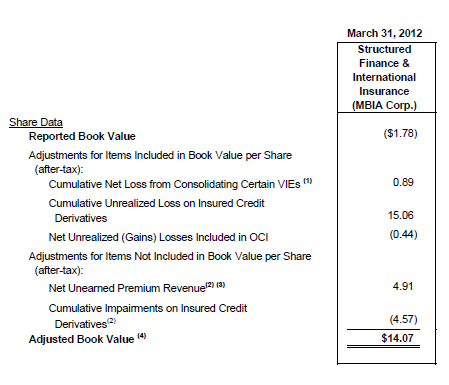
As I already mentioned, the outcome of the put-back litigation will essentially determine whether there is value in MBIA Corp (the financial structuring wing) or not.  If the outcome is favorable, the value is not inconsequential.  Below is the adjusted book value of MBIA Corp.   Adjusted Book Value accounts for all expected loss payments by MBIA, all expected premium receivables, and most importantly, the $3.1B that MBIA thinks it has coming back to them from litigation.

Like the transformation case, the put-back case looks strong for MBIA.  The rulings thus far have narrowed the banks ability to deflect the blame or limit the scope.  In addition to the above rulings, perhaps the biggest win for MBIA was the court decision that in order to put-back loans MBIA only had to show that the loan was breach, and not that the breach was responsible for the default.   MBIA had found billions of dollars of breached loans within months of beginning their investigative process, and the tone of management on the conference calls was always one of confidence and to a large extent dismay when they spoke of the scale of the fraud that they were uncovering.

A terrible mistake?

I don’t think so.  In fact just the opposite.

I wish that MBIA had not risen so soon after I first discovered the idea.  I would have liked to have a larger position.  As it is, the stock accounts for about 4% of my portfolio.  While I had originally hoped for a move back down to the single digits, I now think I would be inclined to buy more if it dipped to even the low 10’s.

Both the put-back case and the transformation case are winding down and we should not have more than 6 months before we see some significant rulings on both cases.  I have to think we will see a settlement with Bank of America before it goes that far. I just can’t see Bank of America stringing this out, the risk of a ruling that puts into question the much larger

A settlement in the $3B range would leave MBIA Corp with an adjusted book value of around $14 per share.  National has an adjusted book of $20 per share.  Netting out holding company debt and you are left with a valuation of the holding company of above $30.

What’s more, that valuation is looking strictly in the rear view mirror.  Considering only the premiums earned and the expected claims paid.  There is nothing in the valuation about new insurance written.  If MBIA begins to write municipal insurance again what is the stock worth then?  How about if they can get themselves back into some of the simpler first lien RMBS under-writings?  I hesitate to put a number to the eventual value of the company, but suffice to say that I think the upside potential is tremendous.