Skip to content

Posts tagged ‘regional banks’

Regional bank earnings round-up

Over the course of last week four of the five regional banks in my portfolio reported first quarter earnings.  Since that time I have been busy reviewing those earnings and drawing conclusions on whether the stocks should remain owned, or be punted out for other opportunities.  Below I will go through my analysis and thoughts on each of these banks.

Rurban Financial (Ticker: RBNF)

Rurban Financial reported earnings last Tuesday.  Rurban does not have a particularly troubling loan book, and while they do have some non-banking related problems (such a legacy data processing business that does not appear to be doing very well) they are mostly set to generate strong earnings going forward.  So when I look at Rurban’s results, I focus on what they were able to earn.

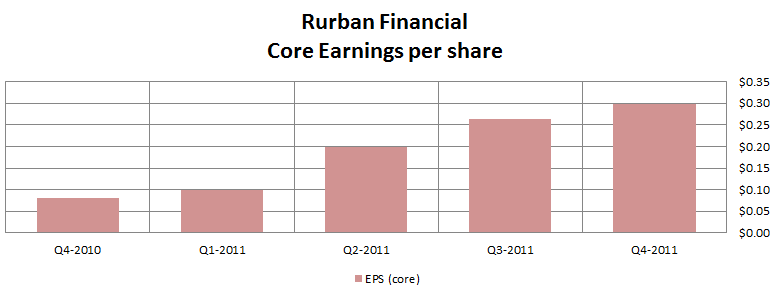
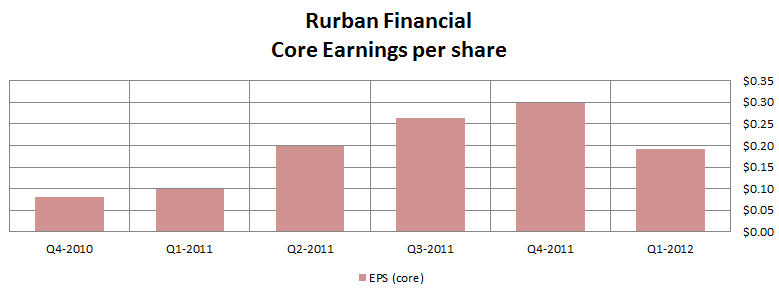
Earnings per share came in at 20 cents.  Because Rurban has a  large mortgage servicing portfolio they are subject to big swings in earnings due to the GAAP valuation adjustments that they have to take on their portfolio of mortgage servicing rights.  While these adjustments are GAAP requirements, they tell us nothing about the business and tend to obscure the true earnings of the business.  Thus, I like to look at a “core” earnings number that eliminates the valuation adjustments as well as any other one time charges and the loan loss provisions.  Core earnings came in at 19 cents.  Core earnings for the past 5 quarters are shown below:
I’m not too worried about the decline in earnings quarter over quarter because a lot of it is seasonal.  Rurban sold a lot less mortgages in Q1 2012 than it did in Q4 2011 and that is just the seasonal nature of that business.  For some reason a lot of markets in the US experience high mortgage demand in Q4, and low demand in Q1.  In most Canadian markets it is the opposite of that, with Q4 being the slowest of the four quarters.

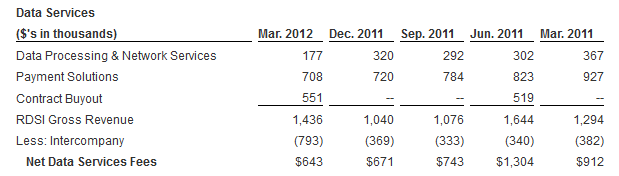
Another contributor to lower earnings was reduced revenues from the RDSI data processing subsidiary.  RDSI provides data processing services for banks across the Midwest. RDSI lost $1.4M in 2011 and doesn’t appear to be doing any better in 2012.  Its a strange situation because the big cause of the loss in Q1 were writedowns related to Rurban’s own bank deciding not to use RDSI for their banking related data processing needs.  Clearly they are cutting ties (winding down?) and maybe that will be for the best in the long run.  Below are revenues from RDSI less intercompany over the last 5 quarters.  Its become small enough that going forward it should cease to be the drag on earnings that it has been.  And that’s a good thing.
Mortgage revenue at Rurban continued to be strong; Rurban generated $1.2M in origination volumes in Q1 versus $420K in the same quarter last year.   As I already mentioned originations are always down in Q1 versus Q4, so that number was a decline from $1.5M in the previous quarter.   The year over year growth in origination led to further growth in their servicing business, which was up by another $20MM in terms of unpaid balance sequentially.  Nonaccrual assets continue to fall, down to $6.5M from $8M in the fourth quarter of last year.  And the company continues to rein in cost, witness by another drop in non-interest expense.   Negatives for the quarter were pretty much the same as those I saw elsewhere in the banking sector.  They are getting squeezed on interest margins (down from 4.07% to 3.64%), and loan growth was pretty flat quarter on quarter.

Overall Rurban announced pretty solid results and they are continuing to move towards their potential $1 per share of earnings.  There is still work to be been, ROA remained poor at 0.60%, but that is why the stock trades at only 2/3 of book value, and why the opportunity for further price appreciation remains.  I have been very happy to see the shares move up as they have over the last week.

Shore Bancshares (Ticker: SHBI)

Shore had a tough quarter.  While I had been hoping  that the company’s loan book was on the mend, the first quarter results showed that there is still some work to be done.

The loan book deteriorated over the quarter.  The company had to put aside provisions for credit losses of $8.4M, which was way up from $4M in Q4 and $6.4M in Q1 2011. Nonperforming assets rose to 8.1%.  I had been hoping that nonperforming assets had peaked in Q3 and would continue to roll over in Q1.  Unfortunately not.
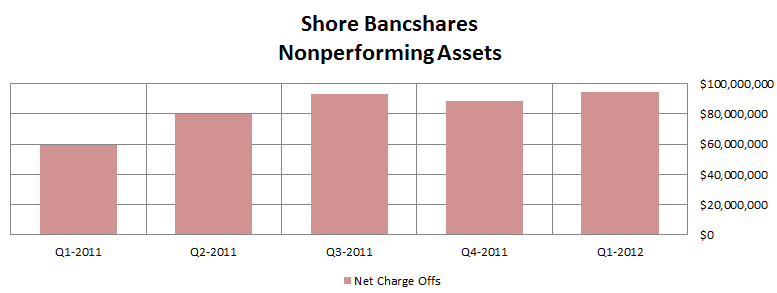
The company said that the rise in nonperforming loans resulted mainly from one relationship. 50% of the $9.1M in charge-offs were related to a single large real estate borrower.

If you can get past the loan book (and I wish they could get past their loan book), there were some positives for the quarter.  While deposits increased 4.2% on a year-over-year basis and, notably, core noninterest-bearing deposits were up 17.4% year-over-year, so the company’s borrowing base continues to move towards lower cost loans.

If you look at Shore’s eventual earnings poential, if they could stop taking massive writedowns every quarter, it remains strong.  Earnings ignoring the provisions were $0.39 per share.  Over the previous twleve months Shore has put together earnings of $1.50 per share if you ex out the loan losses.  So the potential is certainly there.  Unfortunately loan book stabilization appears to be a bit further off then I had anticipated.

I’m not sure what to do with Shore.  I am tempted to cut it and run.  I originally got the idea from Tim Melvin of Real Money.   He described the investment as a 5 year hold and a 3 to 5 bagger.  Given that the bank trades at about 1/2 of tangible book value and that it used to be a $25 stock before the collapse of 2008, and you can see where he is coming from.  However I am not quite as patient as Mr Melvin.  I like stories that are in the process of turning it around, not just with the potential to turn things around at some point.  I haven’t sold out of the stock yet, but I have an itchy trigger finger.

Community Bankers Trust (Ticker: BTC)

BTC’s earnings are always obscured by the effect of the indemnification asset that the company carries as a result of an agreement to take over a failing bank, SFSB, back in 2009.  The indemnification asset is an accounting tool that accounts for the FDIC guarantee that BTC received when they took over the SFSB loan portfolio.  Unfortunately, the accounting of the asset it such that when there is better than expected performance in the SFSB portfolio, the company has to amortize the indemnification asset on their income statement.  The size of these amortizations is extremely large relative to earnings.  In Q1 the amortization was $1.9M versus net income of $0.9M.

I always ex-out the effect of the indemnification asset when I look at BTC’s earnings.  The asset says nothing about their cash generation and earnings ability.  In fact it actually works in reverse to that underlying ability.

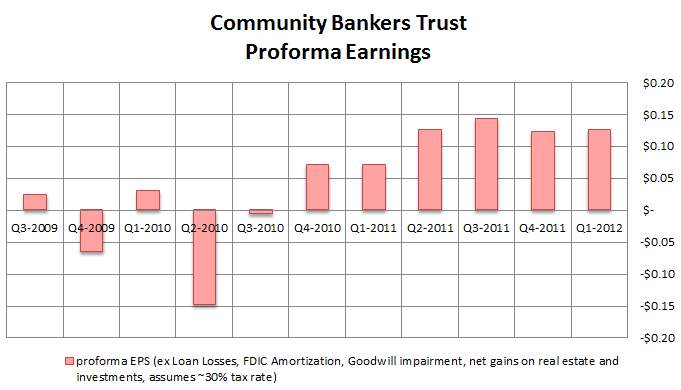
Ignoring the indemnification asset and a few other small one time gains and losses, BTC earned 13 cents in the quarter.  On this core earnings metric BTC has earned 52 cents over the prior twleve month, which means it remains an incredibly cheap stock trading at a little over 4x earnings.  Looking at the same sort of “core” earnings number that I did for Rurban, you can see that the bank is consistently been pulling in 10-15 cents of earnings a quarter for the last 4 quarters.
BTC has done an excellent job of pulling itself back from the brink of bad loan losses, and this continued in Q1.  Nonperforming loans on its non-covered portfolio (non-covered refers to loans not covered by the FDIC loss sharing agreement) decreased 13% or $4M quarter over quarter.  Nonperforming assets have fallen from a high of 9.7% of total assets in the second quarter of last year to 6.9% of assets in the most recent quarter.

Meanwhile the company grew its loan book marginally in Q1, which is traditionally a slow time of the year for loan growth for the company and a quarter where their loan book shrank last year.   It is also interesting to note that unlike most of their competitors, BTC managed to maintain a flat net interest margin in the quarter, at 4%.

I really like the turnaround that is taking place at BTC.  Having bought the stock at a little over a $1, I am sitting on a double already.  Yet I have no plans to sell.  BTC was a $3.50 stock as recently as the beginning of 2010 and was a $7 stock before the financial crisis hit in 2008.  I don’t see any reason why they can’t return to a level somewhere between those two numbers.

Bank of Commerce Holdings (Ticker: BOCH)

I learned about Bank of Commerce Holdings from a BNN Market Call with Benj Gallander, the Contrarian Investor guy.  He had BOCH as a top pick and I was looking for regional banks at the time so I took a look at the stock and bought some at $3.25.  Watching Market Call is a hit and miss time investment, you can sit there and watch episode after episode and get nothing out of it, but every once in a while there will be a gem.  BOCH was one of those gems.

Bank of Commerce Holdings is steady as she goes.  I’m not quite sure how they have done it, but BOCH has managed to keep nonperforming assets at reasonable levels (2.45% in Q1 which was down from 2.68% in Q4 2011) while operating in one of the hardest hit real estate markets (Sacramento).  To be fair they also operate in a second market, Redding California, which didn’t have quite as bad of a housing decline.

The company has been consistently reporting return on assets (ROA) of 1% and return on equity (ROE) of 8-9% for the last 3 quarters.
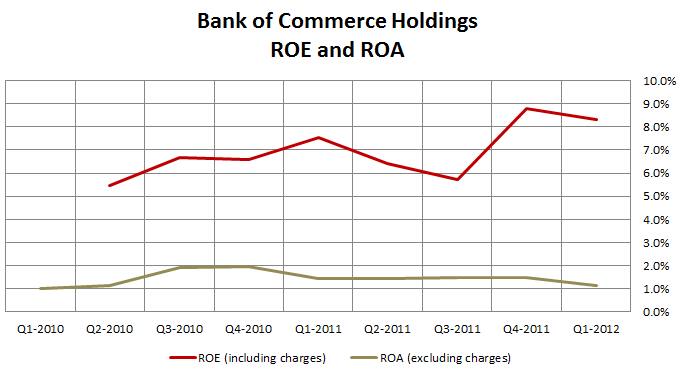
Much like Rurban, the first quarter seasonally has lower mortgage banking revenues than does the fourth quarter so I am not concerned about the decline in ROE and ROA sequentially.  Mortgage banking is a big part of Bank of Commerce Holdings banking business so they are subject to these seasonal effects.  What is more relevant is the trend in mortgage banking revenues.  They have climbed substantially from $2.5M in Q1 2011 to $5M in Q1 2012.
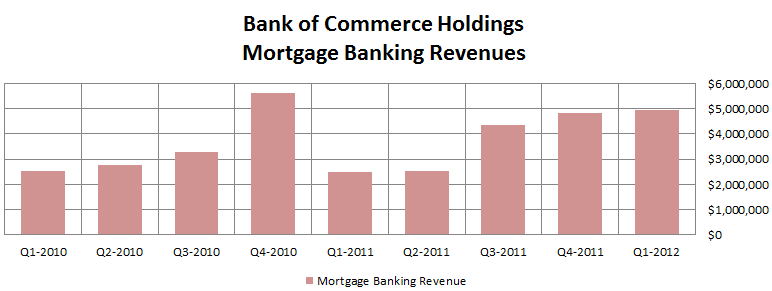
Bank of Commerce Holdings earned 35 cents per share in 2011 and 31 cents per share in 2010.  I would expect them to earn over 40 cents per share in 2012.  BOCH is not going to be a shooting star type of a performer.  Its not going to double in a year.  But the company is consistently profitable and consistently adding to shareholder value.  There is also the chance for them to raise ROE above 10% and ROA above 1% by increasing their operational efficiencies.  I hope to see this occur over the next year as the economy improves and opportunities present themselves.   I think it is reasonable to expect the stock to trade to the $5.50 range by the end of 2012.  That is good enough for me.

A look at the Rurban Financial Annual Report

Rurban Financial is quickly becoming my favorite regional banking investment.

Under the retail name of State Bank and Trust Company, Rurban operates 20 branches in Northwest Ohio, servicing the mostly rural communities of Allen, Defiance, Fulton, Lucas, Paulding, Wood and Williams.

I’ve already discussed Rurban in a small amount of detail here.

The company is generating an improving return on equity, improving earnings, and has a reasonably low amount of non-performing assets.

I just finished reading through the Rurban Financial Annual Report that arrived in my mail box a few days ago.  There were a few highlights that I thought were worth noting.

The Ohio Economy

In the CEO Letter to Shareholders, Mark Klein pointed to improvement in the Northwest Ohio economy.  He noted that the downturn in the Midwest economy occured later than in other parts of the country and so the recovery has been likewise delayed, but that signs of recovery are appearing.

Klein also pointed out that Ohio has risen to number one in job creation in the Midwest, and is up to ninth nationwide from 48th a year ago.

As part of a section of the Annual Report titled “Commitments to our Communities” Rurban profiled two farm lending relationships that they have cultivated, as well a tractor parts dealer.  Rurban’s primary clientele is rural Ohio residents and business.  I feel quite confident that grain prices will remain at profitable levels and that opportunities to service these folks will only continue to grow.

The loan book

In 2011 loans outstanding grew by a small amount, from $428M to $443M.  Unfortunately agricultural loans decreased from $40.8M to $38.4M but I would expectt this to pick up in the next year as another year of strong grain prices is under the belts of farmers.

I was pleased to see that the company has no land loans and no contruction loans.

Non-performing assets make up a fairly small 1.77% of total assets.  This is down from 2.87% at the end of 2010.

Increasing exposure to mortgage banking and mortgage servicing

Mortgage banking activity is seen as “exceptionally strong”. One of the attributes of Rurban that I like is that they hold onto the servicing rights of the mortgages they originate.  While these mortgage servicing rights (MSR’s) are not being valued very highly by the market, I expect that to change.

I was surprised to learn that Rurban will not revalue the MSR’s upward if (when) rates begin to rise or defaults begin to fall and, as a result, the valuation model used to put a value to the MSR begins to show increasing value.  As part of Note 1 to the financial statements the company wrote that “the valuation allowance is adjusted to reflect changes in the measurement of impairment after the initial measurement of impairment… Fair value in excess of the carrying amount of servicing assets for that stratum is not recognized.”

Rurban took a beat down because of the valuation adjustment that they had to make to the MSRs that they hold.  The valuation adjustment for the full year 2011 was $1,119,000.  That works out to 0.22 per share of before tax earnings.  Rurban reports the MSR adjumstent within its “core earnings” calculation, so it does not get ignored as is the case for some of the other mortgage servicers like PHH.  I’m not sure why they don’t “ex” it out of core earnings.  Its a somewhat bogus accounting requirement in my opinion.  If an asset can be adjusted up or down 25% in a single year is than you have to question the valuation period.

There has certainly been a move by the company to increase its MSR portfolio.  Below is a graph of the unpaid balance held by Rurban over the past 5 quarters.

Core earnings are increasing and not reflected in the stock price

If you ignore the effect of the valuation adjustment that Rurban has had to take on its MSR portfolio, and you look strictly at the company’s recurring core earnings, you quickly realize that the company’s stock price is not pricing in the full extent of its earnings generation or its earnings growth.

To come up with core earnings I have taken GAAP earnings and made the following adjustments:

  • OREO impairments
  • Goodwill impairments
  • Provisions for loan losses
  • Gains on securities
  • MSR valuation adjustments

Earnings have been improving both because of loan and mortgage business growth as well as because of prudent management of costs.  Looking at the income statement I was struck by the degree of cost cutting that the company has done in the past 3 years.  Looking at salaries and employee benefits, they were reduced from $21M in 2009 to $18M in 2010 and to $14M in 2011.   Similarly, professional fees fell from almost $3M to less than $2M.  Even postage and delivery expenses fell, from $2.1M to $1.1M.

Going forward in 2012, Rurban is going to focus on growth in revenues.  I expect loan totals to increase along with originations.  I expect further increases to mortgage banking activity.  Both of these should drive further improvements in earnings.

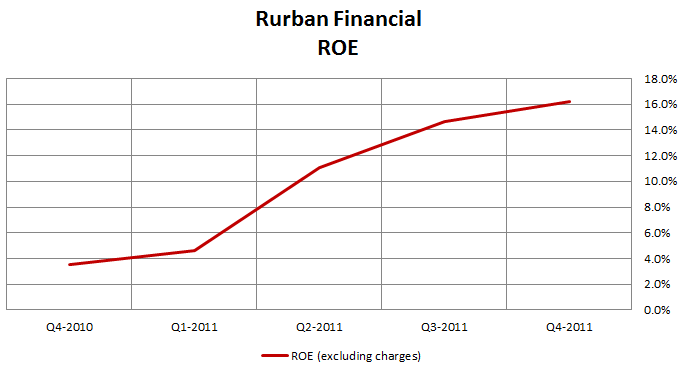
Improving return on equity

In the chart below I am looking at core earnings return on equity, which ignores one time charges and MSR valuation adjustments.

Why doesn’t the market care?

It seems kind of crazy to me that a bank with a solid loan book, decent growth and with earnings that look set to top $1/share in 2012 can be trading at less than $4.  But I guess that is why the regional banking sector remains the trade of the decade.

Listening to the financial news for the last couple of weeks, I am starting to hear some positive comments made about the large money centre banks.  I think this is the first step in the healing process of investor sentiment towards the banking industry.  It may take some time yet, but at some point solid regional and community banks like Rurban are going to benefit from that change in sentiment.

Rurban trades at 4x core earnings and at about 60% of a tangible book value that is valuing their MSR portfolio at an extremely low level.  That just doesn’t seem sustainable to me.  As the cycle turns I would expect to see the company trade at a premium to book value and at a double digit earnings multiple. Both would suggest a share price over $10 per share.


Community Bankers Trust: As good as it gets?

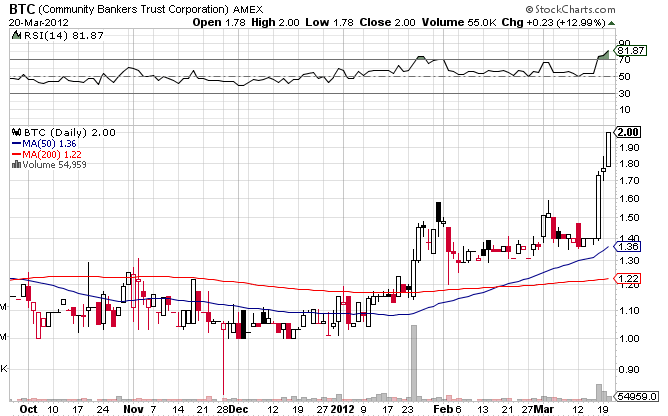
Ever since Community Bankers Trust (BTC) announced that they were repaying the dividend on their TARP preferred , the stock has gone into the stratosphere.  Its now become a double since my initial purchase.

What I want to do in this post is look at whether this move to the upside is all I should really expect, or whether this is the beginning of a larger, longer term move.  The question is: Do I have a two-bagger here, or a potential five bagger.

A little history on the company

I bought Community Bankers Trust (BTC) as a turnaround story.  They are a bank that has been trying to reincarnate itself after the first incarnation came close to an early death. My observation is that they have been successfully navigating this resurrection, and with the recent turn in profitability (and a helpful turn in the economy) the bank is on its way to realizing its earnings potential.

How did they get to here?

The original growth strategy was, as far as I can tell, to buy other banks and get bigger.  Witness, the name of the original company was called Community Bankers Acquisition Corporation  (CBAC).  They weren’t exactly being subtle.  Along with the acquisition strategy, the bank seemed to have a “worry about the profitability later” strategy.  This may have worked ok if the economy continued to grow as it had in the early part of the decade but it fell flat along with the economy in 2008.

As best as I can discern the acquisition effort was spearheaded by Gary Simanson. He headed up the original company CBAC, and then moved into a position of Strategic Vice President, a position I don’t think I’ve ever heard of with any other company. According to this article, Simanson was responsible for subsequent acquisitions.

In truth, the timing was what killed the acquisition strategy.  To quickly step through the timeline, in May 2008 the company began its journey by acquiring two local Virginia banks, TransCommunity Financial Corporation, , and BOE Financial Services of Virginia, Inc.  In November the bank moved ahead and acquired The Community Bank, which was a little bank in Georgia.  Finally in January 2009 they acquired Suburban Federal Savings Bank, Crofton, Maryland.

So you had 4 bank acquisitions in less than a year happening at the time of a 100 year financial tsunami.  How do you think things turned out?

Change in Direction

By 2010 Simanson had left the company and the direction of the company was changed to the more pragmatic “we need to get profitable before we go belly up” strategy.

This was described pretty bluntly in the 2010 second quarter report. CEO Gary Longest said at the time:

Our strategy has shifted from that of an aggressive acquisition platform, to one that meets the banking needs of the communities we serve, while providing sustainable returns to our stockholders. To this end, we are taking the necessary steps to return immediately to profitability. We are actively analyzing our market base to assess the contributions of all branches to our franchise value and will take the appropriate actions in the third quarter of this year. Additionally, we will make aggressive expense reductions, and will look to restructure and strengthen the balance sheet. We are confident that the analysis of these potential critical paths and the resulting execution of these initiatives will lead us back to profitability quickly.” “Our goal is an immediate return to consistent quarterly profits. To accomplish this, we have no alternative as a Company but to make clear and intelligent decisions in the next 60 days, no matter how difficult, to accomplish that goal as soon as possible. That is our full focus.”

In a somewhat odd twist to which I’m sure there is a good story, Longest himself was gone only a couple months later. Nevertheless the interim CEO and soon to be permanent CEO Rex L. Smith took up the reins and has carried out the strategy quite well given the circumstances.

Why the TARP payment matters?

As the chart I posted at the start showed, the stock had been trending up for a couple of months but it was really the news of the TARP payment that has sent the shares to another level.

The amounts involved in the TARP dividend are fairly inconsequential.  The accumulated payment is around $1.5 million.  The deferred payments on the trust preferred capital notes looks to be significantly less.

What is consequential is that the regulators are putting their stamp of approval on the bank and giving it a clean bill of health.  What is also consequential is that with the TARP funds being paid the company is setting itself back up towards the eventual issuance of a common dividend.

Where are they now?

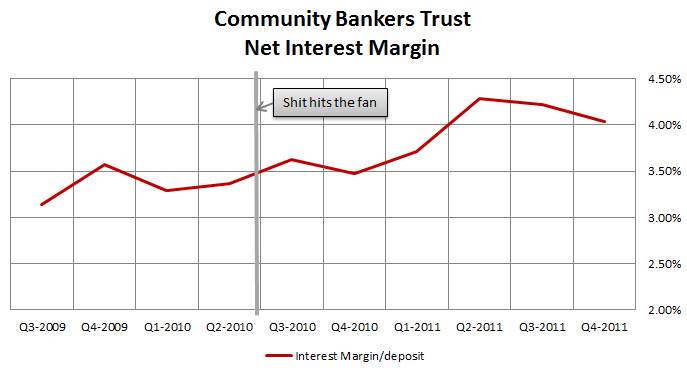
Community Bankers Trust has done a lot to lower costs since the clean-up in Q2 2010.  First, they have brought down the interest costs of their deposit base.  Time deposits, which are expensive high interest bearing deposits, have decreased from 73% to 67% of total deposits since the end of 2009.  As well, the cost of the time deposits has come down from 2.9% in 2009 to 1.6% in the third quarter.

The effect has been a step change in net interest margin (NIM) since the strategic direction change in 2010 (note that this graph is a simplified version of NIM calculated as a percentage of all assets rather than the more common formulation of interest bearing assets).

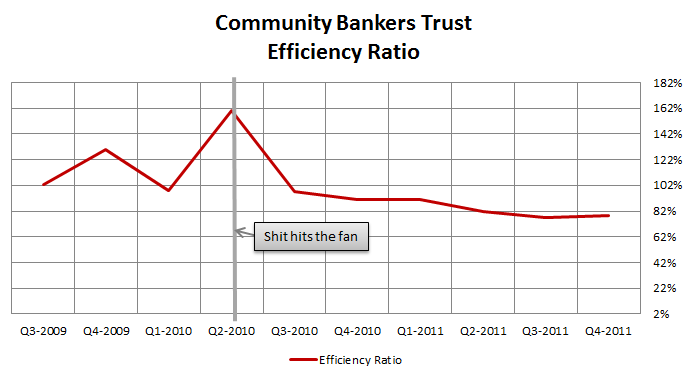
The company also undertook efforts to reduce operating expenses.  The Effiency ratio, which is simply the ratio of the total non-interest expenses at the bank (so the salaries, building costs, lawyer fees, pretty much everything except the actual cost of borrowing money) to the  net interest margin (so the amount of interest made minus the amount of interest paid), has fallen to a low level.

Two ways of valuing the company

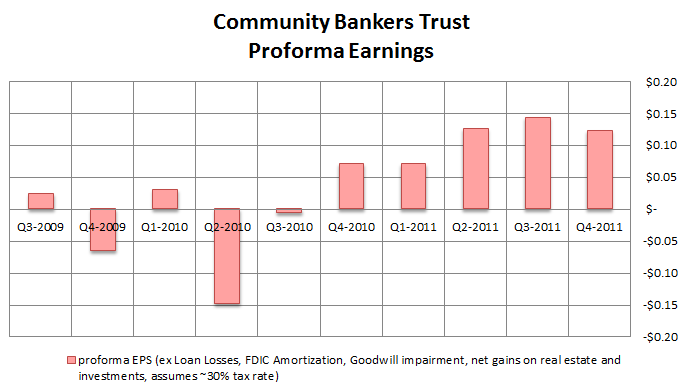
First lets look at earnings.  The chart below shows proforma quarterly earnings for the last couple of years.  The proforma number strips out the provision for loan losses, the FDIC intangibles, losses on real estate and gains of the sale of securities.  So basically I looked at the banking skeleton that is BTC.

The bank has consistently been pulling in more than 10 cents per share for the last 3 quarters.  While the numbers ignore the rather large loan losses that the company has had to take, they make the point that once the bad loan book is worked through, the bank has significant potential for earnings.

Now lets look at book value.  I’m going to take this straight from the company’s fourth quarter report.  The bank sports a tangible book value that is much greater than the current share price even after it has double from $1 to $2:

How about the legacy loans?

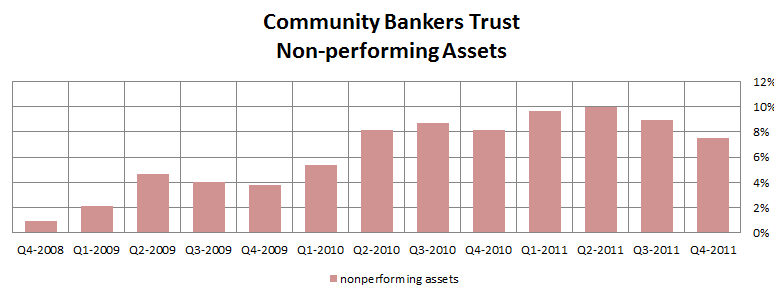
The remaining negative for the bank is that it still has an extremely elevated portfolio of non-performing loans.  However there are signs that this is abating; the fourth quarter showed more progress in bringing down nonperforming assets.   The bet with Community Bankers Trust remains what it was: the US economy is turning the corner, the Fed is not going to allow it to fall into another recession, and so the worst of the loan defaults are behind us.

To put these numbers in perspective, typically you wouldn’t want a bank to have non-performing loans in excess of a couple of percent.  Many of the best banks I’ve looked at have nonperforming loans of well less than 1%.  BTC, onthe other hand…

So can it go higher?

The question I set out to answer is whether I think the bank can continue to move higher.  A double is great, especially when it happens this quickly, but keep in mind before the summer of 2008 this used to be a $7 stock.  Based on what I have laid out above, I think you can make a strong case that it could go higher.  Things have to go right to be sure, but if they do the earnings and the assets are there.

Bottom line: I’m not selling.

Jumping into another Mortgage Servicer

On Tuesday the financials broke out and that breat out has continued through the week. A quick look at the KRE shows that the trend has been up since the end of December and that the move this week took them decisively above the July-August levels just before the break down occurred.

Along with the plain vanilla regionals, a number of the mortgage specialists that I have leaned towards are showing strength. Newcastle Investments continues to move higher. PHH Corp is flirting with $15. I’m pleased that these stocks are responding so well; as they continue to do so I will continue to add to my positions.

As it is I have bought the breakout over the last few days by buying a new bank and a new mortgage originator/servicer. On Wednesday I initiated a position in Shore Bancshares.The bank is trading at about 1/2 of book value and looks to be slowly turning around its admittedly elevated delinquent loan book.  And just yesterday I initiated a new position in a recent IPO called Nationstar Mortgage Holdings.

Nationstar Mortgage Holdings

I have been stepping through the Prospectus on Nationstar. It is available here .

I’m pretty excited about the company. I have been looking for another pure play on the mortgage servicing rights thesis. Newcastle is not a bad way to go, and PHH Corp looks good, but Nationstar looks like another cheap alternative to get leverage to an early turn in the US housing market and to the pricing disconnect of mortgage servicing rights.It appears to be trading at about 17x last year’s earnings (ex the MSR adjustments), and I expect that with the growing servicing portfolio (they have grown at a 70% rate for the last 3 years), and with deals like the one they are doing with Newcastle, that those earnings are going to go up substantially.

The company has been privately owned by Fortress Investment Group (another company I want to look at), which is a private equity firm. Fortress is the same firm that is involved with Newcastle.  Apparently someone at Fortress is seeing the same thing I see in the mortgage servicing right business.

Fortress did the IPO of Nationstar at $14 but interestingly will remain a large majority shareholder at 81%. I have no doubt that Fortress made the IPO because of the opportunity they see to capitalize on the mortgage servicing industry.

Newcastle Investments

And since we are speaking about mortgage servicing, yesterday Newcastle also made the predictable announcement that they would raise their dividend from 15 cents to 20 cents for the first quarter.  I find it kinda fascinating how the stock jumps on these dividends increases.  They also left the door open for further increases and further investment into MSR’s.

Kenneth M. Riis, Newcastle’s CEO commented, “I am pleased to announce our second common dividend increase since it was reinstated in the second quarter of 2011. Our ability to increase our dividend is a result of deploying capital at attractive returns and improving our overall operating results. As we complete new investments, we expect our operating results and cash flows to improve further.”

I don’t know if there will be another share offering but I don’t really see any other way for Newcastle to “complete new investments”. Any offering could mean a short term down draft in the shares. But with an investment opportunity like mortgage servicing provides right now, I would argue that raising capital is a good thing over the long run.

Remember that the MSR’s that Newcastle has invested in thus far are expected to return 20% IRR based on the expectation that 20% of those loans will refinance or default every year. That’s the base case. Yet we are in a period where refinancing and defaults could begin to fall substantially, which would drive up the IRR of the servicing. In my opinion the potential for an IRR far beyond the base case is significant.

The current Opportunity in Mortgage Servicing Rights

I’m going to say it again.  MSR’s are a HUGE market disconnect right now.  The disconnect is being brought about by a combination of regulatory changes that have made MSR’s unnattractive from the Tier I capital perspective and from a legacy business of bad loans that many of the banks are stuck with.  The result is that most of the biggest players traditionally in the MSR industry are stepping back and some (Bank of America for example) are getting out completely.  This has left the industry undercapitalized, which has resulted in a collapse of pricing of mortgage servicing rights.  The rights have traditionally traded for 4-6x their coupon; today they are trading at less than 2x.  Newcastle has done its recent deals at around 2x.  And this mispricing has happened at a time when the industry fundamentals for servicing have never been better.  Loan quality is high because standards have become very tight, and with rates so low the potential for significant refinancings has dwindled.

No one else seems to be noticing this. I feel like a loan wolf.  Nevertheless I remain convinced that this is a great opportunity.

In the mean time I will continue to take advantage of the silence and keep adding to Newcastle, to PHH, and now to Nationstar.