Skip to content

Posts tagged ‘sb financial’

Community Bank Earnings: SFBC, SBFG, PKBK


Owning community bank stocks is boring.  Even on earnings day they often trade less than 1,000 shares.  The shares move up and down on so little volume that you never really believe the moves are real.  They seem like dead money, but then a year passes and you check out your account and you own a bunch of stocks up 20% and you can’t figure out how that happened.

So get ready for a boring but quite possibly profitable update.

I’ve had a number of the community banks I own report fourth quarter results.  All of the results were good so far.  I’m going to go through 3 of them here.

SB Financial (SBFG)

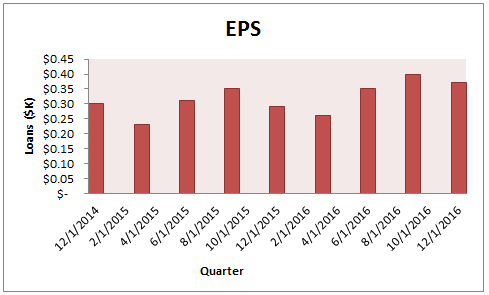
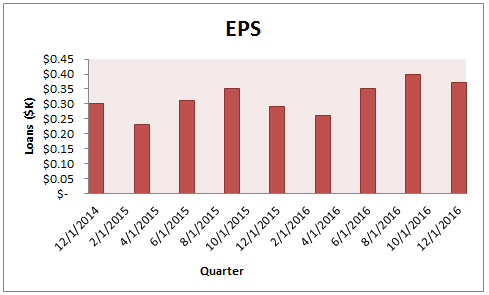
SB Financial was the first to report, a couple weeks ago.  The company made 37 cents EPS in the fourth quarter and $1.37 for the year.  The stock has traded up since the report, but even at $17.50 the PE multiple remains low at 12.5x 2016 earnings.
sbfg_eps

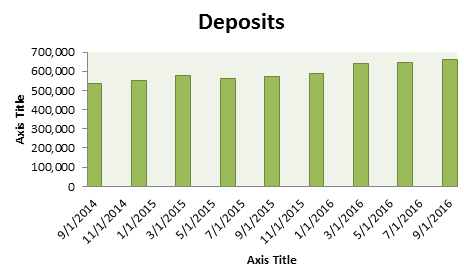
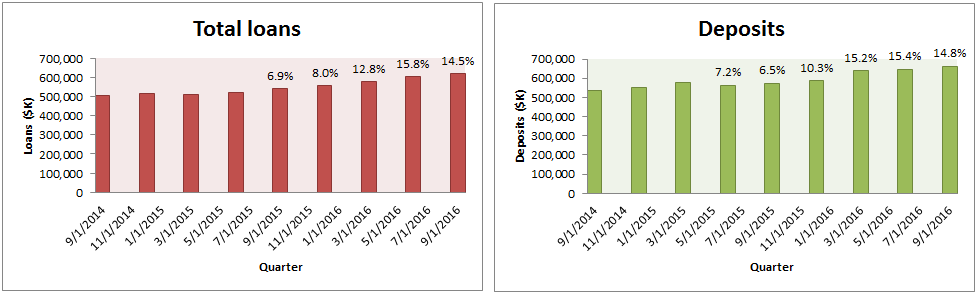
One of my criteria for buying a bank was loan growth and deposit growth.  These are the two pillars that will lea to eventual earnings growth (as long as the bank is well run and can leverage their expenses).  Loan growth at SB Financial continued in the fourth quarter, up another $15 million or 14% year over year. Deposit growth was up $20 million or 15% year over year.
sbfg_loansanddeposits

My one complaint was that earnings were somewhat low “quality” compared to the past few quarters.  Fee income was a little lower ($1.5 million versus $1.6 million in the second quarter), while the company got a big gain from the mark to market of its mortgage servicing right portfolio.   I’ve talked about mortgage servicing rights in the past. The mark to market adjustments from servicing rights can be large as they are very sensitive to changes in interest rates.  But this doesn’t really reflect health of the underlying banking business and if anything it portends to lower originations.

Nevertheless return on equity (ROE) was 10.72% and return on assets was 1.14% which are solid numbers.  Non-performing assets remain a small percentage (0.65%) of total assets.  I am happy with the results.

Sound Financial (SFBC)

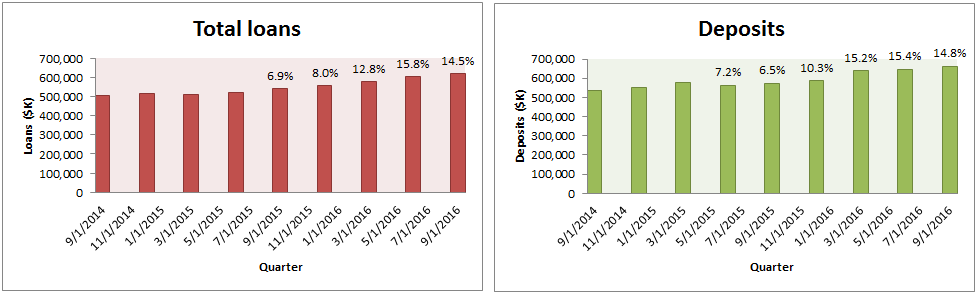
Sound Financial put together a similarly good quarter.  Loan growth was 8.4% year over year.  Yield on loans reached 5.19%, which is a 10 basis point bump in the last year.  Deposit growth was 6.3% year over year.  Non-interest bearing deposits, which are the best because they are essentially free, rose to 13.6% of total deposits from 11.5% of deposits the previous year.
sbfg_loansanddeposits

Deposits should continue to increase in the first quarter after the pending purchase of deposits from Sunwest bank in October:

Sunwest Bank of Irvine, California to acquire approximately $17.7 million of deposits for a core deposit premium of 3.35% and its University Place, Washington branch located at 4922 Bridgeport Way West.  The cost of funds from this branch is an attractive 17 basis points and the cash received is expected to be used to pay down FHLB borrowings.

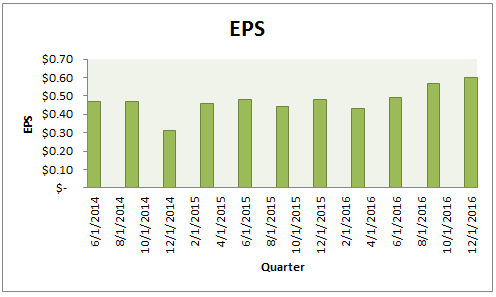
Earnings per share were 63 cents in the fourth quarter and $2.16 for the year.  On a trailing basis the stock trades at 13.4x earnings.

sfbc_eps

Like SB Financial, Sound Financial suffered from lower fee income which declined from $647,000 to $586,000. I’m not sure the cause of these declines and whether there is general pressure on the industry.  It is something to keep an eye on.  Also like SB Financial, they took a gain on mortgage servicing rights, though the servicing portfolio is much smaller so it was to a much smaller degree.

Book value rose 80c in the quarter and is now $24.  Return on assets crept up to almost 1%, at 0.97% up from 0.89% at the end of last year.  Return on equity was at 9.4%.

Non-performing assets are up a little, to $4.5 million from $2.9 million a year ago, but this is still a tiny 0.77% of assets so nothing to worry about.  Again, solid performance and it remains a cheap stock.

Parke Bancorp (PKBK)

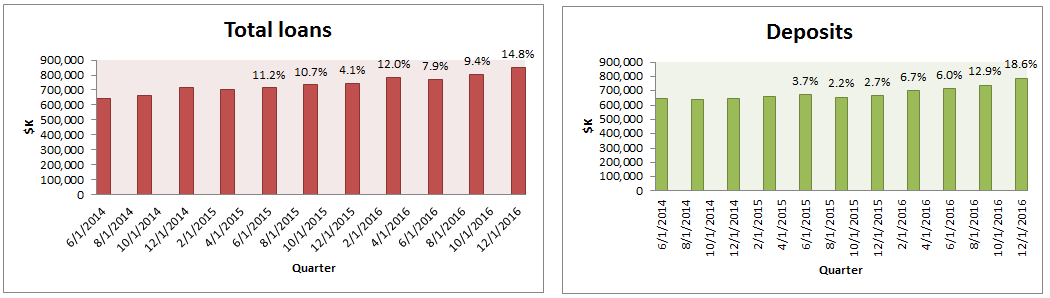
This is going to feel repetitive.  Parke Bancorp had a good quarter as well.  They saw year over year loan growth (15%) and deposit growth (18.6%).
pkbk_loansanddeposits

Diluted earnings per share for the quarter were 38c.  For the year, earnings per share were inflated because in the second quarter the company sold its small business admin loan business for a $9 million gain.  Excluding that sale I estimate diluted earnings for the year would have been about $1.50.  That trades the stock at 13x earnings.  Below is diluted earnings ignoring the sales of the SBA business.

pkbk_eps

Earnings likely would have continued to grow in the third and fourth quarter had the company not chosen to monetize their SBC business.  I’m not sure why the bank sold it?  In the second quarter press release they referred to it as a “unique opportunity”.  It’s possible they just got a great offer, which the profit (over $1/share) suggests.  They still plan to offer SBA loans through their bank, but it probably won’t be at the same scale.  There were no SBA loans sold in the third quarter and no the fourth quarter press release there was no mention of SBA loans sold.

Parke Bancorp has somewhat higher non-performing assets than the other banks I own, at $21.7 million or 2.4% of total assets.  Over half of that amount is real estate owned.  In the fourth quarter press release the bank mentioned one property in New Jersey that has been written down from $12 million to a little over $3 million.  The trend on non-performing assets is in the right direction though, they stood at $30 million a year ago.

The bank has opened two branches in the last year, which is helping deposit and loan growth.  The first is in Collingswood New Jersey and the second is in Chinatown Pennsylvania.   These banks are still ramping and should help fuel growth in 2017.
SB Financial: Like watching paint dry

This is the first of some short write-ups on the community bank stocks that I have invested in over the last month.  I mentioned in my portfolio update that I had thought the community banks taken a basket approach, buying 5 names (some of which I had already owned a small amount of in some accounts for a long time).   I’m not sure if I’ll write-up all of them, but I’ll try to do a couple.

My thoughts behind the trade are that pretty much all the community banks are going to benefit from a few tailwinds over the next year.  These are:

  1. Higher interest rates leading to higher net interest margin
  2. Lower taxes (most community banks pay over 30% in tax)
  3. Reduced regulations (reduced compliance costs)
  4. Better economic growth and a better environment for loans

I want to preface this write-up, by saying I don’t really know if any of the banks I have invested in are the best way to play a rise in community/regional bank stocks.  There are so many bank stocks out there.  I can’t possibly go through them all.  I have a list of about 40 that I looked at and I picked 5.  20 were small and 20 were larger names that I was looking at for baseline.  The stocks I bought were those that compared the most favorably.  They also seem reasonably priced to me.  But there may be (likely are) better ones out there that I just haven’t heard of.

I’m starting with SB Financial (SBFG), which is the new name of a long time holding of mine Rurban Financial.  I actually wrote about the stock first here, almost 5 years ago!  Its probably the name I like the best out of all the stocks I bought.

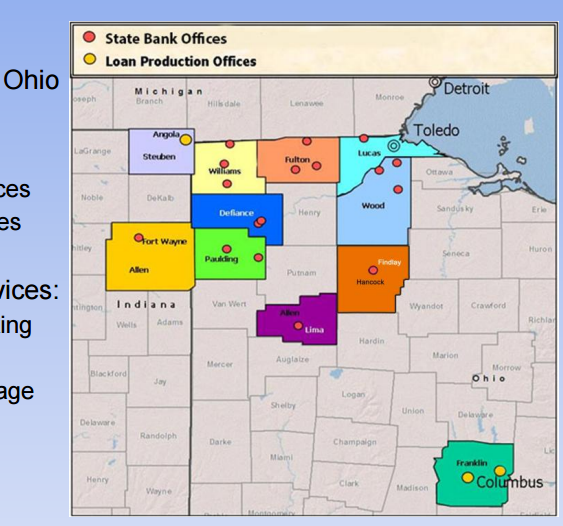
SB Financial operates primarily in Ohio with 18 branches, though it does have a branch and loan office in Indiana and another loan office in Michigan.

operating_area

Overall loan growth in the last few quarters has been in the mid-teens year over year:

total_loan_growth

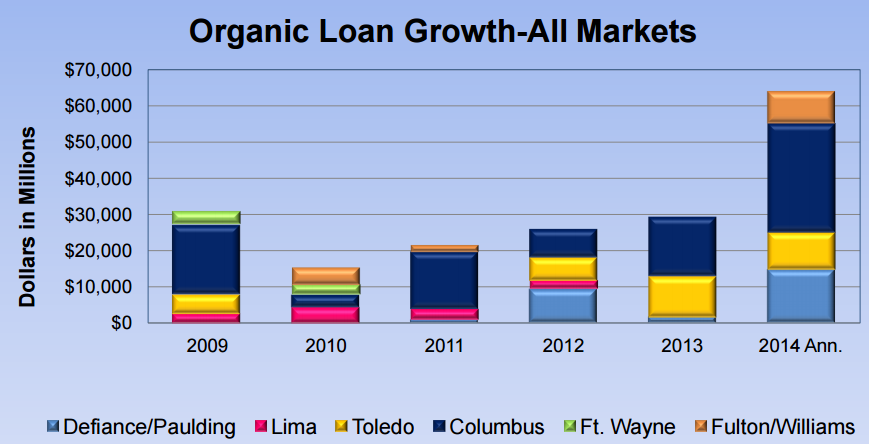
In a 2015 presentation they describe their growth markets as Defiance, Columbus and Toledo:

loan_growth_market

I haven’t found any newer data describing loan growth by market.

SB Financial is not as heavily into residential loans as some banks.  Only about 22% of loans are residential.  Most of their loans are either commercial, commercial real estate or construction loans. I know that construction loans are typically riskier, and the company does not break-out construction loans from commercial real estate from what I can see, so this might be seen by some as a flag.

Nonperforming assets are only 0.6% of total assets.  So at least their history is one of prudent lending.

SB Financial generates a fair bit of non-interest income.  Apart from the usual fee income, they have a mortgage origination segment that has been growing originations over the last year (up from $86 million to $117 million year over year in the third quarter).  While rising rates will have an impact on this business, on the third quarter call the company said that 88% of originations were new money, so refi’s are only a small part of the business. The company also holds a position in mortgage servicing rights that will perform well as rates rise, offsetting the impact of reduced refinancing.

Other non-interest income is generated by the asset management business. Assets under management (AUM) grew to $376 million in the third quarter, which is up 11% year over year.  Fee income was $700,000 for the quarter, so their fees are around 0.7-0.8% of AUM annualized.

To fund their loan growth the company growing its deposits by adding branches.  At the beginning of 2016 they expanded full service banking into Columbus.  On the second quarter conference call, they have pointed to a strong start for deposit growth in Columbus, up $5.8 million in first 6 months, 43% since the beginning of the year.  The company is planning a similar full service entrance into Bowling Green in the fourth quarter of 2016.

In the past few quarters deposits have been growing at a similar rate to loans, 15% year over year.

deposit_growth

SB Financial trades at 146% of tangible book value.  They have some goodwill on the balance sheet, which makes their price to book a little lower, 130%.  The P/TB is the highest of any of the banks I bought.  However they have been the best of the bunch at allocating capital.  Return on assets in the third quarter of 2016 was 1.28% and was 1.1% for the first 9 months of the year.  Return on equity was 11.9% and 10.3% respectively.  I have read that if ROA is above 1% and ROE is above 10%, the bank is doing a pretty good job.

The addition of new branches has likely been a drag to earnings.  The company’s efficiency ratio (this is the ratio of their operating expenses to revenue) was 68% in the first 9 months, which is average at best.  However as they build the branches I would expect this to come down.

The company reported $1.01 EPS in the first 9 months and 40c in the third quarter.  They trade at a little under 12x earnings on an annualized basis of the 9 month numbers.  That doesn’t seem unreasonable to me given the 15%ish growth that they are producing.

I’ve owned this stock for 5 years and its given me no surprises.  I don’t expect one going forward.  Its like watching paint dry, and that’s OK.

I expect the company to keep on generating returns on assets similar to the past, continue to build out its deposit base into new markets (first Columbus, then Bowling Green) and grow fee income through asset management and mortgage originations.  Simple story.  Hopefully with an additional boost from a federal government policy revamp the stock can trade up to 2x tangible book.