On AI, Math and Cryptography
Because I haven’t written in this blog in a little over two years, and because AI has been my primary vehicle for investing for the last two years, I have a lot of thoughts about AI that need to be prefaced before I get to anything else.
Even though some of them may sound a little dated by now, well, I have to start (again) somewhere. And while I was going to talk about a couple of stocks at the end of this post, Akamai and Circle, both of which have not done well, and explain why I think that was, but the post got out of control long so I will leave that for next time. So instead, this is just a second, state-of-where-my-mind-is-at post, and I’ll talk about more specific stocks shortly.
I wanted to bring up Akamai and Circle because they have been AI related stocks that really haven’t worked. Which makes them outliers, at least for me. AI has been the only thing that has consistently worked for me for about the last 2 years.
When I have tried to wade into an non AI name, it has had about a 50/50 chance of blowing up in my face.
Just thinking of just the last few months, I have, at various times, gotten long Boston Scientific, Abivax, BuildersFirst Choice, and Amer Sports. All of these stocks have been somewhere between disasters and duds.
My non-AI loser stocks have definitely outnumbered the winners for some time now.
Fortunately, the AI names I have owned have mostly worked.
Yet I am always uneasy about the AI names. Not for the most commonly held reason though. My uneasiness is NOT that I buy into the commonly held bear case of the big AI bears, the guys like Michael Burry and Ed Zitron. I actually suspect they won’t be proven right for quite a while yet (they will eventually of course, because stocks always have a bear market).
Even though there are a lot of different ways of saying the commonly held AI bear case, I believe you can boil it down to a few points and one big unknown that determines their outcome. Those points being:
- Spending is so big that it can’t possibly realize the return that it expects
- GPUs depreciate too fast to have their investment realized
- Creative financing mechanisms are being used to keep the boom going and those will collapse like they always do
Those three points gather their potency if one future development occurs: AI does not deliver on demand.
If AI delivers enough demand, then none of the above worries matter. Money will be made that will paper over shortcomings and the boom with continue.
For now, I think that demand will prevail and that the rally has legs. That is my tentative conclusion (always tentative because it depends on what is happening next and, I admit, before Muse I beginning to waffle that the doomers may be right).
But anyway, this is the common bear-side worry. But not the source of my own unease.
Instead, my uneasy feeling has more to do with how quickly it is getting better. And my inclination that this is just going to accelerate.
For a bit of background on where I am coming from…
In the fall of last year, I sort of decided that I was going to figure out how AI worked.
I had been in and out of different AI stocks through some of 2024 and 2025. But I never really had conviction. I was always torn between the “it’s a bubble” bear camp and the promise of productivity and profits. And so I was always selling out too soon.
I don’t know why it takes me so long to realize obvious things, but it was then that I realized the only way I was going to gain that conviction (or not) was if I figured out how the dumb thing worked.
I got this book called Why Machines Learn, that gave me a good headstart. I followed that up by going through AI papers, a lot of papers, starting with this list from AI researcher Ilya Shutskeyver, who contributed many papers to the subject and was a co-founder of OpenAI, of the 30 most important papers he thinks you need to read to understand AI.
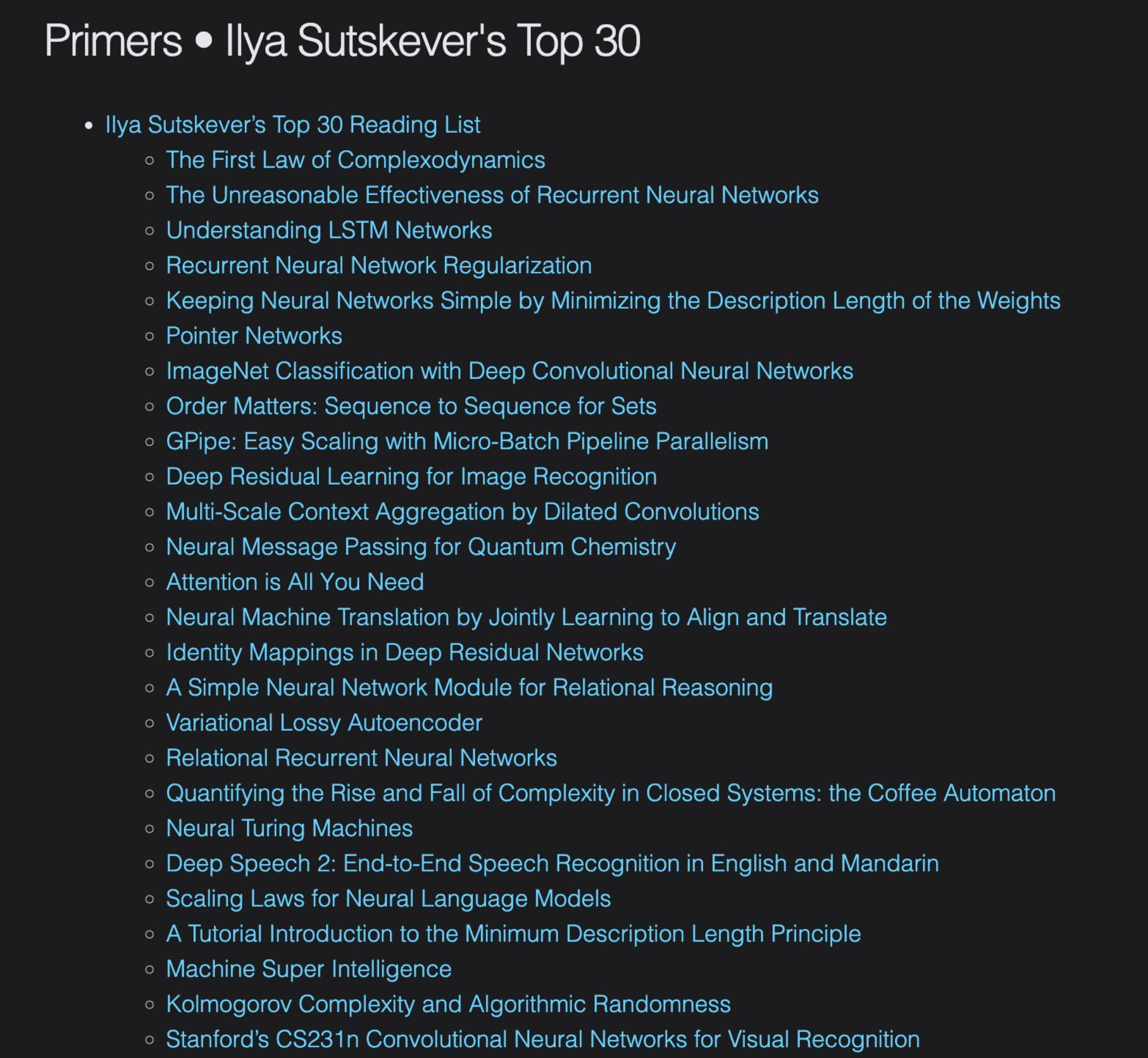
These papers and others are all available for free and are very useful for understand the math and science that goes into AI and how we got to this point. Once you get through them you can tackle pretty much any new idea that comes out and have a good understanding of whether its meaningful or not. I’ve kept at it, reading about what the open labs are doing and, where possible because unfortunately it is all behind closed doors now, what OpenAI, Anthropic, Google and Meta are doing as well.
This learning process was useful for conviction, just as I hoped it would be. What has stuck with me the most is that this stuff is surprisingly simple. It’s all based on math that I learned in undergrad engineering. Today it involves matrices that are enormous, I mean they are hundreds of billions of parameters now, but the actual operations you are doing are not that different than what I learned in first and second year university.
I’m not the only one who has been blown away by the simplicity. Sutskever said himself that one of the reasons he got into the field was because when he read a couple AI papers after his under-grad and couldn’t believe how simple the math was compared to what he was doing with his other math classes and projects. It was a hint to him that this was onto something.
So that’s the first piece of my uneasiness. AI is pretty simple.
Second bit of background. One of the papers that Sutskever lists above is what is known as the Scaling Laws paper.
You hear a lot about scaling laws and what they mean for AI, from bulls and bears alike. What they are usually talking about is this paper called Scaling Laws for Neural Language Models. One of the writers of this paper is, interestingly enough, Dario Amodei, who is the guy in charge of Anthropic now.
This is one of the easier papers to read because it isn’t really exploring any new method or technique. It is just investigating what happens when you make models bigger.
It was written in 2020. It is hardly ancient history.
It didn’t really set out with the expectation to find out what it found. In fact, it was sort of assumed by everyone in AI at the time that eventually as models got bigger things would break down. If you go through the previous 20 or 30 years of AI research, there is this sort of underlying assumption that you can’t just keep making things bigger.
Which sort of goes with the territory. Science is all about simplifying things down through clever solutions. Brute force is frowned upon.
With that expectation, the big discovery of the scaling laws paper was that no, that’s not right. The expected wall doesn’t happen and, in fact, model performance seems to follow a remarkably consistent pattern, called a power law, whereby output gets better regardless of model size.
A power law is just a really simple equation that says that when you make some quantity, say x, bigger, the resulting y scales by a much larger (or, depending on the exponent, smaller) amount. It looks like this:
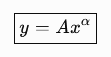
When they found that models followed a power law is was an aha moment. It meant that A. you could basically extrapolate how well a model would perform as it got bigger. And B. It followed a law where outputs got big much faster then the inputs, which tends to be profitable over time.
The paper identified three key inputs by which model performance scaled: the number of parameters (ie. How big the matrix is), the size of the training dataset, and the amount of compute you use.
They found that these relationships held across more than seven orders of magnitude. Again, no sign of anything breaking down or even hinting that it would break down across a really wide range of sizes.
We are now six years past when that paper was written and so far the power law still hasn’t broken down.
Maybe we shouldn’t expect it to. Or at least, maybe we will be surprised with how big it can get before it does.
Power laws are everywhere in nature. Earthquakes, animal sizes, tree networks, blood vessels, river networks, there is just a lot of nature that follows a relationship of power laws.
Which is to say that when you start thinking about all this you start to wonder if we (being humanity that is) really stumbled onto something here. We’ve tapped into something very simple but that scales. Which certainly makes you go hmmm.
None of this is to say anything is for certain about any particular outcome for AI. Nothing is.
But when you put together the simplicity and the scaling I think we are more likely to be surprised by how quickly AI improves, and as it improves creates more use cases, and with that creates more demand, then we are likely to be surprised that its been a big capital spending black hole that has no use.
The problem with the internet, which everyone likes to compare as the example of a bubble that popped, is that the technology didn’t move fast enough to keep up with the infrastructure being built. If we could have had a Blackberry (the phone, not the pager) in 1998, an iPhone in 2001 and streaming Netflix by 2004, maybe the bubble wouldn’t have burst? We just would have just kept laying fiber and building cell towers.
All of this is by way of background to understand where my uneasiness lies. My uneasy feeling is about how quickly AI is getting better. Which brings me to why I was reminded of that this week.
It started with this sort of cryptic (yes, pun) tweet:
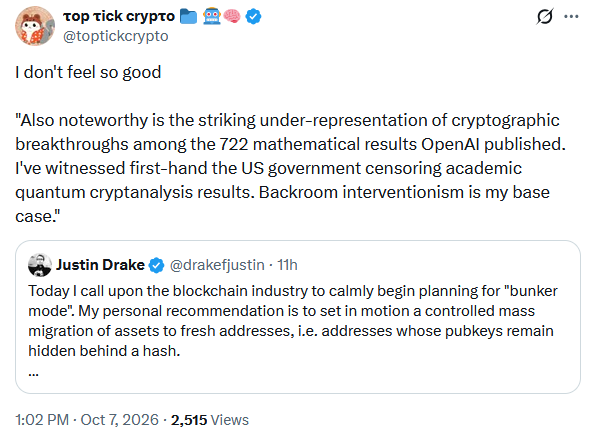
Who is toptickcrypto? It has been a long time and I don’t remember who exactly toptickcrypto is the monikor for anymore but I do remember he was a fund manager, maybe he still is, that he got into crypto in like 2018 or something, and he knows a lot about stocks and crypto.
Him not feeling so good made me want to investigate what he was feeling not good about. Which took me down the rabbit hole of AI models and math. And it all was a little unnerving.
It all starts with this release by OpenAI.
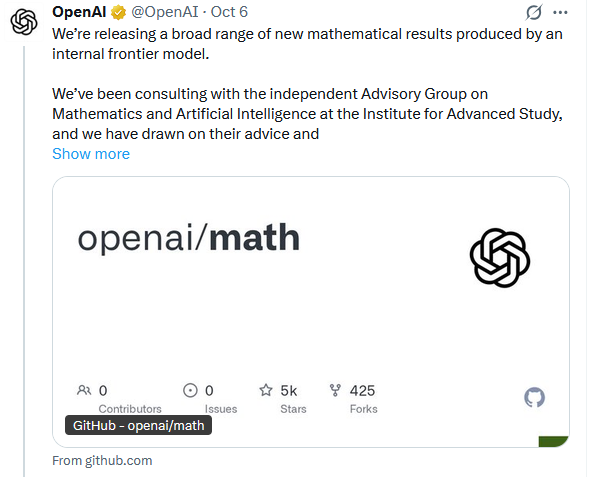
OpenAI published 722 math papers that together solved 372 math problems that had previously been unsolvable. They did it with an unreleased version of their model.
So that’s pretty crazy. And while I see an instance or two of people refuting the solutions, I see much more acceptance admitting what OpenAI did was real.
But beyond that, what Toptickcrypto is pointing out, and what makes him as a bitcoin/crypto guy not feel so good, is the rather ominous omission of those 722 problems: that 0 of them are cryptographic.
Cryptographic means solving a problem that deals with encryption techniques (you know, those things we depend on for literally EVERYTHING on the internet).
Which of course makes one wonder if A. they just happened to decide not to tackle cryptography or B. the cryptographic results are a little scary (ie. good at breaking encryption) and they don’t dare publish them or everyone would freak out.
This was not unnoticed in the crypto world, where there was some freaking out done.
Let me just preface this by saying that crypto, as the name implies, uses cryptography. Also, because of the way crypto is structured, crypto is probably the #1 most vulnerable place to be hacked if cryptography techniques are hacked.
To point to just one of the posts from the community, from Vitalik Buterin, the guy who founded Ethereum and therefore should be taken seriously:
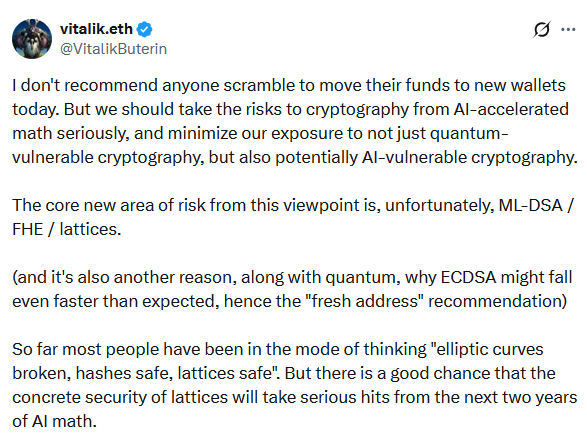
This isn’t the whole tweet. The whole tweet is worth reading because Vitalik has put a lot of thought into this. I have two thoughts on his thought.
First, saying “I don’t recommend anyone scramble to move their funds” is what every bank manager says before the bank run. I’m not saying there is going to be bank run, I’m just saying this isn’t something you want to be saying.
Second, he is admitting that AI is making major steps in math, and that it is unlikely that those steps aren’t happening in the area of cryptography. And based on that, his solution for you, for now at least, is to start moving your crypto to wallets that haven’t had their public key exposed (it turns out that if you have never sent money from a crypto wallet you have never shared your public key and thus it can’t be hacked). Which again, is a bit like saying, take your money from the bank and put it under your floorboard and you’ll be okay.
I’m going to spend just a minute explaining how this all works and why this could eventually be a problem.
First, in crypto, pretty much all crypto, you have a public key and a private key. Both of these are just very long strings of numbers.
The public key is what you send out to the world to transact. The private key is what you would never tell anyone about, and ideally you would keep it locked in a bank vault somewhere. If someone knows your private key, they essentially own all the crypto in your wallet.
The path between the two looks like this:
private key ──(step 1: elliptic-curve math)──▶ public key ──(step 2: hash)──▶ address
The worry is that first “elliptic-curve math” step. The real problem with that step is the “math” part.
I haven’t really bothered to understand exactly what elliptic curve math is, but I can tell you a few things about it.
First, it’s a nifty technique whereby if you go in one direction (calculating the number that is your public key from the number that is your private key) it is relatively easy to do. But if you go the other way, calculating your private key from your public key, it becomes very, very hard. So hard that no one has ever figured out how to do it in a way that wouldn’t take many, many, many years.
However, it is not necessarily impossible. No one has ever proved that going backwards in elliptic-curve math is theoretically impossible. It just has been proven over decades of use that no one has been able to hack it, which means it’s practically impossible.
That is an important distinction, and suddenly quite a relevant one. Because yes, we have something that no human being has figured out a shortcut around. But AI is figuring out all kinds of whacky shortcuts.
Last detour, I promise.
When I was looking into all this I stumbled on this blog post, which talks about the mathocalypse. Anyway, the author of the blog’s wife is a complexity theorist, which means she deals with really hard math. His wife was reviewing one of the AI proofs from OpenAI. And she had this to say about it:
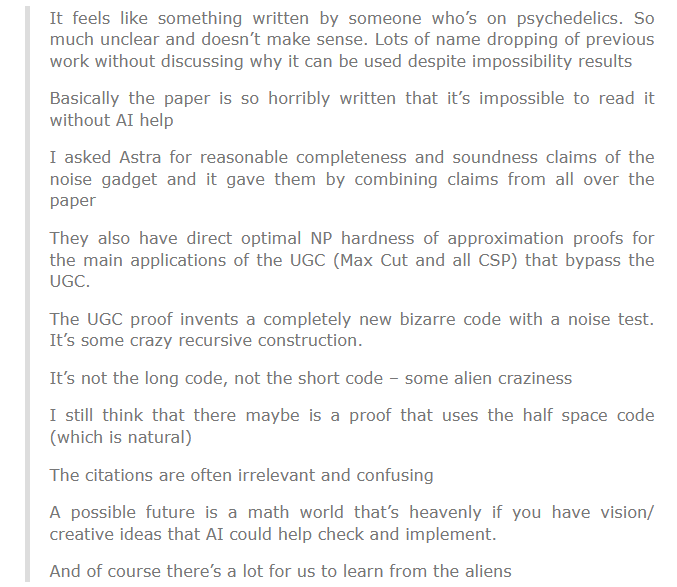
So there are a couple of ways you can take this.
First, you can take it in the mainstream “AI-isn’t-all-it’s-cracked-up-to-be-and-makes-things-up-all-the-time” sort of way. If you did, you would conclude AI is clearly spitting out gobbledygook and we have nothing to fear with this whole math proof stuff.
Or… the other way to take it is a little more seriously. What if AI is simply making connections that are so far from being obvious to us that they sound like gobbledygook (to an expert in the field, keep in mind) but are really fundamental to what you need to know to solve the problem?
Again, you sort of go hmmm. Can’t know for sure but it is alarming.
Of course, all this strikes me as something that could be bad for crypto at some point. And particularly bad for companies like Coinbase or Robinhood. The idea that everyone in crypto is not going to be able to transact without exposing themselves is not a good scene.
But not just yet. None of this matters just yet because fortunately OpenAI has tackled 700+ math problems but is leaving cryptography alone…. riiight. But most of crypto was up on Friday so it is true to say that no one cares about this yet. Citrini, the research substack, had this big piece on AI agents using stablecoins on Thursday, which helped crypto and actually makes a lot of sense and should send the crypto space much higher as long as (or until?) AI doesn’t cut it off at the knees.
The bigger thing for the plain vanilla common stocks I own is why this is a great example of where my uneasiness lies.
What I have been trying to lay out here is why things are progressing very quickly, why things are likely to continue to progress quickly, and from that, why the proper conclusion to draw is not the bear case that its all going to fall apart because of lack of demand, but instead that the real bear case is that at some point AI could break something in bad way.
There is no immediate action to take from that conclusion. In fact, everything I am saying is actually very bullish on AI as long as and until something bad happens. I think token usage will just keep rising, use cases that we haven’t even thought will keep materializing and Ed Zitron, Michael Burry and Paul Kedrosky will keep yelling at the sky.
But I think you also need to stay vigilant here, because we have quite possibly latched onto something that is lightening in a bottle. And I don’t think any of us can say with certainly where it is going to take us.


