Evaluating a Bag full of Akamai
A month or two ago I listened to a podcast interview with a credit investor. I have racked my brain and my listening history to try to figure out what I was listening to at the time, and for the life of me I can’t find the exact podcast or the name of the investor. But I do remember exactly what he was talking about. It was the credit market for AI.
What stuck with me from the interview was (clearly not his name but) the analogy he made between AI credit and commercial real estate credit. He used the investing paradigm for valuing commercial real estate credit to poke some holes in AI financing.
On the surface, what he said made sense. Credit is credit and doing credit analysis is doing credit analysis. Judge the risk of default under different scenarios and price the credit based on relative risk.
Nevertheless, I felt like something was off about it. I just couldn’t put my finger on it. It wasn’t until credit and AI started to become a real issue that I did.
The issue has to do with the nature of commercial real estate and the nature of AI.
AI has lots of upside and lots of downside. Things could turn out really good for AI in general, and they could turn out really good for the winners. But they could also go really badly. And even if AI wins, there could still be some big losers.
AI stocks, other than the biggest ones like Amazon or Microsoft or Meta, are largely options on being one of the big winners. That is why they can move around so much. No business’s underlying value fluctuates 10% or 15% in a day. But when you are treated as an option on an outcome, you can see those fluctuations as the probability of that outcome shifts.
The contrast with commercial real estate couldn’t be more different. Commercial real estate can have real downside if it is done carelessly. But if it is done prudently, the downside can be mitigated. The upside is modest. You will collect a spread, and if you are lucky your property will appreciate at a reasonable rate over time.
This makes commercial real estate ideal for credit. As a credit investor, you are all about understanding the downside. The upside is not really that relevant to you, because by owning a bond you don’t participate in it anyway.
But take the same credit framework and apply it to AI. You are focused on protecting the downside. Looking to price risk appropriately to mitigate it. If everything goes well you get coupons and your principal back. If everything doesn’t, you could lose everything.
Given the risks of AI, unless the debtor has pristine credit, you better price it dearly to be compensated for it. You don’t care what the upside might be.
And that is the problem. It is sort of missing the whole point right?
With that in mind, let’s turn to Akamai.
Akamai has just been a mess of a stock. And much of it is connected to them getting into the business of selling compute for AI.
Akamai began as a Content Delivery Network. They evolved into an edge security platform. Those are the core businesses.
Akamai owns servers all over the world. These aren’t big data centers. They are small and co-located with other servers by design. Most of them are located around big cities. The intent is to be located close to traffic, so they can deliver and monitor content close to the source.
If you are a streaming service, you might pay Akamai to house some of your most popular content in local servers around large populations. Then if someone wants to watch one of these shows, instead of you having to send the content from your server farm in timbuktu, Akamai can play it from much closer. It can be cost effective.
On the security side, you just flip it around. You might pay Akamai to monitor the traffic to and from your website, and if you are attacked or if something suspicious happens, Akamai will shut that traffic down.
For Akamai, it is a business they have been in for 25 years.
Because Akamai didn’t own the sort of space you’d use to stand up 1,000s of GPUs and start training models, it wasn’t a natural play in the first few years of the data center buildout. In fact the stock has done nothing for a long time.
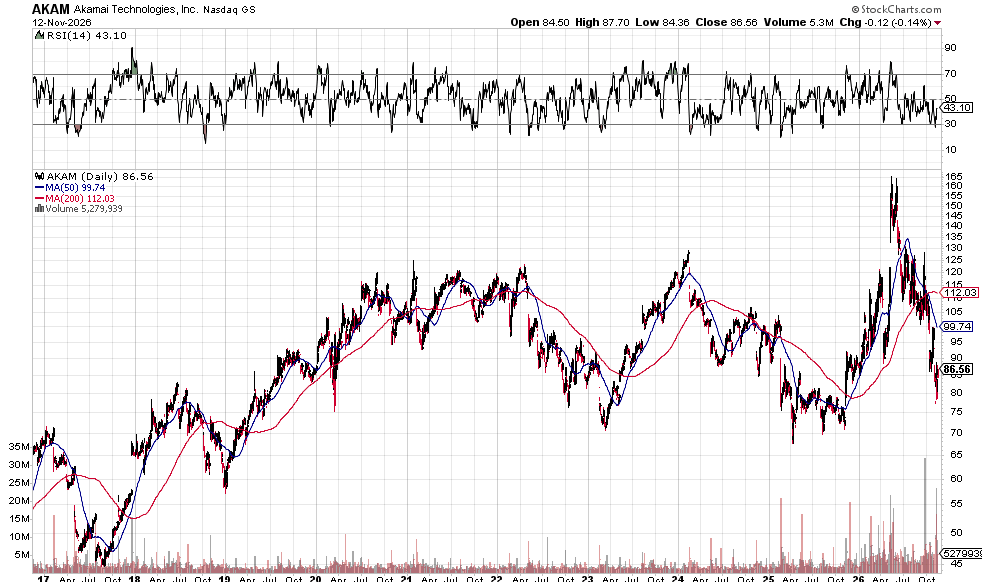
I didn’t buy Akamai because I thought they’d get into the business of selling compute, though I did get stuck as a bagholder because of it. I bought the stock after listening the Cloudflare Q4 conference call back in February, and I started to think that Agentic AI may change the game for not only Cloudflare but Akamai as well.
It made sense to me, and still does, the AI agents will generate far more internet traffic over time and that this traffic should drive traffic to the security services and content delivery services that Cloudflare and Akamai offer.
You just think of how agents scour every website to find information, will read 10x or maybe 100x as many pages of information as a human. I think the clincher for me on that Cloudflare call was when CEO Matthew Prince said “if humans looked at 5 sites when they were making a decision, agents might look at 5,000”.
Cloudflare says bots, including AI agents and crawlers, now make about 57% of web requests. They do much of this through APIs, and websites will have to act to protect themselves and guide these agents through those APIs using tools like what Akamai and Cloudflare sell.
As well, if traffic is going to explode I thought that proximity to content may, over time, gain importance. I’m not sure if the CPU based servers that Akamai and Cloudflare use would ever be used directly for inference (both do own some limited GPU servers that do inference), they would be used to fetch web pages, run agent’s tools and process data, tasks which seems likely to grow.
There is a world here of a lot more traffic and more dangerous traffic and what Cloudflare and Akamai do is manage traffic. So while this business has not been a good on in the past, I thought that may change.
Anyway, that is the thesis. It has worked for Cloudflare, because everything seems to work for Cloudflare, but not for Akamai.
Akamai is maybe seeing a slight sign of stabilization in their content delivery revenue which has narrowed to a -3% decline, but there has been no inflection at all in their security business, which has bounced around between 9-11% growth for two years.
I don’t know whether Akamai is just going to miss out on this opportunity, or if I’m just early and we aren’t going to see a lift until AI video becomes a thing. But I was not ready to give up on Akamai, especially after doing pretty well on the stock on my first go round. So I bought the stock in September at $105, thinking really, how much further could it fall?
Shortly after that Akamai did a pivot of sorts. On September 18th, about a week after I bought the stock, Akamai announced a large compute deal with Anthropic. The total commitment had Anthropic buying at least $11.6B of capacity from Akamai over 7 years.
This is not chump-change for Akamai. Akamai’s revenue run rate is a little over $4 billion a year
Sounds great right? Wrong!
Akamai’s stock has done just horribly since that time.
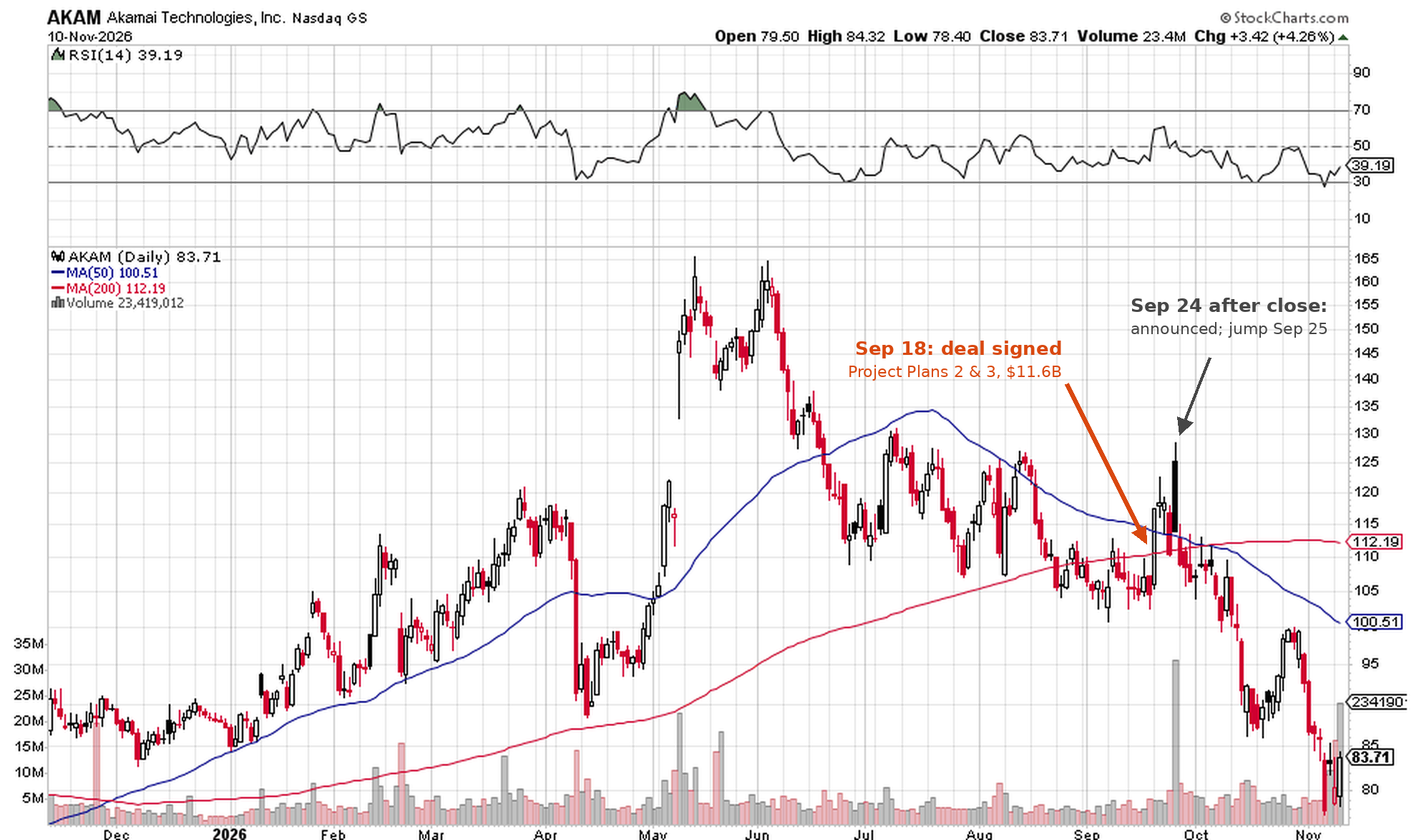
What the heck happened?
Not really knowing what I had just gotten myself into, I set out to find out. Shortly after the deal was announced I ran the numbers. At the time, there were only sparse details on the deal so I did the best I could, which is what I have reproduced below.
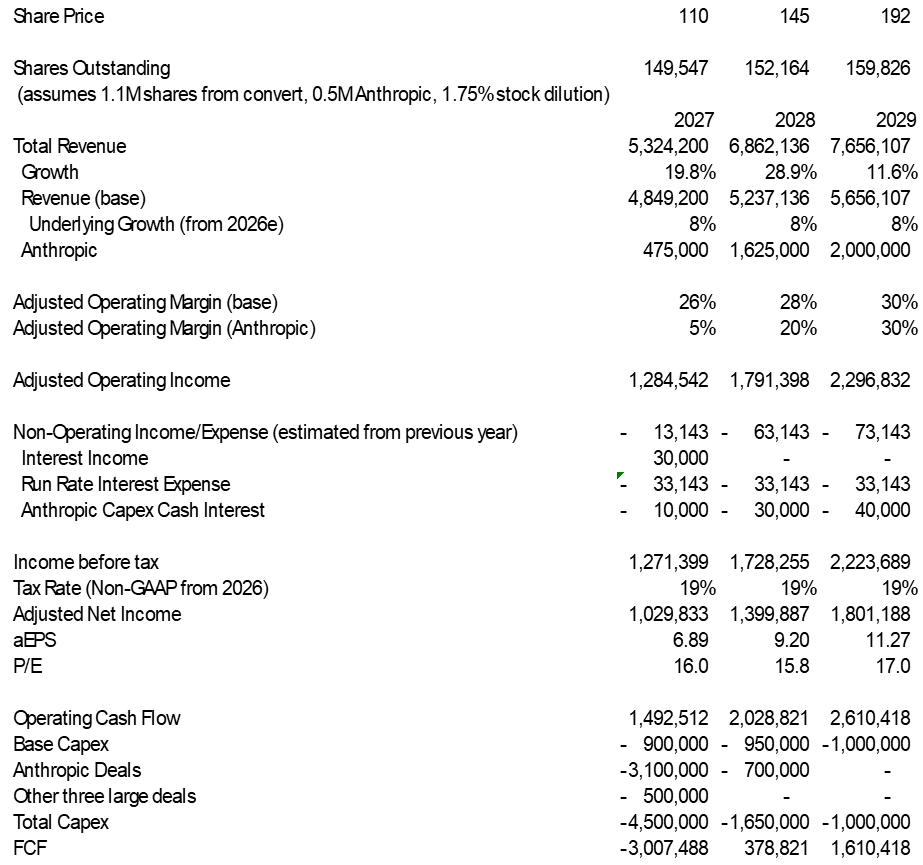
My interpretation of the deal with Anthropic was that it was going to be a positive for Akamai earnings, but just not right away. And markets don’t like lags.
For context, at the end of Q2 Akamai was guiding to a range of $6.40 – $7.05 per share of earnings for 2026. If you look at the impact to earnings in 2027, it is within guidance for 2026. So no real growth. It isn’t until 2028 and 2029 that the deal ramps and Akamai sees its earnings rise.
In fact the deal will likely depress earnings for at least a few quarters. You can see that my margin estimate from the Anthropic deal for 2027 is only about 5%. If you parsed out quarterly numbers, Q1 and Q2 of 2027 were likely to be even more negatively impacted by margins as Akamai built out their cloud ahead of any revenue. They would have to begin paying for colocation costs and increased headcount even before Anthropic started paying for capacity.
On top of that, as we saw with the release of Akamai’s Q3 results, big deals like this have delays. Which push out earnings even further.
Markets don’t like it when things get worse, even if the promise is that they will get better after that. There are just too many examples of things getting worse and then just getting even worser.
Markets also don’t like it when things get worse and it costs money to do it.
Akamai would have to pay to install the capacity it is selling to Anthropic upfront. They estimated back in September that they would have to add $5.5 billion of capex to deliver the capacity to Anthropic from the deal. Of that, $1.7 billion would be spent in 2026, before any revenue is generated, $3.1B in 2027, when very little money is being made and the rest in 2028.
The market was being asked to digest the financing risk of capex and the time risk of cash flow all at once. And give Akamai capital to do it.
It was a fairly straightforward exercise to go through Akamai’s cash and debt maturities over the next few years. And from that to conclude that they didn’t quite add up.
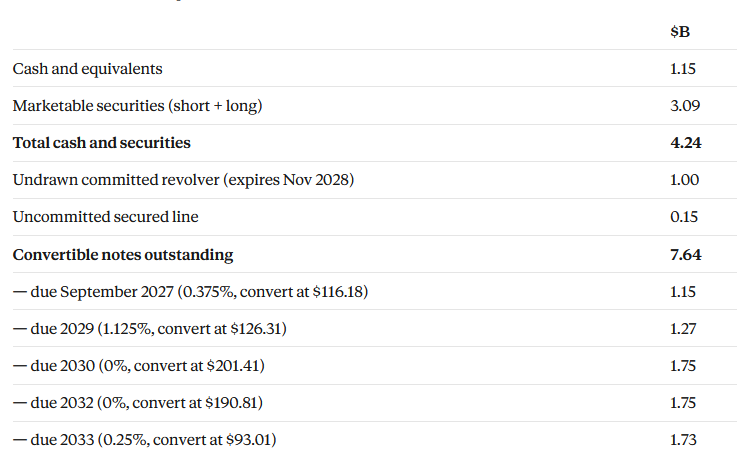
Even ignoring the later maturing convertibles, Akamai was short of about $1.4 billion of cash. And that is with full use of their outstanding revolver. If they wanted flexibility, you could raise the shortage to $2.4 billion.
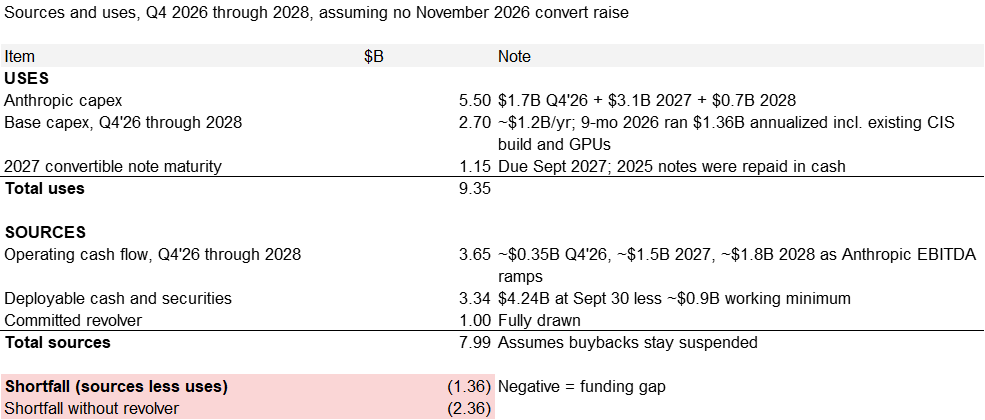
You put all of this together and I think you can see why the stock price tanked.
Well what’s done is done. Akamai reported earnings on November 5th. They gave us more detail about the large Cloud Infrastructure Services (CIS) deals.
The most interesting information they gave was this slide:
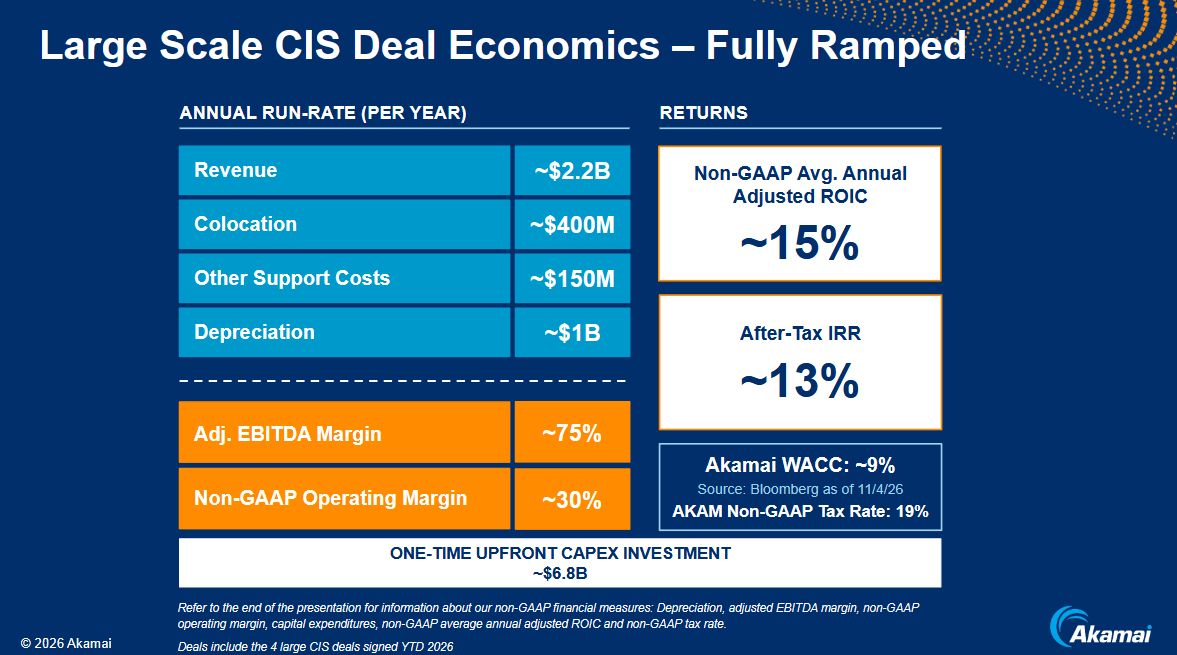
The slides validated a lot of my original assumptions, but made me modify a few others.
The revenue from all four of Akamai’s CIS deals is $2.2 billion per year, versus the $2 billion I was using based on the Anthropic-only deal release. The 3 other deals that add up to about ~$0.5B are likely these one’s announced in the first half of the year:
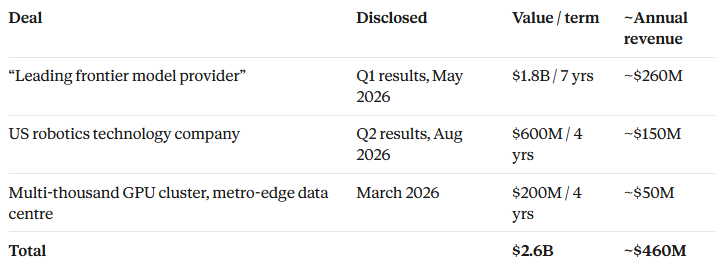
Capex for the 4 deals is $6.8 billion instead of the $5.5 billion that I had been using.
The hardware depreciates over 7 years, not 5 years.
Some minor changes but it really didn’t make a big difference to the earnings per share.
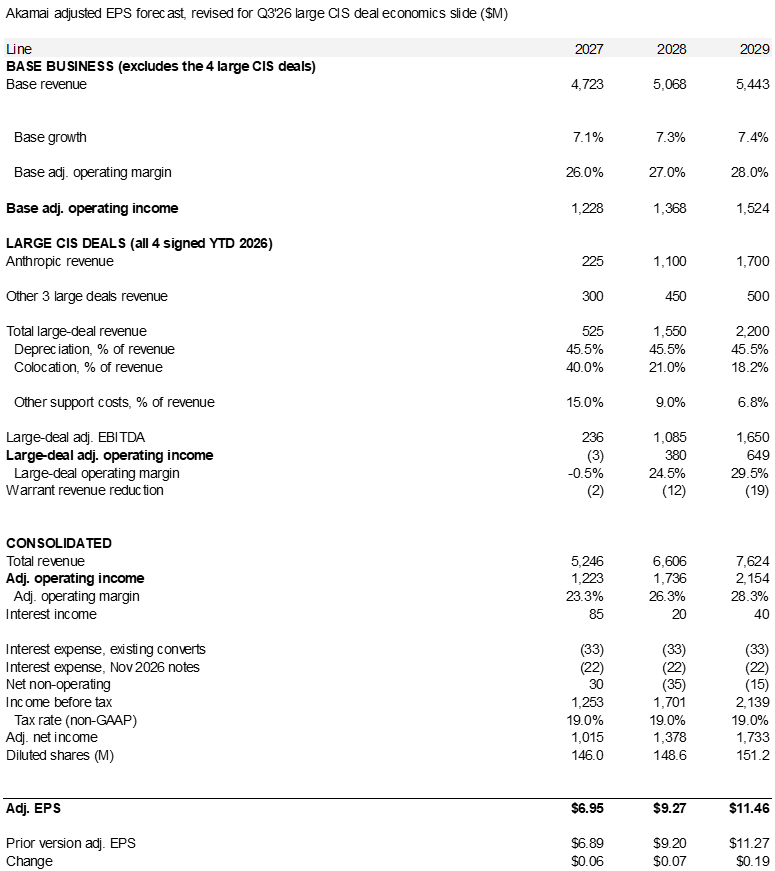
We still have the same problem though. Akamai will not see much in the way of earnings growth in 2027, but they will in 2028 and 2029.
So it is kind of like a microcosm of what I was saying with AI in general. The upside here is pretty good. If earnings do hit $11+ in 2029, and the stock trades around 15x, it is a $160 stock. Maybe it even gets a higher multiple if my original thesis, that traffic growth will grow their legacy businesses and they can shake the label of being a commodity CDN provider, plays out.
What Akamai needed to do to stop the bleeding of the stock was figure out a way of leveraging that potential upside into the capital it needed to fund it.
Four days after earnings Akamai announced and then closed an offering for $2.2 billion of convertible senior notes.
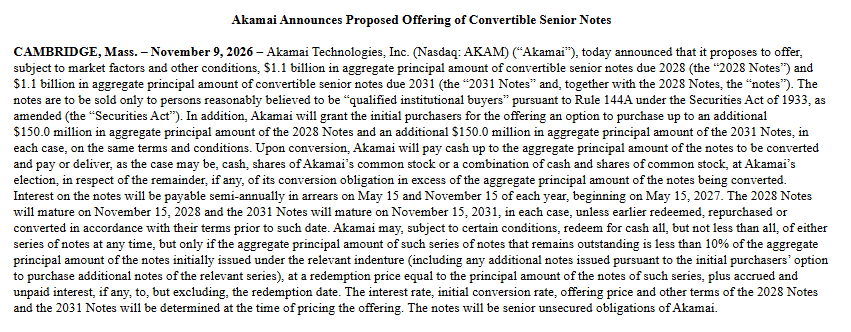
If you read through the details of the notes, they have a couple of features worth pointing out.
First, these notes carry an interest rate of 1%. A very low rate. So just in terms of the cash interest costs of this financing, it is very cheap.
It is cheap because of the convertible feature. When these notes come due Akamai will pay the principal in cash. But they will pay the excess value, which will be determined by how much Akamai’s stock price exceeds the exercise price of the notes at the time of maturity, in stock or cash. The example below is with the 2031 notes:
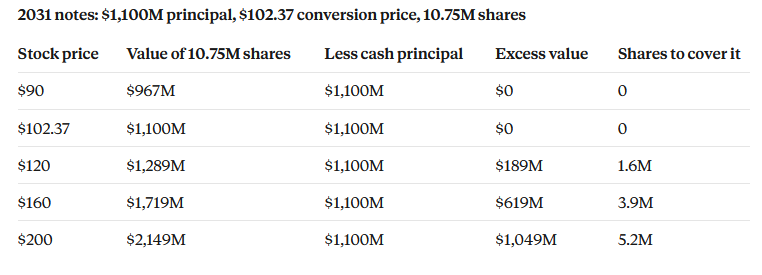
In plain English, Akamai has structured participation in the upside.
I think it’s the upside that is the important feature of these notes. And it is something that we will see more of.
What’s more, Akamai bought back the upside they sold through a separately made hedge with Bank of America. They paid $250 million for a hedge that offsets dilution up to the bank warrant strikes. The note buyers get the upside, but Akamai paid cash to cancel most of the cost to shareholders. They paid for it of course, but not with dilution.
COREWEAVE STRUCTURING AN UPSIDE
So that’s Akamai and that is mostly the end of this post except that I want to relate it briefly to CoreWeave. Why? Because no one really cares what happens with Akamai but everyone seems to care what happens to CoreWeave. Yet there is an analogy there.
I listened to the CoreWeave call Tuesday night. This was their third quarter call, and because CoreWeave is being treated as a bellwether of AI health, I knew the call would be important.
It was one of those calls where immediately you feel like it’s a turning point of sorts.
The problem with CoreWeave is the problem with Akamai on steroids, and the problem I described at the start of this post. It has been trying to raise capital to fund an AI infrastructure build by offering investors no upside and participation in the downside.
Who wants that? I get a 7% coupon but if things go south in AI I’m hooped? It just doesn’t make sense. Especially with a levered, optionality rich bet like CoreWeave.
The whole reason to invest in a company like CoreWeave at all is because of its optionality. There’s no option with the debt.
CoreWeave can’t get quite the sort of deal that Akamai did. Akamai can price convertible notes at 1% because they have a growing $2.4 billion security business and a $1.5 billion cash flowing delivery business if the AI bet doesn’t work out. CoreWeave doesn’t have that to fall back on.
But just as Akamai found a way around this with its converts, CoreWeave seems to be finding a way around it with its customers.
CoreWeave said on their call that they would not be accessing the unsecured debt markets through at least 2027.
Instead, they are going to get money from those that benefit from their success. Who is ultimately going to benefit from CoreWeaves capacity? Its customers. So CoreWeave asks them to prepay, which many of them can.
You can call this circular financing if you want, but in my opinion it is just a logical outcome of the asset being financed. It is the outcome of trying to finance an asset with lots of upside and lots of downside. You need financiers that get the optionality of the upside.
That could be by offering participation in the share price, or by asking customers, who need the capacity to benefit, to pay upfront. Either way, the counterparty is invested in the upside. Which is the whole point with AI.


