Skip to content

Archive for

Jumping into another Mortgage Servicer

On Tuesday the financials broke out and that breat out has continued through the week. A quick look at the KRE shows that the trend has been up since the end of December and that the move this week took them decisively above the July-August levels just before the break down occurred.

Along with the plain vanilla regionals, a number of the mortgage specialists that I have leaned towards are showing strength. Newcastle Investments continues to move higher. PHH Corp is flirting with $15. I’m pleased that these stocks are responding so well; as they continue to do so I will continue to add to my positions.

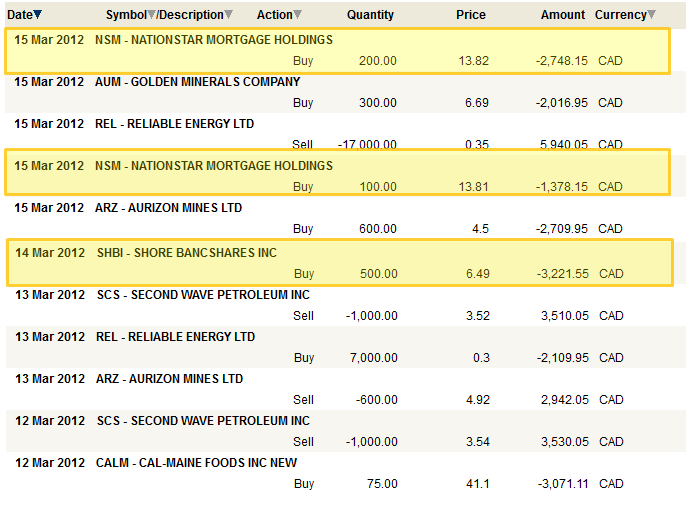
As it is I have bought the breakout over the last few days by buying a new bank and a new mortgage originator/servicer. On Wednesday I initiated a position in Shore Bancshares.The bank is trading at about 1/2 of book value and looks to be slowly turning around its admittedly elevated delinquent loan book.  And just yesterday I initiated a new position in a recent IPO called Nationstar Mortgage Holdings.
Nationstar Mortgage Holdings

I have been stepping through the Prospectus on Nationstar. It is available here .

I’m pretty excited about the company. I have been looking for another pure play on the mortgage servicing rights thesis. Newcastle is not a bad way to go, and PHH Corp looks good, but Nationstar looks like another cheap alternative to get leverage to an early turn in the US housing market and to the pricing disconnect of mortgage servicing rights.It appears to be trading at about 17x last year’s earnings (ex the MSR adjustments), and I expect that with the growing servicing portfolio (they have grown at a 70% rate for the last 3 years), and with deals like the one they are doing with Newcastle, that those earnings are going to go up substantially.

The company has been privately owned by Fortress Investment Group (another company I want to look at), which is a private equity firm. Fortress is the same firm that is involved with Newcastle.  Apparently someone at Fortress is seeing the same thing I see in the mortgage servicing right business.

Fortress did the IPO of Nationstar at $14 but interestingly will remain a large majority shareholder at 81%. I have no doubt that Fortress made the IPO because of the opportunity they see to capitalize on the mortgage servicing industry.

Newcastle Investments

And since we are speaking about mortgage servicing, yesterday Newcastle also made the predictable announcement that they would raise their dividend from 15 cents to 20 cents for the first quarter.  I find it kinda fascinating how the stock jumps on these dividends increases.  They also left the door open for further increases and further investment into MSR’s.

Kenneth M. Riis, Newcastle’s CEO commented, “I am pleased to announce our second common dividend increase since it was reinstated in the second quarter of 2011. Our ability to increase our dividend is a result of deploying capital at attractive returns and improving our overall operating results. As we complete new investments, we expect our operating results and cash flows to improve further.”

I don’t know if there will be another share offering but I don’t really see any other way for Newcastle to “complete new investments”. Any offering could mean a short term down draft in the shares. But with an investment opportunity like mortgage servicing provides right now, I would argue that raising capital is a good thing over the long run.

Remember that the MSR’s that Newcastle has invested in thus far are expected to return 20% IRR based on the expectation that 20% of those loans will refinance or default every year. That’s the base case. Yet we are in a period where refinancing and defaults could begin to fall substantially, which would drive up the IRR of the servicing. In my opinion the potential for an IRR far beyond the base case is significant.

The current Opportunity in Mortgage Servicing Rights

I’m going to say it again.  MSR’s are a HUGE market disconnect right now.  The disconnect is being brought about by a combination of regulatory changes that have made MSR’s unnattractive from the Tier I capital perspective and from a legacy business of bad loans that many of the banks are stuck with.  The result is that most of the biggest players traditionally in the MSR industry are stepping back and some (Bank of America for example) are getting out completely.  This has left the industry undercapitalized, which has resulted in a collapse of pricing of mortgage servicing rights.  The rights have traditionally traded for 4-6x their coupon; today they are trading at less than 2x.  Newcastle has done its recent deals at around 2x.  And this mispricing has happened at a time when the industry fundamentals for servicing have never been better.  Loan quality is high because standards have become very tight, and with rates so low the potential for significant refinancings has dwindled.

No one else seems to be noticing this. I feel like a loan wolf.  Nevertheless I remain convinced that this is a great opportunity.

In the mean time I will continue to take advantage of the silence and keep adding to Newcastle, to PHH, and now to Nationstar.
Newcastle Investment Dividend Ratio

I’m not much of a dividend investor.  Maybe when I get older I will covet the security of knowing I’m getting 3-4% back from the company every year.  But not now.  Right now that 3-4% doesn’t seem like a lot to me.  I’m certainly not going to be changing my lifestyle any time soon on a 3-4% return.  I’m trying to build capital and to do that I need to have a few home runs, not a bunch of sacrifice flies.  I certainly don’t put in as much work as I do so I can make a couple more points than the rest of the mutal fund / index fund / ETF crowd.  Dividends don’t normally excite me.

When a dividend gets to 10%. like Newcastle’s is, then it starts to pique my interest.  But just barely.   10% still doesn’t cut it.  If the best I can do is 10%, than I still think I should quit and hire an adviser.  That’s my thinking anyways.

So when I bought Newcastle, it was with the understanding that the dividend was a nice feature, but not the reason to buy the company.  The reason to buy the company is because I think the price of the shares are going to go up.

Of course…. Newcastle is a REIT the main driver of the share price is the dividend.  So the two are intertwined and therefore I need to understand the relationship.

As the dividend goes, so goes the stock price

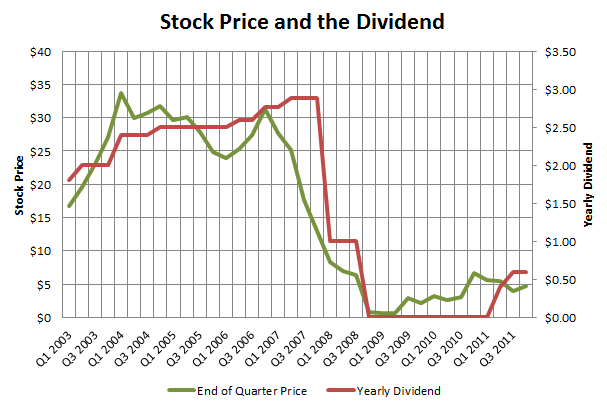
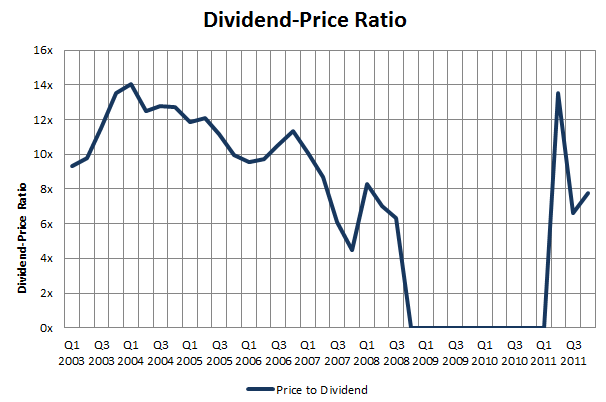
I went back through the last 6 years of Newcastle’s 10-K’s and came up with the following graph that helps illustrate how closely the dividend and stock price are linked.

Here is what I found:

The stock price is clearly linked to the dividend.  In most cases (as you would expect) the stock price leads the dividend.

The stock price usually falls within a broad range of 8x to 12x the dividend.  It depends if times are good or if times are bad.  Right now, times are improving, so perhaps a move to 12x is not out of the question.

I haven’t run the numbers in full on the second MSR deal that Newcastle announced.  Until I do I won’t be able to say what I think the dividend will eventually be.  But to ballpark, based on a sustainable cash flow of 10 cents per share from the first dividend, and given that the second deal is roughly 4x larger than the first, I think that a sustainable dividend in the 80-90 cent range is not unreasonable.  Tacking on a 10x to 12x multiple and we get a share price range of somewhere between $8 and $11.

Week 36: Short-termism

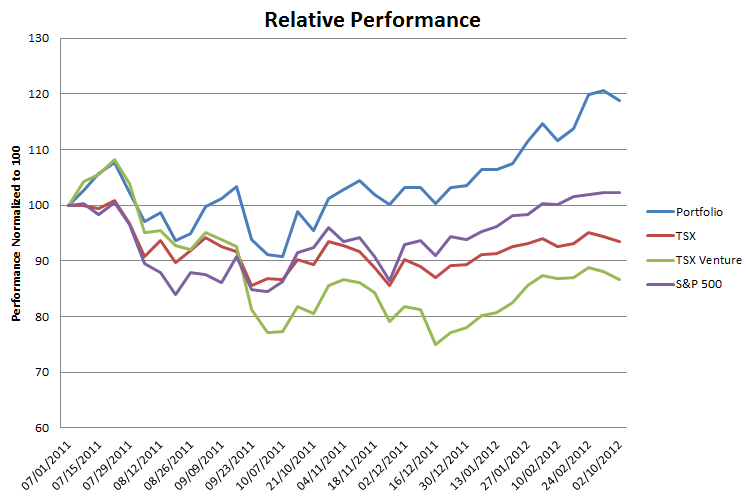
Portfolio Performance

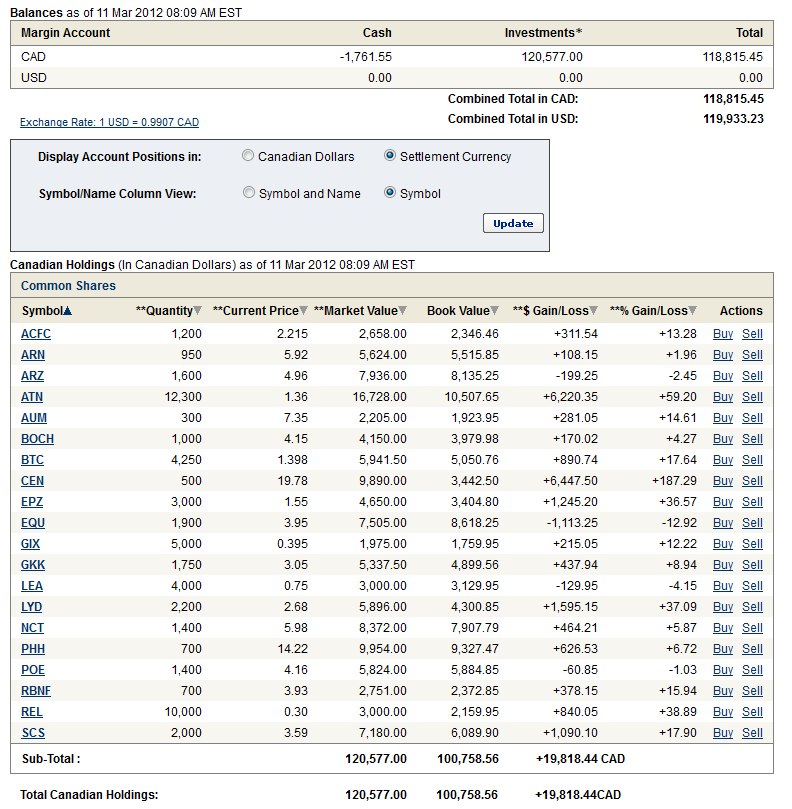
Portfolio Composition

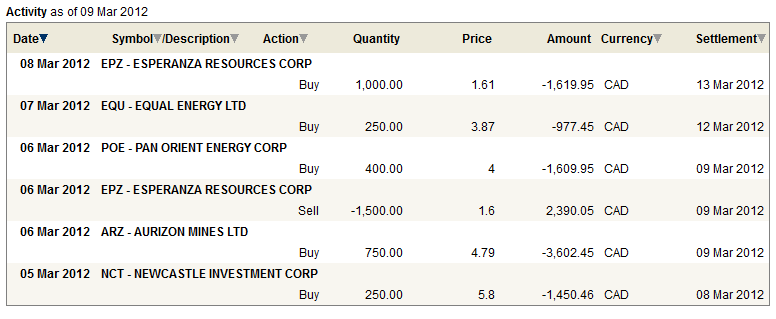
Trades:

Short-termism

One of the unfortunate realities of being invested in the stock market is that while you have to keep your eye on the longer term problems, you can’t let them cloud your ability to look for short term opportunities.  So while I accept the view that the world could quite possibly go to hell in the medium term (see my post on Greece earlier day for the latest installment), in the short term we’re in another liquidity induced high.  Party on or something of that vein.

Buying the correction

As I wrote about on Tuesday, this week I bought the correction, buying Aurizon, Pan Orient and Golden Minerals (I screwed up the Golden Minerals trade in the practice account I post here and didn’t realize it until I checked this weekend so I will have to buy the stock next week to reconcile the practice account with my actual account.   As I mentioned earlier, I bought a fairly substantial portion in my trading account.  In a couple of my other accounts that I do not track with the RBC Practice account I also bought more Newcastle Investments and Atna Resources.  I’ve been doing work on both of these companies and I think these represent two of the best opportunities for appreciation in the next few months.

Never add to a losing position… except this time

I also bought more Equal Energy when it got down into the $3.80’s.  I am going against my rules with Equal.  Never add to a losing position.  I’m losing on Equal.  But I’m simply of the mind that even with low natural gas prices this is getting ridiculous.  The activist shareholder movement posted a new slide to their presentation that showed just how undervalued Equal is compared to some peers, particularly NAL.  NAL has ok assets but I would not say they are that much better than Equal’s.  Yet NAL trades at a valuation that is more than double of what Equal is at.  Something has to give here.

Back into Leader Energy Services

The other stock that I bought recently (was actually last week that I bought it, not this week, but I haven’t mentioned it yet) was Leader Energy Services.  Leader did a bought deal financing two weeks ago.  They raised about $6M with 8.5M share dilution.  For those that have followed this blog for a while, I owned Leader back in the summer but sold the stock when Europe broke out because I feared (rightfully) that a company in a cyclical business with a lot of debt would have a tough time in that environment.  I wrote up my thoughts on why I originally bought Leader in this post.  I wrote up my thoughts on why I sold Leader in this one.  The basic thesis of why to own the stock is still valid.  With the financing, many of the debt concerns are not.  Given that, and given that the immediate problems in Europe having receded, I decided it was probably the right time to take back a starter position in the stock.

Turning Greeks into Germans

On my ride into work this week, on Tuesday I think, I listened to the Planet Money program, In Greece, How Office Politics Could Take Down Europe.  Its a very interesting podcast, and I recommend it to everyone.

Office politics and Europe have a lot in common.  Office politics are mostly about power struggles between competing elements.  They typically put forces of the status quo against forces of change.  The winners tend not to be those with the best ideas, but those with the most clout.  And in the end the losers of the battle have to either conform to the dicatates of the winners, or get out and find at new place to work.

Such is the case with Germany versus Greece and the rest of the periphery.  Greece is getting closer to that bifurcation where they have to either conform or get out.

Serpico

The podcast describes the travails of a lone Greek Technocrat, Andreas Georgiou, sent back to Greece by his employers in Brussels to go through the books.  Of course, the books are cooked and the more our technocrat (hero?) delves into them, the more he finds out not only how cooked they are, but also how difficult it is to get the truth out.  Eventually they try to put him in jail for his efforts.

It reminded me of one of those old “one good cops” stories, where it seems like everyone on the force is on the take and how can our hero ever persist?

Unfortunately, he probably can’t.

Debt Crisis Delayed, not Over

What I think the story illustrates is just how deeply rooted the problems in Greece are, and just how hard it is going to be to get those attitudes to change. With the focus centered around the default of Greece and whether there will be private sector involvement or ECB involvement and how much the haircut is going to be and whether the ISDA is going to call it a credit event or not, it seems like we’ve kind of gotten side-blinders on and are thinking that once Europe gets through the default its all good.

Of course its not.  As the podcast pointed out, the basic premise of the EU strategy is that in the future when a country starts misbehaving, so when Greece starts running a big government deficit again or some other misdeed occurs, technocrats will swarm the country and force measures of austerity before it gets out of hand.  Greece and the rest of the EU are essentially to give up their economic sovereignty.

Well, Georgiou is a bit of a canary to that coal mine, and he is facing jail time for his attempt.

It’s the Economy Dummkopf

This is all just another way of stating the basic argument that Michael Lewis made in his Germany piece in Vanity Fair.  This article was a bit of an eye-opener to me; it was the point where I saw for the first time just how intractable the problems in Europe are.  In the article Michael Lewis pointed out the dilemna that the periphery faces:

The Greeks (and probably, eventually, every non-German) must introduce “structural reform,” a euphemism for magically and radically transforming themselves into a people as efficient and productive as the Germans. The first solution is pleasant for Greeks but painful for Germans. The second solution is pleasant for Germans but painful, even suicidal, for Greeks.

For the solution to work (and by solution I do not mean the short term papering over that we are accomplishing with the LTRO, the next bailout tranche or the cohersion of the private sector to accept a 70% cut), the Greeks have to become Germans.

And that is just not going to happen.

As I pointed out in my now clearly ill-timed post about the ineffectiveness of the LTRO, eventually the interpretation of Europe is going to come back to the economy.  When it does, and when the somber assessment that the Greeks are still not German sets in, well then the fact that we’ve shaved some debt off the top is going to matter a bit less.

These guys are done.  And not just Greece.  The whole EU.  Its like a walking dead, being propped up by the printed money of the LTRO.

But that’s fine.  I am in no rush to have the market turn over.  I’m in stocks that I think for the most part will outperform the market significantly in an upcycle.  I just have to not forget that the key to investing, at least right now in these debt-ridden times, is to accept the necessary short-termism, but always with a wary eye on the inevitable long term.