Skip to content

Posts from the ‘MBIA’ Category

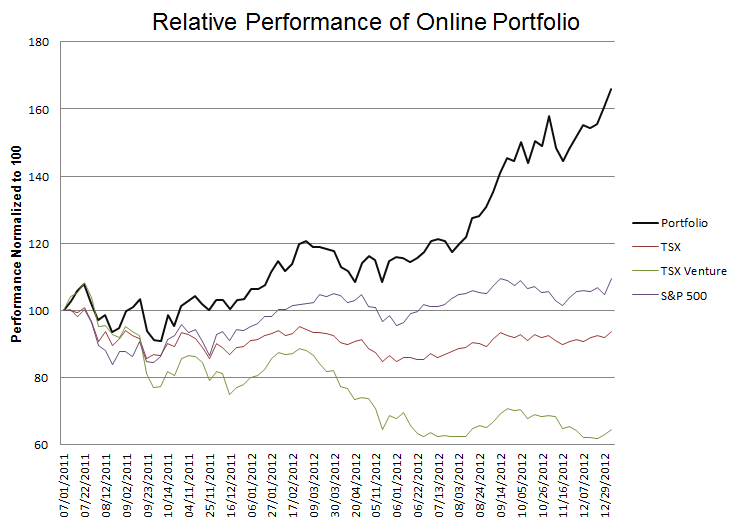
Week 79: From Chaos to Order

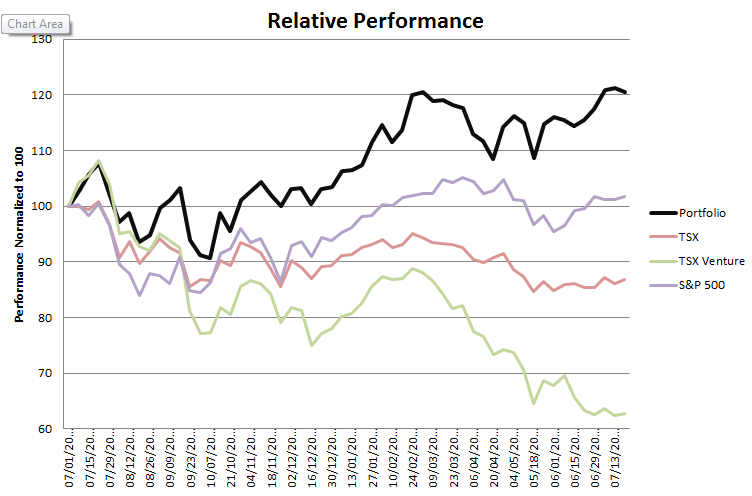
Portfolio Performance

week-79-performance

Summary

I am going to try to keep to a shorter update but given my track record with brevity we will see how that pans out.  The reason I want to keep it brief is that I am attempting to write a Visual Basic program this weekend that will allow me to paste my transactions into an excel spreadsheet and automatically spit out a list of the closed positions, the open positions, and the relevant transaction parameters.  I want a better solution than a snapshot of the RBC Practice Account portfolio holdings page;  I have no ability to come up with graphs and charts of performance with my current snipit method, the practice account summary has a bug that screws up the book value and gain/loss numbers every time you make a partial sale of a position, which is a real pain, and I want to be able to post a consolidated list of all my closed positions along with their gain and loss, something that is not possible from the practice account (my current method, which has been to post every one of my updates on my portfolio page, is getting to be a little too long).

On the Cliff

The market was a real yo-yo over the last couple weeks but I didn’t really panic much.  I have been known to do violent purges in the midst of chaos, but not this time.  I was pretty confident that something would get done, either at the deadline or as a result of the steep fall that would occur after it was passed.  As it was, things turned out just about in-line with my expectations. Read more

Why I added to MBIA

I decided to re-establish my original position in MBIA Inc.  I did so after the drop Tuesday and Wednesday that was precipitated by Bank of America’s offer to buy MBIA holding company indentures.

I don’t want to rehash the background of Bank of America and MBIA in this space.  For background on the MBIA consent solicitation and the tender offer by Bank of America in response I would recommend this article by Christian Herzeca, this Bloomberg article, and this blog post by analyst firm BTIG for background.

What I want to focus on is why I decided to add my position.  I could have just as easily cut my losses and run.  The market sucks this week and I am losing money.  My instinct right now is to cut my losses (and in most places keep my profits) and sell.  Moreover, I do not often add to a losing position, which is what I am doing with MBIA.  I try to make a habit of doing less of what doesn’t work, and while MBIA has been profitable for me through most of the time I have held it, it recently has not been.

Yet I decided to add.  Why?

I decided to add to the position because I believe that the market has unfairly priced in an increased chance of an NYDFS takeover of the securitization subsidiary (MBIA Corp.) that would lead to a bankruptcy of the holding company (MBIA Inc.), and has decided to ignore a number of the potential positive catalysts that could occur over the next couple of months.  It just seems to me like a case where the market got the wrong news at the wrong time and panicked a bit too much.

Positive catalysts for the stock in the near term

The positive catalysts include:

  1. A positive ruling on the Article 78 proceedings (this is a verdict on the legality of MBIA severing its municipal insurance business from its securitization business.  It is being contested by Bank of America.  It has been on the desk of Judge Kapnick for over 5 months now)
  2. A positive summary judgment on the fraud and breach of contract lawsuit that MBIA has against Bank of America.  There was a recent article on the summary judgment here.
  3. Perhaps a bit more nebulously, the response of MBIA to Bank of America.

To expand on that third point, I find it hard to believe that MBIA did not consider the potential that Bank of America may respond this way.  By issuing the consent solicitation, MBIA was effectively backing Bank of America into a corner.  The holding company wanted to remove the remaining necessary ties to the securitization business by redefining the holding company bonds so that they would no longer have the ability to be accelerated in the event of a default at the securitization subsidiary.  All of Bank of America’s claims reside in the securitization sub and much of them are subordinated in the event of a bankruptcy.  Thus MBIA was really about to cut Bank of America off at the knees.  So Bank of America responded in kind.

MBIA Counter-measures

There are a few different counter measures that MBIA could respond with.  I can’t take credit for these ideas.  I got them from some of the very astute tweeters that follow MBIA (hat tip to @cherzeca,   and @alex_ryer)

  1. A consortium of largest holders of the common stock combine to put together a better offer for the bond indentures.  The idea was put forth by BTIG in this article, where they said “we would not be surprised to see an announcement that some of MBIA’s deep-pocketed friends had formed a limited-liability corporation (LLC) that they would use to top BAC’s offer and buy up the 50% of the 5.7% Notes that would be needed to push a consent solicitation over the top.”
  2. MBIA buys the indentures back themselves.  The bond issue that Bank of America is going after are callable by MBIA.  It wouldn’t be cheap, I read that the price to call the bonds is par plus future interest payments.  MBIA would have to pay for the re-purchase through a new private placement which also would be more expensive than the existing indentures.  But it would effectively allow MBIA to pressure Bank of America with the leverage that if Bank of America does not pay a reasonable settlement, the MBIA holding company could put the MBIA Inc. insurance subsidiary into bankruptcy with no consequence to the holding company.

The third option that MBIA has is to let Bank of America buy up the indentures.  Now I haven’t heard this from anyone else so maybe I’m off-base here, but it seems to me that it is significant that Bank of America is buying the bonds because they don’t want the holding company to have the option of throwing securitization sub into bankruptcy without consequence to the holding company.  But by buying bonds of the holding company that are contingent on the viability of securitization sub it becomes even more in Bank of America’s interest to not see the insurance subsidiary go into bankruptcy.

By allowing Bank of America to buy the bonds, MBIA is raising the probability that the worst case outcome in their dispute is that the MBIAwalks away without a bankrutpcy, and with the municipal insurer National intact.   The National franchise is worth maybe $20 per share, so that outcome is extremely accreditive to the current share price.  If we could end this all today with this outcome I would take the consequences.

Liquidity

The final piece of the puzzle is the company’s liquidity, which is the other element that has the market spooked.  The securitization subsidiary has a limited amount of liquidity to pay claims.  While the overall statutory surplus at the securitization subsidary is $1.1 billion, a little less than $500 million of this is invested in common stock.  What the common stock refers to is the interest the securitization sub has in its subsidiaries, primarily in UK Holdings, which does business in Europe, and makes up about $450 million of that common stock number.  This $450 million is based on the statutory capital available at UK Holding, which is not immediately available to MBIA.

If you remove the common stock from the equation, MBIA Inc. has $386 million in cash and liquid assets, and another $250 million or so that is in bonds.  While the company has been non-committal about how long this cash will last them, the consensus is that it is more than enough to get them through the first half of next year.

While I see how the securitization sub will eventually be pushed into liquidity problems if nothing changes, I think that it is far enough off that I can discount it for now.   My re-established position in the stock is based on much shorter term factors that should play out before year-end.  I am willing to wait this out a month or two, and see how it plays out.
Week 55: Skittish

Portfolio Performance

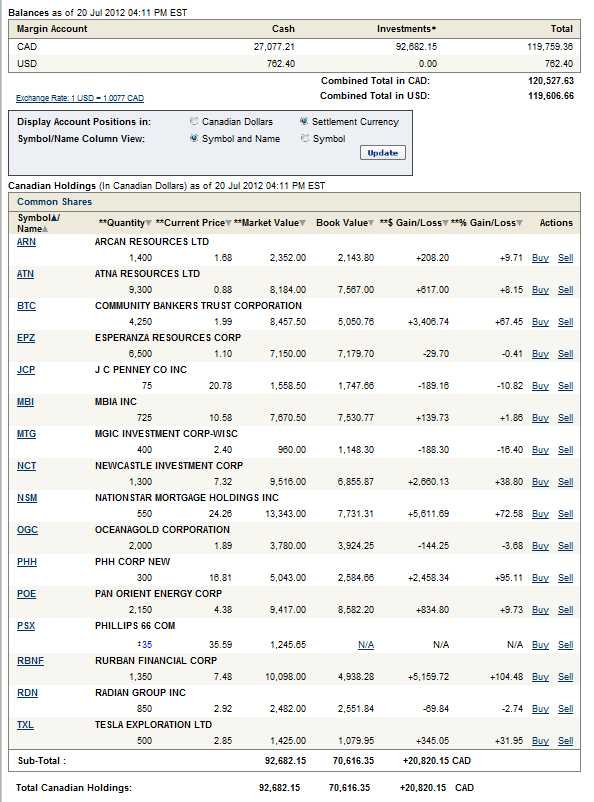
Portfolio Composition

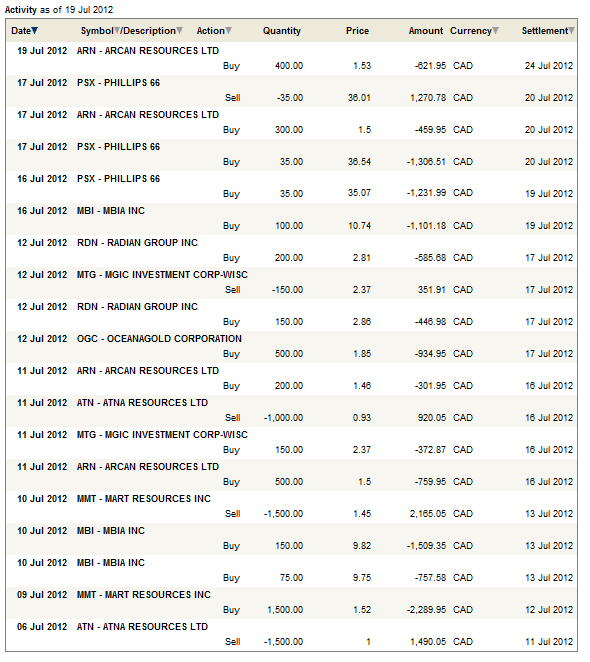
Click here for last two weeks of trades.

Portfolio Summary

I have reluctantly added some risk over the last couple of weeks  My cash position is down to $27,839 from $35,893 two weeks ago, which is a drop to 23% of total assets in my tracking portfolio.

The stocks I have bought have been added because I believe they are cheap.  I think that there is a reasonable chance that they will be worth significantly more over time.  But I do not add them with complete conviction.

The problem remains Europe.  And I remain wary of when the next shoe will drop.    Until Friday, the market had forgotten about Europe for the time being, but we have seen this happen before, and always with the same ending. Europe comes back and again trumps all else.  With Spanish yields rising to a new high on Friday (7.267%)  I am already questioning whether I have made a mistake by purchasing rather than selling stock.  I have already considered an about face.

You can see just how skittish I am by looking at how many trades I am second guessing myself on.  Three times in the last two weeks I bought a position only to sell it later the same day.  These weren’t planned “trades”.  I don’t play the day-trade game.  These were cases where I took the position and couldn’t handle the weight of it, and decided to sell instead of worrying about whether I had made a mistake by buying.

I am typically not so wishy-washy.  That the market has me going through convulsions speaks volumes to the uncertainty that exists at the moment.

As for the stocks I bought, those that I kept that is, I am confident that I got them at a decent price which, in the absence of more macro-malaise, will lead to eventual profits.  More on the individual position updates in the post below:

Company Updates

Radian Group (RDN), MGIC (MTG), MBIA (MBI): here

Arcan Resources (ARN): here

Phillips 66 (PSX):  here


Week 55 Update: The Insurers

The Insurers

I added to all 3 of my insurers in the last two weeks; Radian Group, MGIC, and MBIA.  Regarding Radian and MGIC, while the data this week was mixed, I still am of the mind that the worst of housing is behind us.  While I’m not ready to jump into home builders or lumber stocks or anything else that is dependent on a robust recovery in prices or demand, I am willing to make a bet on mortgage insurance companies that need things to just stop getting worse.   The insurers need prices to stop falling and defaults to continue to slow.  I am inclined (albeit skittishly) to believe that will happen.

The housing data this week, while not great, supported that thesis.  The market focused on the month over month decline in existing home sales (down 5.4%), but year over year the trend is still to higher sales (4.5%).  The trend, while not robustly bullish, appears to be of a bottoming nature.

Perhaps more importantly, inventory continues to decline and the year over year number is down a somewhat startling 24.4%.

Total housing inventory at the end June fell another 3.2 percent to 2.39 million existing homes available for sale, which represents a 6.6-month supply4 at the current sales pace, up from a 6.4-month supply in May. Listed inventory is 24.4 percent below a year ago when there was a 9.1-month supply.

Bill Mcbride (of CalculatedRisk) pointed out in a recent post that it is really the inventory number that we should be focusing on:

I can’t emphasize enough – what matters the most in the NAR’s existing home sales report is inventory; what matters the most in the new home sales report next week is sales. It is active inventory that impacts prices (although the “shadow” inventory will keep prices from rising). Those looking at the number of existing home sales for a recovery in housing are looking at the wrong number. For existing home sales, look at inventory first.

Meanwhile the monoline insurers (Radian and MGIC) are writing more  new business and this is some of the best business they have every written.  I have already written about how strong lending standards are these days.  Below is the trend for New Insurance Written (NIW) for the first 7 months of this year.

The returns on the new business should be quite impressive.  Mark Devries, the analyst from Barclays that covers the insurers, was quoted in this Bloomberg article on expected returns:

Firms that stay in the business may benefit from a return on equity above 20 percent on new coverage as the exit of some rivals allows remaining insurers to boost prices, and tighter underwriting standards limit claims.

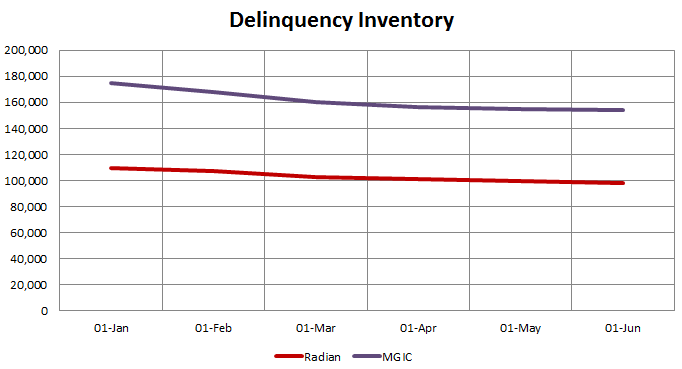
Meanwhile the old book continues to wind down.  The delinquency bucket for both insures continue to fall.

The insurers are like those movies you see where there is a big explosion and the movie star starts running and there is this big fire ball behind them and its gaining on them but the movie star keeps running and eventually the big fireball burns itself out.  These insurers are trying to outrun their legacy business by printing as much new business as they can to overcome the losses on the legacy.  I think when they hit that point that new gains outrun old losses is when they really move.

As for MBIA, the company is less dependent on any specific economic dynamic then they are on  the outcome of their court cases with Bank of America.  There are signs these cases could be coming to a head, but of course they might not.  Its really difficult to say when this will end and whether a settlement will be reached before a verdict.  When I tried to analyze the deal between Bank of America and Syncora earlier this week and the conclusion I came to was that you couldn’t extrapolate much of anything to MBIA.