I have spent the last couple of nights reviewing the first quarter (and first ever) Nationstar Mortgage financial statement.
While the statement is not overly complex, it does have a few tricks. At the end of the day, I am trying to determine an earnings estimate for each business segment. To do that, need to make sense of the each of the line items that constitute the GAAP earnings, and then decide which are legitimate revenues and expenses, and which are just accounting items that need to be excluded.
What is the Business of Nationstar?
Nationstar operates three businesses:
- Mortgage Servicing
- Mortgage Origination
- Legacy Business
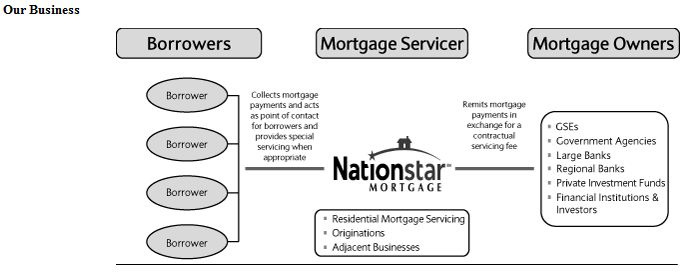
Through the mortgage servicing business Nationstar services a portfolio of loans. The portfolio consists of loans that they have originated, loans for which they have bought the servicing rights from another party, and loans that they have agreed to subservice for a set fee. Nationstar collects principal and interest payments and generates ancillary fees related to the mortgage loan. In return Nationstar receives a fee, usually defined as a percentage of the unpaid principle balance of each loan.
The mortgage origination business originates residential mortgage loans. Most of the loans that Nationstar originates are qualifying loans, meaning that they are eventually bought by and securitized through one of the GSE’s (such as Fannie Mae or Freddie Mac). Nationstar runs this business as as feeder for their servicing business. The vast majority of the loans originated are refinancings of existing loans that Nationstar previously serviced.
The legacy business consists of a number of legacy portfolios. The portfolios of what are basically pools of mortgage loans whose cash flows pay interest and principle to note holders sit on balance sheet and are in run-off.
Why you can ignore the legacy Business
Each portfolio of loans and its related outstanding notes under the legacy business segment constitute what is called a variable interest entity (VIE). According to the GAAP accounting rules, Nationstar has to carry VIE’s on its balance sheet and consolidate the profits and losses of on its income statement.
According to GAAP, the rules for consolidating a VIE is such that if Nationstar is the primary director of activities of the entity and if Nationstar holds a beneficial interest or obligation to the entity, they must be consolidated on the books. Nationstar meets these criteria and so the entities go on the balance sheet.
Yet in Nationstar’s case, the liabilities are non-recourse to the company. Thus Nationstar is not liable for any losses that these entities incur. This makes the consolidation somewhat misleading. The losses experienced by the VIE’s are not transferrable to Nationstar, even though they pass through the income statement like they are.
I decided to take a bit closer look at these VIE’s to understand exactly what they are and make sure they weren’t boogey men in the closet.
Nationstar accounts for the VIE’s with the following assets and liabilities on its balance sheet.
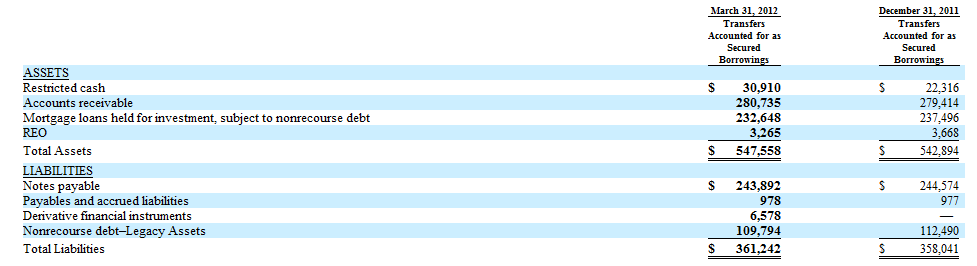
The VIE’s are of two types.
- Securitizations of residential loans transferred to trusts
- Special purchase entities (SPE)
In both cases, Nationstar is considered the director of activities because they are the servicer of the mortgages that make up the assets of the entity. So that’s the first criteria met. In the case of the securitizations, Nationstar has retained one or more of the subordinate securities from the securitizations, and so this qualifies them as holding a beneficial interest. In the case of the SPE, because Nationstar remains in control of the mortgages transferred. The result is that in both cases these entities must stay consolidated on the books as per GAAP.
But the key point is that the debt holders do not have recourse to Nationstar. The assets within the VIE’s structure are the only assets that can be used to repay debt. So in reality, the VIE is quarantined from the rest of the balance sheet.
The other side of the coin is that Nationstar may be able to see income from the interests they do retain in these entities. However this is unlikely. That’s because the entities are full of a lot of non-performing mortgages that were originated before the mortgage market blew up. Nationstar says the following about their prospects in the last 10-Q:
As a result of market conditions and deteriorating credit performance on these consolidated VIEs, Nationstar expects minimal to no future cash flows on the economic residual
With no likely benefit from the VIE’s, and with all losses experienced by the VIE non-recourse to Nationstar, there is basically no reason to consider the VIE in any evaluation of the company. And that is what I plan to do here.
The Mortgage Servicing Business
I’m going to start the analysis of servicing by providing the segments income statement and then going through each item in the statement line by line.
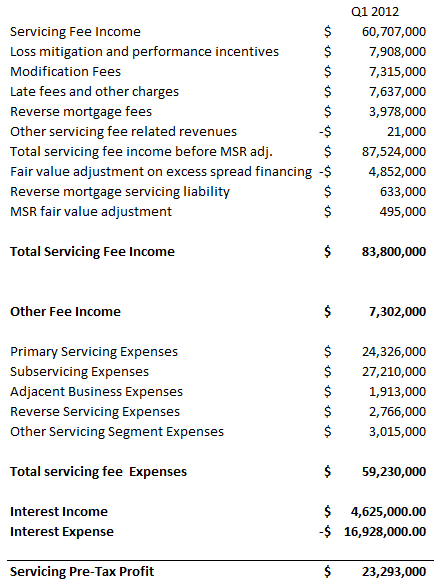
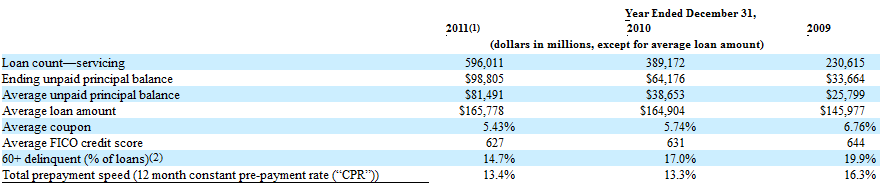
Servicing Fee Income: This is the base fee that Nationstar receives. A servicing fee is generally a percentage of the unpaid principle balance of the mortgages being serviced. The unpaid principle balance averaged $96,107,000,000 in Q1. Nationstar earned fees of 60,707,000 off of that. That puts the average servicing fee at 25 basis points, which is the typical fee received for servicing Fannie Mae and Freddie Mac qualified mortgages.
Loss Mitigation and Performance Incentives: Fannie and Freddie compensate servicers if they successfully complete a repayment plan or loss mitigation on a loan that is 60 days or more delinquent. The guidelines Fannie has set out for this are:
- The mortgage loan must be 60 or more days delinquent when first reported with a Delinquency Status Code 12 – Repayment Plan – by the servicer.
- The mortgage must be brought current upon the successful completion of the repayment plan.
- Once a repayment plan incentive fee has been paid, a 12-month period must elapse from the date the related mortgage loan became current before another repayment plan incentive fee will be paid on that mortgage.
Nationstar receives fees when they mitigate a loan meeting these guidelines. I didn’t look for Freddie’s guidelines but a imagine they are similar.
Modification fees: These are special fees that Nationstar earns through modifying loans that qualify through the government sponsored HAMP and non-HAMP Modification programs. As per the FHFA servicing paper:
In certain instances and programs, servicers can also earn revenue in the form of incentive fees available under proprietary modification programs (generally in accordance with the Enterprises’ Servicing Guides) and through federal government modification programs (e.g., the Home Affordable Modification Program (“HAMP”)).
Late Fees and other Ancillary Charges: According to FHFA, “servicers are also entitled to certain ancillary fees under the Servicing Guidelines, which include, among other things, late fees assessed on delinquent payments, charges for issuing payoff statements, fax charges, biweekly payment fees, and advertising supplement fees.” That sums up what these are.
Reverse Mortgage Fees: These are fees from their reverse mortgage portfolio of servicing right. In terms of the servicing fee structure, the fees accrue to Nationstar but I’m not sure if Nationstar actually gets paid in cash until the property is sold and the mortgage (and all its accrued interest) is paid off.
Change in Fair Value on Excess Spread Financing: This has to do with the Newcastle deal. Nationstar and Newcastle have entered into a couple of servicing arrangements whereby Nationstar performs all the servicing for a base fee (usually 7 basis points) and Nationstar and Newcastle share in the excess servicing right (with Newcastle getting a cut because they put up a substantial portion of the capital to purchase the rights). When Nationstar sells their partial interest in the excess servicing right (usually 65%) to Newcastle they treat that on the balance sheet as a financing. So they book a liability associated with the loan and an asset associated with the underlying servicing rights. The loan liability is recorded at fair value so Nationstar has to mark the value up and down each quarter. In my opinion this is a pure accounting item and shouldn’t be included in earnings.
MSR Fair Value adjustment: This one is tricky. The MSR fair value adjustment is comprised of 3 parts:
- Actual prepayments of the underlying mortgage loans
- Actual receipts of recurring cash flows
- Market-related fair value adjustments
The fair value of the mortgage servicing portfolio is affected when the loan is repaid because the value associated with that particular mortgage servicing right gets written off. The value of actual receipts of cash flows could be considered to be the basic amortization of the mortgage servicing right. The Market-related fair value adjustment is the adjustment to the value of each servicing right based on the likelihood it will prepay in the future or not. It’s the market-related fair value adjustment that we want to remove from the earnings calculation. Unfortunately Nationstar doesn’t break out the fair value adjustment between these items so its impossible to know how much of the adjustment is market related and how much is due to prepayments and recurring cash flow and how much is the fair value adjustment.
To give an example of what each of the three components might look like, PHH breaks them out into separate items. Here is an excerpt from their first quarter 10-Q.

The reason that its important to deduct actual prepayments and actual receipts of recurring cash flows is because Nationstar is capitalizing the servicing portion upon origination. So they are booking the earnings at the start, and that is only legitimate if they are amortizing that capitalized servicing right over the life that they receive fees. If you ignore the amortization but not the capitalization you would be double counting earnings.
Given that Nationstar does not break out the items, I think that the only way I can properly handle this is by deducting the capitalized servicing from the origination segment and ignoring the entire fair market adjustment. If I ignore the capitalization of the servicing and the fair market adjustment, then I don’t have to worry about its amortization over time.
Expenses and Impairments: In the 10-Q Nationstar doesn’t breakout what the individual expenses and impairments are. However, in the prospectus they do. They reported the following expenses and impairments for the last 2 years:

I do note that none of these items are impairments so I’m not sure what that’s all about.
Interest Income: It looks like the main source of interest income for Nationstar comes from the reverse mortgage servicing that they hold. To be honest I am not sure what aspect of the reverse mortgage this interest income is coming from. I know that Nationstar receives a fee in return for servicing the reverse mortgage, but it’s not clear to me whether some of this fee is defined as interest as opposed to just being a fee. My guess on this is that when a reverse mortgage is created Nationstar collects interest on the as of yet unadvanced amount. But I don’t know for sure whether this is the case or not. If its not I don’t know how they are are collecting interest. In the end it’s a small sum.
Interest Expense: As a servicer you are responsible for payment of late principle and interest amounts. You are also sometimes responsible for taxes and insurance if the escrow funds set aside for the borrower aren’t sufficient. All of these funds will eventually be paid back, but in the mean time you have to get the money from somewhere. Nationstar sets up servicer advance lending facilities with banks and draws on these funds. The cost of funds is generally a LIBOR plus arrangement. Interest expense also includes interest from the senior unsecured notes that the company has outstanding.
The Mortgage Origination Business
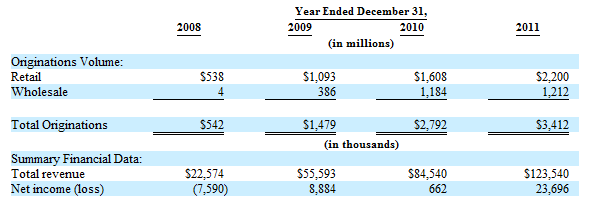
Following in the same vein as servicing, here are the numbers for the origination business, followed by a description of the items involved.
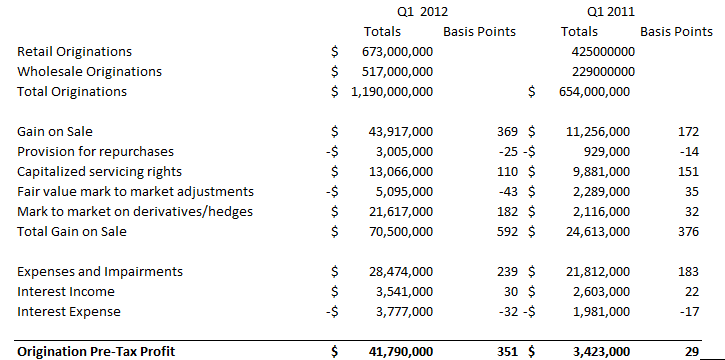
Gain on Sale: According to the prospectus, “transfers of financial assets are accounted for as sales when control over the assets has been surrendered by Nationstar”. So unlike PHH, which books revenues when the interest lock commitment is made, Nationstar does not book revenue until the mortgage is transferred. Margins were high in the first quarter, at 369 basis points. PHH also recorded extremely high margins in the first quarter, so Nationstar was not the only one. In the PHH 10-Q the company suggested that these margins are expected to remain high for the remainder of the year, and that they may stay high for longer as the increased risks associated with the industry are being realized through higher margins.
Provision for repurchases: I can’t be positive because Nationstar doesn’t provide any details about this line item, but I suspect that it is a provision taken for repurchase requests from the GSE’s. Nationstar originate the vast majority for their loans for the GSE’s and there have been notable putbacks by them on originators for poorly originated loans during the boom. PHH took a $65M provision in the first quarter. Given that Nationstar was a fairly small originator until just recently, the $3M provision by Nationstar seems comparable to me.
Capitalized Servicing Rights: I already discussed this item to some extent in the servicing segment. Nationstar capitalizes the expected profit from the servicing cash flow stream and books that as profit up front. Changes to that capitalization are realized in subsequent quarters on a mark to market basis as part of the MSR Fair Value adjustment. The important point to note is that Nationstar capitalized its servicing at 110 basis points. This means that Nationstar is capitalizing servicing at roughly 4x the servicing fee.
Fair value mark-to-market adjustments: These are adjustments that are made on the mortgage loans held for sale. Nationstar originates mortgage loans and there is always a pipeline of these loans that have yet to be sold to a GSE or other securitization. The changes in the value of this pipeline from quarter to quarter is recorded as this line item. I don’t think this item should be considered in earnings. The loans will eventually be sold and at that time will be recorded as gain on sale. Until that time the marking up and down of the unsold loan portfolio is really just an accounting fiction.
Mark-to-market on derivatives/hedges: There are 3 types of hedges/derivatives that Nationstar uses:
- The first type of hedge that Nationstar has is an interest hedge on the Interest Rate Lock Commitment (IRLC). The IRLC is a commitment by Nationstar to provide a particular interest rate to the borrower for a certain amount of time. We have all gotten these when we went to a lender for a loan.
- The second type of hedge that Nationstar enters into is one that de-risks changes in value of the mortgage that will eventually be originated and sold from the IRLC. Nationstar enters into forward sales of MBS against IRLC’s in an amount equal to the portion of the IRLC expected to close, and against mortgages held for sale in amount of the mortgage to be sold.
- The third type of hedge is a interest rate swap that it will use to hedge the interest payments on its debt. Nationstar always has short term warehouse lending facilities drawn upon to fund its origination pipeline. These lending facilities are typically variable rates and base on LIBOR. Nationstar will enter into a swap to essentially fix that rate.
Origination Segment Operating Costs: According to the prospectus, the originations segments operating costs include staffing costs, sales commissions, technology, rent and other general and administrative cost. Pretty basic stuff. Making a comparison again to PHH, Nationstar had operating costs that were about the same on a per origination dollar basis. Expenses and Impairments for Nationstar were 239 basis point of Total Originations. For PHH costs were 246 basis point.
Interest Income: This is income that Nationstar earns on originated loans prior to selling them to the GSE’s.
Interest Expense: Similarly to interest income, interest expense is the cost of funds required to originate a loan. Nationstar taps warehouse funding to bridge the gap between the day the loan is signed off and when the loan is eventually delivered to the GSE or other third party who will ultimately securitize the loan.
Adding it all up to Earnings
The point of going through all of the above was to determine which of the line item revenues and expenses should be included as part of operating earnings. To review, I concluded that I would ignore the expenses due to the Newcastle arrangements, the fair value adjustments to the servicing portfolio, the capitalized portion of the origination, and the fair value adjustment to the originated loans that have yet to be sold to the GSE’s.
I also have to come up with a tax rate. In the 10-Q Nationstar said that they expect a tax rate in the range of 20-28% for the period ending December 2012. I have chosen the midpoint, 24% as the rate I will use here.
Igoring the items and applying the tax rate results in the following first quarter earnings for the company
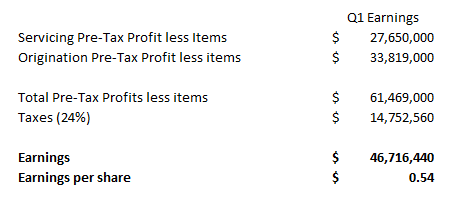
Its not bad. These earnings would put the current share price at a little under 10x earnings.
The key point for putting this valuation in perspective is to not that Nationstar is growing at a phenomenal rate. The company grew their servicing portfolio at 50% last year, after having grown it at 100% the year before. The Aurora transaction will expand the unpaid principle balance of the servicing portfolio from $97B to $160B, or about 60%. The deal that Nationstar is negotiating with ResCap is even bigger. The Rescap deal is for an unpaid principle balance of $374B. Now Nationstar is splitting this between themselves, Newcastle and Fortress Investment Group. Presumably though Nationstar will be doing all the servicing work, with the other parties just stepping in to provide capital and take a piece of the excess servicing fees. Obviously, such a large deal would represent tremendous growth to Nationstar, upwards of 300%. While one has to wonder if Nationstar can pull off the logistics of such quick growth, there is little doubt that the earnings potential of the company will increase exponentially if this deal goes through. And you get that potential for about 10x their operating earnings. The bottomline with Nationstar is that you get to participate in an impressive growth opportunity without having to pay up for that growth.



 Reminiscences of a Stockblogger