Skip to content

Posts from the ‘Oil Stocks’ Category

Out with the Old, In with the New: Arcan Resources and Reliable Energy

Updated:  I mistakenly stated that Arcan had spent $40M on the Stimsol purchase.  It was $24M.  I got my original information from a Scotia report, which read: we note ~$40M of the uptick was associated with the purchase of StimSol and for land.  I mistakenly read this as $40M for Stimsol.  I also  sleepily referred to Stimsol as a frac fluid producer when of course they produce acidizing chemicals and solvents for de-waxing.

On Monday in the mid afternoon Arcan released third quarter results that I was less than impressed with.  I was lucky enough to receive a google alert on the earnings release before the market fully reacted. I quickly halved my stake in Arcan in my on-line portfolio.
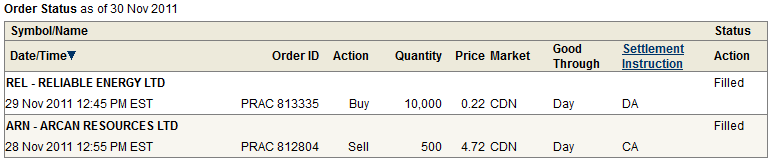
As I wrote on the weekend, in my real portfolio I had already substantially sold down my position.  With the release of the quarter I sold more, dropping it to a rather miniscule 1% weighting.  With the stock is trading in the mid-4’s two days later it appears to have been the right thing to do.

Was the quarter that bad?  On the face of it, the production numbers were ok.  Arcan produced 3,680boe/d in the third quarter. This was somewhat disappointing since the company had stated as far back as July 20th that they were producing 4,400boe/d. Growth is trending upwards, but the company really needs hit their exit guidance of 6,000boe/d to prove to the market that they have built a solid base to grow off of.
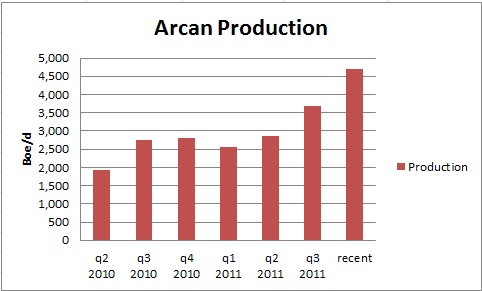
And while the company provided 4th quarter guidance of between 4,600boe/d and 4,800boe/d and exit guidance of 6,000boe/d, they did not give an estimate of current production.  I always wonder about this.  While it is not necessary for a company to provide a current production number, you have to think that if they don’t it isn’t because they have good news to share.

Overshadowing the production figures were the 3rd quarter capital expenditures by the company.  Arcan spent a rather extraordinary $87M in the quarter.   This is far and above the already high levels of CAPEX that the company spent in the previous 2 quarters.  It is also far and above its cash flow. Now $24M of this capital was spent buying Stimsol, a maker of the acidizing blend that Arcan uses.  But even subtracting out that sale, Arcan still spent almost $63M of capital, or 5x its current cash flow.

Given the future capital expenditures alluded to in the quarters report (road building, a pipeline from Ethel, remediation of the existing pipeline at Morse Unit, waterflood at Ethel), one has to expect this trend to continue going forward.  To be fair though, the recent debt and equity offering the company made does give them the money to fund these expenditures.

While CAPEX went up, netbacks came down.  Netbacks in the quarter were $41.90, versus $55 in the second quarter.  Of course much of this can be attributed to the Swan Hills fires in the summer (the company said this amounted to $10-$15/bbl) which was a one-time cost, but in addition at least some of the increase is attributable to Ethel production, which right now is being shipped by truck to the Morse Unit.  The situation is explained by the company in the clip below, along with an ETA of the first quarter of 2012.

Arcan estimates a significant reduction in operating expenses in the first quarter of 2012 due to a number of activities which are currently underway. These activities include completion of the construction of a high grade road system that connects the DM2 through Arcan’s Ethel property into Morse River, the commencement of pipeline infrastructure along the new road system backbone that will allow production in Ethel to flow to the DM2 oil facility, and the construction of pipeline infrastructure to facilitate water injection in the Ethel area. Arcan is also working on resolving issues with the clean oil pipeline which flows from the DM2.

Arcan is still on the right path, they are just moving more slowly down it than I would like to see.  The problem with moving more slowly is that Arcan is valued quite highly compared to its peers, so slower than expected growth leaves lots of room for downside questioning.

All flowing boe numbers are based on the latest production estimate provided by the company.

With some of the proceeds of Arcan I bought a position in Reliable Energy.

Reliable Energy released their 3rd quarter results on Tuesday morning.  While Arcan produced a decent production increase while spending a lot of capital, Reliable showed similar production increases (production has almost doubled since the 3rd quarter), while spending more closely in line with their means.
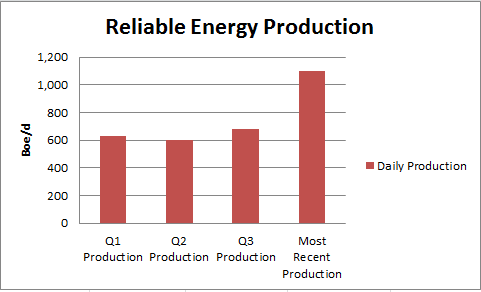
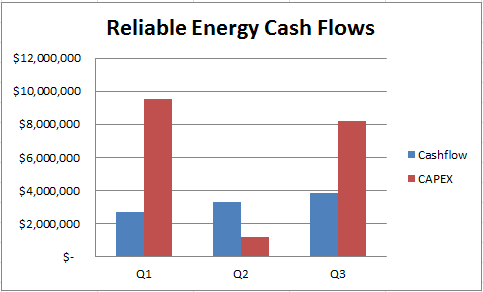
Moreover, a look at cash flow shows that Reliable will be more able to spend within their means in the coming quarters.  Reliable generated $3.8M of cash flow in the 3rd quarter with a netback of $65/bbl.  As of their latest production estimate they are now producing about 500bbl/d more than they averaged in Q3.  At $60/bbl netback that would work out to about $3M additional per quarter in cash flow.  That puts the yearly cash flow somewhere around (maybe slightly above) the $25M per year range.  The capex budget for 2011 is $25M.

Midway, Arcan and others have had to spend well beyond their means to grow production.  In some environments that is not a deterrent.  In our current liquidity strained environment, it is.  Reliable looks to be in a better position to do that, at least in the short term.

The other important consideration with Reliable is that they are beginning to ramp up into the 2nd of 3 consecutive quarters of drilling.  Reliable basically moves to the sidelines during spring break up, and so they tend to see decent production gains through the winter months as they spend a disporportionate amount of their yearly CAPEX budget during that time.  The drilling and completions in Q3  is responsible for the production increases so far in the 4th quarter.  With a little luck it will continue going forward.

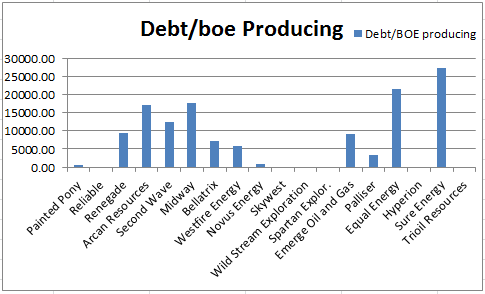
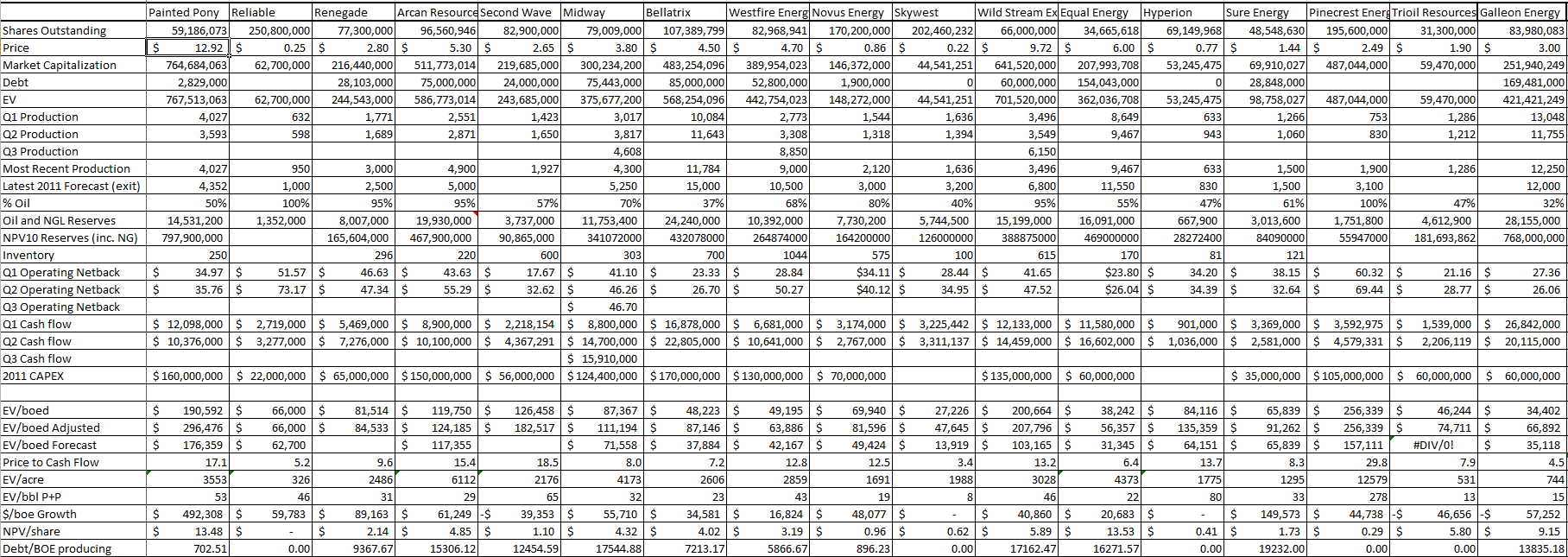
The company trades at about half of what Arcan does on a flowing basis.  At $47,000/flowing boe (see the above chart where I compared flowing boe numbers for a number of juniors) the company is reasonably cheap compared to its peers, especially considering they are producing high netback light oil.  On a reserves basis the company trades at close to its 2010 NPV10 of $0.19.

I suspect when their 2011 reserves report comes out (likely not until late in the first quarter) it will show a significant increase over the 2010 reserves.  The 2010 reserve report (available on Sedar) gave them 800,000bbl of undeveloped reserves and 400,000 of developed producing reserves.  The 400,000bbl was likely entirely vertical drills.  The undeveloped works out to the equivalent of about 8-10 horizontal locations depending on the evaluators productivity per well guess.  In the next report that number should go up pretty substantially.   Up to the end of the 3rd quarter Reliable had drilled 10 successful hz wells this year so offsets alone should double that number.

In all, Reliable Energy looks to me like a better bet for near term price appreciation than Arcan does.
Comparing the Oil and Gas Juniors

Earnings season should be upon us shortly for the Oil and Gas junior companies.  To prepare for the onslaught of earnings reports over the next month, I have updated and published below my junior comparison spreadsheet. I’ve added a few new companies to the list of those I follow, with those being Pinecrest and Galleon (now Guide Exploration).

A few things jumped out at me after having reviewe the spreadsheet:

  • We’ve had a big move in Equal Energy from $4 to $6, but even with that move the stock is trading very cheaply on pretty much any metric
  • Skywest really looks cheap compared to its peers.  I used to own Skywest, but I sold it when it looked like they were headed for a cash crunch.  I think it is worth looking at again at these levels.
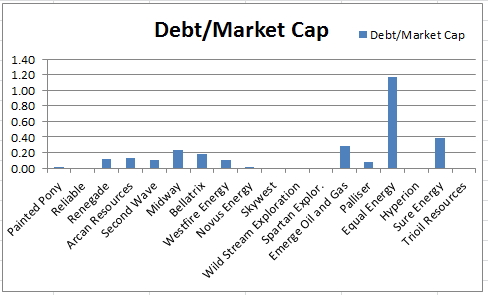
  • Arcan trades at a premium to its peers.  Just something I like to point out to be aware of.  I believe that it should trade at a premium, but its worth remembering because it suggests that any production hiccup will be severely punished
  • Reliable Energy is starting to look interesting again.  They had some interesting drill results in their last update and are reaching that critical production level (1,000bbl/d) where they will begin to generate the cash flow needed to ramp their production up on a consistent basis


A Positive Step for Equal Energy

In a week that was littered with strong stock performance, one of the best stocks in my current ownership lot was Equal Energy.  Most of the outperformance came after the company released news that they were disposing of non-core assets.

Equal Energy Ltd. (“Equal” or the “Company”) (TSX: EQU): (NYSE: EQU) announces that it has entered into definitive agreements to sell several non-core properties in Canada for a total cash consideration of $49.35 million (the “Asset Dispositions”). The proceeds from the Asset Dispositions will be used to reduce outstanding debt.

Don Klapko, President and CEO commented, “ Equal will continue to develop its key oil plays in the Alliance Viking and Lochend Cardium in Canada, and its liquids-rich gas play in the Hunton formation of Oklahoma.”

The Asset Dispositions include properties in Alberta, Saskatchewan and British Columbia and compromise total current production of about 2,100 boe/day, of which 51% is natural gas. Upon closure of the transactions, Equal expects to realize lower operating costs and interest expense resulting in improved cash netbacks per unit of production on the remainder of its assets. Equal estimates that its net asset value will be approximately the same after the completion of the Asset Dispositions. The Company anticipates its second half 2011 production to range between 9,200 – 9,700 boe/day, after taking into consideration the Asset Dispositions.

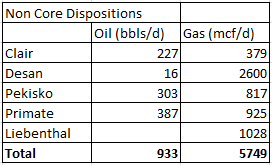
By taking a look at the last Annual Information Form released by the company (March 24th) its pretty clear that Equal sold off all its land outside of the 3 core areas of the Alliance Viking, Lochend Cardium in Canada, and the Hunton formation of Oklahoma.  Below is a list of other properties owned by Equal and producing totals for each area.  Together these properties add up to about 2,000boe/d.

So what are these properties?  Below I’ve copied the description of each from the AIF:

  • The Desan property is located 120 kilometres northeast of Fort Nelson, British Columbia in the gas producing greater Sierra area.  The primary producing zone is the Jean Marie formation.Daily average production in Desan for December 2010 was 2.6 mmcf/d of natural gas and 16 bbl/d of oil and NGLs.
  • The Clair property is located 20 kilometres north of Grande Prairie. The Corporation’s assets include a 100% working interest in 4,380 acres of land (1,340 net undeveloped acres), 15 producing wells, 6 water injection wells, and a profit sharing interest in an oil blending facility.  Oil and natural gas production is primarily from the Doe Creek (Dunvegan) formation. The Doe Creek oil pool produces light (41 API) oil along with solution gas and is currently under water flood to maximize oil recovery. There is also natural gas production from one Charlie Lake well. Average working interest production for December 2010 was 227 bbl/d of oil and 379 mcf/d of natural gas.
  • The primary production is crude oil (27 API) from the Pekisko formation. Much of the Corporation’s land is covered by 3D seismic with detailed geological and geophysical studies outlining new development drilling opportunities. Additionally, significant potential lies in the Bow Island and Sunburst formations. During 2010, Equal drilled two wells in the Princess area. At year-end, the Corporation had 25 producing wells in the Princess area with average working interest production of 303 bbl/d of crude oil and NGL and 817 mcf/d of natural gas. Net undeveloped acreage totalled 1,237 acres at year-end.
  • The Primate heavy oil field is the main producing asset in the Primate area and the Corporation holds a 100% working interest in this property. Oil and natural gas production comes primarily from the McLaren and Mannville formations respectively. Despite the oil’s gravity, 11 API, the gas saturation of the reservoir allows cold production of the oil under a primary recovery scheme.Average December 2010 production from the Primate area was 387 bbls/day of crude oil and 925 mcf/d of natural gas.
  • Natural gas production from the Liebenthal area comes from the Viking formation. The Corporation holds a 100% working interest in the pool. Seismic indicates that the pool is structurally controlled. Average December 2010 production from the Liebenthal area was 1,028 mcf/d of natural gas.

None of these properties strikes me as terribly interesting and the undeveloped land appears to be negligable.

Reduction of Debt is a Good Thing

The reason that this is such a good move for Equal is not because they scored a killing on the price.  They didn’t.  They received about $25,000/boe producing on the transaction.  This could be considered a bit low, but given the following facts, its not bad:

  • The amount (51%) of natural gas involved
  • The oil produced at Primate is 11 API
  • the oil produced at Pekisko is 27API and presumably requires a lot of water handling
  • There is almost no undeveloped land involved in the deal

The reason this is such a good move for the company is because it de-leverages them.  I think that the amount of leverage that Equal has is the primary reason that the company is trading so cheaply.  When you look at Equal’s debt compared to its production level, and compare that to the other juniors I follow in my universe its rather clear that Equal is quite leveraged up.


After this transaction Equal’s ratio drops to 16,300, which puts them more in line with their peers.

Onto the Mississippian!

The second positive that comes out of this transaction is that it should help to speed up the development of the Mississippian.  I was clearly too early when I bought Equal in the spring on the expectation they would begin exploiting their Mississippian prospects in Oklahoma soon.   But while the company has yet to spud a well or provide a firm development plan for the Mississippian, it is clearly on their radar.  Again from the news release:

Equal has amassed a significant acreage position on an exciting new Mississippian light oil play in Oklahoma that exists on acreage held by production from certain of its Hunton fields. The Company plans to continue consolidating acreage prospective for the Mississippian while it considers options to begin development of the play during 2012.

It remains a waiting game.  Having held it this long, I will continue to hold Equal until these Mississippian wells begin to be drilled and the company hopefully gets revalued to a more reasonable level in anticipation.

Arcan Resources: Thoughts on the Waterflood at Ethel

Arcan’s Q2 MD&A, which was released August 29th, was somewhat short on detail.  Unlike the past, the company neglected to provide much detail about their quarterly production.  Previous MD&A’s broke out production on a well by well basis, which helped to give some insight into where Arcan’s production has been coming from and what problems, if any, might lie ahead.  Nothing of the sort this time.  Its been suggested that this was Crescent Point’s influence.  Could be, the timing certainly coincides.

Nevertheless the MD&A did provide one nugget that was perhaps overlooked by the market but is nevertheless important.  Waterflood approval from the ERCB, which had been expected early in 2012, was given early.

In August Arcan received approval for water injection in the Ethel area. Wells are currently being converted to water injectors and water handling facilities are currently being constructed in order to commence water injection.

This is terrific news for the company.  Waterflood should be having an effect by sometime late in Q4 or early in Q1.

The news of the waterflood at Ethel made me want to dig a bit further into Arcan’s prodution.  I decided to investigate how much production was coming from Ethel, and what kinds of declines that unit was currently experiencing.

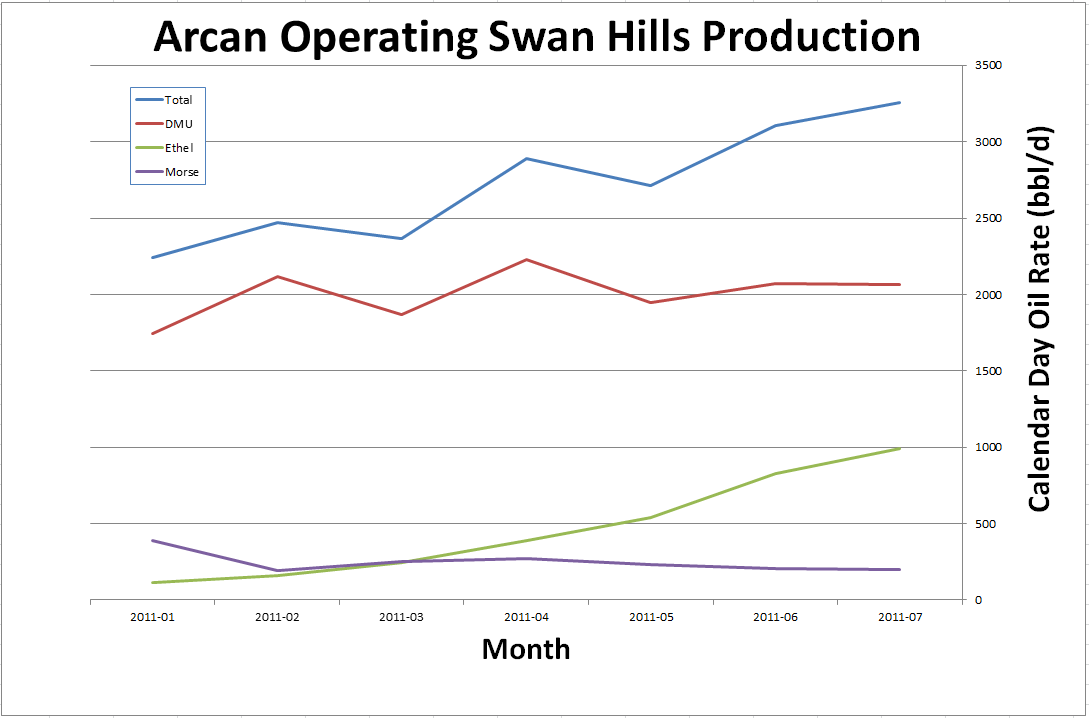
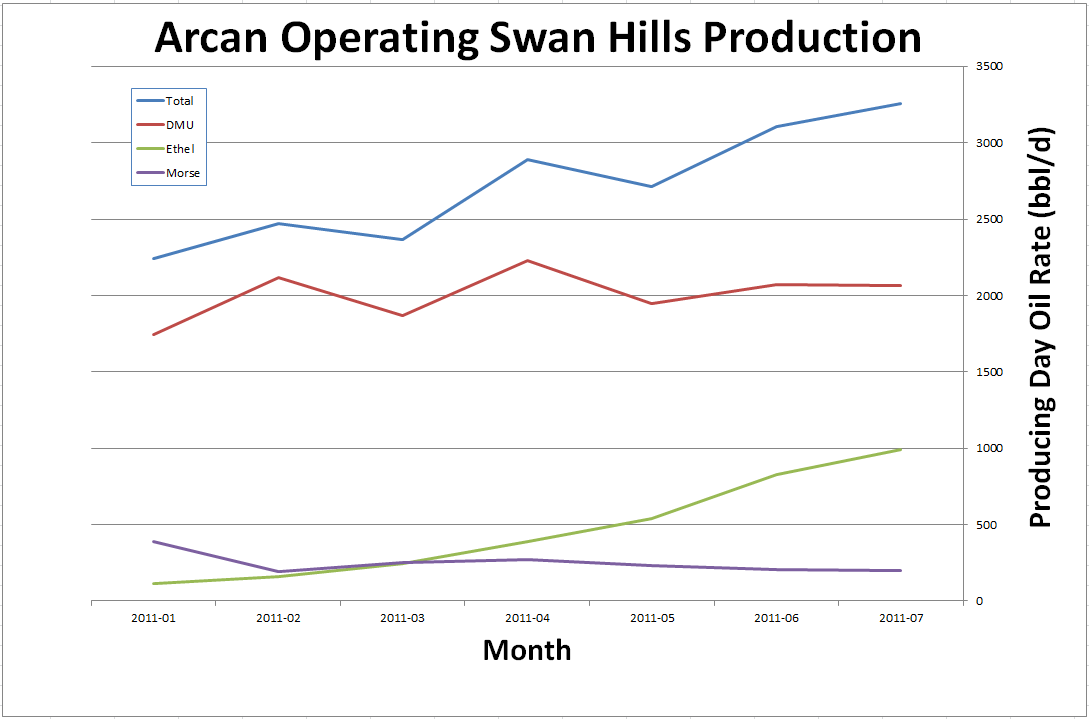
Below is a graph I made of Arcan production by unit (data available is to and including July 2011).  Note that I have not taken into account working interests and so the numbers are gross.  There are also a few wells that appear to me to fall outside the units (meaning the extents of waterflood) so I didn’t include those.  The production data is in calendar day rates.


Ethel is where Arcan has been focusing their resources of late and that is where the overall production increase is coming from.  At Ethel Arcan brought on-stream a well in April, a well in May, two wells in June and there are 2 wells tied in that should have been producing in August (15-08 and 06-10).  Meanwhile, DMU (Deer Mountain Unit) has been surprisingly flat given that they’ve only added on-stream a couple wells since the first quarter of this year.  Morse River is mostly vertical wells that have been producing for years, so its profile is basically flat.

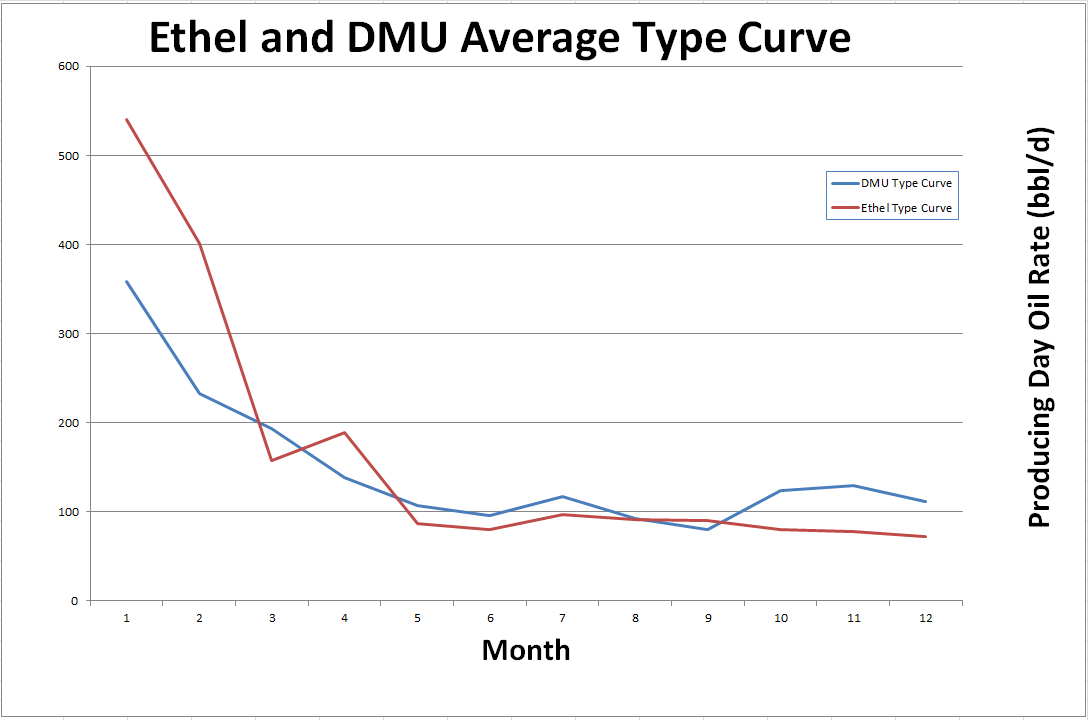
Next I took a closer look at well performance at Ethel.  If you look at the average Ethel and DMU production curve, you can see the effect of the waterflood taking place at DMU versus Ethel.  Ethel wells do appear to stabilize at a lower level. The following chart looks strictly at horizontal Ethel and DMU wells drilled after Jan 1st 2010 (I didn’t want to confuse things by adding data from old completions) averaging out the monthly production for all wells at that point in their decline.  Producing day rates are used.

Now it has to be pointed out that the post 6 month data for Ethel is a single well (the 10-27).  So we are not dealing with a large dataset here.  Still, I think the conclusion can be made that Ethel wells drop off quicker and stabilieze at a lower rate without the waterflood.

Presumably with waterflood one would expect that Ethel type curve would shift up to where the DMU curve is.  One mitigating factor to this improvement might be reservoir quality.  The sands at Swan Hills have often been thought to thin to the south.  On the other hand, Arcan’s completion techniques have improved quite dramatically lately with the move to the larger acid fracs (another detail that was provided in the Q2 MD&A).  This is witnessed by the significantly higher IP30 and IP60 results produced by these presumably thinner sands at Ethel.  So this may help the Ethel wells outperform.

Its a bit of a guessing game until you get some data.

So what does it mean to production?  Two things.  First, with the waterflood implemented you would expect that the existing wells at Ethel would deliver a higher rate.  I’m going to speculate that, on average, this would be about 40bbl/d for the post 2009 drills.  This would add about 350bbl/d of production to Arcan.

A bigger effect will occur going forward.  Those wells put on-stream in June and July and those wells being drilled right now and through to the end of the year should see a shallower decline and more stable production profile after the first few months.

Arcan Resources was, for a time, my largest holding.  Arcan announced a large bought deal yesterday just before market close.  As you would expect, the stock did poorly today, trading down to the price of the deal.

After watching the stock fall on account of the bought deal, and doing some thinking about Ethel and the upcoming waterflood, I decided to buy a bit more Arcan yesterday.

When you look at the bought deal, they were able to raise a significant amount of money in what is a difficultenviornment.   As well, $85M of the $135M deal was in debentures.  This is good from the perspective of dilution; the debentures are convertible at $8.75.

Jennings put out a piece yesterday suggesting Arcan had the cash to be drilling 6 wells a month.  I don’t know if that will be the case, but if it is, 6 wells drilled into three areas now under waterflood should produce some impressive production gains. I remain of the opinion this is one stock worth holding through the unfolding European implosion.