Skip to content

Posts from the ‘Uncategorized’ Category

LGFVs

Markets look to be up for the second day straight. Crisis over?

Fintwit thinks so – the mocking of the Evergrande posse is well underway. The VIX is almost back to where it started. I listened to the first 10 minutes of Cramer last night and he said that the moves by Xi took the Evergrande worry “off the table”.

me? Well, I’m going to keep my cautious stance a little longer, even as right now it is wrong.

I read a thread from Hugh Hendry last night. It was – as always – cryptic.

But I get about half way through and Hendry mentions this:
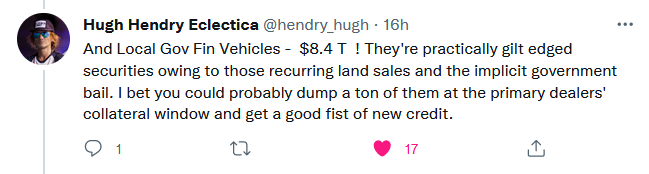
And I’m like – wait, what?

So… I do not profess to know much, but one thing I know is that $8.4t is a lot of money.

It caught my attention. So I start digging.

This is primarily going to be a cut and paste excerpts/charts from FT. Please don’t forward because FT doesn’t like people using excerpts and I don’t want to get in trouble.

My take, which is evolving, is that Evergrande is kinda a sideshow here. Maybe a better description would be a symptom. But there is an underlying ailment that seems to be gaining steam and I’m not all that sure how that plays out.

Start with the basics. Property prices in China have gone up a lot, much like the rest of the world:
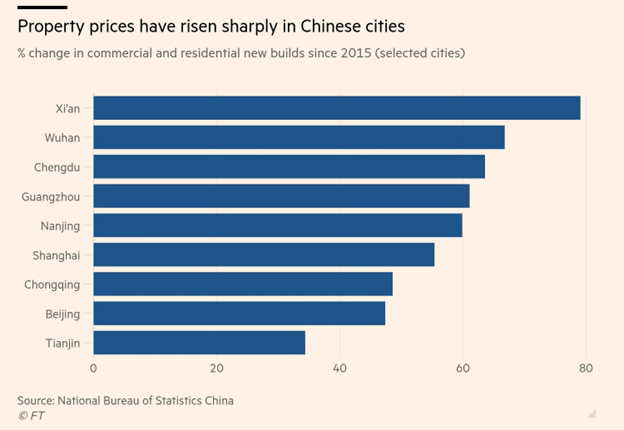
Today, China has a lot of unsold housing inventory:

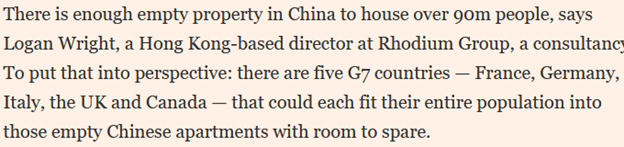
On top of that unsold inventory, China has another 90mm of empty property:
China seems to recognize this has become a problem. In addition to all the usual consequences of a property bubble, China has the additional issue that their 1-child policy means a smaller population in about 10 years. I think the government realizes they have to deal with this now before it gets even more out of hand in 10 years.

China is unquestionably squeezing developers to try to reduce the investment made in new properties.  China drafted rules in the summer of 2020 – so not that long ago – that constrained how much leverage developer could take on. 

They called this 3 red lines.  It limited borrowing to developers/financials based on ceilings they apply to 3 metrics: debt to cash, debt to equity and debt to assets.

One detail of this that I got from a Youtube video is that China gave developers 3 years to comply with these limits. The Youtuber pointed out this implied that many developers were likely far over these limits right now.

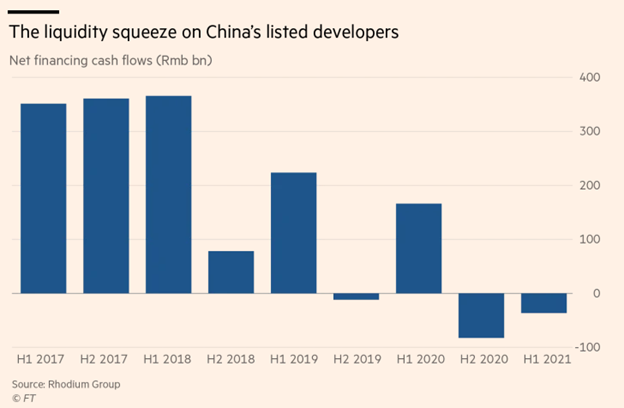
Not surprisingly Evergrande stock began to slip at around that same time. And financing to developers has gone negative the last 12 months.
But developers and Evergrande aren’t the headliner here. They are like the cog in the gear system that is stuck. The engine seems to come from the regional and local governments (more on that in a second) and that could be a problem. It has to do with the end-source of the financing new infrastructure development in China.

So…. there are these sources of capital for Chinese local and regional governments called local government financing vehicles (LGFVs).

LGFVs are an off-balance sheet way for local governments in China to raise money.  The money they raise is mostly used to fund infrastructure (ie. what you need for property development).  FT calls them the “main lenders behind China’s infrastructure building boom”.

Why do local and regional governments use these “vehicles”? To get around the limits put to local government borrowing. They are “off-balance sheet” so they mean a government can lend without looking like its lending.

Way back in 2019, so before Evergrande was on anybody’s radar, China “hit the brakes” on LGFVs, saying they could only refinance existing debt in the second half of the year.

But then Covid hit and the brakes came off.

Now the brakes are on again. And not surprisingly, Evergrande and other developers that depend on development (and thus LGFVs) are back on a downward path.

So LGFVs fund infrastructure and infrastructure is a big part of China’s economy.  43% of GDP was fixed asset investment last year.

Here’s the thing about the LGFVs.  They have a shitload of debt. And I mean a shitload. Here is where Hendry almost assuredly got his number from:
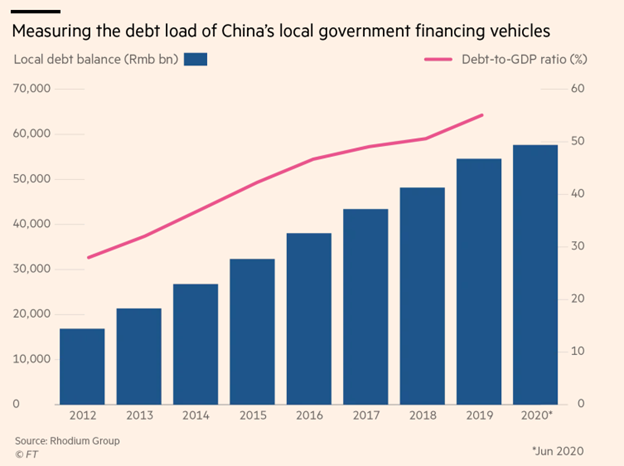
$60t Renminbi of debt is over $8t USD.  That is real money. 

And here is, IMO, the big reveal:

Hmmm – that sounds an awful lot like the “house prices don’t have to go down, they just have to stop going up so fast” argument of the Great Financial Crisis.

So there is all this debt outstanding at the local and regional levels. It is kept afloat by land sales. But land sales are collapsing because the big developers like Evergrande have been squeezed and are in trouble.

I don’t know… I’m not smart enough to say how this plays out. But I am cautious enough to think there is somthing more tectonic at play than a property developer going bust.
I’ve Sold 9 of the last 2 Crises – So why stop now?

First of all, my primary reason for writing this post is that I really like the title. I was thinking about Evergrande last week and it just popped into my head and so now I have to write something to go along with it.

I wanted to get this out on the weekend but I didn’t really know how to say it. Then Monday happened and I didn’t want to say something bearish with the market down so much. But now we have had a nice turnaround-Tuesday and my thoughts have stewed enough to percolate so it seems like as good of a time as any.

The story behind the title is that I always sell first and ask questions later. I’ve written about it before. This time I am writing about how most of the time I am wrong to do so.

This was not always my instinct. When I was a novice investor I had a conditioning that I think all human beings have – the want to hold on to hope.

Unfortunately, when you are investing, and in particular when you are investing in small cap shitcos for the most part, hope is more your enemy then your friend.

My experience is that if you hold on to hope you will be more often than not disappointed. The reality is that 9 times out of 10 (that is not a scientific estimate) you can buy back at roughly the same price anyway a few weeks later.

So whenever I smell even the hint of a crisis I go into defense mode.

As the title suggests, usually this is wrong. The crisis blows over as nothing.

But every once in a while, it becomes a full-blow 10%+ correction. Which can be a 20%+ correction for the crappy little stocks I own.

But more importantly – every once in a blue moon, it becomes a real bear market.

When I am wrong, I miss out on the fire sale selloff and usually the first few days of market recovery.

That is too bad. But when I am right, particularly when it is that blue moon event, it more than makes up for it.

Consider my posts from back in February 2020 (including my comments at the time). Just think – in February 2020 I did not really know if this ensuing “pandemic” was going to amount to anything!!! I was selling and shorting and at the same time cautiously admitting I might be horribly wrong for stepping aside and if the market took off I was “okay with that”.

LOL!

I didn’t have a freaking clue what was about to hit the market. In fact even though everyone says otherwise now, I doubt that more than a few did. Those that suspected were more like I was – feeling uncomfortable but not all that sure how things would play out.

But because I followed my rules and “sold the crises” – which meant buying inverse ETFs, selling some shorts where I think they might be particularly vulnerable to the crisis flavor of the day, and buying a little bit of VIX for leverage – I can happily recollect that my portfolio was up 3% on the year when the market hit its low of 2,100 and change – even as my remaining small cap positions were obliterated.

Now of course that first move up from 2,100 to 2,500 was not something I participated in. C’est la vie. I lost no sleep from my portfolio through a horrible time for everyone and that is worth way more than a few points of performance.

So is Evergrande the next Lehmans? Eh. Probably not. But it could be the next 10% correction if the cards fall right. There is a lot of debt off the balance sheet, there is apparently some $500 billion in new build buybacks that they are on the hook for, and there are some strange ties to private equity and even to tether which just seem odd.

And there is also another one of my axioms, which is that no one really knows what the F&*$ is going on in China.

Last week I started to take precautions. I peeled back some risk in stocks I have less conviction in, added a couple short China ETFs (just the 1x CHAD and YXI), and added a little VXX.

I’m still far from “short” the market, but it was enough that during yesterday’s bloodbath I was pretty much flat on the day, which is basically my goal during periods of turbulence.

If the market takes off from here, the playbook says that I will underperform for 5 or so days. I will pull my hair out during that time as I see indexes rise, the VIX fall, but all the stupid little microcaps I own do nothing. Oh well, I am getting used to that, it is just the circle of life.

It is imperative, maybe as much because of my own particular psychology as anything, that I prepare for the worst each time, even as I know it is a poor-odds bet.

To each his own. This is what works for me.

Corvus Pharmaceuticals and Two Types of Stock Picking

My investment strategy is really two pronged. These prongs are completely different from one another, polar opposites in fact.

One prong, which makes up most of my portfolio, consists of buying “undervalued” stocks. These are not necessarily cheap stocks. They can be. ie. the containership companies a few months ago, but no one could have said Caribou Biosciences was “cheap” at a $900 million IPO market cap.

If I see the stock as undervalued on some metric – in Caribou’s case because they hold patents to CRISPR Cas12a, have Jennifer Doudna on their board and are run by Rachel Haurwitz – then I buy and I wait for others to see the same thing.

So that is the first prong, and it make up most of the stocks I own.

The second prong is to buy the news.

While this is not as material to my portfolio, the situations tend to be much more fun to write a blog post about. So while I have been buying immunology stocks through September on the expectation of news someday, the ones that are most interesting to discuss are the one’s that I bought today on news yesterday.

Corvus Pharmaceuticals. Here is their story.

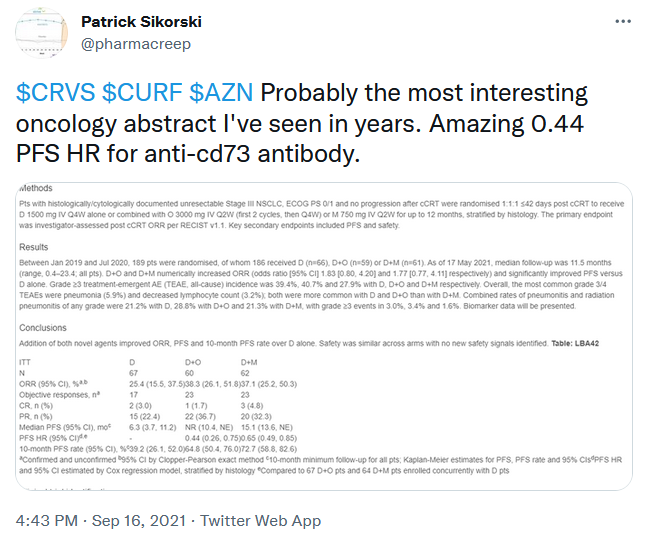
So after the market closed last night I am perusing my Twitter Biotech lists (lists are great on Twitter, and you don’t have to create your own, just join others that have a good swath of fintwits) and I see this bit of news.

Now I don’t know Patrick, but I do follow his comments on the list from time to time and he seems like a good chap. Doesn’t seem to be one of these biotech pumpers on twitter that runs from one pump and dump to another.

As it happens, because I have been researching immunology stocks for the last month or so, I know a little bit about one of the companies mentioned – Corvus.

I don’t know a lot about Corvus. In fact, I don’t believe I know a lot about immunology. Which is why I haven’t posted at all in the last month. I keep thinking, I really should write about these immunology stocks I’m buying. And then I think, but I don’t really know what I’m talking about, so what if I am just the sucker at the table?

Well there are a couple of things I remember about Corvus from having looked at them about 3 weeks ago. First – I know they are cheap. Prior to today they were worth only about $30 million ex-cash. So the market gives them no respect.

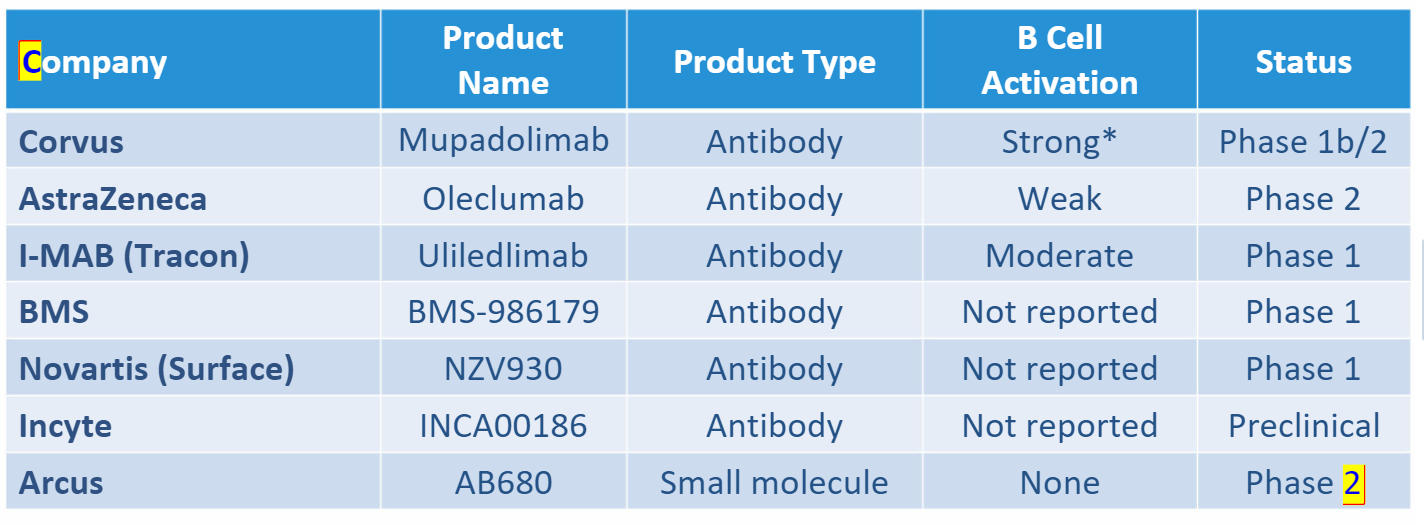
Second, I know they have a anti-cd73 antibody. In fact, I remember that they listed the AZN drug in their presentation.

Third, I know that they are going after NSCLC in their trial, they just expanded that trial, and that data will be announced very shortly (November).

Fourth, I have done enough work in the field of immunology now to realize two other things:

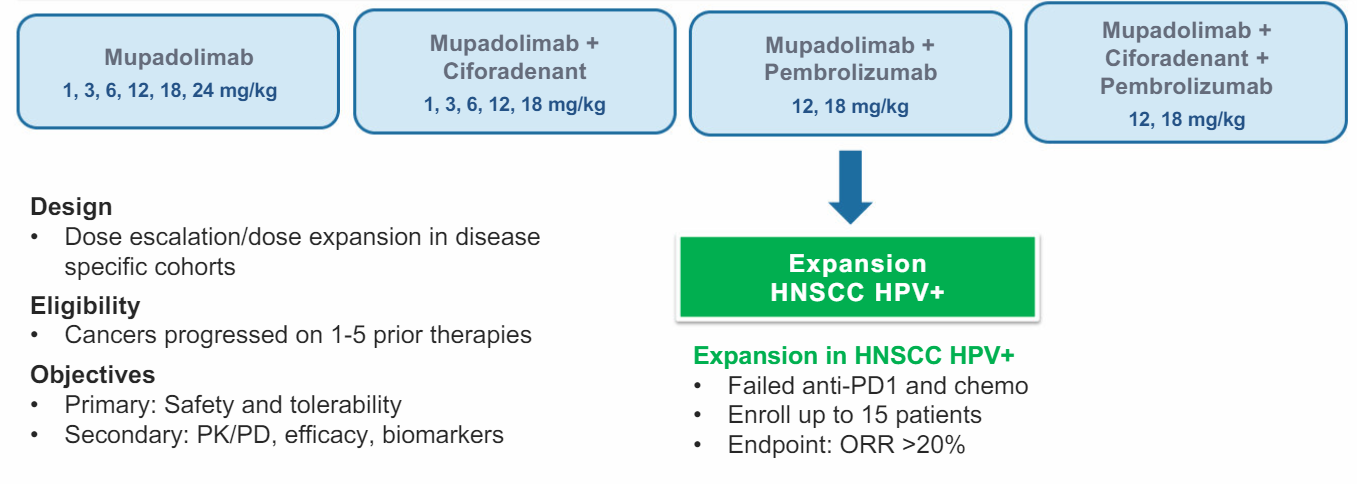
  1. The D+O arm of the AZN study is showing very good results (albeit on a very small sample size).
  2. An EV of ~$100 million for a potentially successful therapy is nothing.

Now keep in mind that I would consider myself to be in the “no clue if I’m the chump” category of investing in immunology. There is still SOOOO much I don’t understand. But I bought Corvus this morning in premarket and again after the open. I also bought the company who owns the “M” in the above study – Innate Pharma.

Somebody, I can’t remember who, said that you do the work so you are ready to act when the moment comes. It is a bit like muscle memory. But with the brain – all that research up front so that you can recognize a situation that is mis-priced and jump on it when it happens on you. That is what this second prong strategy is.

Let me emphasize one last time that I am a newbie to immunology. I could get creamed on both of these. But at least they make for an interesting story.

A Bit of Vindication

After a few tough weeks (in particular a CRISPR drawdown and the general biotech drawdown – which I bought into the way down – blah – was particularly grueling) I feel a bit vindicated these last couple of days. It was probably a good thing I have been away on vacation most of the time and not able to dwell on the ups and downs.

There were a couple of interesting bits of news last night.

Biorem

The first was news out from Biorem. I talked about Biorem way back in January. I have held my position since then and it has done basically nothing. Biorem released their second quarter results last week and those results were fine but did not hit the inflection I am hoping for.

Biorem’s backlog, however, remains very large ($30 million – which is over a year of revenue) and in their earnings release (no conference calls for this microcap) they stated ““Barring some unforeseen developments we expect a much stronger second half of the year as we deliver to projects delayed from the first half of year as well to projects originally scheduled for delivery in the second half of the year”.

The opportunity for the stock price to appreciate on such an improvement in their business increased markedly this morning. Biorem announced a share buyback. But not just any share buyback. A “60% of outstanding share” share buyback!

They are buying back 23 million shares from TPFG Environment Investment Limited for 52c. 23 million its a lot of shares! This is above the recent trading price of 45c but below where I was willing to buy shares back in January.

If the results in H2 are indeed better than H1, the purchase of these shares is a steal. There are now ~15 million shares outstanding. That means the stock has a market cap of $7.5mm. Yes the cash is gone, but it has been put to good use.

Derek Webb, who is CEO, and Doug Newman, CFO, have 400k shares and another 2.2mm in-the-money options between them.

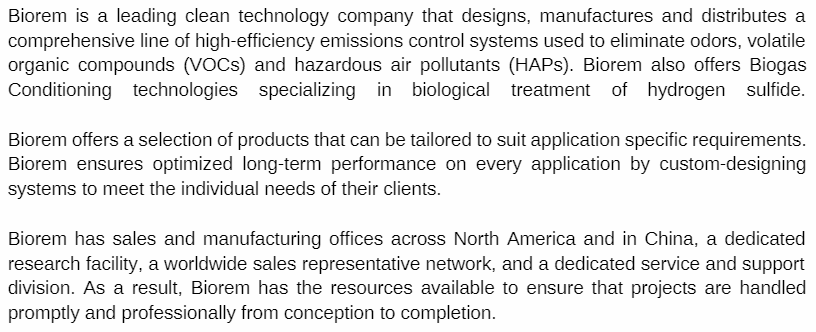
Just as a reminder on what Biorem does:

While I can’t be sure of how the second half will materialize it feels to me like Biorem has improved the potential reward side of the equation by buying back so many shares. Consider that they did $2 million of earnings last year. With only 15 million shares, that would have been 13c EPS. On a stock that is 55c that seems decent.

Dixie Group

This is the second time in the last year that I have written about Dixie right after earnings. The first time was (briefly) last November. I owned the stock for a couple weeks then sold it for a bit of a gain.

Well I am at it again with Dixie. Ironically, I bought in this morning at pretty much the price I got out of it back then.

For some reason Dixie’s results of late make me think of Larry David – pretty, pretty, pretty, good. Kinda of that not quite believing, skeptical, wondering whether it will all blow up tomorrow kind of vibe.

But to Dixie’s credit they put together another good quarter.

Dixie has 15 million shares outstanding so a market cap of $45 million. They have about $75 million of debt.

In Q2 Dixie topped the $100 million mark in sales for the first time since Q2 of 2019. They had EPS of 22c per share.

The third quarter looks pretty, pretty, pretty good so far as well:

Our residential floor covering sales and orders for the first 5 weeks of the quarter have continued at a very strong pace, well ahead of the same period a year ago. Both residential sales and orders are approximately 30% ahead of sales and orders last year and 2019 as well. 

Dixie is in the process of selling their commercial flooring business. Its a weak business (sales have been down since COVID) so I don’t know what they will get for it. It is also not the manufacturing facility – that is going to be used to expand the residential business. In Q1 commercial did $14 million vs. $21 million the year before. I won’t know Q2 until they come out with the 10-Q.

I’d hope they could fetch at least $25 million for the commercial business (though I have to admit, without the manufacturing I’m not sure what the rest is worth).

The bottom line with Dixie is that they just keep putting together surprisingly good quarters and the stock, while better than it was back in November, has a ways to go to reflect that.

Finally, Eiger Pharmaceuticals.

Honestly, last night I was planning to write a post on how stupid things had gotten with Eiger. The stock, which closed at $7.55, was trading at a market cap below $260 million with above $160 million in cash. A $100mm EV for a company with an approved product (Zokinvy) and two pretty good shots on goal at the $1 billion+ HDV market just seemed crazy to me. I never thought the stock would get this low again.

Well biotech woke up this morning and Eiger did with it. Its about time! Still, Eiger should be higher, if you ask me.

I last wrote about Eiger in November, when Zokinvy was approved. Zokinvy targets Progeria and processing-deficient progeroid laminopathies.

BTIG did a writeup on Zokinvy where they said Eiger would get $650k per year for each patient. There are 20 patients in the US, 23 in the EU and 180 patients identified worldwide (there is estimated to be 400 total but some of those I’m guessing are no identified yet?). I’m not 100% sure how Eiger collects on that steep $650k because in the US, where they are collecting revenue already, they say that none of these patients pay directly. They did about $3.5 million in revenue from the drug in Q1 but that included the initial inventory stocking.

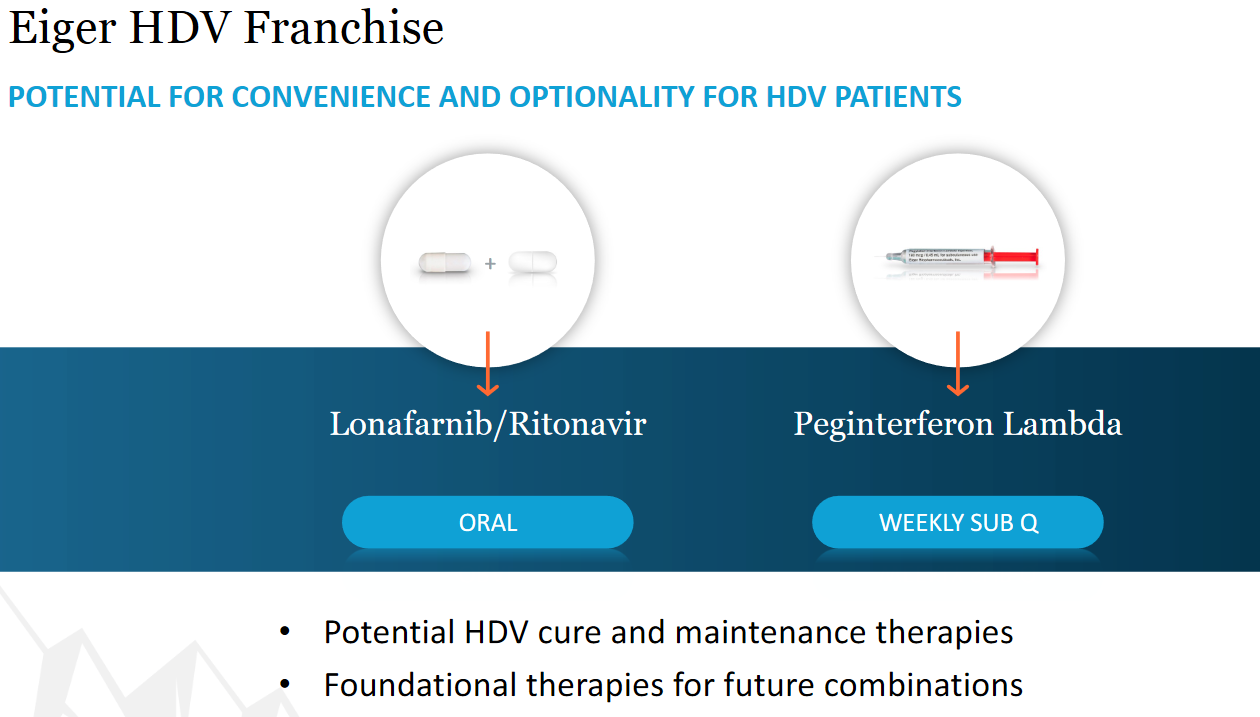
Eiger has two drugs targeting HDV.

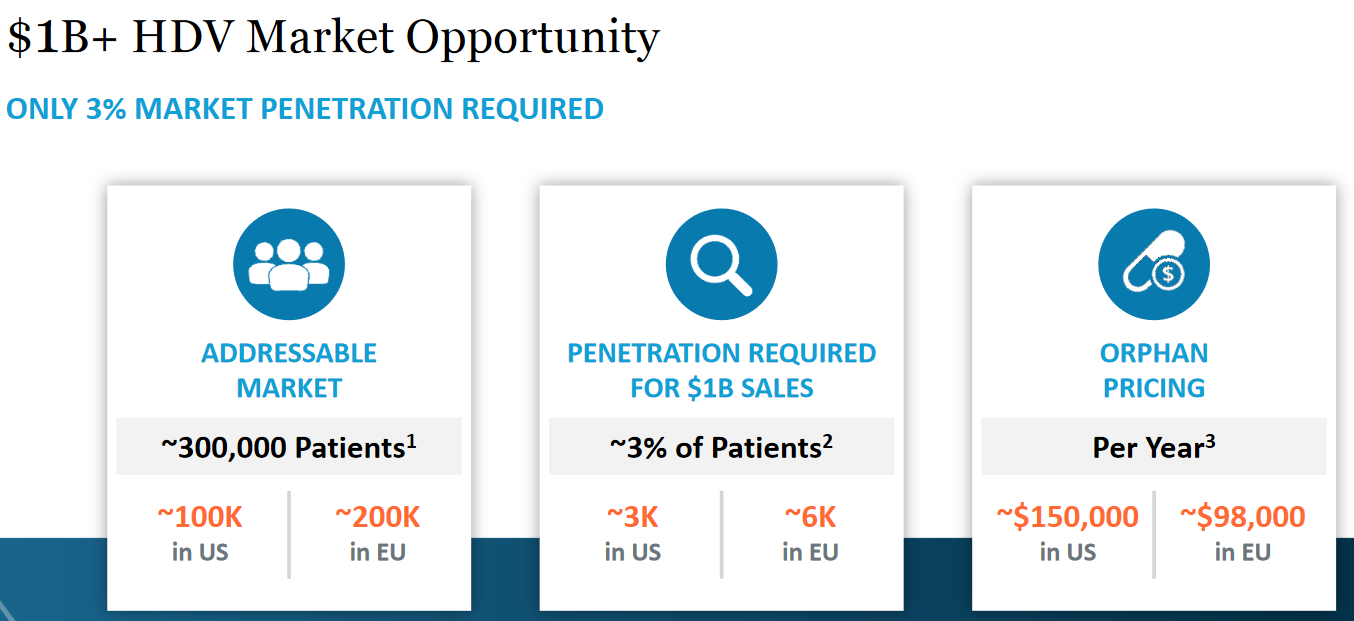
At the Ladenburg Thalmann conference Eiger outlined the oportunity for these therapies:

So what does this mean for our commercial opportunity? Well, if you think about those 300,000 patients — roughly 100,000 in the US and 200,000 in Western Europe — and we’ve done considerable market research and benchmarking and believe that a treatment for HDV will cost $150,000 per patient, per year. And if you think about the number of patients then you would need to diagnose and actually get onto a treatment to create a $1 billion market opportunity, it’s 3%; it is roughly 3% in the US and 3% in Western Europe. So that’s less than 10,000 patients in total.

In other words, it is easily a $1b market.

Lonafarnab/Ritonavir is in Phase 3 and will complete enrollment this year. Lambda is just starting its Ph3 and will begin enrolling shortly (we should get an update on that with earnings tonight).

There is a wildcard too. Lambda is also working its way through a Ph3 study with COVID. Eiger had this to say about that at the TL conference.

Now Lambda is also currently in a Phase 3 trial, as I mentioned earlier, investigating newly diagnosed outpatient COVID-19. We generated positive Phase 2 results out of the ILIAD study in Toronto at Jordan Feld’s clinic, demonstrated a potential to improve clinical outcomes and curb community spread. Treatment was well tolerated. This is a single subcutaneous injection upon — literally upon diagnosis, and the patient goes home.

 So we believe Lambda represents a potential true outpatient treatment versus monoclonals, which have to be intravenously infused. And even in patients who are vaccinated, the threat — as you may now be well aware, the threat of variance is a major concern.

 Brazil is on fire with COVID. We were lucky to have the investigators in the TOGETHER trial come to us and request that Lambda be included as an arm. We have now dosed our first patients, and we look forward to updating on what could be a registration-enabling study for Lambda in COVID in Brazil.

Eiger kind of blew the opportunity with COVID early on because Lambda Ph2 data actually looked very good, but they were slow to get it out into trials. But with Delta, they get a second chance. If they report good data the stock could move on that alone. Consider HGEN, which is worth $950 million right now.

I think Eiger is getting thrown out with all the biotechs. Its just been a complete disaster in biotech land since March, and I am hopeful this rally puts it behind us. I think if it does Eiger should do very well.