Skip to content

Posts from the ‘Uncategorized’ Category

Biotechs are Awful and Caribou Biosciences Looks Reasonable

My foray into gene editing has been more miss than hit so far. I bought a few of these stocks four or so weeks ago and have subsequently watched them crumble along with the rest of biotech.

As of Friday I had positions in CRISPR Therapeutics and Intellia Therapeutics. These positions are both underwater now, by 15% and 10% respectively.

More generally, it has been a tough market to buy biotech stocks. This is definitely the pain trade right now. A pain trade is buying something that is clearly out of favor and has zero love with the expectation that this will change and it may change quickly. Energy has been the best example of a pain trade over the last few years. You buy energy stocks because they are hated and then every once in a while they have a barn-burning rally and you make a killing.

Biotechs are definitely loading up on the pain right now. That pain is accentuated by the fact that the market keeps going up as they go down. The only biotechs that are not going down are… is Moderna. I own some Moderna, so that is a nice respite from the others.

But back to gene editing. I lightened up a little on a few of my gene editing names Friday afternoon once I realized that there was a new name that I think looks better than the others.

Caribou Biosciences went public on Friday about 2 hours after the market opened.

I did not realize Caribou was about to go public. I have been on vacation and missed the news. So about 30 minutes before the market closed Friday after seeing a tweet on Caribou, I was scrambling to see if I wanted to own the stock.

One thing about spending the last month or so trying to understand gene editing is that while it has not translated into making me a good picker of these stocks, it has at least given me a decent understanding of the landscape.

And if I am right, Caribou is mispriced compared to its more established (as stocks, not as a company) peers.

At its closing price on Friday Caribou traded at a market cap of $950mm. They have $425mm of cash on hand. That compares to CRSP and NTLA at around $10 billion, BEAM at $6.5 billion, EDIT at $2.7 billion, VERV at $2.4 billion and GRPH at $1.5 billion.

Now CRSP and NTLA have programs that have already had some positive Ph1 results. That is why they have the highest valuations. BEAM does a newer version of gene editing called base editing that may turn out to be superior to Cas9 editing, and that is why BEAM gets the relatively high valuation given that they are pretty early on (they don’t have a therapy in human trials just yet). The rest have points for and against but all are very early stage.

In general, at least a ~$2 billion valuation seems to be the norm for these gene editing CRISPR stocks. You could certainly argue they are all overvalued – in fact what I see is most traditional biotech investors are pretty put-off by the valuations these stocks get given the point where their therapies are in development (either Ph1 or pre-clinical) – but I think its tougher to argue why Caribou should be at $500 million net of cash while these others all trade at multiples of that.

Why? Well for one, Caribou holds a lot of the CRISPR IP. If you read the Intellia 10-K, they say they license much of their IP from Caribou. In fact, if I am understanding the disclosure correctly, Caribou will get a mid-single digit royalty on any product Intellia markets that uses the Caribou IP.

Caribou has the IP because this is Jennifer Doudna’s original company. Caribou was created shortly after Doudna and Emmanuelle Charpentier discovered CRISPR Cas-9. Doudna is still with the company heading up their scientific advisory committee. Their CEO, Rachel Haurwitz, was with Doudna as a research assistant since the beginning and has been CEO since Caribou was established.

It seems like a pretty all-star-like team here. They are full of the original discoverers and they own the underlying IP (though there are ongoing patent battles with the IP so that is something that could change, for the better or the worse).

The biggest knock that I have seen made against Caribou is that they are going after different indications than the rest of the group. Pretty much all the CRISPR names I’ve mentioned are going after the kinda “lowest-hanging fruit”. That would be stuff like sickle cell disease and other genetic blood disorders, liver diseases, and eye diseases. There are a bunch of reasons why CRISPR editing is most conducive to these targets, but they are.

Caribou is going for the big kahuna. They are going after cancer.

There are a couple things about targeting cancer that could be construed as negative.

First of all, its a tough nut to crack. Something like sickle cell disease is relatively simple because we know that it is caused by a particular gene mutation and we know that CRISPR techniques can knock-out gene mutations. So its a fairly low bar (I mean intuitively, not in practice) to conclude that if you can get the process down right, you can knock out the genes causing the mutation and prevent the disease.

Cancer is of course very complicated. What’s more, Caribou is not doing something totally unique with their approach. Caribou is using Cas9 and their own, proprietary (I think) Cas12a editing techniques to edit CAR-T cells that are used in cancer therapies.

(Note: I don’t believe that Cas12a editing is done by any of the other public gene editing companies. I am trying to learn more about Cas12a editing. FWIW Caribou says that its more precise edits than Cas9.)

Using CAR-T cells isn’t at all new. But editing them in the way Caribou is doing is new. The specific edits Caribou is making to the CAR-T cells are new, including the “first clinical-stage allogeneic anti-CD19 CAR-T cell therapy withPD-1 removed from the CAR-T cell surface by a genome-edited knockout”.

Planning to use allogeneic cells is also new. Allogeneic means using cells from a healthy donor, rather than harvesting cells of the patient. This has the potential to make the manufacturing of a therapy a much easier and consistent process. From what I have read, the limitation of using patient cells has been a stumbling block in getting CAR-T therapies used so far.

Caribou’s lead therapy candidate, CB-010, has just started its Ph1 trial. They recently dosed their first patient in the trial and expect results in early 2022.

CB-010 will be followed up by 3 other therapy candidates:
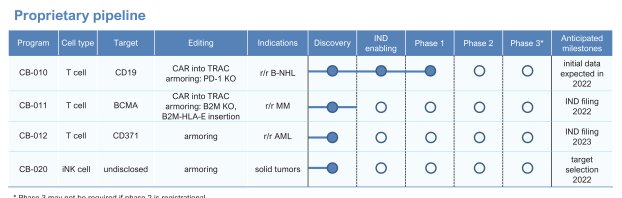
Worth noting is that the CB-010 CAR-T edits are being done by Cas9 editing. The following 3 candidates will use Cas12a.

So anyway, going after cancer is maybe a reason that Caribou is not valued like the other gene-editing names. But you could also argue the opposite. Cancer is a huge TAM and if Caribou shows some success with CB-010 the market is going to flip on its head and look at Caribou as the leader in new gene edited therapies against cancer. Which would obviously be massive.

My point in this very quickly written post is not to try to parse the positives and negatives with a fine tooth comb. It is simply to look at the positives and negatives and conclude (tentatively at least) that Caribou is probably as well positioned as most of these other gene editing companies, and yet the stock price is less than half of their valuation.

PS –

In addition to the gene editing pain, I have taken on additional pain by buying or adding to a number of biotech positions in the last couple days. I bought some BIOC on my expectation that their COVID testing business may last longer than many have anticipated. I bought some Lyra because it is again trading close to cash. And I bought back my EIGR position because it again has dropped below $8 and they have a Ph3 Covid trial that should readout soon and that could be more relevant with the Delta variant gaining steam.

On the other hand, if biotechs go from bad to worse to off the charts then I am going to feel pain this upcoming week.
Aehr Test Systems

Aehr is a stock that I have been waiting on for (literally) years. I’ve owned the stock maybe a half dozen times. Whether I have made money on it as a whole, at least before yesterday, is questionable.

Aehr is has always been a stock of big promises. The promise has been the big order, that new vertical application, a customer, or customers, that is going to buy their test systems by the 10s or 100s.

That is not just me speculating. If you go back to my original post on the company (here) I noted that management itself was speculating on this way back in 2017.

The company doesn’t give a lot of guidance, and there isn’t much of an analyst following to prod information out of them, but on the third quarter conference call management said that if successful with their lead customer (probably TI?) they could ship 10 systems a program and that they are currently working on 2 programs.  So the lead customer alone could amount to a $40 million to $60 million opportunity per program.

But I had pretty much given up hope on this ever happening. Year after year of small piecemeal orders created skepticism. It did not help that Aehr has some directors that sell shares incessantly, which does not boost one’s confidence.

Recently, one thing that I had noticed about Aehr was that the stock price seemed stronger than I would think it should be. The stock had been trending in the $2-$3 range through the first 6 months of the year. This was a little unusual, because Aehr’s results had not been very good at all, and while management talked a good talk on calls that was really nothing new.

When a stock is stronger than it should be, especially when its a micro-cap, it is often telling you something.

So I took particular interest to the company’s fiscal fourth quarter call last Thursday to see what might be going on.

The numbers in the fourth quarter were ok. The revenue number, $5.5 million, was nothing to write home about, but they had $5.4 million in bookings and a backlog of $7 million.

A $7 million backlog has been kinda a magic number for Aehr. When things are good, the backlog gets to above $7 million. When they are bad it can go as low as the $2’s. I believe that $7 million of revenue a quarter was the breakeven level that the company stated years ago. On the call they guided this coming fiscal year at above $7 million per quarter, which is pretty, pretty good – for Aehr.

On the call Gayn Erickson, who has been Aehr’s CEO since I started following the company, gave color about a few new opportunities that have shown themself to Aehr.

One of these opportunities is in silicon carbide devices.

This past fiscal year, we made significant inroads into the emerging silicon carbide device market, which continues to be a very promising key growth driver for Aehr and will be a major focus in the coming fiscal year. Silicon carbide power semiconductors have emerged as the preferred technology for battery electric vehicle power conversion in onboard and off-board electric vehicle battery chargers and the electric power conversion and control of the electric engine. Our FOX-P family of products are very cost-effective solutions for ensuring the critical quality and reliability of devices in this market, where performance and reliability cannot only mean increased battery life but also whether you have to walk home from a vehicle whose power semiconductor fails in the powertrain.

Failures of the SiC device is particularly bad in a vehicle because it usually means the vehicle just stops. It reminds me of an alternator in an ICE.

SiC chips are more expensive than silicon, which is why they are not used across all applications. Where they shine is in high voltage applications and in applications where the chip is going to be under a lot of stress. Renewable applications like EVs, solar and wind fit the bill.

Aehr has had a customer that has been looking at their test systems for silicon carbide chips for a while now. I believe the first mention of this was the October 2019 call.

What was news on Thursdays call was that the customer had qualified the Aehr test system and was expected to order a number of them this year.

During this past fiscal year, our lead silicon carbide customer qualified Aehr’s FOX-XP system for high-volume production burn-in and infant mortality screening of silicon carbide power devices at wafer level for electric vehicles. This customer is a leading Fortune 500 supplier of semiconductor devices with a significant customer base in the automotive semiconductor market. They have now qualified several devices for automotive applications on our solution, ordered multiple FOX-XP systems and have purchased multiple new WaferPak contactor designs that are expected to be qualified and moved to production during this new fiscal year.

Also on the call, Erickson talked about a ramp from the other major developing vertical, silicon photonics:

We’re excited to mention that our lead customer in silicon photonics has forecasted a ramp that we believe will drive new orders for additional FOX-XP systems and a significant number of WaferPaks this quarter. This customer one of the world’s largest semiconductor manufacturers, continues to look to Aehr to support their high-volume production ramp and wafer level burn-in capacity, and is forecasting significant growth in shipments for silicon photonics devices that we expect to drive the need for additional production test and capacity for multiple years in the future.

Erickson went on to describe why Aehr’s Fox system is ideal for the new evolving designs in silicon photonics:

It turns out that the photonics part of the silicon photonics, which is the laser needs a thing called aging or stabilization. We actually test the devices and it takes a number of hours to stabilize the laser to be able to get it to a point where it is useful in that application. Historically, that stabilization was done in a discreet package at somewhere else. But when you put it into a silicon photonics, when you integrate it together, that laser exists on a wafer. Well in order to actually enable that, you would actually need to be able to do a wafer level burn-in to make — to take advantage of all of the scaling that’s going on, and that’s where we come in. The FOX-XP system is capable of not only having all the power supplies and the capability to 100% discreetly determine and test every single laser that are measured in thousands per wafer in one short, but also can deal with the amount of power to the devices and removal. And then we can do that with up to 18 wafers at a time. So now all of a sudden, it is a cost-effective enabler for silicon photonics.

They also announced that 2 new silicon photonics customers had accepted the Aehr system after completing testing.

The thing about Aehr is that they have always held out the possibility of a big home run. While they piddled along with these pissy little $1 million or $2 million orders, the opportunity was that one day they would announce the big score.

Again going back to those old 2017 conference calls with Erickson. At the time he was saying that he thought that Aehr’s FOX-XP system “increases their TAM from $100mm to $400mm annually” and that they could take a significant portion of that.

It is that “carrot” that has kept me watching the stock through all the years while it did nothing.

I took a position on Friday after reviewing the call but honestly, I thought I still had lots of time to add to it before something would happen. After all, this is Aehr and Aehr is all about over-promising and under-delivering.

I was wrong.

Yesterday Aehr announced a $10.8 million purchase order from the SiC customer that they mentioned in the call. They will be used for testing SiC devices in the automotive market.

In the press release Aehr said there is more to come: “This customer continues to forecast orders for multiple additional FOX systems and WaferPak Contactors this fiscal year and a significant number of systems and WaferPaks over the next several years due to electric vehicle semiconductor test and burn-in demand. “

Aehr has never had an order like this. Like I said, its always these $3 million, one-off orders. A $10 million order is a whole new ball game.

It suggests to me that this time around Aehr is actually gaining traction in commercial applications. Not just selling systems piecemeal for a niche application or a verification by some large OEM. But real commercial applications.

Of course, the stock popped yesterday. I am sorry about always being late to the game with these posts but when the news comes out first thing in the morning I just don’t have time to write up a post in real time explaining what it means.

Nevertheless, even at $6 Aehr has a market cap of $140 million. This really is not a lot in the grand scheme of things. Way back in 2018 I made some projections of what EPS might look like if Aehr got to a magical $10 million revenue per quarter number. I estimated they could do 35c for the full year.

Flash forward to today and really, not much has changed. If anything their cost structure appears to be lower.

Aehr is a lot like Vicor. Remember that Vicor was a stock I held on and off for years and they were forever promising the big order and it never happened and then one day it happened and the stock took off.

My mistake with Vicor was not realizing just how far things could go. With Vicor I sold the stock at around $35 per share. It was a triple or so, so I did fine. But Vicor kept climbing, it got above $100 at one point!

I never completely understood how that happened but the lesson is that once the new market materializes (and interestingly with Vicor it is actually the same market – EVs – as Aehr is benefiting from), and if that new market is the hot new thing, the valuation can get rather silly.

With Aehr, even though it has moved, the valuation is far from silly.

The caveat is that Aehr probably raises capital here. They have a little under $5 million of cash, which is really not much. I would not be at all surprised if they raise more here or at least very soon.

I’ve Gone All-in on Gene Editing

Something pretty big happened on Monday. Intellia, which is a genome editing company that uses CRISPR to slice up, remove and add DNA segments, announced some pretty amazing results from their Phase 1 trial targeting a rare disease called transthyretin (ATTR) amyloidosis.

ATTR amyloidosis happens because of a mutation to the TTR gene. This mutation makes the liver produce misfolded TTR proteins. These misfolded proteins get into other organs and wreak havoc on them.

With CRISPR/Cas9, Intellia’s therapy targets the gene and basically knocks out the mutation from the strand (this is called a “knock-down”). Without the mutation in the gene, the body stops producing the misfolded proteins and all is well.

From FierceBio: David Lebwohl, M.D., Intellia’s chief medical officer said that the the result was “beyond what we expected.”

These results, it seems to me, are a very big deal. Why? Because this is the first time that the CRISPR/Cas9 system has been used in a trial, inside a human being, to change a gene (called in vivo).

Up until now, if you wanted to change a gene with CRISPR, you had to do it in vitro – which means either taking cells out of the body or using someone else’s cells, slicing and dicing the DNA, and then injecting them back in.

Obviously this is not ideal. It really limits the usefulness. It is much better to be able to administer the therapy into the body and let the work happen there.

And now we have evidence you can do that. A one time treatment and boom – a functional cure to an awful disease.

This is the first time I’ve written about gene editing with CRISPR (I think?) but I have been working on this for months. I’ve read three books on the topic (one of the co-founders of Intellia, Jennifer Doudna, is the main character in the book The Code Breaker, which was a good introductory overview of the sector for me), and have been pouring over brokerage reports and papers on it. I’m still a newbie but starting to get the just of it.

Enough to know that this is a pretty big deal.

For some perspective, this is only a Phase 1 trial, so there’s that. And the target that Intellia chose is a gene that is in the liver – the liver, from my understanding, is a relatively easy target because getting therapies delivered to it migrate there easily.

As a final caveat, one of the big problems with CRISPR is something called off-targeted edits, which is exactly what it sounds like, editing genes somewhere else, and Intellia noted 7 of them in this case. These could be bad or they could be nothing. From what I read we often won’t know if they are a problem until they are a problem.

But even with all these caveats, the big picture is that it worked. In fact, the results were far better than anyone expected.

The thing about in vivo CRISPR therapies is that if they work, they can basically knock out problem genes or replace problems genes or add good genes with a single treatment. Instead of treating symptoms or supressing a problem they are really knocking the problem right out of the body. It really is a game changer.

The obvious thing to do after these results would have been to buy Intellia. So of course, because I am an idiot, I did not do that. It was just up so darn much Monday morning – but of course since Monday it has been up even more.

Instead I bought all the others: CRSP, EDIT and GRPH. CRSP has not really moved since Monday, likely because its been so overbought, but the other two have continued to move up.

Even though these stocks have very high market capitalizations and, of course, no real revenue, I felt that I just had to own them. Literally the only thing that had kept me from these stocks in the past few months was that I kept thinking, if this is just a treatment that is only done in vitro, that is going to be pretty limited application.

But that is no longer the case. I feel like it will take some time for the market to truly catch up to that change.

Ships and Steel – Managing versus Predicting

I always struggle with days like Thursday. A sudden about face in the market and you have to figure out what to do.

Two days later, I’m still not sure what to do. I have done stuff, but I may undo them or I may do other things altogether.

Four sectors that I own stocks in took a dump Thursday – steel, shipping, banks and gold.

Gold

So first off – gold. This one is easy. You just sell. I have found that it is already best to sell gold stocks first and ask questions later. If it turns around just buy them back. There is always a chance to buy them back with gold stocks. I have invested in gold stocks for 15 years. I can’t think of one time where they “got away from me”.

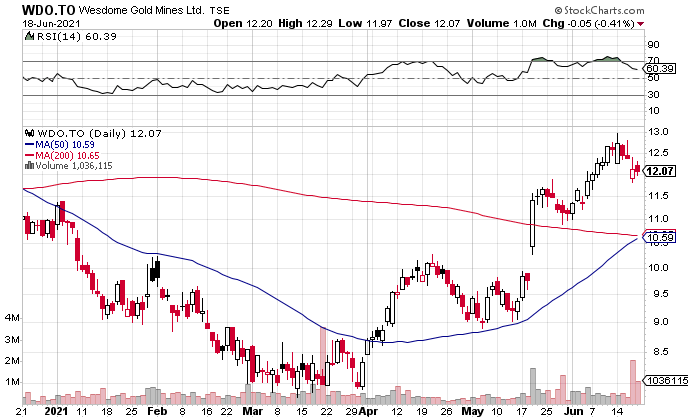
I don’t own New Gold any more, I don’t own any Gran Colombia (which I had bought Monday) and I sold most of Wesdome and Fiore.

The only thing that gives me pause is Wesdome – and that simply is that it hardly sold off.

The stock is (relatively) so strong. I don’t know what is going on there but while bigger gold names fell 5-6%, Wesdome was actually flat at one point on Thursday. That is why I kept a bit.

Banks

Second – banks. With the banks I am in a different spot because I have sold a lot of my positions. So this is more about whether to buy them back.

I was really surprised to see both the banks and gold down. They have been a hedge to one another over the last year. When one is up the other is down.

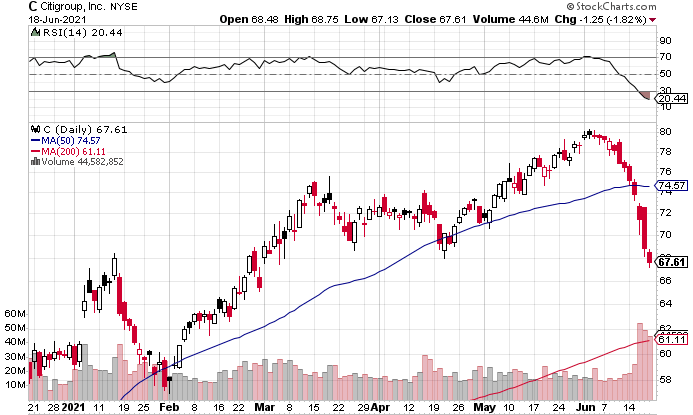
When you look at the big money center banks, they have been down for days. The charts of JP Morgan and Citigroup in particular are really ugly. I mean, what the heck is going on with this:

This large bank move was not Fed induced by the looks of when it started. It just carried over to the small banks on Thursday.Whenever the banks start going down I feel like I have to figure out what it means. This case is no different but I have not figured it out yet. I won’t be adding to my positions until I do.

As for the other two – shipping and steel… I am battling my mindset versus the volatility of these sectors.

My mindset is – do not lose money. If I make some great, but more important, don’t lose any. The problem is that shipping and steel are two sectors where you can lose money very quickly if things go against you.

Which is why, even though they do not make up a particularly large part of my portfolio, they are taking an outsized amount of my attention right now.

Shipping

In the case of shipping, the stocks suffered quite a drop on Thursday, which makes the decision more immediate.

But I sold some of the shippers the week before so that played into it as well. I did not go into Thursday’s drop with full positions in these names.

Nevertheless, I did sell some more. For reasons I will explain. But on Friday I added a new container (not containership) idea, Triton International, so that offset those sales some. I still own less of these stocks than I did coming into Thursday but enough to be nervous about them going forward.

Containerships

Let’s go back to where the market is. First, containership rates are still at all-time highs and they look to be going higher.

This article, from American Shipper, says that rates are actually “accelerating”. There is a huge backlog of ships (90 of them) just sitting off the coast of China ports because of a Covid outbreak at the very large port of Yantian. While this backlog has come down a bit (from 104 a week previous) that is only because the ships scheduled to dock at Yantian are omitting the port altogether.

Ships omitting the port has consequences because the containers that are supposed to be loaded from the port are stacking up. According to this CNBC article:

Approximately 160,000 40-foot containers, the equivalent of 300,000 TEUs, or 20-foot equivalent units, are waiting to be exported, according to logistics companies with operating knowledge of the port.

300,000 TEUs would be about 10 days of shipping from the port.

This article from gcaptain put it this way:

Yantian Port now says it will be back to normal by the end of June, but just as it took several weeks for ship schedules and supply chains to recover from the vessel blocking the Suez Canal in March, it may take months for the cargo backlog in southern China to clear while the fallout ripples to ports worldwide.

“The trend is worrying, and unceasing congestion is becoming a global problem,” A.P. Moller-Maersk A/S, the world’s No. 1 container carrier, said in a statement Thursday.

Over 90% of the world’s electronics are exported out of the Port of Yantian.

Another article from Lloyds List says it will take weeks to work through the backlog and that is the best case scenario.

The gcaptain article estimated “the congestion in Yantian will take six to eight weeks to clear. That timetable is a problem because it extends the disruptions into the late-summer period of peak demand from the U.S. and Europe, where retailers and other importers restock warehouses ahead of the year-end holiday shopping rush.”

So the port congestion runs into the holiday rush runs into other economies opening up as they become vaccinated. And no significant new ships builds are coming along for 2 years.

Meanwhile the containership companies are booking 2 or 3 year charters at rates well above $30K/d. Today I saw a 3 year time charter at $42k per day and a 5 year charter at $34k per day.

The much, much hated NMM (just read the post of @the5hippingman on twitter) charted 5 containerships for 36 months on Tuesday. With these charters these ships will bring in $60 million of EBITDA per year.

That is from 5 ships. NMM has 51 dry bulk ships and 38 containerships. NMM has an EV of $1 billion.

As for Euroseas, which has been my main containership play, they have about half of their vessels opening up for new charters between now and the second quarter of 2022.

Those vessels are going to recharter at much higher rates.

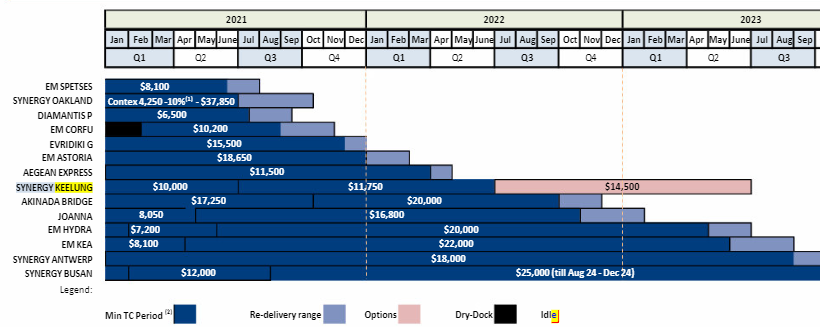
The SPETSES, DIAMANTIS AND CORFU are all currently operating at charter rates of $7k-$8k per day. At current rates they will be able to re-charter at $20k-$25k. The OAKLAND, which is a bigger Panamax ship, was booked out at $4k per day in Q1. In Q2 they will be on a better but very short charter of $38k until July. When that charter ends, these sort of Panamax vessels are getting $40k for years right now.

Analysts have been raising estimates for Euroseas for some time, and we are now at an average of $7.42 EPS for 2022.

So the market looks very positive. What makes me nervous about the containership market is the new build order book. That order book (which I showed last post) has grown a lot in the last 6 months or so. That makes me think that investors will be less likely to bid up containerships on current earnings, as they realize those earnings won’t last.

The other thing that is tough about containership stocks is there just aren’t that many stocks out there, at least on North American exchanges. It is one of the reasons I bought Triton.

The cheapest of the bunch is NMM, which is one of the basket of 3 that own, but it has a real problem with credibility, and because their CEO, Angelica Frangou, does not always do what is in the best interests of shareholders, there is a chance that some day we wake up to news with NMM that destroy the value of the 2x P/E valuation.

Euroseas and Danaos are both up a lot in the last few weeks. So its really hard not to be trimming those on the least bit of worry.

So I sold some Navios and Danaos Containerships and a little more Euroseas. But I still own all to a lesser degree, as the market is so strong I could easily see it having at least one more leg up.

Dry Bulk

The dry bulk market is a little different than the containership market because rates are just strong, not crazy, insanely strong, while the order book is very, very low (see my last post for this). For this reason, I am a little less trigger happy with my dry bulk stocks.

I did lighten up on Star Bulk earlier this week but I ploughed about half of that into Diana Shipping and Globus Maritime, so my overall exposure to dry bulk is still about 75% of the what it was (with containerships I’ve taken about 1/2 off the table overall).

Together with Grindrod, these moves mean I’m moving down the chain in quality and size, which might be seen as a dumb idea if we are moving towards the end of this move.

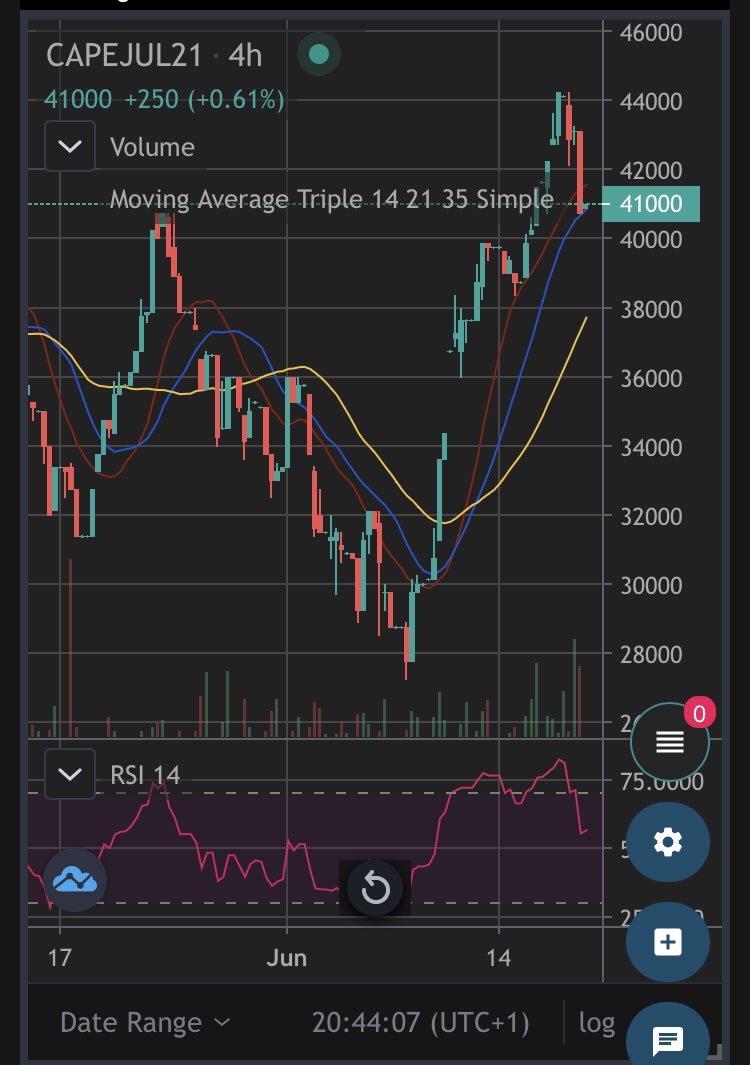
In the dry bulk market, while Capesize FFA’s (that is future freight rate agreements) have pulled back a little the last couple of days, they have had a very good move over the last 2-weeks and they are around $40k, which bodes well for dry bulk shippers.

Image

The smaller size ships, so the Panamax, Supramax and Handysize, are seeing even better rates. Grindrod and Globus Maritime both own these smaller ships. Diana Shipping owns both the larger Capesize and the smaller Panamax/Supramax size.

The crux of my desire to hold dry bulk is that stocks like Grindrod are just so cheap on multiples. I’m going to go through Grindrod as an example.

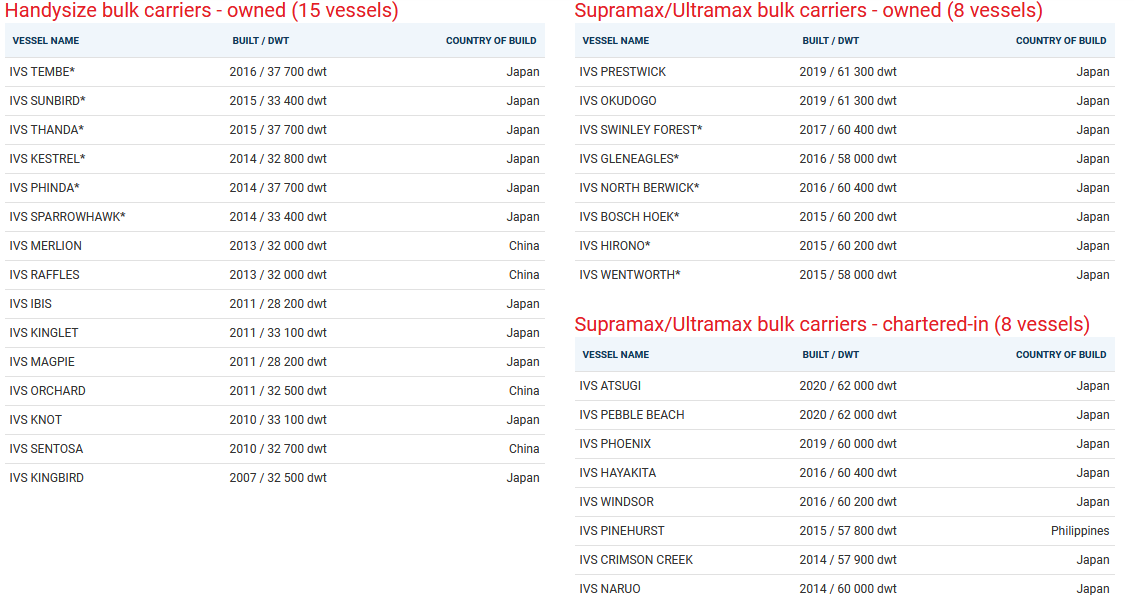
Grindrod has 15 Handysize and 16 Supramax size vessels.

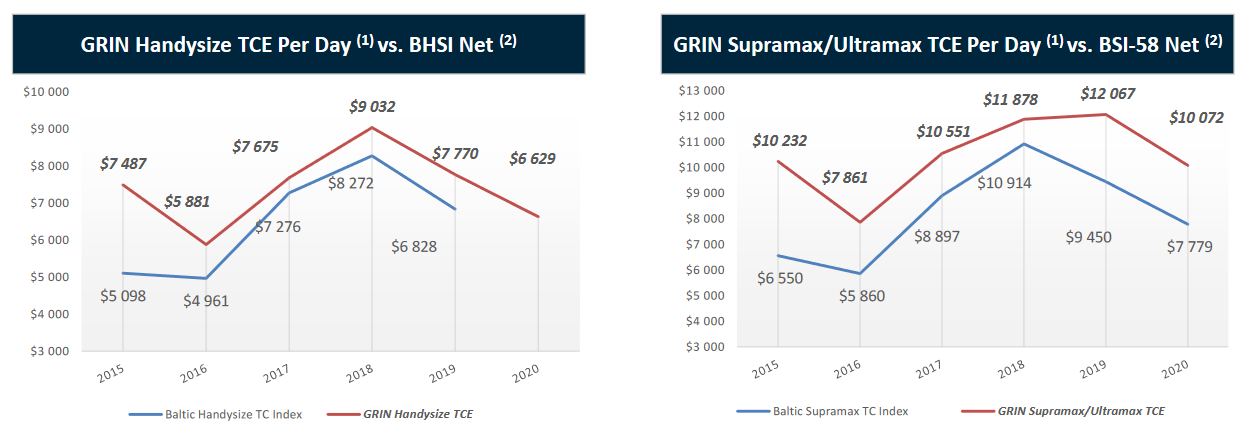
Now let’s look at where rates are versus where they have been. Supramax vessels are contracting out at $32k per day right now. In 2020 Grindrod averaged $10k per day. Handysize vessels are going for $22k per day right now while Grindrod averaged $6.6k per day in 2020.

So Grindrod is experiencing far higher rates now that it has in the past. I mean, we are close to triple the 5-year rates on these ships.

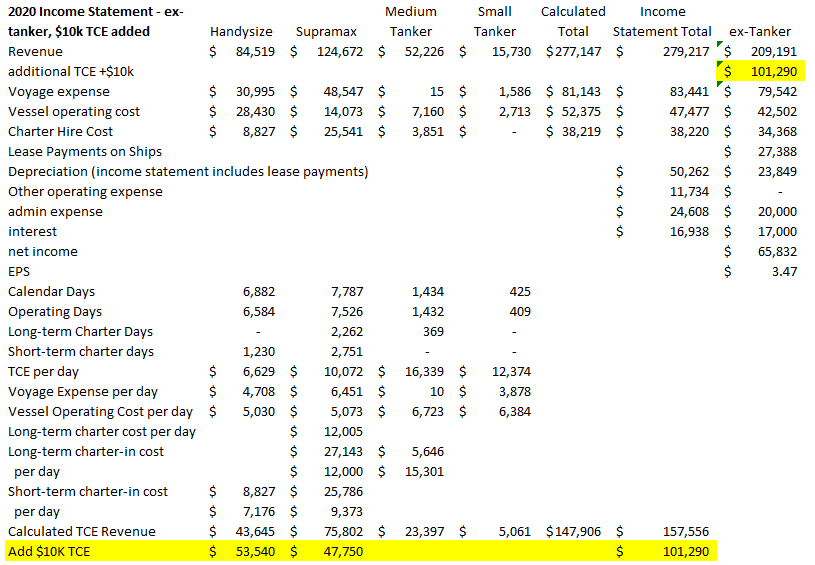
I did a very back-of-the-napkin estimate of what even an extra $10k of TCE means for Grindrod. $3.50 of EPS. You can see the results below.

The spreadsheet is a bit convoluted, but the important column is the last one, where I have taken the 2020 numbers, removed the impact of tankers (they have since been sold) and added revenue from an additional $10k TCE for the owned and long-term charter operating days.

What is worthwhile pointing out is that A. TCE’s right now are more like $15k-$20k above the 2020 numbers. B. I’m assuming no positive impact from the short-term charter-in days (which were ~1/3 of Supramax days in 2020). C. I did not reduce the debt payments even though Grindrod has paid off about 1/4 of their debt. And D. cash flow is higher – nearly $90 million.

So to sum this up: Grindrod has a market cap of $200 million right now. Cash flow at the +$10K TCE level is close to half their market cap. Every $10k increase in TCE after that is another ~$100 million.

So that is why I am reluctant to sell. Particularly when the order book for new builds is extremely low, it appears that the environmental regulations coming into play on propulsion systems is going to make shipowners wary of ordering new builds, and shipyards are filled with orders of LNG and containerships for the next couple of years anyway.

Whereas with containerships I am wary of how high investors will bid up stocks when the end of the cycle can be seen, I cannot say that for dry bulk.

Steel

In the case of steel, the two stocks I own, Stelco and Algoma, did not really go down much. So the question becomes, do I sell while I still can?

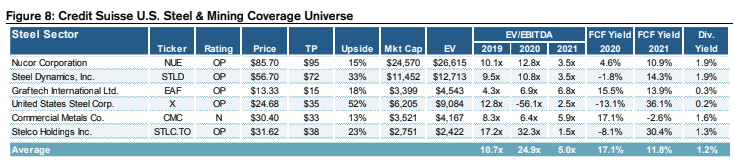
While steel makes me very nervous, I still decided to hold on. As I wrote about previously, both Stelco and Algoma are very cheap compared to their US peers. According to Credit Suisse, Stelco trades at like half of what the US steel companies do. I don’t see any good reason for this discount.

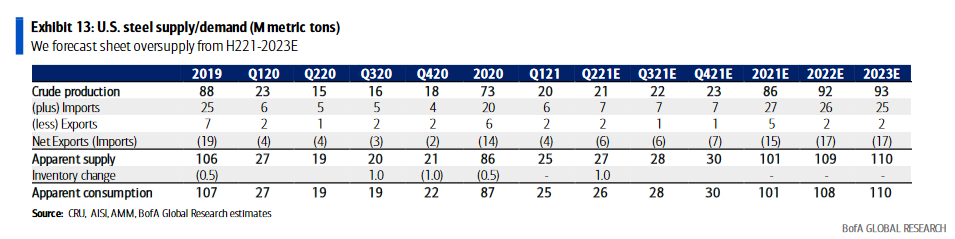
The bear case for steel is summarized by Bank of America, who has been calling for “Steelmaggeddon”. Steelmaggeddon for some time. They are basically saying a bunch of new supply coming on that will wipe out the deficit and bring prices back to $600/t next year. Actually, BofA was saying by H221 but that does not seem likely now, so they have pushed it out to 2022 now.

This is BofA’s US supply/demand forecast for their Steelmaggeddon forecast:

It actually seems pretty balanced to me (the numbers don’t actually add up either). It also depends on steel demand not getting back to 2019 levels until 2022.

On the other side, Morgan Stanley is pretty bullish steel prices. They think steel could stay near the $1,700/t level until Q1 of next year.

They note that: demand strong across all end uses, demand does not appear to be inflated by significant double ordering, inventories are uncomfortably low and some service centers are seeing “unprecedented level of contract demand”.

Average estimates are for Stelco to earn $13.50 this year, followed by $6.50 next year (because no one believes steel is going to stay near this level). Algoma isn’t covered by anyone but its multiples would be about the same.

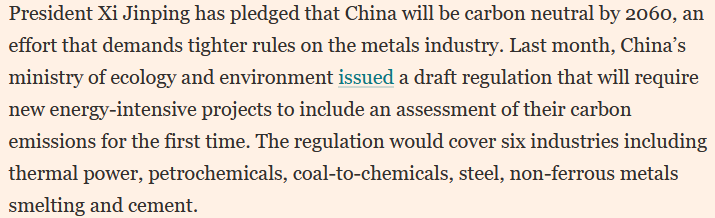
The reason to keep an eye on steel is China and carbon. If China is serious about their commitments to greening steel, they have to begin to slow down the dirtiest production.

China produces about 1 billion tonnes of steel a year. If China cuts even 1% of its dirtiest steel production, that is more than all the new North American capacity adds next year. And China is talking far, far bigger numbers than 1%.

FT has been the best on reporting this story. They said in an article last week that:

These changes are going to have a big impact on China steel production over the next 4 years:

The Tangshan province, which produces 14% of China’s steel promised big cuts earlier this year:

It is almost unimaginable to me that China could drop that much steel production. The market would go crazy. Chinese steel companies are already trying to build plants outside of China to offset. It is going to be a delicate balance.

And so far this year, we aren’t seeing the cutback. Steel production in China, at least the official numbers, is up.

So it might not be a huge cut overnight. But my point is more on direction. China is not going to be adding steel production like they have, at the margin they are more likely to reduce it, and as a result it is quite possible we could see exports from China decline.

This seems to me to be the sort of thing super cycles are made of.

Going back to that BofA supply/demand balance, they are predicting exports to the United States to increase.

Add it up, and I’m not ready to through in the towel on these two names just yet.