These guys are opaque and not very concerned with shareholder relations. They have no presentation and their press releases are dull.
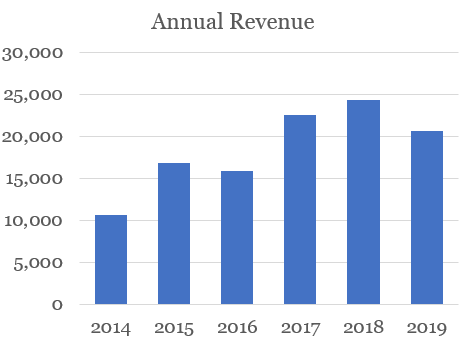
This is also not a business with an impressive history. Annual revenue is unexciting.
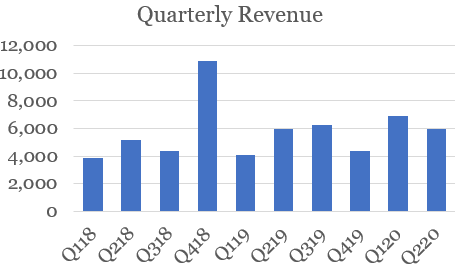
Quarterly revenue growth has not been any better.
Exciting stuff so far.
But the quarterly backlog has been growing. Backlog was $21 million at YE 2018.
Q3 backlog of $34mm and bookings of $8.7mm
Q2 backlog was $30.9mm and bookings were $7.7mm
Q1 backlog was $31mm and bookings were $5.5mm
There is $9.3mm of cash on the balance sheet and no debt. Biorem has 38.7mm shares at $.60 for a market cap of $23mm.
Business
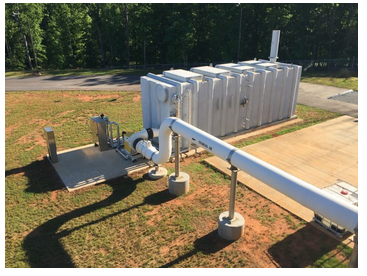
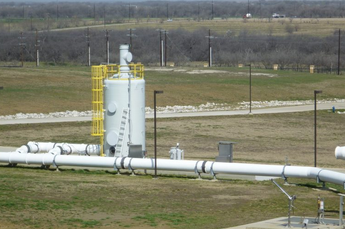
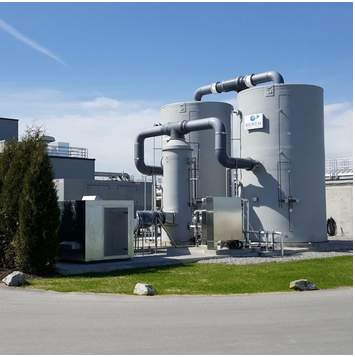
Biorem makes systems to remove hazardous pollutants from industrial and commercial emissions. These systems eliminate odors, VOCs, hazardous air pollutants from air streams. They use microbes that eat the pollutants and turn them into harmless byproducts. In their portfolio there are 3 different grades of air filtration systems and a biogas H2S removal system.
BASYS and BiofiltAIR
smallest biofiltration system
removes VOCs and contaminants from the air
Here is how it works:
Odiferous compounds or hazardous air pollutants are transferred into the biofilm where they are used by the microbes as a food source and converted to harmless byproducts such as carbon dioxide and water vapor.
MYTILUS Biotrickling Filter
fixed film biological reactors
air this is air cleaning system
circulating air in “biological reactor” where there are microbial cultures that eat the contaminants
used for the removal of hydrogen sulfide at waste water treatment facilities or ethanol from industrial processes
SYNERGY
this is the high end filtration system (“where failure is not an option” – the website)
several stage system
can include several biological reactors in series and stages with specific chemicals to address specific contaminants
designed to handle the most difficult air stream applications
used by municipalities for sustainable wastewater treatment
BIOGAS
uses sulfur degrading bacteria that eat the H2S
removes H2S from landfill gas and other methane gas mixtures
Recent Wins/Engagements
Dec 14 – NYC to examine using their biological processes for mitigating odours and air pollutants from wastewater treatment facilities
Nov 16: 2 contracts for $2.4mm with Miami, $2.5mm win with Montreal, $2.3mm win with Loudoun County in Virginia, 2 orders from China for $2.2mm
Jan- announced JV in China
Dec 19 – order for $6mm air emission abatement project in Montreal, they are modernizing, constructing new organics facility, will produce soil amendments and natgas
I’m of the mind that even though the clean energy names have had a good run, they may have further to go with this Democratic win. Most are too expensive for my tastes. This is one I accumulated over the last week of the year and does not seem expensive.
In addition to Biorem I added a couple of solar installer small cap trades: OEG and PECK, to try to capitalize on the Democratic senate. We’ll see if those pan out and they really are just trades. I’ve also bought a number of small biotecths over the last few days: BNTC, CLBS, ETTX, and NTEC. Of the 4 I think NTEC is most interesting. This is an old Marc Cohodes pick that didn’t pan out, but they have a platform that doesn’t seem like its dead to me and yet the stock trades at a level that suggests it is.
The banks are rocking and gold is not. I like that these two sectors provide a bit of a hedge to one another on a daily basis while both seem to be on an uptrend in the long run.
Sometimes I reluctantly reduce my positions, having regret that I will miss out on future gains. But this is not one of those times.
Over the last 3 trading days, I sold across the board except for my community bank and gold stock positions. Everything else I either reduced or removed entirely. I am much reduced on most of my speculative plays. I also added to my index shorts, which I believe will make me roughly hedged (its hard to say). I took a position in PSQ to go along with RWM, HIX, and HIU.
I am also fully unhedged on my US dollars.
I don’t know if this is the top or whether the market keeps going for another month. But its been a very good 30 days and it would just be bad management to not take the gains I think. Pigs get slaughtered right?
Gold is up a lot today and looks to be breaking out, and it hasn’t really participated in this move, so I will hold those positions and have added a couple more (I added back ROXG for one).
The community banks have done well, but other than Silvergate, which has gone stratospheric (I sold the rest this morning), they aren’t particularly expensive. They certainly aren’t in a bubble, which cannot be said for some other sectors. So I have kept the banks as well.
The truth is, I am pretty darn lucky with the timing here. As is my usual tact, I would have been selling all the way up if it hadn’t been December. But because I knew that if I held on just a little bit longer I could defer tax gains for a year, I waited it out. That I made it all the way to the 30th (last day for tax selling was the 29th) is sheer luck.
So it turned out well. No need to overstay my welcome. We’ll see what the market does next.
Bionano is another one of these examples of finding a stock shortly before it takes off. I don’t know why it happens that I research something and a day or two later a press release comes out and I am left scrambling, but it happens over and over again. And while I really don’t like writing about something that just popped like Bionano did yesterday, the blog is locked (again) and I am trying to write mostly for myself, so I need to write about what is top of mind. Just bare in mind that the news announced yesterday was not really all that earth-shattering. It is another layer of evidence that seems to be proving out that Bionano’s Saphyr system has a larger place in the genomics ecosystem, which is what I am going to talk about.
I stumbled on Bionano twice. Oppenheimer had a note on Bionano back in mid-November. I read it, and flagged it, and then promptly forgot to follow up. Then Oppenheimer had another note on them Monday and I was like, oh yeah, I meant to look into that, so I did.
So I dug into Bionano on Monday and (of course) yesterday the company has a press release. I had learned enough about Bionano that I had decided I was going to buy the stock and it did not pop right away in the morning so I had a chance. You could call it lucky or unlucky timing, depending on how you want to frame it. But I don’t know if that pop will stick – like I said the news is not really a game-changer in and of itself.
There are a few angles to the story. First, for the last 10 years Bionano has been a company with one of these ‘platforms for research’ business models that doesn’t generate much revenue because the market is limited to a few labs. They have been selling their platform for a decade with only niche success. The story today is that this could be changing.
There have been a number of papers published this year where doctors are saying that Bionano’s platform (called Saphyr) can replace the standard of care (SOC) for something called cytogenetics.
Cytogenetics is a broad term for studying changes in chromosomes. Chromosomes are long strands of DNA. Right now, if you want to detect changes in chromosomes, you have to use pretty old techniques like karyotyping, FISH and microarrays.
What about the sequencing platforms, like those from Illumina and Pacific Biosciences? It turns out that those platforms are not so good at reading long-strands of DNA like you need to do for cytogenetics. The Illumina platform isn’t really cut out for it and while the Pacific Biosciences platform does read long-strands better, it is not good enough for cytogenetics. If you do a search through the filings of Pacific Biosciences for cytogenetics you don’t even get one hit.
The Saphyr platform does work. It uses a different technology, called optical mapping, to capture the DNA sequence.
Saphyr can detect large-length differences in the DNA, which are also called structural abnormalities (these have the short-hand SV for some reason).
These SVs aren’t important for detecting the genetic markings of most diseases. But they are important for detection of some. Bionano got its start selling Saphyr and its predecessor system called Irys to labs investigating rare pediatric diseases where there was a need to detect SVs.
The problem with that focus is that these diseases are rare so they are not much of a market. But this year a number of studies have been published that have presented data showing that Saphyr is good for other, more common diseases – specifically some types of cancer – that are characterized by SVs and where right now microarrays, FISH and karyotyping are used to detect the genetic anomalies.
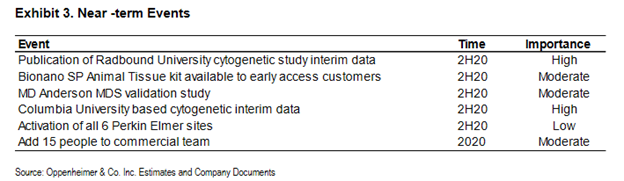
At the beginning of this year Oppenheimer initiated coverage of Bionano. In that report they gave this handy little table of the expected events of 2020. Included were a number of studies that would determine whether Saphyr would make it or break it as a replacement for SOC.
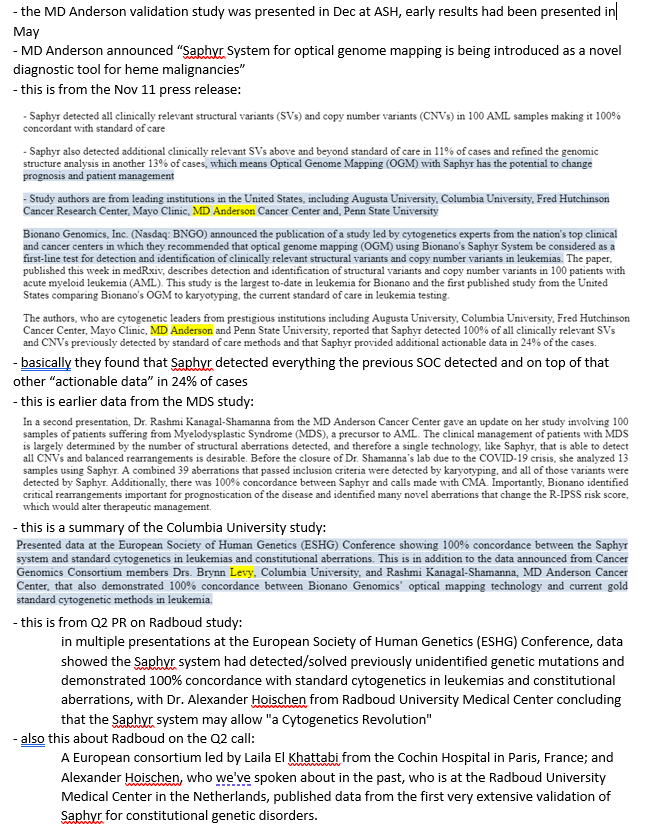
Now flash forward to today. The three studies noted in the table have been presented. In addition there is at least one more positive readout. In all the literature released this year, Saphyr looks to be a better solution.
Its faster (5 days versus 3 weeks). Its cheaper. It finds all the anomalies of the existing tech and in some cases is finding anomalies that the existing tech did not.
Here’s my summary of the studies that have been presented this year:
The next step, which Oppenheimer noted Monday, is the “pending publication of KOL recommendation of optical mapping to replace traditional cytogenetics tools in a peer-reviewed journal”.
Now some perspective. Bionano is not the next Illumina or Pacific Biosciences. The TAM of cytogenetics is $200-$400 million. Recurring consumable revenue at ~70% gross margins.
If Saphyr becomes SOC for these tests, Bionano is going to capture their fair share of that TAM. And that should make the stock worth more than it is right now.
The question is if there are more applications. I think so, but I’m still trying to figure it out. I did notice that the Radboud study mentioned above describes Saphyr as alternative for “reproductive disorders”:
The study authors describe Saphyr as a viable alternative to both karyotyping and CNV-microarray, especially in reproductive disorders as a potential replacement of karyotyping as the primary cytogenetic testing method. Sequencing-based methods have failed to replace karyotyping, especially in prenatal testing, because of a high incidence of false positive findings, which has not occurred with Saphyr.
That reminds me of Combimatrix, which used micro-arrays for just this sort of test. So that is another potential addressable market for the technology.
So this is a story about a platform that is maybe coming of age. But I also cannot ignore the other angle – which is investor exuberance. You saw that yesterday with the move that far exceeded the news that underlay it. Along these lines, the Ark guys are at least aware of Bionano. Simon Barnett, who is a Genomics Analyst with ArkInvest, has been asked about Bionano a few times. His responses seem to be that he likes the technology, but believes it has limited opportunities. For example:
It is worth keeping an eye on whether Barnett and Ark, which seems to have some responsibility for the rise of small biotech names this year, might be willing reevaluate Bionano given if the role of the platform expands to SOC for cytogenetics.
The other piece, which is silly but still can’t be ignored, is that the market is simply crazy right now. Stocks in the right space are being bid up to ridiculous heights. I’m making the most money from the dumbest ideas.
So here you have a company that is in the right space – genomics – and there is a whole heap load of positive data that has come out this year that expands the application of their technology to a wider range of diseases. You just have to wonder if the market might keep bidding it up even if the opportunity is admittedly limited and this is a niche player.
Bionano has 148 million shares outstanding. There are another 30 million warrants. Most of those are quite far out of the money. The company did do a very dilutive financing with 33c warrants in April but I think most of those warrants have been exercised. I am triangulating a little based on the pre and post offering disclosures but I would guess about 5 million of those low priced warrants are still out there at most.
I remember how I never really understood the decline that happened towards the end of the year 2018. The market went down every day and I just kept asking why? And then, starting just before the end of the year, things suddenly turned and it was like nothing had ever happened.
I have already related the prescient comment of my Uncle at Christmas dinner that year. He pointed out that everyone, himself included, was going to get rebalanced at year end because stocks were down and bonds were up and how that would be a tailwind.
Looking back, it seems that those with some expertise in the matter do attribute the turnaround at YE 2018, at least in part, to that rebalancing. It was all about flows and passive.
If there is a lesson this year, it is that flows and passive are now king. So I have to wonder, is year end going to mark a change as the rebalancing takes place in reverse?
2. How I can SaaS go?
In the early spring I wrote a few posts that basically could (together) have been titled – why SaaS should and will only go up. That turned out to be quite prescient, and I did well on the idea. But I do not have the constitution to hold SaaS completely without regard to gravity. I can’t do it. What remains of my SaaS holdings today (that would be CDLX, IDN, SHSP, TEAM) I have now mostly offset with other names that I am short. I am not usually one to talk about my shorts, but how can Zoom maintain its multiple once we are vaccinated?
3. It is not an everything bubble or is it?
Stocks are going up and some stocks are going up to degrees that I can only explain by calling them a bubble. But the big question is whether this is an everything bubble or not. If it is, then I should sell it all or at least hedge it all. But is it? I keep thinking back to 2000, when internet and tech stocks crumbled but many other parts of the market did fine. Can these banks that I have been buying really be part of a bubble at less than tangible book?
4. Biotechs?
The XBI is through the roof like everything else since November. But I hesitate to use the term bubble.
Unlike SaaS, EV, anything green, the biotech names don’t have the same bubbly quality to me. And the innovations here seem far earlier and far more important. Could this just be the run-of-the-mill start to a multi-year bull market?
5. Bitcoin versus or and Gold?
Gold did well for the first 4 months after the pandemic and now Bitcoin is doing well. I am starting to cycle back to gold names again. I sold half of Silvergate and half of my too sheepish to name crypto-mining POS that has traded up to la-la-land. I bought back Wesdome when it slipped below $10.
I think the timing of the moves in gold and Bitcoin is interesting. Gold moved right after the pandemic, when things were bad and the concern was real. Bitcoin moved well after that, at the same time the EV’s and ESG’s and SPACs started to go to speculative heights. And at that same time gold corrected. There is a time for owning both and that time did not appear to coincide. Is that telling us something?