Skip to content

Posts from the ‘Uncategorized’ Category

Revisiting IDT – again

IDT is at it again. They are generating free cash and incubating businesses. Spin-offs will be soon to follow.

A brief history of IDT:

IDT is run by the Jonas family (first father Howard, now son Samuel, and I think some other relatives are involved). They are majority owners and they run this business however they see fit. If they don’t want to answer questions at an earnings call, they don’t. If they don’t like a question on the call, they say so. They do want they want and disclose what they want.

In other words they don’t really care about what shareholders have to say. And you know what? I am okay with that because the Jonas family does one thing very well – make money for shareholders. If they make even more for themselves in the process, who am I to protest?

The IDT template that has played out 5-6 times over the last 10+ years: They start with their boring legacy business of international calling and carrier services. This business does not grow very much but does spit off a lot of cash. Then they use the cash to incubate losses from new, fledgling businesses that are started. Once those fledgling businesses gain traction, they spin them off into their own companies, with the shares going to existing shareholders.

They did this with IDW Media, Genie Energy, StraightPath, Zedge and Rafael, and that is in addition to Fabrix, which rather than spin-off they sold to Ericsson for $65 million. If you aren’t familiar, look up the history of StraightPath and what happened to that stock.

After the Rafael spin off in 2018 it looked like the cupboard was bare. But as the old saying goes, never count out a Jonas.

I hadn’t looked at IDT since Rafael. What brought it to my attention again was simply that the stock was up. Given that IDT gets no respect, I figured that a move in the stock like we have seen was most likely because something good was happening.

It turns out that was the case. The folks at IDT are doing what they do best, incubating businesses and letting them grow.
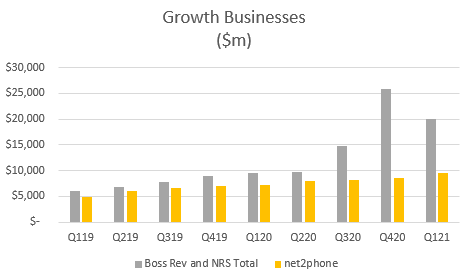
This time around we get three nascent businesses:

  • BOSS Revolution Money Transfer – an international money remittance/payment transfer
  • National Retailer Solutions – nationwide POS payment processing solution aimed at independent convenience store
  • net2phone – a UCaaS cloud communications solution aimed at LatAm

The BOSS Money Transfer and NRS businesses are both growing at 100% yoy. net2phone is growing at 40% yoy.

Both the money transfer and payment processing businesses have recently announced expansion plans. The next step for Boss Money Transfer is to become a neo-bank (in all probability the Jonas’s have noted that neo-banks (like chime) get ridiculous valuations and all they really do is collect interchange fees, which BOSS already does with transfers). IDT first mentioned this on the fiscal Q4 call two weeks ago:

we will roll out BOSS Money Visa card in peer-to-peer transfers early next year. This is the first step in a broader and strategic challenger bank initiative that we are now focusing on to help our immigrant, underbanked and unbanked customers conveniently access and participate fully in the digital economy.

With NRS, the expansion will be to a broader range of locations. Right now NRS is focused on independent convenience stores, of which they are in 12,000 locations and increasing those deployments by 450-500 terminals per month. The expansion will target liquor stores, gas stations and fast-pay restaurants.

The NRS business is particularly interesting because companies in this space get eye-popping valuations. Consider Lightspeed POS. Lightspeed recently made two acquisitions: Upserve and ShopKeeep

Upserve is a POS platform for restaurants. Lightspeed bought it for $430 million, which is 10-11x trailing revenue.

The second was ShopKeep, a general small-business oriented POS. Lightspeed bought ShopKeep for $440 million. That works out to a multiple of about 9x trailing revenue.

NRS has trailing revenue of around $15 million. And like I said, it is growing at 100%.

Now NRS, like all things IDT, is not going to have a flashy, silicon valley start-up type of look or feel. That simply is not the way that IDT works. Check out the website of NRS. Now look at ShopKeep and Upserve. The latter two look slick and hip. The former looks like an infomercial.

But here’s the thing about IDT. That is just the way it is. You are always buying businesses that make you purse your mouth and squint your eyes. But these Jonas guys find a way to make money.

You can make a simple argument for IDT on valuation. The market cap of the stock is about $330 million. There is around $128 million of cash and securities on the balance sheet. So the EV is about $200 million.

In the last 4 quarters IDT generated $40 million of free cash ex-working capital. That puts you at a 5x FCF multiple.

All of that free cash flow is coming from the boring legacy business. Each of the incubated businesses are losing money right now. But they are also all growing with leaps and bounds.

The NRS business could be worth a significant part of IDT’s capitalization already. 10x revenue on $15 million puts you almost there. Even at 5x you are half the EV.

The Boss Money Transfer business, which has done $55 million in revenue the past 4 quarters, could get a 1-2x revenue multiple just on a comp with MGI, or it could be much higher if IDT is successful in their bid to turn it into the next neo-bank.

net2phone has $34 million in trailing revenue and I don’t even know how to value that one. True UCaaS businesses get 5x revenue multiples and some much higher.

My bottom line is that I don’t know what all these parts are worth. But who cares? They are worth more than the current price of the stock. And you are betting on the jockey here. If history is any guide, the Jonas team will find a way to realize that.
Innovate Solutions & Support – Another Dividend

ISSC had a curious press release after the market closed last night. The company announced a special dividend of 50c to common shareholders, payable December 21th.

What makes the announcement curious is that:

  1. The company just announced a special dividend of 65c 3 months ago.
  2. The company reported fiscal Q4 earnings literally hours before with nary a mention that such a dividend was coming

In fact, on the call, ISSC was asked about what they planned to do with the remaining cash on the balance sheet. After the first special dividend, the company had cash of $12.6 million, down from $22.4 million prior to that first dividend payout.

Roger Goldman:

My question, as it usually is, goes to the use of cash. We’ve got a company with no debt, with solid operating profit and, even after the dividend, a fair amount of cash on the books. Any thoughts of either an acquisition or a small regular cash dividend that I think would have a great impact on the stock price?

 Geoffrey S. M. Hedrick, Innovative Solutions and Support, Inc. – Founder, Chairman & CEO:

 It’s a good question. Some of that I can answer. Some of them, if you can…

Roger Goldman:

 No. I know you can’t. I know you can’t.

 Geoffrey S. M. Hedrick, Innovative Solutions and Support, Inc. – Founder, Chairman & CEO:

 But it’s a reasonable question. Absolutely. Look, we have — we know we generate a lot of cash. And our interest is we’re operating in a business not for us to look at cash that doesn’t generate any income at all. I mean I personally have cash accounts that they’re paying interest in pennies.

So we have no interest in doing that anymore. If we can reasonably invest it in other things, we’re doing some automation on the floor and CapEx kind of things.

 We are actually looking at dividends on a long-term basis because we believe that the business itself will generate cash on a regular basis, and that we believe that our stockholders could make good use of cash. So we’re very conscious of that. That’s what precipitated the $0.65. And yes, we continue to look at it, especially in light of what might be changes in taxation policy.

Does this sound like another special dividend was imminent?

ISSC put up a very good revenue number in the quarter. Revenue was $6.3 million, up from $4.8 million the year before.

The stock sold off during the day yesterday because the backlog was low. It ended the quarter at just about $3.6 million, whereas it was above $6 million the previous quarter.

Investors focused on that and fled the stock but they must have missed the call. Because on the call a number of very bullish comments were made.

The company said they expected a better than seasonal Q4 quarter, that they were seeing exponential growth from retrofits, that the retrofit business is ‘looking better every day’ and that they expect “that the growth is going to be exponential.”

They singled out Textron on the call.

We announced last quarter that Textron had awarded us an OEM production contract to supply our ThrustSense Autothrottle with LifeGuard protection on the new King Air 360 twin turboprop. In November, Textron celebrated delivery of its first Beechcraft King Air 360 turboprop aircraft.

 More recently, Textron announced that the ThrustSense Autothrottle is standard equipment on the new King Air 260. Delivery is scheduled to begin in the first half of 2021.

 We are pleased to be working with Textron and are grateful for the support through the certification and moved into production. They are a strong supporter of our technology. The IS&S autothrottle is the first among a list of 360 upgrades mentioned in their King Air 360 promotional material.

For those new to the story, these are my notes on what they have said on Textron and the retrofit opportunity in the past.

  • Textron retrofit business could be more than the OEM business – sounds like it should be – the 5,000 aircraft out there are all operating, they are significant investments, retrofit cost is small compared to the expensiveness of the airplane
  • Have not sold one retrofit yet and market opportunity is $250mm to $300mm

After announcing all this in the morning, apparently they got the board of directors together in the afternoon and decided to dish out 67% of their remaining cash to shareholders in a second dividend. Just cuz.

Like I said, curious.

On Not Writing and Prothena Corp

It is getting harder to find companies that I want to talk about. As I wrote on the weekend, I am content with the positions I have, but being enthusiastic about new ones is tougher.

Even some of the new positions I might take, I don’t really want to elaborate on. I have four positions in my portfolio right now where I can definitively say that the only reason I own them is because I think they are going up more. All four are crappy companies. Of them all, I have very little good to say. But largely because they are in the right sector at the right time (Bitcoin, SaaS, and clean energy), they are all going up and are some of my best performers. One is (ridiculously) the best performer in my portfolio this year. And the company is a mess.

I’m not going to write about these names because what would I say? I am not going to say I am excited about their prospects because their prospects are largely smoke and mirrors. I am not going to say that I like the growth runway because I don’t. In one case, a SPAC (of course), the growth run way to 2025 revenue is so ridiculous that I can’t imagine that they will even come within even half of that number. But the stock goes up.

These facts would make it depressing to write about them. Depressing because right now doing research on stocks is only peripherally related to success. While the stocks you spend hours of research on, and find to be attractive, are likely doing well, there are other stocks, one’s where even a cursory overview would find them to be garbage, that are probably doing better. That is depressing.

The reality is, the market is taking the dumbest, silliest ideas and bidding them up to even sillier heights and nothing that you can reason will change that. So you might as well own a few on speculation even if the business makes zero sense in the long run. But don’t write about them, because it will be embarrassing to look back in a year and see that you even mentioned the names.

So instead of talking about these depressing messes of success, I want to point out a stock that I found that has found very little success so far this year (until of course today – I swear that I started writing this post I had no idea that the company would release news this morning. Total coincidence. The number of times I look at a stock on the weekend and it has news within days is uncanny). But it does look attractive to me.

Prothena

First, what is going on today. Prothena announced results of their Ph1 follow-up for the molecule PRX004, which is targeting Amyloidosis. The reason the stock is up is because, while the trial was primarily looking at whether the drug was tolerated by patients, it also gave us an indication of efficacy.

Prothena said that “PRX004 showed favorable results as demonstrated by slowing of neuropathy progression for all 7 evaluable patients at 9 months, including improvement in neuropathy in 3 of the 7 patients, and improved cardiac systolic function for all 7 patients.”

The targets here are amyloidosis patients. These are patients who have heart problems. Those heart problems are caused by little deposits of mutated tissue called amyloids that are on their heart and eventually constrict it. PRX004 is expected to stop amyloids from forming (they come from the liver) and also remove the amyloids that have already formed in the heart.

These results that patients are seeing improved cardiac function and improved neuropathy suggests that the drug is doing what it is expected to do.

So its a positive result. And the stock is up a little on that. But it is a Ph1, so it is a long way from knowing anything for sure with PRX004. I would not buy the stock on this news. It will be forgotten soon I think.

At any rate, PRX004 is not the main event. The main event is two-fold. It is a very early stage Alzheimers pipeline and a later stage molecule called prazinezumab. First, the latter.

Prazinezumab is targeting Parkinson’s. This would be a huge market if successful. No therapies to slow progression. 7-10mm patients.

Prazinezumab works like a lot of drugs, binding to the bad molecule or protein before it can bind to something else:

  • Targets alpha-synuclein
  • Alpha-synuclein accumulates in cells in Parkinsons
  • Prasinezumab molecule binds to the extra-cellular (means the one’s just floating around) alpha-synuclein instead of letting the alpha-synuclein bind to new cells

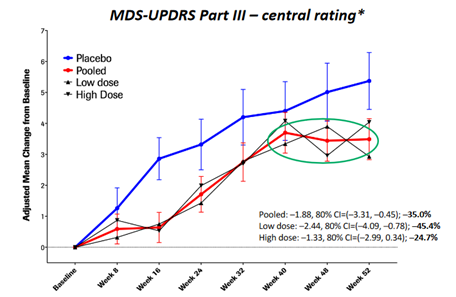
Prothena is collaborating with Roche here. It is a 30/70 split. They’ve done a Ph2a study and they showed some positive results though it did not meet the primary endpoint, which is what has held back the stock. However, the efficacy was there as they did meet secondary endpoints and, though I’m not an expert in this, it seems like the study was more geared toward compiling data on the secondary endpoints that were achieved, so they are now onto a Ph2b add on to that study.

The reason that they are doing a Ph2b instead of going to a Ph3 has to do with the symptom masking medications most Parkinson’s patients are on. In the Ph2a study, Prothena/Roche wanted to make sure they were comparing apples to placebos, so they limited enrollment to patients that were not taking any meds that would mask symptoms. Now that they have the data that shows that prazinezumab works versus a placebo, they are expanding enrollment to include this much larger (they said 4x the size) patient population.

So far the results look promising.

Prothena has interesting molecules targeting big markets and it has a lot of cash.

First is the cash on the balance sheet. The net cash position is $310 million right now. The market cap of the stock is $470 million.

Then there is a $60 million payment from Roche that will occur when the first patient is dosed with prazinezumab in the Ph2b. That is going to happen soon, so you can add that cash to the bank.

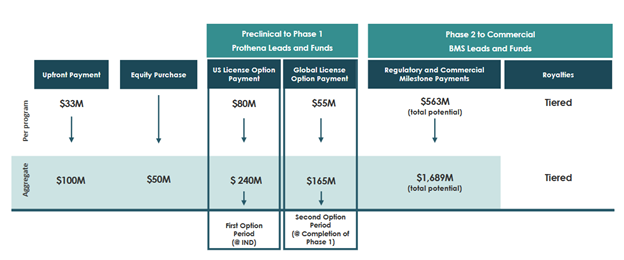
More cash could be coming in from their licensing agreement with Bristol-Myers-Squibb. For every new program that Prothena files an NDA for, BMS has the option to opt-in for $80 million.

Prothena is going to be filing an NDA in 2021 on a molecule called Tau that would qualify for this collaboration. Tau is targeting Alzheimers. We can’t say for sure whether BMS will opt in or not, but it is another potential event.

Also on the event front, there is a read-out from Biogen that is coming up on their Parkinson’s drug that could have an impact on the stock. Biogen is using a similar mechanism, targeting alpha-synuclein, but in a different way. Good results would probably boost PRTA, at least temporarily.

Biogen plays into this story in another way. Prothena has a couple of different Alzheimer candidates. The first is Tau, which I mentioned. The second is PRX012, which has similarities to another Biogen drug, aducanumab, which has had a roller-coaster ride. I’m not really sure if it is a good thing to have a molecule that investors relate to aducanumab, at least in the short run.

But Prothena was clear, even before the aducanumab/advisory committee findings (this is a very long story and just go google it if you want all the details), that their molecule was similar but different and that they expect different results. Here is how they put it in their 10-Q:

Prothena has developed anti-Aβ antibodies with greater potency that retain or improve on key attributes that are thought to underlie the observed efficacy of N-terminally directed therapeutics such as aducanumab, with the aim of offering similar or improved efficacy with sub-cutaneous dosing regimen. Prothena antibodies demonstrated a higher binding strength to amyloid than aducanumab; specifically, a 5- to 11-fold greater affinity/avidity for fibrillar Aβ than aducanumab while also neutralizing soluble, toxic (i.e., oligomeric) Aβ species. Prothena antibodies were also shown to recognize Aβ pathology to a greater extent than aducanumab, demonstrating more extensive plaque area binding at lower antibody concentrations, which are estimated to be clinically relevant exposures in the central nervous system following systemic dosing.

There is even a third, more secretive molecule targeting Alzheimer’s that is as of yet undisclosed.

With the Alzheimer angle, kind of like the Parkinson angle, this is more about just how small of a fish Prothena appears to be, even as it is playing in these very large oceans. I look at the company and the collaboration with Roche, the deal with BMS, the similar molecules to the one Biogen has and it makes me go hmmm.

Just think about it. Biogen stock moved a $100 when it looked like aducanumab might get approved. That is like $15 billion in market cap. On the other hand here we have Prothena, that has a similar molecule, that has another AD targeting molecule with an NDA that BMS may participate in, that has yet another molecule targeting AD that is still hush-hush, and the stock trades at barely $100 million net of cash. Then they also are going after Parkinsons, have just had some decent early results in amyloidosis, and have this early stage dev agreement with BMS that will pocket them $80 million every time BMS wants to participate.

All this for less than a $100 million? While my SPAC play with the stupid 2025 revenue number that has a zero (and I mean a Steve Eisman hand gesture with your thumb and index finger zero) probability of being hit, has an EV of $1 billion+ ? Like I said, hmmm.

Some General Thoughts and The Bancorp (TBBK)

One of the many lessons in Reminiscences of a Stock Operator is that when you are handed a bull market, the most important and hardest thing to do is just sit and be patient.

“It never was my thinking that made the big money for me. It always was my sitting. Got that? My sitting tight! It is no trick at all to be right on the market. You always find lots of early bulls in bull markets and early bears in bear markets. I’ve known many men who were right at exactly the right time, and began buying or selling stocks when prices were at the very level which should show the greatest profit. And their experience invariably matched mine–that is, they made no real money out of it. Men who can both be right and sit tight are uncommon.”

This is not an easy time to add to the stocks you own. It is likely not the right time to add too many new names to the list (which is why I have not posted too much the last few weeks). But at the same time, you have to be careful about saying that this is the time to get out, if your reason is simply because the market is going up.

I imagine that we have to be in some sort of bubble, at least in so far as many tech names. The numbers of the SaaS names are truly outlandish. And for a company like Zoom, with a vaccine on the horizon, I just cannot fathom how the comps will be favorable to their results come next fall and winter.

I did not take heed of the great Livermore’s advice in this case. I pared back many of my SaaS names even before news of the vaccine and let the rest of them go on the day or two after (With SharpSpring and Intellicheck, if that is really SaaS, being the exceptions). But I was wrong. Names like Atlassian, PagerDuty, and Slack, all names I owned in the summer and early fall, have powered far higher then where I sold. I was simply not patient enough.

If I am to be honest, also at play is that my style is just not well suited to these mid-to-large cap high-priced names. It is too easy to sell Atlassian or Slack at the drop of a hat and on the first hint of fear that the multiples will crash. I am simply a micro-to-nano-cap investor, and it is in that horribly frustrating and insensible space that I am at home.

Fortunately, we really are in a bull market for these names. I tweeted a week or so ago about the moves in some of the small-green stock names – ENG, OEG, IPWR, and BEEM (none of which I owned at the time but all of which I have owned at various times). Insane moves that really make little sense for companies that are of a questionable business model.

But even the good businesses – like the one’s I like to think I own – are doing well right now. It is a bull market. While the first lesson is to be patient, the second, I think, is not to fall prey to the belief that your particular stock picking abilities are anything special. You may feel quite smart because your names are all going up, but right now, all names are going up. What’s more, the names that are going up the most are the one’s that are probably not the best selections in more normal times. So don’t get a full head from it.

The only conclusion that can be drawn in this market is if your names aren’t going up, or if they are worse – going down, then you must conclude you are doing something wrong and it is time to regroup. But otherwise, I don’t think it is helpful to draw any other conclusion, other than that axiom – it’s a bull market.

With that said I did find another bank I like. Two actually – the other being Megalith, the soon to be spin-off of Customers which I dug into this week and decided I liked quite a bit, but I will talk about that one later. I will talk about The Bancorp now. I’m going to refer to them as TBBK, because the The Bancorp sounds weird to me, a little presumptuous.

TBBK is a little like Silvergate. A “little” I say – for unlike Silvergate I do not expect the stock to more than double in two months or triple in three. TBBK is not involved in blockchain or anything like that. But TBBK, like Silvergate, has developed a business line that is largely independent of their deposit base and their net interest margin. And this business is growing because of shifts in the financial landscape that seem likely to continue. Together this factors give TBBK, like Silvergate, the opportunity to grow far beyond their book value, if all goes well.

TBBK acts as the back-end, FDIC bank holding partner for the group of companies collectively being called the “challenger bank service companies”. These are names like chime, SoFi, venmo, even PayPal though they are so large it is hard to call them a challenger.

Some of these names are growing their business extremely quickly. chime quadrupled their customer base in 2019. They doubled it again in the first few months of 2020. I am not sure where chime’s customer base is now because chime, like most of these names, is private and so you only get snippits from articles.

Challenger banks like chime seem to resonate with the millennial. According to Forbes, 2/3 of chime’s customers are under-40.

But these bank challengers are not banks. Unless they get a bank charter of their own, they need a partner to take the deposits and get direct access to the payment system.

That is where TBBK steps in. TBBK operates two businesses that act as the back-end bank to the front end challenger.

Their payment solutions business issues prepaid cards and private label debit cards with TBBK as the sponsor. They offer these cards for chime, incomm, PayPal, SoFi, HealthEquity, SMI and others.

Their payment acceptance business processes payments and transfers. Major customers are PayPal, venmo, ACI, and Intuit.

From what I can tell, the revenue TBBK derives from these businesses is directly proportional to the transactions on the challenger bank platforms. As TBBK says in their 10-K:

The majority of fees we earn result from contractual fees paid by third-party sponsors, computed on a per transaction basis, and monthly service fees.

So as the challenger bank space grows, so will the fees earned by TBBK.

One question that comes up is will chime and others just go ahead and get a bank charter of their own? I can’t be sure, but I don’t think so.

If you listen to what chime says, they are clearly trying to differentiate themselves as not being a bank. This is because they do not want a bank multiple, they want a fintech/SaaS multiple. Getting a bank charter would not help them in this regard.

What is funny to me, is that from what I can tell these bank challengers are generating revenue in much the same way as banks always did. chime, for example, seems to get nearly all their revenue from interchange fees, the fee paid when a transaction is performed. These are the same fees TBBK is getting, they probably just split them with TBBK. But chime, when it goes public, will get an outlandish multiple for that fee income, while TBBK barely trades over book (it is about 1.3x right now).

TBBK is estimating next years earnings at $1.70 per share. The stock is $13. That does not seem right to me.

Admittedly, the bank does not have a perfect history. There have been some bad loans. Until it was lifted just a month ago, TBBK was under a consent order from the FDIC for unsafe banking practices, which goes all the way back to 2012.

Nevertheless, I think the stock is more likely to go up than down, particularly given all my previously mentioned vaccine tailwinds on top of this undemanding valuation. And, its a bull market of course. I do have notes on the stock and will add them to this post in a bit.