Skip to content

Posts from the ‘Uncategorized’ Category

Is the Hard Thing the Right Thing?

The reason for the title is that I found it very hard to write this update. Not because I don’t know what to say. I know exactly what I am thinking. But because it is one of those times where I am very conscious that I am not inline with what I’m hearing from most and so very conscious that I am wrong.

Through this whole downturn in the stock market I have been cautious and hedged. Apart from some individual stock episodes (I’m looking at you Caribou Biosciences), I have mostly avoided having my portfolio whacked by this bear.

But with the market now in the 3,600’s, I’m finding it hard to be as bearish as I was at the beginning of the year.

This week I took off a lot of my hedges. I’m less hedged right now than I’ve been in quite some time. It is difficult to write that.

I’ve done it with an extreme skittishness that illustrates how nervous this market is making me and everyone else. I take some off, I get nervous about doing so, I sell some longs to reduce exposure overall and make the nerves subside, then that doesn’t feel right so I buy some of the longs back.

It’s a messy process. It is like searching in the dark for a comfortable chair. I don’t know what it will feel like until I get there but when I sit down on a hard rock, I know it right away that isn’t it.

Thus my portfolio has had a lot of turnover in the last couple weeks. There are a few stocks where it is embarrassing how many times I’ve bought and sold them, as my inner struggle with what I really think waffles back and forth.

The worst has been PBF Energy. I bought it a few weeks ago and did very well. When it got close to $40 I knew it was way overbought and I sold. But then it started to come down and I was torn between A. thinking oil had to come down, B. oil not coming down, C. PBF being on a parabolic move up that usually doesn’t end well, D. PBF still being incredibly cheap if it can over earn on current refining margins for any decent length of time, E. wondering if the government is going to step in and screw the refiners, F. wondering if I should buy the dip now that the news is out that the government is going to screw the refiners and G. wondering if nothing PBF specific even mattered if the market was going to tank.

Its been a rollercoaster. I’ve bought and sold PBF Energy 6 times in the last week, which is ridiculous. It hasn’t been a good trade – with my indecision I’ve lost about half the gains I made on my original purchase. But I don’t own PBF any more. I think I’m done with it now.

In fact, the reason I’m finally okay with being done with PBF is the same reason I’m feeling a little more positive. We saw oil crack on Friday. We saw rates crack on Friday. That is not necessarily a bad thing.

Of course, both could be spun negatively, and they are – ‘oh look, now oil and rates are saying a recession is coming’. Honestly, if the market wasn’t where it was, I’d probably be inclined to make the same take.

But it would not going to take much to flip the boat to a more positive narrative. Extreme pessimism breeds a new positive narrative.

There certainly is a lot of pessimism to go around.

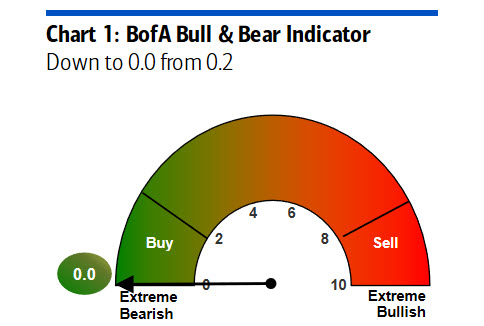
Bank of America’s Bull/Bear indicator has hit the ground:
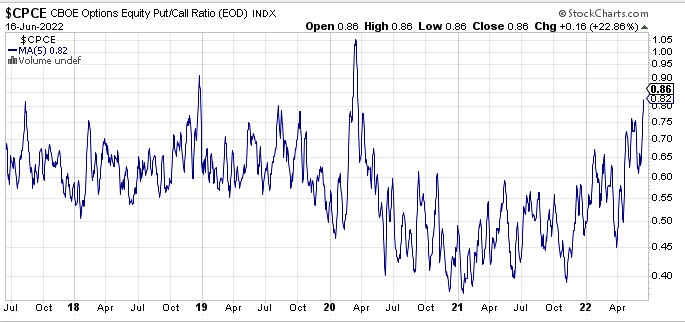
The equity Put/Call ratio is at a level we have only had twice.
The bears are loud on Twitter. Some of the bears I follow, many of whom have a tendency to not be right that often, are tweeting stuff about how they are as short as they can be.

Now I know, I know, the counterargument is that you always have extreme sentiment right before the crash.

But quite honestly, I’m kinda wondering if that isn’t what just happened.

I wrote back in May that my assumption is that this is a Triple Waterfall type bear market. And that this means it will take time.

To me, the important takeaway from this is that what we are experiencing now is not about some one day “crash” that flushes away excess, cures the system of its malaise, and allows us to buy TDOC, SE and PTON again with reckless abandon. If this is a Triple Waterfall, which I think it could very well be, we will not be let off so easy. This will be drawn out for a few years more (I don’t know if I agree with the decades he describes) until the last of hope of the past belief has been vanquished.

This is still what I’m thinking now. I don’t think we are going to have a big 1987 type crash but I also don’t think this is going to be over any time soon.

Absent a big crash though, everyone is so bearish and the market has already come down so much, it seems like a decent time for a counter trend rally.

I don’t believe this enough to be really long here. I am actually less long than usual. The difference is on the short side, where I have taken off a lot of my index shorts and reduced individual name shorts to the one’s that are really crappy.

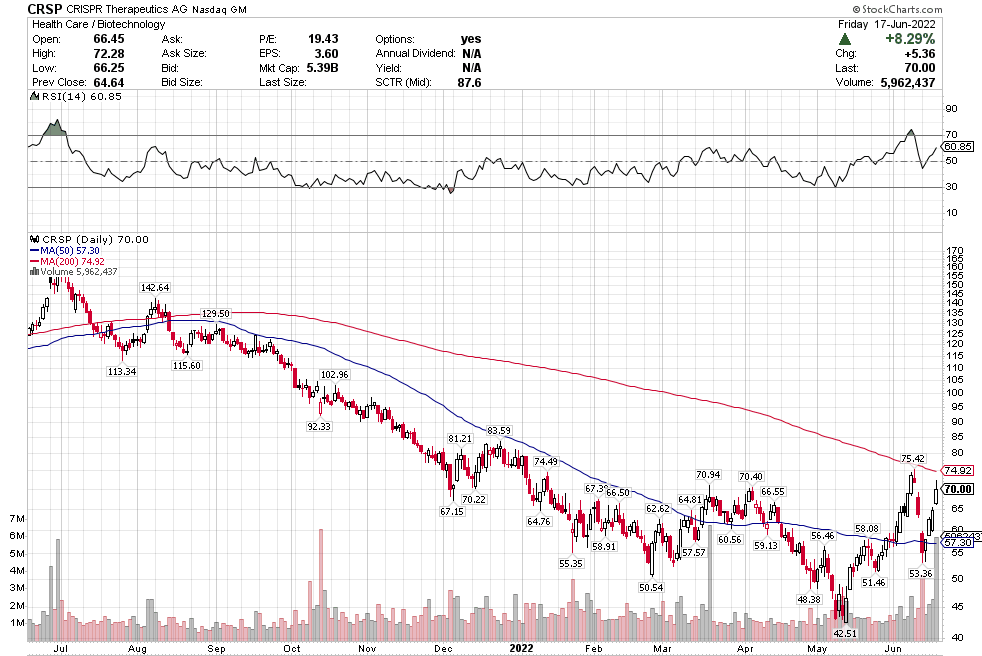
You have to remember, sentiment can change quickly. Just go back to that May post I linked to. My other main topic of conversation in that post was CRSP and how I couldn’t believe how cheap it had gotten, how negative everyone was on it, and yet it was well on its way to having its first approved drug in a few months.

Fast forward to and a month and a bit later and CRSP is 50% higher. Things change.

On the long-side, what did I do this week?

I bought back a bunch of my gold stocks. Speaking of negative sentiment, the gold miners bullish index is plumbing the depths again, which, if you can take the ridicule and a few more days of pain, is usually an indicator that miners are going to go up again.
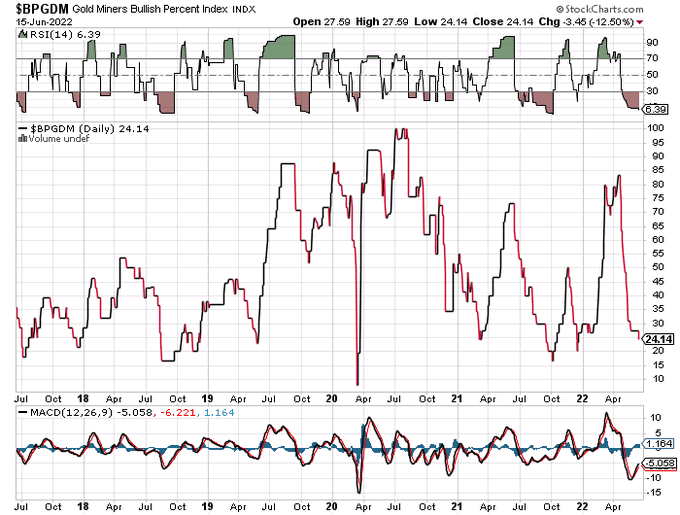
I also held tight my biotechs. I am very, very cautiously optimistic that they are bottoming. CRSP is the leader here and you’d never know how bad this week was if you just looked at its chart:
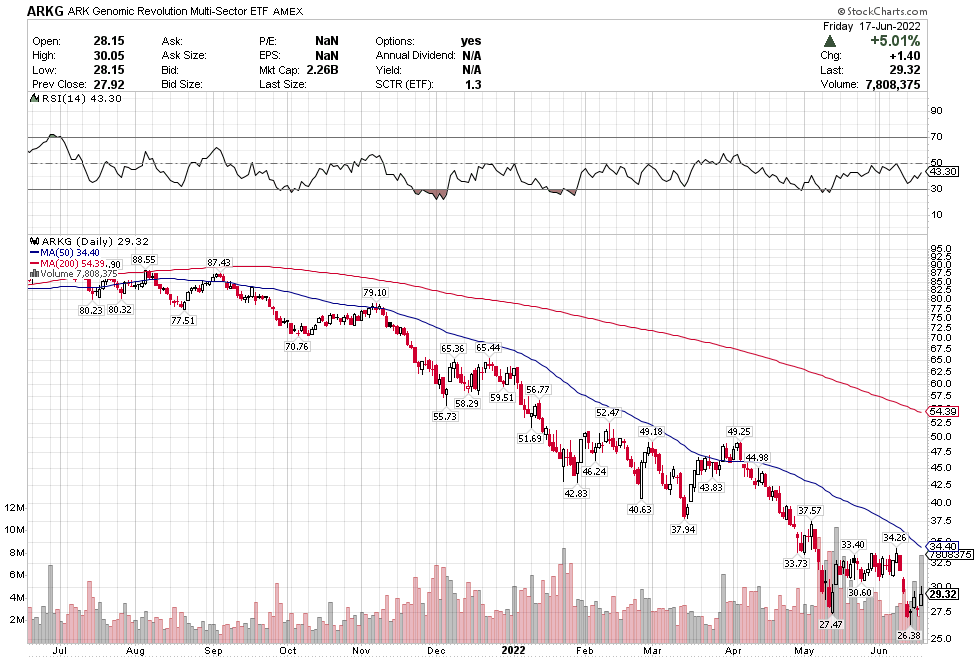
Even ARK Genomics fund held its own during the last 4 days of the week amid the market carnage, including a big volume day Friday.
As for me, I have taken it on the chin in a few names.

I had a big miss with Caribou, which I should probably write about because I made a stupid mistake there. I knew the Caribou data was not going to be great. Everyone knew it. Yet I kind of just forgot to sell the stock. It was a total oversight and a costly one.

And Eiger has not panned out so far. I’m sticking with it. The stock is down because at the Jefferies conference they said they would not be submitting their EUA to the FDA for Lambda until after June 30th. This after they had said they would submit it by June 30th previously.

This isn’t great and the market reacted as such. You could read into it negatively if you’d like. I’m still optimistic though, because:

A. The same day that they announced the delay, Eiger announced a new credit facility to replace the old one and on better terms. Plus the lender took $5 million of stock at $6.60, or above the price at the time. This lender is almost assuredly aware of all the details of what is going on with the FDA and the EUA, so why lend this money out and take equity if it was bad news?

B. This whole EUA process is a bit suspect. If you listen carefully to what was said at the Jefferies conference, Eiger said they were submitting data the FDA had requested, including analysis of how Lambda performed with each variant of COVID. Wait, what? The EUA is the data submission. You didn’t hear about VERU (another COVID treatment play which I don’t really think much of) submitting data ahead of their EUA or having the FDA request data (and believe me, with those guys you would). But here we have EIGR is submitting data in advance of the EUA? And the FDA is requesting that data in advance of the EUA? What is really going on here?

C. That variant analysis was illuminating. It shows that Lambda worked way better with Omicron than it did with Delta or Gamma.
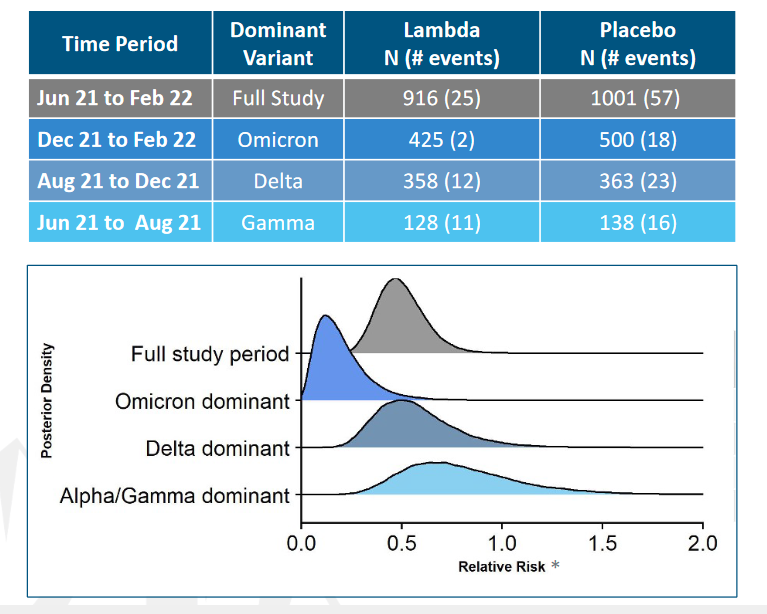
This is interesting because with just about every other treatment it has been the opposite. Omicron is escaping what worked previously. It also starts to make sense why the one earlier trial of Lambda, back in 2020, had kind of lackluster results. But with Omicron, Lambda appears to be extremely helpful

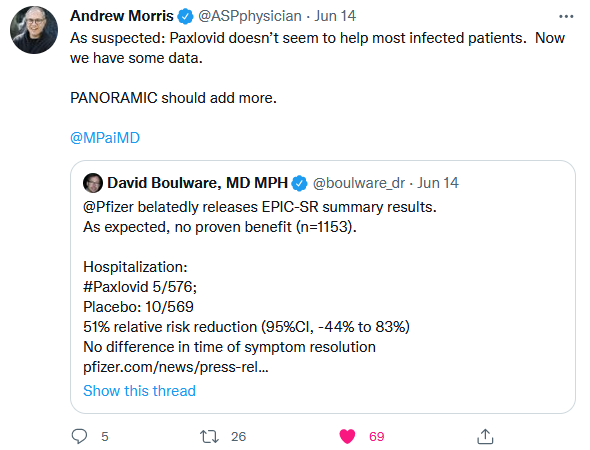
D. We had evidence out that paxlovid isn’t all its cracked up to be. Pfizer had data from their second study out, the one where they had mysteriously removed vaccinated patients half way through. Well, we know why.
E. Covid is over and not over. Yes, it seems past for most of us. We are getting on with regular life. But a couple things here. First, if you follow epidemiologists closely, they are a little worried how COVID keeps evolving. There was a paper out just this week about how the virus is sitting in people with long-COVID for 12 months or more, and all that time it is adapting. Another recent paper is suggesting that the most recent Omicron variant has figured out how to be more virulent against people that were infected with the first COVID variants – its kind of like having inverse immunity. There is all kinds of stuff going on under the surface. Hopefully none of it amounts to anything. But as a government, I think you’d still be crazy to not try to be prepared for it, have a war chest of therapeutics at the ready, just in case one of these new mutations goes off the tracks. Lambda really looks well positioned to fit into that box.
What’s not Working

Those of you that have read this blog for a while will know that my posts mostly focus on the stocks that aren’t working.

If a stock is working, I rarely write about it. If a stock works off the get-go, I may not even mention it all.

Why is that?

It’s no fun writing about what’s going up. This is a private blog with a handful of readers so its not like I’m getting some sort of chest beating bravado by talking about a winner. I’m certainly not trying to procure subscribers. When I reread something I wrote about something that has gone up, I usually cringe.

It is far more interesting to talk about what isn’t working. And that is, in fact, where I spend my time.

Again, if a stock is working I may not re-visit it for months. This is sometimes to my detriment as I have found that I can lose the thesis: in other words something changes even though the price doesn’t and I don’t realize it until its too late.

But there is only so much time in the day and it is better to spend it on what worries you the most.

What has worried me for the past couple months is biotech in general. But now that is right-siding for the most part. My worry now has become more dialed in. To a specific biotech. Eiger.

I already went through the story of what is going on with EIGR a few posts ago. I’m not going to rehash that.

But we are in June now, 3 weeks from July, and there is still no EUA and no real update for that matter.

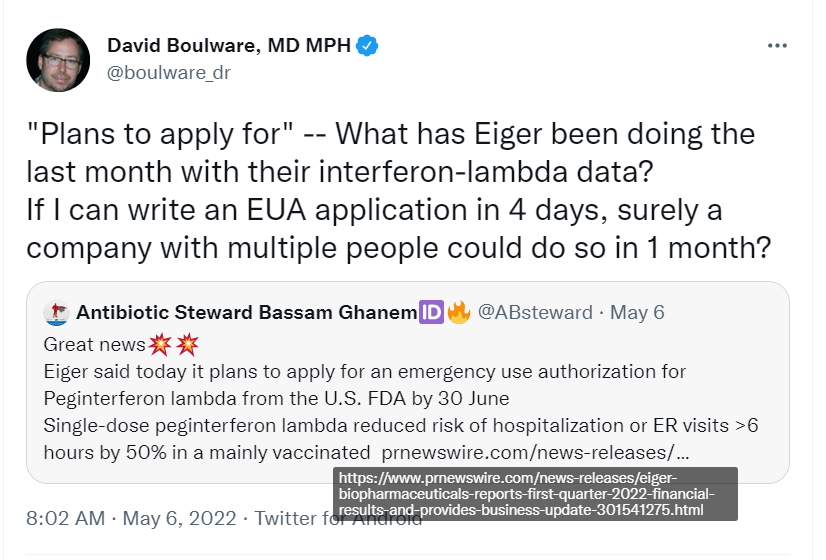
A friend asked me whether I was concerned. In particular he asked me about this tweet:

Here was my response.

Yeah it is related to what I was saying.  But its more nuanced than his tweet. I had to talk to some folks to understand this, but I think I have it straight now:

So EIGR owns peg-interferon lambda.  It is not an approved product.  If you want to do a trial using an unapproved product, like peg-interferon lambda, you have to get EIGR’s permission.  This is different than if a drug is already approved for an indication.  If it is approved, then you can just buy it and use it in the trial – the company doesn’t have a say.

In this case for whatever reason the TOGETHER doctors went to EIGR and asked for permission.  EIGR said okay.  Some agreement was reached.

But this isn’t EIGR’s trial.  They don’t have anything to do with the trial itself, the data collection or the primary data analysis.  They aren’t a sponsor.  That is all on the TOGETHER doctors.

Yet while the TOGETHER doctors are responsible, at some point there is a data transfer to EIGR.  We know this because on the Q1 CC EIGR said they would be the ones publishing a manuscript and they would be the one’s publishing the data.  They are also the one’s doing the secondary analysis, so the more detailed breakdowns and such.

Unidentified Participant [6]

 So also, I have one — just a clarify question to do the — this TOGETHER data will need to be published? Or do you need to just complete the analysis to submit to the Agency?

 David Cory, Eiger BioPharmaceuticals, Inc. – President & CEO [7]

 Ingrid?

 Ingrid Choong, Eiger BioPharmaceuticals, Inc. – SVP, Clinical Development [8]

 Thanks. Yes. So our plan is to complete the secondary analysis and submit all of it in totality to the FDA. Concurrent with that, we will submit a manuscript that will include all of the data as well.

When Boulware talks about how slow EIGR is, I don’t think he is understanding the above situation.  One day before that tweet EIGR had their Q1 CC.  On that CC EIGR said they were still waiting for the full dataset from the Together doctors.  In fact, there is a tweet in that same thread below from one of the doctors confirming they have not finished the data set yet.

Its actually kind of interesting IMO since I love to think there are conspiracies.  A bunch of guys on stocktwits are screaming that EIGR is too slow. Yes, its true, EIGR is slow in general.  But in this case we don’t actually know. We don’t know when they got the data or for that matter even if they have the data right now (hopefully they have it by now though).   I’m more than a little skeptical of some of the motives of these folks that are using this as a tool to bash EIGR management. But I’m always skeptical.

I was worried about how long the process was taking as well, but from another angle.  I was worried the doctors hadn’t published anything yet.

I’m not as worried now.  My misunderstanding was thinking that the TOGETHER doctors could publish something before the EUA came out.  I had looked at the fluvoxamine arm of the TOGETHER trial and saw that it was about 2 months from last data collection to paper.  We are way past that with lambda – its probably at 90 days or so.  That had me worried.

But I’m not worried as much now because I think when EIGR signed an agreement with the TOGETHER doctors, they had the doctors agree to hand-off the process to EIGR at some point.  So we won’t see anything come out until EIGR comes out with their EUA.

The real gotcha here IMO is the incentive misalignment.  Think about it from the TOGETHER doctor side.   They had to do this trial, compile the data, do all the primary analysis, but now they have to hand it off to someone else to do the fun stuff, write the paper, take the credit.  I’m sure they’ll get their names on it but they aren’t in control of the process.

I suspect that is contributing to the time its taking.  Its probably lower on their priority list than it was for fluvoxamine, where they got to write the paper, make the conclusions, present it at conferences.

I think my takeaway is that yes, its taking longer than I would have expected. And that may be saying something but it may not. Bottomline is that EIGR said end of June for a reason, and until it gets passed that date you have to assume its inline with their expectations.

There are other things to worry about with EIGR and COVID as well. One is whether the FDA is going to approve this. I’ve been talking with another Twitter contributor that has recently taken an interest in EIGR. His big worry is that the FDA won’t approve this regardless, because they will protect Pfizer profits.

I’m not sure what to say about this. There are certainly a number of biotech investors that think Novovax got hosed for this reason. That there are now myocarditis issues with the Novovax vaccine that the FDA just leaked are laughable to many given that the FDA approved Moderna, which had similar issues.

I spent some time looking at the Novovax data and I can see both sides. That is to say: I’m not convinced that the FDA isn’t in the pockets of Pfizer, and if that is the case it certainly could work against Eiger. Its a risk I think.

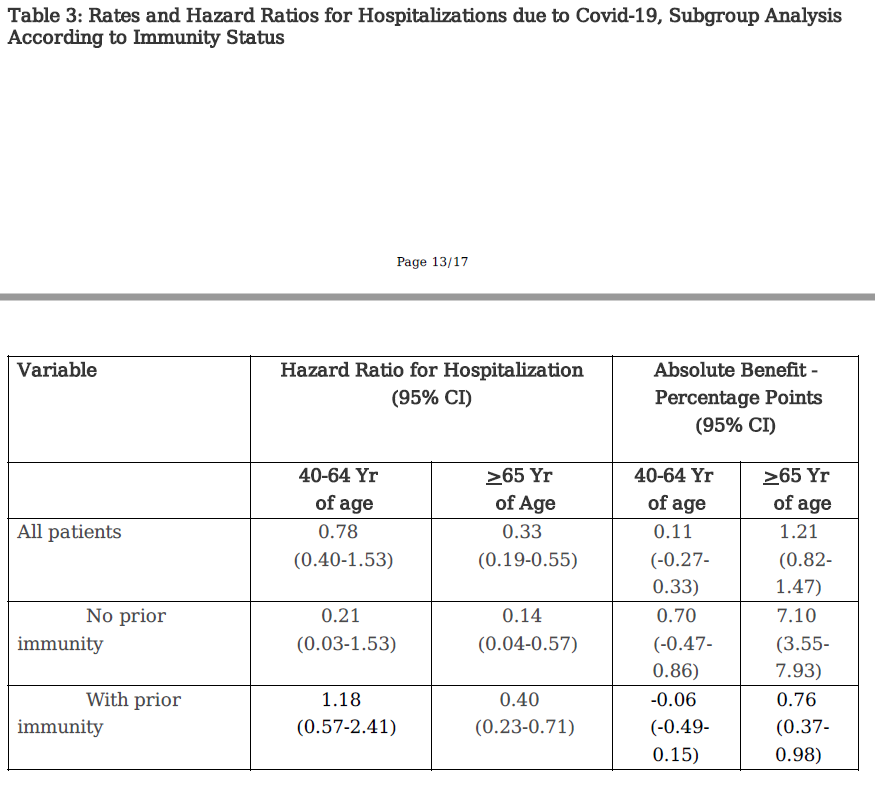
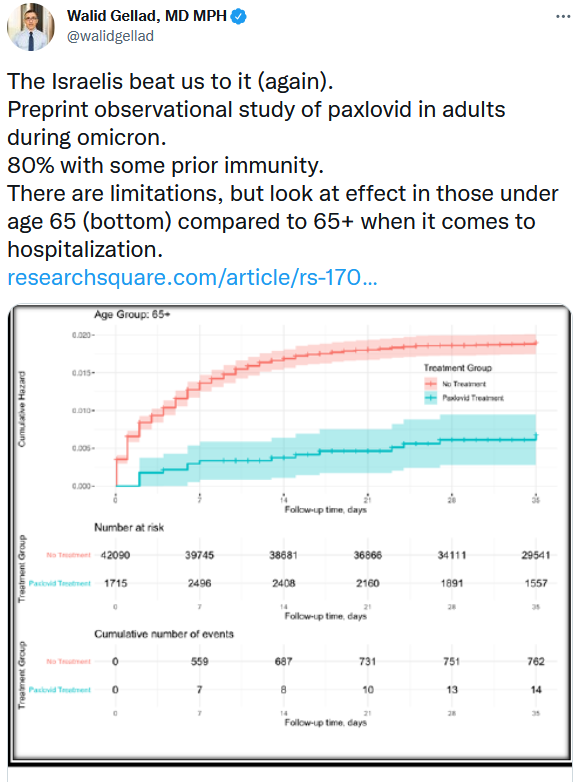
There is also the matter of a recent study from Israel which does show efficacy of Pfizers paxlovid in a largely vaccinated population:

Once you delve in to the study, it is kind of a good/bad story with a whole bunch of uncertainty. It does show very good efficacy against hospitalizations in 65+ (about the same as Lambda did overall in TOGETHER) but it doesn’t show any efficacy in younger people. That is interesting because in the US right now, as it was described by one biotech commentator, they are giving paxlovid out like candy.

Even the 65+ cohort, results are a bit less positive if you dig deeper in the study (or the twitter thread!). In particular when you separate those that have been exposed versus those that have not.

You can see that even in the 65+ population, there is a big difference between the benefit of paxlovid in the prior immunity vs no prior immunity groups. If I understand absolute benefit correctly (and I might not) it is saying that for every 100 people that take paxlovid, you get 0.7 less hospitalizations from the prior immunity cohort, which doesn’t seem like that much benefit to me.

Absolute benefit also has issues. There are lots of papers that talk about them. Not the least of which is that it really depends on the baseline. And the Israeli trial is tricky there too. The cohort not taking paxlovid is massive – 42,000 people. The cohort taking paxlovid is much smaller – 2,504 people. Is this apples to apples?

Anyway I could go on and on. There is other things too but I’m not sure enough about them to write them up. Bottom-line, I don’t think this study is a negative for EIGR.

What is going to really matter for EIGR is how the lambda detailed data plays out. We know that the TOGETHER trial study showed lambda 3-day data is comparable to what we are seeing from paxlovid here and that included everyone, over 65, under 65, prior immunity or not. What we don’t know yet is how all that data breaks down on the lambda side. Is it just way better in the 65+ without prior exposure group like paxlovid? Or is its benefit more general? And what is the population comparison? Are these unhealthier people, or more healthy? We just don’t know any of that yet.

So where do I stand after considering all these (and some other) issues? Probably about the same place I did a month ago. I don’t see any evidence that the FDA will rescind the EUA process any time soon. There is too much worry about a fall wave with a new variant. I’m a little worried about the motives of FDA but not enough to sell. I’m not too worried about the Paxlovid competition – it isn’t really any better and it has lots of other issues, like the rebound effect that has been reported and all the drug interactions that make it hard to take for some people, but I’m also aware that until we have detailed data from lambda, we just don’t know enough to compare.

Lambda’s big positive is that it is a molecule that is in our body right now, and is used by our immune system to protect it against viruses coming in. In fact in people that don’t get COVID that bad, its probably lambda that contributes to that. It has been tested extensively already – its not an unknown like other drugs with worries about poorly understood side-effects.

Meawhile EIGR stock has been on a roller coaster. There isn’t a lot of volume but there are a bunch of big blocks that happen, which is unusual for EIGR and I don’t know what to make of it. Price wise it is back to pretty much where it was when I talked last time. $250 MC, $100 EV. It doesn’t take much in the way of lambda sales to generate that much cash.

But we’ll see. This is a gamble as are all biotechs. There are all kinds of possible unknown unknowns that could be gotcha’s. The downside is the EUA doesn’t happen, its probably a $3-4 stock again. I don’t think it goes any lower just because COVID is still a bit of a sideshow here to the HDV, which are going to report out in Q4. So I think if it sells off too much you will see new buyers that want a cheap ticket on those results. At any rate, it is sure to be an interesting summer.

Covering A Falling Knife

There is a constant battle in investing the way I like to invest. That is the battle between catching a falling knife and not being a hero.

I like to buy stocks that are down. It is my personality. I do not have the constitution of a “growth-bro” (the term used on Twitter for folks that like to buy high multiple stocks that are in long-term up-trends).

I can never bring myself to buy something that is up a lot. When I have, one of two things inevitably happens. I sell on the first move down or I sell on the first move up.

My propensity to buy on weakness makes this market to my liking, but also one that is very dangerous for me.

There is SO MUCH opportunity out there. So many stocks are suddenly trading at low and reasonable multiples (or in the case of biotech, trade at significant discounts to the revenue stream they can achieve if their drug is approved).

BUT – just because a stock is cheap, it is not in itself a reason to buy. How many times have I got myself in trouble because I bought something down a lot only to see it go down more?

Too many to count.

I have learned from my mistakes, and in most cases I quickly cut and run. Witness Finance of America – FOA – I bought it, I wrote it up here briefly why. I thought it had merit but I underestimated the impact of interest rates and when it fell another 15%, I cut it. It has fallen further.

But what we have now is a little trickier situation. Why? Because there is not a particularly good reason for some of these stocks to be trading as cheaply as they are. This makes it hard to A. not buy them, and B. sell them when they go down.

I am in that conundrum right now with about half a dozen Biotechs right now: ALDX, CRVS, CKPT, CRBU, CRSP and NTLA as I am with CUBI. I’m down on each of these between 10-20%. This would normally be my punt zone.

But I just can’t do it. In some cases, I’ve tried. I sold NTLA a couple times over the last two weeks only to feel compelled to buy it back.

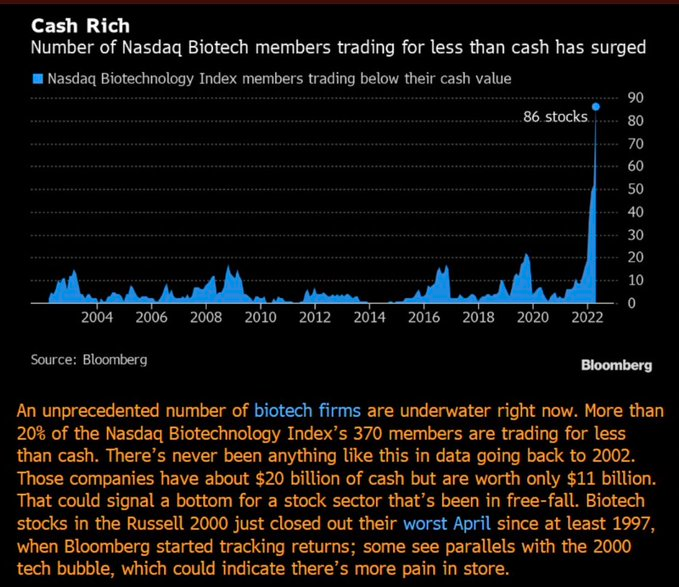
Sentiment in biotech is just so darn bad and (with the exception of ALDX) nothing in the clinical programs of these companies justifies the move down. By any historical measure we are off-the-charts (see below, and I believe the number trading below cash is actually well over 100 now):

In the case of CKPT, CRBU and (maybe) CRVS the stocks seem to have stopped going down and are now just bouncing around the bottom. Every instinct I have is screaming that this is close to some sort of bottom for the rest. I said two weeks ago how I have to think big Pharma begins to step in soon with acquisitions. This tweet put that into perspective I thought:

Keep in mind they are using market cap here. If you considered the cash in the SMID sector, it would be even more extreme.

This is where having the hedges via inverse indexes and individual shorts has been so helpful. In the margin portfolio where I can short, I’m down just a few percent off the high and that high was only a few weeks ago. I’m down somewhat more than that in the tracking portfolio because I don’t have individual shorts. But the lesson is that hedging helps: even though these biotech names have been painful, the loss has been largely compensated for by the gains on the shorts.

But this is a very tricky time right now. many of the individual short names I had got completely creamed last week. To the point where, just like how I am reluctant to sell the Biotech longs because of such poor sentiment, I was reluctant to hold the shorts any longer out of fear that this must mark the bottom.

As a consequence I covered most of my individual shorts towards the end of the week: AMZN, BIGC, BILL, BLDP, CDLX, CRSR, CVNA, CRM, DPZ, HD, HUBS, IPI, LVS, NVDA, OSPN, TEAM, UPST, VICR, W, XPEL. All gone.

I started covering Thursday and I finished Friday. I have almost no individual shorts now. The exceptions are AAPL – I’m still short AAPL, COOP, and a couple of Canadian banks. But that’s it.

I don’t think we are going to crash. Well… I should phrase that more specifically, because we kinda are crashing: I don’t think we are going to get the big one.

I still have the index shorts, just in case I’m wrong.

If I am wrong, I have to admit, I’m not sure that will be enough.

Which brings me to the crux of the issue. What am I going to do if I’m wrong and we just keep going down? For the first time in a while I am not as fully and completely hedged as I usually am. So if the market continues to go down, I’m probably going to lose some money. I already did lose money on Thursday and Friday.

I’ll have to admit defeat and reduce exposure of my lowest conviction positions. As much as I want to buy the value I see, I won’t accept too many losses. I’ll start by selling CRSP and NTLA, which are by far the biggest under-performers for me and quite honestly, just unhinged because of their wide inclusion in ARK funds and the momentum trade they are part of. I had stayed away from these two names for this reason up until recently and it is looking like I was wrong to think I could pick their bottom.

As much as all the reasons I gave a week ago to believe that CRSP and NTLA should bottom still hold true, and as hard as is it for me to believe that CRSP could trade much lower given its cash position relative to its burn rate, the status of their lead drug (which we saw from an update from Vertex on Friday is still looking very positive), and the platform of potentially revolutionary cures they can create over the next decade or two, I still can’t have too much hubris.

I am aware that any long dated cash flow stream is being discounted severely right now, so who am I to say what the right number o that present value is? If their CTX-001 program continues as it has, the company will almost assuredly be a $1+ billion revenue company in a few years. However, that likely won’t be immediate. Maybe 4 years when I look at analyst forecasts. It will take that long to ramp up even if Vertex applies for approval late this year as they reiterated they would Friday. So while it is very easy to see CRSP as a $2-$3 billion revenue company (if not more) in, say, 7 years (Credit Suisse has them at $1.3b in 2027, $2b in 2028), that is a long way off and the market does not like things a long way off right now. It is still easier for me to hold a cheaper Biotech trading below cash than it is one trading well above cash, especially given the ARK dynamic.

I will also likely put back on more index shorts in place of the individual names, as reluctant as I might be to do so. I’m not re-shorting the names I covered. Most have been destroyed and it just doesn’t seem prudent to press.

As for CUBI, I don’t think I will sell it. I actually added to it, and added three other banks late this week: First Mid Bancshares, BCB Bancorp (which I owned recently) and The Bancorp (TBBK). The banks are (believe it or not) behaving pretty well these last couple days – especially the large ones – which makes me want to give the names I own a little rope.

The other stocks in small amounts I added to were BIOX and EIGR.

Eiger had their 1st quarter conference call on Thursday night. I was pleasantly surprised with how positive they were about the potential for an EUA for their COVID anti-viral, peg-interferon lambda.

Concurrent with our top line data announcement in March, we submitted a pre-EUA request to FDA, our first opportunity to socialize the study and top line data with the Agency. We have continued to engage positively and are preparing to submit our complete EUA application this quarter. TOGETHER is a large study of almost 2,000 patients, which provides many opportunities for sub-analysis of the patient population. The TOGETHER study team is completing a comprehensive analysis of the full data set, which will include sub-analyses for variants and vaccination status.

If you go on Twitter there are a chorus of Doctors now championing lambda for COVID. The data suggests that this is the best anti-viral out there, better than Paxaloid. Some are even getting ansy that the EUA has not been filed yet.

But this isn’t the fault of Eiger. This was not Eiger’s trial. It was run independently, by a team of physicians, and Eiger is waiting on them to get the data it needs to file the EUA.

Eiger said they will have the EUA filed by the end of Q2. On the call they made it sound like they are basically ready to file as soon as they get the full data set from the TOGETHER team. And based on this tweet from a TOGETHER Trial doctor, it looks like they are just finishing up (see Dr. Brad Wouters Tweet below):

It is worth noting that Eiger was up Friday, recovering all its losses and then some while the rest of Biotech swooned. If the EUA approves, Eiger is on the ready:

In terms of commercial readiness, we have large quantities to support the introduction of Lambda should the FDA grant emergency use authorization, and we are actively planning for expanded production capacity.

I think this is a very good risk/reward right now (Note: I had used best before and I wrote that off the cuff, like a lot of my posts, and I shouldn’t have used such a definitive term. It could be very good if I am right and it may not if I am wrong). If you can stomach a biotech.

Triple Waterfalls Take Time

I managed to avoid the carnage of the market this week, ending up flat in my long only account and actually up some in my margin account, where I can short and short I do.

Decision-wise, it has been a mixed bag. The worst decision I’ve made over the last few weeks has been to expand my Biotech universe to companies not trading at cash – specifically CRSP and NTLA.

My Biotech positions ex-CRSP and NTLA (and ALDX on Friday – sigh) have held up remarkably well, I suspect because most are underpinned by a whole lot of cash. Even though the XBI index goes down every day (EVERY DAY!), most of these stocks only do so reluctantly, are actually bouncing around the bottom more than anything else, and some are even going up.

But these two stocks, CRSP and NTLA, have not worked and do not act well. I am down ~10-15% on both. What to do, what to do.

The reasons I am reluctant to cut a stock like CRSP or NTLA and take the quick loss are as follows.

First, I think it is quite likely that these stocks are being beaten down primarily because it is in just about every Cathie Wood ARK fund in existence.

This is a good reason for a stock to be down but a less-good reason for it to stay down. Cathie Wood’s ARK funds are down because she picked overvalued stocks and stocks that have a business that is not performing well in this re-opening/inflationary environment. She invested in a new paradigm that is now under question. But that does not mean that every stock that ARK owns must necessarily be a basket case. Just that they all trade like one now.

The malign-ment of ARK on Twitter is reaching a fevered pitch. Sentiment against ARK seems rather extreme to me. They are being maligned by folks that, in my opinion, should be maligned themselves. CRSP and NTLA to me are, as much as anything, contrary bets that this has gone to far for now and we are due for a reversion to the mean.

Second. CRSP, to take as an example, is not all that expensive IMO. In some ways it looks quite cheap. It was expensive last year at this time, when the stock was 4x higher, no question about that. But at $50 CRSP has an market cap of $3.8 billion. They have cash of almost $2.5 billion, which means the EV is only a little under $1.4 billion.

Last year Vertex bought 10% of CRISPR’s SCD cure for $900 million + an extra $200 million to be paid in the future at approval. So…. a year ago Vertex said that 10% of one drug that CRSP now owns 40% of was worth $1.1 billion to them. Forget the rest of CRSP’s pipeline and platform.

Vertex just so happens to be trading near 52-week highs. While CRSP’s currency is depressed, Vertex’s is not.

There are folks on Twitter now saying CRSP is going to $30. Do they realize that CRSP would have a negative EV at $30? Because of the cash position, another $10 move down in CRSP from here would put the EV of roughly ~$600 million, or more than 50% less than VRTX paid for 10% of one of their drugs last year.

It is easy to say it is a new paradigm for stocks, that valuations were silly and that time is over. It is all true. It is why I have been short the momo-trade for months, when it was not nearly so fashionable. I am far from a growth-bro. But if you think CRSP is worth today’s price, then you should short VRTX, because their stock is at its highs and they are clearly run by idiots for paying what they did – and this for a drug they KNEW VERY WELL because they already owned the other 50% of it.

I don’t think that’s the case.

It is not just Vertex that among big-pharma holds highly valued currency. In fact, the same could be said for much of big-pharma. Merck is at its highs. Bristol Myers close to its highs. Eli Lilly is close to its highs. Abbvie was at its highs until they made a bad announcement last week. Even smaller big-pharma wanna-be’s like Neurocrine are not breaking down like the market as a whole.

Does that not seem like a ripe environment for takeovers?

There is some patent stuff going on between CRSP, NTLA and other gene editing companies that hasn’t been super-favorable to the two I own, but no one I’ve read seems to think this is a problem. It will get sorted out with new agreements and licenses.

Really, the only way I could see CRSP or NTLA having their value permanently impaired from this level is if news came out from one of them or some other CRISPR editing company that off-target editing has resulted in a really bad outcome for a patient.

That is a legitimate risk with these companies. But it has been a known legitimate risk for like the last 5 years. It is not new. Youse take yours chances…

So that is enough about CRSP and NTLA, which is a bit more expensive but a better pipeline and probably better opportunity to the upside.

On to some things that have gone right. What I have done right over the last few weeks has been to:

  1. Keep my shorts on
  2. Keep BIOX even when I sold most of the rest of my commodity stocks
  3. Don’t buy anything outside of these Biotech names
  4. Keep my shorts on

This market is a gong show but it kinda seems like we are getting to the crux of the issue now and 1 of 2 things is going to happen shortly. We are either going to have a crash or we are not.

When sentiment gets really bad, it seems to most often portend to a rally or, and this is kind of the black swan option, if it doesn’t rally things get much, much worse. When things get worse then bad, that’s when you have a crash.

I don’t think it ever really makes sense to “bet” on the latter because crashes very rarely happen. We had it during COVID. We had a bit of one in December 2018. We had bigger versions if you go back further.

But I’m not really convinced we are going to get one here. It would be too easy of a way out. I would say those hoping for a crash are just evidence that there is much more work to be done.

This is really more like the internet bubble of 2000-2002, which was targeted and specific and drawn-out but without a sort of big capitulation-like event that you see in a crisis-sort-of-general-bear market. The internet bear market was more of a rolling bear market, with troughs of massive negative sentiment, bear market rallies, and then another leg down. We could be on our way through the next leg down, but that is different than a crash.

I always come back to Donald Coxe and his book “The New Reality of Wall Street”. In his first chapter, The Taxonomy of the Bear, he described the different type of bear markets. It is important to distinguish because as he says, just as “it can be a matter of life and death for hikers to know which species of bear territory they are invading. Similarly, investors should learn to distinguish the kinds of bear attacks the market faces”.

He outlines 5 bears: the Teddy, the Baby, the Papa, and the Mama. The Mama is broken up into two types – the mini-Mama and the Big Mamas.

I suspect, or am at least willing to use as a working thesis, that what we are in now is a mini-Mama. The mini-Mama “only appears at the advent of Triple Waterfall crashes”. The Triple Waterfall is what Coxe’s book is about, as it was written at the time of the internet-bubble collapse.

I’ve used that term a number of times in the blog and this is where it comes from.

The Triple Waterfall is the “avenging bear who keep killing and devouring until an entire belief system has been destroyed”. That sounds a lot like what has been happening for the last year.

But most importantly I think is what Coxe notes about the nature of the Triple Waterfall: “Triple Waterfalls aren’t mere bubbles. They are financial pandemics that take not months, not years, but decades to run their course.”

To me, the important takeaway from this is that what we are experiencing now is not about some one day “crash” that flushes away excess, cures the system of its malaise, and allows us to buy TDOC, SE and PTON again with reckless abandon. If this is a Triple Waterfall, which I think it could very well be, we will not be let off so easy. This will be drawn out for a few years more (I don’t know if I agree with the decades he describes) until the last of hope of the past belief has been vanquished.

But you never know. So I’ll stay in the cautious camp, my two CRISPR bets notwithstanding.

A few tidbits from other stocks I own.

Vidler – they released their acquisition documents this week and, quite honestly, I am somewhat less inclined to believe we get a better offer now. They really did do a lot of DD and they only received one offer that was for the whole company. However, there were other interested parties, which gives a glimmer of hope. The other glimmer of hope is that the water crisis at Mead and Powell is getting more and more attention. It is too bad that the deal closes in May, I think the news cycle on the drought could reach a fevered pitch this summer as the levels in these lakes continue to decline. Oh well, I bought some PCYO, which owns water rights in Denver, as an alternative. Its not quite the idea VWTR was, but it could benefit from that news ramp.

Eiger – There was some news from Eiger of a successful trial with their drug avexitide for protein-induced hypoglycemia in patients with congenital hyperinsulinism. But the bigger news for me comes from the DEF 14A form they released, where it looks like they completed their $50 million ATM already. They managed to sell 6-7 million shares into the market, in a TERRIBLE Biotech bear market, and now the stock is surprisingly resilient as the XBI index continues to fade.

Makes you go hmmm – as does the announcement this weekend that Pfizer’s Paxlovid is resulting in delayed infection from those that take it AND the news Pfizer snuck out last week that their new trial of Paxlovid in Omicron would now remove all vaccinated patients from target group (Eiger’s trial was primarily on vaccinated patients). Kinda sounds like we need another anti-viral.

While I know COVID is over for many, I also suspect that governments around the world will want to stockpile COVID treatments, especially those targeting the most at risk, just in case we see a more dangerous variant arise, especially if that treatment is variant-agnostic (Peginterferon lambda is) and is simple (Peginterferon lambda is a single shot that can be given as much as 7 days after infection).

And with Eiger, with its modest EV of under $150 million, it wouldn’t take much stockpiling at $1,000 per dose to basically surpass the market cap on this indication alone.

All this without even mentioning Eiger’s main event, HepD.

Bioceres – Bioceres got approval of HB4 soy from China, which is a genetically modified drought tolerant soy bean. Now China will be allowed to buy soybeans grown from this HB4 seed. This is pretty important because HB4 soy is already approved in the growing regions of Brazil and Argentina (the US too) but those regions sell so much into China that they can’t grow HB4 without China approval. Now they can.

Soy revenue has been pegged at $82/ha. So that’s a cool $1.5 -$2 billion TAM to target.

I think Bioceres is overlooked because its in Argentina, has a complicated share structure, has a fair bit of debt and doesn’t really have any comps. There is no legit brokerage coverage. But the more I look at the company, the more it looks to me like a legit agri-tech firm. That is even more the case with the acquisition of Marrone-Bio.