Skip to content

Week 55: Skittish

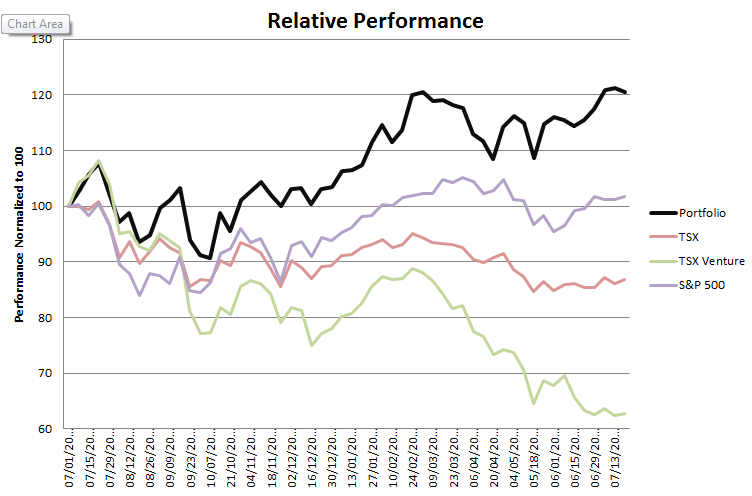
Portfolio Performance
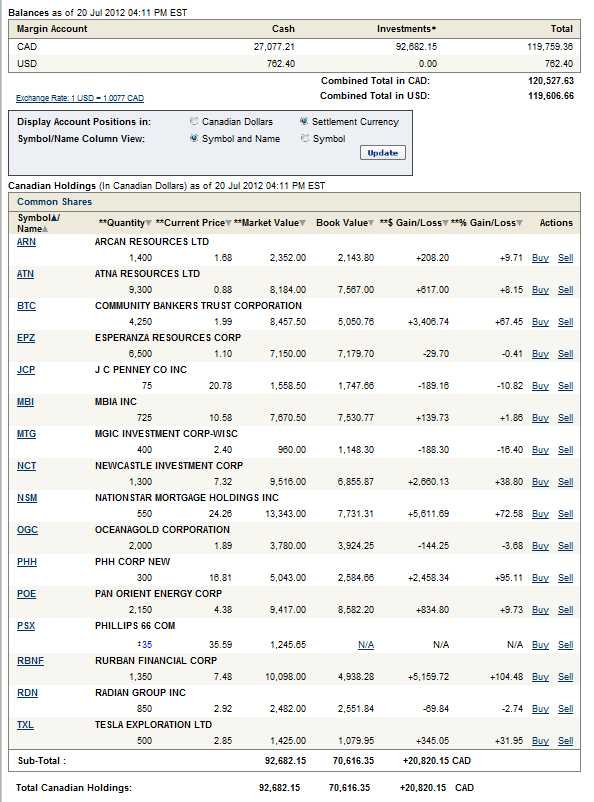
Portfolio Composition
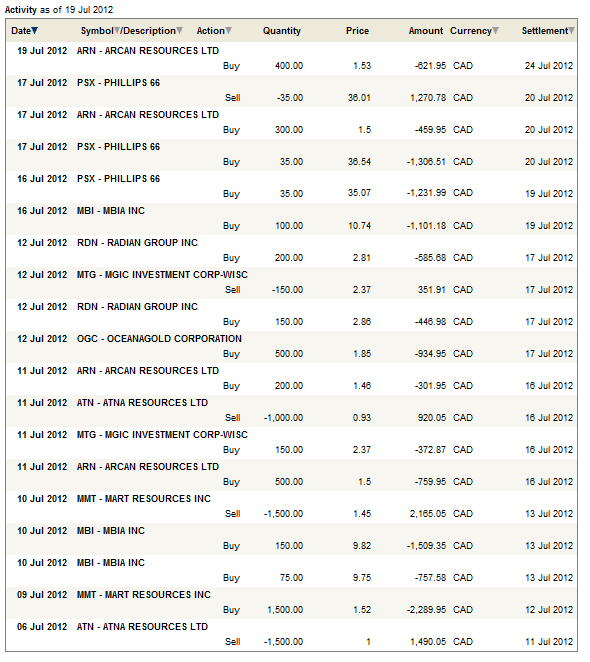
Click here for last two weeks of trades.

Portfolio Summary

I have reluctantly added some risk over the last couple of weeks  My cash position is down to $27,839 from $35,893 two weeks ago, which is a drop to 23% of total assets in my tracking portfolio.

The stocks I have bought have been added because I believe they are cheap.  I think that there is a reasonable chance that they will be worth significantly more over time.  But I do not add them with complete conviction.

The problem remains Europe.  And I remain wary of when the next shoe will drop.    Until Friday, the market had forgotten about Europe for the time being, but we have seen this happen before, and always with the same ending. Europe comes back and again trumps all else.  With Spanish yields rising to a new high on Friday (7.267%)  I am already questioning whether I have made a mistake by purchasing rather than selling stock.  I have already considered an about face.

You can see just how skittish I am by looking at how many trades I am second guessing myself on.  Three times in the last two weeks I bought a position only to sell it later the same day.  These weren’t planned “trades”.  I don’t play the day-trade game.  These were cases where I took the position and couldn’t handle the weight of it, and decided to sell instead of worrying about whether I had made a mistake by buying.

I am typically not so wishy-washy.  That the market has me going through convulsions speaks volumes to the uncertainty that exists at the moment.

As for the stocks I bought, those that I kept that is, I am confident that I got them at a decent price which, in the absence of more macro-malaise, will lead to eventual profits.  More on the individual position updates in the post below:

Company Updates

Radian Group (RDN), MGIC (MTG), MBIA (MBI): here

Arcan Resources (ARN): here

Phillips 66 (PSX):  here
 

Week 55 Update: The Insurers

The Insurers

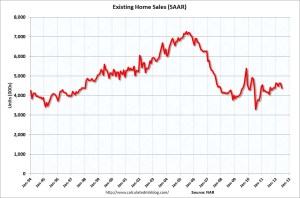
I added to all 3 of my insurers in the last two weeks; Radian Group, MGIC, and MBIA.  Regarding Radian and MGIC, while the data this week was mixed, I still am of the mind that the worst of housing is behind us.  While I’m not ready to jump into home builders or lumber stocks or anything else that is dependent on a robust recovery in prices or demand, I am willing to make a bet on mortgage insurance companies that need things to just stop getting worse.   The insurers need prices to stop falling and defaults to continue to slow.  I am inclined (albeit skittishly) to believe that will happen.

The housing data this week, while not great, supported that thesis.  The market focused on the month over month decline in existing home sales (down 5.4%), but year over year the trend is still to higher sales (4.5%).  The trend, while not robustly bullish, appears to be of a bottoming nature.

Perhaps more importantly, inventory continues to decline and the year over year number is down a somewhat startling 24.4%.

Total housing inventory at the end June fell another 3.2 percent to 2.39 million existing homes available for sale, which represents a 6.6-month supply4 at the current sales pace, up from a 6.4-month supply in May. Listed inventory is 24.4 percent below a year ago when there was a 9.1-month supply.

Bill Mcbride (of CalculatedRisk) pointed out in a recent post that it is really the inventory number that we should be focusing on:

I can’t emphasize enough – what matters the most in the NAR’s existing home sales report is inventory; what matters the most in the new home sales report next week is sales. It is active inventory that impacts prices (although the “shadow” inventory will keep prices from rising). Those looking at the number of existing home sales for a recovery in housing are looking at the wrong number. For existing home sales, look at inventory first.

Meanwhile the monoline insurers (Radian and MGIC) are writing more  new business and this is some of the best business they have every written.  I have already written about how strong lending standards are these days.  Below is the trend for New Insurance Written (NIW) for the first 7 months of this year.

The returns on the new business should be quite impressive.  Mark Devries, the analyst from Barclays that covers the insurers, was quoted in this Bloomberg article on expected returns:

Firms that stay in the business may benefit from a return on equity above 20 percent on new coverage as the exit of some rivals allows remaining insurers to boost prices, and tighter underwriting standards limit claims.

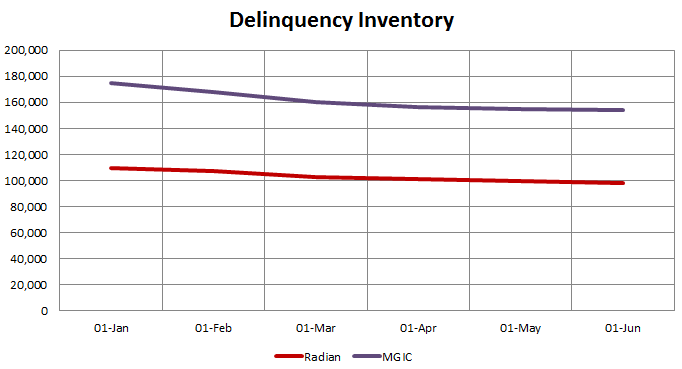
Meanwhile the old book continues to wind down.  The delinquency bucket for both insures continue to fall.

The insurers are like those movies you see where there is a big explosion and the movie star starts running and there is this big fire ball behind them and its gaining on them but the movie star keeps running and eventually the big fireball burns itself out.  These insurers are trying to outrun their legacy business by printing as much new business as they can to overcome the losses on the legacy.  I think when they hit that point that new gains outrun old losses is when they really move.

As for MBIA, the company is less dependent on any specific economic dynamic then they are on  the outcome of their court cases with Bank of America.  There are signs these cases could be coming to a head, but of course they might not.  Its really difficult to say when this will end and whether a settlement will be reached before a verdict.  When I tried to analyze the deal between Bank of America and Syncora earlier this week and the conclusion I came to was that you couldn’t extrapolate much of anything to MBIA.

Week 55 Update: Arcan Resource

I’ve owned Arcan before, but I have always had trouble holding onto it.  I think that in the aggregate I have probably lost a few dollars on the stock.  Yet here I am again to take another stab at it.

Arcan is an excellent example of why I follow the rules of:

  1. Never add to a losing position
  2. Do more of what’s working and less of what isn’t

With Arcan, I eventually sold out for good on March 23rd at $4.75.  At the time there wasn’t anything in particular that you could pinpoint that would suggest the stock was about to fall by more than two-thirds.  But what concerned me was that the stock wasn’t doing what it should be doing if things were going well. That is, it wasn’t going up.

And then there was the CAPEX.  My skittishness with Arcan and most other oil juniors has always been based on their level of capital expenditures in relation to their cash flow.   As I outlined in this post back in February, Arcan has been spending multiples more money than its been taking in.  You can’t just keep doing that forever.  It will work as long as the market sees you as a “growth stock”, but as soon as that music stops, well so do your funding sources.

Arcan has gotten themselves in over their head with funding and now they are going to have difficulty meeting their growth expectations.  The near-term outlook for the company is not terribly clear.

So why buy?  Well the stock is off 75% from its highs.  I think its all price in.

As well the company appears to be changing (perhaps by necessity) its spendthrift ways.  President, Doug Penner, said the following in the first quarter press release:

“I am excited about implementing Arcan’s next stage of development.  Having expanded rapidly in our first nine years of operation, we are maturing as a company, ensuring that our continued growth also delivers value for our shareholders over time. We are focused on reducing down‐time, operating costs and G&A expenses as we work to bring our capital spending more in line with our cash flow. We are also looking at all of our assets  strategically, and we will consider divesting non‐core assets as opportunities arise.”

Of course, with reduced spending will come reduced growth, and that is one of the reasons the stock has been decimated.  At $1.50 per share, which is about what it cost me on average to buy a position, we are getting awful close to the value stock territory.  The company has a $7+ NPV of its reserves.   Their production numbers haven’t been stellar, but they are showing stability and they should be getting past the initial flush declines and into more stable exponential declines on most of their wells.  AS well, the company should begin to benefit from the infrastructure spending of the last year, as the pipeline from Ethel brings down operating costs and we begin to see the fruits of the waterflood at Ethel in the second half of this year.   As I pointed out in that same article earlier this year, there is a clear difference between the Ethel decline curves and that of Deer Mountain Unit, where there is waterflood.

Arcan is simply a bet that the stock has gone down too far.  A move back to $2 would be a 35% gain and I could see it happening with nothing more than a bit of improved sentiment.

Week 55 Update: Phillips 66

I have actually owned Phillips 66 (PSX) for a while now, just not in the account I track online. Phillips 66 is a spin-off from Conoco Phillips.  The company has 3 lines of business:

  1. Refining
  2. Midstream
  3. Chemicals

I originally came across the idea of Phillips 66 after reading a Barrons article that was posted on the Investorvillage.com BRY board.  Phillips was a recommended pick of Meryl Witmer.  The thesis outlined by Witmer was as follows:

Phillips’ 50% of PCChem could earn $1.30 a share this year. These earnings deserve to be valued at a 10 multiple, or $13 a share. The midstream segment owns and operates natural-gas processing facilities and fractionation plants, and a large and valuable natural-gas pipeline system. It also owns 50% of a master limited partnership. It should have free cash flow of $1.20 to $1.30 a share and about a dollar in earnings once it finishes up a couple of projects. It is worth 17 times free cash flow, or more than $20 a share…

So at $35 you get the refining business for free.

My original purchase a few weeks ago was somewhat vindicated after Warren Buffett noted in a Bloomberg interview that his company had bought a large position recently.

The interesting thing about Phillips is that they stand to benefit from the increased liquids production in North America.  Below is an excerpt from the company’s CEO at the Citigroup Global Energy Conference:

If you think about natural gas at kind of $2 a day and ethane that was 30 cents and going down I think the last time I looked at it. But ethane at 30 cents is about $5 a million BTUs. So we capture the upgrade from the wellhead at $2 to 5 bucks through the midstream business and then the petchems really pick up at $5 and go to essentially the crude level, which is what the rest of the world competes on when they’re buying naphtha. Think about that at $17 to $18. And while we don’t know exactly where that rent is going to get captured through that chain, by the ownership in DCP and CPChem, we benefit all the way through that chain in the ownership in capturing that margin upgrade. So we really like that position that we have there.

The thing that makes Phillips interesting is that, as was implied by the Meryl Witmer analysis in Barrons, based on the valuation of the company, investors seem to be treating the company as a refiner, when really only a third of the company’s business is refining.   Moreover, as the company pointed out at another conference recently, this time put on by UBS, the other two-thirds of the business, midstream and chemicals, have return on capital metric north of 20%.

My only problem with Phillips is finding a price to buy in at.  I bought into it in other accounts at under $32.  It pains me now to buy at $35-$36.  Perhaps we will get a further pullback, though after the Buffett endorsement I kind of doubt it.