Skip to content

Buying when you don’t want to

The hardest posts for me to write are the one’s where I have to write that I bought a bunch of stocks on a day where the market was down a lot.  Its tough because I am worried I will be proven wrong.  Its extra tough because I am notoriously early and so I have been wrong many times before.

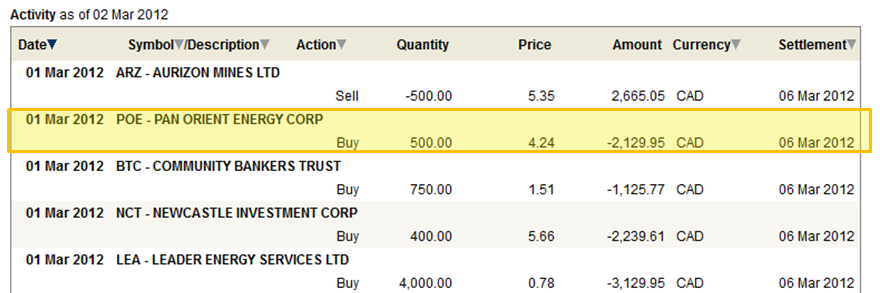
The market really tanked today and nothing tanked harder than the junior gold and oil stocks.  I had lightened up significantly on the gold stocks last week; I exited Canaco Resource, OceanaGold and a significant portion of Aurizon Mine. Unfortunately I used some of the proceeds to buy Pan Orient Energy, which took it on the chin today.

Nevertheless there is some truth to the old adage that the best time to buy stocks is often when you don’t want to.  Today I didn’t want to buy anything.  I even had half a mind to sell it all and stand away.

But having thought it through, I am having trouble making sense of the idea that this is the start of something big.  I have become a convert to the idea that the LTRO has taken out much of the systemic risk potential. The prices of periphery bonds suggest as much; even after today’s shellacking Italian and Spanish bonds sit near their lows.  The TED spread and Swap spread hardly moved at all and currently sits at 40 and 27 respectively, well of their highs of 60 and 55.  The bank stocks, while hit hard, did not lead the way down in the way they did in August.

It just doesn’t feel to me like it did in August, or in November for that matter, when the fear was palpable.  Yes, we are worried about Greece and what is going to happen.  But the evidence does not suggest that the big players are that worried.  If they were we would see more signals of the stress in the bond market.

Which makes sense.  By this point everyone knows about Greece.  Everyone who had money at risk with Greece should have been able to figure out how to take it off the table.  That yields aren’t rising in the periphery suggests that the real problem, that a Greece default would cause a domino effect, is not in the cards.

What I bought
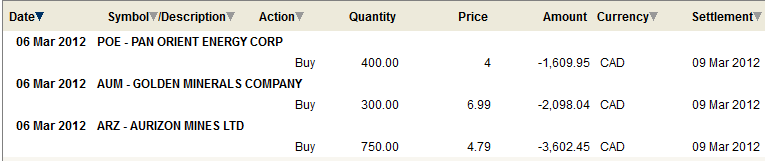
I’ve had good luck buying Aurizon under $5 in the past and so I did so again today, restoring my full position in the stock.  I also bought more Golden Minerals.  Golden Minerals is a stock I had been tempted to sell when it got to $10, but I got a little greedy and decided against it, only to watch the stock fall back to $6.80 today, which is not too far away from my original purchase price.  The stock is reasonable at these levels; the company has $2 cash on hand per share and a 6Moz gold equivalent resource.

Interestingly, Rick Rule was on BNN yesterday and he had some positive comments on Golden Minerals in this clip (I’m not really sure how to embed video from BNN).

Since last Wednesday its been a swift fall for many gold stocks.  My bet here is that the latecomers have been fleshed out and that with stocks like Aurizon and Golden Minerals approaching their 52 week lows once again, we are close if not at the bottom.

I also added to Pan Orient.  This will be the last time that I add until I see the stock begin to rise again.  For the time being I will sit tight with what I own.

My Thoughts on Equal Energy Activism

The pot was certainly being stirred up around Equal Energy last week. One shareholder, Nawar Alsaardi, singlehandedly engaged the investor base of the company, gathering together a group of shareholders to push for a major change in direction fo the company. According to a recent post on Yahoo! message board, Nawar has signed up a significant number of shares:

In total, we have the support of 29 private shareholders, plus two institutional shareholders, those parties collectively present just under 3 million shares, or 8.5% of the outstanding shares.

I’m pretty sure that is enough to petition for a board member to represent the group.

The proposal

Nawar has posted his proposal for the steps he would like to see Equal take as a slide show on slideshare:

Equal energy

View more PowerPoint from Nawar Alsaadi

The proposal is basically to sell the Canadian assets (Lochend and the Viking) and reduce debt, turning the company into a US based trust that focuses on the Hunton, pays out a dividend, and has the Mississippian as a kicker for growth.

I think its a plausible strategy and I support the move in principle; to pressure management to better promote the company and look for ways to reduce debt. To raise my own personal grievance: if Equal did lose 4,000 acres of prospective Mississippian land to lease expiries (as it seems like they have), that is just not acceptable. 4,000 acres is $10M lost, or around 30 cents a share.

However I am having trouble supporting the specific actions being advocated.   I don’t want Equal to sell all their Canadian oil assets. It seems counterproductive to me to sell what amounts to be many acres of undeveloped land with only about 1,100boe/d of mostly oil production when Nawar (and I believe management) feel these assets would only fetch around $80M in their current state.

The problem is that they would be selling mostly undeveloped land. The company is in the business of buying land and de-risking it; that is the basic value-added premise of an oil and gas company. Under Nawar’s proposal Equal would be selling land that is for the most part not de-risked.

If I were management

I approached my decision to support or not support the proposal as if I were management. And if I were management I would put my focus on the oily areas right now.  I would attempt to “add value” by proving up locations and increasing production. In particular, the Viking has low drilling and completion costs and you could likely gain a couple PUD locations for every well you pop into the ground. Grow that production and then (maybe) look at selling it once you have reached 2,000+boe/d. At that point you would be able to fetch a much higher price for the land and production, perhaps enough to bring down the debt entirely.

Worried about NGLs and natural gas

My other concern is that the proposal would essentially turn Equal into a natural gas and NGL company. I work on the natural gas side of the business and I am not optimistic about the short and medium term future of natural gas prices.

One consideration that rarely gets mentioned when discussing the relative merits of oil versus natural gas is that natural gas and the slightly heaver NGL’s are quite a bit easier to get out of the ground than oil is. They exist, for the most part, as a gas in the reservoir.  There is plenty of energy within the fluid that does the work to lift them out. Its just an inherently easier process then trying to get the heavier hydrocarbons out.

This is why its always going to be easier to drill and find natural gas than it is to drill and find oil.  It is also why I am far less skeptical about the long term performance of gas shales and tight gas reservoirs where horizontal multifracs have been used to produce the formation, than I am of the oil shales.

The second point, which is more immediate, is that everybody and their dog is drilling the snot out of any play that is liquids rich right now. One has to wonder whether there will be a propane glut or a butane glut coming down the pipe (sorry, bad pun).

The third point is that rising NGL production is as much about separation techniques as it is about finding the resource. There are plenty of NGL’s that are being passed through the pipeline with the methane simply because it hasn’t been economic to knock them out. With methane at $2.50 and some of the heavier hydrocarbons significantly higher, its getting economic to do a more thorough job of separation.

There was an excellent First Energy piece on Deep Cut Gas Plants a couple of weeks ago. FE said the following:

Deep cut gas plants are field gas processing plants that have a special processing capacity to extract more liquids. On average, deep cut plants in Alberta extract 3.7x more liquids for a given volume of gas than ‘shallow cut’ plants. This is because of their special processing units and because these plants are located in the areas in the basin where gas is more liquids-rich

First Energy listed the following deep cut plants either under construction or under consideration in Alberta:

Now to be fair, all this is Alberta centric information. I don’t have information on the supply/demand dynamics of NGL’s in Oklahoma. Nevertheless, its a North American market and I suspect the price differentials of a given hydrocarbon can only be stretched so far from market to market.

The bottomline

My basic point is more qualitative than it is quantitative. I don’t like the direction the NGL market is going, and if I were managing a company like Equal that had oil assets and ng/NGL assets, I would be reluctant to part with the oil assets. Getting back to the “if I were management” theme, if I were in charge of Equal the first thing I would do is commission a study of the NGL market in Oklahoma, make sure I understood the dynamics of that market, and from there decide if I should be selling off some or all of the Hunton assets before NGL prices begin to slide.

But the oily assets. I just find that a tough proposition to support. I wish the others the best and if it works out I will eat my crow pie. But I have to stick with what I see that lies ahead here and I just wouldn’t want to create a natural gas, NGL company right now.

Week 35: Continuing to Move away from Gold: Out of OceanaGold, Canaco Resources, into Pan Orient Energy, Newcastle Investments

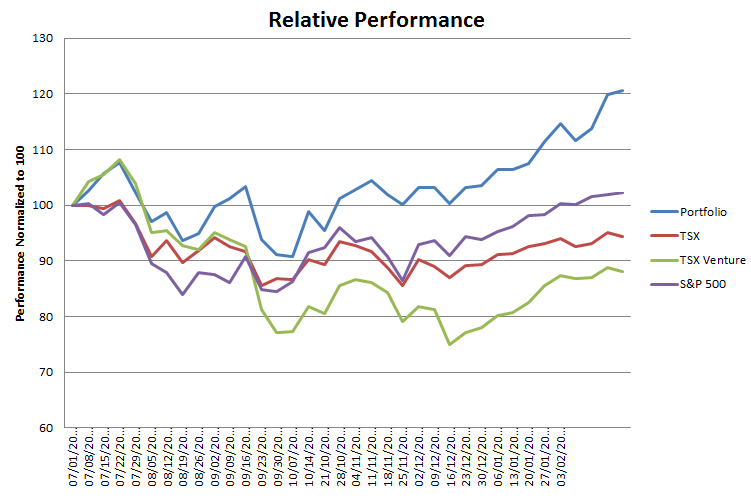
Portfolio Performance

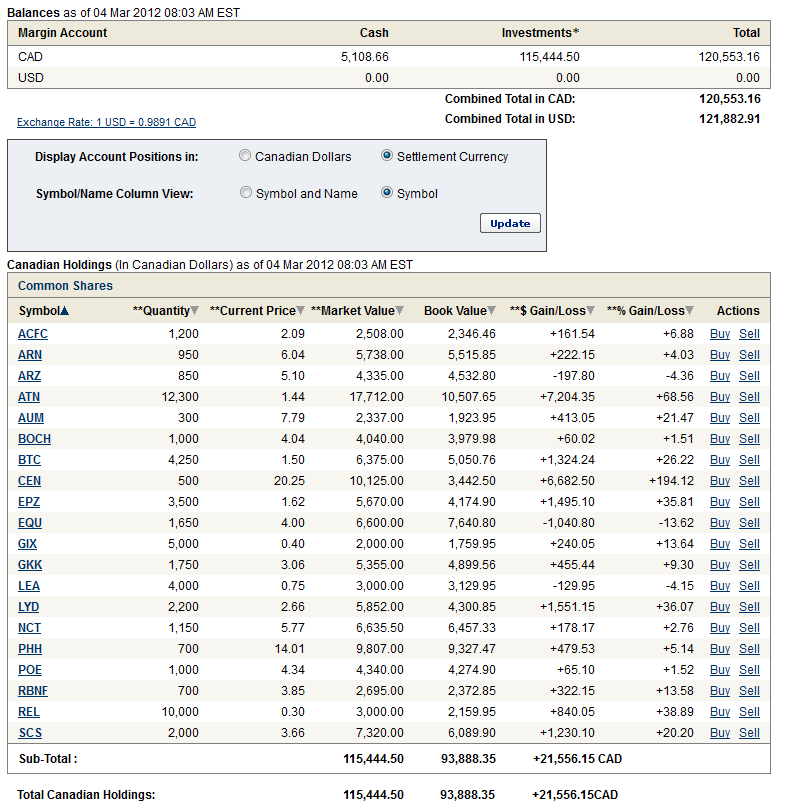
Portfolio Composition:

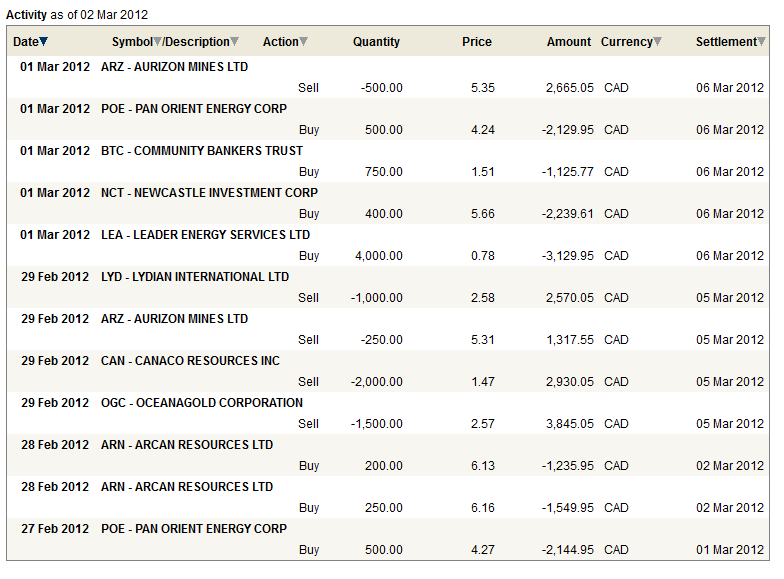
Trades:

Sold the Gold Sell-off

This was the week where I got fed-up with gold stocks doing nothing and began to sell them en masse.  I completely eliminated my position in OceanaGold, and in Canaco Resources.  I dramatically reduced my position in Aurizon Mines, and somewhat reduced my position in Lydian International.

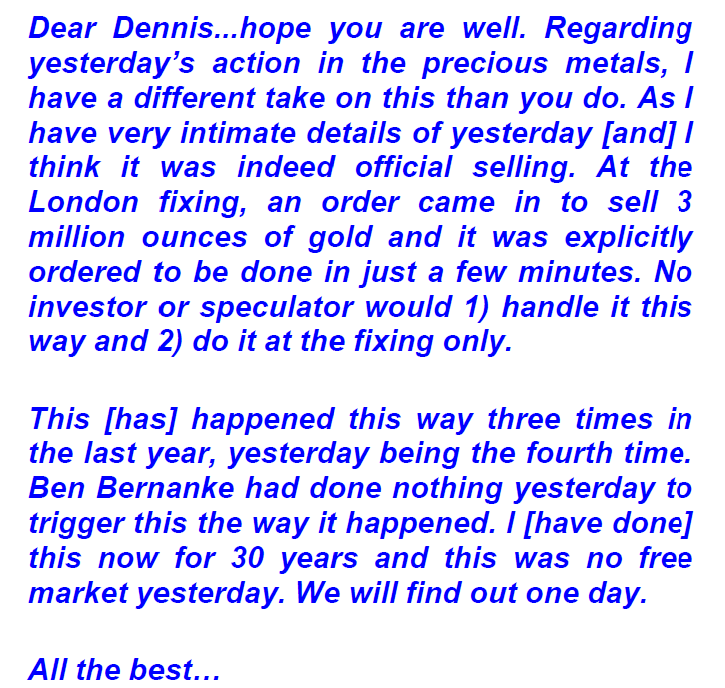
I do have to wonder whether the $90 drop in the price of gold was orchestrated.   Interestingly, mention of such a possibility came from a rather unlikely place on Thursday, as I was sent the following excerpt from Dennis Gartman, who was quoting from a friend “near the centre of the events”:

Whether or not the plunge was orchestrated, I had to start removing dead weight from my portfolio and this provided a good excuse.  As the price of gold fell and OceanaGold and Canaco Resources began to crack, I asked myself what am I still doing in these stocks?  I couldn’t come up with a good answer so I sold.

In the case of OceanaGold and to a lessor extent in the case of Aurizon Mines, the catalyst that could move the share price higher remains somewhat in the distance.  I am not seeing anything like the takeover frenzy that has been predicted by some, and so these stocks become waiting games; lined with the hope that either the market catches onto the name and bids it up, or that some sort of (lucky) catalyst emerges.  I have not had very much luck investing on such hopes in the past.

In the case of Canaco Resources, I re-read my analysis of Magambazi.  That analysis got a lot of attention during the early part of the week as it was posted on Stockhouse (by some guy who seems to be taking credit for doing the work – sigh).  While I still question whether there is an error in my analysis, I do think I raised enough questions about the deposit, and enough uncertainty about the eventual resource estimate to be somewhat wary of the NI 43-101 that will be out shortly.  I decided to step aside until that resource comes out, or the share price falls back to the point where I feel like the downside is priced in.

Adding to Newcastle, Pan Orient, Leader Energy Services

The other part of my reasoning for selling some of the gold names is I see better alternatives elsewhere.  With oil at $100 per bbl I would rather be involved in oil companies with near term catalysts (Pan Orient) and service companies poised to take advantage of the move to drilling for more oil (Leader).

In the case of Newcastle, I listened to the fourth quarter conference call and reviewed the companies slides on mortgage servicing rights.  This appears to be an opportunity that has been overlooked by the market.  Newcastle is investing money into MSR’s with potential rates of return exceding 20%.  If they inded capture these sort of returns, I expect a significant dividend increase and a move in the share price to around $10.  I will write-up some of my findings with Newcastle later this week.

Adding to Pan Orient

I increased my position in Pan Orient on Friday.

The more I look at the story here the more I like it.  The following comment from Raymond James was posted on the Investors Village board:

…after speaking with management we believe the recent discovery could have significant resource upside potential (see page 2 for details), and lead to a step-change in the company’s current production profile. The discovery represents an important milestone for Pan Orient as it moves towards its goal of increasing production from more stable sandstone reservoirs (as opposed to the prolific but highly volatile volcanic reservoirs which until recently underpinned the company’s production base).

The one short term negative for the stock is that it is expected that there will be a 10MMbbl writedown of reserves from their legacy volcanics field in Thailand when the reserve report comes out.  The reserve report will come out some time in the next month or two.

Chen Lin was interviewed earlier this week and he had some comments about POE as well:

Pan Orient has a slightly different thesis than Mart Resources because there is some exploration/discovery risk. It is drilling wells, potentially very big wells, but I don’t know if the wells will be successful. With Mart, there is much more certainty. However, though there is risk for Pan Orient, it is a very experienced oil exploration company, and it’s been in Thailand for five years, drilling and fine tuning its technology.

I shared with my subscribers a report that estimates each of the three Pan Orient wells in Indonesia is worth about $3 of net asset value (NAV)/share if successful in the first half of 2012 and $2 for each of the other three wells in the second half of 2012. In addition, Pan Orient also has an oil sands property in Canada that it wants to sell. The company has $1/share cash on the balance sheet and cash flow over $1/share right now, and this is in addition to the oil sands property that it has for sale. Thailand is ramping up production and Indonesia has the big wildcat wells at work. So in terms of risk-reward, it’s an ideal situation. I wouldn’t be surprised to see the stock be a ten-bagger by the end of this year. The company could be a $1 billion (B) company. It was a $2 stock when I recommended it in my newsletter. Right now it’s $3 and change. With some success in drilling in Indonesia, I’m looking for a ten-bagger. Seldom do you have those in one year, so I have pretty high hopes on the stock

I think that Chen Lin can be a little over-enthusiastic at times; I mean we are still a number of good events away from being a 10 bagger. Nevertheless, the possibility certainly is there and the possibility of a 50% return, which is nothing to sneeze at, is, in my opinion, extremely high.