Skip to content

Letter 23: Thinking it Through

Let’s Start with Europe (again)

The unfortunate reality of investing at the moment is that you cannot make a decision without first appraising the situation in Europe.  Correlations of most stocks, most asset classes, have gone to one.  The ability of the ECB to buy Italian debt, or the liquidity position of Societe Generale weighs as much on the price of Coastal Energy or Arcan Resources as does the success of their next well.

Its a bizarre new world.

This week Europe had their latest summit installment.  The response of the market to what transpired was confusing.  The market crashed mightily on Thursday, only to rally just as mightily on Friday.  Italian and Spanish bond yields spiked on Thursday but then dropped modestly on Friday.

Given the confusing signal sent by the market, I want to take a few minutes to step through what was agreed to at the ECB and among the EU members.  Hopefully we will be able to draw some useful conclusions as to what it means to the stocks we invest in.

The Fiddling of the ECB

A tweak here, a tweak there and pretty soon you have… well not a whole lot to be honest.  Let’s take a look at what the ECB did:

  • They lowered the rate for banks to borrow money from the ECB
  • They increased the types of collateral that banks can use to get liquidity from the ECB
  • They extended the period for banks to do long term borrowing from the ECB to 3 years and suggested they would facilitate such loans in unlimited amounts.

While these actions are somewhat helpful, what the ECB failed to do (at least directly) was to agree to buy significant quantities of government bonds.    This failure was likely responsible for the collapse in the market on Thursday.

Some have argued that the change in long term borrowing requirements will effectively let banks buy sovereign bonds on behalf of the ECB, effectively skirting the rules.  From the horse’s mouth:

There is no need to be a great specialist to understand that tomorrow, thanks to the central bank’s decision, the Italian state can ask Italian banks to finance part of its debt at rates which are undeniably lower than today’s market rates,” Sarkozy told reporters at a European Union summit on Dec. 9. “I take Italy but I could take the example of Spain. This means that each state can turn to its banks, which will have liquidity at their disposal.”

What Sarkozy is talking about is theoretically possible, however I am skeptical that it is going to be very meaningful in practice.  For one, the EU banks are already in the process of deleveraging.  By all accounts they are already too leveraged.  The process described by Sarkozy just adds more leverage.  For two, you have to think that the last kind of assets that the EU banks want more of are questionable sovereign bonds. Finally for three, if the banks decided to leverage up with even more sovereign debt all you’ve really done is doubled down on eventualy bailout that will be required when that sovereign debt goes bust.  You haven’t actually solved anything.

One of the last gasps of a Ponzi scheme is to use one investment vehicle to start purchasing the assets of another at an inflated price.  In other words, once you run out of outside suckers, you try your best to shuffle around the funds to appear solvent.  Needless to say this typically doesn’t last very long.

In all I don’t think that what the ECB did amounts to much more than a temporary blip of increased demand.  The problem of too much debt remains, liquidity to banks only helps solve the banks liquidity crisis, and the ECB still refuses to get its hands dirty by buying that debt in bulk.  However, if you want another opinion on this, on the bullish side, I think there was an excellent summary written by Savannahboy on Investors Village.

What did the EU do?

Describing what the EU did is trickier.  It is easy to get caught up in the market move upwards on Friday and assume that something significant must have happened at the meetings.  Well, I did a lot of reading and if something significant did happen, nobody told the journalists.  I suppose that the existing “plan of a plan” got tweaked and even pushed forward a couple of steps. Yet it  still remains a long way off from being a clear path to solvency.

A good Globe and Mail article by Eric Reguly reported the following summary of what was accomplished:

At least 23 of the 27 countries in the European Union – soon to be 28 with Croatia’s apparently suicidal desire to climb aboard the listing ship – agreed to a new, long-term fiscal pact designed to ensure that the euro never again gets hit with an existential crisis. (Britain isolated itself by refusing to join the deal, for fear that it would have to sacrifice the safeguards on its banking industry.)… On top of that agreement, the EU is strengthening its roster of financial stabilization tools. The EU will lend about €200-billion ($272-billion) to the International Monetary Fund, co-sponsor of the bailouts of Greece, Portugal and Ireland, to boost its firefighting capabilities. The European Stability Mechanism, the permanent bailout fund, is to launch next summer, a year earlier than originally planned, and its lending capacity is to be increased.

Reguly goes on to make what I think is the very valid point that all of these moves will do nothing to deal with the fact that the peripheral countries are not growing.

Look at Greece. Two years of austerity demanded by the EU and the ECB – read: Germany – with the IMF at their side have pushed the country to the verge of failed state status as economic activity vaporizes. The rest of the EU is slipping into recession.

With no growth, budget deficits everywhere refuse to disappear. Debt is going up. Perversely, the German-inspired response to the persistent deficits is demand for even deeper austerity. This is self-defeating, vicious-circle economics. At its worst, the lack of growth will erode the ability of the weakest countries to service their debts. Once investors figure that out, their sovereign bond yields will soar again, to the point their funding costs become unsustainable. Italy is getting close to that point.

This is key.  Markets are almost exclusively focused on what bandaid can be created to keep the banks from going belly-up next week. Perhaps the summit made some strides in this regard.  We should be able to make it through Christmas without anything catastrophic occuring.  But nothing that is being done about growth.

Jane Jacobs and the Feedback Nature of Currencies

The reality is that the fundamental problem in Europe is what brings it together in the first place: the existence of a single currency.  Italy, Greece, Spain, etc, cannot compete with Germany on a level playing field.  These countries need to have a way of leveling that reality out.  The primary (perhaps the only market based) mechanism for doing so is the relative value of the currency of each region.  If there is only one currency, there is no way to rebalance between the Eurozone countries.

This was the salient point made by Jane Jacobs years ago in her great book “Cities and the Wealth of Nations”.  In that book Jacobs begins with the basic premise that a currency is a feedback mechanism.  She goes on to argue that the problem with a country based currency is that it doesn’t allow for proper feedback of the individual cities that make up that country.   Cities within a country have a wide range of productive capacities.  What needs to occur in order to correct imbalances between cities is a readjustment of each city’s currency.

Jacobs provides a number of examples of how national or imperial currency regions usually results in one or two economically powerful cities, and a number of other dependent cities, usually requiring transfer payments of some sort to survive.

Speaking particularly of Europe she says (remember this was written in the early 1980’s):

In Italy, as time has passed since the unification of the country a century ago, the economics dominance of Milan has grown only more marked, not less so.  Even Rome itself has only a meager cioty region, vanishing a few miles south and east of the city where, immediately, the poor south of Italy begins.  In Germany before its postwar partition, Berlin had become ascendent…In France, only Paris has a significant city region now, unlike the country’s so-called eight great peripheral cities: Marseilles, Lyons, Strasbourg, Lilli, Rouen, Brest, Nantes, Bordeaux.

Outside of Europe she points to the example of Canada (Toronto and central Canada has typically grown briskly and propped up the weaker maritimes provinces), the  US (cities of the northeastern corridor typically being much stronger then those of the south), and Britian (where “the passage of time simply widened the economic gulf between [the rest of Britian] and London”) to name a few.

What Europe has embarked on with the Euro is the exact opposite of what is needed.  Currency regimes need to evolve to produce better feedback, not worse.  The Euro currency feedback mechanism is skewed by the strength of the German economy (actually more exactly the economy of its one or two prime export replacing cities, Berlin and Frankfurt).  Peripheral countries like Italy, Greece, Spain and Portugal are doomed to receive faulty feedback rather than the natural “export subsidy” that would occur if those countries had (lower value) currencies of their own.

US Housing Market

Getting away from Europe, I spent some time this weekend listening to an interesting debate at the AmeriCatalyst Housing conference.  I was introduced to this conference when I discovered some of the videos of Kyle Bass being interviewed at it.  As it turns out there is a lot of interesting stuff at the conference, not the least of which is the discussion below about the state of US housing.  This is a debate / information session put on by experts in the mortgage and housing industry.
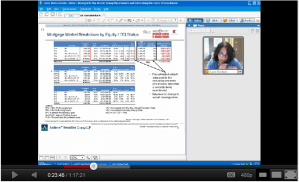
Probably the most interesting aspect of the debate was with regard to shadow inventory.  I’ve never been totally clear on just what shadow inventory was, and it seemed to be a number that varied significantly depending on the conclusion the purveyor was trying to draw, so it was interesting to hear the comments of these experts on the concept.

The truth is that the magnitude of shadow inventory depends as much on the definition as anything.  A couple of different estimates of shadow inventory are made by different analysts.  Laurie Goodman (who I first learned of from ftAlphaville fame) pegged shadow inventory at 11M (which is an amazing 20% of housing mortgages outstanding).  Mark Fleming pegs it at 2M.  Both analyts are using the same data.

How is this possible?  Its all in the assumptions.  Shadow inventory is really just houses that are expected to go into default at some point.  There is nothing particularly nefarious about the concept, even though the name suggests it is some sort of inevitable flood of housing supply.  It may be, but it may not.  It depends on what happens.  Laurie, to come up with her 11M number, assumes a fairly large number of prime mortgage defaults, including some that are currently with LTV (loan to value) of less than 100%.   Laurie also looks at 60 day past due as her “bucket” from which to extrapolate current nonperforming loans.  Mark on the other hand, uses 90 day past due, and does not include currently performing prime mortgage defaults.

As Mark Fleming puts it, the true shadow inventory is “behaviorly perception driven”.  In other words, if the housing market begins to be viewed as bottoming, if the economy is perceived as improving, the impetus to default will be less and the shadow inventory will be on the lower end.  If the view is another lengthy recession, then expect a lot more inventory to come out of the shadows.

What it Means to the Portfolio: Lightening up on Gold

I sold out of Newmont Mining earlier this week, and I lightened up on my position in Aurizon Mining. I remain bullish of gold stocks, just not as bullish as I was.

I have been expecting that the European problems would precipitate ECB money printing.  I still believe this is going to happen, At some point that is; as I pointed out the structural flaw in the Euro currency union means that there simply is no way that Italy, Greece, Spain and Portugal (maybe even France) are going to grow themselves out of  their debt.

Nevertheless Draghi’s comments this week suggested that money printing may be a little further off into the future than I had hoped.  Without that, gold remains vulnerable to the headwind of its own price appreciation, and the damage that has done to jewelry sales.

The WSJ  had a good article on this:

India’s wedding-season gold demand has nearly disappeared as the yellow metal’s local prices have climbed to near-record levels because of a fall in the rupee’s value, sparking a rush to sell scrap during the usually peak buying period.

“There is virtually no demand for gold,” said Prithviraj Kothari, president of the Bombay Bullion Association.

I feel reasonably comfortable holding story stocks like Atna Resources and Lydian International (I also started a position in Esperenza Resources this week, though not in my online portfolio).  I feel less comfortable with Newmont, which is basically a play on the price of gold.  The same case can be made to a lessor extent with Aurizon Mines (though the reason to hold onto Aurizon is an eventual consolidation of the gold sector).

Buying the Banks

While I am reducing gold, I am buying back some of the regional bank holdings I sold off after beginning to be concerned about Europe.  The truth is, the regional banks have faired better than I would have expected during the past 6 months.  The recent bottoming of the ECRI weekly leading index, along with decent jobless claims data, suggests to me that the US economy does not have its bottom falling out.  I suspect that a muddle through for the US should be good enough to see decent price appreciation in some of these beaten up regionals.

Bank of Commerce Holdings

A bit of a punt here.

I was listening to BNN last week and I caught Contra The Herd’s Benj Gallander’s top picks.  One of them was Bank of Commerce Holding (BOCH on the Nasdaq).  I did some work this week on the company and it looked cheap (less than 10x earnings, trading at about 50% of tangible book), it had a reasonable level of nonperforming loans (3.3%), and it has the potential for better earnings in the future once it works its way through its loan loss write-downs. So I bought some.

The worry about this regional bank is its region.

The Company conducts general commercial banking business in the counties of El Dorado, Placer, Shasta, Tehama and Sacramento, California.

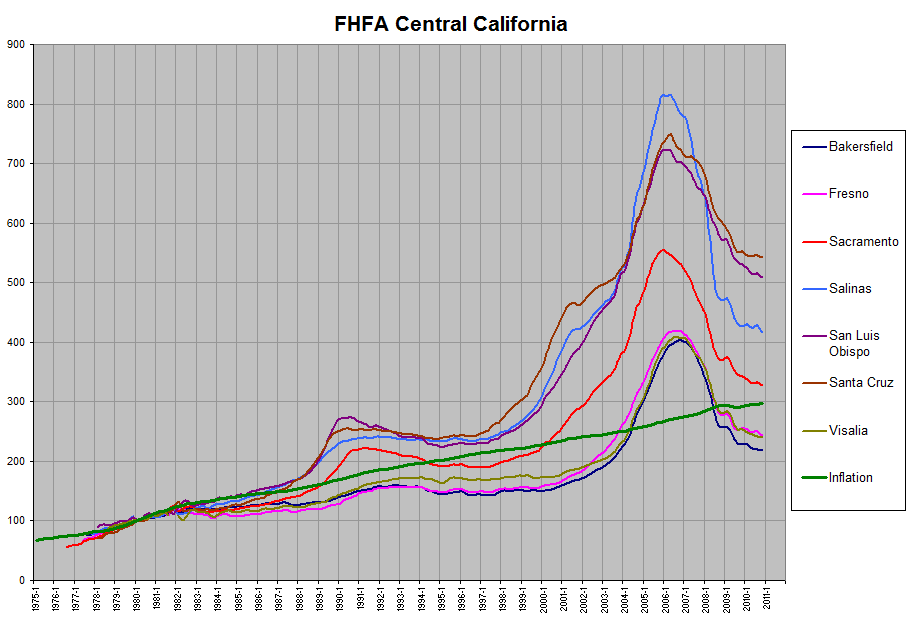
This is not-exactly-but-close-enough-to the inland empire that didn’t fare so well during the housing bust:

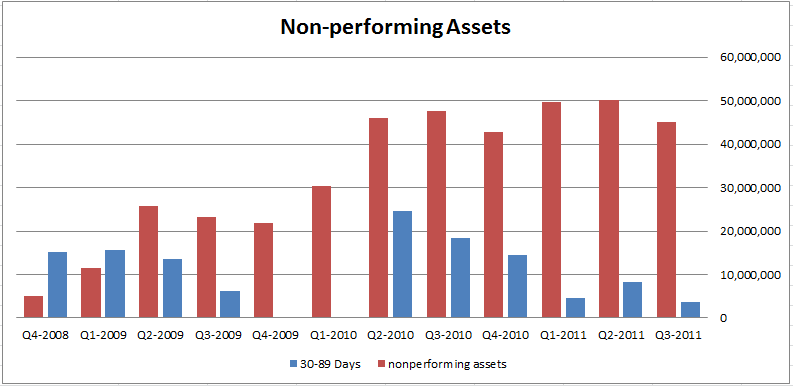
Given the circumstances, the company has done an admirable job of keeping their loan book clean thus far:

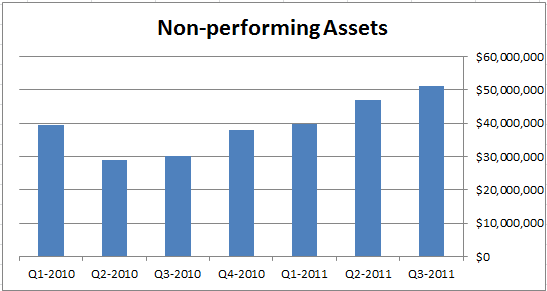
  • Nonperforming loans to total loans 3.33 %
  • Nonperforming assets to total assets 2.30%

As well ROE has been decent, particularly if you consider that the number includes the provisions to losses the company has taken:

Return on average assets (ROA) and return on average equity (ROE) for the three months ended September 30, 2011, was 0.91% and 7.45%, respectively, compared with 0.67% and 5.95%, respectively, for the three months ended September 30, 2010. ROA and ROE for the nine months ended September 30, 2011, was 0.75% and 6.45%, respectively, compared with 0.70% and 6.61%, respectively, for the nine months ended September 30, 2010.

I estimate that if you looked at ROE ex-provisions, the number would be very close to 10%.

Bids in for Oneida Financial (ONFC) and Community Bankers Trust (BTC)

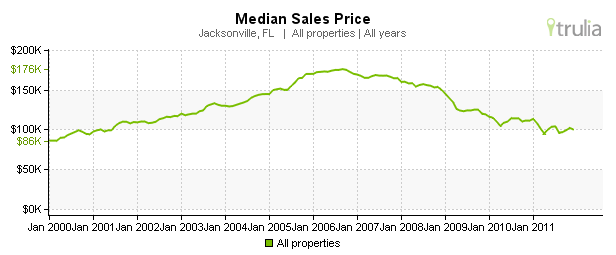
While I managed to pick up a position in BOCH quite quickly, I have bids in for, but so far haven’t been able to purchase, too many shares of ONFC and BTC.  Rest assured I will wait patiently until I do.  Both of these banks represent good value, and unlike BOCH they are both in areas with stable economies and housing (Virginia for BTC, Central NY for ONFC).

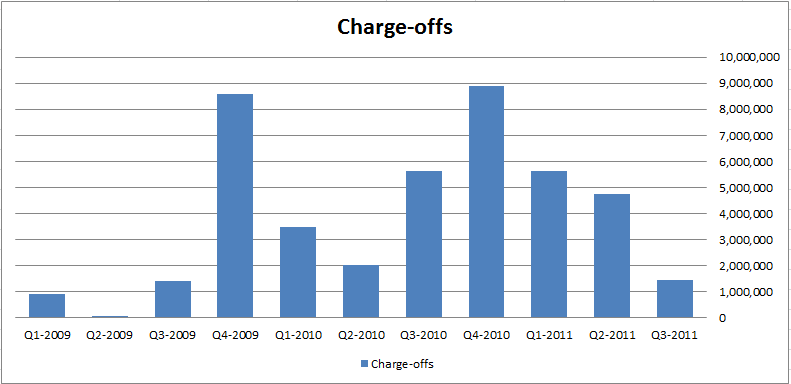
In the case of Community Bankers Trust, the 3rd quarter brought the first profitable quarter in quite a while.  It also showed a continuation of the trend towards less charge-offs.
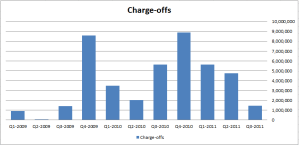
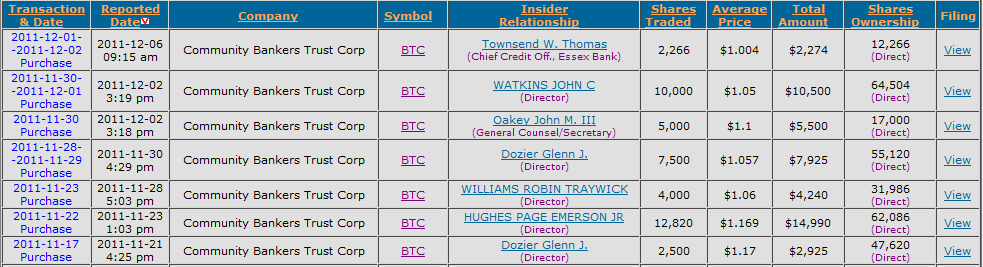
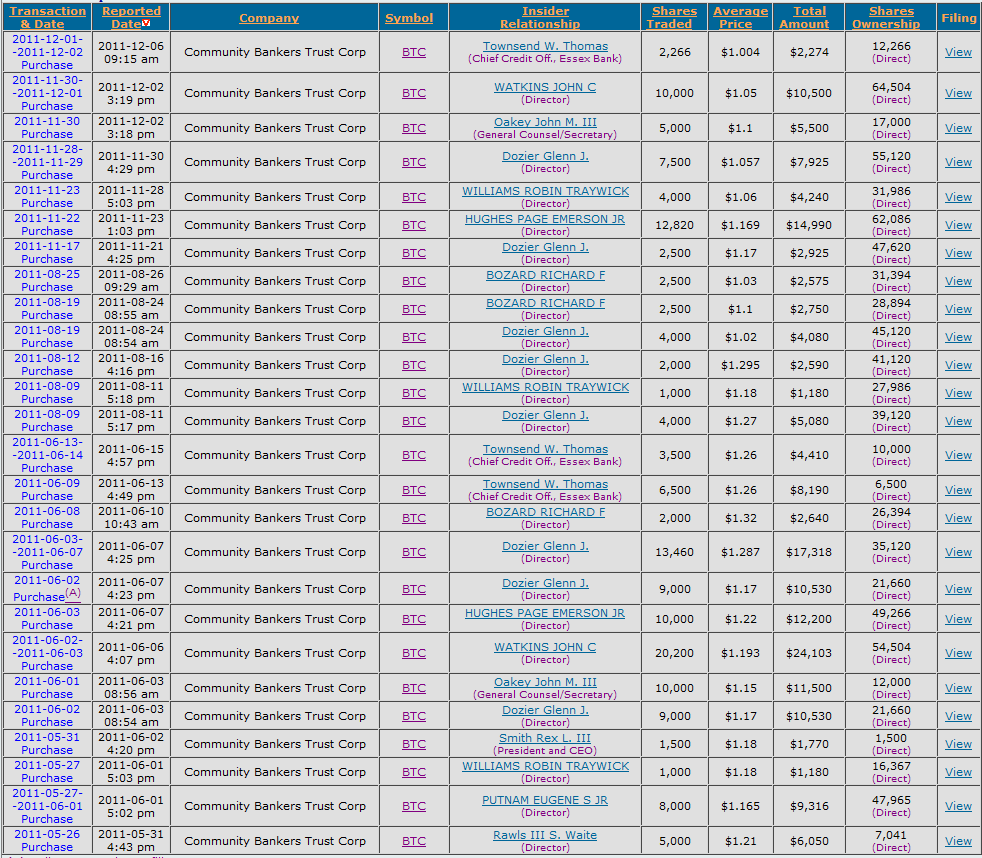
BTC trades at less than a third of tangible book value ($3.67) at this point.  Meanwhile, insiders continue to buy shares.

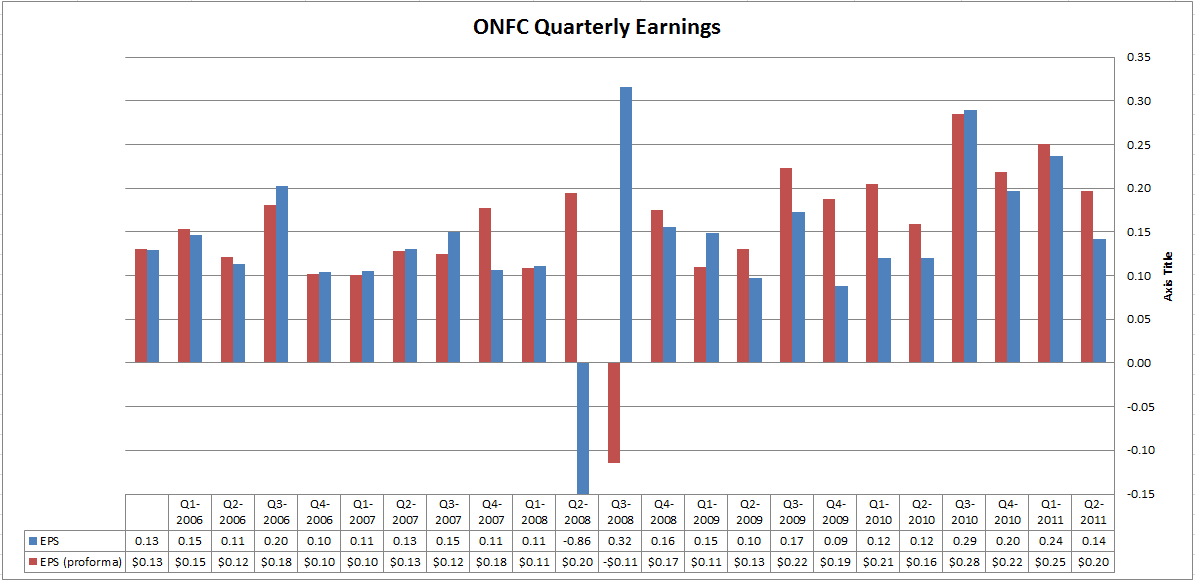
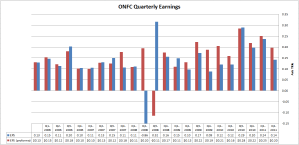
Oneida Financial is a NY based bank with stellar loan performance (well under 1% nonperforming assets to total assets), strong earnings performance (should earn in the neighbourhood of $0.80 this year), and is trading slightly under tangible book value of $9.10.

I am particularly impressed with Oneida’s consistency of earnings throughout this tumultuous period.
Oneida also pays a dividend of 5%.

Portfolio Composition
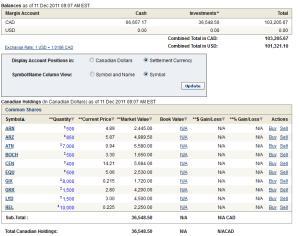
Week 22: Still Partial to Cash

(see end of post for current portfolio composition)

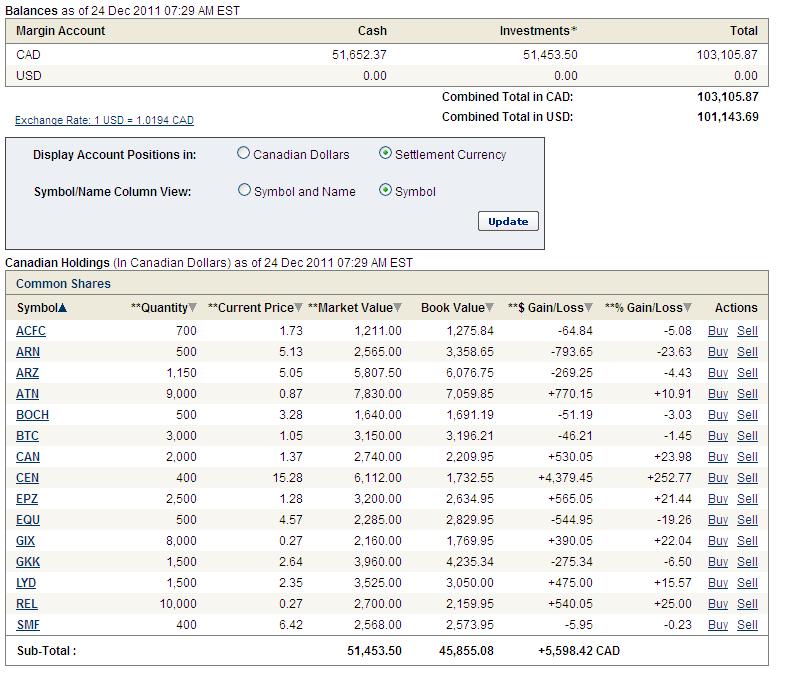
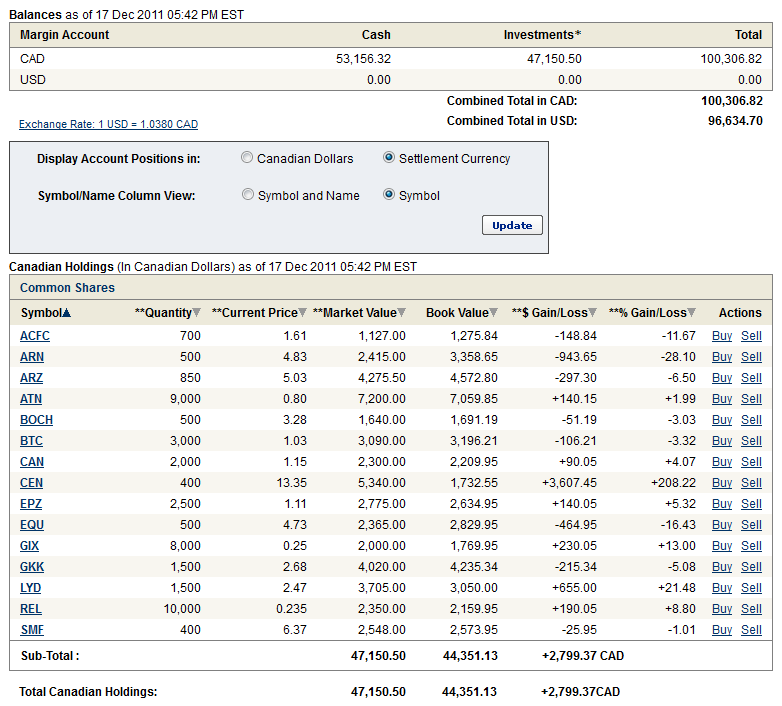
When you are 57% cash, its difficult to outperform the market to the upside.

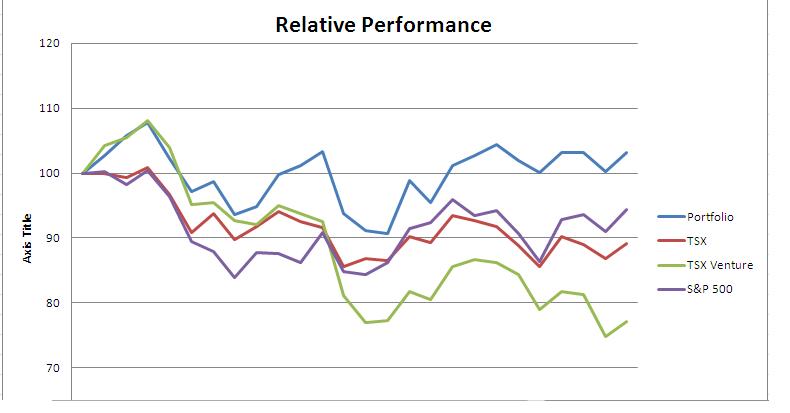
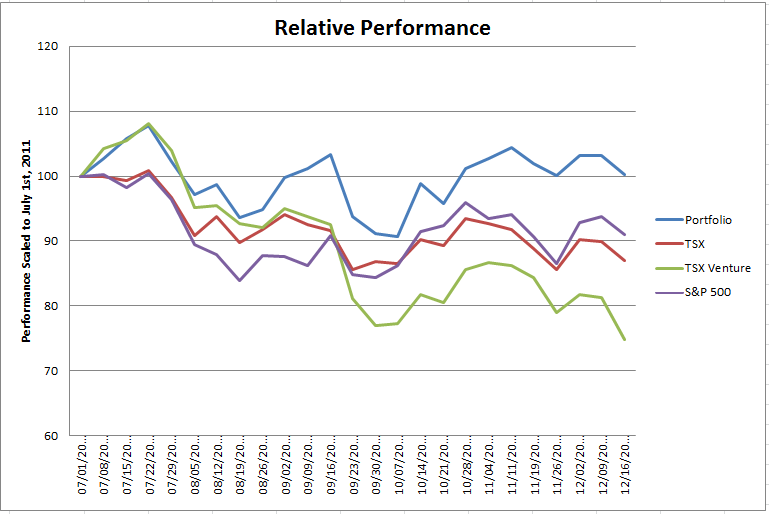
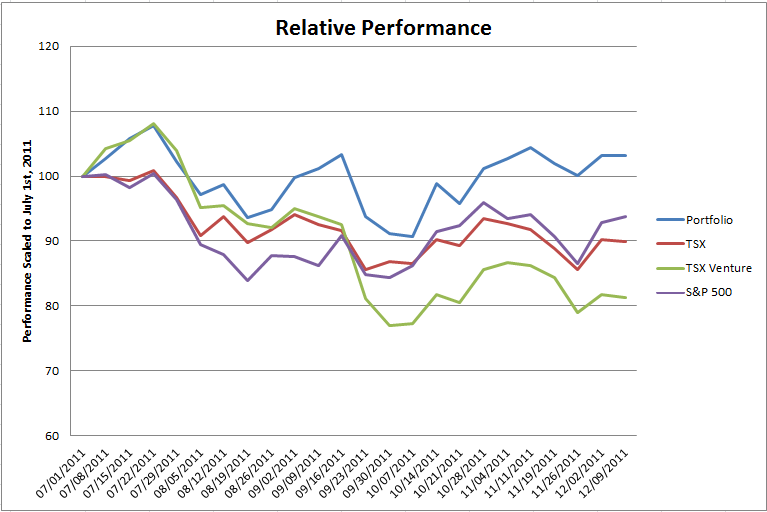
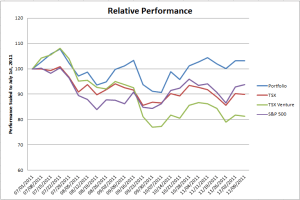
That is exactly what happened this week.  The TSX was up 5%, the S&P up 6%, the Venture up 3.3%, and my portfolio was up a lowly 2.9%.  Having as much cash as I do certainly has protected me against the downward trend over the last 4 months, but it will also prevent my portfolio from having outsized gains if we have a significant rally.

I Remain Wary of Europe

I am, however, in no mood to change my tact.  Though I admit that the developments this week were constructive, and they could very well lead to a continuation of the market rally.  In the short term, the dollar liquidity provided by the central banks will allow the European banks to fund themselves for a while longer. Probably more important, Mario Draghi’s statement below, clipped from this WSJ blog post, sets the stage for rate cuts and at least raises the possibility of a QE of sorts out of Europe

Yesterday, Mr. Draghi made a statement that we find tectonic-plating-shifting-like in nature when he said firstly that the “Downside risks to the economic outlook have increased.” They have indeed, and we’ve no problem with what he said for that is indeed the truth. Then, however, the plates shifted when he said, noting that the ECB’s mandate, that price stability is to be maintained “in both directions.” In other words, the ECB’s mandate forces the authorities to be concerned about deflationary risks as well as those inflationary. Did you hear the plates shifting? You should have for they have indeed shifted. Draghi’s warning was that the authorities are just as concerned about deflation as inflation and that monetary expansion is to be considered just as has monetary contraction.

Yet if anything I am less inclined to add to investments.  I am more convinced that the outcome is Europe is close at hand, and the while a positive resolution (assuming there is such a thing) would lead to a continuation in the move to the upside, the risk still remains that the resolution won’t be positive.  I am sure in such a case everything (save the USD and treasuries) will go down.

Bass Talks Again at AmeriCatalyst Conference

Case and point is Kyle Bass, who in my opinion has the clearest explanation of the problems in Europe.  He was again at the AmeriCatalyst conference this year, and a few days ago the segment was postedto youtube.

One of the interesting points that Bass makes is that while Greece bonds are trading at astronomical interest rates, the actual rate of interest the Greeks pay is a little more than 4%.  At thta interest rate, interest payments in Greece are 16% of government revenues.  This was basically the tipping point of no return for the country.

It reminded me of something I wrote in my analysis of Italy a few weeks ago:

According to Italy’s Ministry of Economy and Finance, Italy’s outstanding debt is around E1.85B or USD$2.5t (2010 figure but Italy is close to a balanced budget so its probably nearly the same this year).  Government revenues in 2010 were E729B or  USD$950B.  To do a little simple math then, every increase in the Italian rate of borrowing of 1% results in an eventual increase in borrowing costs for Italy of about $25B, or about 2.5% of government revenues.

In 2010 Italy paid E80B in interest expenditures. So right now the average interest rate that Italy is paying is about 4.3%.  A 1% rise therefore raises the average interest rate to 5.3%…Once the market starts to determine that you are on a road to insolvency, its pretty easy to get pushed on the fast track.  In the case of Italy, 6% is starting to get closer to 7% every day.  If yields rose 3-4%, then Italy would begin to have a problem with the interest that had to pay on their debt.

The problem that I alluded to above is that when you have as much debt as Italy has (or for that matter Greece or Portugal or Japan or even the United States has), your ability to pay that debt is as much determined by the market’s perception of how able you are to pay your debt as it is of anything.

I also noted that “if yields rose 3-4%, then Italy would begin to have a problem with the interest that they had to pay on their debt”.  Well here we are.  Right now Italy has interest payment that are a little under 11% of government revenues.  At 8% interest rates, Italy would eventually soar past Greece’s paltry 16% of revenues on a path that would eventually lead them above 20% of revenues.  Hmmm….

Is the Gold There?

Another very interesting clip from the interview occurs at the 42 minute mark.  If you don’t listen to any other part of the interview, I would beg you to listen to this.   Bass gets asked why he decided to take delivery of the gold futures he held on the Comex.  He explains how he looked into the situation at the Comex.  Turns out they had $80B of open interest and $2.7B of deliverables.   This seemed to him to be slightly underfunded.   He went to the head of delivery’s at the Comex and asks what they would do if suddenly everybody (or at least 4% of contract holders) wanted to take delivery.  The response he gets is A. “Oh Kyle that never happens, we rarely get 1% of contracts taking delivery”, and B. price would fix the problem.

In other words: there is no plan for what to do if everyone wants to take delivery.

This is one of those situations that isn’t  a problem until it is a problem and so far it isn’t a problem.  But when it becomes a problem, and when Comex or whatever clearinghouse that has teh problem has to pony up more gold then it has, well that is the definition of a squeeze.  But maybe this never happens.    If it does happen, price is going to do something, and that is go straight up.

The Best Bargain Among the Gold Stocks

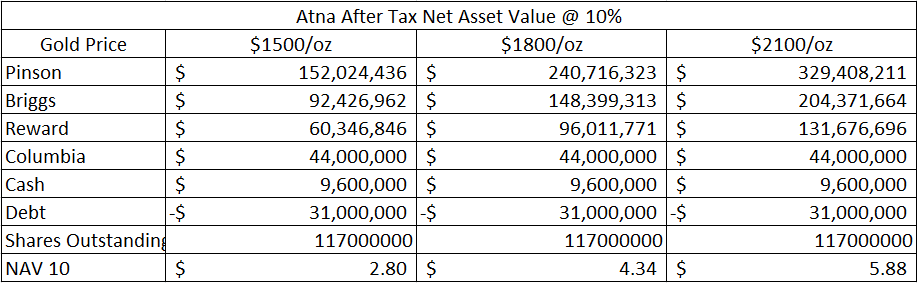
I have been working through an analysis of Atna and while I am not quite ready to post that analysis, I am ready to say that I believe Atna is the best way of playing a bet on sustainable gold prices at $1500/oz or higher.  As I have dug deeper into the company I have been surprised with just how many assets they have.  In addition to a producing mine (Briggs) and a low capital cost, high grade development (Pinson), they have over 1Moz of gold in Montana (Columbia), 300Koz of oxidized resource and based on recent drill results more to come at Reward, and another 150Koz of oxidized resource a few miles away from Briggs at Cecil.   And those are just the properties with a known resource.  In addition they have a score of properties with exploration potential, including a few that are signed off as JV’s to be drilled using other people’s money.

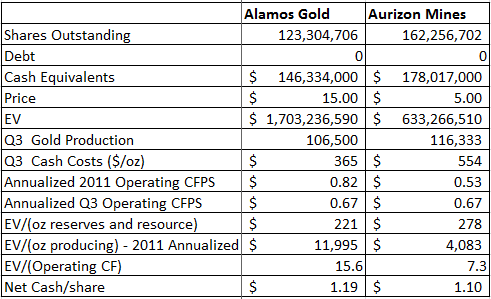
In the analysis I will post later I will get deeper in the net asset value of the company, but for now consider the following table. With Atna, for a price of about $100M enterprise value, you are getting around 5Moz of total resource, of which the majority is either very high grade (Pinson) or has open pit heap leaching potential (Briggs, Reward, Cecil).  All to be had for $20/oz.

I plan to increase my position in Atna even further.  I could forsee a time when it is primary vehicle for investing in gold.

Portfolio Changes

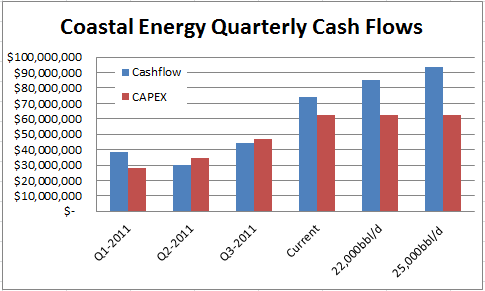
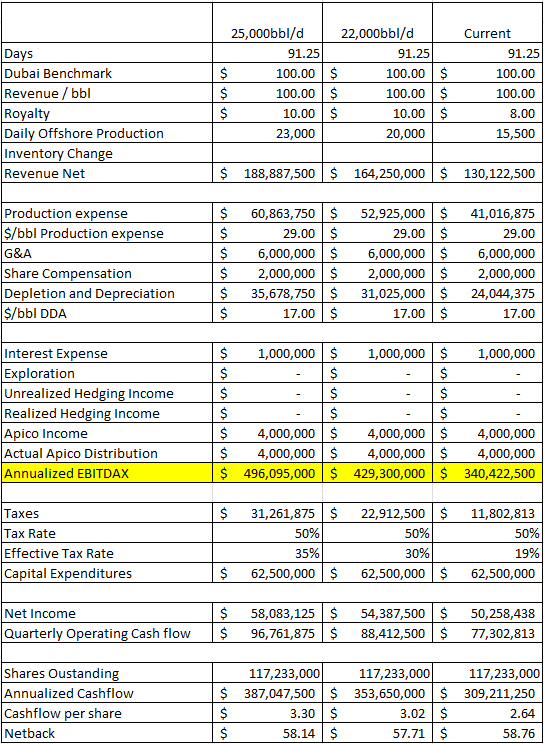
As I posted earlier this week, I’ve reduced down my position in Arcan Resouces substantially.  I now basically have equivalent positions in 3 domestic oil producing juniors, Arcan, Reliable Energy, and Equal Energy.  Consider this to be my oil junior basket.  I own much more of Coastal Energy.  I have no plans to reduce my position there.  Coastal remains the single best oil investment out there in my opinion.  They are self-funding, are increasing their reserves with every well, and trade reasonably at $98,000 per flowing boe, and far below their NAV (the NPV10 as per the 2011 reserve report was $10.42 per share, since that time they have increased proved and probable reserves from 25mmbbl to over 90mmbbl.

Portfolio

Out with the Old, In with the New: Arcan Resources and Reliable Energy

Updated:  I mistakenly stated that Arcan had spent $40M on the Stimsol purchase.  It was $24M.  I got my original information from a Scotia report, which read: we note ~$40M of the uptick was associated with the purchase of StimSol and for land.  I mistakenly read this as $40M for Stimsol.  I also  sleepily referred to Stimsol as a frac fluid producer when of course they produce acidizing chemicals and solvents for de-waxing.

On Monday in the mid afternoon Arcan released third quarter results that I was less than impressed with.  I was lucky enough to receive a google alert on the earnings release before the market fully reacted. I quickly halved my stake in Arcan in my on-line portfolio.

As I wrote on the weekend, in my real portfolio I had already substantially sold down my position.  With the release of the quarter I sold more, dropping it to a rather miniscule 1% weighting.  With the stock is trading in the mid-4’s two days later it appears to have been the right thing to do.

Was the quarter that bad?  On the face of it, the production numbers were ok.  Arcan produced 3,680boe/d in the third quarter. This was somewhat disappointing since the company had stated as far back as July 20th that they were producing 4,400boe/d. Growth is trending upwards, but the company really needs hit their exit guidance of 6,000boe/d to prove to the market that they have built a solid base to grow off of.

And while the company provided 4th quarter guidance of between 4,600boe/d and 4,800boe/d and exit guidance of 6,000boe/d, they did not give an estimate of current production.  I always wonder about this.  While it is not necessary for a company to provide a current production number, you have to think that if they don’t it isn’t because they have good news to share.

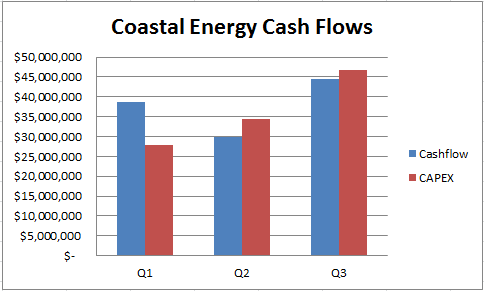
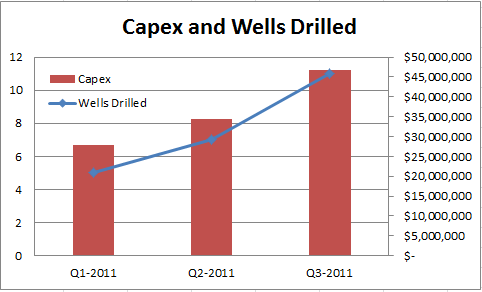
Overshadowing the production figures were the 3rd quarter capital expenditures by the company.  Arcan spent a rather extraordinary $87M in the quarter.   This is far and above the already high levels of CAPEX that the company spent in the previous 2 quarters.  It is also far and above its cash flow. Now $24M of this capital was spent buying Stimsol, a maker of the acidizing blend that Arcan uses.  But even subtracting out that sale, Arcan still spent almost $63M of capital, or 5x its current cash flow.

Given the future capital expenditures alluded to in the quarters report (road building, a pipeline from Ethel, remediation of the existing pipeline at Morse Unit, waterflood at Ethel), one has to expect this trend to continue going forward.  To be fair though, the recent debt and equity offering the company made does give them the money to fund these expenditures.

While CAPEX went up, netbacks came down.  Netbacks in the quarter were $41.90, versus $55 in the second quarter.  Of course much of this can be attributed to the Swan Hills fires in the summer (the company said this amounted to $10-$15/bbl) which was a one-time cost, but in addition at least some of the increase is attributable to Ethel production, which right now is being shipped by truck to the Morse Unit.  The situation is explained by the company in the clip below, along with an ETA of the first quarter of 2012.

Arcan estimates a significant reduction in operating expenses in the first quarter of 2012 due to a number of activities which are currently underway. These activities include completion of the construction of a high grade road system that connects the DM2 through Arcan’s Ethel property into Morse River, the commencement of pipeline infrastructure along the new road system backbone that will allow production in Ethel to flow to the DM2 oil facility, and the construction of pipeline infrastructure to facilitate water injection in the Ethel area. Arcan is also working on resolving issues with the clean oil pipeline which flows from the DM2.

Arcan is still on the right path, they are just moving more slowly down it than I would like to see.  The problem with moving more slowly is that Arcan is valued quite highly compared to its peers, so slower than expected growth leaves lots of room for downside questioning.

All flowing boe numbers are based on the latest production estimate provided by the company.

With some of the proceeds of Arcan I bought a position in Reliable Energy.

Reliable Energy released their 3rd quarter results on Tuesday morning.  While Arcan produced a decent production increase while spending a lot of capital, Reliable showed similar production increases (production has almost doubled since the 3rd quarter), while spending more closely in line with their means.

Moreover, a look at cash flow shows that Reliable will be more able to spend within their means in the coming quarters.  Reliable generated $3.8M of cash flow in the 3rd quarter with a netback of $65/bbl.  As of their latest production estimate they are now producing about 500bbl/d more than they averaged in Q3.  At $60/bbl netback that would work out to about $3M additional per quarter in cash flow.  That puts the yearly cash flow somewhere around (maybe slightly above) the $25M per year range.  The capex budget for 2011 is $25M.

Midway, Arcan and others have had to spend well beyond their means to grow production.  In some environments that is not a deterrent.  In our current liquidity strained environment, it is.  Reliable looks to be in a better position to do that, at least in the short term.

The other important consideration with Reliable is that they are beginning to ramp up into the 2nd of 3 consecutive quarters of drilling.  Reliable basically moves to the sidelines during spring break up, and so they tend to see decent production gains through the winter months as they spend a disporportionate amount of their yearly CAPEX budget during that time.  The drilling and completions in Q3  is responsible for the production increases so far in the 4th quarter.  With a little luck it will continue going forward.

The company trades at about half of what Arcan does on a flowing basis.  At $47,000/flowing boe (see the above chart where I compared flowing boe numbers for a number of juniors) the company is reasonably cheap compared to its peers, especially considering they are producing high netback light oil.  On a reserves basis the company trades at close to its 2010 NPV10 of $0.19.

I suspect when their 2011 reserves report comes out (likely not until late in the first quarter) it will show a significant increase over the 2010 reserves.  The 2010 reserve report (available on Sedar) gave them 800,000bbl of undeveloped reserves and 400,000 of developed producing reserves.  The 400,000bbl was likely entirely vertical drills.  The undeveloped works out to the equivalent of about 8-10 horizontal locations depending on the evaluators productivity per well guess.  In the next report that number should go up pretty substantially.   Up to the end of the 3rd quarter Reliable had drilled 10 successful hz wells this year so offsets alone should double that number.

In all, Reliable Energy looks to me like a better bet for near term price appreciation than Arcan does.

Week 21: Getting Worried Again

(current positions shown at end of post)

The benchmarks that I compare my portfolio performance to have begun to trend ominously down.  I am a little concerned about what the market will do next week now that Thanksgiving is over and investors are looking more soberly at a pictrue of Europe that really should perhaps not be viewed without a good bottle of scotch.  Of course the rumor making the rounds tonight is that the IMF is going to set up a massive bailout fund for Italy and that has the market soaring.  Count me a skeptic here.  Morgan Stanley put out the following note on the subject:

The Italian newspaper La Stampa reported over the weekend that the IMF is preparing a €400-600bn loan at a 4-5% interest rate for Italy. We would view this report skeptically, as even a credit line amounting to the lower end of the reported range would eat up the entirety of the IMF’s available $385bn (as of Sept ’11) forward commitment capacity. The only workaround would involve substantial IMF quota increases, a measure that would require the support of the US Congress.

The bottomline is that while stocks may be rising on the news, yields in Italy have hardly fallen this morning, an German yields are actually up.  There simply is no easy Sunday night fix for this crisis.

Europe Still Dictates my Decisions

What worries me is that in the end it is the ECB that has to step up and fill the void and there is more than a little evidence out there that the ECB has no intention of coming to the rescue of profligate governments.  There is a very good article in the NYT this weekend called As Crisis Mounts, Europe’s Central Bank Stands Back.  The article explains the ECB position.  Printing money to buy the bonds of countries facing funding problems does not solve the underlying issue. And the ECB is not necessarily going to step in.  Witness the following:

“I think markets are going up a blind alley thinking there’s going to be a common euro bond or thinking that the E.C.B. is going to act as a lender of last resort,” Norman Lamont, the former British finance minister, told Bloomberg on Friday. “I think Germany would rather leave the euro than see the E.C.B.’s integrity affected.”

Instead, the E.C.B. insists, euro area governments must amend their errant ways. “Governments need to ensure, under any circumstances, the achievement of announced fiscal targets and deliver the envisaged institutional and structural reform programs,” Mr. González-Páramo said in London on Friday.

This is true.  However what printing money does do is it avoids a full scale banking crisis and the commiserate deflationary recession brought on by the insolvency of Italy or Spain that results from the funding problems.

If the ECB chooses not to engage in significant bond buying, and to stand aside as Italian and Spanish yields march higher, markets will rightly conclude that a deflationary recession must be priced in.  And this isn’t going to be goo for any asset, save perhaps US treasury bonds.  It isn’t even going to be good for gold.

It is with that line of reasoning that I remain 50% cash, and while I am not allowed to short in my online portfolio, I am 50% hedged with shorts against my long positions.  My long positions remain significantly skewed towards the gold stocks.

Portfolio Moves:

I didn’t buy or sell any stocks this last week in my online portfolio. This was not entirely the case however for my actual portfolio.   In particular, I sold some Arcan early in the week this week.  My overall exposure to Arcan in my online portfolio  is about 5%.  In my actual portfolio it is now only 2%.  In addition to Arcan, I have a small position in Midway (about 1%) that is not represented here.  Let’s talk for  a second about the problem with these stocks.

Why you should be Wary the Oil Juniors:

Both Midway and Arcan are junior oil producers.  Arcan has a large (96,000 acre) position in the heart of Swan Hills.  I have written extensively on the company here.  Midway has a fairly large (33,000 acre) position in the Garrington Cardium and a reasonably sized position (23,000 acres) on the fringes of Swan Hills.

Both Arcan and Midway show strong growth in production, as witnessed below:


Based on their growth both companies look like great investments.  And they are… in the right environment.  The problem comes with the particular environment we find ourselves in.  We live in a credit constrained world.  Based on events of the last few months, most notably of late the escalating problem that even the Germans are having trying to raise money, and one has to wonder how well companies that are not self-financing are going to do.

The downfall of Arcan and Midway is that they are anything but self-financing.

With European banks teetering on the brink it just doesn’t seem like a great time to be taking much of a chance on companies that need cash.  I have reduced my exposure to Arcan and have decided to leave my exposure to Midway at its current level unless we see some sort of resolution across the ocean (as if).  I likely will wish that I had done the same steps here online.   Unfortunately Arcan fell rather substantially last week and I am reluctant to reduce the position now at below $5/share.

New Short Position in Deutsche Bank:

The other move that I made that is not expressed in the online portfolio is that I add a short position to Deutsche Bank.  I have been trying to add a short position in this stock for months.  Its hard to get the shares to short with.  I finally had some luck and shorted it at $34.  I have been reading about the company regularly in FT.  This is one leveraged bank.  The tangible assets to equity ratio is 60:1.  To compare, when researching the regionals, I wouldn’t look twice at a regional bank that had a ratio above 10:1, and many of the one’s I found most attractive (Home Federal Bank of Louisiana for one) had ratios of less than 5:1. This makes DB the most underfunded bank in the EU.

Secondly, DB relies on wholesale funding for short-term liquidity to a greater degree than most. Below is how Deutsche Bank stands in comparison to other EU banks with regard to the Net Stable Funding Ratio (NSFR), which is often used as a proxy for determining a banks reliance on wholesale funding.

It seems to me that the combination of high leverage and reliance on less than stable sources of funding are a recipe for a liquidity squeeze for DB as Europe continues to get worse.

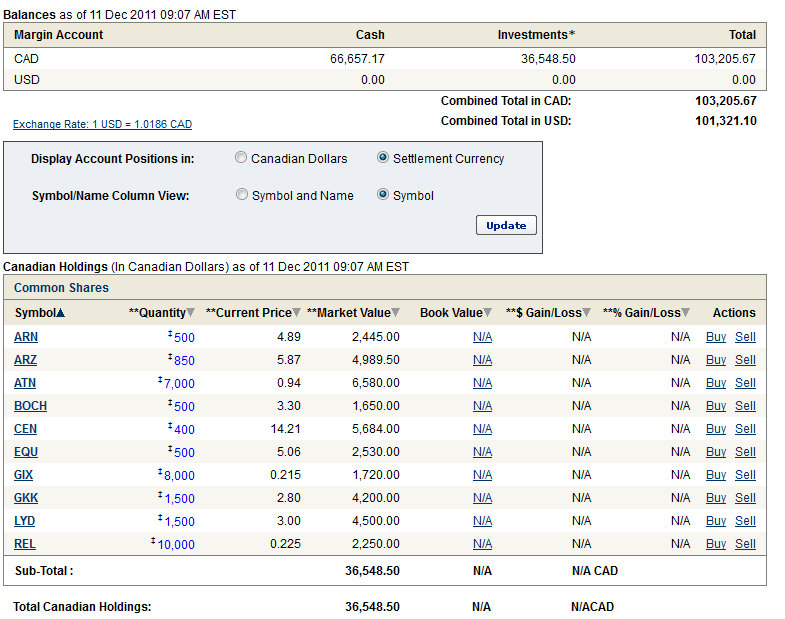
Current Portfolio: