Skip to content

Not Buying this Rally

While I have been happily taking part in the rally this week I remain skeptical in its sustainability.  The positives right now are all in the “price action”.  If you look beyond the improving prices of the stocks, there is not very much positive to be said about the underlying conditions.

Lets take, as our first exhibit, Europe.  The market rally seemed to get kicked off this week with the news out of Brussels that Sarkozy and Merkel had a plan.  Or the makings of a plan.  Or a plan of a plan.  They had talked anyways, and the market deemed this to be significant and positive.

It is worthwhile here to look at some of the details of what was said by the two leaders.  In particular, the emphasis that they made that changes were needed to the actual constitutional treaty that underlies the EU.  Here is what Dennis Gartman said on the matter:

We continue… perhaps too dramatically… to dwell upon the statement by Ms. Merkel that France and Germany “will make proposals in a comprehensive package… that will include changes to [the] treaties” that established the European monetary and political unions. Ms. Merkel went out of her way Sunday and again yesterday to reiterate that “treaty” statement so that no one anywhere would misunderstand the seriousness of the situation. Changes to the treaties of Maastricht, Amsterdam, Lisbon and Nice require passage by either public referenda or by vote of the parliament in individual nations… that is left to the nations themselves… and importantly the votes must be unanimous. Not one… not a single nation in the “unions” in question… can vote against such changes. They are not passed by mere majorities of the member nations, nor by super-majorities, but by unanimity. Essentially, Slovakia must agree with Germany and Germany must agree with Ireland and Ireland must agree with Austria and so on to unanimity… Unless Ms. Merkel was lying openly and often in the past two days regarding the need to revise these seminal treaties at the core of the political and monetary unions, we find it difficult if not wholly impossible to believe that this unanimity can be achieved within anything less than one year…

The situation in Europe is far from resolved.  I would even argue that given the difficult nature of what it looks like they are now trying to accomplish, things just got a bit worse.

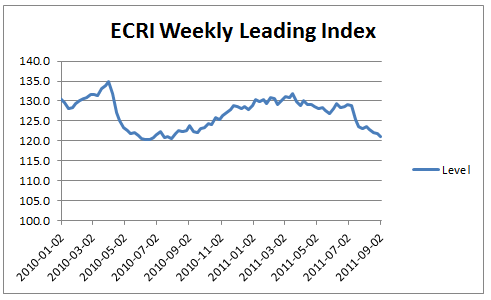
Meanwhile, one of my most trusted gauges of economic forecasting, the ECRI, has been getting more and more negative on the outlook for the US economy, and last week they tipped officially into the recession camp.  Now these guys are no David Rosenberg; they are not making a recession call based on a theory or the historical precedent of credit contractions elsewhere, no the ECRI is looking at the long leading indicators that have traditionally foretold economic strength and weakness and these indicators are, right now, pointing solidly downward.

I think its worth mentioning that during the sharper but shorter downturn in the index that occured in the spring of 2010, the ECRI was adamant that this did not signal a recession.  A lot of other bears did, I remember reading Rosenberg at the time and he conveniently used the WLI data to foretell a recession that never came.  But the ECRI did not.  I think they key difference is the “persistance” of the current move down.  The index has been moving down steadily since March.

The index also seems to be a very good indicator of stock market turns.  It turned almost co-incidentally with the market during the March 2009 bottom.  As you can see from the chart above, this year it turned down almost at the same time as the market topped.  I would have somewhat more faith in this rally if the index was not foretelling more economic weakness ahead.

This week I sold out of Gramercy Capital.  Gramercy was the last of my US real estate related holdings, as I have already sold out of Oneida Financial and Home Federal Bank of Louisiana.  With the US economy slowing, this doesn’t seem like a particularly good time to be making long bets on real estate. FT Alphaville posted an interesting article on the state of prime mortgages in the US.  It seems that a number of the prime mortgage indexes have fallen off preciptiously in the last few weeks.

Now these indexes only represent a sampling of the outstanding MBS, and it very could be that they are skewed to areas of the country (ie. Califronia) that are currently experiencing more weakness then the country as a whole.  Still its a sobering thought to contemplate that the housing downturn has another leg left in it.

Tying this back to Gramercy, while the company remains in a much better position than it has been in for the last few years, being no longer overly leveraged and generating significant cash flow, the lifeblood of that cash flow is still tied to the US economy, and so Gramercy is not going to be immune to a US recession.  You saw that this was the case last week when news came out that CDO-2005 failed its overcollateralization test for September.  When the company released their delayed 10-Q’s, they had this to say about CDO-2005:

“We expect that the overcollateralization test for the 2005 CDO will fail at the October 2011 distribution date”

Now this is not the end of the world for the company.  Indeed, Plan Maestro pointed out on one of the boards that it likely gives Gramercy more chances to buy the CDO bonds at distressed prices.  CDO-2006 is still generating lots of cash flow.  My point is that in an environment of a deteriorating economy, and in a world where the collapse of the second largest reserve currency is still very much a possibility, one needs to err on the side of caution.

I suspect that absent some sort of private equity take-over of the company, I will be able to buy Gramercy back at a cheaper price than I sold it at.  Just a couple weeks ago the stock was trading in the $2.60’s.  I sold at $3.20.  I suspect I will be able to pick it back up in the $2.60’s once the dust settles and Europe is found to be still wearing no clothes.

Some last bits of news, again of the positive sort, was, first of all, that Crescent Point participated rather significantly in Arcan’s recent financing.  So while retail was selling stock at sub $4, Crescent Point was buying it at $5.45.  The market is somewhat ridiculous, isn’t it?  I picked up a few shares of Arcan during the “panic”.  I’ve been contemplating reducing my position back to its normal size now that the stock has moved up, but I haven’t done so yet.  But I will; I want to use this rally lower risk in my portfolio right now, and so scaling back on everything is prudent I think.

Last night Coastal Energy released what looks like some very good news.  The hope has always been that the Bua Ban North A and B reservoirs were actually a single, larger reservoir.  The latest well seemes to confirm this:

“We are extremely pleased with the results of the A-08 well, which further supports the conclusion that Bua Ban North A & B are likely in communication in the western fault closure of the structure. We now plan to drill an additional delineation well halfway between the A & B fields on the western side of the structure to further confirm this. This well will spud by this weekend.

Coastal was another stock that I bought a bit more of on fire sale.  I don’t think I’m going to sell any of this one.  Its too cheap and the results remain too good.

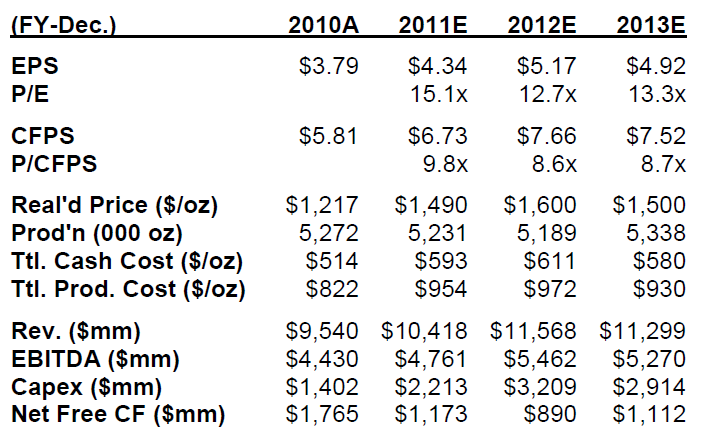
The last thing I have been doing this week is paring my positions in my junior miners in favor of a position in Newmont. Why Newmont, you might say.  A couple reasons.  First, as the below snapshot from BMO illustrates, Newmont is not expensive.  In fact the stock is trading as cheaply now as it ever has.

Second, if you look at the price performance of Newmont through the recent downturn, it has performed admirably well.  While the juniors got decimated during the two week downturn, Newmont did not.  An while I still really like the idea of gold stocks, I don’t totally trust that if Euope goes into freefall again that they won’t put in a repeat performance of this themselves.  I’d rather own a little bit less of the volatility provided by Jaguar and OceanaGold and a little bit more of the stability (and dividends!) provided by Newmont.


Week 14 Portfolio Update: Treading Water

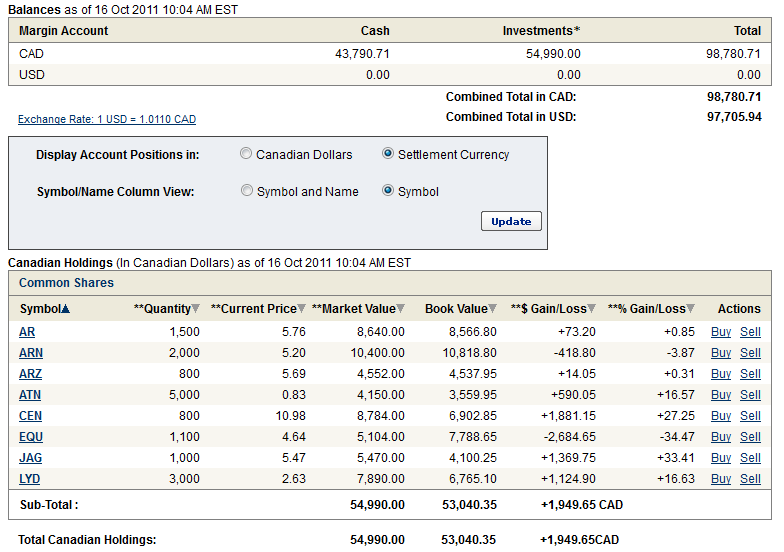
The only two changes made to my portfolio this week were to add Atna Resources and Brigus Gold to the list of gold stocks that I own.  I plan to write-up Atna in short order, but in the mean time their denver gold show presentation outlines why I like the company quite well.  I remain stubborn (for now) to the fact that gold stocks cannot continue to trade at the same prices they did when gold was $500/oz less.  These companies are making a tremendous  amount of money right now, and that is going to be born out in Q3.  I am holding these stocks through the operational updates, which should begin to be released this week.

Meanwhile the takeover of Daylight Energy this weekend should help buoy my energy stocks next week, and has me actively contemplating adding to my position in Equal Energy at these levels.  If it wasn’t for my continuing wariness of Europe I undoubtably would.  But these are not normal times.

Argonaut Gold

Over the past couple months I have put together a fairly decent sized position in Argonaut Gold.  I’ve taken advantage of its dip below $5 (who’d a thunk it?) and the stock now makes up my largest gold stock position.  In preparation for the companies coming Q3 release (operating results will be released October 15th if history is any guide) this last weekend I sat down and listened to Argonaut Golds Denver Gold Show presentation and re-listened to their Q2 conference call.

Now I want to talk for a second about capex.   A lot of the simpler analysis that you will read on the web will provide a valuation of the company on a EV/oz basis.  In the case of most micro-cap evaluations (pumping?) this is usually followed by a comparison to the EV/oz value of a number of competitors, and then a conclusion that the stock in question is undervalued by some multiple of its current price.

So the unwitting gold mining investor jumps on this yet-to-be-discovered-by-the-market gem and proceeds to agonize over the fact that years later the value has yet to be realized and the stock, which has likely been diluted by multiple share offerings at this points, is still languishing at or below its current price.

Such is the agony that most of us gold stock investors have gone through when we first began investing in the sector.  Unfortunately, it seems that many continue this mistaken evaluation technique until they either give up or lose all their money.  I myself got tired of losing money and instead decided to try to understand why some gold stocks go up and others seem to do nothing for years.

One of the main differences between the winners and the losers of gold mining are the capital expenditures that it takes to bring the mine into production.  Mining is a process that takes place over many years, but the costs to build a mine are incurred mostly up front.  In any discounted cash flow model, those costs loom particularly large in determining whether a project is economic.

The cheapest type of mine development (as a general rule), is a heap leach mine, particularly if the ore does not have to be crushed before being taken to the pad.  All a heap leach mine requires are a bunch of yellow trucks and some cyanide solution to leach the gold out of the rock.   Lydian’s Amsular project is an example of a heap leach development.  Argonaut says that a typical heap leach project can usually be built for about $50/oz.  That means a 2Moz deposit can be built for $100M.  That’s about 1/4 of the costs it would take to build a mine of similar size that requires a mill and circuit.

During the Denver Gold Show presentation Argonaut put a lot of emphasis on the fairly minimal capital costs that it will take to bring on their two advanced stage projects.   Argonaut can bring on a lot of production for what amounts to a relative pittance of capital expenditures.  How can they do this?  The company was smart in acquiring a couple advanced stage projects when they bought out Pediment Gold.  The projects they bought were heap leach projects.

Management said during the presentation that an SRK estimate done by Pedimont (previous owners) suggested that La Colorada could be brought into production for around $25M.   I took a look at the PEA released for the San Antonio project and the CAPEX for that project is estimated at $70M.

There are not many companies that can boast near term production potential with so little up front costs.

Both of these projects will have a material impact to Argonauts production profile, but the San Antonio is the bigger of the two.   Once built, San Antonio has the potential to produce 80,000-90,000 oz of gold a year at $500/oz.  The study (by AMEC) that developed that production profile was based on a resource of 1.2Moz.  Recent drilling at San Antonio has discovered an additional new zone with potential and the resource has grown to 1.6Moz.

I wrote an article the other day where I quoted from a recent Rick Rule interview.  One of the points he made was that pretty much all the PEA’s that are coming out these days are being done at $1100/oz gold.  Impressively, many of them are showing good economics at this price, but they would show much better economics if something approaching the forward strip price was used.  Most juniors are being evaluated and priced on this much lower gold price.

While Rule was referring to non-producing juniors, the same could be said for producing juniors with a pipeline of projects like Argonaut Gold.  And San Antonio  is a poster child for just that kind of valuation mismatch.

I spent a couple of hours working through the August 2010 PEA that Argonaut released on San  Antonio.  I looked at how the economics of the project would be affected by higher gold prices.  Below are the NPV10 results that I determined (the full analysis is available here).

I  think you could make the argument that right now, Argonaut is getting minimal or any value attributed to San Antonio.  The stock is trading on par or at a discount to peers based on metrics of current production, when those peers have nowhere near the growth profile that Argonaut has.

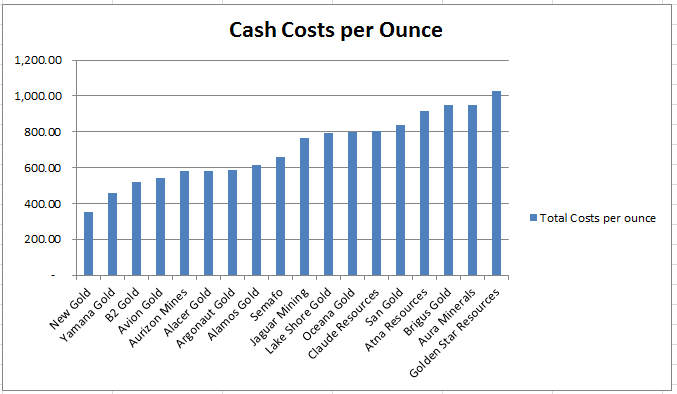
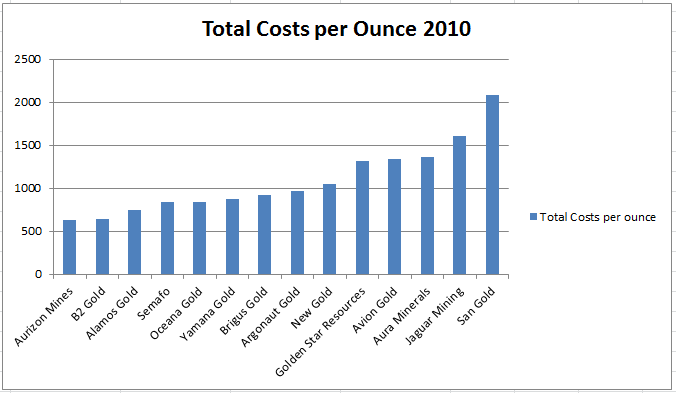
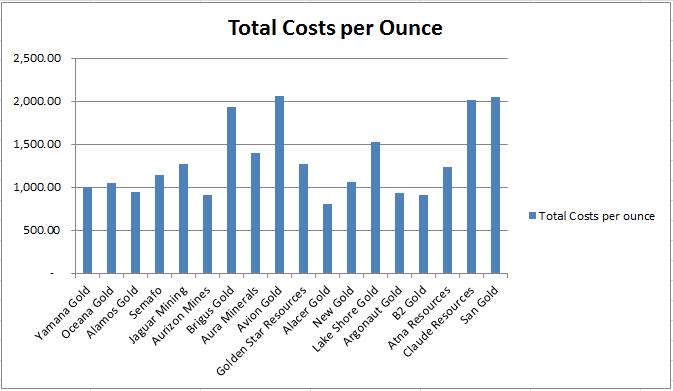
This is particularly perplexing, I would say, given the relatively low capital cost associated with bringing the mine into production.  Below is where Argonaut sits on an earnings and cash flow basis in the BMO universe.

And San Antonio is not the only growth opportunity that Argonaut has.  La Colorada is smaller, and it seems like the company is still trying to get a firm understanding of the mineralization, but the project does boast over 600,000 oz of resource, and there was mention made that this probably exceeds 750,000 oz now with the recent drilling. As I mentioned already, a mine can be built at La Colorada for the paltry sum of $25M.

It looks like La Colorada has a bulk tonnage deposit at about 1g/t, but with a couple thin but very high grade veins fairly close to surface.  There should be a new resource estimate on La Colorada coming out shortly.  The advantage of La Colorada is that it is a past producing mine, so it is fully permitted and partially developed.

Together the two projects will cost about $90M to bring into production.  Argonaut should be able to generate in the neighbourhood of $70M cash flow from El Castillo if gold prices stay around these levels.  Thus, Argonaut should be able to substantially  grow its production with little, if any, share dilution.

The key to this though will be El Castillo. El Castillo is an extremely low grade (0.33g/t) heach leap mine, also in Mexico.  Argonaut has been very successful at producing fairly low cost ounces (~$550/oz) at El Castillo.

I have to admit that the low grade ore at Castillo scares me some.  Such low grade leaves little margin for error.

The reason Argonaut can mine cost effectively with such low grades is because the deposit has a very low strip of less than 1.  I grabbed the following screen capture from a presentation on El Castillo.

If you were to extend the graph into 2011, the strip would be even lower.  In Q1 the strip was 0.88 and in Q2 it was down to 0.78.

During the Denver Gold Show presentation management went on to point out that the mine plan should allow them to lower the strip further in the coming yeasr.  The strip ratio is expected to drop further as they progress deeper into the pit.  The company has also recently built a processing facility on the east side of the mine.  This should not only expand capacity, but it will help reduce costs.  One of the biggest expenses in a low grade mine is the transportation costs.  Having processing on either side of the pit should help reduce those costs.

When you put it all together you have a company with decent positive cash flow trading on reasonable metrics and with a tremendous growht profile that can be funded without dilution.  It seems like a reasonable investment to make as long as the fundamentals remain in place for gold to stay at these levels.

Rick Rule Agrees!

One Sunday I wrote a post describing why I am remaining bullish of gold mining shares.  Nervously, I have stuck by my premise that many factors are aligning in favor of the gold mining stocks, and I have added to my position in the last two days.  Tuesday was nerve wracking, and there were a few hours where I wasn’t sure if the market would ever stop falling, but I tried to look past the immediate carnage and capitalize on some of the opportunities I saw.

To that end I bought new positions in Brigus Gold, Aurizon Mines, and added to my position in Atna Resources.  I now own a basket of mid-tier producers.  I hold them nervously, but I still firmly believe that the factors I laid out on Sunday.

Today I found out I am not the only one.  Rick Rule did an excellent interview with James Pulplava on September 28th where he laid out the bullish case for gold mining shares.  He stated a lot of the same reasons that I outlined myself.  On top of these though, he added a few more catalysts that should contribute to a favorable revaluation of gold mining shares over the medium term.

  1. The project net asset values and existing project cash flows are being evaluated and valued off of much lower gold prices.  Most project pre-economic assessments are being done at $1100/oz gold, and many done over the past couple years were done at even lower prices.  As the brokerage community becomes comfortable with a higher gold price, these numbers should rise, as should the share price
  2. Senior gold producers are finally beginning to generate significant amounts of free cash flow.  Rule says that they expect the gold mining sector to generate more free cash flow this year than they have in the last 5 years combined.  Many of the small and mid-tier producers trade at discounts to the seniors, so it is reasonable to expect that senior producers will begin to take some of them over.

Rule elaborated on the first point.  He went on to say that at Sprott they had actually done the analysis on 5 non-producers  with pre-economic studies but not with feasibility studies out to see whether you could take the companies private and achieve an acceptable level of return from them.  They looked at the effects of hedging a portion of production up front with the takeover to help pay off the capital expenditures associated with building the mind.

I couldn’t help but think that one of the companies Rule likely evaluated was Lydian International.  Lydian fits the description of a company with a deposit that has a pre-economic assessment complete.  Rule has talked about Lydian before, calling them an excellent take-over candidate.   And my own analysis on Lydian showed an upside to the stock of $6/share at $1300/oz gold.  At $1600/oz gold the value of Lydian is literally multiples of the current stock price.

I also couldn’t help but think that if Sprott is performing this kind of analysis, it must be considering some sort of actions along these lines.

Rule said that of the 5 companies he evaluated there were 3 that passed the criteria.  Some other companies that I could see being include in that evaluation are Trelawney, Spanish Mountain Gold, and Geologix.

All companies I will have to keep an eye on.