Skip to content

Gold Stocks: Am I Wrong?

Last week was playing out just dandy until about 7:30 am on thursday.  That’s when the stock market opened and the gold stocks I owned fell along with the rest of the market.

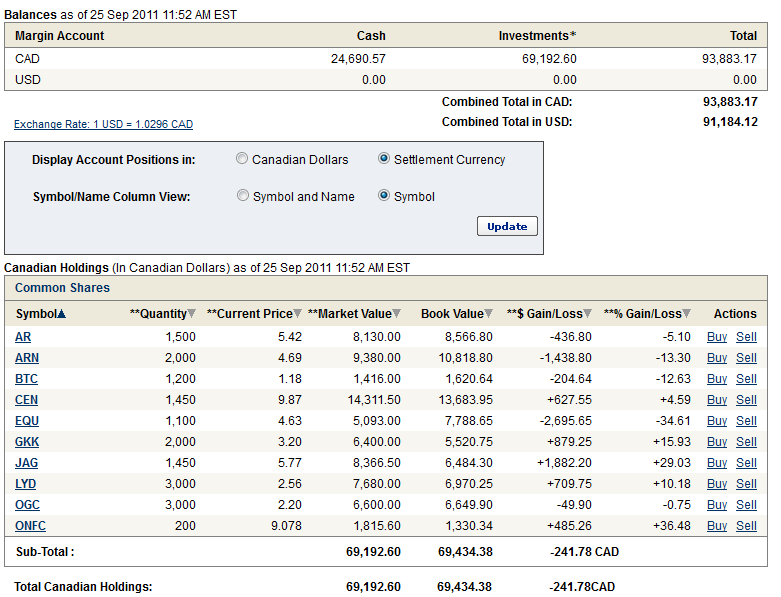
Since the peak on Wednesday afternoon Jaguar Mining is down $1.10, or 16.4%.  OceanaGold is down 0.65, or 23%.  Argonaut Gold is down 14%.  Lydian International is also down 14%.

Now I could write a post about how unjustified this is.  How these 4 stocks, and gold stocks in general, never began to price in a gold price of $1500/oz, let alone $1800/oz.  And about how in the case of OceanaGold and Jaguar Mining, the stock price is significantly lower then it was when the gold price was $1000/oz.

All of this is true, but its not necessarily helpful going forward.  What is helpful is to assess the situation and determine if I am best to stick it out, or admit that maybe I am wrong about the direction of gold stocks.

I’ve spent most of the weekend pondering the reasons for gold stocks to go up and the reasons for gold stocks to go down.

I think that the basis of all the arguments for and against come down to the causation of the rise in the price of gold.  Now maybe I am simplifying the situation too much, but think you can narrow it down to two contrasting views of why gold is going up.  Each view leads to a drastically different opinion of what will happen to the price of gold (and the price of gold stocks) going forward.

These views are:

  1. Gold has gone up on the expectation of Federal Reserve balance sheet expansion
  2. Gold has gone up on fear of the disintegration of the Euro and the EU

The first argument is what is being bandied about the most over the weekend.  Gold, and thus gold mining stocks, were pricing in QE3 and that didn’t happen.  Operation twist is not quantitative easing.  There is no expansion of the Federal Reserve balance sheet and there is none on the immediate horizon.  So if the price of gold is a function of the Federal Reserve balance sheet, then gold must return to pre-QE3-anticipation levels.  A good starting point would be $1400-$1500/oz.  Or perhaps gold goes lower if it overshoots to the downside or if the Fed begins to gain credibility in its balance sheet management.

The second view was invoked quite often over the last month, but it seems to have fallen on deaf ears in the last couple of days.  That’s because it doesn’t fit the evidence.  the EU is still a mess.  The price of gold is falling precipitously.

So does the move of the last two days mean that the Fed watchers are right and that the run in gold is over until there is at least some evidence of QE3 on the horizon?  I’m not willing to say that yet.  I’m going to re-quote what I paraphrased from Donald Coxe a couple days ago:

The investment case for gold lies in the 500 million people living within 17 different countries that have their savings, pay cheques, and pensions tied to a currency that was based on a theory and seems by the day to have less of a tie to reality.

This argument still holds a lot of water in my mind.  There is still no good way to resolve the situation in Europe.  As long as this is the case, gold should continue to have a bid.  And I can’t see how this will stop being the case.  There simply isn’t the money available to resolve the debt issues of the PIIGS.  The only solution seems to be the extradition of at least some of the PIIGS from the EU.  That is going to be such a messy process, with so many potential pitfalls for both the sovereigns and the banks, that I can’t see how gold would fall in such an environment.

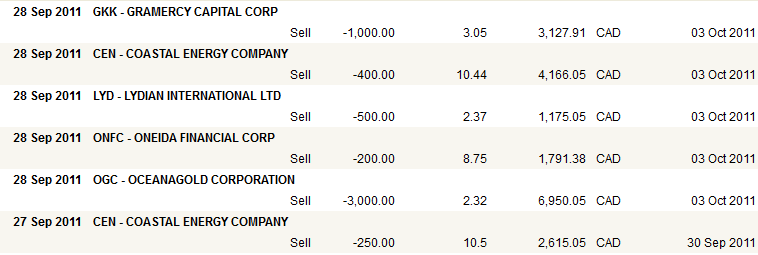
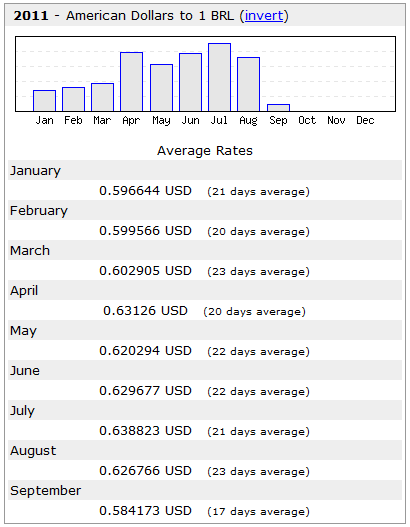
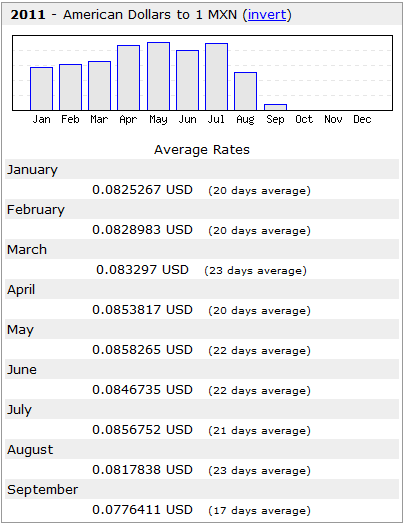
But I remain open to the possibility that I am wrong.  I will be watching the price of gold over the next few days and if the weakness continues I will have no choice but to cut my positions.  In that regard, I will likely lighten up on OceanaGold first.  Both Jaguar Mining and Argonaut Gold are in somewhat envious positions right now.  Jaguars mines are in Brazil, while Argonaut Gold has its mines in Mexico.  Both the Real and the Peso have been falling lately.  This will help bring down Q3 costs and even more bring down Q4 costs.

OceanaGold operates in New Zealand, and while the currency there has began to weaken, it is still above the average levels of Q2.

Lydian I will continue to hold because the story there is really less attached to the price of gold then in the other cases.  Lydian is moving forward an exploration project that will be profitable at much lower gold prices.  At some point the company will be taken out.  So that one I will hold as well.

We’ll just have to see how this next week plays out.

An Afternoon with Donald Coxe

This afternoon Donald Coxe talked at the Hyatt hotel in Calgary.   I was fortunate enough to listen to him speak.

Before I get into the details of what he talked about I want to recount something he said on one of his weekly conference calls a couple of weeks back.  During the question and answer session, a questioner asked what Coxe thought would be the outcome of the European crisis.

Coxe hesitated and walked around the question for a time, before finally explaining that he had to watch what he said on the conference call since they were now being transcribed.   He was worried about being quoted to a comment that might be too candid.

Well I guess that the talk that Coxe gave tonight wasn’t transcribed, because he was very candid and  he spoke plainly about what he thought of the situation in Europe.

What he said wasn’t terribly encouraging.  Nor was it terribly surprising.

We are in a financial crisis.  The economy is taking a back seat to the events in Europe.

The problem that he described is well known and one that I have brought up myself numerous times in the last couple of months.  It has guided my own investment decisions, those perhaps not enough.

Along with the euro came a strange presumption among banks and ratings agencies that countries of disparate histories and lifestyles could now be considered to behave as one and that the same terms of credit could be applied to their debt.   At the extreme of this conclusion was Greece, whose bonds were valued a mere 10 basis points above the Germans, and whose debt was triple A.

Unfortunately the historically profligate countries lived up to their reputation. Equally unfortunate is that so many European bankers fell for this ruse.   The problem that we now face is not so much that Greece and the other PIIGS cannot repay their debts, but that the holders of those debts are European banks that do not have the capital to cover the losses of default.

In the question and answer session the same question that had been posed on the call was posed to Coxe again: How was this mess in Europe going to turn out?

Coxe, being free of transcription, was much more candid in his answer.

First, he said that the process, whatever it may be, was bound to be messy.  He pointed out that the EU has no escape clause that allows for a country to leave.  It is the quintessential “roach motel”.  This lack of a way out makes it very difficult to map out the sequence of events that will precipitate from a default.

But defaults, at least in the case of  some of the PIIGS, is inevitable.  Thus, a recapitalization of some of the banks (he made reference the French ones) is inevitable too.

The tax paying public of the European countries who will have to anti up for these bailouts are not going to be happy.  How strong the response is we can only speculate, but Coxe did point out that each of the 5 French constitutions written in the countries history were, like the EU, devised without a clause for their unwinding.  In each case the constitution was eventually unwound by “the mobs of Paris”.

But that was not the end of Coxe’s forthright appraisal.  When the dust settles, Coxe said he would not be surprised if the Eurozone rolled all the way back to its beginning, and was reduced to its original 6 member nations.

I’m not sure if the audience grasped the gravity of that forecast.  The Eurozone is right now 17 countries.  That means he sees potentially 11 countries leaving the EU and returning to currencies of central banking of their own.  One can only shutter at the dislocations that would be involved in such tectonic shifts.

Well, in a world where the earth is moving  miles under our feet and where the admittance that the debt the PIIGS owe will not be repaid must be owned up to, what does one do?

Invest in the asset class that is the opposite of such un-payable liabilities.

Gold.  And gold mining stocks.  Gold is no one’s liability.

Lately we have had lots of commentary attributing the movements in gold to what the Fed is going to do or what the US economy is not going to do.  Well tonight Donald Coxe did not mention Operation Twist once in his primary comments, nor did he mention Bernanke, and he only once mentioned the US economy, but it was in a passing comment, one that actually was referring to the reality that it was not the economy that would drive the direction of the markets in general, and gold in particular, going forward.

To Coxe, trying to peg each movement of gold to a Fed comment, to operation twist or to a disappointing economic data point is akin to predicting the movement of the poles by watching which way the wind blows.

There are far greater forces at work.

The basic point that he made was that the reason to invest in gold and gold mining stocks right now is not the traditional one.  It is not the expectation of inflation, or the anticipation of a clever monetary trick by Bernanke.  The investment case for gold lies in the 500 million people living within 17 different countries that have their savings, pay cheques, and pensions tied to a currency that was based on a theory and seems by the day to have less of a tie to reality.

Coxe does freely admit, however, that the move up in the bullion must be consolidated.  With gold having risen dramatically, Coxe feels that the gold mining stocks are the better place to put your money.  He said that this kind of disparity between the bullion and the mining stocks has only existed one time before in history. So while he feels gold will go much higher, he also believes that more value lies in the gold stocks at the moment.

In particular Coxe passed along his usual recommendation:  look for companies with long life reserves in secure areas of the world.  Put less emphasis be put on near term earnings and more emphasis on long term asset value.  And if possible, find companies that have large peripheral deposits that will become or have recently become economic with the rise in the price of gold.

As Europe slowly and painfully gets resolved, Coxe thinks that gold is going to work its way back into the monetary system.  The Keynesian economists are going to fight it, and they are not going to like it, but in the end the only way to reinstate solvency in these otherwise bankrupt and soon to be currency-less countries is going to be to accept that gold must be used in some form to bring some confidence back to their system.

Coxe was short on words to describe how this process may play out.  But he did say, quite emphatically, that it would happen at a much higher gold price then the price we have today.

Arcan Resources: Thoughts on the Waterflood at Ethel

Arcan’s Q2 MD&A, which was released August 29th, was somewhat short on detail.  Unlike the past, the company neglected to provide much detail about their quarterly production.  Previous MD&A’s broke out production on a well by well basis, which helped to give some insight into where Arcan’s production has been coming from and what problems, if any, might lie ahead.  Nothing of the sort this time.  Its been suggested that this was Crescent Point’s influence.  Could be, the timing certainly coincides.

Nevertheless the MD&A did provide one nugget that was perhaps overlooked by the market but is nevertheless important.  Waterflood approval from the ERCB, which had been expected early in 2012, was given early.

In August Arcan received approval for water injection in the Ethel area. Wells are currently being converted to water injectors and water handling facilities are currently being constructed in order to commence water injection.

This is terrific news for the company.  Waterflood should be having an effect by sometime late in Q4 or early in Q1.

The news of the waterflood at Ethel made me want to dig a bit further into Arcan’s prodution.  I decided to investigate how much production was coming from Ethel, and what kinds of declines that unit was currently experiencing.

Below is a graph I made of Arcan production by unit (data available is to and including July 2011).  Note that I have not taken into account working interests and so the numbers are gross.  There are also a few wells that appear to me to fall outside the units (meaning the extents of waterflood) so I didn’t include those.  The production data is in calendar day rates.


Ethel is where Arcan has been focusing their resources of late and that is where the overall production increase is coming from.  At Ethel Arcan brought on-stream a well in April, a well in May, two wells in June and there are 2 wells tied in that should have been producing in August (15-08 and 06-10).  Meanwhile, DMU (Deer Mountain Unit) has been surprisingly flat given that they’ve only added on-stream a couple wells since the first quarter of this year.  Morse River is mostly vertical wells that have been producing for years, so its profile is basically flat.

Next I took a closer look at well performance at Ethel.  If you look at the average Ethel and DMU production curve, you can see the effect of the waterflood taking place at DMU versus Ethel.  Ethel wells do appear to stabilize at a lower level. The following chart looks strictly at horizontal Ethel and DMU wells drilled after Jan 1st 2010 (I didn’t want to confuse things by adding data from old completions) averaging out the monthly production for all wells at that point in their decline.  Producing day rates are used.

Now it has to be pointed out that the post 6 month data for Ethel is a single well (the 10-27).  So we are not dealing with a large dataset here.  Still, I think the conclusion can be made that Ethel wells drop off quicker and stabilieze at a lower rate without the waterflood.

Presumably with waterflood one would expect that Ethel type curve would shift up to where the DMU curve is.  One mitigating factor to this improvement might be reservoir quality.  The sands at Swan Hills have often been thought to thin to the south.  On the other hand, Arcan’s completion techniques have improved quite dramatically lately with the move to the larger acid fracs (another detail that was provided in the Q2 MD&A).  This is witnessed by the significantly higher IP30 and IP60 results produced by these presumably thinner sands at Ethel.  So this may help the Ethel wells outperform.

Its a bit of a guessing game until you get some data.

So what does it mean to production?  Two things.  First, with the waterflood implemented you would expect that the existing wells at Ethel would deliver a higher rate.  I’m going to speculate that, on average, this would be about 40bbl/d for the post 2009 drills.  This would add about 350bbl/d of production to Arcan.

A bigger effect will occur going forward.  Those wells put on-stream in June and July and those wells being drilled right now and through to the end of the year should see a shallower decline and more stable production profile after the first few months.

Arcan Resources was, for a time, my largest holding.  Arcan announced a large bought deal yesterday just before market close.  As you would expect, the stock did poorly today, trading down to the price of the deal.

After watching the stock fall on account of the bought deal, and doing some thinking about Ethel and the upcoming waterflood, I decided to buy a bit more Arcan yesterday.

When you look at the bought deal, they were able to raise a significant amount of money in what is a difficultenviornment.   As well, $85M of the $135M deal was in debentures.  This is good from the perspective of dilution; the debentures are convertible at $8.75.

Jennings put out a piece yesterday suggesting Arcan had the cash to be drilling 6 wells a month.  I don’t know if that will be the case, but if it is, 6 wells drilled into three areas now under waterflood should produce some impressive production gains. I remain of the opinion this is one stock worth holding through the unfolding European implosion.

Week 11 Portfolio Update: Riding Ahead on Choppy Waters of European Sovereign Debt

Well we made it through another week without the world washing away.  In fact the market was even up a few percent.  I don’t understand how, but it was.  We have a horror show all around us, with this perhaps being encapsulated most eloquently by the WSJ, of which I posted about on Tuesday.

The WSJ printed a truly frightening account of the borrowing situation in Europe.  The quote is so jarring that it is worth repeating I think. As per the WSJ, from the lips of one French bank executive:

“We can no longer borrow dollars. U.S. money-market funds are not lending to us anymore,” a bank executive for BNP Paribas, who declines to be named, told me last week. “Since we don’t have access to dollars anymore, we’re creating a market in euros. This is a first. . . . we hope it will work, otherwise the downward spiral will be hell. We will no longer be trusted at all and no one will lend to us anymore.”

The S&P promptly went up 12 points.

I mean, seriously?

Of course BNP denies the rumor vehemently.  So it must be just fear mongering, right?  The WSJ, meanwhile, stands by their source.  I don’t think its any secret that the French banks are going to be the first to have short term funding problems.  This has been pointed out many times by FT, with the most recent being here.  FT provided the following two graphs to bring the point home.

Both BNP Paribas and Soc Gen are high on wholesale funding (ie. they need access to markets to get the dollars to meet liabilities) and low on liquid assets (ie. they don’t have a lot of readily exchangable assets on hand to trade for dollars).

FT summed this situation up by commenting that it was “not good.”

Indeed.

Anyways, I made money this week, and it felt a bit like it might when you collect you’re last severence check and you’re not sure where the next one is going to come from.   I also sold more stock to raise more cash.  Every week my portolfio comes closer to approximating an underleveraged turnaround gold stock ETF.   Gold stocks are the only asset class I have an ounce of comfortable holding.  I keep hoping for a buyout of Arcan or for some truly unignorable news from Coastal that will send these positions to the stratosphere, but candidly I admit that the more likely scenario is that they shall go down with the good ship Europe.

What will next week bring?  God only knows.  Europe implosion?  Europe salvation?  Or more muddling misery where every rumor of an Asian knight is met with cries of relief and cheers of joy, even if its just the 5th update on the same retread story from Bloomberg.  Anyways, some day something is going to give.  Lets just hope that when it does, gold goes up.