Skip to content

A Bet on Biotechs

I have an awful lot of cash. While I am trying to not be in a hurry to use it (for all the reasons that I have explained in the past few posts), it is hard to pass when I see a decent looking trade.

As I wrote back in December, I am more inclined to believe that we are seeing a new bull market in the Biotech group than I am for other sectors. A longer-term chart of the XBI, which consolidated for years heading into this break, certainly looks that way.

Well, if that’s what I think then at some point I have to put my money where my mouth is. Therefore, after selling out of many of my biotechs during my portfolio purge last month, I have decided to buy back one of those names back and add a couple of others.

The one I am buying back is Renalytix. I wrote about the stock previously here.

Renalytix is developing a platform that will help physicians diagnose chronic kidney disease (CKD) early on. The platform is called KidneyIntelX.

KidneyIntelX takes in a range of patient data, including validated blood-based biomarkers, inherited genetics and personalized patient data from the EHR system. It uses a repository of patient histories with CKD to compare to the patient data, and then, using an “AI” algorithm, it spits out an assessment of where the patient stands in terms of risk of having or developing CKD.

This is a brand-new platform, so the company does not have any revenue yet. What they have so far are partnerships that look pretty good to me.

Their first partnership was with Mount Sinai health system. Right now, they are in the process of rolling out their first test reports to physicians in the Mount Sinai network. Mount Sinai will use KidneyIntelX to manage their 65,000 patients with DKD (that is diabetic kidney disease). They have another 150,000 patients with CKD.

Next Renalytix announced a partnership with Davita in January. Davita is one of the largest providers of kidney care services (205,300 patients at 2,809 outpatient dialysis centers) in the U.S. They wwill rollout KidneyIntelX to three states to start with, in hopes of identifying CKD patients earlier on.

Finally Renalytix announced this month that they had secured a partnership with the University of Utah to implement KidneyIntelX system-wide at University of Utah Health, which would include 1,700 clinicians across six states.

Renalytix also said in their March Q2 news release that they expected more partnerships announced before their June YE.

There is an upcoming catalyst this week. Renalytix should hear back from the FDA on their final submission for breakthrough device designation. In February 2021, the FDA sent written notification to Renalytix stating that it expected the final review process would return to normal no later than April 15, 2021.

If Renalytix gets final approval, which I would assume they will, KidneyIntelX will be approved for Medicare coverage via a rule called Medicare Coverage of Innovative Technology (MCIT). This rule, which was just finalized by HHS in January, provides for “opt-in national Medicare coverage determination for medical devices and diagnostics approved or cleared out of the FDA Breakthrough Device designation program.”

Pricing for the test has already been finalized at $950 per. The number of people that have CKD in the United States is 37 million and the Medicare spend on CKD is $120 billion. Worldwide the number of people with CKD is 850 million (!!).

There is a big problem with catching CKD early on. 38% of patients with CKD initiate dialysis with little or no prior clinical specialist consultation, and up to 63% of patients with CKD initiate dialysis in an unplanned fashion with a central venous catheter and/or during emergency hospitalization.

When I look at the Stifel initiation report for Renalytix, they estimate revenue of $46 million in 2022 and $85 million in 2023. These numbers were primarily based on the Mount Sinai patient population (Renalytix did not have Davita or Utah Health partnerships at the time of the report) so they should be even higher now.

The stock is not cheap – the market cap is about $800 million at this level. But if Stifel is right about how many tests and how much revenue we’ll see, it could begin to look very reasonable on a P/S basis, particularly if those 2022 and 2023 numbers go up with Davita and Utah Health.

What’s more, I know this market is all about TAM and quite honestly this looks like a very big TAM to me. Unless I’m missing something (which is possible – maybe there is a hiccup with the FDA or the test volume Stifel is estimating is too optimistic) then the stock could go quite a bit higher I think.

The second biotech I have added is a new position. Lyra Therapeutics.

I have had Lyra on my radar since December. It is one of those stocks where my timing has sucked. I had resolved to buy it on February 10th – the day before the stock popped $3 on an analyst initiation report.

I waited and waited and now it is pretty much back to that level. So I bought it.

Lyra has developed a drug delivery system to the nasal cavity, called their XTreo platform. XTreo is a patch that is implanted by the ENT during a “brief, noninvasive procedure”.

The patch carries with it momestasone furoate (MF), which is the standard of care treatment for chronic rhinosinutitis (CRS). The MF dose is time-released to the cavity and will last 6 months.

The upside of XTreo is that it can deliver the drug directly to the site of the inflammation rather than through a nasal spray or injection. The six months of time-release means the patient does not have to be compliant with administering it multiple times a day. And maybe most importantly, the indication that Lyra is going after is very broad – CRS with and without nasal polyps – which means that they will cover a lot of patients if approved.

The last point is the most important one I think. There are a number of drugs out there that treat CRS, but none with quite the combination that Lyra’s drug and delivery, LYR-210, offers.

The closest comparison is IntersectENT’s Sinuva. It was approved in 2017. Like LYR-210 it is a patch and it time releases MF. But it was only approved for post-surgery patients with nasal polyps. That is a small population. In 2020, which admittedly was likely impacted by covid, Sinuva only did about $5 million in revenue.

Optinose’s Xhance did much better – $48 million in revenue in 2020 after $30 million in 2019. Xhance is a nasal spray, it has to be administered twice a day, it is $425 per dispenser and each dispenser only lasts 15-30 days.

Merck’s Nasonex, which is the original MF nasal spray, did $200 million last year. But the drug has been off-patent since 2014. Merck did a little under $1 billion in sales with Nasonex the year before generics came to market.

Bank of America estimated 1.8 million patients a year that would qualify as the pre-surgery addressable population. At $2,000 per procedure that would be $4 billion of TAM.

Lyra had Ph2 results released in December and they were viewed unfavorably by the market (you can see that the stock tanked early-December, when they were released). But the issues with the results seem to have had more to do with COVID then with the performance of LYR-210.

The company could not enroll as many patients as they wanted, and because they had a smaller enrollment pool they needed a bigger effect from the drug versus the placebo to get the P-value (estimate of clinical significance) that they needed.

As it turned out, LYR-201 still reached clinically significant results for 8, 12, 16, and 24 weeks of treatment (it is the 7,500 micro-gram dose you want to look at in the chart below). But they did not for 4 week data, which was the primary endpoint.

Here’s the thing – the Ph3 trial that they expect to start later this year is not going to use the 4 week endpoint. It is going to use a 24 week endpoint. This should be a far lower hurdle for them to leap over.

Lyra has a ~$150 million market capitalization and about $75 million of cash. While it is not a perfect stock – I mean the indication is crowded, Optinose is in a Ph3 of their own for CRS, and Lyra isn’t developing a new drug, just a new way of delivering it – it seems like a reasonable bet on decent results now that the stock has tailed back off.

So those are the two I wanted to talk about.

We’ll see. I might be wrong – maybe the run in biotechs is over and they are back to a bear market. But I just find that hard to believe given the liquidity in the market, the strength of the market, and the chart of biotechs having broken out from such a long base. Anyway, we will find out shortly if this is an extended downturn or just another test.

Half Right and/or Half Wrong

One of my favorite books on investing is the very first book Jim Cramer ever wrote, called Confessions of a Street Addict. He wrote the book quite a while ago, before he had a show on CNBC and had turned into kind of a meme of his own, back in 2002.

Cramer was a hedge fund manager and a pretty good one. The book is about those hedge fund years. It has a lot of insights on how he managed the market with his fund.

There are some nuggets in the book that I have taken to as my own rules. Three of those are what Cramer used to do when he began to fall behind. He used 3 maneuvers when his fund was not doing well and he could not break the slump:

  1. Circling the Wagons
  2. Maidens to the Volcano
  3. Going Flat

Circling the wagons is when you pare back to a few positions that you have the highest conviction in, selling everything else.

Maidens to the Volcano is a sacrifice – sell the positions you love the most to appease the trading gods.

Going flat is the nuclear option, selling everything, good and bad.

I do all these things when I start to get frustrated with how my stocks are doing. Usually in stages of grief.

I start by circling the wagons, selling positions I’m not certain of in the first place. This time round it was stuff like Renalytix, Arca Biopharma, Millendo Therapeutics – stocks that I think could go up, but have some reservations about.

With my portfolio still not going up enough on up days and going down too much on down days, I start chucking the maidens. My first maiden this time around was Rada Electronics. Love the stock. Sold it, about 50c from the bottom too. Sold Intellicheck, this time better timed as it kept coming down. Sold most of Eastside Distilling.

Still not working. Market rallies, my portfolio does nothing. Market falls, my portfolio falls. A couple of days of this is enough. F- it – I’m going flat. Sell everything other than a few mega-cap positions like Facebook and Amazon and Google that were the only things that are working. Dump everything else, long, short and otherwise.

I sit on that for a few days. I ruminate. At first, I feel a huge wave of relief. My portfolio is not going up, but it is also not going down. I’m out. I can take a step back. Not worry about reading the news. I write something about how I don’t get this market, stepping aside, blah, blah blah. But what I really need is some perspective and I only get that when I step away for a few days.

But then the next stage of the process starts. I begin to get that gnawing feeling. I have not been looking at the market, not paying much attention, but nevertheless I’m getting anxious – anxious about being out.

So I start drilling down into that anxiety. What am I anxious about? Which stock am I craving?

I’m doing the work now on those names that are gnawing at me. Going through the numbers again, reading my notes. It is easier to do the work because I have no skin in the game. Do I really want to own this? Is it really worthwhile? Oh yeah, I forgot about that, this is a good idea. How is the market not seeing this?

Through this process I begin to see what I really want to own and what I did not need to. The stocks that give me that gnawing feeling, and where I take that second look and think man, that is a good idea – those are the one’s I buy back. The stocks that don’t – those are the one’s I should not have been holding in the first place.

Call it a process. A cleanse. I seem to need to go through this every so often.

The stocks that really gnawed on me? Rada. Intellicheck. Eastside Distilling. Biomerica. To a lesser extent, Smith-Micro. I bought those all back, some with even more conviction than before.

It is a terribly inefficient process. I will have to pay taxes on all those sales I made. I had to buy Rada back well above where I sold it. Obviously I’m paying all these trading fees on flushing everything out and then buying it back.

But I don’t know how else to do it? I never get clear-headed until I’m out. I never know what I really want to own until I don’t own any of it.

So anyway, that’s my last couple of weeks. This market is too strong. I was very right to get out of the index hedges. I was right to get into the mega-caps.

In addition to Facebook, Google and Amazon, I also bought the pharma stocks I mentioned in an earlier post – Bristol Myers, Abbvie and Lilly. I added to my Facebook position. I bought back Sharpspring, I stock I owned last fall. I’m still short puts on the high-flyers, though I feel like I screwed that up by not going for the EV names like RIDE, AYRO, GOEV, NKLA, and XL. Those are the real losers here and I kinda missed that.

And I was wrong to get out of all the micro-caps. But it was a necessary wrong. I had to get out, only to see what I needed to get back into.

March Update

My troubled feeling about the market began on January 8th.  And not necessarily to the downside. 

I was worried in the sense of “I’m not comfortable with what is going on”.   I was actually worried as much about a melt-up as a melt-down.  I wrote:

I have become actively worried about my hedges. So much so that before the market closed Thursday I went through all my inverse index positions and calculated how much my portfolio would lose from them if the market was up 2%, 3% or 4% on Friday. And then I adjusted their size to make sure each was at a level I could live with.

This is not normal.

I remain uneasy.   About index hedges, about many longs. 

In response, through March I got smaller.  Both on the long side and the short side.  Slowly reducing my hedges.  Reducing my individual longs.   

This week I took the step of being completely out of S&P and Russell inverse ETFs.    I am unhedged! 

Yet I am not bullish.  I added more cash and I reduced a lot of the micro-caps I own.

We have had a crazy period of small cap out-performance.  As I wrote in my last post, I thought that many corners of micro-cap land had gone too far.

So I am changing tact.  Selling the small stocks and looking to own big ones.

The S&P index continues to do great.  If you simply looked at the chart of the S&P, you would conclude I should be very bullish.

sanp

That chart is saying that nothing untoward is going on.  The market is clearly going up.  One look at this chart and you would conclude that you certainly do not want to be short right now.

BUT…. under the hood it is far more chaotic – and much less certain.

This is the problem – for me at least.  The market is going up but the same can’t be said for many names.  You can get creamed in this market if you own the wrong stock.

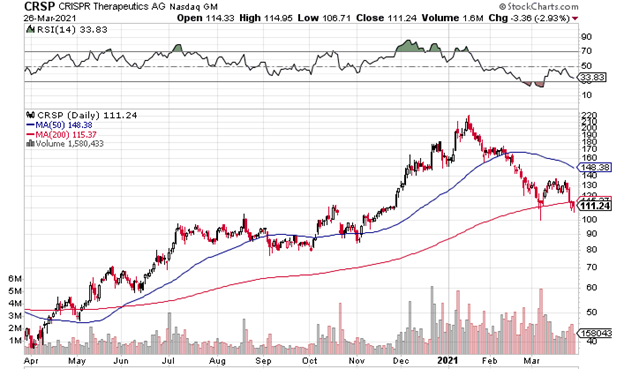
Leading the charge of this malaise are the stocks that led the market up for the last year.  The following two charts are what I would call “type curves” for a wide swath of tech/SaaS, clean energy and biotech high-flyers.

crsptwlo

“Type curve” is oil and gas parlance for an expected decline curve from a well.  In a given reservoir you might have 2-3 type curves of potential well performance.  When you drill a well you expect that it will perform roughly along one of those curves, and a bunch of wells should average out to the type curve. 

In this case, our type curves are two charts that fit the form of many, many stocks.

First, the CRSP chart fits all the stocks that ran up huge from the day of the November election until mid-January to mid-February (many, clean energy stocks, biotechs, and lots of micro-caps,).

Second, the TWLO chart fits the SaaS and stay-at-home world.  These are stocks that saw a relentless march up from the March lows of last year until mid-January to mid-February.

For those of you that do not follow individual stocks particularly closely, I recommend going to stockcharts.com and looking up the one-year charts of the following symbols: SE, ROKU, TWLO, PINS, PTON, ETSY, SQ, CRWD, TDOC, NET, TTD, TSLA, Z, PSNL, XONE, SSYS, DDD, FTCH, DDOG, FSLY, ZM, OKTA, TEAM, NLS, ADBE, SHOP, ZS, LSPD, PLTR, HUBS, CDLX, DOCU, IDN, PD, PAYC, CRM, LPSN, EXAS, BNGO, CRSP, PACB, TDOC, NVTA, TXG, CLPT, NSTG.  I could go on.

Tell me these aren’t all the same as one of the above two charts.  The numbers are different, there are nuances, but the type curve, ie. the basic pattern, is the same.

This is just a small sampling – the SaaS names and a few biotechs I follow.  If I listed all the electric vehicle names and clean energy names, like a QS or a FUV, or if I listed all the really crappy micro-caps (like IPWR, OEG, etc) you would see higher peaks and more distinct, severe sell-offs.  But they would all have the same pattern.  The point being that there are so many stocks that fit these type curves right now.

If you spend some time going through all of these charts (and the other 100 or so that I look at each week), it is hard to want to be really long right now. 

These charts all look like they topped out a month or so ago, broke down from that high, and now are about to do one of two things.  Either consolidate at lower but lofty levels, or make their way down another leg.

Is it the former or the latter? I mean, who knows.

But I lean toward the latter.  To reiterate what I said in my last post, there are a lot of names that don’t make sense to me.  To add to that  list, I find it hard to believe that TSLA (to use the most obvious and biggest example) can consolidate at $625, or a $600 billion market cap.  That is 12x bigger than Ford, 10x bigger than GM and 6x bigger than Volkswagen.  Meanwhile its business is seeing competition from all sides, its sales growth slows and its founder appears to be finally getting a microscope to his actions.

Or take PLUG, which even after being cut in half in the last 6 weeks has a market cap of nearly $20 billion.  That is a little less than half the enterprise value of Renault, the French automaker that is partnering with PLUG on a new H2 commercial vehicle.  Renault has $50 billion of revenue and $5 billion of EBITDA.  PLUG has never had $250 million of revenue or even $10 million of EBITDA. PLUG actually had negative revenue last (yes, that’s right, negative) and they are restating their financial statements because they found accounting errors.

But what do I know?  Maybe TSLA IS consolidating at $600 only to make that run to the $3,000 price target that ARK Investments put out for it on Monday this week.  Maybe PLUG IS on its way to being a $100 billion leader of the hydrogen economy.  When things have gone bat-shit crazy there is very little point trying to rationalize what the future outcome may be.

So what am I doing?  Well I am certainly scared to be short and kinda scared to be long.  That does not leave much left.

To a large degree, I am just sitting this out until it is a bit clearer.  I had a good year last year and a good first month and a bit this year and now my main goal is to not blow it.

I don’t like micro-caps in this market for a number of reasons.  First, they had a huge run since November.  Second, the IWM (the micro-cap index) has the same chart as type curve #1.  Third, the IWM is full of names like PLUG and PENN that are high-flyers and could roll over big-time if things go south.

But I don’t own those stocks so what do I care?  The problem is that micro-caps are very susceptible to catching a cold.  If the bigger one’s roll over the smaller one’s will get creamed, even if their fundamentals are far better.

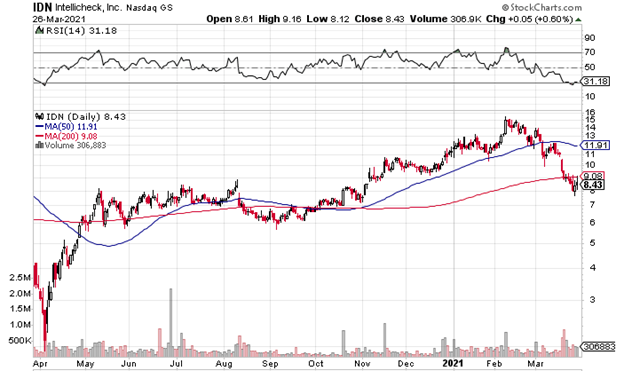
You have to consider which stocks might get caught up in the unwind.  A stock like Intellicheck should be a reopening play, but it is clearly in a downtrend of SaaS and high-flyers and who am I to say that $9 or now $8 is the bottom and not $7 or $6 or $5.  Its basically the same chart as all those stocks I mentioned above. 

IDN

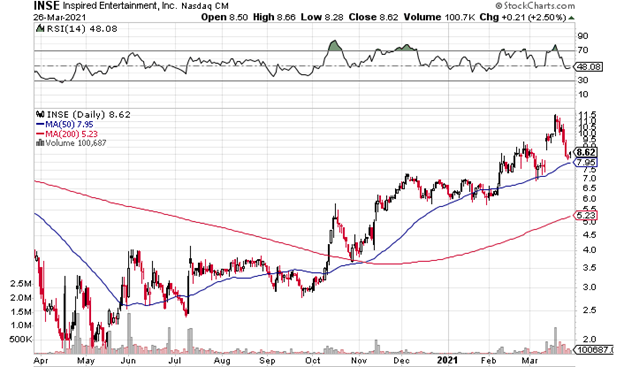
And adding new positions in micro-cap land is equally tricky right now.  Take Inspired Entertainment – INSE, a stock I talked about in October (at $3!!). I owned INSE from $3 to $5.50 or so.  I sold it because when a stock nearly doubles in a couple of months, in any normal market it would make sense to take profits.  In this market, I instead watched it go to the moon after I sold.  But if I had panicked (to the upside) and bought the breakout in early March, thinking OMG, FOMO – it’s another leg up (!!!), I would have been creamed this week and last.

inse

That is to say, these are more dangerous times than they appear.  Even though the S&P looks like a smooth train up, there is a lot going on with individual names that raises an eyebrow.  And if you are caught too long (or short for that matter) in the wrong individual name you could get hit pretty hard.  And micro-caps are minefields at the best of times.

On the other hand, I know there are trillions of stimulus checks and I have read or seen so many articles about the Treasury General Account and how there is $4 trillion in it that is coming out and is going to flood everything with liquidity the next few months.  And of course there is vaccines and reopening and blah, blah, blah.  So maybe the indexes keep going higher.

Last post I talked about Facebook and Amazon.  Google is another that has been consolidating for 2 months and does not seem to be particularly expensive for a well-moated tech firm with 20% growth (it trades at 25x 2022 earnings).  Abbvie trades at under 10x earnings and really has not done much of anything.  Likewise for Bristol Myers, which trades at 8.5x this years earnings.  Walgreens is 10x 2022 EPS and is one of the few stocks that has yet to get to its pre-Covid levels.  Even IBM is kinda interesting – 12x EPS and yes I know it is hated but wasn’t Intel hated not long ago?

I am still long many of the regional banks, though with much reduced sizes.  I am out of many of my microcap positions.  My cash levels are high.  I did go long a few gold stocks again, mostly because some of them had become so bombed out a couple weeks ago that they just seemed too cheap (Fiore Gold was down to 3-4x FCF at its low and New Gold is still at ~6x 2022 EPS at far lower copper prices).

Most importantly, I have almost no index shorts.  The only one that remains is a small position on the Nasdaq (PSQ), which I’m keeping on to balance against the mega-cap tech positions.  But I do not trust these index shorts right now.  Take that move Friday afternoon.  That was crazy.

The shorts I have are mostly long-dated out-of-the-money puts on the highest of flyers.  These are smallish bets that have big payouts if I am right and names like TSLA, PLUG, PTON, XONE and the like are not just consolidating and do indeed breakdown. 

I started putting these puts on in January, so some are much closer to their strike prices then they were then.  They only amount to ~1.5% of my portfolio.  If they all go bad then it’s a manageable loss. 

Unlike shorts, with puts I can only lose what I invested.  In that January 8th post I explained how nervous I was with TSLA, that it might gamma-squeeze further and that my short position might blow up one morning.  It may have been irrational but the fear was real.  So I exchanged my shorts for long-dated puts. 

These and other puts I bought are now in the money.  If a few of these high-flyers continue to crumble, they could be worth gains of five or ten times.  I still need more weakness to get those kinds of gains so it may not happen.  I need TSLA below $400 or PLUG below $20.  But we’ll see.

These next few weeks will be interesting.  We’ve have two tests of the support levels.  You can see that with the TWLO and CRSP charts.  Another rally maybe?  And then if that one fails, things won’t look very rosy for the type curve stocks.

Running out of Steam

Programming Note: I deleted my first 20 subscribers by accident. I do not know who I deleted but if someone mentions no longer having access to the blog, please have them contact me.

The good times are gone and it is time for moving on.

Well, at least from the gamma squeezes.

I’ve sold all the names that might have been squeezed. I have gone short a few of the most egregiously priced stocks. And I am long the largest of the large, as I will explain below.

I have not written too much since I talked about the gamma squeeze idea a month ago because really, what is the point? When what is working are stocks you were embarrassed to say you own, who wants to put up research and reasons for that ownership for all posterity to see?

Better to make some short term bets and collect dollars in the shadows, with no one the wiser.

I should not say the good times are gone. I do not really know. There is another round of stimulus checks coming, so it is possible there will be a round two of the silliness. But I really hope not. It is just so dumb.

I am actually starting to find the whole thing a bit annoying. There are so many crazily priced stocks. That these 3D printing names have gone up to such insane levels (though they finally came off thankfully) on growth that is, at least so far, very moderate, is just unfathomable to me. The same can be said for many biotech names. And of course for the EV stocks.

I was happy to see Zoom drop after every twitter shill screamed about its magnificent quarter last night. Not because I have anything against Zoom. But it seemed to signify a lessening of the euphoria in the market.

With that in mind, let’s talk about Kopin. I wrote up Kopin last fall, I wrote about it here, and I held the stock until $3.50 or a little above that. Now the stock is $9 and their quarterly results today were good. They were pretty much inline with what you’d expect given the large military contracts they announced last year that we knew they would be delivering on beginning in Q4.

On these results the stock was up another $2.50 early in the morning. I mean, holy geez. This idea that there is no limit to what something is worth as long as they beat has gone too far. Kopin is up 900% since the last quarter. So after a move like that, just because they beat the outdated analyst estimates… (the average estimate I saw was ~$9.5 million of revenue, which meant that the analysts weren’t really trying. They had clearly not updated their numbers to account for the big contracts that had been signed and so those estimates were basically meaningless). Nevertheless, the stock goes up another 25%? Come on.

When the stock was nearly $12 today Kopin was a $1 billion company. When I was looking at Kopin it was a $130 million company! That was 4 months ago? Its worth $1 billion now? Something completely game-changing must have happened right?

Not that I can see.

The biggest thing that happened is what I just said. Kopin began delivering on a couple of big military contracts. Nothing surprising. We all knew this was coming.

But what about the consumer AR/VR? Yup, no doubt about it, there is a big potential opportunity ahead in consumer AR/VR. That is what I liked about the stock in November. And yes, it maybe appears to be coming to fruition faster than anticipated. Maybe. On the call Chin Chiang Fan (the CEO) said the adoption cycle has been brought in 2-3 years.

But the numbers… I mean I did a DCF on this stock when I bought it. Those results are, quite honestly, why I didn’t hold it to these double digit nosebleed highs. I’ve played around with that model today. If you make what I think are some extremely optimistic assumptions, with many years of 40% growth and 15% FCF margins, and then you give Kopin a decent 15x FCF multiple on the terminal value 10 years from now, you get a price that is about $14. So a little higher than the high today.

Yet Chiang Fan is already explaining the reality. On the call he said gross margins are only going to be 20-30% for consumer wearables. This is not a SaaS business. So yeah, the volumes, when and if they come, will be high, but margins will be lower. I think my FCF assumption of 15% is likely too optimistic. We know one of the stumbling blocks of AR/VR is that the devices are expensive. According to MS “Apple’s flagship iPhone 11 Pro retails for $999. The Oculus Rift costs $599. The HTC Vive costs $799. And the Microsoft Hololens costs $3,000+.” This is all going to eat into hardware supplier margins if costs are going to come down.

Meanwhile there is going to be competition. Kopin is not in the Facebook Oculus product. According to BoA, Facebook is “massively investing” in the space. These small companies can get outspent and marginalized quite easily.

Finally, as Morgan Stanley pointed out in a piece a few weeks ago there is still no killer use case. A few months ago, when I was digging into Kopin, there was a lot of talk around education, virtual tours, medical procedures, and how these “stay-at-home” use cases would be the trigger for wide based adoption. But now, with a vaccine, how likely are these use cases? Are we really going to choose to go house hunting virtually when we could just drive and look at the place. Or attend virtual school? I’m not so sure.

I am not trying to diss on Kopin here. I love Kopin. I did well on it. It probably has a great future. At the right price I would buy it back. But right now the stock is pricing in a world of nothing but growth and roses. And my experience kinda says that does not happen most of the time.

So that is one and I spent a lot of time there talking about it. A couple other shorter takes. These 3D printer companies. Take Stratasys. At the top the stock had quadrupled since November. Things must really be booming right?

Well, not really. They had results Monday. The company forecast flat revenue next quarter and mid-teens growth in the second quarter.

But wait, mid-teens, that sounds good, right? Well yeah, but this is using comps of 2020, when they saw a 28% year over year revenue decline. Before 2020, when revenue was down 18% for the FY, Stratasys had 4 years of essentially flat yoy revenue.

When I look at average estimate for Stratasys, the growth horizon is about 10% growth as far as the eye can see. The company has generated some free cash flow in the past, but it will take a lot more to live up to that $1.8 billion valuation that they have now.

The main acceleration appears to be the share price. I guess we just have to believe. Things will change, the promised land will come, growth and profitability will manifest. Just like it will for all the SPACs.

One more example. Acuity Ads. I owned this stock a year and a bit ago and then kinda lost track of it. It is up a crazy amount this year, I think close to 25x. My bad. Acuity came out with their fourth quarter results today and revenue was down yoy. Down? Acuity blamed it on covid and their hospitality clients. I mean, come on. These guys are supposed to be the next TradeDesk. TradeDesk revenue was up 40% in Q4. So why is it up 25x?

There is not anything wrong with any of these companies. These are actually good companies. But we are in full-on stupidsville here. So many microcaps have gone crazy and it just isn’t a good risk/reward any more. I am not playing that game. Instead, I will look for value somewhere else (and short the insanity where it is most egregious).

With that in mind, this is my one idea right now. A world on its head coming from me:

What if you just bought the big tech stocks. Could even short some smaller one’s if you want to hedge your bet.

Here are my reasons.

For one, Facebook and Amazon have basically not participated in this entire run-up over the last 4 months. Their under-performance has been quite stark. Google has participated because they beat earnings by so much, so maybe you need to wait a bit for that one. Apple might be an alternative, but I did not get a chance to look at it as I did these 3 others.

Second, though I have some chagrin about the overexposure of Mike Green (is he on every podcast these days?) I do believe that his idea about passive investing makes sense. My earlier posts on the reinforcing nature of the S&P carry-trade (here) feed into this as well.

These factors should, over the medium term, mean that these large tech companies, which are pillars of the index, outperform. We have just had a period of crazy out-performance of small-caps. Is it so hard to believe that there could be a mean reversion?

Third, and this is the reason I like the most: these names are actually pretty cheap.

I did simple DCF models of Facebook, Amazon and Google. I followed that up with DCF models of three smaller (but not really small) tech names that I picked somewhat at random: Workday, Atlassian and ZScaler.

In my assumptions I tried to take a very conservative view for the 3 large names. I had growth moderating to the low teens rather quickly and then to 10%, and in Facebook’s case I assumed growth dropped to as low as 5% for the last few years of the 10-year period. With the smaller names I assumed much more robust growth. Workday was the lowest, I assumed their growth did come down to 10% in 10-years. I assumed Atlassian’s growth is well over 20% for each of the next 5 years, followed by a slide to 15% growth thereafter. For Zscaler I make the assumption that it continues to grow at 25% for a full 10 years running.

For all the names I used a 10% discount rate. While I am sure this is wrong, every time I read about WACC and what I should be using I just end up confused, so I decided to go with 10%. And what I really was looking for was an apples to apples comparison.

For each of Facebook, Amazon and Google I assumed a terminal value at 10x discounted FCF at the end of the 10-year period. For the smaller names I assumed 15x.

So the assumptions are all favorable to the smaller SaaS names. Yet even so, they all appear to be overvalued by 20-30%, while Facebook and Amazon are below fair-value, and Google was about 8% above.

And I am not even really trying with the smaller SaaS names. I picked the 3 above mostly because I follow them and like the companies. I’ve owned both Workday and Atlassian in the past. These are all good, free cash flow generating companies.

I am sure with a bit of work you could find much worse.

So in summary: if I were to take longs in these very large-cap names, and take shorts in some smaller tech names as a counter, I would be doing 3 things at once: I would be long passive-momentum, I would be contrarian the current market, and I would be betting on value (at least relatively)!

So I did. This market has, for whatever reason, forgotten about big-tech and decided that micro-caps are worth the moon. Maybe that will change.