Skip to content

I bought it, but I didn’t believe it

Jimmy cracked corn and I don’t care

It is a Constanza market.  Everything you might want to do – do the opposite.

If you think a stock is overvalued – buy it.

If you think it might go bust (or already has) – go all in long.

If something looks overbought – it’s not.  If it looks oversold, it’s not.

But most of all – remember the #1 rule of fight club – every event is good for SaaS.

I’m kidding of course.  Kind of.   In a market like this there is just no point in looking too hard at companies.  Analysis is out the window.  You just shoot first on both ends of the trade and don’t think to much about the long-term.

To take but one example: what is the point of a deep dive into Air Canada’s social distanced load factors and where their breakeven profitability might be?  All you needed to know was that the company raised cash and wasn’t going bankrupt.   And then after that 30% move in a week, that the market was getting pretty extended.  None of this has anything to do with the business.

I could go on with other examples of silliness.  But that is the past because I am off that train.

I played it as best as I could, but it had to end – for me at least.  We might be at that point more generally – I see the indexes are down again today but clawing back up so who really knows.  But last Thursday was the end of the speculation for me.

I started selling some things as early as a couple of weeks ago but I still got caught by Thursday’s sell-off.  It wasn’t too painful, but it was the omen I needed – I had made myself a deal – when we get our first big correction, I’ll step away again.

My earlier sells were my earliest purchases – the mortgage names, some gold names and some one-off plays that have moved significantly (like DLH Holdings and Sonoma Pharmaceuticals – which was a bit of a fluke).

But I did a bit of buying too and it more than offset the sales: a few small regional banks – Bank7 Corp, Sound Financial and Parke Bancorp.  A few new names like Digital Turbine, Intellicheck, CRH Medical, Protech Home Medical and a very small position in Intermap.  Increased position sizes in existing positions like Rada and Schmitt.   And the biotech basket I mentioned in the previous post (which I have since re-formed into positions in Dare, Eiger, Enlivex and Obseva).  Most speculatively, I had taken on some “economy” names – like Air Canada and American Axle.

My net exposure was going up.  I was monitoring that exposure but with the market rising I was allowing it to stay a bit elevated.  I should have known I was getting a little too offside when I had a big up day (for me) last Tuesday – more than 1%.

Of course, this was followed by the opposite on Thursday, to the downside this time – 2%.

That may not sound too bad, after all the market was down 5%, but I’ve really tried to create a portfolio that doesn’t go up or down more than 1% on any day no matter what the market does.

So last week was a wake-up call that I had strayed from that.  I was compelled to correct that imbalance.  I sold the longs I was least comfortable with (which was anything economically sensitive), reduced some others to lower weights, and most importantly, added to my index hedges.

I’m not short now, but I’m (hopefully at least) not too far net long any more.  My basic objective remains the same as what I articulared in February – I want to do well when my individual names do well (like when Schmitt buys an ice cream business for a million bucks) and not get creamed (pun-intended) if the market does.

Looking back

What strikes me most about the last few months is how closely they mirrored the 2008 playbook.   The big difference this time around was that about 2 to 3 years worth of rotations were fast forwarded into the last 3 months.

First you had the golds move, right at the bottom of the market.  Then you had the growth names.  Then the mortgage names.  Then the banks and value.

It was interesting to me how it was basically the same song all over, only performed by the chipmunks.

But now?  I’m not so sure.

Other than from perma-bears, I don’t see too many predicting a second wave, or even thinking about what a second wave actually is.  Instead all I see are justifications for the rise in cases.  Mostly, that it is just testing.

Okay.  That could be.  I know from our experience in Alberta that this logic was on display in early April: its just testing…we don’t have to worry… the numbers lie.  I said it myself.

Then we found out there were two super-spreader events and that the testing explanation was a red herring.  It was bullshit.  The real indicator was that percent positives were 3-4%.  In states with so-called elevated testing we are rarely even down to that level from what I can see.

So I am skeptical of this hypothesis.  I’m also not sure whether the same can be said for what is going on globally.

I also see a lot of finger pointing to data that is improving.  I don’t find that argument all that compelling either – not with the market at 3,000+.  If it is the economy that the market is going to rise on – what matters from here would be the last 5%, and there is no indication yet of when we get that back.

The most compelling argument to me by far is that you simply do not fight the Fed.  Or in this instance, every central bank in the world.

I think it is best to be honest: this is really the single leg of the bull case from here.  Its not really about earnings or economic growth or green shoots or things getting better faster than some bogus projection that no one really could have guessed at any way.  Its just about liquidity – and how maybe we have triggered a massive bubble in stocks where higher prices beget higher prices regardless of what the economy does.

Don’t get me wrong, I’m not saying this derisively.  I am 100% onboard with this possibility.  I don’t think anyone really knows how high a market can go on liquidity alone, and the possibility exists that the answer is much higher.

But I think you gotta be honest and admit that this is the single reason, albeit a very big reason, to bet on the upside.  That’s the bet.

Meanwhile, I am uncomfortable with all the speculation I see.  Every time we see some guy like this barstool dude become an investing guru overnight, you gotta raise an eyebrow.  When have we ever seen something like that and looked back in 2 years and said, yup that was the start of a real run?  Or when have we seen the start of a bull market coincide with the rise of retail investor speculation, or with crazy moves in stocks in bankruptcy that have no business going up?

So even as I realize that this is possibly the exception to the rule, possibly the next 1999 (which I don’t think you can brush off – this could be the next 1999 given the liquidity), it seems more likely that this is evidence of excesses that needs to be worked off first.  I am choosing to be cautious, for now at least.

Anyway, like I’ve written a few times, I don’t have to be right.  I just have to be not wrong.  To see my portfolio continue to creep up slowly in fits and starts.  And by balancing back out my exposure I should be able to do that.

Onto some specifics

First, the other big thing I am still waffling about – gold.

I’m really unsure about gold.  The employment report a couple of Friday’s ago gave me a big pause.  As did the rise in the stock market.

But at the same time, I am reluctant to cut my exposure too much.  The central bank positioning is ideal for gold right now.  It seems likely further stimulus will be passed.  It seems possible that rates go even more negative.

What’s more, the movement of gold since the employment report has been surprising to me.  Honestly, when I saw that number I thought it was done for gold.  It seemed like a disaster.  And on that Friday, it was.

But since then, well I have to admit – it hasn’t cracked.  It keeps getting whacked, like it did today, but each time it gets whacked it comes back.  And each whack is a little less exuberant then the last one.  So I don’t know…

That unemployment report should have been a knock-out blow that sent gold reeling.  It should have been months to recover.   Yet here we are.  Still above $1,700.

As well, the gold stocks, the one’s that I own at least, seem to be very reasonably priced.

Roxgold trades at 3.5x trailing EBITDA, Gran Colombia trades under 2x trailing EBITDA, Teranga Gold (which I recently added) trades at under 4x next years EBITDA once the acquisition is integrated, Wesdome is more expensive, at 12x EBITDA, but will look much cheaper once Kiena gets into production.  And yes I know, EBITDA is not the right metric to sue, but its right there on my screen whereas I’d have to dig into each name to get cash flow, so this is what you get.

Similarly, the bucket of developers I own are barely higher than they were pre-pandemic.

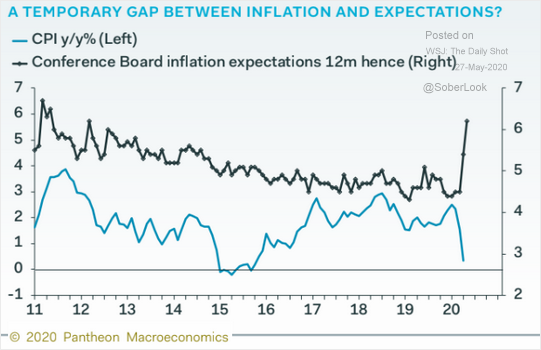
It is also interesting that inflation expectations have spiked.
Hugh Hendry

Two of the most influential interviews for me over the last couple of months involved Hugh Hendry.  Both were on RealVision.

RealVision gets a lot of hate and I think it is misplaced.   I get a lot out of it.  Their interview with Emad Mostaque, which I watched during the first week of February, was a game-changer for me – Mostaque outlined a very coherent view of what was likely to happen with the coronavirus.  That interview alone saved and made me way more money than I will ever pay in subscription fees.  I feel like investors like to rail on the service because they or their guests are often “wrong”.  Who cares.  You subscribe for divergent views and you make your own decision.  Its not about trying to find someone to tell you what to do.

Anyway, back to Hendry.  I didn’t really know much about the guy, and I still don’t, but he said some stuff that really resonated with me.

In the first interview, he was interviewed by Raoul Pal.   In the second, Hendry interviewed the author of the Princes of the Yen author Richard Werner.  The Princes of the Yen interview was particularly insightful.  It gave Werner’s views on the workings of central banks, and many of the insights were things that I hadn’t considered before.

But I’ll keep the talk to Hendry for now.  Hendry thinks this environment is likely good for gold – but that gold, as I am so painfully aware, will do everything in its power to buck you off before going to its rightful place.

And Hendry makes another very good point – that you may want to be long gold here, but don’t believe in it.

The idea is this.  Gold doesn’t just go up just because of money printing.  It goes up because of the belief that money printing will lead to inflation.

For example, gold tanked in 2012-2013 when investors started to clue-in that all the money printing was not leading to an increase in the velocity of money.  There was no transmission to the economy.

This time around?  Well, Hendry is again skeptical that there will be transmission.  Count me in on that.

But in the short-term, that likely “truth” is irrelevant.  What matters is whether investors think there will be transmission.  They have so far, and most likely will continue to.  So gold should go up on that expectation.

You can act on that, but you don’t want to believe it.  Hold through the rally, but don’t trust that it will last.  Because the better probability is that money velocity won’t pick up and gold will eventually tumble back down.

Hendry also seems to be cautiously uber-bullish on equities.   If that sounds like a paradox, it probably is, but that is where we are at right now.  His perspective, again like what I’ve been thinking, is that the middle of the road is not very likely right now.

I get the impression that Hendry would not be surprised to see 4,000 or 2,000 on the S&P – and maybe both.  That’s basically how I feel.  Things are that messed up right now.

He’s not the only one.  @Volslinger, who is a fintwit follow I always look for (though I wish he said a bit more) summed it up well on Friday.

My take is this: I don’t feel like this is a good time to pretend you know what is going to happen.  You may end up a hero, but you also may end up getting punched in the face.

It is anything goes time.  Maybe if your goal is seeking publicity for your barstool media business its the perfect time to be all in one way or another.  But if you are actually managing money for your family and your future prosperity depends on these decisions – well, I don’t think that this is the right time to be taking a big risk.

Anyway, the bottom line on all of this is that I am back to hedged. I’m not net-short like I was in February (After all, the Fed), but my portfolio should not go down much if the market continues to swoon.  In fact, if at the same time the Canadian dollar falls back down down after this ridiculous rally (which my god, it has to, right?), I suspect I could go up a bit.  I took off all my CAD hedges last week.

Today when the market fell 2% at the open, I was flat, even with gold down $25.  That’s what I like to see.

I think I will leave it at that for now.  I was going to talk about individual stocks in this post, in particular Schmitt, but this is getting long so I will write something separate up later this week.
Shoot First and Ask Questions Later

I’m starting to figure out why I am doing what I’m doing.

That may seem like an odd thing to say.  But its true.  I started to do things a month and a half ago and I didn’t really know why.

If you go back and look at my transactions and my last few posts you can kind of see it happening.  I started, in the depth of the crisis, to buy gold stocks.  Nothing too surprising so far – this was a pretty easy one for me.  I know gold stocks well and I know the 2008 analog.  They are the last one’s in, first one’s out.  I thought that would happen again.  So far it has.

Second thing I started doing was buying mortgage stocks.  This may have seemed a bit foolhardy at the time, after all with the shit hitting the fan how many people are going to pay their mortgage?  Fintwit told me these names were shit and they’d all go belly-up.

But again I knew these stocks pretty well, and from past performance I knew that the mark-to-market nature of their business, and because liquidity = solvency for most of these names – well that meant these stocks usually followed a pattern of taking a big hit up front and then doing better (even if they didn’t prosper) once the Fed was firmly at their back.

I’ve continued to add a few names to the list – buying Altisource Portfolio Solutions, Real Matters and even a little Ocwen a couple weeks ago.

Third thing I did was buy SaaS and technology stocks.  Here is where things really went on tilt.  I don’t buy SaaS stocks.  But I’m buying SaaS stocks now.  Hand over fist.  I even bought LightSpeed POS (aptly named perhaps) last week, a stock I have shorted in the past!

Look, I wrote in my last post a few of the reasons why.  I now have a better understanding of the margin compression of their growth model.  The work-from-home environment is clearly a huge tailwind for most of the names.  Low interest rates raise the present value of their earnings 5+ years out.

But even at the time, I was thinking there is more to this.  I knew I was buying them for another reason, I just hadn’t figured out what it was.

Fourth thing I bought, well actually fourth and a little bit of fifth, is I bought natural gas stocks.  I even added to that with an oil stock (for shame!), buying Whitecap last week.

But let’s stick to the natural gas stocks, because that is more on point here.  I bought the natural gas stocks in part because I thought the oil shut-ins were going to drive down natural gas production, and that we might even be surprised by how the drop in light liquids pricing (C3+) would drive even more natural gas shut-ins in the more liquids rich basins (where the economics are really tied more to the liquids then the gas).

But I also bought these stocks for another reason – they were among the first to go up.  There can be exceptions of course (and natgas could turn out to be one of them) but the stocks that rally first out of a crisis tend to do so for a reason.  And these stocks rallied hard. They were like SaaS charts, which is saying something for a sector that has been shit for 5+ years.

Fifth, I’ve made bets on a few small, biotech names.  Stocks that were whacked by the virus but shouldn’t be impacted much.  I started with Eiger Pharmaceuticals a month ago (another former position that I know well).  I’ve added a few more names on top of that the last couple weeks including Dare Bioscience and Immunic Inc.

Ok, so there are all my bets on the table.  There are some other individual names I have bought, a stock like Rada Electronics, where it doesn’t really fit a thesis per se, I just think it is a stock that is going to do well.  But mostly the stocks I own revolve around these themes.

But what’s the big theme here?  What do these sectors all have in common?  Why am I buying these things?

Here is what I’m starting to wrap my head around in the last couple of weeks. There is a lot of thoughts in my head about this, but I’m going to dumb it down to two basic points.

First, this virus has caused a huge hit to the economy.   Massive unemployment all around.  Many small businesses are going to close.  That unemployment is probably going to be slow to come back because small businesses do most of the hiring.  For a lot of people, its going to remain a tough go for a while.

The other side of the coin is we have this huge stimulus.  This thing could be $10 trillion+ in the United States alone.  And everyone gets free money.  There was an article in the Globe and Mail a week ago that the Canadian Emergency Response Benefit (CERB) that gives $2,000 to everyone that lost some wages plus the 75% wage top-up to businesses have completely offset, in the aggregate the wages lost due to layoffs.

Think about that for a minute.  In total there is the same amount of money out there now as there was before.  It’s not necessarily in the same hands. some people are worse off for sure, but that means some are better off.

And that doesn’t count the money that isn’t going to people.  There are the backstops of pretty much every asset market out there by Central Banks.  They are buying government bonds, mortgage bonds, high yield bonds, its money for everyone and everything.

So you’ve got all this money out there and its basically compensating for the loss of money due to the virus.  But – and here is where we have to go back to point 1 – that money can’t go back to all the usual spots.

In the real world a lot of sectors are still doing bad.  Even as they improve as the lockdowns lift, they are still going to be sluggish until we get a vaccine.  That means that this money, at least at the margins, is not going back to air travel, to restaurants, to hotels or airBNB, or to Uber.  You can go down the list.

What I think this means is that one of two things can happen (or maybe a combination of both) – the money is going to go into savings (Robinhood?), or it is going to go into the parts of the economy that it can still go into – and those parts are going to boom.

In the investment world its the same dynamic.  At the margins, the money isn’t going into mall REITs or office REITs.  Its not going into airline stocks, restaurant stocks, or travel.

Instead, it is going to all get funneled into businesses that are at least doing okay – even better if it is a business that is doing great.

Like I have pointed out in my last couple of posts, we are (to my initial surprise) in an environment where there are some businesses that are doing okay.  Some businesses are doing way better than okay.  The shift in work, the shift in activities, and (depressingly) the hollowing out of small business is allowing larger, mostly publicly traded companies to take market share – and that means that some businesses, mainly larger, publicly traded businesses, are doing very well.

SaaS is the obvious example here.  You can argue that this move in SaaS is getting a little stretched technically.  Sure.  But if there was ever a time that was ripe for a crazy sector specific bubble, this has to be it.  And these businesses, they are doing well; they are raising estimates and those long runways of growth are getting pulled in as demand moves online faster.  It makes me wonder if they may just be the vehicles for a real, honest to goodness, bubble.   Remember that in the 2000 internet bubble the numbers never really made sense.  But it still happened.

I am reminded of something I’ve heard from some very smart people – that the best case for the stock market is if the Central Banks are flooding the world with liquidity but the economy isn’t strong enough to accept it all.  Because then all that money that needs to go somewhere goes into assets.  The banks have to lend to someone.

Is that not the case that we have now?  What’s more – this concentrated money flood scenario is even more concentrated today – because that money can’t even go into all the markets, it can only go into the pieces that are kind of, sort of, doing okay.

Look, I’m not married to this idea yet.  If I was I would sell my short S&P hedge.  I’m not quite ready to do that yet.  But I have to admit, I am struggling to see the fatal flaw in the logic.

In the short run that is.  The flaw in the long-run is this can’t end well.  If this idea is right, then we end up with some sort of Nasdaq 5,000 or Nikkei 40,000 scenario before it is all said and done.  Bubbles burst.

But we are  a long way from that.  And maybe this is totally wrong.  Maybe insolvency will overwhelm the whole thing and send us back down.

But maybe not.  There just may be too much money out there, with no where else to go.

More on the Bifurcated Economy

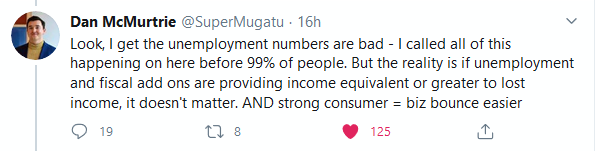
Yesterday, @SuperMugatu made a “controversial” tweet that said something I’ve been speculating about.  He wrote this long tweet storm, but the one that really caught my attention was this:

My speculation along these same lines has been whether all this stimulus is at least partially offsetting to the huge negative downdraft from the pandemic and because parts of the economy are basically shut down, it is all being funneled into what is left standing, causing this part of the economy to boom.

Make no mistake, I keep wondering whether this could be true because the market is rallying.  I probably wouldn’t be thinking this way if we were down 30% still.

But the market is rallying and it keeps rallying so I have to ask myself why.  I am not going to stubbornly sit in a bearish camp while it runs away from me – and I haven’t.  I have bought stocks, stocks that I like of course, but with an underlying reason that if the market keeps going up maybe it is seeing something I am not.

As I alluded to in my update on Thursday, it does seem clear that the economy is bifurcated.  That means that not everyone is a loser here.  There are some clear winners.  And that really does make this time unusual – its not a full-on economic downturn where everybody loses.

It seems like it is more of a giant wealth transfer.  Yes, some of that is a wealth transfer from poor to rich, and some of it from the government to everyone, but the other wealth transfer is from companies based in the real world (so real estate, restaurants and such) to companies based in the digital world.

I have about 540 companies on my watch list in Sentieo.  These are mostly small companies and many are micro-caps.  Every morning at this time of year I get their earnings updates.  I try to read every earnings release I get every day.  I don’t read every filing or every transcript, that takes too long, but the earnings releases are generally succinct enough that I get through the list each morning of earnings season.

I do this because quite honestly, I find that one of the easiest ways to capture gains is to catch a company that beats the numbers and buy them right at the open.  In my world of micro-cap stocks, the market is rarely efficient.  It is almost guaranteed that the market will not reflect the full nature of an earnings beat at 9:31 am.  Machines don’t seem to be out in front of these stocks on earnings like they are in the larger names.  In a lot of cases I imagine the stocks aren’t liquid enough to make it worth their while.

So front-running the herd is a legitimate strategy that has worked for years.

Anyway, what that means is that I read a lot of earnings reports from a lot of companies, most of them tiny.

In the last two weeks I have been surprised – no shocked – by how many of them are doing really well.

Not everyone of course.  Any company with real world exposure is not doing well.  Any company with small business exposure is removing guidance and talking about reduced visibility.

But man, it is not nearly as bad as I expected it to be.

And some companies are blowing the doors off.  Photon Controls released results Wednesday and they announced a record backlog that was 50% higher than the previous year (!!).  I bought the stock on the open.

Maybe the poster-child of this happened Friday morning.  Well, Thursday night actually – that was when they released earnings – but I didn’t get around to reading it until Friday morning.

It was Identiv.  Little ole Identiv.  It was one of the last reports I read Friday morning.  I got to it like 10 minutes before the market opened.  I almost didn’t even read it.  I mean Identiv – they do on-premise security – that’s got to be a disaster right?  There is no premise right now.

But I read the report and, pardon my language but holy $hit, these guys put together a better backlog than I have ever seen them have.  This is Identiv, a company who perennially disappoints.  Yet they are saying their backlog is up 85% sequentially and 100% year-over-year?!?

I literally said WTF out loud.

What happened is that while the physical premise security stuff is down, just like you would expect, Identiv is doing extremely well on work-from-home smart card readers and Thursby Mobile remote signing authentication software.  They are also a vendor of the government which is not pulling back on orders right now.

Stephen Humphreys, who seems like a nice guy but has to be the most long-winded CEO in the world, put it this way:

“The sudden transition to work-from-home caused demand for smart card readers to suddenly accelerate, and also led to a jump in online Thursby orders, which nearly tripled to over 400 units per week. Our RFID business grew 66% year-over-year, remaining one of the largest growth drivers for our business in both the short and long-term. As we focus our business rigorously on the long term growth opportunity in RFID and on our core strength providing security solutions for federal and state governments, we’re driving to reduce overall operating expenses even while expanding investment in these two focus areas.  With a fortified balance sheet, a resilient federal customer base, an extensive backlog, reduced operating expenses and market trends in our favor, we’re  positioned to not only weather the storm, but to return to our growth trajectory as the world begins to normalize.”

It seems impossible but they are simply doing really well.

So yeah, I bought Identiv at the open.  Now to put this all in perspective, the company just maintained its full-year guidance – they didn’t raise.  But the stock was severely depressed from where it was pre-pandemic and you know what – the business does not look any worse.

The bigger picture point here is that this is a company that I would not have expected in any way to be doing better right now.  It is not a company that should be doing well if this was just a typical recession.   If I had owned the stock in March I am sure I would have sold it.  And that would have been totally wrong.  If you have enough of your business tied to work-from-home, stay-at-home, or parts of the economy that aren’t shut-down, you may actually be doing better now than you were.

It may seem crazy.  I still find it hard to believe.  But when the facts change…

Sticking with One’s Knitting – Portfolio Update

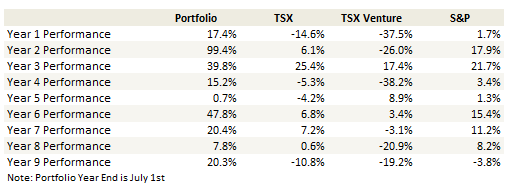
Portfolio Performance

Thoughts and Review

I have been intending to do this update for a while but with kids at home all day and us parents now taking on the role of full-time teachers in addition to everything else, well, its not an easy juggling act.  This update takes me up to the end of last week.

My portfolio has continued to perform well since I last updated at the beginning of March.  I am not lighting the world on fire with 20%+ gains off the lows (like the market itself is), but I also did not have a low that was less than the previous high (my last lows came as the market set its previous highs).  So I am content with my modest performance and the lack of volatility that has come with it.

I did follow the market up last month to some degree, purchasing long positions in a few sectors that I felt presented opportunity.  It truly is a bifurcated economy, and it has become clear to me that while the overall impact may be negative, there are a bunch of big winners here.  While I am of the mind that some businesses are still best to be stayed-away from, others have the potential to do well because of what has changed or because the Fed has their back.

SaaS

On the first account (trying to find winners because of what has changed – ie. the stay-at-home and work-from-home economy) I missed out on the early work-from-home/stay-at-home ideas like Atlassian, Citrix or Zoom.  But I try not to be stubborn.  Last week I bought Overstock, which looks to be a likely beneficiary of stay-at-home trends (the April sales numbers were ridiculous!), and this week (so not included in the update below) I bought into the SaaS trend with Workday, Pagerduty and today (Thursday) Alteryx, all of which should be beneficiaries of work-from-home.

I have been hesitant to buy SaaS names in the past but I have changed my mind.  I have been presented with two ideas (revelations?) that have made me willing to wade in a little.

First, there was a piece from Morgan Stanley last week that finally explained to me why these stocks can’t be valued on traditional metrics.  And it made sense.  A few arguments were made, but the most insightful to me was when they went through the math of just how much the operating margins are depressed by the growth.  It was a bit of an ‘aha’ moment to see this.

Second, I just look at the likely outcome of this pandemic: if a company looks at their expenses at the end of this whole ordeal and says “you know what, this stay at home thing worked not too bad”, they are going to quickly realize that they can reduce their office space by some factor and scale up their licenses to SaaS by some other factor (to make sure those stay-at-home workers have the absolute best in connectivity) and in the aggregate I am sure the company will save many dollars.

That should make this shift durable over time.  It means there are going to be winners and losers here and SaaS really does look like a winner.

The third point is something I’ve said before – these SaaS companies are mini-bets on rates.  Their earnings are way out and therefore present value discounts matter.  But rates are so low, and I find it hard to believe they will do anything but go lower, which is yet another tailwind for the sector.

But I’m still pretty chicken.  My favorite name of those I’ve researched so far is Atlassian.  I used to work as a product manager, so I know their software and I totally get how its going to be sticky and scalable and all that jazz.  But man, I just can’t pay 20x sales (I think it might actually be 25x sales now) for a stock.  I was looking at it last week and then it sold off briefly after earnings but I couldn’t bring myself to buy in.  The 3 I’ve bought are not cheap (Workday and Pagerduty are 7x sales while Alteryx is 12x) but I think I’ll need some more time before I can comfortably go much further.

Mortgage Stocks

I have also done reasonably well in identifying a few winners of the Feds largesse.

Thinking of how one picks stocks in such a tumultuous time, I listened to one podcast early on in the crisis, I believe it was back in March, where the hedge fund manager being interviewed made a very salient point – that it was too late to do the work – you already knew what you knew and you should stick to that knitting because that is what you will have conviction in.

There is definitely some truth to that.  When the world is collapsing, trying to buy a new name that you only just learned of is tough.

It is no surprise, therefore, that the names I bought early on in the crisis were largely the one’s that I have owned in the past – or at least which come from sectors I have owned in the past and have comfort in.  My mortgage bets are a good example of this.

As a group the mortgage players have been my biggest bet.  I started with the agency mREITs, which I wrote briefly about a few weeks ago.  These guys were an obvious bet – I mean the Fed was basically buying their primary asset (MBS), the Fed was backstopping their funding (repo), and they had already taken it on the chin from the write down of everything on their book but the kitchen sink in March.  I bought Annaly and Orchid.

As is usually the case, investors got very negative on these businesses after they had gone through the wringer.  After Annaly, AGNC, Orchid and the like had taken massive hits to their book value, investors (on SeekingAlpha in particular) came out of the woodwork explaining how awful these businesses are and how they would never own them.

Now to be clear, those statements are not completely without merit – I mean a business that can collapse like these did is perhaps awful, and I would have not have owned any of these companies before the COVID collapse, but after virtually every negative event that you could imagine had been thrown at them and after they had fallen to levels that were significantly below what was a much reduced book value, well I was willing to re-evaluate their relative awful-ness at that point.

Much the same can be said (but with even more gusto) of my second foray into the mortgage industry – buying companies that own the MSRs (New Residential, Mr. Cooper and PennyMac Financial).

Here again, I know MSRs fairly well, I made a good deal of money investing in these companies back in 2011-2013 when very few investors knew what an MSR was, and so I have a level of comfort here, both with what makes an MSR good and bad.  It is not a perfect asset.  It has pitfalls.  But it is also not a dumpster fire.

What happened to these stocks is much the same as the agency mREITs – after New Residential, Mr. Cooper and PennyMac Financial had already taken enormous hits to their book value, well, then investors piled on and said these companies are uninvestable.

Quite honestly, the post-mortem trashing of New Residential has become almost a tradition.  I swear that every crisis the same thing happens.  New Residential gets clobbered (always for basically the same reasons – because their business really is flawed under certain circumstances of extreme volatility), and from there the rants begin about how awful the company is and how it is going bankrupt.  This occurs in concert with the Fed stepping in and backstopping what were the main flaws in their business.

But again, I do not necessarily disagree with the term “uninvestable” (though I’m not sure it is actually a word), but I do disagree with the tense – these companies were uninvestable – they are businesses that are very vulnerable to dislocations in the credit market and yet they were priced for a never-ending status quo in a world that was bound to throw a curve ball at some point.

But now?  Now they trade at a fraction of their book value, that book value already been greatly reduced because the fatal flaws have been realized, and meanwhile the Fed has insured that there will be liquidity for all and asset price stability.

While it is easy to write off these companies as too hard or too levered or some sort of scheme (all of which are kinda true), I prefer to look at them positively.  That is to say – these companies have a lot in common with a bank.  They have assets that earn interest.  They have liabilities that allow them to fund those asset purchases.  The equity is a fraction of the overall balance sheet.   So yes, they are very levered – just like any bank is.

The difference, of course, is that their funding sources are not deposits and their assets are not loans.  Their funding is a combination of repo, securitizations and bank lines.  Their assets are MSRs, mortgage loans, mortgage securities and other instruments that hedge against them.

So when I think about this I ask – is it better to own a bank? – One that has maybe 10% of assets in construction loans, another 10-20% in commercial real estate (that is full of tenants that have been closed the last month), maybe 20% in residential loans (some of which are in forbearance) and a bunch more in business loans (many of which are small businesses that may or may not survive)?

Or is it maybe even bit safer to own a company whose primary asset is an MSR – an asset that sits at the top of the chain in the case of default, that returns cash regularly, and where the government has limited your exposure (in the case of Fannie/Freddie to 4 months of servicing advances, in the case of Ginnie, they have put in place a facility to deal with advances entirely).  And which, on the liability side yes, they do not have deposits, which are for sure the preferable funding alternative.  But the issues around repo, securitization and bank loans were the risk before this happened.  But now? With the Fed buying everything in site and doing whatever it takes to make sure these markets get back to normal? Is this really such a big risk?

Let me say this – if the repo market and securitization market re-freeze now, with the amount of intervention that the Fed is doing and indicated it will do if necessary, then we probably have a much bigger problem to worry about than whether the mortgage servicers will do well.

To punctuate the point – in my opinion, the biggest difference between the banks and the mortgage names at this point (and this goes for both the agency mREITS and the hybrids with MSR assets) is that the mortgage names all had to take their losses up front – they have had to mark their assets and they have had to deal with the margin calls – while the banks get to string it out much longer – extending terms on loans, using government backstops to cover losses, and most importantly, not marking their loan book too closely.

Because of that, banks trade at above book (for the big ones) or only slightly below book (for most of the small ones).  Believe me I looked – I went through at least 50 community bank filings looking at how cheap they were and hoping for a bargain.  But I was disappointed.  This is not 2009 yet – these banks are not trading at a big discount and I am simply not willing to buy a bank for 90% of tangible book given where we are at.

But because the mortgage names have taken their losses upfront, they have been punished.  At the time I bought them they traded at less than 50% of their reduced tangible book.   This made (and still makes, to a lessor degree) them seem attractive to me.  The bad news is out and a lot has been priced in.  The Fed has their backs.  Yes, these are flawed businesses.  And no, I will not be owning New Residential when it trades back to double-digits and announces a 25c per quarter dividend.  By then the world will be back on its feet and most likely all those risks that caused New Residential to collapse will be getting put back on the balance sheet.  But at $5?  Sure, I’ll take a swing at that.

Gold, Natural Gas and Everything Else

Well that discussion of the mortgage names I bought took up much more space than I intended so I will keep the rest of this update short.  What else I have bought are a few more gold names – a basket of gold project developers – for as I wrote in my prior post, if this gold market does become a bull market (which is still an open question), these names will begin to outperform.  I bought a basket – 4 names – because even though I’ve researched each I find it very hard to tell which will be the biggest winners.  So it is simply a method of smoothing out my odds.

I also bought a number of Canadian natural gas producers.  This is a very simple bet – if oil is being shut in, so will all the gas associated with that oil.  For the first time in maybe 10 years, that means something positive has happened for the natural gas producers.  I do not think it is a coincidence that the natural gas producer stocks have been very strong.  Their charts echo the best of tech – Amazon, Zoom, or Atlassian.  I added Advantage Oil & Gas, Peyto Exploration and Pine Cliff and they are doing particularly well today.

I also added a few individual names.  Two I went back to the trough for: Radcom and Intelligent Systems – both names I have held in the past (and one’s I only realized Monday I forgotten to add to my tracking portfolio here so I have corrected that now but they aren’t reflected in the positions below) – as well as one brand new name, DLH Holdings, which is a staffing company but with a government bent and where I saw little risk of disruption to their business and a very cheap price.

Finally, I kept my index shorts and yes, they weigh down the performance on days like today, but they more than did their job when the market was in collapse, and I am not smart enough to know with any certainty whether we will go straight up to 5,000 or not, so I will keep them on.  The only days I find these shorts supremely frustrating are days when the markets are up 5%+.  On these days it is without fail that my longs under-perform the market – usually because 1 or 2 of them is down 5% for no reason at all (usually on less than 1,000 shares, just to really stick it to me).

But this happens every crisis – and I mean every crisis – it happened in 2016, it happened in 2018, and it happened now.  While I freaked out about it in 2016 (this was the first time I had been through a collapse with a hedged portfolio) I’ve seen it enough now that I can take it in stride.  If we are indeed recovering this will likely unfold like it has the other times – the indexes will settle down and the micro and nano-cap stocks I own will catch up.  It is simply a lag.

Portfolio Composition

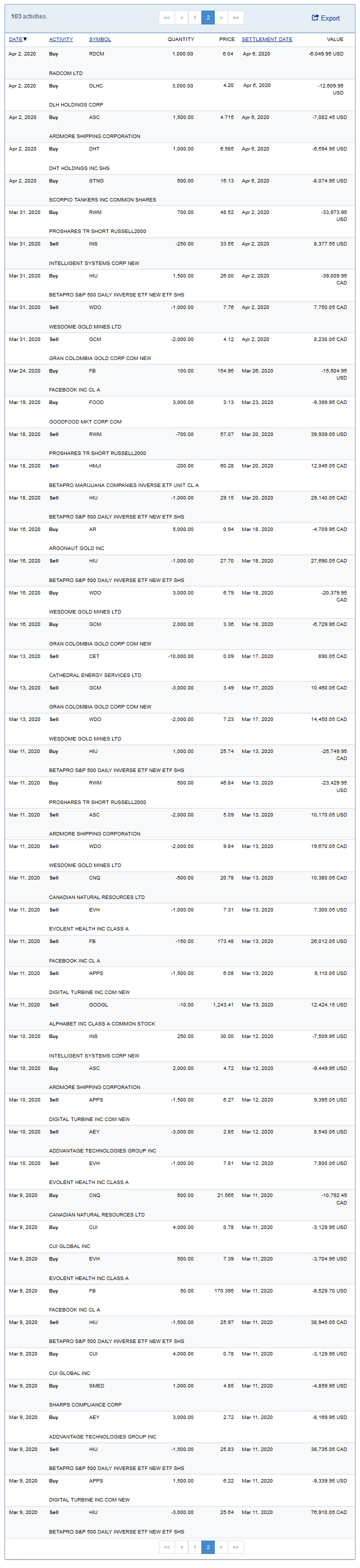
Click here and here for the last eight weeks of trades.