Skip to content

Schmitt Industries

I took a position in Schmitt Industries this week on the wake of news that they had sold their Schmitt Dynamic Balance Systems (SBS) business line to Tosei Engineering Corp. and Tosei America, Inc., for a purchase price of $10.5 million in cash.

The sale sets up an interesting situation whereby Schmitt is now trading at what is essentially cash levels.

After the close of the sale Schmitt will have between $11 to $12 million in cash on the balance sheet depending on closing costs.  In addition, the working capital position of Schmitt was quite positive at the end of the last quarter (ended September 1st) at $7.5 million (though I don’t know how the sale of the SBS segment will impact this).

At $3 the stock trades with a market capitalization of the company is $12 million.

For that $12 million, in addition the cash, this is what you get:

  • A measurement business with TTM revenue of $4.6 million, operating income of $447,000 and a recurring revenue component
  • 40,000 square feet of Portland commercial and industrial real estate
  • An activist investor CEO that is intent of extracting value

The Measurement Business

Let’s talk about the Measurement business.  The company has two product lines, Acuity and Xact.  They have owned these businesses for a while – Acuity was purchased in 2000 while Xact was purchased in 2007.

The Acuity product line are lasers and white light sensors used for making precision distance measurements.  They include short range lasers (3 – 1,300 mm) used in manufacturing processes and long-range lasers (up to 3,000 m) used in construction.

Xact is a product portfolio of remote tank monitoring equipment.  There are gauge or ultrasonic sensors that measure water levels.  Measurements are transmitted to the Globalstar satellite network where they are monitored and recorded.  The Xact product line targets IoT applications with its real-time monitoring capability.

While the SBS business has been the bigger of Schmitt’s two business lines, the Measurement business is in many ways the better of the two.  The SBS business has long struggled with profitability while the Measurement business has not.
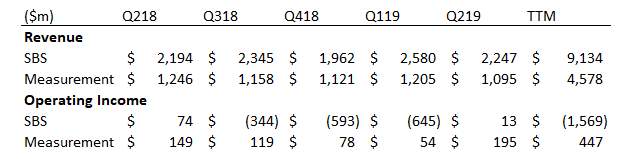
The Measurement business has another interesting element – it has a recurring component.

Because its targeting real-time measurement of tank fill levels, customers pay for the data on a monthly basis.  While sales of measurement products can be lumpy (this is what accounts for the poorer performance this recent quarter) Xact’s recurring monitoring revenue amounted to $367,000 last quarter, or about 35% of the segment’s total and up 16% year-over-year.

Gross margins of the combined Xact and Acuity businesses were 46% last quarter.

Xact also recently partnered with the start-up Tank Utility, which will offer their gauge readers to their customers.

Xact and Tank Utility can offer an industry-leading package of tank monitoring products and related monitoring services to the delivered fuels market, regardless of where customers’ tanks are located. Tank Utility’s leading-edge cellular technologies will cover customer needs wherever reliable cellular connections are available and Xact’s industry leading satellite-based solutions will fill in the coverage gaps with dependable service.

What you are left with a businesss that has a profitable and recurring revenue stream and is partially levered to the growing IoT vertical.  I don’t think it is unreasonable to speculate whether the Measurement business should be valued similarly to the SBS business.

Real Estate

Schmitt owns 3 buildings with 40,000 square feet of real estate in Portland Oregon.  As best I can tell, these buildings have two addresses: 2765 Nicolai St and 2755 Nicolai Street and comprise two offices and a manufacturing space.

The 2765 Nicolai Street address is where the company main offices have been.

The 2755 address, which is a 3,961 square foot office, was up for sale a couple of years ago for $825,000, or around $200 per square foot.
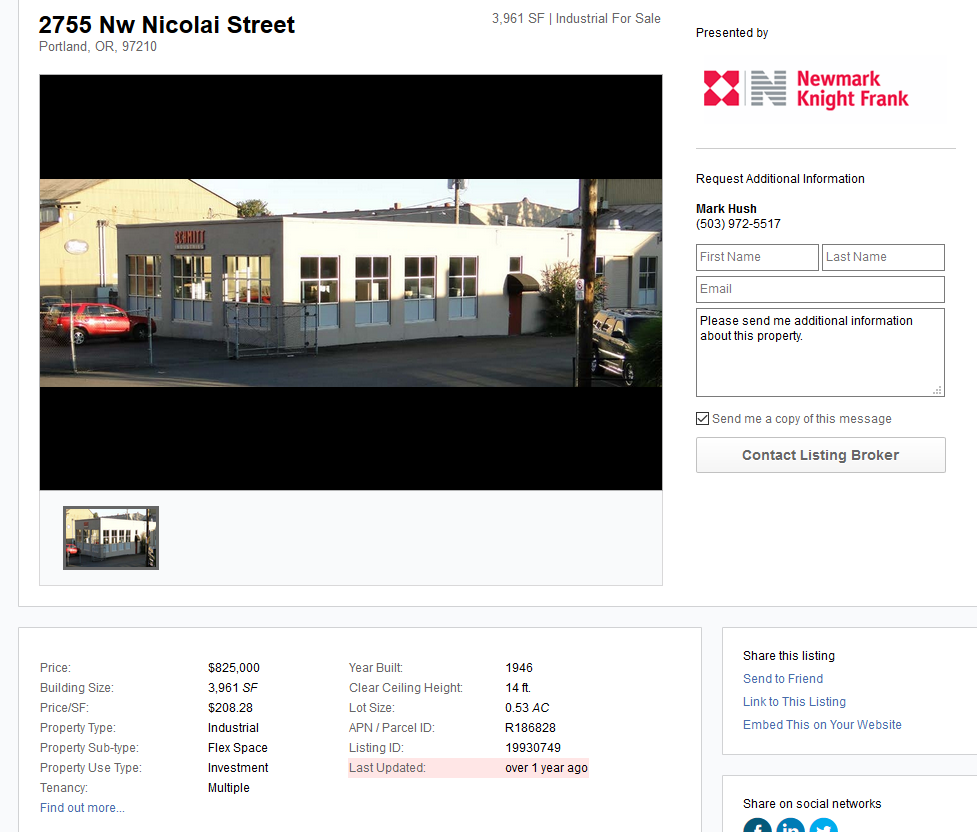
The 2765 address building is a lot bigger than the 2755 building at 7,712 square feet.  It also appears to have had better upkeep, at least from the outside.

Though I wasn’t able to find a square footage associated with the manufacturing floor, I believe the rest of the building space is manufacturing space.

Part of the SBS deal is that Tosei agreed to a 10-year lease on at least part (maybe all?) of the facility.

Activist Investor

An activist investor approached Schmitt last summer and this started the ball rolling on what has so far resulted in a sale of SBS.

Michael Zapata and Sententia Capital sent this letter to Schmitt management.  Zapata and Sententia own about 18% of outstanding shares of Schmitt.

Sententia followed up with a second letter in August where they became more hostile and nominated two board members.  They also produced this research piece on the company.  Zapata eventually took over as CEO in August of this year.

For more depth about the company I would recommend reading their piece.

The bottom line is that Schmitt should be worth at least $4 per share.  Probably more.

While I don’t expect the Schmitt to become a multi-bagger, this seems to me to be a very, very well set up risk/reward situation.  I am purchasing shares of Schmitt for what is basically the cash value.  They have sold less profitable of their two businesses and now have what I would suspect to be the easier task of selling the profitable one.

In Sententia’s report they valued the SBS business at essentially what they sold it for.
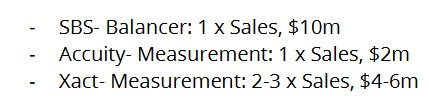
If they are similarly prescient on their estimate of the Accuity and Xact businesses, sale proceeds would be $6 million to $8 million.  This would mean $1.50 to $2 per share.

In addition, Sententia estimates that the real estimate is worth another $7 million to $9 million.  This would be another $2+ per share.

While I don’t know if all this value will be realized, I think it is safe to conclude what Sententia’s intentions are.  In one of their letters Sententia expressly said that they would sell the Accuity and Xact business lines if given the chance.

After the sale of SBS it seems likely that the intent here will be to sell the entire business and realize the value.  As much as I like the Xact business, stand-alone this seems to small for a public company and I suspect Sententia would feel the same way.

I made Schmitt one of my largest positions after the stock opened on Thursday.  I added to that position Friday.  I think it is a very favorable risk/reward.
Update: Flip Flopping but Still Cautious

I couldn’t stay out of the IMO 2020 trade for very long.  I said last week that I sold out of my tankers and refiners (other than Vertex Energy – more on that in a minute) but that lasted a whole of 3 days before I was sucked back in.

On Thursday, after news came out that Robert Bugbee of Scorpio Tankers had made a huge option bet on the company, my fear-of-missing-out (FOMO) kicked in and I piled back in.  I missed the bottom with my panic, but you can’t win them all.

This time I am more circumspect about my shipping and refining bets.  I have kept my positions in Ardmore and Scorpio relatively small.  I have similar small positions in PBF Energy and Valero.  While I am holding DHT Holdings and Diamond S Shipping on the crude tanker side, I am not at all convinced that a move up in the crude tankers will prove to be sustainable.

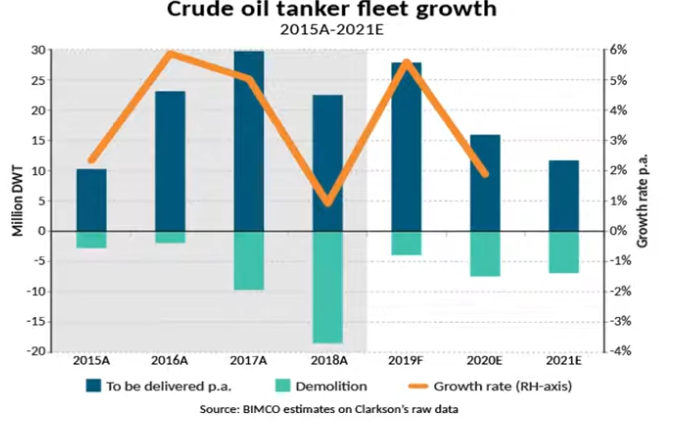
There was a good update put out from Bimco (h/t @Fbuschek for sharing it with me).  They are not all that bullish on any of the shipping sectors, but are particularly sanguine about the crude tankers.

BIMCO points out that fleet growth in VLCCs has been significant this year and that this is likely to keep rates down next year.

It was uncomfortable to learn that new VLCC’s (so the largest crude oil tankers) were even being used to ship crude products during the summer months.  This means that A. the VLCCs had no where else to go and B. they were crowding out the product tankers for their own commodity.

No wonder product tanker rates were so low!

At one point over the weekend I was about to turn an about-face and sell-out of the tankers again.  But I have thought better of it – for now.

First, crude tanker rates are showing signs of strength.  Today VLCC rates spiked above $60,000 on Monday, so no more will they be trying to take share from the product tankers.

Second, the second half of the fourth quarter is always strong for tanker rates.  My expectation is that tankers will rally like they usually do in the fourth quarter because its the fourth quarter if for no other reason.

This seasonal move should be exaggerated this year by A. scrubber retrofits taking tankers off the market and B. a shortened refinery maintenance season.

The strength of that rally may get confused or misinterpreted as a secular move brought on by IMO 2020.  Who knows, maybe it will actually be a secular move.  Its not impossible, but I’m not planning to bet on that.  Whether it is or is not, I think the point where these names pop will be the optimal time to sell.

Vertex Energy

I mentioned that even as I have hemmed and hawed over what to do about tankers and refiners, I have stayed steadfast in my holding of Vertex Energy.

This is because the one aspect of IMO 2020 that I have some confidence in is that high sulphur fuel oil (HSFO) prices are going to fall.

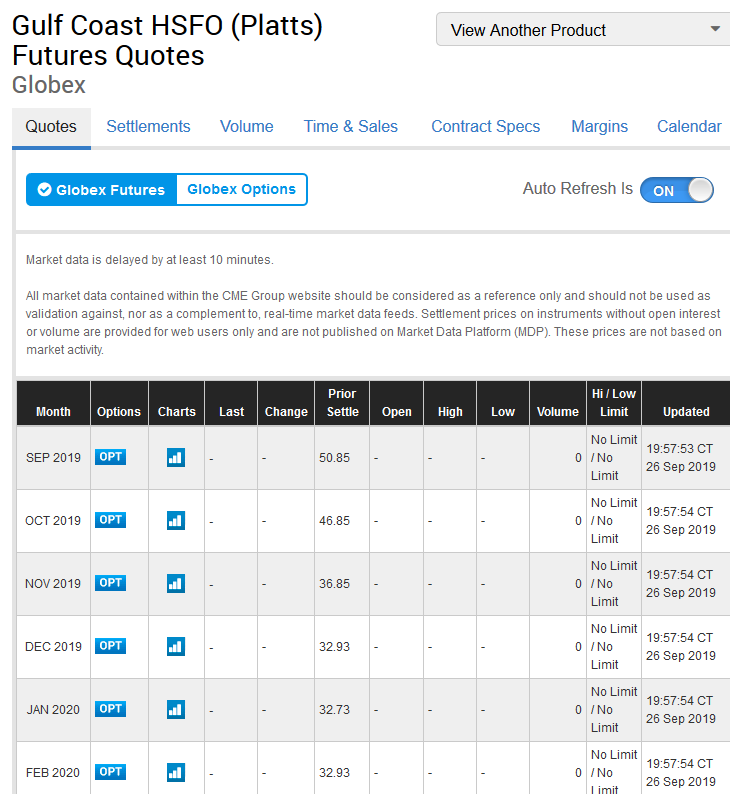
The CME Futures are saying as much.   This screen capture was taken last Thursday when the September contract was still trading.  The backwardation in HSFO between September and January was close to $18/bbl!

Since that time January HSFO futures have slid further.  They closed yesterday at a hair above $30 per bbl.

Vertex makes their money on the spread between HSFO – which is what their used-motor-oil feedstock is priced off  – and the products they sell, which are a combination of base oils and low-sulphur fuel oils.

The company commonly uses Gulf coast Unl 87 Gasoline as a benchmark for their fuel oil pricing.

With that in mind consider the following:

  • In the second quarter the average Gulf coast Unl benchmark was $78.86 per bbl. The average benchmark HSFO was $61.15 per bbl.  Thus, the spread was $17.50 per bbl.
  • Looking forward to the January 2020 spread, based on last Thursday’s numbers the difference between Gulf coast Unl and HSFO was $34.51 per bbl ($67.24 per bbl -$32.73 per bbl)

Looking forward to next year Vertex should have double (or more) the margins they had in the second quarter of this year.  As best I can tell, those margins are at least $10 per bbl better than even their best quarter in the past.

Meanwhile the company has restructured itself with the recent partnership announcement with Tensile Capital.  Assuming a successful pilot program is completed by year-end, Vertex will have removed its debt from the balance sheet and secured the capital for future growth.

But nobody cares. Maybe I’m missing something – but I don’t know what.

The Swine Flu Crisis Intensifies

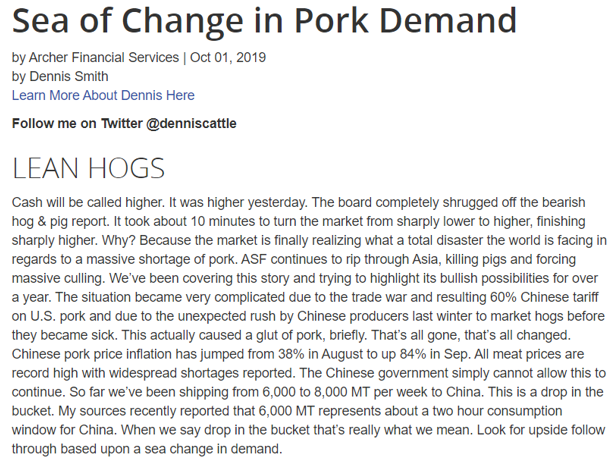
The best follow for the swine flu epidemic has been @winsteadscap on Twitter.  He/she has been providing excellent information on the expanding crisis that is unfolding.  This morning, they put the following out:

I have gotten longer of BRF SA and am tempted to do the same with Seaboard Corp.  It seems like the news just keeps getting worse for pork consumers.

Sells

I sold out of my Canadian oil stocks yesterday.  It looks like I was wrong about Saudi Arabia having trouble getting oil back online.  Either that or they have done a better than expected job of fooling the market through disinformation and inventory management.

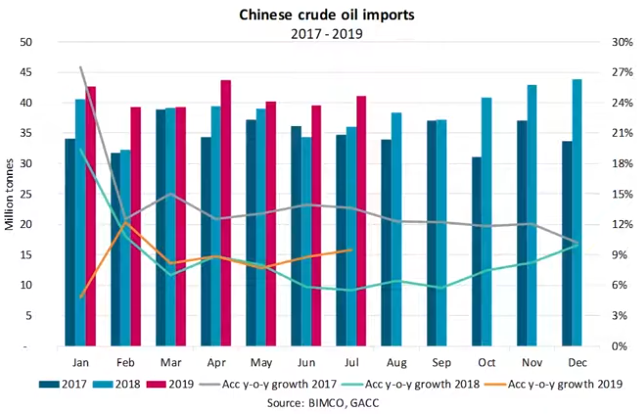
Whatever the case, it does not appear that the oil market is undersupplied right now.  In fact, this chart from BIMCO spooked me a bit.

Chinese crude imports this year have been especially strong.  This even as the Chinese economy has, by all accounts, been relatively weak.  What gives?

It makes me wonder if the bears are onto something – that we truly are awash in oil still.  While the summer has been good for draws in the United States and builds so far have been modest (ex-hurricanes), maybe there is too much oil and it is just going elsewhere.

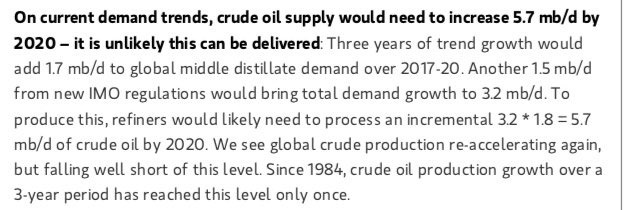
The only thing that really gives me pause with oil right now is what IMO 2020 does for demand. I was reminded this week that incremental distillate demand from ships switching to low-sulphur fuel could mean a big increase in oil demand.

If that comes to pass then oil is going higher.

It is still what I said a couple weeks ago – clear as mud.  But given that this is the case, I need to at least step back and think this through with a clear head.  I exited, I’ll step back, re-evaluate, maybe get back in.  I would rather not lose money in this environment and miss out on making it.

Slowdown

Overall, I’m still positioned very cautiously.  In addition to the oil positions I sold yesterday I also sold out of my small position in CUI Global (which was unfortunately timed to be just before today’s positive news release) and HyreCar (which was, sigh, unfortunately timed to be just before today’s pop).

I reduced a couple of my gold stocks a little yesterday, just in case I am wrong and this is not just a normal correction.  But I also increased my position in Wesdome, which had a very good resource report for their Kiena Mine Complex last week and which I think is a good deal under $6 per share.  So overall in gold I think I am about flat on positioning size.

My caution on the overall market is twofold.  I still wonder about dollar liquidity, which seems to have taken a back seat for the moment.  But in its place, we are seeing some pretty rough looking economic numbers.

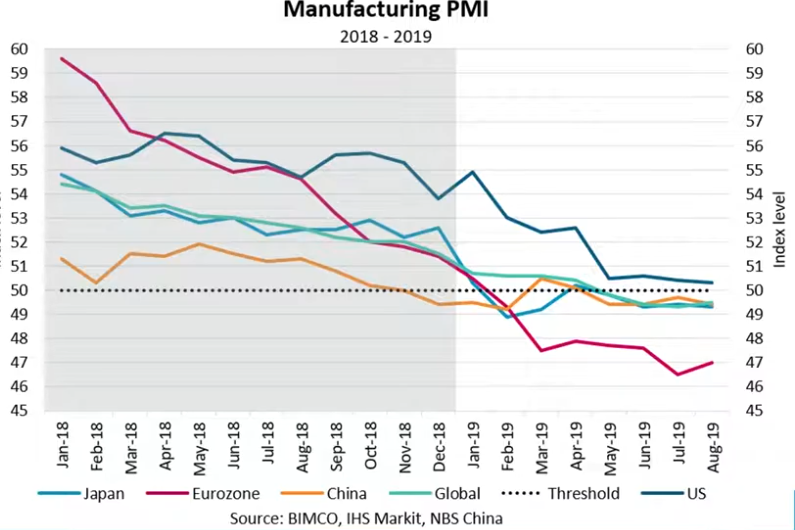
Below are a number of key manufacturing PMI’s heading into September.  The weakness is evident.

These numbers have been followed up by further weakness in September.  A few days ago September data from China showed a still weak number, the German manufacturing PMI was characterized by some as being in “free-fall”, and there was a weak PMI in the United States.

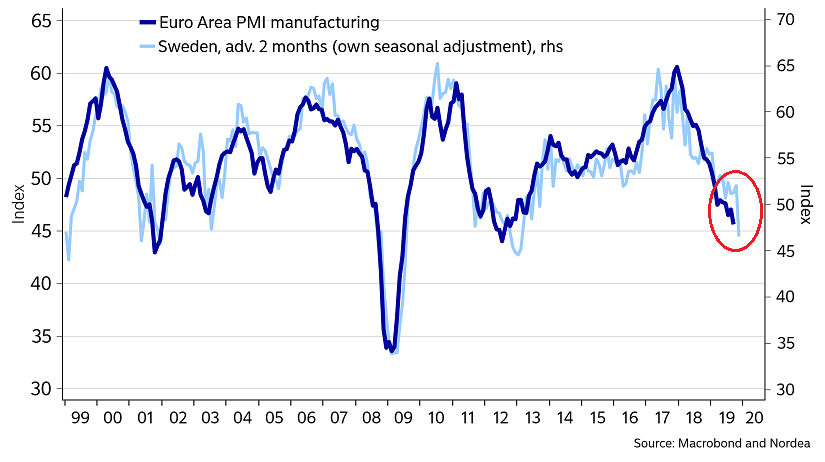
The weak number in the US that came out today overshadowed another number from Sweden.  Their PMI plunged below 50.

Sweden is apparently a useful canary.  I’ve read that Sweden is one of the most export-oriented economies, it is extremely open to trade flows, and therefore when Sweden starts to go south it is usually indicative of trade slowing.

So overall, I am cautious, with large positions in reverse index ETFs and also some shorts in individual names.  I decided to go short on a couple of Canadian cannabis names last week as I came across numbers on (over) capacity that seemed a disaster in the making.  I have also been short a few of the high-flying SaaS names that have begun to sputter, a couple of solar names, a couple of biotechs and a couple of US shale producers.  These are all very small positions, and my main hedges are the inverse ETFs, which let me sleep soundly while I wait to see if my long positions play out as I expect.

Clear as Mud

We are one week past the attack on Abqaiq and Khurais and there is still a lot of uncertainty (or disinformation) about what is really going on there.  Take for example these two news stories.

The first is the from the Wall Street Journal, posted last night.

Many Aramco executives and board members, meanwhile, are privately expressing doubt that the company can meet its target of a three-week return. They estimate the production recovery will take twice as much time, according to people in touch with them.

Some “board members are horrified” that the company could communicate such optimistic assessments, said one of the people.

The second was posted this morning on Reuters.

Saudi Arabia has restored around 75% of crude output lost after attacks on its facilities and return to full volumes by early next week

I have been pondering all morning how both of these stories, from reputable news outlets, can be true.

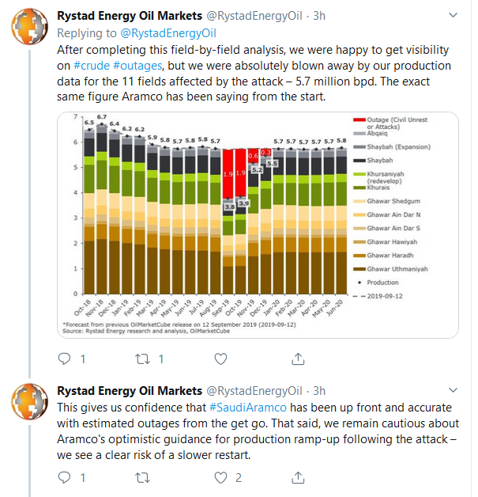
The attack took offline 5 million bbl/d of throughput.   According to the Reuters article, Aramco is already back to 4.3 mmbbl/d.  So it is basically a non-issue.

But if that is the case then where is the WSJ getting their information from?  Who are the board member and executives that are “expressing doubts”.  How can they be expressing doubts about a situation that has already rectified itself.

Some are suggesting that the stories are talking about different things – that Reuters is talking about production and the WSJ is talking about capacity.  But that is not what I read – the doubts being expressed are about the return of production.

I’m not the only one that is skeptical about the Saudi optimism.


My Way to Play it – Canadian Oil

Fortunately, I can hold the Canadian oil stocks I bought without having to worry too much about where the truth lies because they haven’t really been bid up very much any way.  What’s more, most of them are starting to benefit from big stock buyback programs (Gear Energy just announced a 5% program today) and there are other non-Saudi positives that should play to their benefit as well.

What are those positives?  We know that Alberta pipeline adds (optimization from Enbridge and TC) are 185,000 bbl per day in the fourth quarter.  We also know that the Sturgeon refinery is likely to switch to bitumen feed-stock shortly.  We also know that Jason Kenny said last week that he would lift the curtailment if you can ship your oil by rail.

Meanwhile heavy oil seems to be supported by the attacks in Saudi Arabia.  I have to admit I don’t really get this part – it seems that it is light oil that the Saudi’s are hinting they might have trouble delivering, yet when you look at spreads it seems like heavy oil has been more of a beneficiary.

As I mentioned last week I made a bet on PBF Energy with the thesis that the pop in high sulphur fuel oil (HSFO) wouldn’t last.  That has somewhat played out – HSFO did drop off its highs and the December contract is back to $36/bbl – it was $33/bbl before the attack.  PBF Energy recovered as I expected.   I unfortunately sold out a day too early, on Friday, while the stock has continued to pop today.

But I am still not sure where all this is going.  Is there going to be less HSFO because the Saudi’s will use it to run their power plants (this is not good for the environment by the way) so they can ship more low-sulphur oil to their customers?  Or will the Saudi’s ship high-sulphur crude abroad to refiners like PBF and they will make a killing on the collapsing differentials?  It’s not at all clear.

Overstock – I Swear I’m Out for Good This Time

Another bit of news today is Overstock, which has become even more of a gong-show than even I thought possible.  The CFO resigned and the company reduced guidance (which they had only just raised in July!).

I sold out of what remained of my position as fast as I could this morning.  When a CFO leaves, particularly in the middle of tumult (as has been the case with Overstock), it is better to stand aside.  I made some money on the way up, and gave some of that back on the way down.  I do think this will be the last trip I have with the stock.

Mission Ready Conference Call

Last Thursday Mission Ready had a conference call with investors.  I thought it was pretty positive.  The company outlined the business in more detail than they have done before.

I learned that gross margins are in the 12% area right now and they’d like to see them up to 15%, but that they can’t go much higher without raising eyebrows at the Department of Defense.

I learned that the major impediment to growth right now is the small team and that they have plans to grow their sales staff significantly.

I learned the foreign military deal is indeed dead but that there are others they are in contract with.

Most importantly, I also learned that we should expect more extensions on the TLS contract rather than a new 10-year contract being awarded.  As I wrote in this post, the TLS contract has 6 prime-vendors, with Mission Ready subsidiary Unifire being one of them.  The largest of these 6 vendors is a company called ADS.   ADS has volumes in the billions of dollars.

ADS is in trouble because they were stripped of their small-business designation and they had to pay a settlement associated with having fraudulently obtained some of the small-business set-asides from these contracts.  This article from the Washington Post describes the situation.

The upshot of this is that ADS may get removed from the vendor list of the next TLS contract.  What I learned from the call was that if they did, ADS would almost certainly protest the decision.  If, on the other hand, they didn’t get removed, all the other vendors would protest.

The mess that this would entail makes it very likely that there will just be 6 month to 1 year extensions made to the existing contract.

This isn’t a bad thing for Mission Ready, as extensions mean there is no review of vendors, it gives them time to ramp Unifire as a vendor and prove themselves.  If Mission Ready can continue to take contract wins at the rate they have over the last 6 months or so, I think the company is setting itself up quite well.

After the conference call Mission Ready announced another $15 million in wins the next day.  They are up to $75 million to date.

Nuvectra Bonus

On Friday night Nuvectra filed their employment agreement with their new CFO, Jennifer Kosharek,  As part of that employment agreement the filing stated that Ms. Kosharek and other executives are in line for a “transaction bonus”:

Transaction Bonus Plan

As previously disclosed, the Company is exploring potential strategic alternatives to enhance shareholder value and recently implemented a reduction in force. To incentivize and reward employees for their increased responsibilities in light of these events, on September 16, 2019, the Company’s Board of Directors, upon the recommendation of its Compensation Committee, approved a cash incentive plan to reward a broad base of employees in connection with a potential sale of the Company (the “Transaction Bonus Plan”). Under the Transaction Bonus Plan, cash payments would be made to eligible employees (1) 50% upon the signing of a definitive agreement for the sale of the Company and (2) provided that the definitive agreement remains in effect, 50% upon the earlier to occur of March 31, 2020 and the closing of the transaction. Participants must be employed by the Company at the time of payment. The total cost of the Transaction Bonus Plan, if fully implemented, will not exceed $1.6 million.

In general, executives do not decide institute a big incentive to be paid out in the case of a transaction unless they feel that transaction may occur.

Emmaus – Blah

I also sold most of my Emmaus on Friday (I should have sold it all, its down again today!).  The stock is acting so bad and the company didn’t get approval of their appeal at the EU (they announced this Thursday).  I can’t figure out why insiders were buying so much given that since they have bought there has been nothing but negative news.  and am left to conclude that maybe they were just wrong.  I have been too, and what is left of my position is pretty insignificant so I might just sell it and admit defeat on this one.

A Couple of General Comments

Overall I remain even more cautious than last week.  In addition to my skepticism that oil prices will remain so sanguine, it occurs to me that if oil prices do continue to do nothing, it could be because the world economy continues to sputter.   There seems to be more and more evidence that the global slowdown is getting worse, not better.

We are also entering a time where liquidity is unusually tight.  We had the odd spike in repo rates last week that the stock market does not seem to care about but which nevertheless is just a little disconcerting.  We are also in a period where a lot of US dollars are leaving the system all at the same time.   This kind of liquidity squeeze is usually not good for the speculative sort of stocks that I like to hold.

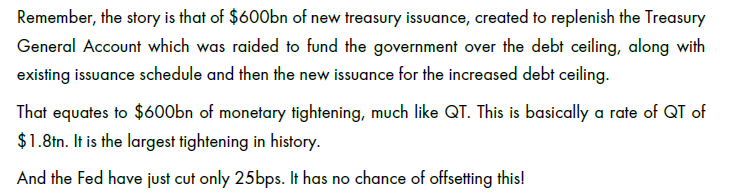
This morning I received from a friend a PDF of the latest Macro Insights piece from the founders of Real Vision.  In it they pointed out:

When you consider that with quantitative easing the Federal Reserve balance rose about $3 trillion over 6 years, it just seems like this one-time treasury issuance, which has the effect of the opposite, is not insignificant.

When you couple that with what seems to be real funding stress in the repo market, well, you just have to wonder where we are going.

Look, I don’t know this stuff inside out.  I invest my money and write a little blog saying why I do what I do.  This could be a whole lot of nothing.  Probably is.  But for me, I’m going to be even more cautious than usual.  With that in mind I sold Scorpio Tankers (for now), sold Ardmore Shipping (for now), sold the rest of Moneygram and bought some more inverse ETF shares on the S&P.

Last point: Elizabeth Warren appears to be gaining momentum in the polls.  I do not necessarily disagree with much of what Elizabeth Warren says, but I am pretty sure that if she gets elected and does what she says she is going to do, it is not going to be good for the stock market.   The market obviously doesn’t care about this yet but at some point, if her strength continues, it will.


Complacency

I think the market is being too complacent about the events in Saudi Arabia over the weekend.

Oil was up some, but the S&P was hardly down at all.  I find it hard to believe that we can have an event of this magnitude, and a corresponding increase to the threat of war with Iran, and add so little risk premium into the market.

I’ve read everything I could about the extent of the damage and it is as clear as mud to me.  But as I tweeted on the weekend, if they really did blow up a bunch of gas-oil separation towers, those aren’t the sort of things that can be ordered overnight. They are likely custom towers that would take at least a month or two to build, if not more.

This word “redundancy” keeps coming up in tweets and in the media.  What does that word actually refer to?  Is it just a placebo word to quell an argument, or are there specific redundancies (other than storage) that will make this a non-event?  I suspect it is more of the former.  Again, if they hit enough of the separation towers, I don’t think there is much that can be done other than to rebuild the towers and get them back online.

The one thing that really did make an out-sized move was high sulfur fuel oil (HSFO).  I think this is because there is the expectation that Saudi Arabia will use HSFO to run their power stations as they divert crude to fill their export requirements.  But then I also just read a Reuters article that said that Asian refiners are expected to get heavy crude instead of medium crude, so it’s all still very uncertain.

At the margin I actually added a little to Crescent Point when it dipped mid-day.  I also took a small position in PBF Energy.  PBF was likely getting hit because HSFO was popping.  They are somewhat more dependent on heavy oil price than other refiners.  But at the same time, yesterday Jason Kenney lifted restrictions on Alberta production if they can get it moving by rail.  This seems to have flown under the radar, but it should increase supply of heavy oil in North America at least.  That, and the expectation that higher oil prices are generally good for refiners, makes me think PBF is worth trading when it gets into the $22’s.

Other than that I was cautious yesterday and added to index shorts.

This reminds me of the chapter in Reminiscences of a Stock Operator when the earthquake hit in San Francisco.  The market did not react right away.  It was a bull market.  There was too much positive energy to digest such a negative event immediately.  It took time for the market to realize what had just happened.

I don’t understand how we can have this big of an event and it is a non-factor to the market.  I believe the oil market still matters.  The Middle East still matters.  We’ll see if I’m wrong.