Skip to content

A Little Update on my Payment Processor Position

I’ve had family commitments the last couple of weeks and that has led to a longer than usual radio silence.  I am due for a portfolio update, and I plan to get to that next week.

In the mean time I wanted to talk about one change I’ve made to my portfolio since I last wrote a month ago.

While my rule is generally is to not add to positions until they show a profit, I paradoxically only seem to accumulate larger positions in the stocks that go down.   I guess that once I break the rule, I might as well go whole hog.  As much as I try to add to my stocks that are working, I rarely do it meaningfully.  As such, my biggest winners have always been the stocks that have gone down significantly after I bought.

It doesn’t always work.  One name that comes to mind is Bellatrix, which in 2014 I bought and bought and it fell and fell.  My timing was terrible, and whether I was right about the Spirit River potential at the time or not, it was irrelevant – any upside was lost in the commodity collapse.  I eventually gave up and sold the lot of it for a loss, wiping out much of the gains I had earlier in the year in the ethanol trade.

I mention this as a warning.  Just because I have decided to break my rule it does not mean I am right.  It just means that I have an unusual amount of conviction.

Intelligent Systems

I had that unusual amount of conviction in Intelligent Systems as I added to it a few weeks ago.  I mentioned the stock in my last update and at the time it was my usual starter size.  In late April, as it dipped to the low $30s and high $20s I decided to increase the position.

Since then the stock has done well.  It reached the mid-$40s before appearing to take a breather.  In full disclosure I did take a few shares off the table, but only because my position was getting a little bigger than I was comfortable with, and it remains a fair bit larger now than when I first talked about it last month.

This move is the latest in a number of “steps” that the stock has taken to higher levels over the past 6 months.  The chart of Intelligent Systems is not typical for one of my investments.  It is clearly up and to the right.  I usually find stocks that are either down and to the right or just plain down.  I enjoy misery.

The valuation of Intelligent Systems is not typical for me either.  The stock trades at 16x trailing price to sales.  Twelve month trailing earnings are 70c, which puts the stock at a rather nose-bleed trailing PE.

So this isn’t the usual “cheap” story that compels me to take a larger than usual position.  At least on the surface.

But this is a company that has had a big inflection point.  I suspect we are still fairly early on along that road.

The reason the stock ran so far in the early part of the year is because the company “won” business from Goldman Sachs to create their back-end processing software that will drive the new Apple Card.

Of course with such a ridiculous move higher, the bearish point to be made would be that this is more than priced in.

I’m not so sure about that.  As well, I think there are reasons to believe that wins with other names are imminent.

More on that in a bit, but first lets talk about Goldman Sachs/Apple.  The win is a licensing contact for the Intelligent Systems software.  Intelligent Systems is delivering the processing software that Goldman Sachs will use to be the processor of the new Apple Card.  Goldman Sachs will be the processor of that card.  Intelligent Systems will be paid with license revenue, professional services for the work they are completing on the software development (much of this has been recognized) and maintenance revenue that will be a function of the number of licenses.

What is that worth to Intelligent Systems?  Potentially quite a bit.  Intelligent Systems licenses their processing tools by the user.  So what matters is how many Apple customers apply for a card.  While few brokerages have provided their estimates (so far Apple hasn’t really given any guidance – at least none that I can see), one that has is HSBC.

If HSBC is correct, Apple will onboard 14.6 million users to their card each year beginning in 2020.

Corroboration that this estimate is in the ballpark comes from the Intelligent Systems first quarter conference call where they said:

We’re working and helping a licensee build a world-class processing environment. It’s one that will process 5 million, 10 million, 20 million or more accounts.

We don’t know for sure what Intelligent Systems gets on a per user basis for their licenses.  It’s a bit of a theme with the company – they are light on investor relations and therefore light on details.  We do know that the license revenue they charge varies based on the complexity of the card.  The Apple Card, a supposedly revolutionary card, is likely to be fairly complex.

On one call the CEO of Intelligent Systems, Leyland Strange, gave a theoretical example that used a $1/license number.  So perhaps that is a good place to start.  There is some scuttle that has an existing licensing company with a very simple platform being charged in this range.

So if the Apple Card is more complicated maybe it would be a bit higher.  The number seems likely to be somewhere between $1-$2.  That would mean anywhere from $15 million to $30 million of annual revenue from licenses, at least over the next few years, if HSBC is correct.

Could I be wrong?  For sure.  The only other reference to what the Apple Card uptake might be is from this article, which suggests that Goldman is expecting 21 million accounts in 2020.  This is quite a bit higher than HSBC.  I don’t have access to Goldman research however, so I can’t verify the number directly.

On the calls the Intelligent Systems management, in particular Strange, has stated that license revenue is essentially 100% gross margin.  It is technically true, though they do a ton of professional services work upfront to develop the software, customize to the clients specifications, etc.  But that work is at its own profit and already done it is independent of license revenue, which means the important thing for investors is that the license revenue does fall in whole to the bottom-line.

On top of license revenue Intelligent Systems will continue to generate maintenance revenue and professional services revenue from Goldman Sachs.

The professional services revenue will come as Goldman or Apple ask for tweaks, new functionality or an expansion of what the software does.

On the last call management clarified that the maintenance revenue piece was tiered and based on the number of licenses.  While again I do not have enough information to equate a hard number to maintenance revenue, it seems that it will increase as Apple Card licenses are on-boarded.  Overall it is safe to assume there will be material recurring revenue from the relationship separate from the one-time license revenue.

While I don’t believe that it has ever been stated by anyone, I also think it is quite likely that the relationship between Intelligent Systems and Goldman is about more than just the Apple Card.  It seems likely that it began as work on Goldman’s new consumer platform called Marcus.

Goldman launched Marcus a couple of years ago.  It started off as a consumer digital deposit platform in the United States and last year expanded into loans.  They launched a similar digital deposit platform in the United Kingdom in September.  That platform in the UK has taken in $5 billion of deposits since then.  In the US and UK combined Marcus has taken $46 billion of deposits.

Consumer deposits and unsecured loans were just the first step of Goldman’s vision with Marcus.  The following is from a presentation Goldman gave in early-2018:

The credit card piece has perhaps been clarified with the Apple Card.

Here is what Goldman has said about the Marcus platform.  This is from their second quarter conference call:

Importantly, I want to turn your attention to the key elements of this project as they represent the same drivers that underscore a range of major strategic growth initiatives underway at the firm. These elements include: re-imagined projects that address pain points for corporations, institutions and consumers; new technology unburdened by legacy systems that often slow down innovation; digital delivery mechanisms that produce scale and efficiency; and access to large customer populations. These elements are critical to our key growth platforms, including: Marcus and mass affluent wealth, where we will pursue partnerships to access large numbers of consumers; Marquee, our digital institutional platform with the ability to innovate can help us engage its other institutional client base; and corporate cash management, where we can serve existing clients for the firm and offer differentiated products on a digital platform.

In my opinion, the key points as they might relate to Intelligent Systems role, is the excerpt I highlighted.  It gives an idea of what Intelligent Systems is delivering.

But this is just me guessing.  I don’t know what role Intelligent Systems has in Marcus.  I assume that Marcus is the engine driving the Apple Card processing.  I also assume that Goldman’s vision with Marcus is not going to stop with Apple.  On Intelligent Systems first quarter call, in a comment where he was referring to their “world-class licensee”, Leyland Strange said that Intelligent Systems was a “key contributor to the main system of record that requires a highly scalable and high availability infrastructure”.

With all that in mind, it is important to note that on completion of the Goldman platform Intelligent Systems will retain the IP.

It surprises me a little that Goldman is so willing to let the IP of one of their next, big growth engines to remain in a relatively small company in Atlanta.  But maybe I don’t understand the risks and they are less than I think.

At any rate that IP will be a key to future growth at Intelligent Systems as it will be the basis of their own processing business.  On the last conference call:

The fact is that we cannot take on a new 5 million account client in our own infrastructure and environment at this point in time.  So it’s better for we ourselves to say not ready rather than customer due diligence come back with, you’re not ready…

We’re working and helping a licensee build a world-class processing environment. It’s one that will process 5 million, 10 million, 20 million or more accounts. We’re the key contributors to the main system of record that requires a highly scalable and high availability infrastructure.

 We will then add the elements that we have brought to them as well as lessons learned from their smart people to our own environment and have a good, valid reason to then claim we are a world-class processor. I hope we do it by the end of this year. It could drag on if we are tied up with them a whole lot longer.

Intelligent Systems has a processing business already, but not one of the scale they are describing above (processing and maintenance revenue was about $1.8 million last quarter).

Where are these (large) processing clients going to come from?  There is reason to believe that Intelligent Systems is working with a few large operators already.

The one that is likely closest to launch is Sallie Mae.

No one has said that Intelligent Systems is working with Sallie Mae.  Yet I think they are.  Here is my reasoning.  We know that Sallie Mae is working with a company called Deserve on the new credit card they are about to launch.  Sallie Mae has mentioned Deserve by name on a number of their conference calls.  This reference is from their third quarter call (SLM CEO Raymond Quinlan talking):

Deserve is a west coast, very modern, integrated native app purveyor of credit cards. And when we looked at our entry into the card business, several things guided us: One is that the card business is filled with very capable competitors, many of whom have excess capacity, while we’re sitting here; two is that we did not want to build an infrastructure that had high fixed costs associated with it; three is that we wanted to be modern and we thought that we would have an advantage over existing players who frequently are bound by their old unintegrated and not fair consumer-friendly systems. And so as we surveyed who would be a potential partner, we looked at multiple potential capabilities. We hit upon the Deserve folks because they are modern, they are dedicated to us and — but they are a relatively new company, and so we made a small investment in them.

A little bit of digging turns up that the Deserve platform is powered by Corecard, which is the brand that Intelligent Systems markets their processing solution under.  From the Deserve Privacy Policy (a h/t to Hiddensmallcaps for finding this link):

There are a few other indications of the Sallie Mae connection that I’ve discovered but won’t get into here.

What is the Sallie Mae business worth?  Well first of all, this is a different model than what Intelligent Systems is delivering to Goldman/Apple.  Sallie Mae (if I am right and it is indeed them that Intelligent Systems is working with) is almost certainly the processing client that was delayed last year and it now being ramped up.  This is something Intelligent Systems has discussed a number of times on the last few calls.

As a processing customer, the revenue model is more traditionally recurring.  Intelligent Systems will generate revenue on a monthly basis as a function of the number of accounts processed for the card holders.  So again it’s a function of accounts – but this time it is not a one-time fee and maintenance.

How much is that fee?  I can only make an intelligent guess.  I dug up some information from First Data that is very old (2003) that suggested at the time they generated $4/year/card holder on processing.  I can also infer from 3Pea International disclosures (they are now called Paysign) that they generate $8/year/card holder for their processing platform, though they also provide a more end-to-end solution than Intelligent Systems.

How many users will take up a Sallie Mae card?  Again, tough to say with any certainty.  Sallie Mae has over 1 million customers and originated almost $6 billion in loans last year (I had previously written 25 million customers but I didn’t realize that came from a disclosure before the spin-off of Navient).  How many of those customers take a card?  Your guess is as good as mine here.

Now again, nothing has been officially announced with Sallie Mae. This is my speculation based on the information I have dug up.

What lies beyond Goldman and Sallie Mae?  Another big question. We know there are two processing customers they are working with.  We have talked about the first likely being Sallie Mae.

I can’t say for sure who the second is.  My only guess is that it may be Greensky.  Greensky partners with merchants to provide point of sale credit.  They primarily derive their business from home improvement stores (Home Depot makes up 5% of sales while Renewel by Anderson is a sponsor for another 19%).

Why Greensky?  Well its more of a stretch than Sallie Mae so take this with a grain of salt: First and circumstantially Leyland Strange has made point-of-sale credit comments on the conference calls a couple of times (there is a long example of POS credit scenario at Bass Pro Shops that he says only Intelligent Systems could handle on the fourth quarter call).  Second, there is a striking similarity between the credit card service portal of Final, which is a Corecard client, and Greensky (though I have to say I am comparing the screens second hand as my IP is in Canada and I am blocked when I try to access this Greensky portal – a h/t again to @hiddensmallcaps here).  Third, if you do a Google search with the terms ‘mygreensky.com corecard’, oddly this is the only result that appears.

So those are my guesses at the immediate two processors that are in the wings.  There is reason to believe that they have another large processing customer that is still a year or more away.  There is scuttle on this that truly is scuttle and so I’m not going to speculate on who.  There was mention of this on the last call, though Strange was quick to say that this customer is not in any “pipeline” – so take that for what its worth.  Either its not a done deal or Strange is being his usual understated self.

More broadly, I believe that Intelligent Systems had a unique processing platform and through Goldman/Apple has been paid to develop an even better one.  I suspect the platform is geared towards real-time processing, which from what I gather from listening to panel discussions and the calls of larger processing players, is really the shift that is beginning to take place – replacing ACH batch processing with immediate transfers has many use cases.  Real-time processing offers speed, transparency and 24/7/365 capabilities that give it advantages to merchants and consumers.

It is my sense that the processing industry is quite a hodge-podge of solutions.  Companies like Fiserv, Total System Services and First Data have a number of different brands and versions of payment solutions that they have acquired over the years and from what I can tell they are all quite distinct from one another and are difficult to combine.  Case and point is that as Fiserv has made a bid to acquire First Data, they listed a host of synergies between the two companies but were clear that the product lines would see limited or no integration.

It’s an industry that is ripe for disruption.

So that’s story and why I was willing to add to the stock as it dipped, rather than following my usual strategy where I do not add until I see begin to see a profit.

Going forward I think the stock can move higher, but the time frame is less certain.  This company does very little to promote itself (there is no corporate presentation and no IR to speak of), so there almost assuredly will be no press releases between now and the second quarter results.  Those second quarter results might be a catalyst; there may be an uptick in license revenue from Apple/Goldman – but there also may not.  I can only guess when the licenses will begin to be recognized or how fast it will be recognized.  The Apple Card is not launching until the summer.

The two processing customers will begin to generate revenue in the second half of the year.  But this will likely be a small base at the beginning.

Could the company be taken over?  I think that is a possibility.  On more than one occasion Leyland Strange has said that they are a “very opportunistic” company.  He said this specifically in response to questions about being acquired.  He is also 76 years old and owns over 25% of the company (two holders, Strange and Weitz Investment Management, own over 50%).

As well, Goldman themselves said on their own third quarter call that while they did not plan to make any large acquisitions, they were looking at ways to “consolidate their technology”, particularly on the consumer (Marcus) platform.  They said that such acquisitions would be small for Goldman and not require share issuance.

The short interest in the stock has risen, which is interesting.  I imagine there is a simple thesis around valuation.  On a trailing basis the company looks very expensive.  I also wonder whether the inclusion on the board of a prominent executive that has been in the cross-hairs of short sellers (I will not mention his name because I have no interest in this blog being listed in Google searches with respect to this individual – I have come to dislike publicity in general and specifically of this nature!) who you can look up easily enough in their filings.  My thoughts on this board member are – it is what it is.  He’s been there forever, there is a relationship there and if you want to make something of it that is yours to do.  I have seen no reason to myself.

That short interest could be negative but could also be positive.  The float is actually quite small here as between Strange, Weitz and a few other individuals and funds own over 60% of the shares.

Either way I don’t care much about that.  I plan to stick with this name as long as it continues to execute.  I’m hoping that, barring a takeover, that will be a very long time.
 

Update on a Few Stocks

Here are some of the changes I made to my portfolio in the last two weeks.

Liqtech

I sold out of Liqtech after reviewing their fourth quarter results.  I did so a couple of reasons.

First, their guidance for the first quarter was okay but not as strong as I would have hoped.  The company said they expected $7 million of revenue in the first quarter.  Assuming diesel particulate filters rebound back to historic levels, that implies 10-15 filters, depending on the price.

That’s not as many sales as I would have hoped for at this point.  We’re less than a year away from IMO 2020.  I would have liked to see twice that.

Second, the company decided to stop reporting its backlog.  As a rule, companies don’t stop reporting items that have positive implications for the stock price.  Which leads me to wonder if and why the backlog is not be increasing as quickly as hoped?

One of my worries with Liqtech has always been that shippers go with “hybrid-ready” scrubbers that are designed to use a filter some day, but not right now.  I follow the announcements on Ship & Bunker and other sites and I’ve noticed most of the large scrubber orders are described as hybrid-ready.

Gregory Vousvonis made interesting comments on SeekingAlpha yesterday saying:

Although closed loop and hybrid scrubbers make sense there is a legit counter-case to be made that the overwhelming economic benefit can be collected with a cheaper open-loop model and thus avoiding the more expensive and complicated closed loop / hybrid scrubbers. Which also have the disadvantage of having to dispose the solid residue from the wastewater management system.

Liqtech is still going to get a lot of filter orders, but the pace of these order may be more stretched out than I had hoped.  And order may lag until there is a more general ban on open-loop scrubbers everywhere

This is all just guessing.  Maybe the company has completely unrelated reasons for not reporting backlog.  The stock price has actually held up quite well since the earnings release which makes me wonder if I am wrong.  Nevertheless I decided to do my guessing from the sidelines.

Product Tanker Stocks

In his comment on SeekingAlpha Vousvonis says he was researching Scorpio Tankers when he came upon the insights about open-loop scrubbers.  It’s a coincidence because I have been researching tankers myself.

I’ve known for a while that product tankers (the one’s carrying gasoline, diesel and other clean fuels) are expecting an uptick in demand from IMO 2020.  Gasoil and low-sulfur bunker fuels will need to be transported to the bunkering hubs.  As well longer shipping routes will be required as low sulphur fuels now need to travel further (refineries that are most able to produce low sulphur fuel are in North America and Europe whereas the demand will increase in ports across the world in particular in developing nations).

With that in mind I found this panel discussion with four product tanker companies, which was tweeted by @20slots, to be really interesting.

Each participant is very bullish.  Of course it could be said that shipping companies are always bullish.  But I don’t know – not like this.

The most interesting argument made is that product tankers have been in a bear market for 11 years.  The companies cannot respond to the coming demand from IMO 2020 because they are too levered already and their share prices are too depressed.  This sets up a scenario of an extended cycle.

I took equal positions in 2 of the panelists: Ardmore Shipping and Scorpio Tankers.  I took a smaller position in Pyxis Tankers.  Of the 3 I am inclined to think Scorpio might fair the best.  Why?  Because they have been the most proactive with scrubbers.

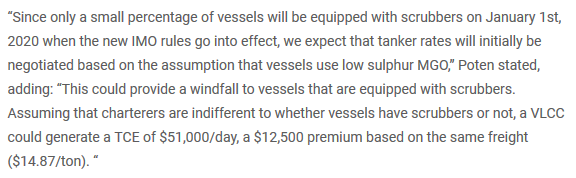
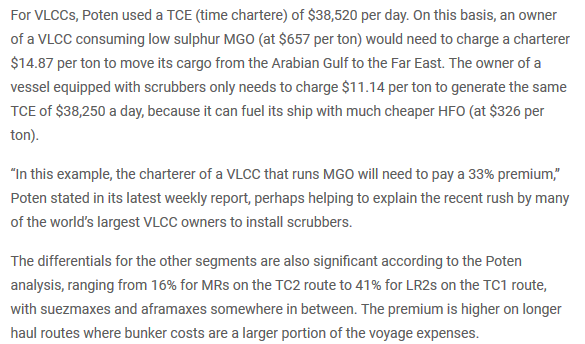
Scrubbers could potentially be quite lucrative to the shippers that install them.  An old article from last year:

The estimates in the article are for VLCCs so the absolute margin increases will be lower for MR and LR tankers, but you get the idea.

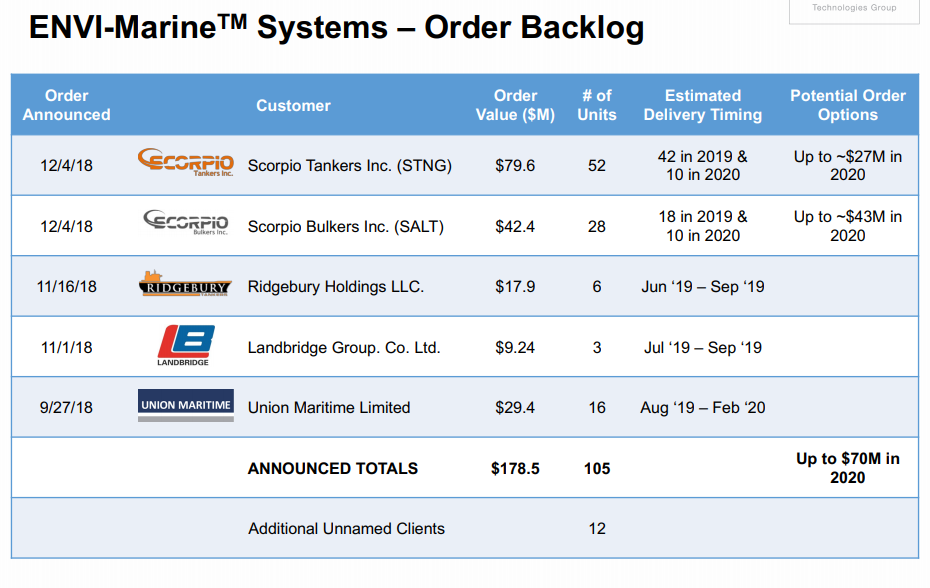
Speaking of selling scrubbers to Scorpio, @FBuschek found an obscure little company to play scrubber installations with.  Pacific Green Technologies has scrubbers orders with Scorpio Tankers, Scorpio Bulkers and a couple of other tanker firms.

Pacific Green is an illiquid little OTC company, so I took a very, very small position in it.  Really its more just for curiosity than anything else.  They have a partnership with a Chinese company called Power China, which makes me a little wary.  They also split gross margins with Power China 50/50, and with no guidance from the company on what margins might be, its difficult to put together any kind of financial model

Nevertheless scrubber orders of nearly $200 million on a stock with a $135 million market cap makes this an interesting one to watch.

Oil stocks – Athabasca Oil and Gas and Crescent Point

I made a couple bets on oil stocks.  The price of oil has risen and the stocks so far have not followed.  This happened last year.  At the time it was frustrating to watch until it wasn’t.  In April of last year oil stocks decided to join the rally and some of them rose 75-100% in the matter of a month.

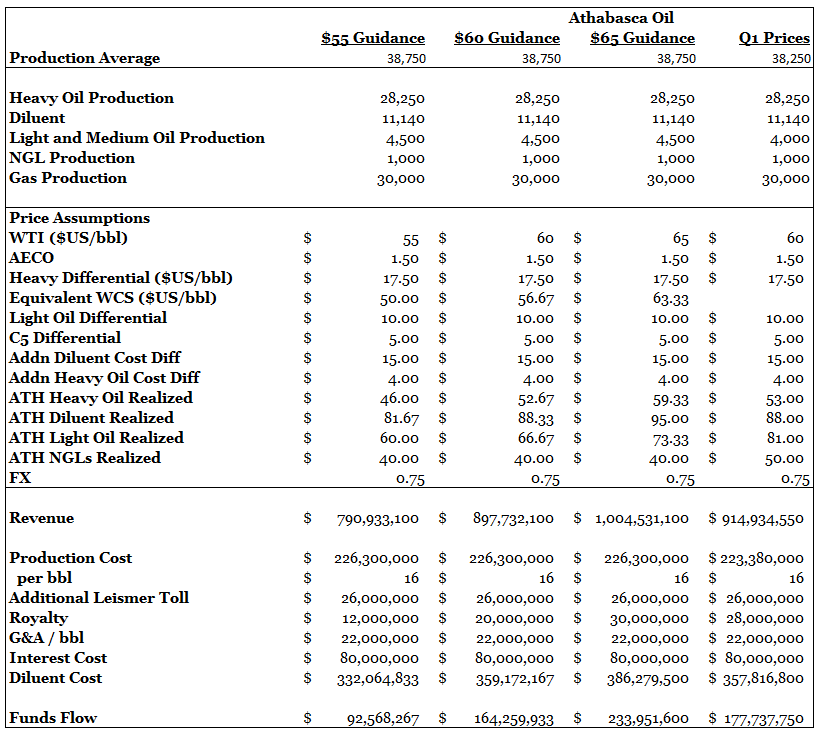
Will that happen again?  Who knows.  But its worth a small gamble I think.  I added Athabasca Oil and Gas and Crescent Point.   I did a rough model on Athabasca, essentially replicating the company’s own guidance, and it’s quite stark how levered the company is to each $1 increase in the price of WCS at these price levels.

Athabasca is guiding to CAPEX of between $95 million and $110 million for 2019.  So you can see how the free cash flow begins to add up.  WCS prices were USD$56/bbl yesterday.  Athabasca has a market capitalization a little under $500 million.

HyreCar

I owned HyreCar earlier this year and briefly mentioned it in one of my portfolio updates.  I didn’t talk about it extensively because I didn’t know how long I would hold onto the stock.  I was worried about their ability to add dealer inventory to their rental car platform.  As it turns out I sold it after a month but missed much of the run-up to $7.

Well the company reported their fourth quarter earnings and the stock responded poorly.  To be fair I think the stock moved more on the Lyft IPO than anything to do with its own results.  The same could be said for the prior move to almost $8 per share.

I thought HyreCar’s results were actually pretty decent.   As it turns out Hycar was pretty successful adding dealers to the network.

In our third quarter call, we noted that we had 25 dealerships representing an estimated 250 cars on our platform. A number we expected to double in the fourth quarter of 2018. Today I am proud to report, we listed our 100th auto dealership today, of which, 1200 cars have been listed to the platform.

HyreCar had 10% growth sequentially in the quarter which is pretty good.  But I think the headline number may underestimate the underlying growth.

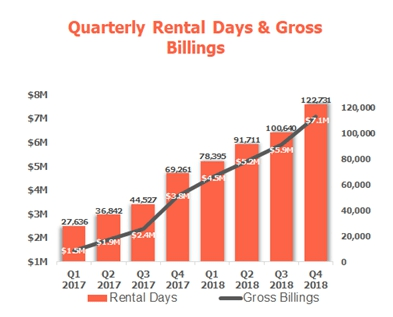
If you look at the 10-K there is a table showing gross billings and rental days.  Both increased around 20% sequentially in the fourth quarter.

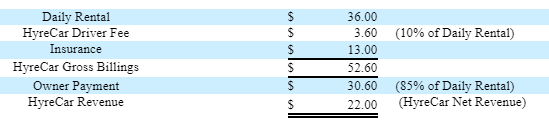
But HyreCar didn’t fully participate in the growth of gross billings and rental days because owners took a higher percentage of profits in the quarter (the tables are in weekly and daily respectively so you have to convert one of the two to see the apples to apples comparison).

Third quarter margins per vehicle:

Fourth Quarter margins per vehicle:

I’m not surprised that owner margins went up because HyreCar had to entice dealers to deliver cars to the network.  The success of that initiative is more important to the long-term viability of the business than the lost margin in the short term.

My hope would be that margins stabilize and HyreCar more-fully participates in margin growth going forward.

Also in the 10-K is a note that HyreCar should be realizing better margins on insurance in the second quarter:

American Business Insurance Services (“ABI”) is our insurance broker and Y Risk is our mobility-focused managing general underwriter. Y Risk was sold by our incumbent insurance company American International Group (NYSE: AIG) to The Hartford (NYSE: HIG) in December 2018, and we are in the process of moving our annual car insurance policy with The Hartford for the plan year from April 2019 to March 2020 under superior pricing and term

Together these positive data points made it worthwhile for me to add back the stock.

Aehr Test Systems

I’ve been watching Aehr flounder the last few quarters after selling it last year.  But it looks like they may be turning the business around here.  It was a pretty positive conference call, and I haven’t known the management team to be all that bullish unless there is reason to be.

On the call management made the following points:

  • Evidence of a ramp in orders – $6.9 million backlog at the end of fiscal third quarter plus recently announced orders means they have a $10 million plus backlog
  • Currently actively engaged with 12 customers
  • Expect to see a significant increase in bookings in the fiscal fourth quarter
  • Expect a return to profitability in the fiscal fourth quarter

If I understood what they were saying on the call, it sounds like the low-end products they’ve introduced have been successful in bringing on new engagements and initial orders.  As well maybe, just maybe, the technology of smaller dies is finally beginning to require a solution like the FOX family of systems as CEO Gayn Erickson said “our solutions stand alone as the only way to cost effectively scale to meet the demands of these devices that are used in 5G infrastructure build out, 2D and 3D sensors, and enterprise and datacenter server and storage applications.”

So we’ll see.  I took a starter.  I mean my biggest worry here is that the semi-conductor industry is strong enough to support the growth, but I guess I’ve been totally wrong about my assessment of the economy in general (or at least that is what the market has told me!) so I’ll try to keep that concern locked away in the back of my head for the time being.


A few updates and a new position

I’ve been harping on my lack of risk tolerance for about 9 months now.  The same goes for the leash I keep my positions on.  I sold a couple of stocks already this week: Overstock and Evolus.

In the case of Overstock, my conviction is just not high enough to handle the volatility.  I sold out earlier this week, getting spooked out on the first dip in the $17’s on Monday.  I felt dumb a few hours later but I feel better about it today.

With Evolus, the final straw was the prospectus for selling shareholders.  Now I don’t know the motive, why these guys are putting up their stake for sale and whether they actually intend to sell their shares at all.  But whenever I see this kind of thing I know the stock is likely to be under pressure (and it has been!).   So I’m out.

A couple of other updates.

Digital Turbine got clobbered on Monday (Monday was not a great day for me) on news that Google is reviewing their Chrome ad policy.  That this is negative for Digital Turbine made about zero sense to me.

First, all of Digital Turbine’s revenue currently comes from their pre-install product that has nothing to do with Chrome and nothing to do with cookies or user derived data for that matter.

Second, Digital Turbine doesn’t sell advertising.  In fact the only product that is remotely related to the news is Single-Tap, which even then is not an ad-product itself, it’s something an advertiser or app developer would embed in an existing ad.

Third, I can’t imagine Chrome is that important to Single-Tap because Single-Tap is for mobile and users get most of their mobile content via apps, not a browser.

Anyway I think for these reasons that Digital Turbine got pulled down in error and so I added a little.

I took a new position in Intelligent Systems.  This is the company that won the right to be the back end tech on the Apple/Goldman Sachs credit card.  I’m still digging into the stock and so I could be wrong, but after having read through the 10-K, some transcripts and having dug a little into the technology advantage I have to say it looks like a pretty good bet.

I wish I would have caught it sooner, I mean its run up like crazy since the Bloomberg article I linked to and I have no one to blame there but myself.  Buying here exposes me to all sorts of risk because its way over-bought and probably due for a pullback.  Now that I have a position I fully expect it to see the $20’s.

Nevertheless I decided to take a position because it really doesn’t look as expensive as it appears on the surface (they were profitable last year and generated over $6 million of free cash), the Apple/Goldman revenue should mean a lot of growth in 2019 and there are some indications there are other big customers in the wings.

What’s more, I just like what I hear from the management team.   Their CEO Leland Strange seems like a straight shooter.  I also just love that they doubled their revenue last year while actually showing a decline in operating expense.

I also added back Gran Colombia Gold, Roxgold and added to Wesdome.  I just couldn’t stay away from the gold space, especially now that the Federal Reserve is being stacked with money-printing yes-men.

Finally while I never talk about any of my shorts I do have to say that in my opinion the Canadian banks look pretty weak here.   I’m biased living in Alberta (where the economy remains moribund and us citizens depressed) but even so I have to wonder how the banks can withstand what appears to be an accelerating housing slump and an inverted yield curve all at the same time.

Week 401: Treading Along

Portfolio Performance

Thoughts and Review

Treading water might be the best way to describe my portfolio performance.  I haven’t participated much in the rally we’ve had over the past 7 weeks. My stocks got the initial bump in early January but since then its been only a little bit up.

In fact the tracking portfolio looks better than my actual portfolio because I don’t hedge the Canadian dollar here.  That has helped the numbers by about 2-3% since my last update.

But what are you going to do?  I said last update that I didn’t feel comfortable buying heavily into the rally and therefore I wouldn’t be chasing it.  And I haven’t.  The lack of performance is a consequence.

Nevertheless I am happy with the stocks I own.  I think there are some that could turn out to be decent winners.  Digital Turbine looks good.  No one cares about Mynd Analytics but there is every indication that the merger with Emmaus is going to happen.    Smith-Micro, Mission Ready and Evolus,  all of which I will discuss below, give me plenty to be excited about.

Smith Micro

Smith-Micro had a great quarter.  I added to the stock at $2.30 last week and added again Monday (which won’t show up in the portfolio totals below) as I think it could really turn out well if things continue in this direction.  BTW, a thanks to Mark Gomes for his video on Smith-Micro, which helped give me some insight on the quarter.

I am told that the subscriber count, which is expected to see a doubling of between the third quarter and the end of the first quarter, was not a surprise, but to me it was, and I saw this as very positive news.  Those subs should ramp to over $2 million in quarterly revenue over the next few quarters. That’s a pretty big jump from the $1.2 million of SafePath revenue that we had in the fourth quarter (which itself was up from $1 million sequentially).

Speaking in maximum double negatives, there seemed like there was not much not to like here.  The fourth quarter revenue was really good ($7.4 million which was up from $6.5 million the previous quarter).  They had positive earnings (3c EPS) and positive cash flow.  Smith-Micro forecast another tier-1 win for SafePath in the first half and suggested they could have more than one new tier-1 by year end.

And the valuation is still not expensive at all.

The average estimate here pegs growth in 2019 at 30%.  While that number could be higher or lower depending on how the Sprint ramp continues and the other Tier-1’s materialize, let’s take it at face value for now.  I believe there is about 34 million shares outstanding including the warrants that are in the money again.  So the market capitalization is $85 million.  I realize there is cash with the warrants and on the balance sheet but I’m going to ignore that.  At an $85 million market capitalization Smith-Micro trades at 2.5x forward revenue.  If I didn’t tell you this was Smith-Micro and I just said I had a 30% grower with 80%+ gross margins and recurring revenue at 2.5x sales… I think you’d have to say that sounds like a deal.

Now I realize its never quite that simple and you can go down the road of why Sprint still hasn’t sunset the legacy software, why they didn’t Smith get a Tier-1 by year end like they had suggested they might, why are reviews still mixed on GooglePlay.  There are always questions.  But after these results and with the color they gave on the call I felt comfortable adding.

Mission Ready Solutions

One of the more interesting positions in my portfolio right now is Mission Ready Solutions.  It is a stock I’ve held for a year and a half.  For most of that time I have been flat to underwater on it.  The original thesis I invested on is busted – there was an LOI with a distributor for purchases of their BCS armor vest (called Flex9Armor) from a foreign military.  It never amounted to anything and the LOI was eventually dissolved at year end.

When orders from the LOI didn’t materialize many investors lost interest and were rightfully ticked off.

I stuck with the stock because… well, I don’t know exactly why.  Probably some hope mixed in there. Also their lead product, the Flex9Armor vest, always appeared to be a legitimate product to me, maybe the best ballistic combat shirt out there.  Same for the team at their subsidiary, Protect the Force, which on all indications is a premier R&D firm for tactical gear and body armor.  I kinda took the opinion (and this is purely my opinion) that Mission Ready was likely given the run around by the distributor on the foreign military LOI.  Also, the price of the shares remained surprisingly resilient through the first half of last year, a period of basically zero news and few positives to speak of, which made me wonder why that might be the case.

It turned out that Mission Ready was about to sign a merger deal with Unifire.

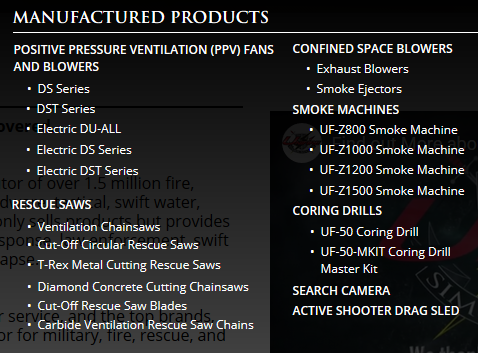
Unifire is a manufacturer and distributor of fire, military, emergency, and law enforcement equipment.  The following are their own manufactured products, but in addition they distribute over 1.5 million products from a whole pile of different vendors.

In the first half of 2018 Unifire had $18 million USD of revenue (that number comes from Mission Ready’s original press release on the acquisition).   We don’t have a lot of information yet on revenues prior to that.  Government data shows that Unifire had $31 million of revenue via Federal Government contracts in 2017.

The interesting part, and I wrote about this before in this blog post back in September but will give an update here, is that Unifire is one of six participating vendors in Defense Logistics Agency contracts (DLA).

The most recent awards for two DLA contracts came out in February. Unifire is still one of six vendors for the “$4,000,000,000 bridge contract under solicitation SPM8EJ-13-R-0001 for special operations equipment” and one of six vendors for “$90,000,000 bridge contract under solicitation SPM8EH-12-R-0009 for fire and emergency services equipment”.

These are big numbers but before we get carried away there are lots of unknowns here.  The biggest one is what piece of the pie Unifire will get.  Historically it’s been small.  Like I said, in 2017 Unifire received $31 million of government revenue.  In 2018 that appears to be down to more like $6 million (which may or may not be because they have been tied up with this merger with Mission Ready over that period).

The story behind the merger is that Unifire has been capital constrained and that has prevented them from bidding on higher volumes.  A $20 million available credit line was announced by Mission Ready a few weeks ago and with it in hand Unifire/Mission Ready should be able to bid on (and presumably win) more product.  It makes sense, but we’ll just have to see how it plays out.

At any rate I don’t think it is any coincidence that Mission Ready announced a private placement after these DLA awards were announced.   Literally the next day a $2 million private placement was announced.  Likely a lot of investors had been hesitant to participate in anything until they knew for sure that Unifire was still on the DLA go-to list.

Today they announced that the PP was over-subscribed and would be increased to $3 million.  A good sign as it means they at least have the original $2 million.  It’s certainly better than the alternative.

A successful private placement is good news because it will mean we can finally get closure on the merger.  After being halted for 7 months (maybe it was more? I lost track…), in February Mission Ready announced they had an escrowed close on the merger that still required approval by the TSX Venture to close (this is the first time I’ve ever heard of an exchange escrowed merger close?).  So the merger has so far been a kind-of-mostly-done-deal.  Once the money from the private placement is in hand I suspect it will become a fully done deal.

I added to my position in Mission Ready.  While there is still a lot I don’t know, I do like the direction the story is going.  Finally.

Overstock

Overstock announced fourth quarter results on Monday morning.

While the results missed estimates, disappointed many, and so on, I have to say I actually thought the retail business was in better shape than I had expected.  I mean the fourth quarter wasn’t ideal but that wasn’t really a surprise.

Apart from the fact that I firmly believe that I cannot take anything Patrick Byrne says at face value, the thing that has most kept me from getting behind Overstock again over the last 9 months or so has been this retail traffic problem.

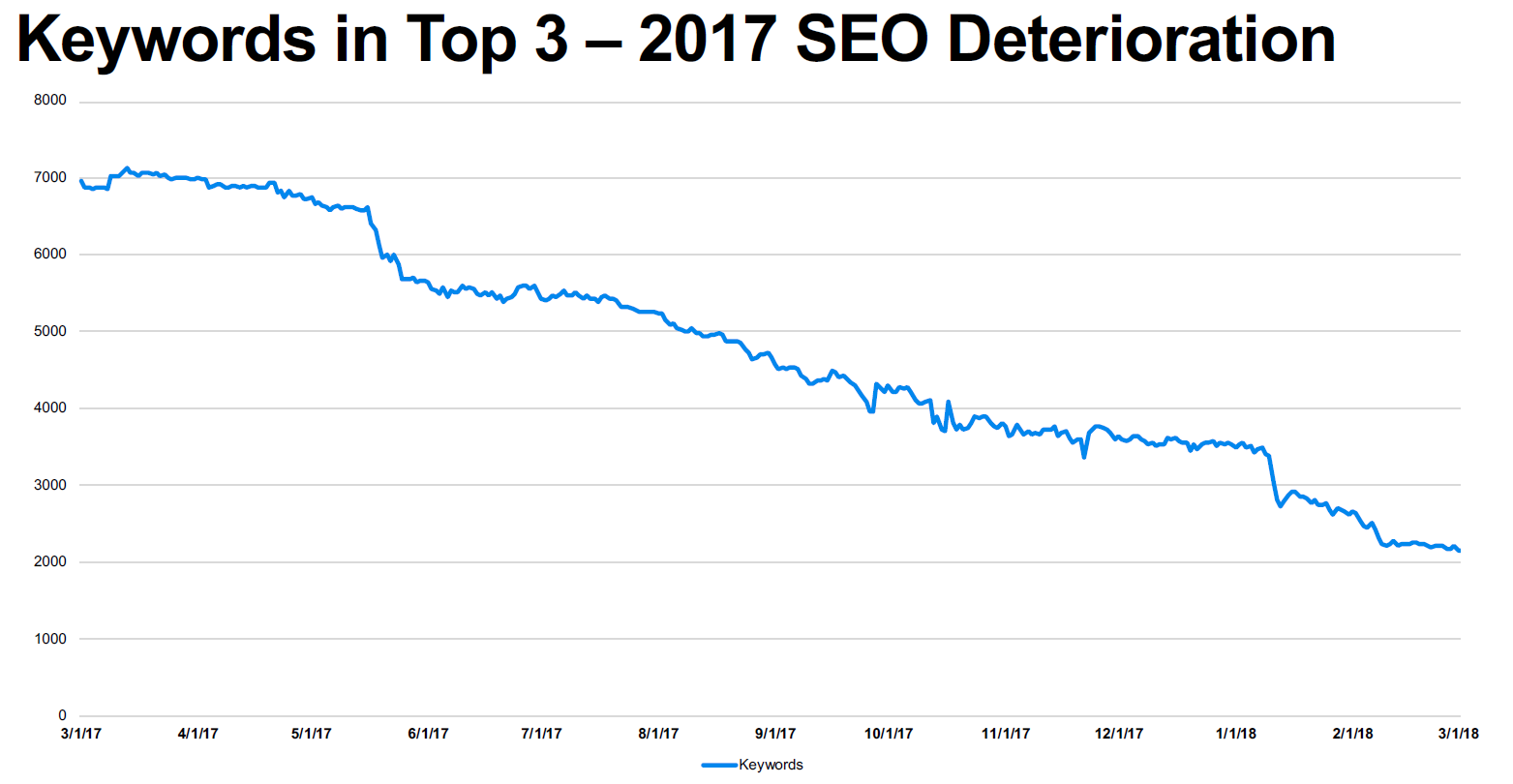
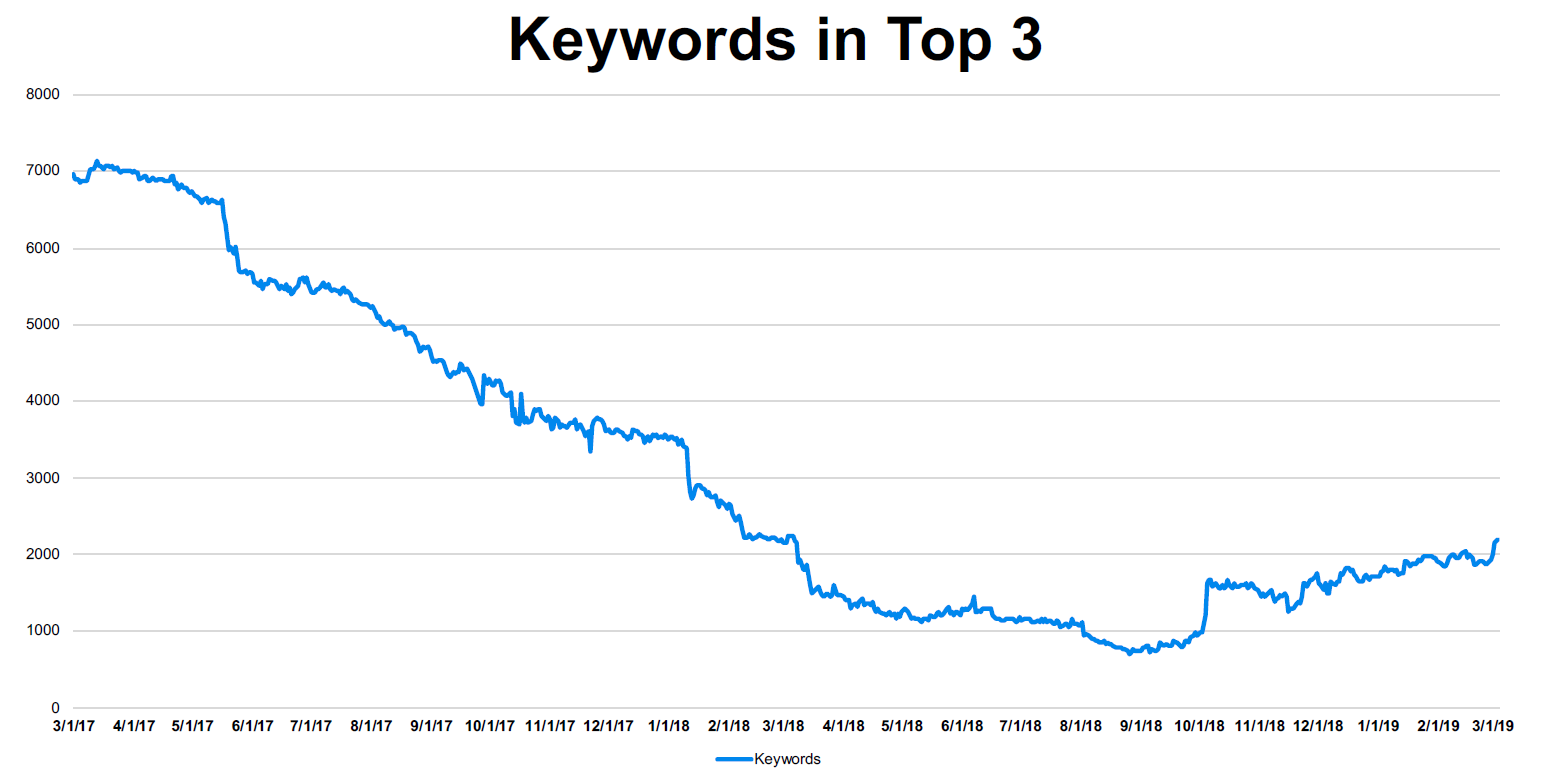
Overstock has had a problem for about two years.  Their search engine optimization (SEO) traffic had been collapsing.  I’m no online retail guru but even I can figure out that if your free traffic is declining precipitously you are probably in big trouble.

I’m pretty sure Byrne knew they were in big trouble too.  In fact I would hazard to guess that the crazy marketing spending spree that Overstock did in Q1/Q2 of last year was a smoke screen to cover for the disaster that was SEO.

Byrne saw that the numbers were going to continue to get worse so he ramped marketing spend to cover for it.  This created a false bump in revenue and allowed him to play the market with his growth schtick. You can even get hints of what they were really up to on the third quarter conference call, where they admit that they spent a lot of that money on testing and R&D. I have my doubts that the spend had much to do with competing against Wayfair.  I think it was about ploughing money into a collapsing retail business in a last ditch attempt to right the ship.

Like many of the things Byrne does, while you can’t take it at face value you can have some confidence there is some legitimate plan behind it.  Just probably not the one stated.  And this time it appears to have worked.

The fact they are off that train and on the conference call said they would bring ad spend back down implies to me that they have some confidence that they will right the ship.   I would be willing to bet that if Byrne didn’t think they could do it he’d come up with some new sleight of hand to get the market to look elsewhere.

There are two pieces of good news here.

The first good news is they did turn around their contribution dollars.  And they are saying they can keep that going.  The first quarter number they gave is quite good.  The fourth quarter number wasn’t terrible either.

The better news is that there is a definitive turn in SEO.  It’s not exactly a hockey stick but at least the collapse appears to be in the past.

I have struggled to see why an acquirer would be willing to buy retail for anything other than a very low-ball offer while SEO was in free fall.   Any acquirer would see the pre-Q4 numbers as part of their due diligence and realize the business is likely doomed.  Even if they were interested in Overstock’s logistics and back-end platform, I doubt they’d be willing to pay much given the negotiating position Overstock would be in.  But the numbers above suggest this is changing.

The final bit of news is that while the first quarter revenue comp looks ugly it is bogus IMO because the marketing spend deluge that was done Q1/Q2 of last year.

Putting this all together, my wild guess would be that they might actually be able to sell retail once they show a couple quarters of solid contribution number and get above that break-even EBITDA number.

Meanwhile on the blockchain front in August tZero opens up to retail investors.  This seems like a big deal to me and I like the idea of holding the stock heading into that.  Its a tiny position but will be interesting to watch.

Evolus

Not much to say here as the stock treads water in the mid-$20’s, I hold my position and wait. Evolus released their fourth quarter results Monday night.  Everything is going fine with the upcoming launch.

The most positive news was that they alluded that they already have the head-to-head data with botox and that the results are thumbs up. That should be a big positive as they will release those results in conjunction with the launch.

The second most positive news was that they received $100 million of debt financing.  This reduces the worry of dilution.

Nevertheless I’m not increasing the size of my position.

Its still going to be a few quarters before we really understand the uptake.  They said that the second and third quarters will be full of trials and free samples as they try to gain traction and take share.

I also need to understand the competition better.  There was a discussion on the call last night about a longer acting toxin that will hit the market in a few years:

Irina Rivkind Koffler, Mizuho Securities: how do you contemplate the market entry of a long-acting toxin sometime maybe towards the end of next year or middle of next year? Does that change the #2 positioning? And can you stay at #2 beyond 24 months?

This toxin, called RT002, is owned by Revance Therapeutics.  They had a Phase 3 study completed and plan to submit a Biologics License Application in the first half of 2019.  A longer acting toxin, if the results are comparable, will likely be tough competition.  Just how tough?  I don’t know.

So I’m not sure yet how I should expect this all to play out.  I’ll keep my position small.

A few comments on stocks I sold

Gran Colombia – it remains cheap and after I sold they changed the offering from shares and warrants to debentures.  Had it been debentures in the first place I’m not sure I would have sold.  I might have though.  The small, worrisome piece of the story that always had me a little on edge is that if you read through the technical report on Segovia the grades are expected to start to decline after 2019.  Now the veins they are chasing have been around forever and have always been high grade so there is every possibility that they find more high grade gold and this is not a problem.  Still, it was the other contributing factor to me selling.

Golden Star – I’d like to see some sign that Prestea is straightening out. It feels like its been a year and the results at Prestea are getting worse if anything.  The stock price has held up really well since I sold and so I am left to wonder if maybe this is the quarter where that happens and I will be kicking myself in a couple of months.

HyreCar – I mentioned in my last post that I had bought and sold HyreCar.  The buying was a great idea, the selling not so much.  I don’t see any news to account for the rise.  I’m guessing that this $2 move since I sold (ugh) is because of the Lyft IPO?  You know I always underestimate things like that.   I mentioned the Lyft and Uber IPO’s as potential catalysts in my notes on HyreCar, but I didn’t really give that much weight to them.  Turns out its the overriding factor.

Superior Drilling – I sold a bit of this.  Nothing is really wrong with the stock but nothing is particularly exciting either.  If I had to give a single reason for reducing my position it would be that their OPEX spend in 2019 is going to be higher than I had thought, so the company will grow, but they won’t be delivering as much free cash as I had hope for.

Liqtech – I have continued to reduce my position in Liqtech, which may turn out to be a mistake.  Why sell the stock?  Well it was a pretty big position and it is also a binary one.  There still are a lot of assumptions in any of the calcs I run.  So its really just a matter of risk management.

Portfolio Composition

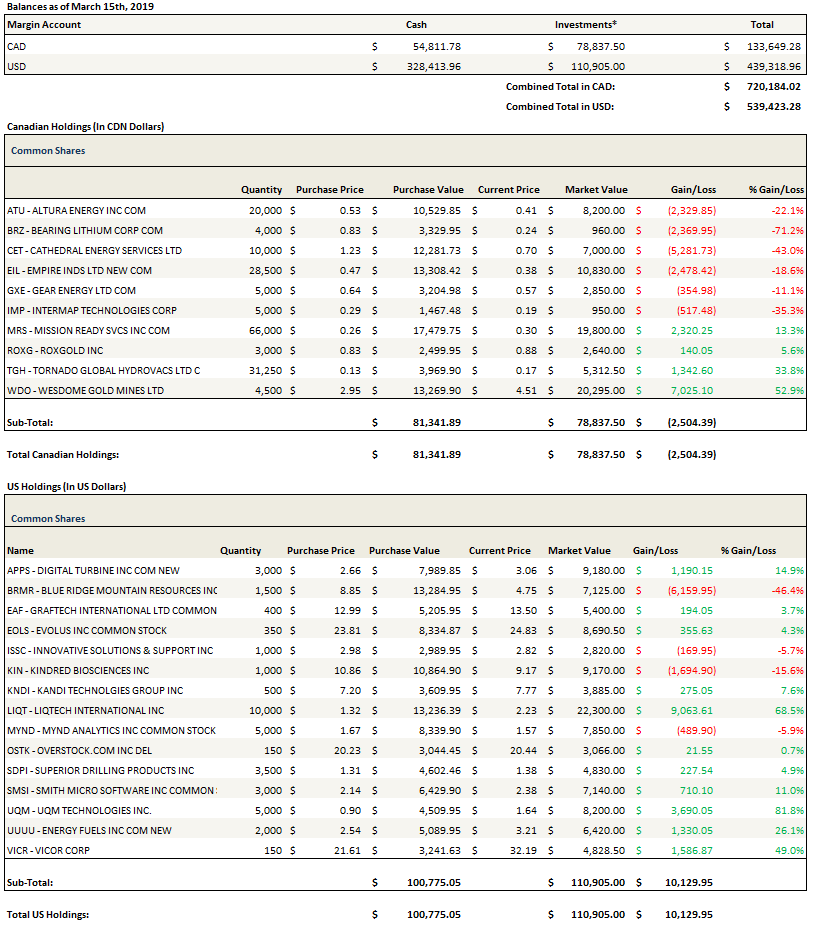
Click here for the last seven weeks of trades.  Note that I found a problem with my spreadsheet in the last update.  From December 12th 2018 until my January 2019 update I had double counted my Smith-Micro shares (6,000 instead of 3,000).  Therefore the totals for my portfolio during that time were roughly $7,000 (~1%) too high.  I corrected all my tables and charts in this update.