Skip to content

Week 340: Back Writing but Staying Cautious

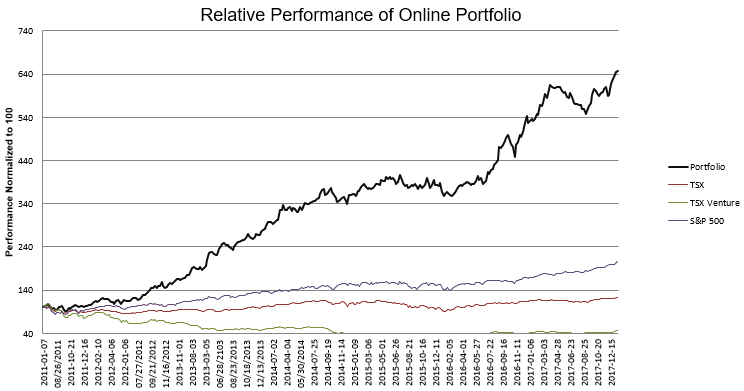
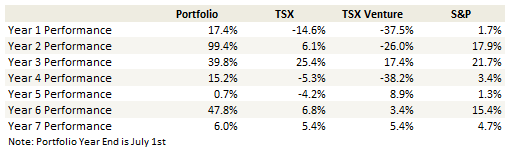
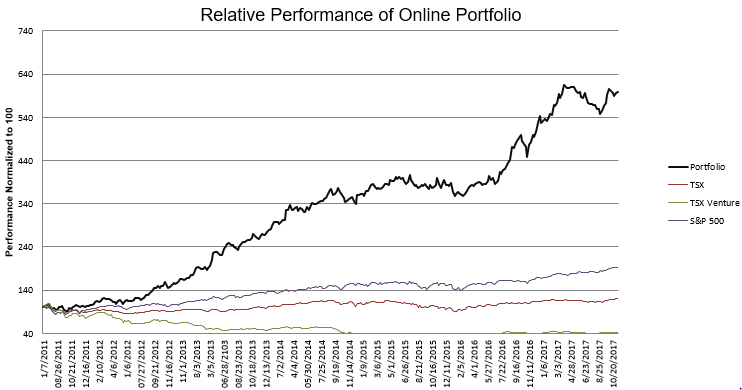
Portfolio Performance
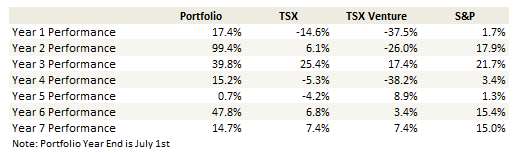
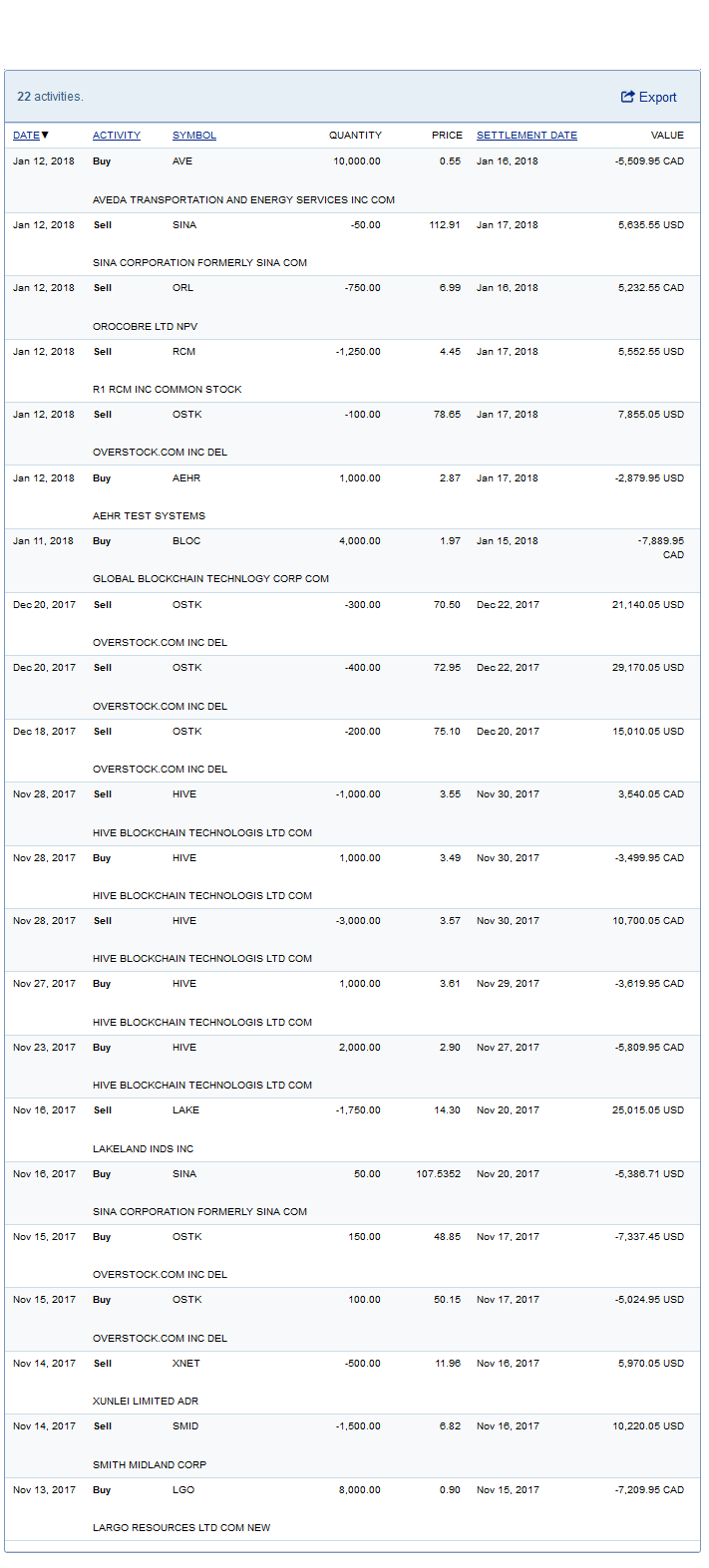
See the end of the post for my full portfolio breakdown and the last four weeks of trades

Thoughts and Review

I’m back!

Its been a month and a half since I have written.  I was on vacation for the last 3 weeks and before that I was so focused on learning about blockchains (and Overstock) that I didn’t have much time to put my thoughts down.  I should get back to more regular posting going forward.

Overall, my portfolio is doing okay.  I’m keeping up with the S&P, primarily thanks to Overstock.  I have a high cash level, which hurts when the market is going up like it is, but I just can’t bring myself to larger exposure when the market seems so lofty.  If the S&P keeps going up like it has been, and barring another Overstock type move in one of my small-caps, I will likely continue to struggle to keep up with the index.  I’m okay with that.

Overstock

Since the last time I wrote the only big thing that has happened is that Overstock worked. After a big run up I reduced my position down to a more reasonable level before Christmas.  It was simply too big.  Its not very often that an investment causes me to lose sleep, but when Overstock was a 30% position, a level that is unheard of for me, it was doing that.  I reduced too early of course, in the low-$70’s.  I remain holding a more modest 5% position in the stock, which means it remains large, but not to the ridiculous degree it was before.

Apart from position size, I had a few other reasons for reducing Overstock.

First, after reading the offering memorandum for the tZero ICO, it looks like Overstock hasn’t started developing the ICO trading platform.  So this is still early days.

Second, in that same documentation there was no mention of the stock lending platform, which I had been hoping for an update on.

Third, and I might be wrong about this because I’ve heard to the contrary, but it appears to me that the tokens are locked up for a year before they can be traded, which if true removes the upside of “price discovery”, or maybe bubble-discovery if you prefer, that I had been hoping for when the tokens became free trading.

Fourth, Byrne has been on the circuit giving interviews and his comments aren’t always consistent.  I’m still not exactly sure what his plans are with e-commerce, yet I feel like at $75 the stock is pricing in some expectation of sale and a premium price.  Take for example these comments.  They were actually made after I reduced my position, but illustrate how uncertain the direction here is.

“Maybe it’s about time we stop seeing Overstock as two separate businesses,” he said. “Our retail platform had 40 million unique people come to it last month. So as we’re developing these blockchain applications, these blockchain companies, the retail business is an extremely valuable retail business to have in terms of bringing awareness and traffic to the blockchain properties that we anticipate developing.”

It doesn’t seem like the thing you would say if you were in the mid-stages of selling the business.  So I’m not sure what to expect next.

Blockchains

More broadly, while I am very excited about blockchains and what they can do, I also think this is a long game and we are in the very early innings.  I dedicated a significant amount of time over the last two months to blockchain research.  I read books and a whole pile of white papers on individual companies.  I think the opportunity is real, but it is mostly still in a very speculative stage where picking winners is hard.

I started to make some investments in the token space over the past couple of months. They have gone well, but mainly because the whole sector went crazy in December and not because of any particular insight I had.  The token space is insane of course.  It makes no sense to me that they have valuations in the $100’s of millions or billions of dollars when in many cases there isn’t even a platform yet.  Moreover when you read many token white papers, the structure is often premised on a reasonable transaction fee that would seem to me to be negated by the current token valuations.

Nevertheless, the momentum could continue for some time yet.  This is because A. there is a real value that will eventually be realized in blockchain applications, much like there was real value the internet in the 90s, so there is a basis for the enthusiasm, and B. the moves thus far have been mostly retail dollars and if even a sliver of fund gets involved in the next year the bubble should inflate further.

Apart from the tokens, I’ve been in and out of a few different blockchain related stocks over the last couple of months but I’m reluctant to mention them because they are generally pretty sketchy and you buy them for the single reason that you think someone else will buy them higher in short order.

Its all pretty insane.  On the token side, let me just take Factom for example, which I pick because it actually seems like a solid platform and could eventually have all kinds of uses, it has backing and is established and it has an Overstock connection.  It also has a $525 million capitalization for the token.  If you assume that all of the economic benefits of the platform confer to the token holder, that means the platform is worth $500 million already?  This isn’t a hit on Factom, they are really interesting and maybe someday when services use their platform to tie in mortgages and deed titles and stock ownership into their platform then that valuation will be reasonable, but man, $500 million?  All these tokens are trading at multiples that suggest the platforms are mature and with robust usage.  And we just aren’t that far into the game yet.

The irony is that the valuations perpetuate themselves.  You end up trading on relative values and picking up “cheap” tokens that are in reality extremely expensive in their own right.  I bought another token called Tierion because it seemed like a reasonable alternative to Factom at ¼ of the price.  But its still a $100 million market cap for a platform with still limited utility.

It’s all pretty crazy, but I bet it has further to go before it ends.

On the stock side of blockchain the only one (other than Overstock) that I find somewhat interesting is Global Blockchain Technologies.  The stock is expensive (around $175 million market cap at current prices), they provide only a fuzzy idea of what their assets are (crypto mining and a token fund) and they have a ton of cheap warrants outstanding that are likely keeping a lid on the price.  So those are the reasons not to own it, or maybe to short it.

But I think there could be an interesting short-term play with the stock.  The chairman of Global Blockchain is Steve Nerayoff.  He seems to get a lot of flack on twitter, many think he’s nothing more than a promoter.  They may be right.  But he also happens to be a strategic advisor to tZero.  In these two positions it would seem to me that Nerayoff basically has two responsibilities.  A. to find tokens for Global Blockchain to invest in, and B. to help make the tZero ICO successful.  So it seems like a reasonable speculation that Global Blockchain picks up a piece of the tZero ICO.   News of the Kodak ICO investment (which is only about $2 million), briefly sent the stock up 45%.  I have to think that similar news with tZero would be regarded with equal or even more exuberance.

Commodities

As I alluded to earlier I have been reducing exposure to stocks.  Apart from a speculative blow-off its hard for me to add to positions with the market having run so far and with it being so long since the last correction.

However I have been willing to add to my commodity stocks. I continue to hold a number of base metal names, mostly those with ties to electric vehicles and batteries.  I note that Largo Resources has had a nice run up, even after the company diluted shareholders once again at bargain basement prices.  I also continue to own Lynas, Ascendent Resources, Leading Edge Materials, Bearing Lithium, Mkango Resources (very small position), Sherritt International and Norilsk Nickel.  Ascendent Resources announced fourth quarter production numbers on Friday and while mixed, they are still making progress on the mine ramp. The stock is trading at roughly 4x free cash flow if they can reach their 2018 guidance.

Gold stocks have not done much of anything and interest in the miners must be at record lows.  I’ve heard a few people articulate the theme that bitcoin interest is eclipsing gold and that the metal will continue to suffer as a consequence.  I’m not so sure about that.  Gold dynamics are so complicated, with factors from jewelry demand, Indian economics, Central bank proclivities and of course investment interest from individuals and institutions.  I have found that trying to predict the direction of gold from any single thesis usually turns out to be wrong.

What seems to be the best predictor of gold and gold stock movements is sentiment.  When everybody hates gold stocks, that is when they will go up.  And vice versa. This is primarily what my thesis is here.  Nobody wants to own gold stocks, so I think they will do well.

My largest gold stock position for some time has been Gran Colombia, and I really like the way the chart is setting up here.  I think the agreements they signed back in the summer with the artisanal miners give a legitimacy to their business that they haven’t had in the past.   If the market agrees with me the stock will go higher.

I have smaller positions in Jaguar Mining, Wesdome, Alamos Gold, New Gold and Orvana Minerals.

I also have a bunch of oil positions, though I’m a little more reserved about these.  Oil just seems to have such a dismal longer term outlook to me.  I know that the dominance of electric vehicles and renewable power is still a ways off, but I think its inevitable, and I wonder if it accelerates faster then anyone expects as the momentum snowballs.

But in the short term I doubt the market will look far enough ahead to care about that eventuality.  Right now oil inventories are dropping and with oil prices at current levels, the stocks look pretty attractive.  I still like the Canadian services names the best.  The three I own are Cathedral Energy Services, Aveda Energy Transportation Services and Essential Energy Services.  All of these companies trade well below book and have seen improving results over the past few quarters as oil prices have firmed.  I would expect that to continue in the coming year.

On the producer side I still own Spartan, Gear Energy and InPlay on the Canadian side and Silver Bow and Blue Ridge Mountain on the US side.  Blue Ridge Mountain is one of the few gas names that hasn’t moved at all over the past month.  This is because it doesn’t trade at all.  The company sold their Eureka Midstream interest in September for almost double of what the assets were held at on the balance sheet.  In the process they reduced their operating costs, gave them more flexibility for drilling and freed up prospective land that had previously been tied up due to proximity to the pipeline.  The company is now a pure play on the Utica/Marcellus.  It’s got to be worth at least $12 or $13 if not much higher, given the run up in other gas names.

Other Stocks

Just some brief mentions of a few other names in my portfolio.

Aehr Test Systems had a good quarter and announced a new customer for their FoxXP test system.  There is still a lot of selling pressure on the stock, pretty much every pop is sold. If you read through the third quarter conference call its hard not to come away enthused about their prospects.  They have unique technology that provides a tangible efficiency benefit for testing many of the new components that are being developed.  Its just a matter of bringing in more customers and building momentum.  I’ve added to the stock on weakness in the last couple of months.

I’m still holding Mission Ready Services even though the company hasn’t announced its first PO yet.  I came away from their December 7th conference call with many of my fears allayed, in that they seem to be building a legitimate business.  The research I have done on the people they’ve brought on-board and what I’ve already described about the products (and technology) itself make me inclined to wait it out until the first order and hopefully some other good news.  However, the stock is under pressure and probably will continue to be as long as there is no announcement and more existing investors get frustrated and leave.

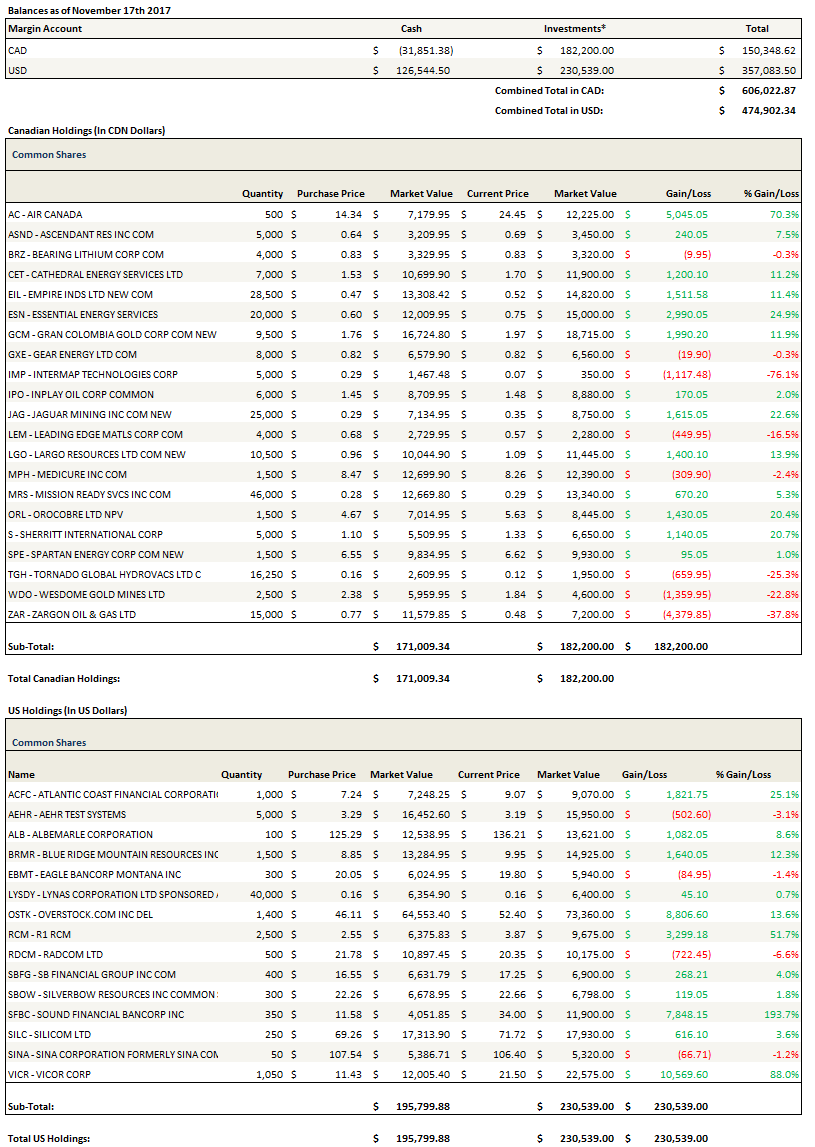
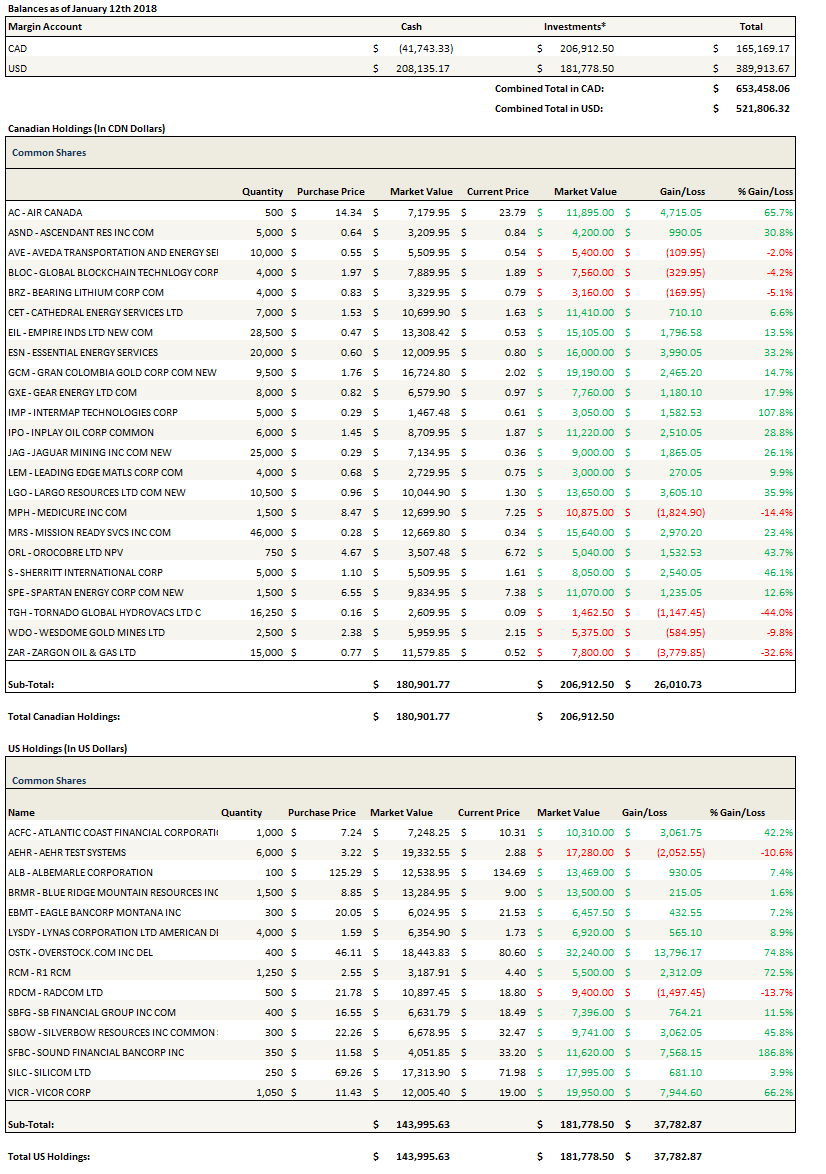
Portfolio Composition

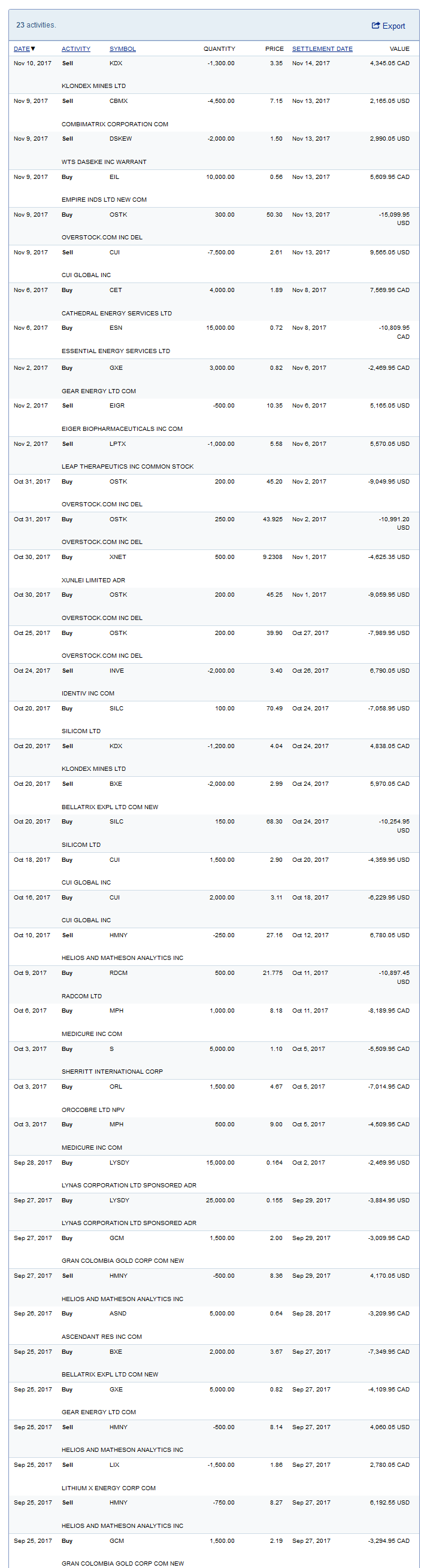
Click here for the last eight weeks of trades.  Note that the prices below are as of Thursday, January 11th.
HIVE and Proof of Stake

I sold my position in HIVE.  I hate doing an about face on a position so quickly, but I came across an issue that gave me some concern.

My post the other day raised the question from someone of what the expected change in Ethereum to proof of stake consensus would mean for HIVE.  I did a bunch of reading on the matter and it makes me uncertain enough to sell.

Proof of stake is a change to the consensus method used.  If Ethereum switches to proof of stake, I’m not sure what role miners will have.

I wasn’t able to get a good feeling for when or even if Ethereum will implement proof of stake.  It sounds like it could be some time in 2018, but it also sounds like its a change that has been promised for some time and there remain to be issues to be sorted out before it can be implemented.  It may never happen.

Nevertheless based on what I’ve read, it seems likely that if it does get implemented, the need for miners for will be greatly diminished.  While miners will move to other tokens, I can’t quite see how these other tokens, with much smaller market capitalizations then Ethereum, will be able to absorb the supply.

Until I can understand this better I thought I better sell.

HIVE Blockchain as a crypto-mining bet

When I started looking at the crypto-miners a month or so ago, I was pretty skeptical.  I thought there was a good chance that the business was a promotion to make it sound like you were a blockchain company when really you weren’t.  The company’s were all shells that had flipped the switch to blockchain overnight.  It was hard to take it too seriously.

But since then I have come around.

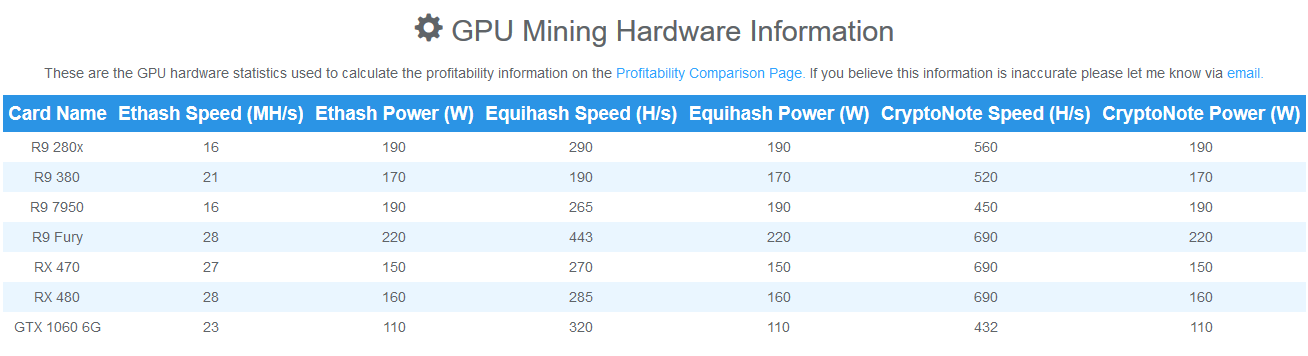
What made me change my mind was profitability.  This post, which is from an excellent crypto-blog, does a great job of describing the opportunity.  If you want raw data, check out this calculator and these GPU hardware stats.  A single RX 480 card has a hash rate of 28 MH/s and takes 160W of power.  Using the calculator, 28 MH/s and 160 W of power at $0.10 per kWh gives you a profit of $31.26 per month from mining 0.143 Ethereum. On Ebay you can buy a 7 GPU mining rig for $3,214.  7 GPUs should pull in $2,600 worth of Ethereum per year at $450 Ethereum.  It’s a pretty solid return and I haven’t even shopped around, tried to buy wholesale like a scaled player or moved my operation to a low cost power district.

You can run through a similar exercise with bitcoin.  You can buy the equipment at retail and still come away with a pretty solid return on investment. If you start shopping wholesale, or assembling the rigs at scale, I imagine the payback is over 100%.

With that said I’m not getting into the crypto mining business.  I have a feeling the devil is in the details, and there is a lot more to it than just buying the equipment and plugging it in.

But you get the point.  The above analysis gave me a reason to look more closely at the miners and what they are trading at.

Stepping my toes into the water, at the beginning of last week I bought a little Riot Blockchain.  I had lucky timing as the stock almost immediately started running.  I bought Riot because on an equipment basis, when I compared it to HIVE Blockchain, it seemed quite a bit cheaper.  But I was never really sold on the story, mainly because Riot hasn’t really given many details about their operation and we don’t even know if they are mining yet.  As such I sold out way too early. I began selling at $11 while the stock got as high as $22 on Friday.

Thus my Riot Blockchain experience is likely finished.  But it led me back to HIVE, which looks more interesting as I have dug deeper.  I took a position in HIVE on Friday at about $2.80 (Canadian), for the reasons I will explain below:

HIVE Blockchain

HIVE started out as a reverse merger of a gold company called Leeto Gold (yes a reverse merger; you can pull out the red flags, I’m not going to deny they aren’t there).  They got into the crypto-mining business when they acquired two data centers in Iceland from a very large private mining firm called Genesis Mining, the first in September and the second in October.  I first looked at the stock after the purchase of the second data center.  I struggled to wrap my head around the business, and the disclosure was (and still is) lacking.  So I passed.

I watched the stock shoot all the way up to $6 (Canadian).  But then it came crashing back down.  With Ethereum prices 40% higher and with HIVE securing a third much larger data center to be built in Sweden (in two phases) I decided to look again.

The short report

Ironically it was a short report that cemented my interest in the stock.  I don’t know who wrote this or where it came from.  Someone posted a link to it on Stockhouse last week.  Reading it made me reconsider my thoughts on HIVE.

The report does a really good job of weaving together the sparse disclosures from HIVE and gauging the size of their mining operation.  It was very helpful to see how you can build a model (a rough one but a model nevertheless) from the somewhat detailed disclosures HIVE gave on the first Iceland data center and the subsequent minimal disclosures of how much each additional data center would increase hash capacity.

Of course the report, being a short report, concludes that HIVE is way overvalued.  But I’m pretty sure this is because of one little mistake.

If you read the report, you will note that it references 2,301 GPU cards in the first data center.  Because of the lack of disclosure from HIVE, all of the other data center calculations are factors of the known size of the first one.  As the report explains, if there is only 2,301 GPUs in the first data center then HIVE isn’t going to make much money, either on the first data center or any of the subsequent one’s.

But here’s the thing.  When I read the report I had done enough research to know that 2,301 GPUs is not very many for a data center.  Moreover, it seemed like there was no way anyone would pay $9 million USD and 67 million shares for that many GPUs.  You’d have to be crazy.

Luckily I have a subscription to Sentieo, including their Canadian data, and that makes it really easy to search for something like “2,301” and find out the context.  As it turns out, the document is hidden in the obscurity of the annual report of the reverse merger parent Leeta Gold Corp.  And it doesn’t actually say GPUs. Here is the relevant paragraph (my underline):

The HIVE Facility consists of 2,301 graphic processing unit (‘GPU”) mining rigs. Maintenance costs, including electrical power, to be paid to Genesis, for operation of the HIVE Facility are expected to be around US$144,650 per month. The maintenance costs will be part of the Master Services Agreement

Its 2,301 rigs.  This makes much more sense and changes the calculations significantly.  Its pretty easy to google “gpus per rig”.  If you do you find that most rigs have at least 5 GPUs.  Many rigs have more than 10 GPUs.

Thus, when I looked at the short report conclusion and saw that they projected $750,000 per month in revenue, I was like, wow, its actually more like 10x that much.  And that’s at $300 Ethereum!

Time to buy.

Conflicting Disclosures

If the short report is off by a factor of 10x then HIVE is a no brainer.  To get a levered play on the direction of cryptocurrencies at a cheap price is a steal.  Unfortunately as I have done more work to make sure the details align, things have become a bit muddled again.

To reiterate what I said earlier, the tricky thing about evaluating HIVE is that:

  1. There isn’t a lot of information about each of the data centers. In fact every subsequent data center has to be based off of the known information about the first data center
  2. The company has provided two fairly different estimates of the profitability of the first data center

So what do we know about the first data center?  Well, we know there is 2,301 rigs.  But we don’t really know how many GPU’s each rig has (though I’m pretty sure its more than one).

The other information we sort of know is the profitability of the first data center.  Unfortunately, I say sort of because HIVE has given us two numbers for this and they aren’t that close to one another.

On June 14th, in this press release, HIVE said the following (my underline):

Based on the computational capacity of the first Data Centre, the historical prices, and required hash rates, and using a mine and immediately sell strategy, the trailing 12 month EBITDA would have been approximately US$7 million.

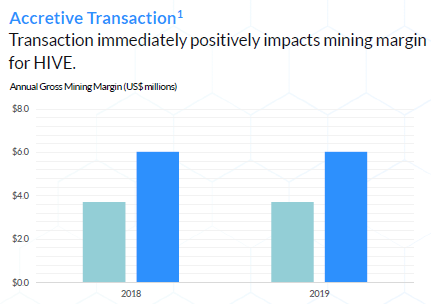
Later, in their October presentation, HIVE provided this chart on slide 18 (light blue represents the first data center only and dark blue represents two data centers in Iceland).

There is a big difference between $4 million of “gross mining margin” and $7 million of EBITDA.  Because the $4 million number is more recent, I’m going to assume it’s the correct one.

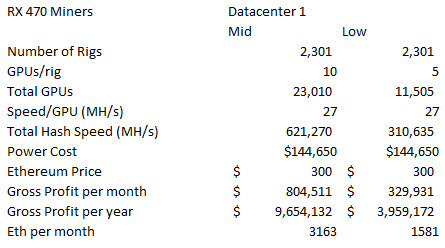
I wanted to try to get to the number independently.  With the disclosure of 2,301 rigs and a reasonable assumption of GPUs per rig its pretty straightforward to use a cryptomining calculator to come up with gross profit, which is likely the equivalent to what HIVE describes as their “gross mining margin”.

But how many GPUs per rig?  I would have expected at least 10.  From what I’ve read, a big miner like Genesis should have at least 10 GPUs per rig.  You’d think Genesis would be using the most efficient GPUs in their stack.

The problem is that the numbers don’t work out with 10 GPUs.  I’ve tabled two scenarios, one with 10 GPUs per rig and the other with only 5.  I actually also had a third scenario with 15 GPUs per rig (the “high” scenario), but given the results that one seems unlikely so I didn’t include it in the table.

Surprisingly, it’s the 5 GPUs per rig scenario that matches a data center generating $4 million of margin at a $300 Ethereum price.

One other possibility is that there are indeed 10 GPUs, but they are lower end processors.  My assumption above was based on the RX 470 card, which has processing speed of 27 MH/s.  I’m told this is one of the most efficient cards.  But maybe the Iceland data centers use R9 280s, which would have a little more than half the processing power as the RX 470s (see the table below).  That would get us closer to 10 GPUs per rig while still staying within the $4 million gross mining margin range.

Of course the other wildcard is that if the earlier $7 million EBITDA number is correct, then my mid case is likely closer to the truth.  But like I said, given the dearth of information I am forced to believe the later number is more accurate.

Once you get the first data center pegged, its easy to figure out the contribution of subsequent data centers from the increases in hash power that HIVE has disclosed for each.

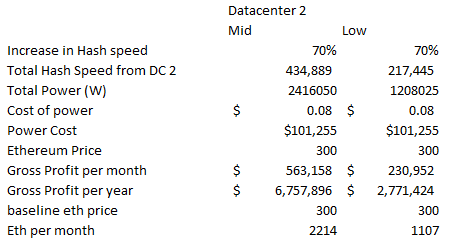
The second data center is said to “increase hashpower by 70%”.  From this information, and assuming a similar power consumption agreement as the first data center, its easy to calculate its contribution.  Keep in mind that it’s the “low” number in the table below that is the one I’m assuming is most accurate.

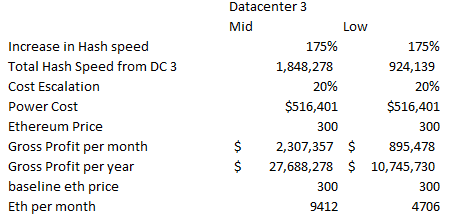
The third data center (in Sweden) was said to increase hash power by 175%.  Note that I also added a 20% cost escalation for power and maintenance costs on top of what HIVE is paying for the Iceland assets.

For the fourth data center, the company said the following about its Swedish operations on November 14th:

The Sweden Data Centre will consist of newly constructed GPU mining rigs using the latest hardware, custom-designed by Genesis. Each phase is expected to represent approximately 6.8 MW of electricity consumption for a total of 13.6 MW in Sweden. HIVE and Genesis are evaluating expansion potential in Sweden as well as Iceland. In Iceland, HIVE’s current operating facilities represent 3.8 MW in electricity consumption. Completion of the Sweden Data Centre is subject to a number of conditions, including but not limited to, Exchange approval.

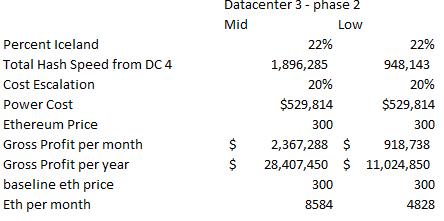
To calculate the hash power of the second phase of the Swedish data center I used the same method as the short report, which noted from the above disclosure that Iceland would be 22% of power consumption and Sweden was 78% of power consumption.  Since we already know the hash power from Iceland as well as from the first data center in Sweden It just takes a little bit of math and isolate the second phase in Sweden:

Conclusion

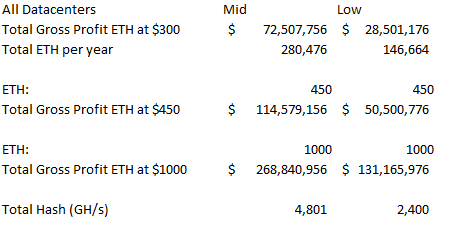
So where does this all leave us?  Well HIVE may not be super cheap, but neither does it appear to be outrageously expensive.  I actually think it’s a pretty interesting way of playing the rise in the Ethereum price (this is something I never would have expected to say a month ago!).  Below is the summation of the profitability of all of the 4 data centers at 3 different Ethereum prices.  Again, remember it’s the low case column that is the likely one, at least given the information that is available.

Of course the numbers above don’t include G&A and taxes so some adjustment has to be made for that.  With 280 million shares outstanding HIVE has had a market capitalization on Friday of $650 million USD.  That capitalization doesn’t seem all that out of line with the low case profitability at $450 Ethereum even adjusting for some G&A and tax.  Especially given the upside blue-sky potential for crypto-currencies and the probability that their relationship with Genesis will lead to more data center deals in the future.

With that said there are plenty of questions remaining.  How long before the profitability drops?  How quickly does the equipment need replacing?  How old are the Iceland data centers?  Is the business actually sustainable over a longer period of time, in particular if the proof of stake changes are implemented?

I don’t have firm answers to those questions yet.  I bought the stock Friday and there is still a lot of digging to be done.  But in the short term, I’m not even sure how relevant those answers are to the primary question, which is where the stock price goes from here.  Its already moved big time today (Monday) and I added a little more at the open this morning.  I suspect we are relatively early on in the speculative excesses of blockchain technologies.  If HIVE can show the above level of profitability and more investors begin to clue into that, I think there is a better chance the stock price moves higher than lower.  And that’s ultimately what we’re all in this for.

Week 332: More Churn

Portfolio Performance

See the end of the post for my full portfolio breakdown and the last four weeks of trades

Thoughts and Review

So I’ve been doing so-so with the portfolio.  I had a big bump up in September because of Helios and Matheson, and since then have mostly been treading water, a few winners and a few losers.

My online portfolio has actually done somewhat better than my actual one.  This is primarily because A. By chance I held on to a larger piece of Helios and Matheson into the high $20’s and B. I’m fully exposed to the Canadian dollar fluctuations in the online portfolio and the Canadian dollar has fallen back below 80c of late.

I’ve still failed to outperform the market for the last 6 months, and that’s been frustrating.  My outperformance in the near term is going to depend a lot on Overstock, which is my largest position right now.

I added around my oil positions as it seems more likely then not we will continue to see draws through year end.   I find the Canadian service companies particularly interesting, mainly because they really look cheap based even on backward looking metrics but stand to benefit further from the price and volume increases one would expect are coming.  I have mentioned Cathedral Energy before, and also like Essential Energy (with the recent positive decision on the outstanding lawsuit) and Aveda Transportation, which is quite levered and has a business tied closely to drilling.

I sold out of Klondex.  I had reduced my position earlier and sold the rest after a pretty so-so quarter.  On the other hand I increased my position in Gran Colombia, which is a frustrating stock for me because it raised guidance and continues to show good cash flow but has these towering asks day after day that keep the stock down.  Gold has been crummy through December in the past but I am pretty excited about gold in 2018.  I want to keep more than my usual weighting going into the new year.

I was pretty happy with the mining results of Ascendent Resources, Largo Resources and Lynas, though none have really done much since their reports.  I plan to write something up on Largo in the near future.  Vanadium seems to be catching some attention and Largo is the only way to play that.  Largo had a really good day on Friday, but its volatile so I don’t know if there will be follow-through.  Vanadium prices are firming up though.  There was a good overview of Vanadium in this blog.  I plan to write up my thoughts on Largo soon.

I was disappointed in Sherritt’s results and sold down my position for now.  Similarly I didn’t like what I saw with CUI Global, particularly that the odorizer technology is not ready for prime-time.  So I sold that one too.  Smith-Midlands was disappointing and who knows when an infrastructure bill gets passed, so I’m out of that stock.  I sold Lakeland Industries, though I might buy that one back in the short term.  I sold the rest of Identiv, a bunch ahead of earnings and the rest after their dismal report.  I sold Daseke ahead of earnings, which turned out to be fortuitous.  And I bought and sold a company called Xunlei Limited, which I quite honestly lucked into when searching for blockchain companies.  I really can’t wrap my head around what they do, so I didn’t stick around after some gains there.

So there’s more churn for sure.  I’m going to try to be quicker to the sell button going forward.  I think that I have been slow to sell for logistical reasons, and this has been a contributor to my poor performance over the last few months.

I’ve taken a few other small, new positions but nothing with enough conviction that I want to talk about them yet.

In fact that’s about all I want to say about the portfolio right now.  Here is my portfolio as of Friday.

Portfolio Composition

Click here for the last eight weeks of trades