Skip to content

Oclaro Second Quarter Update: No sign of the inflection yet

I’ve owned Oclaro since last spring, first wrote about the company here, and subsequently here.  Oclaro has their year end in June, so the company recently reported their second quarter results.

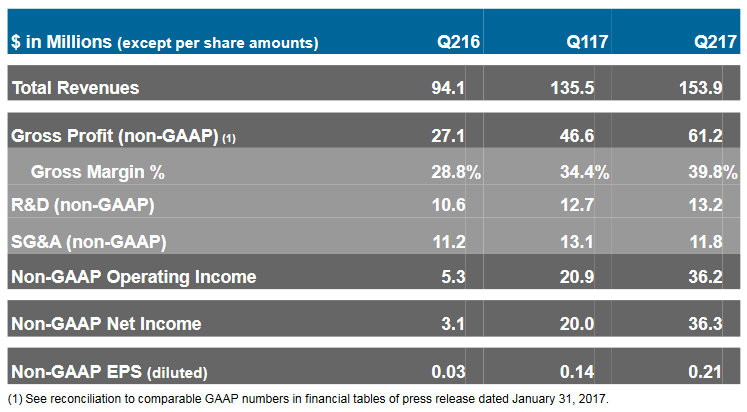
Oclaro had another very good quarter, which had been expected after a preliminary announcement two weeks prior.  Revenue grew 14% sequentially and 64% year over year.  I calculate that adjusted EBITDA was $41 million in quarter, more than double what it was in the first quarter.
oclrincomestmt

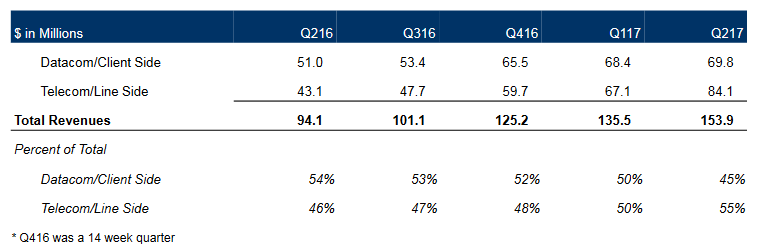
Digging a little further, the growth came almost entirely from the telecom/line side of the business.  Just to recap (see my earlier posts for more details), Oclaro makes transceivers and laser components that are used for optical data transfer.  Oclaro divides this business up between a client side, which consists of shorter length lasers (they have names that start with CFP or QSFP 28), and line side, which consists of longer length lasers of which the most significant is their new CFP2-ACO product.  Below is the breakdown between the telecom and datacom sides.
oclrrevenuebreakdown

Growth coming from telecom/line means that the aforementioned CFP2-ACO product was responsible for much of it.  This is a relatively new transceiver (see here for a bit of background) that was pioneered by Oclaro.  Being first to market, they are enjoying a window of 100% market share as the competition races to develop their own versions of the transceiver.  The CFP2-ACO was expected to be the growth driver in the quarter.

Competition is going to come into the market beginning in 2017, as the company conceded on the conference call.  Acacia, Finisar and Neophotonics is are developing their own CFP2-ACO products.

Still Oclaro has a significant lead and has used their head start to lock down customers for this fiscal year (ending June) and their fiscal 2018.  From the conference call:

[We] negotiated or are completing negotiations of several multiyear contracts or extensions contracts for some key product like the ACO that run as long as through calendar year 2018

The CFP2-ACO sales have centered on North America and Europe so far, but Oclaro did say on the call that they are seeing sales from China begin to pick up.  China buys a lot of Oclaro products (40% for the quarter), and in the past these have been lower end of the spectrum transceivers (the modulators and lasers that go into the transceivers).  China revenues for Oclaro grew 9% sequentially in the second quarter.

While the telecom side drove growth last quarter, the client side products continued their strength of prior quarters but are constrained by production limitations.  The lower end CFP product remains sold out (probably in part because of China?).  Oclaro hasn’t gotten as much traction on the higher end products (CFP2, CFP4, QSFP28) but they expect this to pick up, and they “do expect to shift [to] the CFP2, CFP4 and QSFP28 transceivers to accelerate through the summer”.

Its worth noting that the CFPX and QSFP28 will have lower average selling prices (ASPs) than the CFP, which could be a drag on top line revenue, but that margins for these products will be higher than the CFP, so the bottom line should improve.

At the Needham conference in January (here is the replay) Oclaro said that the growth of their business relied on 3 end markets: Datacenter, Metro 100G and China.   There wasn’t anything on the second quarter call or in the guidance Oclaro gave to suggest any of these 3 markets have slowed yet.

For the third quarter Oclaro guided $156 million to $164 million, which is another sequential increase from the $154 million in the second quarter.  To a large degree growth is being driven by the sold-out conditions of many of their products.  Management gave some color around how they would like to ramp production faster than they have been able to.

I’ll continue to hold Oclaro.  I’ve expressed my concerns in the past about not knowing when this cycle is going to peak.  The color I get from listening to the company and its competition is that we are still at least a few quarters off.  There is much talk of consolidation in the space, and I would hate to sell just before an offer comes in for the company.  So I will continue to management my uncertainty via a reasonable position size, and hold out for a selling price in the mid teens.
Hortonworks Fourth Quarter Update – The hadoop adoption cycle continues

Hortonworks is the second of the three companies I own that reported on Thursday night.  The first, Ichor Holdings, I wrote about yesterday.   The third, Radisys, I’ll get to shortly.

I originally wrote about Hortonworks along with another company Attunity in November after doing some research on Hadoop and concluding that its adoption presented a good growth opportunity for the companies involved.  At the time the stock was trading at $6, had recently been issued a sell recommendation from Goldman Sachs, and was pretty hated all around.

Nevertheless the company was growing like a weed (40% annually).  It was also bleeding cash flow like a sieve.  But at an enterprise value of less than 2x revenue I found it difficult to pass up the growth.  Knowing Wall Street loves those growth stories, I figured a couple solid quarters would put the stock quickly back on its feet.

Fast forward a few months and that is exactly what you got.  The company is still growing like a weed (revenue was up 39% in the fourth quarter, guidance was for 28% year-over-year growth in 2017), they are not bleeding cash flow quite so materially (cash flow in the fourth quarter was actually close to flat), and the stock isn’t hated quite so much.

At $11 and with a $1.40 of cash the stock is still trading at 2.4x revenue.  So the valuation is actually not that different than when I bought it.  One key difference is that back then the cash level was higher (roughly $130 million), the shares outstanding were lower (the company issues stock like toilet paper) and the price per share was lower, so cash was a much bigger piece of the overall valuation and that was partly what I found interesting.

The most interesting thing about the fourth quarter was that growth in their Hortonworks Data Flow platform has really taken off.  I wrote about HDF in my original write-up.  I’ll repeat how the company described HDF at the Pacific Crest conference last year:

Now [customers] want to have the ability to manage their data through the entire life cycle.  From the point of origination, while its in motion, until it comes to rest and they want to be able to drive that entire life cycle.  It fundamentally changes how they architect their data strategy going forward and the kind of applications and engagements they can have with their customers.   As they’ve realized this in the last year its changed everything about their thinking about how they are driving their data architecture going forward starting with bringing the data under management for data in motion, landing it for data at rest and consolidating all the other transactional data.  So it’s a very big mind shift that’s happening.

I still think HDF could be a big growth driver for the company and we are starting to see that.  They said on the fourth quarter conference call that HDF grew 6x year over year in the fourth quarter.

So there is lots of reason to think growth will continue.  Nevertheless, I am reluctant to add.  It’s the cash flow that still gives me pause.   While the fourth quarter number was good, they’ve approached break even cash flow in the past only to diverge again into big losses the following quarter.   They said on the call that they expect mid-teens negative operating cash flow in the first quarter.

More optimistically, they also said that they expect break-even cash flow in the third or fourth quarter.  So that would be a turning point.  But then in response to a question about whether we should expect free cash flow after that, if felt like they were trying to scale back expectations:

Yes, I don’t want to talk beyond that yet, Q3, Q4 seems a long way out, but from a – if you think about free cash flow we have been running may be $2 million to $3 million a quarter on CapEx. Q4 was a little light, I think it was under $2 million, but I think once we get to the sort of breakeven number sometime between Q3 and Q4 we will reassess to how much above that we want to punch.

So I’m not sure what to think.

Hortonworks also issues a lot of stock, which while it doesn’t factor into the cash flow number, does dilute shareholder value.  The shares outstanding have gone up by almost 3 million in the last couple of quarters.

On the other hand is my experience with Apigee.  Another high growth company, with cash flow, that was issuing lots of shares, and the company never really sorted any of that out yet the stock tripled from the $6 price I bought it at to the almost $18 where it was bought out by Google.  Hortonworks could easily follow that path.

There are certainly reasons to add.  Strong growth, ramping of HDF.  They announced another new product launch, enterprise data warehouse in February, and are gaining traction on their Azure and AWS offerings.  They also stand to gain visually from accounting changes enacting in 2018 that will allow them to defer less revenue and spread out commission expense, in turn improving the income statement.

Nevertheless my gut, informed by the aforementioned concerns about cash generation and stock issuance, is telling me not right now.

I think if the stock pulled back on a market pullback I would be more likely to add.  But it’s hard for me to double up at this price, as I have been prone to do with other ideas that start to work.

So I’ll probably sit with my 2-3% position and watch what the stock does.  I prefer to take the safe route when my gut is giving me pause.

Fourth Quarter Update: Ichor Holdings beats and beats

I have a lengthy update on Oclaro that I finished a couple of days ago and was planning to post this weekend but it will have to wait a few more days because I wanted to write a few short posts about what was a busy day on Friday.  After going a few days without any significant earnings updates, I was blitzed on Thursday night with 3 sets of year end results: from Radisys, Ichor and Hortonworks.

Two of these companies, Ichor and Hortonworks, produced unquestionably solid reports.  The third, Radisys, was considered a disappointment by analysts.  Of the three names, I added to my position in one, and it wasn’t the one with positive results.

I’ll start with the beats in this post by talking about Ichor.

Ichor Holdings

I wrote up the reasons for taking a position in Ichor about a month ago.

This was the first quarter that Ichor reported as a public company.   The report was very good, and the guidance for the first quarter was excellent, but all of this was expected.  Ichor pre-announced both in early January.

The most interesting new tidbit came from the conference call, where in response to a question asking ‘what if things get even better?’, management described their recent capacity additions.  They said that they had recently added or were adding enough capacity to support $200 million of quarterly revenue.  This is quite a large number.  Consider that with the “big beat” in the fourth quarter the company had $131 million of revenue, and that they are guiding to $150 million in the first quarter.  Only a year ago Ichor was generating a little over $60 million a quarter.

As strong as business has been, this has to be considered an indication that management sees it getting even stronger.

Given the growth (over 104% year over year and 24% sequentially in the fourth quarter), the concern of many, myself included , is that at some point this turns.  These capacity adds, which presumably are being done now because of some visibility of what is to come, allay those concerns in the near term.

The company supplies its gas and liquid delivery systems to two major customers, Lam Research and Applied Materials.  These two customers make up 90% of its revenue.  Both of these companies have projected a slower second half.  But even that level, which was described as a 55/45 H1/H2 breakdown on the call, is significantly higher revenue than Ichor was generating a year ago.

The company trades at a reasonable multiple considering the growth that is occurring.  If you annualized the fourth quarter results, the stock price is at 7x EBITDA.  The multiple shrinks to even less than that as revenue ramps higher in the first quarter.

Yet I struggled to add to my position on Friday even as the response to the report was somewhat muted.  I worry about being blindsided when the turn comes, as I feel like I have very little insight into the catalysts that will precipitate it.

It could happen in second quarter or in two years, I just don’t know.  The company suggests it may be more prolonged than many expect, as the drivers, which are 3-D NAND and multi-layer designs, are becoming ever more prevalent, and in the gas delivery business they have room to take market share from smaller competitors.  They are putting their money on that by investing in more capacity today.  But I wonder if Ichor is so far down the food chain that when the inflection comes they will be one of the last to know.

Thus I suspect that Ichor is destined to remain a 3-4% position for me, which I hope through appreciation eventually becomes a 5-6% position, but which I find unlikely I will be inclined to accumulate further and make it a portfolio changing score.

Community Bank Earnings: SFBC, SBFG, PKBK


Owning community bank stocks is boring.  Even on earnings day they often trade less than 1,000 shares.  The shares move up and down on so little volume that you never really believe the moves are real.  They seem like dead money, but then a year passes and you check out your account and you own a bunch of stocks up 20% and you can’t figure out how that happened.

So get ready for a boring but quite possibly profitable update.

I’ve had a number of the community banks I own report fourth quarter results.  All of the results were good so far.  I’m going to go through 3 of them here.

SB Financial (SBFG)

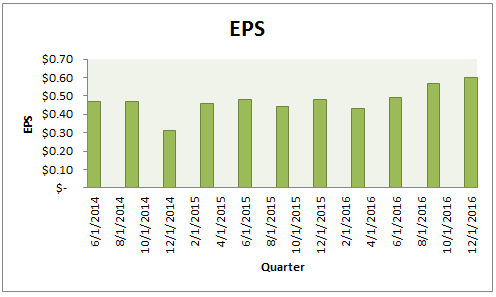
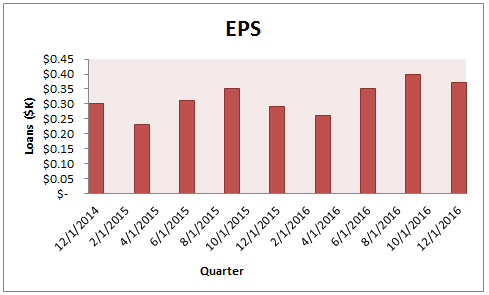
SB Financial was the first to report, a couple weeks ago.  The company made 37 cents EPS in the fourth quarter and $1.37 for the year.  The stock has traded up since the report, but even at $17.50 the PE multiple remains low at 12.5x 2016 earnings.

sbfg_eps

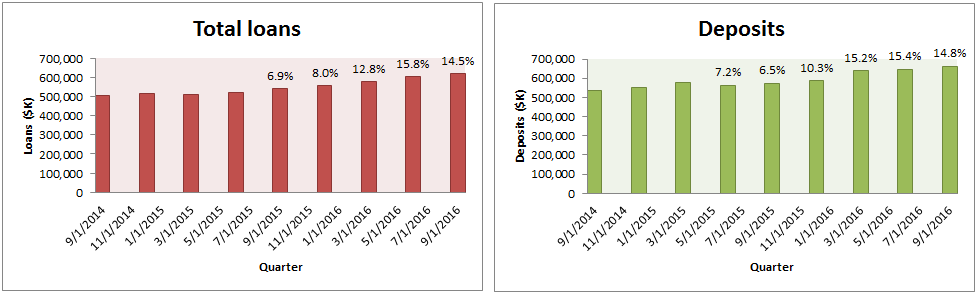
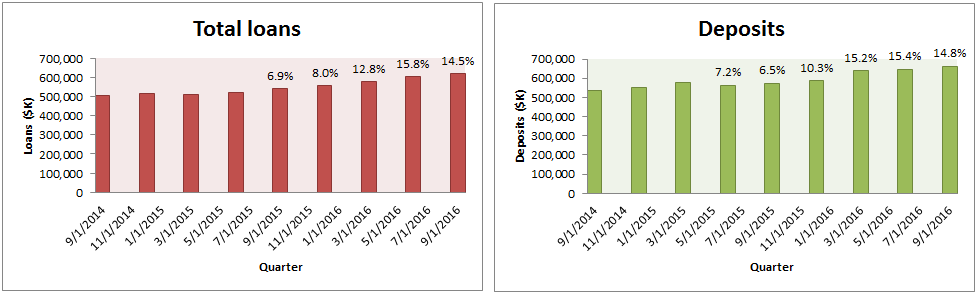
One of my criteria for buying a bank was loan growth and deposit growth.  These are the two pillars that will lea to eventual earnings growth (as long as the bank is well run and can leverage their expenses).  Loan growth at SB Financial continued in the fourth quarter, up another $15 million or 14% year over year. Deposit growth was up $20 million or 15% year over year.

sbfg_loansanddeposits

My one complaint was that earnings were somewhat low “quality” compared to the past few quarters.  Fee income was a little lower ($1.5 million versus $1.6 million in the second quarter), while the company got a big gain from the mark to market of its mortgage servicing right portfolio.   I’ve talked about mortgage servicing rights in the past. The mark to market adjustments from servicing rights can be large as they are very sensitive to changes in interest rates.  But this doesn’t really reflect health of the underlying banking business and if anything it portends to lower originations.

Nevertheless return on equity (ROE) was 10.72% and return on assets was 1.14% which are solid numbers.  Non-performing assets remain a small percentage (0.65%) of total assets.  I am happy with the results.

Sound Financial (SFBC)

Sound Financial put together a similarly good quarter.  Loan growth was 8.4% year over year.  Yield on loans reached 5.19%, which is a 10 basis point bump in the last year.  Deposit growth was 6.3% year over year.  Non-interest bearing deposits, which are the best because they are essentially free, rose to 13.6% of total deposits from 11.5% of deposits the previous year.

sbfg_loansanddeposits

Deposits should continue to increase in the first quarter after the pending purchase of deposits from Sunwest bank in October:

Sunwest Bank of Irvine, California to acquire approximately $17.7 million of deposits for a core deposit premium of 3.35% and its University Place, Washington branch located at 4922 Bridgeport Way West.  The cost of funds from this branch is an attractive 17 basis points and the cash received is expected to be used to pay down FHLB borrowings.

Earnings per share were 63 cents in the fourth quarter and $2.16 for the year.  On a trailing basis the stock trades at 13.4x earnings.


sfbc_eps

Like SB Financial, Sound Financial suffered from lower fee income which declined from $647,000 to $586,000. I’m not sure the cause of these declines and whether there is general pressure on the industry.  It is something to keep an eye on.  Also like SB Financial, they took a gain on mortgage servicing rights, though the servicing portfolio is much smaller so it was to a much smaller degree.

Book value rose 80c in the quarter and is now $24.  Return on assets crept up to almost 1%, at 0.97% up from 0.89% at the end of last year.  Return on equity was at 9.4%.

Non-performing assets are up a little, to $4.5 million from $2.9 million a year ago, but this is still a tiny 0.77% of assets so nothing to worry about.  Again, solid performance and it remains a cheap stock.

Parke Bancorp (PKBK)

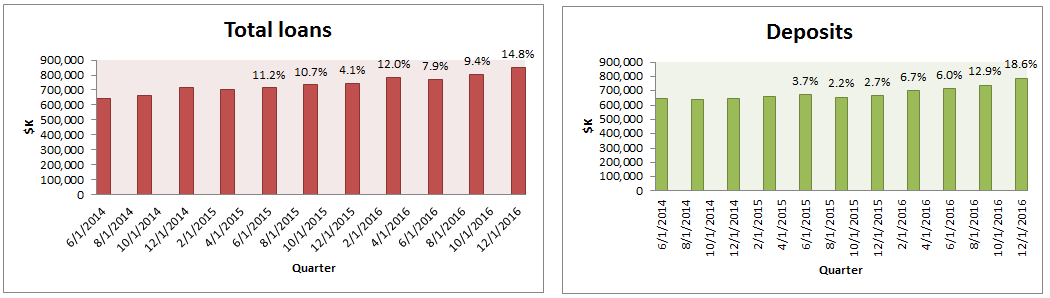
This is going to feel repetitive.  Parke Bancorp had a good quarter as well.  They saw year over year loan growth (15%) and deposit growth (18.6%).

pkbk_loansanddeposits

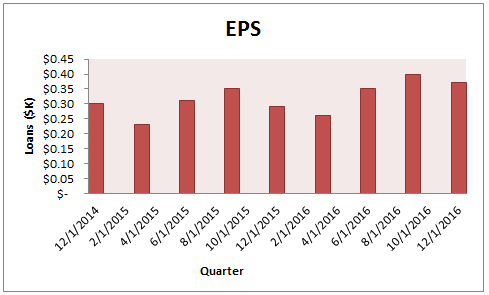
Diluted earnings per share for the quarter were 38c.  For the year, earnings per share were inflated because in the second quarter the company sold its small business admin loan business for a $9 million gain.  Excluding that sale I estimate diluted earnings for the year would have been about $1.50.  That trades the stock at 13x earnings.  Below is diluted earnings ignoring the sales of the SBA business.

pkbk_eps

Earnings likely would have continued to grow in the third and fourth quarter had the company not chosen to monetize their SBC business.  I’m not sure why the bank sold it?  In the second quarter press release they referred to it as a “unique opportunity”.  It’s possible they just got a great offer, which the profit (over $1/share) suggests.  They still plan to offer SBA loans through their bank, but it probably won’t be at the same scale.  There were no SBA loans sold in the third quarter and no the fourth quarter press release there was no mention of SBA loans sold.

Parke Bancorp has somewhat higher non-performing assets than the other banks I own, at $21.7 million or 2.4% of total assets.  Over half of that amount is real estate owned.  In the fourth quarter press release the bank mentioned one property in New Jersey that has been written down from $12 million to a little over $3 million.  The trend on non-performing assets is in the right direction though, they stood at $30 million a year ago.

The bank has opened two branches in the last year, which is helping deposit and loan growth.  The first is in Collingswood New Jersey and the second is in Chinatown Pennsylvania.   These banks are still ramping and should help fuel growth in 2017.