Skip to content

Posts tagged ‘investment ideas’

Taking a position in a recent IPO moonshot: Ichor Holdings

Over the last couple of weeks I spent my spare time listening to presentations from the Needham conference.

Most of what I heard was pretty boring.  A few were from companies that I own (Radcom, Radisys, DSP Group, Oclaro, Nimble and BSquare) and I adjusted a few of my positions upon review (I reduced Radcom a little, added to Oclaro).  But most were new companies that I haven’t heard of before.

I was on the lookout for a good idea and I think I found one.  The company is called Ichor Holdings.  They provide fluid delivery systems for semi-conductor equipment manufacturers.  In particular they produce two products, one a gas delivery sub-system and a chemical delivery sub-system.

The stock was an IPO in December (here is the prospectus).  The IPO went for $9, which was a steal.  It’s over $15 now, which means its traded up significantly.

I bought some at $14.  I haven’t mentioned the stock until now because I kept waiting for a correction so I could buy more (well it came briefly one morning when it dipped into $12’s for a couple minutes but I was at work and not available – argh).  So now it broke out and I’ve given up.  I probably am rushing this write-up out a little, but given the move in the stock I feel like if not now then maybe never.

So you are looking at a stock here that is up almost 50% in the last couple of months.  Caveats apply.  Nevertheless, here’s what I think, why I bought it at $14 and you can choose if you want to wait for a correction or not.

There is a narrative for not waiting.

There are two big players in the outsourced semi-conductor equipment market that manufacture fluid delivery sub-systems: Ichor and Ultra Clean Holdings.  These are fairly similar companies.  I think that Ultra Clean also does some more general component manufacturing and Ichor has a chemical delivery business, but overall the two companies are comparable.

Ichor and Ultra Clean compare favorably based on TTM results.
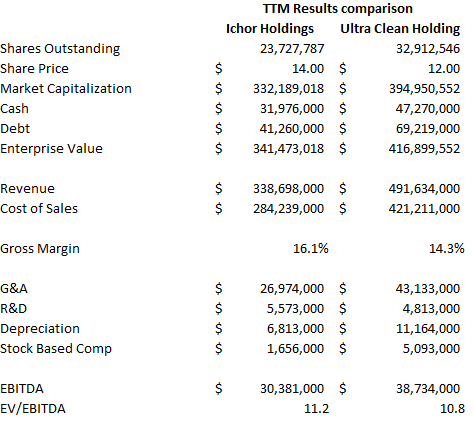
ichor1

Everything seems reasonable so far.  But here is where it gets interesting.  Both companies pre-announced very strong fourth quarter revenues in the last few weeks.  Here is Ichor’s announcement and here is Ultra Cleans.

Ichor’s revenue growth in the fourth quarter was a rather incredible 104% year over year.  There was a small acquisition (Ajax, which contributed $13.4 million in revenue since it was acquired in April 2016) that brought the company into the chemical delivery business but apart from that it was all organic growth.  Ultra Clean had an impressive 67% year over year growth.  Again, organic.

Ichor said that revenue in the first quarter would exceed the fourth quarter.  So we have at least three more months of this tremendous growth.

There are a couple of takeaways from Ichor’s and Ultra Clean’s Needham presentations (here and here) that help explain the growth.  First, both are benefiting from decent wafer fab equipment demand growth, around 6%.

Second, as chip complexity increases and moves to “multiple patterning, tri-gate, or FinFET, transistors and three-dimensional, or 3D, semiconductors” (eg. 3D NAND), deposition and etch sub-systems growth becomes even stronger (Ichor says 15%).  Each layer that is added to the chip requires another etch, deposition and CMD step.  Ichor says this dynamic in the market only began in the second half of last year and is “still in the early innings”.  The following is a slide from Ichor’s presentation:
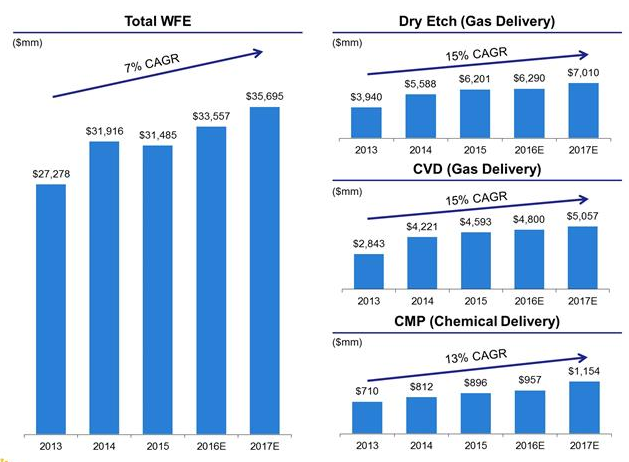
ichor2

Finally, their customers, the OEM process tool providers (LAM, Applied Materials, etc), are outsourcing more of the equipment manufacturing, so Ichor and Ultra Clean are gaining share that was previously held by their customers.

Ichor has the added bonus that they are growing their chemical delivery business at an even faster rate.  I think that the acquisition of Ajax earlier this year brought them into the business, but they may have had a small footprint prior.

The chemical delivery business (via Ajax) was a single digit million revenue business a few years ago but has grown 10 fold the last few years.  They currently have 10% market share so there is room for further growth.

Ichor doesn’t provide a detailed breakout of revenue between their gas delivery and chemical delivery businesses but did say at Needham that Chemical was about one-ninth of revenue and they could see it getting to one-third.

The other consideration that applies for both companies is the business model has good leverage to revenue increases.  While Ichor was a little vague on this, only saying that they have a “variable cost structure that drives highly leveraged earnings model”, and that their operating costs remain relatively flat as revenue increases, Ultra Clean was more specific, providing the following table in their slide deck at Needhams:
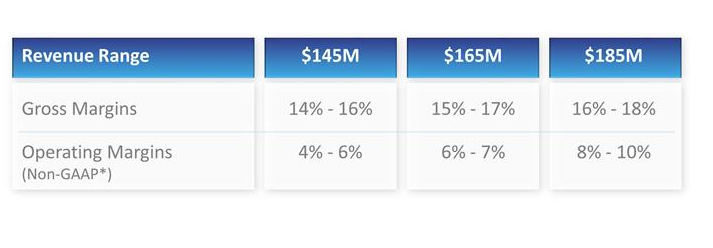
ichor3So I took a reasonably sized position at $14.  I’m willing to watch how this plays out over the next few months.  But I look at this as more of a trade.  If the stock gets up to $20 in the next couple months, I’ll be a seller.

The thing is, I don’t know how long this cycle is going to continue.  It will turn.  I haven’t done a lot of work on the semi-equipment cycle and I don’t even know where to start to determine when that inflection occurs.  And surely the kind of revenue increase we saw in the fourth quarter isn’t going to continue forever.

Nevertheless, with the fourth quarter numbers that Ichor has guided to, they are trading at well under 10x EBITDA (I didn’t run any scenarios yet so I can’t say exactly where I think that ends up).  They are an IPO, which means they are under-followed and probably being estimated conservatively by analysts.  And they have already forecast at least one more quarter of significant growth.   So the runway is clear for another few months.  I’ll look forward to any pullback.
Third Quarter Earnings Updates: INVE and SIEN

Identiv

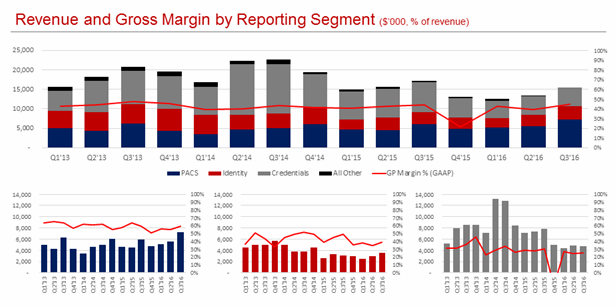
I was pleased with Identiv’s quarter.  Revenue was down year over year but that is mostly due to discontinued transponder sales to Disney.  Excluding this customer revenues were up 13% year over year.   The company appears to be on track.

Sequentially revenue was up 31% for the Physical Access Control Systems (PACS)  segment, 21% for Identity (smart card readers) and was down a little in RFID.  The third quarter is seasonally strong for PACS because of government customers that have a September year end.  But that alone doesn’t explain all of the strength in the results.

q3revs

The story here remains that a turnaround is occurring on the expense line.  Operating costs are down to a $6 million quarterly run rate.  Last year they were double that.

The stabilization of the top line and improved expense management has led to positive EBITDA for the first time in a while.  They have $1.7 million of adjusted EBITDA (no stock option expense) in the quarter.

Guidance was kept the same at $56-$60 million, which puts the fourth quarter revenue in the $14-$18 million range.

I think there is a good chance they can hit that range.  The fourth quarter is seasonally slower than the third quarter

I tweeted a couple of times this morning that I don’t think the stock makes sense at a $20 million market cap.  Its moved up since then but even at $2.50 the market capitalization is still less than $30 milion.  The company has a $55 million trailing twelve month revenue run rate, they are showing growth, they are EBITDA positive now and its not an insignificant amount of EBITDA.  That feels like it should warrant at least 1x sales.   We’ll see if it gets there.

 Sientra

I wasn’t expecting too much from Sientra in the third quarter.  So I was pleasantly surprised to see a couple of positive data points: sales growth of their bioCorneum product and a tuck-in acquisition in the area of tissue expanders.

Sientra continues to progress with their new facility for the breast implant product.   Their manufacturing partner, Vesta, has completed the build out of the facility and is producing test product.  Sientra will submit a PMA supplement (pre-market approval for a manufacturing site change) in the first quarter and expects to be shipping product by the fourth quarter of 2017, if not earlier.

They also announced on the conference call that they received notice (just that day) that Silimed, who was their prior manufacturer and from whom all of the manufacturing issues arose, had sued the company for contract breach.  I have a hard time believing there is much to worry about here since Silimed is under suspension, had their factory burn down under a still undetermined cause and obviously cannot supply product.

All of this was anticipated good news.  What makes Sientra more interesting to me are the moves around supporting products.

BioCorneum is a silicon based gel that is used to prevent scarring and also to hide the appearance of scars.   Sales of bioCorneum continue to improve.  Revenue was $1.32 million in the third quarter.  That is 20% of total revenue and up 18% sequentially.

Through the acquisition of bioCorneum Sientra has proven that they can take an under-marketed product in an adjacent vertical and apply their salesforce to increase sales.  They made a second foray into this “adjacency model” in the third quarter with the acquisition of Specialty Surgical Products (SSP).  SSP has a portfolio of premium tissue expanders, which Sientra said on the call is a $235 million market.  They didn’t disclose sales from SSP but I suspect they are small.  They did say they made the acquisition for a price in the range of 1.5x to 2x revenue.  They also retain “a handful” of sales staff from SSP that will help build-out their own salesforce further.  SSP products are manufactured by Vesta so there is overlap there.

Similar to bioCorneum, management said that the SSE portfolio is an “underdeveloped, under-promoted portfolio can expand with their sales staff”.  Additionally, because tissue expanders are typically used in a hospital sending, the SSP sales staff is geared towards the “hospital-based reimbursement market” for reconstruction.  Sientra has not sold their implants through this vertical, so there are market share gains to be made by leveraging that team.

I added a little to my Sientra position on the news.

Third Quarter Earnings Updates: WLDN and RMGN

Willdan

Willdan has put together a number of good quarters in a row and did not disappoint in the third quarter.

Earnings were 28c per share and revenue was $58 million. Revenue was at a similar level to the second quarter but up 75% over the prior year.  Though part of the revenue increase was due to acquisitions, organic growth played a big part as well. Organic growth is up 30% year to date.

Willdan’s strategy has been to expand by acquiring small engineering services firms with complementary skills that operate in areas that expand Willdan’s reach.  These acquisitions have been Genesys Engineering,  Abucus Resource Management and 360 Energy.  The expectation is that the more complete services package will allow them to bid on contracts they previously would not have been able to.

The strategy has worked.  In the third quarter Genesys generated $16.2 million of revenue, up from $8 million the previous year.

Willdan also provided a robust update of projects in the early stages.  They named the following new programs that are ramping in the third and fourth quarter of this year:

  • 6 year $90 million LCR program for SGD&E announced in March is expected to ramp in 2017
  • 2.5 year, $41 million multi-family program for ConEd, announced in June, continues to ramp, will make a larger contribution next year
  • 3 year, $35 million contract, small/medium business direct install and industrial program for PacifiCorp in Utah, will contribute a little in revenue this year, ramp in 2017
  • 2 year $10 million clean energy program in New Jersey will contribute a little this year and ramp 2017
  • NYC housing program is beginning to contribute a “modest amount”, and is “expected to increase considerably next year” – they only have notice to proceed on small amount of the program right now, expect to know more about the timeline by year end

All the major ongoing programs are expected to remain in place in 2017.  With only a few small projects rolling off, 2017 will almost assuredly be a growth year.  The company put a “minimum public target” for growth of 10% for next year.

Also mentioned on the call was the improving growth landscape in California.  Right now in California 20% of energy efficiency services are outsourced by utilities.  The total ultities budget is around $1.8 billion.  The California Public Utilities Commission (CPUC) has mandated across the board that outsourced volumes needs to exceed 60%, and they have used language that they would like to see it  “as high as 100%”.  This will “dramatically increase the market as new procurements are initiated”.  Basically it is a 3-fold to 5-fold increase in contracted services.  Willdan will be well positioned to take some of this business.

Finally the Tom Brisbin, the CEO, made comments about how he would like to expand the company into more industrial projects, specifically oil and gas and refining.  Industrial end users are larger users of electricity.  The amount of savings per user will be higher and so these will be larger contracts.  Given past history, an acquisition in this area would not surprise me.

I was tempted to add to my position in the stock, but its already quite large.

RMG Networks

RMG Networks had what I would consider pretty decent results, and the color on the conference call was very positive.  Yet the stock has floundered flat to down.

In my opinion investors are being too impatient with the story.  Everyone is looking for a big top line number.  When it doesn’t come they are ignoring what is happening under the surface.

Everything is moving in the right direction: pipeline, partners, pilots, and products.  One of these quarters, maybe even the next one, the momentum will break through to the surface with a big revenue number, $12-$13 million, and it will be off to the races.

The company continues to make inroads into the supply chain vertical.  On the third quarter conference call they said that they had 40 supply chain prospects that were in various stages of negotiation and that the 3 previously mentioned pilots had “been extended” to investigate functionality roll-out in 2017, Each of these pilots can be $1 million of revenue or more.

They also put aside some time to give us more detail on their 3 recently signed partners:

  • Manhattan Associates – Manhattan manages supply chains, sells supply chain products, has 1,300 products, performed account planning in Q3, training to Manhattan sales team, expect initial sales in early 2017
  • Regan Communications – Regan is a leading corporate communications consulting company – are specifically educating and promoting Inview.  The relationship will materially expand reach into the internal communication market.  The partnership kicked off on Sept 29th at Global Employee Communication Conference at Microsoft.  Robert Michelson, Chief Executive Officer was MC for part of event and delivered a keynote presentation.  The presentation demonstrated Inview.  RMG has received 30 new leads on Inview from summit
  • Airbus DS Communications – Airbus is a 911 call leader, 60% of 911 calls are received by Airbus. A new RMG-Airbus solution puts real time data displays into the Airbus system.  RMG closed their first two Airbus customers in Q3 for $100,000 in revenues.  There are a total of 2,800 Airbus customers.

They believe these channel partners can generate $5-$10 million of revenue annually once they are trained and ramped.

Michelson also reiterated that large deals in the pipeline have “increased dramatically” over the past couple of quarters.

Looking at geographical strength, the United States and Europe have been strong but the Middle East has not.  Michelson said with regard to the Middle East that (I’m paraphrasing here):

[We have] orders in the millions but need to see the down payments, the customer has signed the contract… we need things to clear up with the economies there because price of oil has such a disproportionate impact on economy, it gives more beta there.

If oil can return and stay at the $50 level we could see some upside there.  On the other hand at current prices, the Middle East may continue to be a drag on results.

Finally, some color was given on the recently filed S-3.   Michelson was clear that they believed the stock was under priced and any move to raise funds would only be done because growth led to the need for additional working capital.  He said that they would “protect stockholders” and keep them from being diluted, leading me to think it may be a rights offering.   Michelson also said the raise would not be for anywhere near the $10 million shelf that was filed.

I didn’t add to my position but continue to sit tightly.

Week 146: Some thoughts on agility

Portfolio Performance

week-145-yoyperformanceweek-145-Performance

See the end of the post for the current make up of my portfolio and the last four weeks of trades.

Recent Developments

Four weeks ago I wrote:

I think an important pillar of my strategy to take advantage of the concentration that I can have.  I don’t have anyone pressuring me to be diversified or questioning my risk level or anyone to answer to if something goes wrong.  So I don’t hesitate to have a large percentage of my portfolio tied to the names I think will perform the best.

With that said, the names that I am currently of the heaviest weight are, of course, Pacific Ethanol, which remains my largest position by far

Today Pacific Ethanol represents a 2% position for me. Read more